 This issue begins with the Spectre! The story picks up where it left off last issue, with Jim Corrigan (the Spectre, when he still looks like a person, but he's a ghost either way) uses the spell Passwall to appear in the mobsters' hideout. After one of the mobsters spots him, Jim turns invisible (shown visually by shading him out on the page). That first mobster is now dead -- Jim has used a new spell called Death Gaze that requires a save vs. spell or the victim dies in 1 turn (similar to Finger of Death, but not instantaneous). This needs to be a 5th level spell.
Jim ends his invisibility (confirming that magic-users can end spells before their duration ends at will) and one of the remaining two mobsters opens fire; the bullets pass right through Jim. This is in keeping with the ghost race presented in Supplement V: Big Bang Comics and its ability to go ethereal a few times per day.
Then Jim uses another new spell, Withering Touch. This happens to the next person who touches the magic-user. Unless a save vs. spell is made, over the next three turns, the person touching withers away until only a skeleton remains, remains alive and aware in that third turn as nothing but a skeleton, but then dies. Further, the victim has to save vs. spell for every item on his person or those items wither to nothingness too, with a +1 to +5 bonus for magic items, depending on how powerful they are. This probably needs to be a 7th level spell.
Jim toys with the remaining mobster, confounding him with a Mirror Images spell, but this leaves the mobster free to shoot his prisoner, the unconscious Clarice (from last issue). Jim thinks Clarice is going to die from a critical wound, but Jim casts Cure Critical Wounds just by touching her.
When police show up, Jim casts Raise Dead on the mobster he killed with his death gaze, but not the one that withered to a skeleton -- perhaps Jim has finally hit his first limit, that he can't raise someone without a complete body. We also clearly see that Jim can cast spells without anyone around him knowing he's doing it. This runs counter to how most magic-users operate in comics, so maybe this needs to be a new special ability of ghosts.
We see a disadvantage of being a ghost, that Jim doesn't breathe anymore and can't even appear to be breathing (no air exhales from his nose or mouth). Since he will be unable to hide his deathly state from Clarice for long, he breaks up with her.
Although his powers are supernatural, the Spectre's costume is sewn by hand. At this point it's unclear if his body is white and he's only wearing green shorts, or if he's wearing a white bodysuit under the shorts.
The rest of the issue is unavailable to me. From some vague descriptions on a Wiki, it seems that Biff Bronson, in his story, goes up against the "mechanical men" (man-sized robots) of a villain called the Wizard and Captain Desmo, in his story, runs afoul of the Society of Assassins in Bombay.
(Spectre story read in Golden Age Spectre Archives Vol. 1.)
Showing posts with label Captain Desmo. Show all posts
Showing posts with label Captain Desmo. Show all posts
Wednesday, January 6, 2021
More Fun Comics #53

Tuesday, July 23, 2019
Adventure Comics #47 - pt. 2

The plot is a little strange; Steve Carson is knocked out and left in a house with a dying man. Normally, in a story, this is to frame someone for the murder, but the story never goes there.
===
Another wrinkle is that the murderer isn't a spy, but an anarchist (which have been statted for the game since Supplement I).
At one point, Steve appears to get two completely different actions, taking a warning shot to alert the commissioner and then attacking the murderer/anarchist before the m/a gets to act. Normally, if the bad guy knows you're there, you don't get a surprise attack. I believe, even though the m/a clearly knows Steve is there, Steve still gets a surprise action because the warning shot is so unexpected. Then Steve wins initiative on his first turn of regular combat.
===
Socko Strong is in Hollywood starring in a boxing movie. The director is Solly Lloyd and the rival star is Monte Swift, neither of which sounds familiar and are likely not stand-ins for any particular real life people. Monte is able to bribe someone on set to put Socko in danger for just $100. Later, Solly throws a party at his castle -- that's right, he's one of those eccentric rich people who have medieval castles built for them in the U.S., and he's even had deathtraps built into it, purely for his own amusement. Monte traps Socko in a pit with a locked cover that he can fill up with water.
Captain Desmo's enemy, Vasili Gerke, has taken a precaution that few game referees use because in most uses it would seem anticlimactic, but he has guards stationed outside his hideout, tasked with shooting at anyone escaping. One exit has a single sniper watching it, while another exit has a machine gun nest stationed over it.
Having escaped via swimming, and his sidekick Gabby having taken on too much water, Desmo has to perform artificial respiration, which in 1940 still means tipping someone face down and holding them by the ribs.
Desmo uses some unusual dialogue, once saying "We're one rifle to the good," which is either poorly written dialogue or maybe an archaic way of saying "We're one rifle better off than we were." He also uses the phrase "bite the dust," being the first time I've encountered this in a comic book.
Desmo can be a jerk, blaming the two guards that he knocks off a cliff to their deaths for "getting so close to the edge."
===
Does using a gun grant a bonus to a wrecking things roll? Perhaps it should, to justify why Heroes would go the trouble when the noise can so clearly alert the entire hideout (as it does in this story).
Steve Conrad is back after a long break. Steve Conrad's adventure is a bit risque, with him trying to rescue a woman who is grabbed off the street and dragged into a brothel. How do Steve and his sidekick Chang know it's a brothel from outside...? Steve, like a player who's being too cautious for his Editor's plot hooks to work, backs down when the brothel's side entrance is guarded by six yellow peril hoodlums. Only when he reads later in the paper that the girl is the police commissioner's daughter is he shamed into investigating further.
Maybe it's understandable that Steve chickened out earlier; when he comes back, he is bonked over the head and captured immediately. The Editor scales down the scenario to make it less challenging, but goes too far; after Chang rescues Steve, they find all the bad guys are on opium highs and easily tied up.
(Read at readcomiconline.to.)
Thursday, November 1, 2018
Adventure Comics #46 - pt. 2

Steve Carson of Federal Men has an awful easy time investigating this one. When a judge appears to have been kidnapped, Steve naturally suspects the most current criminal defendant and just happens to spot two well-known mobsters outside the man's office. He follows them to a well-known pool-parlor (apparently pool hall is not a common term yet) frequented by the underworld. Now, how does Steve recognize all this? Maybe the Editor gave all that information away as freebies. Maybe he made Steve make skill checks to know it. Or, if Steve's player requested information, and the Editor could not decide if Steve should know it or not, the situation should be resolved by saves vs. plot instead. At lower levels, a basic skill check is easier than most saving throws to make, but an expert skill check is harder than both, so players might do well to be inquisitive and risk that saving throw.
Steve is shown to use an automatic pistol in this story. The judge was actually not kidnapped but was hiding out on his own after thinking he'd run someone over and killed him. The fake accident was arranged by the man on trial. Interestingly, the judge does not recuse himself, but continues with sentencing.
Socko Strong has a strange working relationship with Jerry Indutch; in addition to being Socko's trainer, Jerry is a photographer for the Daily Bulletin. Jerry and Socko are both lured out of town before a match by fake telegrams, but they luckily run into each other on the road as Jerry is driving back. The odds of that seem low, but a basic skill check could be allowed for each of them to recognize the other's car en route. A lucky encounter reaction roll from a motorcycle cop gets them a police escort back to the match (going over 80 MPH, no less -- must have rolled double 6's!).
Captain Desmo's adventure takes place at "latitude 70 degrees, longitude 30 degrees," which is odd because that's nowhere, but if you flip latitude and longitude it would be in modern-day Pakistan, which makes perfect sense for the adventure. The villain in this piece is Vasili Gerke, the sort of Golden Age villain name that is almost impossible to take seriously. Vasili has yet another of those rayguns that can make planes stop flying, but also has a complex irrigation system that allows him to drain lagoons and make them look like suitable landing fields, then flood them again later to hide the evidence. I'm hard-pressed to think of any other adventures where a mastery of irrigation made a villain dangerous...
Skip Schuyler is referred to as a lieutenant in this story, but I had to go back nine issues to find a reminder that Skip works for the U.S. Intelligence Service. Skip is romancing a general's niece outside a party and goes back in to get punch when she is kidnapped and dragged off. Skip can see the evidence of where she was dragged away, but apparently blows his skill check and is unable to track them further. Skip covers for his failure later when talking to her uncle, saying it will be easier to find them in daylight...you know, hours later when they could have done anything to her. Her uncle doesn't seem remotely worried; when Skip tells him he just goes "Hmm..." like he'd just been told a good brain-teaser.
While flying around over the area in his plane, the only clue Skip gets is seeing the sun flash off of something metal among the trees. Skip's player meta-games and assumes this is too important to pass up. Sure enough, that was exactly where the girl, Linda, was taken. Though the story began in the real city of Shanghai, it moves now to the fictional island of Hanyow. The kidnappers try to move Linda again by boat, but Skip makes his skill check this time to spot her. The kidnappers have a repeating rifle (automatic rifle?). Skip flies too fast for the rifleman to aim, but Skip has no trouble hitting their boat at the same speed -- this could be easily explained by the luck of the dice, though.
Skip's shots disable to the boat, but the kidnappers bring up a good point -- Skip isn't flying a seaplane, so he can't get to them and it's a stalemate. The scenario is effectively over for Skip at that point, who has to radio in Army seaplanes to finish his rescue for him.
Rusty and His Pals are in England (still? I'm pretty sure this isn't where they started, but their parents must not be missing them). To get out of the rain, they have to go try to find shelter at a spooky old mansion. I think I've written about this before, but in comic books, if it's raining, you have to save vs. plot to resist seeking shelter. The old man in the mansion seems paranoid, until his bodyguard (not much of a bodyguard) is dropped by a dart to the neck, and then the old man has a heart attack (Editor's fiat, no game mechanics apply to heart attacks).
(read at fullcomic.pro)
Wednesday, February 14, 2018
Adventure Comics #45

Now, some heroes would just beat up her husband at that point and leave him for the police, but The Sandman has only heard the confession; he has no evidence of it. So he abducts Gloria and tries to force a second confession out of her. It's interesting that she does not recognize The Sandman by his distinctive mask, but only by the handful of sand he shows her as a clue. Mystery men may only be recognized by their calling cards, then, unless the non-Hero makes a save vs. plot.
For the first and only time, The Sandman is seen working with a Japanese servant named Toki (an actual Japanese name too!). It is unclear if Toki is one of Wesley Dodds' many employees (the man is a billionaire, after all) or if he works for, or is simply helping The Sandman. The Sandman's hideout is referred to, but we only see one room of it (it looks like a bedroom).
The Sandman cracks a combination lock, probably as an expert skill. We also see that he wears a wristwatch under his glove.
The story is incredibly confusing, being condensed into too few pages. The husband, Rendle, is up to more than Sandman had first guessed. At Rendle's office, Sandman has to face off against two hoodlums and what appears to be a corrupt beat cop. One of the hoodlums is armed with a Tommy gun; he misses Sandman at close range before succumbing to Sandman's gas gun (evidence of how hard it is for a low-Hit Die mobster to hit a target). Pursuing Rendle to a steamer ship which Rendle plans to use to skip the country, Sandman is briefly stunned by being clubbed over the back of the head, but recovers quickly (something I had to account for in the mechanics of 2nd edition).
Barry O'Neil, in his story, appears to have finally outlived Fang Gow (who is shown on his tombstone to had lived to be 69). Fang Gow's age could be as fake as his death, though, as he had apparently taken a Potion of Feign Death and is revived with an Antidote Potion. Meanwhile, Jean Le Grande has been the victim of an extremely slow-moving deathtrap -- a plant has been given to her that attracts a certain type of bug with a deadly bite. Patient hoodlums have to wait until, via proximity and coincidence, she happens to get bitten while tending the flower (maybe a save vs. plot each time she watered it?).
To search for Fang (after finding out he was still alive), Barry flies over Paris and the surrounding countryside for hours, looking for places that look like hideout cliches -- like old castles -- and spying on them with binoculars. Of course, he's lucky that Fang did not go underground, or simply stayed indoors. Unluckily for Jean, Fang is outside watching three lions in his courtyard play cat and mouse with her. I'm not sure how Barry is going to defeat the lions next issue, but I can hazard a disappointing guess that he's going to shoot them all dead.
In Federal Men, a racketeer named Rutska kills a man and only has to pay $5,000 bail. After he kills again and skips bail, the unnamed city this takes place in offers a reward for $25,000 just for information that will lead to his arrest.
Rutska uses a zip-line to escape from the rear window of his boardinghouse hideout, but dies when the line breaks and he crashes into a telephone pole. This could be a good trick for Heroes, zip-lines that have a 1 or 2 in 6 chance of snapping under a full man's weight.
Socko Strong's story begins with a wrinkle on the amnesia cliche: Socko is hit by a car and gets amnesia, but the gamblers who rescue him don't know it and tell him who he is right away. The gamblers aren't evil, but slick opportunists and convince Socko that he had already promised to take a dive in his next fight, for altruistic reasons (skirting the issue of whether amnesia can alter Alignment nicely).
In a virtually unprecedented move, Biff Bronson from More Fun Comics guest stars in this story. Biff and Socko turn out to be old friends and Biff removes the amnesia by punching Socko unconscious (the story goes to great pains to establish how evenly matched they are in the boxing match until Biff sucker-punches him.
Captain Desmo's adventure in India involves "natives" again, though these well-armed natives defy the traditional stereotype. This scenario is different than usual because the natives are a complication rather than the main adversaries; Desmo has to deliver a serum for cholera to a besieged outpost.
Skip Schuyler, while exploring the Arctic, takes a 20' fall, but because he lands in snow he is "shaken, but unhurt."
(Sandman story read in Golden Age Sandman Archives, the rest read at readcomiconline.to)
Tuesday, February 7, 2017
Adventure Comics #44 - pt. 1

The Sandman calls his butler "Feathers."
After being shot by The Face, The Sandman has to spend a week convalescing/healing.
The Sandman can pick a lock.
The Sandman's gas gun has a range of at least 10'.
In an interesting twist, the Sandman's best lead in finding the face is that his costumes are too authentic. He's able to find his costume supplier and track down The Face from there. It's an interesting angle that is largely forgotten in later stories with disguise villains.
For the only time ever, The Sandman deliberately murders a foe.
Fang Gow returns to harass Barry O'Neill -- mainly because Barry was floundering for direction without his nemesis, I'd guess. Gow has invented a potion of wax transformation that seems to be permanent, or at least has a very long duration. The potion is administered by syringe, and in 2nd edition H&H will clearly specify that potions do not just have to be drank.
Gow has some new real estate, operating out of a French castle, but he's so confident that the main entrance only has one guard! Maybe the rest were just on their coffee break, because a "horde" of yellow peril hoodlums are available for Gow to summon later.
The Federal Men story starts with Steve Carson getting a lead on a case, then not getting any further with it for months before a second plot hook comes his way. The smuggler's hiding place is a nod to the Sherlock Holmes story, "The Adventure of the Mazarin Stone."
The Socko Strong story gets a much easier start, with Socko showing up for a photography assignment only to, luckily, spot the person he'd come to photograph tied up through the basement window. Why the thugs abducting the young man would leave him within sight of a window facing the front of the house is beyond me, but without it Socko would never have known something was up and there would be no adventure. So, either Socko has to roll to spot the victim through the window, or he's a plot hook character and is automatically encountered.
The Captain Desmo story is stolen from "The Most Dangerous Game," perhaps the most-stolen story ever. Count Ogreoff has ape-men following him. Desmo is pretty ruthless with offing Ogreoff's ape-men, pushing one off a cliff and rolling a boulder over the others. I think I've covered pushing in previous blog posts -- but, to review, pushing off a cliff requires a failed save vs. science after a successful attack. Rolling a boulder takes a save vs. plot to get a boulder rolling, with a cumulative -1 penalty for each person you expect the boulder to hit (and then each of them gets a save vs. missiles). Desmo is attacked by a constrictor snake before the second wave of ape-men. The second wave switches tactics and overbear him with numbers, assigning a cumulative penalty to his saving throw vs. science for each successful hit on him.
(Sandman read in Golden Age Sandman Archives, the rest read in summary at DC Wiki).
Monday, October 31, 2016
Adventure Comics #42

In this case, Clyde and Happy even know about Wes being The Sandman. It does not seem to be implied that the Sandman identity extends back to '33, so they likely learned about it from him sometime since then.
Wes, Clyde, and Happy all have access to fighter planes. Wes is a billionaire in his backstory, but has likely not had time to accumulate the $20,000+ he would need to purchase a fighter plane in game play. This has to be another hand-out from the Editor for this scenario.
The scenario has the three good guy fighter planes up against four bad guy biplanes. The good guys start out with the advantage of surprise and use the aviation stunt Out of the Sun against them. They immediately fail their primary objective, though, to protect an eighth plane in the air full of innocent passengers. Luckily, the passenger plane has more hit points because it only goes down from complications, while the biplanes are weaker and crash violently instead.
Hideouts & Hoodlums will, eventually, be able to play out a scenario just like that.
Wes has a gas bomb -- different from his gas gun -- that he uses for the only time in this story.
In Barry O'Neil's adventure, he uses not one but three aviator stunts -- Wing Walking, Deadstick, and Improvised Landing.
Then Barry picks up a crate and hits two thugs with it at once -- not possible by the H&H rules, unless these are actually weaker hoodlums instead of 2 HD thugs.
Barry passes up the chance to search Krull's ship for loot by blowing it up with mines first. The scenario kind of demanded it, since other ships were in jeopardy, but Barry's player might be ticked off about that.
Socko Strong meets an ape-man (that's getting a stat entry in 2nd ed.) and sails to its lost world island. The lost world seems, for some reason, limited to a valley on the island that you have to climb a cliff and cross a fallen tree over a gorge to get to. The valley is somehow big enough to support both a tyrannosaurus rex and a stegosaurus with food. Both of these dinosaurs will likely be left out of the basic book, for being just too big and dangerous.
Captain Desmo and Gabby are up against cultists (also getting an entry in 2nd ed.). probably with thugs and assassins (another 2nd ed. add) mixed in. The bad guys have a simple deathtrap for Gabby, tossing him into a pit full of cobras.
Anchors Aweigh puts Don and Red in an unusual situation; they find themselves in an unbeatable scenario, if the scenario is wrongly interpreted as a "save the ship" scenario. The torpedo is too close to the ship for them to do anything about, so this is a survival scenario -- at least initially.
Don and Red meet Admiral Cato, our first bonafide Napoleon character (we've seen some mad scientists so far with Napoleon complexes, but they all fit the mad scientist mold better). From the summary I have to read, I don't know what all of Cato's weapons are, but some of them appear to be poison gas bombs.
Don and Red can't figure a way out of this underwater lair they are trapped in, so they come up with a rather clever plan. After sabotaging the oxygen supply for the hideout, Cato's henchmen fail their morale saves and offer to come up with a way out of the hideout for them.
Sometimes the bigger picture of world war is just going to be backdrop for your H&H stories. The Skip Schuyler story takes place in a Chinese city just as it's being bombed by the Japanese -- but the story doesn't really have anything to do with that. The scenario starts when Skip rescues a boy who serves as the plot hook to uncover the kidnapping of an American reporter. The reporter has a guard guarding her (guards were statted in the first H&H module and will be in 2nd ed. too).
Rusty, of Rusty and His Pals, is menaced by yellow peril hoodlums serving a Fu Manchu villain. Fu Manchu is guarded by guards, but Steve -- Rusty's adult pal -- shows up, makes his save vs. plot, and is able to ignore the guards and go straight after the Fu Manchu villain, Chen Fu. Steve still loses, though, and is placed in a complex deathtrap. He's tied on a plank over a pit full of metal spikes, with a pendulum blade swinging down at him from above (I presume Steve is under the plank and the pendulum blade is to cut the rope and drop him in the pit, though the trap seems like it would work just as well if Steve was on top of the plank and the blade is coming down to cut him).
Cotton Carver has to rescue his friends when they are kidnapped by cultists and taken to be sacrificed. Cotton tracks them through a forest and starts shooting the cultists, but his friends still get dumped into a pit with water in the bottom. He dives in and they all get sucked by an undertow into a subterranean cavern that opens to the sky (? -- hollow world settings confuse me). The "god" of the cultists is a brontosaurus. Like the earlier dinosaurs mentioned, this is way too big and dangerous for the basic book. And yet...Cotton somehow kills it by catching it in a grass fire. Infused with massive amounts of experience points, Cotton and his friends enter a kingdom defended by medieval-esque knights. Do knights need to be their own mobster type?
(Sandman story read in Golden Age Sandman Archives, summaries of the rest read at DC Wikia.)
Monday, October 3, 2016
Adventure Comics #41 - pt. 1

When Sandman does resurface, the girl he's rescuing says she's "heard a lot about" him, which seems unlikely if this is only his third mission ever. Like with the magic-users and superheroes we've seen so far, there is ample precedent for allowing Heroes to begin with more than 0 xp, or even whole "brevet ranks" (called "big bang levels" in Supplement V).
The Sandman spends much of this adventure out of costume -- retaining his gas mask, but otherwise wearing only a bathing suit and a shoulder holster for his gas gun. At some points he is wearing a coat and hat over his bathing suit. Mysterymen do not seem to need to always be in costume as much as superheroes do.
Barry O'Neill, in his adventure, is in Tunisia -- a welcome departure for me from the habit of creating fictional countries (a personal pet peeve of mine). Cecil Krull is a great villain name -- too bad it was just an alias. "Cecil" is a spy, but we already knew spies needed to be a mobster type.
Steve Carson of Federal Men has been slumming for awhile now, but it seems like Jerry Siegel decided to go all out for this issue. An entire town dies, strangely, during a snowfall -- raising the stakes from Steve's recent adventures of stopping crooks. Mobrune is a prophet-like figure who predicts other towns will be hit by the killer snow to be purged of wickedness. As those towns are later hit, Mobrune grows a cult around him (making me wonder if cultist should be a mobster type). Mobrune is actually using a poison gas that is catalyzed by cold air, and the snow is just incidental. A bit bloodthirsty for my liking, but otherwise a plot!
Two of the benefits of a Western campaign (the same with many fantasy campaigns, really) is that a) a trope of the genre is that the Hero is always moving and, b) in a remote environment, any encounter is worthy of description. Which is good because, under normal circumstances an old man looking to go home to see his son -- as Jack Woods meets -- would not seem like much of a plot hook in a busy city.
The bandits Jack Woods meet do something interesting and different -- they just let Jack go, trusting that they've intimidated him enough that he would stay away!
Speaking of different, Socko Strong and his friend Jerry Indutch are shipwrecked on a primitive island but, instead of focusing on getting off the island, Socko and Jerry form ties to the islanders and seem ready to settle down! Socko wins a job as a bodyguard and Jerry has eyes on the chief's daughter. That's creative, proactive roleplaying! The natives use poisoned spears, so the native mobster type needs a 1 in 6 chance of having poisoned weapons.
Should a film projector be a trophy item? Hmm...
Captain Desmo and Gabby are dealing with thugs - the Indian thugs (or Thugees) the word originated with. These thugs are treated as natives, swarming over an Indian city (a fictional city? I can't find a real Jeddur). Since the natives have a huge number advantage, Desmo "has" to resort to wiping them out with a grenade, and the cliche of cutting a primitive bridge over a chasm.
(Sandman read in Golden Age Sandman Archives v. 1, the rest read as summaries at DC Wikia.)
Sunday, June 12, 2016
Adventure Comics #38

Take, for instance, Inspector Kent of Scotland Yard. In this issue, Kent charges through a secret door, sees the secret plans on the table, runs up, grabs the secret plans, and runs back out through the secret door before anyone can stop him. I don't think all of that should happen in just a surprise turn, but even if Kent has the initiative on the following turn, I'm surprised none of the spies at the table get free back attacks on him when he turns to run.
Tod Hunter has the spell Phantasmal Force/Silent Image cast at him, but sees through it (got a save vs. spells to disbelieve) because the bowmen firing arrows at him make no sound. Without resolving this storyline, the wizard simply disappears and Tod leaves to go exploring elsewhere. He finds a wanted poster that mentions rape, the first time this subject is ever addressed in a comic book. At the end of the story Tod is shot -- and is never seen again! Tod Hunter is not the first Hero to have his series canceled in comic book history, but he is the first one to apparently die in his last appearance.
District Attorney Steve Malone is handy in a scenario without being present; he tracks reports of fleeing armored truck robbers by radio, compares them on a map, and tries to predict where they are heading next. This could be a good puzzle for H&H players to try and solve (particularly if there is no wrong answer and the bad guys head where ever the players guess).
Captain Desmo's player might be calling shenanigans in this story -- Desmo and Gabby come across Tartar warriors raiding a village and drive them off. Before the warriors all leave, though, some of them somehow managed to get behind Desmo and snatch Marie, one of his new traveling companions. It's a plot device, clearly, but did not need to be. The Editor could have mapped out the scene, placed all the combatants and noncombatants on the map, and made it clear that Desmo had the double priorities of defending the villagers and his own supporting cast. Could Desmo keep from being outflanked?
Tom Brent is in trouble when he is captured by mobster Vic Gano, but Tom talks his way out of it, pretending to want to join Vic's operation, and thereby gets a new encounter reaction roll out of it, modified by Tom's Charisma.
Vic takes Tom to Vic's boss, or at least a swank apartment where a woman speaks to Vic through a wall. Now, Tom could probably follow up on any number of clues at this point, like finding out who owns that apartment, but Tom chooses instead to get invited to a swank party that night, figuring anyone with that swank an apartment would be invited to it. And turns out to be right!
Skip Schuyler is also captured, but in his case he's tied to a chair and whipped until he has scars on his face. Although rare in comics, maybe there is starting to be some evidence here that there should be a small chance of permanent scarring on Heroes.
Anchors Aweigh reminds us of another use for flashlights: sending Morse code messages to each other (and every Hero seems to know Morse code!).
(Summaries read at DC Wikia)
Saturday, May 28, 2016
Adventure Comics #37 - pt. 1

Barry O'Neill and Fang Gow definitely hate each other. Ol' Fang has Barry in a familiar death trap -- "the 'Water Cure' - drops slowly fall on his forehead, which will eventually cause insanity, then death." I have never understood how that would actually work, but it's enough of a genre staple that it must at least work in Hideouts & Hoodlums. But how, exactly? Since it's obviously not an impatient man's trap, I'd say the victim would have to save vs. plot every four hours to avoid going temporarily insane. Then the victim would have to save vs. plot every four hours to avoid going permanently insane. Then the victim would have to save vs. plot every four hours to escape death.
Fang Gow's followers are described as bandits.
Cotton Carver and Volor the Dwarf are overwhelmed by the "reed men", so called because their skin is green like reeds. In situations like this, when "new" mobster types are clearly just "reskinned" humans, I do not plan to give them their own stats; reed men sound an awful lot like natives to me.
The bigger issue is, how to overwhelm foes with superior numbers in H&H? If, say, 100 natives all try to pile onto a Hero, do you only roll to attack for the 9 who can immediately surround him, or take the collective pushing force, weight, and mass of the whole crowd into account? I here propose rolling to attack for all of them, and giving the Hero a -1 penalty to save vs. science for every hit after the first to avoid being pinned. Even high-level Heroes will have to avoid confronting huge mobs now!
Steve Carson of Federal Men is being led out into a field by three gunmen who plan to shoot him down. No slow death trap, no source of cover -- it looks like Steve's Editor has either decided to stop going easy on him or is ready to end the solo campaign! But Steve's player is smart and comes up with a good plan, to ask the hoodlums which is in charge and get them to fight each other. Given the life-and-death nature of the situation, I might just give him a win and let the trick fool the hoodlums, to reward him for his creativity. But if I was feeling less merciful, I might roll a save vs. plot for the hoodlums to determine if they fall for it or not.
Tod Hunter runs afoul of a jealous wizard with a new magic potion -- Potion of Suggestion (makes him vulnerable to everything said to him, as if the Suggestion spell) -- and a new spell, Life Link. I'd say this spell has to be maybe 7th level, as it's pretty powerful; the Magic-User links his life to someone else and if one dies, the other dies too. Tod gets Dispel Magic cast on him too.
Dale Daring seems a little useless in her scenario; she's surrounded by a company of fighters of up to 4th level (F4 = lieutenant). Still, every good die roll can be important in a scenario, and Dale is able to make the listen check that everyone else fails and allows her to hear the poachers coming.
Captain Desmo is hidden world-exploring and encounters a "prehistoric crocodile." I'm not sure how big it looks in the comic book, but prehistoric crocodiles could weigh up to 8 tons -- we're talking maybe a 30 Hit Die crocodile here. I'm guessing the author had something less dangerous in mind -- maybe a giant crocodile should only go up to 15 Hit Dice? Regardless, Desmo and Gabby wisely run from it.
The human natives need Desmo's help against giants called the Mudas -- and the summary writer wasn't kidding when he called them giants. One of them apparently picks up Desmo in his hand! So we're talking frost giant size here, if not cloud giant size. And yet...the natives manage to bring these giants down with mostly spears? Something seems amiss here to me. I would probably stat the Mudas as hill giants to make them more killable. And I do plan on weeding out some of the giant types from H&H, so it'll be important to watch how many I recognize here in the blog.
Tom Brent, in a rare stand-alone story...is captured by an old man with a shotgun and misses out on most of his own scenario, as the local police catch the smugglers who threatened him. If you ever have a session of H&H that goes badly for you, you can take some consolation if it didn't go Tom Brent-level bad.
(Summaries read at DC Wikia)
Wednesday, May 11, 2016
Adventure Comics #36 - pt. 1

Barry O'Neill goes in disguise and it's a merchant disguise he's apparently worn before. Maybe disguises could be treated like outfits that can just be bought -- merchant disguise, old lady disguise, hoodlum disguise, etc.
Cotton Carver is still on a lost world adventure. He enters the domain of the White Warriors -- some pretty wimpy warriors who still have some remarkable advanced technology for some reason. They have paralyzing ray guns (though maybe not all their soldiers do), and some of them ride around in something called a "Vicla" -- a red tornado (no, not the Red Tornado, she comes later!) -like ...thing that you float inside and control by thought. The Vicla goes fast, but not extremely fast (maybe a 24 Move?), and seems to offer little cover (soft cover?) to the occupant.
Cotton also encounters a dwarf that sounds like he's straight out of Tolkien's Middle Earth.
Tod Hunter moves through a trapped temple in his adventure. One of the traps is a heated floor ("Volcanically" heated -- so hot enough to do 1-10 damage? I recently used a similar trap in one of my home campaigns, where the floor magically burst into fire under people's feet if two or more people entered it).
Tod runs into a magic-user, but we have to wait until the next installment to find out what spells the magic-user can cast.
No game referee likes it when the players bring along too much help. A squad of cops or a couple of G-Men take some of the element of danger off of the heroes and makes the game less challenging for the players. Dale Daring and Don Brewster take that notion and crank it up a notch when they have trouble with a bunch of ivory smugglers -- and recruit an entire Naval regiment to aid them (Dale must have rolled 12 on her encounter reaction check!). The Editor can do two things at that point; he can either kiss his scenario good-bye, or he can up the threat level. In this story, the smugglers -- who had a hard enough time with Dale and Don in the past four installments of this story -- suddenly have mines they can use to try and sink the approaching naval vessels.
Don and Dale also use a cabin cruiser, which makes another transportation item that needs to be statted.
Captain Desmo flies into the Himalayas this time and encounters a new threat we haven't seen before in comics -- cold damage to planes. It's true, I have considered assigning hit points to vehicles for vehicular combat. I don't know how that would work yet. Hit points for living things is based on the mechanic of 1 hit point = 30 lbs of weight (roughly), but that would make for cars with 100 hp! Maybe the weight allowance would double for each hp -- so 1 hp = 30 lbs, 2 hp = 60 lbs, 3 hp = 120 lbs, and so on. That would put the average 1940 car around 8 hp, but a small passenger plane would be far more vulnerable with 4-5 hit points.
Regardless, another way to deal with this would be to simply tell Capt. Desmo's player that ice is forming on the wings, and ask him to save vs. plot or something bad might happen because of this.
Desmo hires guides and porters once his mountain trek starts. Obviously, porters are there to keep heroes from traveling encumbered, while guides give you extra rolls for noticing things along the way, like tracks, concealed cave mouths, and so on.
The footing is treacherous on the mountain, though. There is probably a 2 in 6 chance of someone falling into a snow-concealed crevice (like Irma Gladstone almost does in the story), so the more guides and porters you bring, the more likely you are that someone is going to fall, in that circumstance.
(Summaries read from DC Wikia)
Friday, February 19, 2016
Adventure Comics #32

What I can tell you about this issue is that, apparently, Barry O'Neill picks up where he left off last time in Fang Gow's flooded room trap. Barry quickly finds a way to deactivate the trap and, it does make sense to have a way of deactivating the trap in the same room as the trap -- for the meta-gaming reason of helping Heroes stay alive, as well as the practical reason of allowing villains to deactivate their own traps if they happen to get caught in them.
A hideout burns down in Steve Carson's Federal Men adventure. Players will always have to weight carefully the option of burning the hideout down. Will innocents be harmed? Will valuable trophies by damaged or destroyed? Do the mobsters have an escape route to get out, or will they charge out and attack the Heroes en masse? Would the Heroes have an easier time going in and picking off the bad guys room-by-room? In this case, the fire is accidental and caused by a dropped cigarette. Smoking rates really peaked post-War, but smoking was still very popular in the pre-War years. Smoking mobsters could be as big a danger to master criminals as Heroes.
Dale Daring, in her adventure, deals with the touchy subject of colonization, South American rubber plantations, and slave-like labor. Bear in mind that this is 1938, so Dale's progressive position is that the natives should be treated well and not beaten -- not paid a fair wage, allowed to unionize, or other modern considerations. Players should not be penalized for approaching these issues from a modern perspective, but neither should they be penalized for putting themselves in the mindset of the times.
The Captain Desmo adventure pits him against bandits and, like many earlier comic books, treats "bandits" as an ethnic/cultural role. Also like in some comic books, these bandits are well-armed with both rifles and machine guns.
Pre-Aragorn, Steve in Rusty and His Pals uses pillows stuffed in a bed to fool an assassin. This seems to be such an old trick that it must work on most people, unless they make a save vs. plot (like seeing through a disguise).
(Summaries read at the DC Comics Wiki)
Saturday, January 30, 2016
New Adventure Comics #31 - part 1

In the first room behind the secret door, Barry finds two cobras. Luckily, even though Barry came disguised, he still has a concealed flashlight and weapon.
In the room is a note for Barry from his nemesis, Fang Gow. An Editor can always do this too, retroactively placing notes wherever the Heroes are, as if the nemesis anticipated them. Just be careful not to go too far with this, if the Heroes went somewhere really unexpected.
The tunnel after the cobra room is trapped -- it swiftly fills with water. I assume the secret door Barry used to get in can't be opened from this side. I'll have to wait until next month to find out how he gets out!
Tom Brent, in his adventure, is captured, but his captors forget to search him and leave a weapon on him. This same situation happened in one of my Hideouts & Hoodlums campaigns; in that case, the player asked for a chance of having a weapon left unfound on his person, so I gave him a save vs. plot to make that happen.
Tom makes the smart move of capturing the leader and making all his henchmen stand down, rather than fight his way through everyone. It's the safer move, anyway. I'm not sure I'd allow full experience awards for the henchmen for it, even though he's technically defeated them this way.
Players often want to get to where they need to go as early as possible. Tell them that they have a midnight rendezvous and they'll show up at 6 pm and start staking out the place. The same holds true for Steve Carson of Federal Men, who thinks the 4-hour car ride from Washington, D.C. to New York City is too long and flies there instead. Knowing this, the Editor can plan more scenarios that require a time crunch.
On the other hand, if the scenario has high stakes, like a kidnapped child who will be killed if the Heroes do not find him in time, it's best to keep from setting a definite deadline, so the Heroes can always show up at the last minute and save him.
In Dale Daring, the Heroes shockingly take a moment to check their guns to see if they still have any ammo left. One is empty, but the other is okay.
I have suggested several "fixes" over the years for good ways to more easily keep track of remaining ammo during combat. One of them was to roll randomly, 1d6, to see how many turns you can shoot before running out of bullets. That seems to be what happened here, in Dale Daring, given the disparity between their ammo situations.
In Cal n' Alec, Cal wants Alec to go ahead because Cal thinks he sees quicksand and Alec doesn't. Sounds like spotting dangerous terrain needs to be a random chance, just like finding secret doors.
Cal n' Alec is a gag strip, so I don't know how seriously to take this, but it takes Cal five hours to dig a 25' deep pit.
As Captain Desmo's India adventure continues, a bounty is set for him at 20 gold pieces. Which is odd because, by 1938, India already was using the silver Rupee as its unit of currency.
Desmo wins two battles against the thieves by failed morale saves -- once after mowing down enough of them with a machine gun, and then later by mowing down their leader with a machine gun.
(This issue can be read at Comic Book Archives)
Wednesday, December 23, 2015
New Adventure Comics #29
Anchors Aweigh! picks up where it left off last issue, with our Don Winslow-clone investigating El Diablo. El Diablo has somehow slipped poison slips of paper to Don Kerry's prisoners and the chief suspect is an old friend of Don's. This is a good position to put your players in -- do they stand by their Hero's supporting cast, or turn on them when things look bad?
Later, Don and Red are listening to clues from a nearby group of sailors in a joint, but one of the sailors notices them listening. Hideouts & Hoodlums definitely has a game mechanic for hearing noise, but not for the reverse -- and it does not make sense to simply reverse the mechanic (it should be easier to hear noise through a door, for example, than to hear someone listening through a door). The Editor may have to play this one by ear -- are circumstances right to be observed listening? -- and then resolve it with a save vs. plot for the Hero.
This story also gives us an explanation for why not to have hoodlums immediately use guns in a fight -- for fear that the sound will bring the police.
Don overhears the name of a ship captain who might be in league with El Diablo. But how to find the ship captain? Don asks around, claiming to have a message for the captain from El Diablo. It's a clever and daring plan -- exactly the kind that Editors should give a good chance to work.
Tom Brent's adventure has a crew mutiny, two jewel thieves, a diamond worth $50,000, and a suspect who turns out to be a police inspector doing his own secret investigation. I particularly like this last wrinkle. Could it be a cure for Heroes who shoot first and ask questions later?
The next adventure of Steve Carson of Federal Men is an unusual one in that it takes place just before a Presidential inauguration ceremony -- which means it took place two years earlier in 1936 or two years later in 1940! Time can be a fluid thing in a roleplaying campaign -- it can take place over days or it can take place over years, but generally campaigns follow sequential time. This does not always need to be the case, as I wrote about in Supplement V: Big Bang.
Nadir, Master of Magic, continues to show an aversion to actually using magic. He gets through a locked door, not with a spell, but with a skeleton key. He gets around by "powerful sedan" instead of by spell. Instead of turning invisible, he hides behind curtains. He does cast a Detect Thoughts spell.
Captain Desmo starts this new adventure by flying overhead when he sees travelers being attacked. Luckily he has two grenades for his sidekick to toss over the side of his plane. Then Desmo and Gabby use the oldest trick in the book, disguising themselves (in this case wearing Arabic robes, even though this is supposed to be India) so they can get in to see the big boss. The boss is guarded by a fighter who must be at least 9' tall (I would stat him as an ogre, then).
In Tod Hunter, Jungle Master, the primitives we met last time are called tribesmen here (a better name than natives or savages, maybe?). From the arena we observed last time, the prison cells are only reachable via an underground stream that requires Tod and crew to travel by raft. Past the stream is a maze of tunnels that seem to go on for miles. And yet, the trip back to the throne room seems to take no time at all -- perhaps they find a shortcut back. In the throne room are large urns, axes and spears mounted on the walls, hanging masks, and statues -- including a giant statue of the tribe's bald, fanged god that must be at least 30' tall. Tod is able to climb the statue and find a secret door leading through the statue's arm. The statue (I believe we learned it was wooden last time) is hollow and can be navigated inside by ladder. There is a secret room in the head where a crazy old man with a scimitar can speak through amplifiers and imitate the god.
Dale Daring's boyfriend Don is able to conceal a sub-machine gun under a cloak.
In The Golden Dragon, it's very unclear if the men are attacked by undead skeletons, or men dressed to look like skeletons, Scooby Doo-style. Regardless, a woman present is so frightened that she is paralyzed with fright. I'm thinking that everyone, even Heroes, will have to make morale saves when first encountering the undead, and non-Heoes will have to make morale saves when first encountering people pretending to be undead.
(This issue can be read at Comic Book Archives)
Later, Don and Red are listening to clues from a nearby group of sailors in a joint, but one of the sailors notices them listening. Hideouts & Hoodlums definitely has a game mechanic for hearing noise, but not for the reverse -- and it does not make sense to simply reverse the mechanic (it should be easier to hear noise through a door, for example, than to hear someone listening through a door). The Editor may have to play this one by ear -- are circumstances right to be observed listening? -- and then resolve it with a save vs. plot for the Hero.
This story also gives us an explanation for why not to have hoodlums immediately use guns in a fight -- for fear that the sound will bring the police.
Don overhears the name of a ship captain who might be in league with El Diablo. But how to find the ship captain? Don asks around, claiming to have a message for the captain from El Diablo. It's a clever and daring plan -- exactly the kind that Editors should give a good chance to work.
Tom Brent's adventure has a crew mutiny, two jewel thieves, a diamond worth $50,000, and a suspect who turns out to be a police inspector doing his own secret investigation. I particularly like this last wrinkle. Could it be a cure for Heroes who shoot first and ask questions later?
The next adventure of Steve Carson of Federal Men is an unusual one in that it takes place just before a Presidential inauguration ceremony -- which means it took place two years earlier in 1936 or two years later in 1940! Time can be a fluid thing in a roleplaying campaign -- it can take place over days or it can take place over years, but generally campaigns follow sequential time. This does not always need to be the case, as I wrote about in Supplement V: Big Bang.
Nadir, Master of Magic, continues to show an aversion to actually using magic. He gets through a locked door, not with a spell, but with a skeleton key. He gets around by "powerful sedan" instead of by spell. Instead of turning invisible, he hides behind curtains. He does cast a Detect Thoughts spell.
Captain Desmo starts this new adventure by flying overhead when he sees travelers being attacked. Luckily he has two grenades for his sidekick to toss over the side of his plane. Then Desmo and Gabby use the oldest trick in the book, disguising themselves (in this case wearing Arabic robes, even though this is supposed to be India) so they can get in to see the big boss. The boss is guarded by a fighter who must be at least 9' tall (I would stat him as an ogre, then).
In Tod Hunter, Jungle Master, the primitives we met last time are called tribesmen here (a better name than natives or savages, maybe?). From the arena we observed last time, the prison cells are only reachable via an underground stream that requires Tod and crew to travel by raft. Past the stream is a maze of tunnels that seem to go on for miles. And yet, the trip back to the throne room seems to take no time at all -- perhaps they find a shortcut back. In the throne room are large urns, axes and spears mounted on the walls, hanging masks, and statues -- including a giant statue of the tribe's bald, fanged god that must be at least 30' tall. Tod is able to climb the statue and find a secret door leading through the statue's arm. The statue (I believe we learned it was wooden last time) is hollow and can be navigated inside by ladder. There is a secret room in the head where a crazy old man with a scimitar can speak through amplifiers and imitate the god.
Dale Daring's boyfriend Don is able to conceal a sub-machine gun under a cloak.
In The Golden Dragon, it's very unclear if the men are attacked by undead skeletons, or men dressed to look like skeletons, Scooby Doo-style. Regardless, a woman present is so frightened that she is paralyzed with fright. I'm thinking that everyone, even Heroes, will have to make morale saves when first encountering the undead, and non-Heoes will have to make morale saves when first encountering people pretending to be undead.
(This issue can be read at Comic Book Archives)
Thursday, December 3, 2015
New Adventure Comics #28 - part 1

Like I observed recently, aviator stunts seem to be something every comic book character masters as soon as they sit in a plane. Here, we see the stunt Power Dive, as described in The Trophy Case v. 1 no. 7.
Although Hideouts & Hoodlums is the Golden Age Comic Book Roleplaying Game, Editors need not limit themselves to American comic books, or even comic books for inspiration. The "Anchors Aweigh" story seems inspired by the Tintin comic strip adventure "The Crab with the Golden Claws", combined with the Raymond Chandler story "Nevada Gas".
Tom Brent is also a new character debuting this issue. He's a sailor; I have not felt sailors need their own character class yet. The ones I've read so far are either Fighters or (in Popeye's case) Superheroes. Tom Brent is definitely of the Fighter persuasion. The mood of the story is dark, with heroin smugglers being the villains, and a stash of morphine being used to frame Tom. It is also unusual for taking place in Marseilles, France, rather than the U.S. Note that France won't be conquered for almost another two years.
It's only 1938 and it's already been too long since Steve Carson of Federal Men has had a cool adventure. This serial, vs. The Cobra, might change that. We've already got a hideout set-up here, with a concealed trapdoor in the back room of a flower shop leading into a deep shaft with ladder rungs in the wall. At the bottom is a trapped metal door -- touch it and you're shocked unconscious (or forced to save vs. science to avoid being stunned).
A death trap awaits Steve in the lair of the master criminal -- a fight with a large cobra that is not only a poisonous snake but, curiously, a constrictor snake as well (maybe it's a mutant!). How do we know it's a death trap instead of a normal combat? Because of its placement in the storyline (after Steve is powerless in The Cobra's clutches).
Nadir, Master of Magic continues to go around not using magic. Sure, he claims he's giving a lady he rescued a potion to dispel the hypnotism placed on her, but I can't help but think that "potion" is really just a bit of brandy, or maybe even just a strong coffee. He does, however, seem to have a magic Ring of Evil Detection and he uses the Crystal Ball again he used in his first appearance.
Captain Desmo continues to vex me; the man fights way beyond the abilities of someone who should, at this stage, only be a first level Fighter. He exhibits the special ability of "combat machine" (multiple attacks vs. weak foes) as a Fighter of at least third level, and I can't easily guess how big a penalty to the die roll to assign to not only a disarming shot, but one that shatters a dagger with the bullet.
In this story, Desmo picks up his first supporting cast sidekick, Brooklyn-born Gabby McGuire, who is probably a first-level Fighter. Desmo also happens to know a Hindu mystic named Seyah Ashear, but Seyah is more of a Detective than a Magic-User, using clues to induce information for Desmo, rather than divination spells. Knowing a Detective as a Supporting Cast Member is very handy for players who aren't good at picking up on clues on their own.
(This issue can be read at Comic Book Archives)
Friday, November 13, 2015
New Adventure Comics #27

Detective Sergeant Carey of the Chinatown Squad is still in China, where the soldiers there are the good guys and Carey and his friends are helping them root out bandits. The bandit leader, Sin Fu, has a lair inside a dormant volcano. The soldiers know about the cave complex visibly accessible from outside and have found the caves are all dead ends; the true entrance to his lair is a secret door made to look like part of the rock slope, and opens by being pushed in by a heavy weight (or much force). Sadly, the strip ends abruptly and we have no sense of what the interior of the hideout is like, save that is has a holding cell for prisoners (which keeps the army from just blowing up the volcano).
Captain Desmo fights with lengths of chain, snapping them like whips, in his installment. Even improvised weapons should do normal weapon damage.
Just like Zatara four posts ago, Nadir the Master of Magic uses a gun in this installment -- though, really, Nadir hasn't cast a spell in so long we can barely call him a Magic-User at this point. He might just be a Fighter with a magic item or two.
(Available to read at Comic Book Archives)
Wednesday, November 4, 2015
New Adventure Comics #26
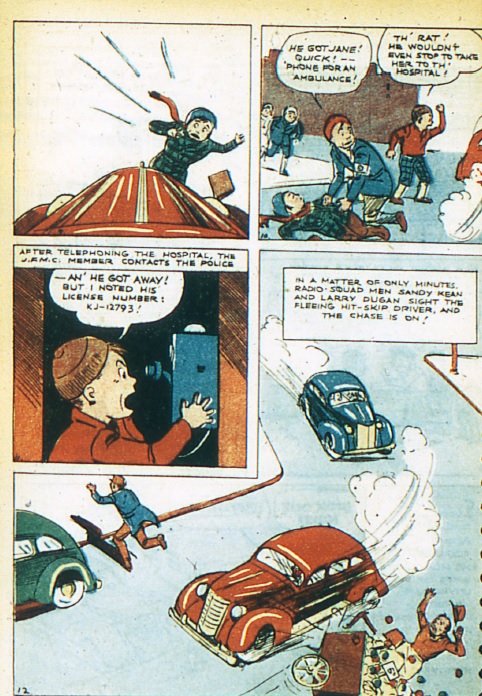


Off-hand, I'd rule that you can move 25 miles in a day, +1 mile for every made save. vs plot.


Also note, Fighter-types can smoke cigarettes.

(Scans courtesy of Comic Book Archives)
Subscribe to:
Posts (Atom)