Showing posts with label secret doors. Show all posts

Friday, April 30, 2021

Daring Mystery Comics #3 - pt. 1

Dale of the FBI is our first feature and it takes place on an island in the San Francisco Bay called Dream Island. There are really 28 islands in the bay (and fewer in 1940, since some of them are artificial), none of them called Dream Island. The heavily forested appearance of the island makes me think it looks closest to Angel Island after perusing some photos. 

This story predates the founding of the real San Francisco National Bank by 22 years.

Dale likely arrives in California at the San Francisco International Airport, which in a year will become a Coast Guard base and Army Air Corps training and staging base. The story isn't clear if Red Corker's men just happen to be at the airport or if they on lookout duty watching for G-Men to arrive. It seems unlikely the gang can spare lookouts for every unlikely occurrence, since the gang doesn't appear to be very big.

Dale isn't very good at noticing his car is being followed; he must have failed his skill check to spot things. 

Other than having a keen eye, I would think research beforehand must explain how Dale immediately recognizes Red's lieutenant. This would either have occurred in-game, with the Editor giving the player specific information, or the player could, in the moment, ask for an Intelligence check or a save vs. plot (but not both!) to determine if he had any foreknowledge of what Red's lieutenants looked like.

Red's scheme is to kidnap the child of a San Francisco oil magnate. The most famous San Francisco oil magnate was J. Paul Getty. 

The rescue scene is peculiar, to say the least. Dale comes riding in on an airplane wing, scoops up the kidnapped girl between his legs while holding onto the wing with his hands, then climbed back onto the wing, held the girl with one arm, drew his gun with the other, and shot Red while holding the wing with his leg. There's a lot of unlikely things in there. A Dex check to cling to the wing (or a stunt), an attack roll "to hit" the girl (at a low AC, given the speed of the plane), and then another Dex check for all the balancing he does. And why does he shoot Red? It's his job to arrest Red and Red can't do anything at this point to harm the girl anymore. 

Next up is Breeze Barton in the Miracle City. It takes place in 1945 "and the world is at war" -- which was sadly accurate. Less accurate is the Japanese invasion of South Africa. When Breeze sees it, his first thought is to report this to London, which is weird because that's 5,600 miles away and there must be dozens of places he could check in closer. It's just an excuse to get him flying north over the Sahara Desert. That's how he finds a mirage of a city that turns out to not be a mirage, but an actual city - a super-scientific city where they already have anti-gravity transportation. People have lived there for over 30,000 years -- the same people in some cases, because the city exists in a pocket dimension where time doesn't pass like normal. Time does pass, even though we're told otherwise -- the sun rises and sets and events are not occurring simultaneously. It's aging that doesn't happen. 

More interestingly, the city can only be entered through a "spot" where the electrons flow just one way, so you can't leave. There is at least one neanderthal in the city and at least one dinosaur outside the city; the neanderthal makes some sense but the dinosaur doesn't on a lot of levels. It pushes the existence of this "one-way electron flow spot" way into the distant past, the dinosaur looks extremely unrealistic (even by how much they knew in 1940), more like a dragon, and if it is really that dangerous you'd think it would have been put down long before now. The weapon that puts it down is a tripod-mounted "heatwave" gun.   

Even the dinosaur is quickly eclipsed by my biggest problem with the story, that Breeze solves how to reverse the electrons with magnetism in less than a day, while the best scientist in the city hadn't thought of that in 12,000 years. It hadn't even occurred to the rival city in this pocket dimension, this one occupied by the demon people, an interesting-looking nonhuman race. They are furry, with spiky manes on their heads, pointy ears, hooved feet, they can fly, but with a single sail on their backs instead of wings. They have their own super-technology; they can make a cloud appear around someone's head that sucks thoughts out of your head through the astral plane. Both cities have heat-wave guns...but yeah, magnetism is beyond them. 

There's a further interesting detail about the culture of the demon people. They keep slaves, but the slaves are other demon people...on first inspection, but the slaves don't have sails on their backs.   

In the Purple Mask, Frederick Swabert refers to the Panic of 1907. I had to look this up, but the Panic of 1907 – also known as the 1907 Bankers' Panic or Knickerbocker Crisis – was a financial crisis that took place in the United States over a three-week period starting in mid-October, when the New York Stock Exchange fell almost 50% from its peak the previous year. Swabert is being threatened to reveal the location of a secret vault he doesn't know the location of, but Purple Mask (Dennis Burton) swipes a book with all of the floorplans to Fred's house in it, like starting a hideout crawl with the whole map in your hand. Since the house has secret doors, this is extra handy. 

The bad guys have a trap for Fred, his phone is rigged to spray poison gas in his face. Purple Mask somehow guesses this -- an impossible hunch -- and shoots the phone. The phone turns out to be a big clue that wouldn't exist today; because the bad guys have their own phone in the same house, so all PM has to do is follow the physical phone line and he locates the rooms they are hiding out in. 

Purple Mask has no compunction against shooting any mobsters holding guns, but if they attack him with fists he switches to the same. 

Somehow a stray bullet hits the secret button that opens a secret door, which is a freebie from the Editor because there's no way that should have happened. The secret room behind the door is where the treasure is and it's an interesting room; the money is in a big box on an island in the middle of a pool of acid with a narrow drawbridge leading to it. The drawbridge can be controlled with controls on the island.

Another discrepancy in the story: Purple Mask somehow knows there is a secret trapdoor under the island, but he didn't seem to know anything about this room from the maps earlier.  

The next adventure is the Phantom Reporter. Typical of these stories, they don't tell us where it takes place. We do get the name of his newspaper, though, and that's interesting because it's the Daily Express, and that is a well-known London newspaper. Is this a UK hero? Even the fact that the crimes occurred in the "East Side" fits, because the East End of London was infamous for poverty and crime. My theory only breaks down when the bad guys start talking in New York accents, and then the reference to Park Avenue clinches it; this is New York City. Oh well.

We're told the Phantom Reporter, in his regular identity, inherited $50 million from his father. Since Henry Ford had $200 billion in 1940, that doesn't even put him close to richest guy in town. 

I don't know what's going on with his mask. It seems to be glowing? Or maybe it's just artistic license to make him look more dramatic, as there's really no reason for it to be glowing.   

(Read at readcomiconline.to)


Wednesday, August 26, 2020

Feature Comics #30 - pt. 1

It's been a long time since we last checked in with Quality Comics' flagship title. Here, the Clock (sans mask) investigates how a car was tricked into careening off the road, and anticipates the movie Goldfinger by 24 years.

That the Clock wakes up after 30 minutes suggests that he was simply stunned and recovers 1-6 turns later, but the Editor has decided to make those 10-minute exploration turns (which the Editor can do, at his discretion).
Monogrammed cigarettes must have been a novelty item of decades past.

That's also quiet an expose in the newspaper, that the dead man was a FBI man with secret industrial mobilization plans on him. I bet the FBI was wanting to keep that a secret. Industrial mobilization was, of course, a real thing, and had been ongoing since Sept. 1939 in the U.S.
I've seen this in games before, paying kids to run messages for you. In a pre-modern age it can be more reliable than technology for communication, though it could put the kids in danger.

Panel 3 is a good example of how easy it is for Heroes to scale walls, even in dress shoes and tuxedos, while carrying canes in one hand.
This is Lena Pry and we haven't looked in on this comic strip in a dog's age. I include this bit because of the discussion of relief checks, which was another real thing. The Agricultural Adjustment Act (AAA) was a United States federal law of the New Deal era designed to boost agricultural prices by reducing surpluses. The government bought livestock for slaughter and paid farmers subsidies not to plant on part of their land.
The Great Bear Lake is a real lake. It is the largest lake entirely in Canada, the fourth-largest in North America, and the eighth-largest in the world. Moose Creek is also real, running through Ontario.

There really is a Nugget City in the Yukon, but it's a RV park and, I suspect, doesn't date back as far as 1940. It's possible that "Nugget City" is a euphemism for the Town of Dawson, which was at the center of the Klondike Gold Rush.
This is Spin Shaw and Spin is in an unusual gaming situation that I've only seen once before in a Star Wars session; Spin is "grounded" by a captain who doesn't want him involved in the scenario, so part of the scenario becomes finding a way to get into the rest of the scenario. Here, Spin's player wisely finds a use for his plane that nothing else can do, forcing the captain's hand to let him take off. No dice rolls should be needed to judge a situation like this, and the player should certainly be rewarded for ingenuity.
Unlike Reynolds of the Mounted, which was surprisingly easy to place in the real world, San Luray seems to be entirely fictional. There actually is an archipelago called the Barren Islands -- but it's in Alaska, and it's very unlikely that this adventure takes place there. "Barren Islands" was surely meant to sound evocative, but also generic enough that they could be anywhere.
The cliche of the hollow statue that can be made to appear to be talking to its worshipers is as old as racism in adventure fiction. I include this example, though, because of the added details, like the density of the foliage concealing the entrance (find as secret door?), the fact that the entrance is a "queer opening" because it's much smaller than a normal door, and the shots of the interior show that the body has just one hollow column leading up to a small floored room in the head.
Eisner makes a point of showing us that Dollman is a good fighter at full-size to explain how he is still so capable at tiny size. Why I share this particular page, though, is for the use of "tomahawk" to describe a sap/blackjack. This may be purely a joke, as I can find no evidence that tomahawk was ever a slang term for a sap or blackjack.

(Scans courtesy of Digital Comic Museum.)

Thursday, August 20, 2020

Wonderworld Comics #11 - pt. 3

We're still here with Patty O'Day and her rival suitors, the aristocratic Mike and the common man, Ham. Ham was climbing out of the well (we saw him get dumped down the well last time) when he pulls this stone loose. Now, we can treat this as a secret door, but it's sort of a build-your-own secret door.

Mike is a very confident climber. Had he begun from standing on top of Ham's shoulders, I would have given him a +1 modifier to his skill roll.
I just googled some pics of French cars of this time period and while, yes, they did tend to have long bodies, and I did see some two-seaters that looked like three men abreast would have to be really comfortable with overlapping thighs...but I still don't think any cars of the era were that narrow.

More evidence of damage done to cars in a chase should trigger a random chance of complication, rather than assigning hit points to vehicles.


Complicating matters about the nationality of these villains, Egroe isn't a French name, but a Dutch word (I believe it means "grand"). Dutch separatists fighting in France?

It's interesting that the bad guys "miraculously" survive, suggesting that car wrecks should usually be lethal in the game. I've got plenty of conflicting evidence on that, but maybe only Heroes should have such an easy time escaping car wrecks.


We're going to leave that story and jump into the following Dr. Fung story. Here, in Persia, Fung and Dan are shown this well by an old friend. It seems like a trap, since there is no visible explanation for how the ground around the well gives way so easily, but apparently it is just coincidental instability.
That is one of the craziest monster designs I've ever seen. I'm not even sure what to call them -- unicycle ghouls? The captions only call them things like "weird creatures" and "strange beings." How do you even rationalize a species evolving to have a built-in wheel?

Complaints aside, I like the idea of pneumatic tubes transporting Heroes quickly between levels of a hideout.

And, of course, we end this page with the cliche of monsters adopting a hot human woman as their queen.
For no reason whatsoever, one of the unicycle ghouls is a gigantic unicycle ghoul, about 20' tall. If unicycle ghouls have 1 HD (I would be skeptical about giving them more, since they should be knocked over easily), then this fella must have at least 12 HD. Rather than being presented as their leader, this thing is just one of them, so it's refreshing to know this race doesn't go in for hierarchical societies, except for elevating human women.

It's hard to imagine the young lady has never thought to scream at the monsters to take advantage of their sensitivity to sound. And then, perhaps she has, but enough of them made their saves that they could always stop her.
We're going to jump ahead again, this time into Munson Paddock's Tex Maxon, the Phantom Rider. The stop, drop, and roll campaign would not start until the 1970s, but that doesn't mean people didn't know that's what to do when you catch on fire in the 1940s.

It's interesting how guns only make lots of smoke when the story benefits from it. I'm not sure if guns every actually made that much smoke, or if this comes from old cowboy movies exaggerating the smoke clouds.

While dropping out of a tree on your opponent looks impressive, I would assign no more than a +1 to hit modifier for it, making it questionable if it was worth all the effort of clambering to get into position for it.


Surprisingly, this "Spark" Stevens of the Navy story may be our very first set in Guam. By October 1941, all U.S. dependents and civilians on Guam would be evacuated, but here at the beginning of 1940, Guam would have a burgeoning population of 22,000.

There's little that need be said about the "damsel in distress" plot hook, except that it's so. darn. easy.

(Scans courtesy of Comic Book Plus.)


Sunday, July 19, 2020

Champion Comics #5 - pt. 2


I'm not as big a fan of any of these other features, so we're going to jump through a bunch of them rather quickly this time.

This is a page of Neptina, the evil queen sub-genre done underwater. Sure, the Krakan just looks like a giant octopus and, to be honest, I would probably just stat it that way. It would be much more terrifying, though, if the guards were right, and krakan's had some kind of death gaze -- save or die if in line of sight of it.


This page illustrates how much fun random encounter reaction rolls are. This scene with the suspicious police chief plays out much more interesting than if the Editor had rolled a friendly reaction and the chief just believed the whole crazy story.


I share this story for the example of how cloth covered in wet clay can serve as a concealed door.
Blood-sucking moths, alone, are not very scary. Find them in their lair, where there are hundreds of them, and...
This is Blazing Scarab, by the guy who goes on to create Green Arrow for DC next! It's pretty goofy fair, but this priestess is pretty powerful, having teleported into their presence on the previous page.

What I didn't know, until I looked it up, was that Ammon was a real place. According to Wikipedia, it "was an ancient Semitic-speaking nation occupying the east of the Jordan River, between the torrent valleys of Arnon and Jabbok, in present-day Jordan."


This is the last appearance of Penny Wright, second best feature in Champion Comics. This chase scene has several London-specific complications in it, including military patrol cars and hedge-placed anti-aircraft batteries. Details help establish a sense of place, even in a chase scene.

The Owl, just one of many comic book characters to have that name, is called that simply for having thick glasses. The wrinkle here is that the Owl is really a woman, dressed as a man, making this one of the first cross-dressing villains.


I have trouble taking Jungleman seriously, not least for being called Jungleman (should Superman be called Cityman for living in a city?). While most jungle heroes would snap the net with their great strength, Jungleman is as helpless as a fish.

Ape people have been in Hideouts & Hoodlums since the beginning, but now we have a new name for them, the Moo-Nang. In the jungle, ape people live in numbers great enough to be village-worthy. So, several hundred?
Further embarrassing Jungleman, two tigers show up to rescue him (actually, it's not clear if Jungleman summoned them or if they are just a wandering encounter), but the ape men are too much for the tigers too.
In the conclusion of Yaqui Gold, a character called the Black Panther is challenged to a duel that goes against him -- surprisingly similar to when Killmonger challenges the Black Panther in the movie Black Panther.

(Scans courtesy of Comic Book Plus.)

Friday, January 24, 2020

Flash Comics #3 - pt. 2

Continuing where I left off...

Hawkman's (or Hawk-Man's) friend is "killed" by Una Cathay, a female mad scientist/magic-user, a very unusual combination in the Golden Age, when most women aren't shown as being scientific-minded. The story is (get ready for spoilers later): she has come up with an interesting spin on raising the dead; her chemical potions can resurrect dead people, but to stay alive they have to remain mostly immersed in the chemical bath. She has a collection of revivified men floating in water tanks, a spin on the "brains in jars" trope. Oh, and she can work "Voodoo" spells. If she ties her hair to someone, she can make him take burning damage even at long range (not sure what to call this spell...Voodoo Fire?).

Hawk-Man does not yet have much of a reputation as a good guy; he is able to easily fool the scientist and a Russian spy working with her (actually identified as Russian and not given a fake country) into thinking he wants to throw in with them. But she decides to kill him anyway, with the aforementioned voodoo spell. Typical of the genre, the spy is an aristocrat (or at least calls himself a count).

Somehow, when Hawk-Man goes home to pick up some throwing daggers, Shiera is there, immediately spots a long woman's hair wrapped around his wrist from across the room, and instead of jumping to the conclusion that Carter is seeing another woman, she jumps to the weirder conclusion that someone cast Voodoo Fire on him. Could that be an expert skill check in arcane lore?

The twist to the story -- as too often happens -- is that there's less supernatural or super-sciency going on than it appeared; Una was poisoning people with something that put them into comas and pretended they were dead.

Hawk-Man confronts the villains after freeing the prisoners and pins the spy's hand to the wall with a dagger, but the dagger really just disarms the spy (it was his gun hand) and the pinning is quickly forgotten flavor text.

Una escapes from Hawk-Man by using a secret door that he appears to be unable to bust through. Does that suggest that secret doors should be harder to wreck than normal doors, or is Hawk-Man only concerned that wrecking the door will take too long and Una will get away?

When the spy falls out a window, Hawk-Man makes no effort to save him.

For the first time in any medium, I've now seen a thrown dagger puncture a tire and make a car crash. Also unusual for the car crash trope, the villain actually dies in the crash, Una suffering a broken neck (and Hawk-Man even checks the body to make sure she's really dead!).

Next up is Johnny Thunderbolt, or Johnny Thunder as we know him! Training to be a boxer, Johnny has gotten ripped since last issue.

"Pile of jack" is slang for "lot of money" in this story. Johnny also uses the term "slop up" to mean "go out for a drink" (though this is Johnny, so he means a chocolate malt, not booze). There is a topical reference to Glenn Cunningham. According to Wikipedia, Glenn Vernice Cunningham was an American middle-distance runner, who was considered as the greatest American miler of all time. He received the James E. Sullivan Award as the top amateur athlete in the United States in 1933.

When Johnny tells bullets to go back where they came from, he activates what appears to be the Turn Gun on Bad Guy power. Since Johnny is a magic-user, that means we need a Missile Reflection spell too.

Johnny is, at least briefly, heavyweight champion of the world. We still haven't seen a physical manifestation of his thunderbolt-genie yet.

Next we're treated to a reprint of Rod Rian of the Sky Police. The Mephisians use a giant raygun (one of those that looks a lot like the dome of a planetarium) to pull Rod out of the sky using a combination of magnetism and gravity, or what we now call in science fiction a tractor beam. In a convenient moment of charity, the Mephisian leader (who's name also happens to be Mephistos) not only spares Rod from being shot and decides to strand him and the other prisoners on The Island of the Living Dead, but also is sporting enough to arm them first. I guess Mephistos isn't such a bad guy after all! On the island we haven't seen the living dead yet, but we get to see the chasm beast! We haven't seen this guy since Dell's The Comics #10!

(Read at readcomiconline.to)


Wednesday, November 13, 2019

Thrilling Comics #2 - pt. 2

We're picking up where we left off with the Golden Age Dr. Strange -- though I apologize in advance for the poor quality of the microfiche scans. These are the best copies I know of out on the Internet.

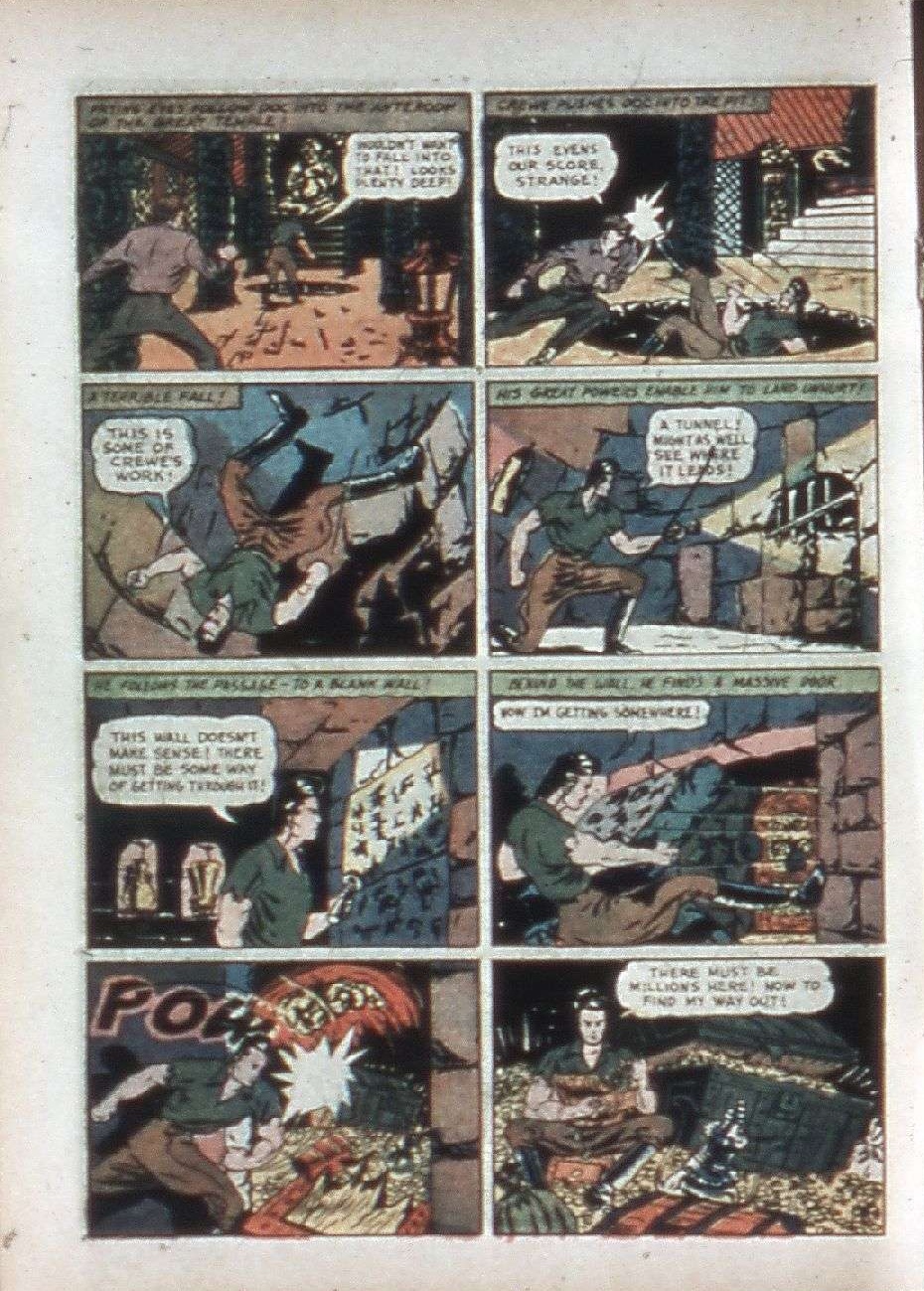
The turning letter that unlocks a secret door is worth remembering. Though, if a superhero suspected there was a door there and wanted to get through badly enough, there is always a Raise power or wrecking things to get through the statue. I would treat this particular secret door as the machines category, one better than door, since the statue adds a non-door element to it.
The ol' "sarcophagus that's full of real diamonds but opens pit traps around the sarcophagus if you disturb it" trap. It looks like the pit has five crocodiles in it, but it's really hard to tell with the quality of this scan.
Dr. Strange's ability to punch boulders away strikes me as flavor text; all we really need for this is his save vs. missiles mechanic to make sure he's not taking damage.

There's no game mechanic that would account for how the boulders break the ledges apart; that seems like Editor fiat.
It doesn't need to be said that superheroes have leaping powers; the distance pictured here looks like one that even non-superheroes might be able to bridge.

Strange beats Crewe in initiative, letting him act before the drugs can be thrown away.

Speaking of thrown away...we know Strange could likely have leapt after Crewe and saved him, but he chose not to. Strange has already demonstrated that he's comfortable with letting villains fall to their deaths.

Interesting how we never hear about this miraculous wonder drug again. Maybe it didn't work as well as advertised.
We're going to jump into the next adventure, this being the debut of The Three Comrades. It's the first story I've seen drawn by Howard Sherman, who will later co-create Dr. Fate!

Newspapers are handy for dropping plot hooks!

Reading shorthand, like decoding a code, is a basic skill and not something automatic, like speaking to Germans or aliens.

A rare instance of a smell-based clue!
I like the little detail of, not just seeing a light, but a reflection of light in the plant tipping them off. I also like how every entrance has a guard on it, even on the roof.
That looks more like a necktie than a carat to me. Regardless, I have to pause now and consider what game mechanic in Hideouts & Hoodlums would emulate this scene? Grappling, with the result of throw? The actual tie grabbing is an irrelevant detail, as H&H focuses on the results, not how you get there.
The same here; it doesn't really matter how much the bullet touches the head or just "parts the hair," as the damage is just an abstraction.

The beat cop is a wandering encounter.

The kicked barrel is an improvised weapon...but a barrel can pick up a lot of speed rolling down a stairwell. I'd be inclined to assign it normal damage.

Did The Mask change his mask since we last saw him...?


This is the first time I've ever seen someone take damage from jumping into a car before! I guess the best way to handle this is to give the jumper a save vs. science, with no damage if successful, and regular damage if it fails.

(Scans courtesy of Comic Book Plus.)
This

Saturday, November 9, 2019

Thrilling Comics #2 - pt. 1

Mike's Amazing World of Comics tells me that the next comic book I should be reviewing, in order, is War Comics #1. But I accidentally reviewed that early, a year ago. Oops! So let's skip another ahead to Better's Thrilling Comics and the original Dr. Strange.

Our adventure begins with a mysterious death and the easy plot hook of Strange being asked to investigate it by the police. Strange looks for clues and, in an unusual move that I want to call your attention to, appears to be using scissors to cut into the dead man's clothing (unless, of course, he's also planning on performing an autopsy...). This is how he finds a secretive pin sewn into the seam of the clothing.
Note how Strange now has dark hair. Does he, instead of wearing a costume or uniform, just darken his hair before going into action?

Really, Fleming? The only place in the world you would find a three-headed serpent is an ancient lost city? I decided to do a quick Internet search on three-headed serpents to see if he was right. Besides an awful lot of hits for the video game Hitman 2, there was an article about a pillar depicting a three-headed serpent that came from Delphi. Good thing Strange didn't go there instead!

I wouldn't put much stock in what that assistant's telling you either, Strange. And you, Richard Hughes, writer of this story, if you knew you were going to base this story in Tibet, how hard would it have been in 1940 to do a little research and learn the real name of the desert there (which is the Gobi)?
One of the nice things about that last page is the fallibility of the assassin, who allows the assistant to get one vital word out before offing him. This makes it pretty easy to follow from one plot character right to the next -- and then risk killing him by punching him through a wall.

The game mechanics of Hideouts & Hoodlums (remember, this blog is also about a game!) don't currently support punching villains through walls, and would either need a modification to the pushing rules, or a new power that combines damage with wrecking things. I would definitely need to consider this as we move ahead, as I can think of quite a few later comic books that combine violence with such a flagrant disregard for property.

This third page, to the right, makes no sense to me...

Strange seems to have Crewe dead to rights already, yet after beating up his henchmen and showing off his Nigh-Invulnerable Skin, he just leaves so he can tail Crewe instead. You would think Crewe would be extra-cautious now about Strange and not act so brazenly criminal.

As stupid as Crewe is, his henchmen must be even stupider to nab a girl and bring her to their boss, just for loitering around a giant skyscraper. Strange isn't happy with them either, as he's perfectly willing to toss one of them out the window, knowing it's a lethal fall from that height.


Now this page has some tricky geometry to it. I'm not sure how Strange twists his body to land on the roof across the street, but it definitely appears that he is still leaping instead of flying. And, the fact that he needs to land on the roof instead suggests there is an upper limit to how far he feels he can fall safely.

In game mechanics-terms, maybe an upper limit needs to be put on the Feather Landing power. 

A herb that cures diseases like the spell would be a very valuable item in any campaign, and probably one best to keep out of the Heroes' grasp so it doesn't change the campaign world too dramatically.

Mongols are just wandering around Tibet? Mongolia is about 1,400 miles from Tibet. Seems like more writing done without research to me. Though the artist, Alexander Kostuk, at least looked at some old references for how Mongolians once dressed.
Strange uses his wrecking things ability on a stone wall, a door, and a cage here, demonstrating that a superhero needs the ability to use that game mechanic in quick succession.

What's going on with the guards being drawn like primitive African natives, hurling spears? How does that make sense in Tibet?

Rescuing prisoners is always a good idea, for the "good deed" XP award, the useful information they may have about the hideout, and their Supporting Cast recruitment potential.

Animals never fare well against Golden Age comic book Heroes and the fights are usually over in a single panel. This one, with Strange fighting two lions, occurs largely off-panel!

Once again, Hughes gets his geography wrong. The "Mountains of the Moon" are a legendary mountain range in east Africa, once thought to be the source of the Nile River.
More evidence that ordinary people can make push attacks on superheroes.

Strange wisely carries a flashlight.

Finding a secret door usually includes finding the means of opening it. But, if you just suspect a secret door is there, but you're getting impatient waiting for that successful "find secret doors" check, you can always wreck the wall. If you're right, you will only be wrecking against the door category, even if you can't actually see the door.

Millions of dollars' worth of treasure is usually a campaign-busting find and should be avoided doling out in actual play.

(Scans courtesy of Comic Book Plus.)

Tuesday, July 9, 2019

Detective Comics #36 - pt. 3

It's a little hard to believe that, three years into Detective Comics, Cosmo, the Phantom of Disguise still has a berth here. This month, Cosmo, who undoubtedly got that nickname because he's so cosmopolitan, has to visit a cowboy ranch. Interestingly, Cosmo admits that acting like a cowboy is outside his wheelhouse and has to visit under other pretense. This is more realistic, but actually contradicts the Hideouts & Hoodlums skill system, where everyone has the same chance of performing any skill, based just on class and level (and possibly modified by race).

The ranch has mortgage payments of $7,000 (monthly? Annually?) and someone makes an offer of $60,000 for the entire ranch, which is apparently low but not entirely unreasonable.

A neat trick Cosmo uses (though I'm not sure this would actually work) to fool some rustlers into thinking he's still hiding behind a boulder is to tie strips of his shirt around bullet cartridges and lit them like fuses. The bullets go off, convincing them that he's still shooting from behind there.

Do I need to stat rustlers? I think I'll just treat them as outlaws.

The disappearing cattle are being herded through a secret door made of stone (or made to look like stone).

Bruce Nelson is skiing in the White Mountains. I was sure this was a generic fictional name, but there really is a White Mountains in New Hampshire and Maine. Bruce is staying at a ski lodge with a bunch of "famous celebrities," but they don't seem to be based on real ones in either name or appearance.

Bruce shows expert-level tracking skills when he looks at all the tracks in the snow outside the lodge -- by moonlight! -- and manages to spot finger-tracks, where someone's hand was dragged through the snow. I'd say that would normally be a 1 in 10 chance of success at best.

Slam Bradley and Shorty are surprised when an intruder enters their bedroom and leaves a small box with $10,000 in it -- though I was more surprised to see Slam and Shorty sleep in the same bed. The money is a retainer from someone who wishes to hire them anonymous, which wouldn't have lasted long had they caught the intruder. To collect, they have to go to Shanghai, which takes them out of the country on a very long sea voyage (the only thing we know about the trip is that Shorty learns how Chop Suey is not a traditional Chinese dish).

The scenario is fairly interesting; Slam has been hired because of his reputation. He's supposed to procure something, but they refuse to tell him upfront. Instead, a female guide is to be sent with him who will reveal what it is at the "proper time." I think this would scream "trap" to my players and they would never touch this plot hook.

Slam was always a tough scrapper, but in this adventure he needs to be rescued from five yellow peril hoodlums, and then gets knocked out by a head blow later. Slam is tortured for information (that he doesn't have) on a strange rack that pulls sideways instead of up and down. Shorty is hung off the floor by his wrists (at least it wasn't his thumbs).

There's a curious plot hole in the story where Slam and Shorty's caravan through China is attacked, the men who tortured them save them (because they are following Slam to the Macguffin) by mowing down the new attackers (and I'm not sure who they are, other than a random encounter) with machine guns. Slam acts like he didn't even notice and is surprised later that they're being followed, even though there's no way he didn't witness the machine gun fire.

The Macguffin is an idol that will give whoever owns it the ability to command people (not a magical ability, I don't think). It is poorly guarded by a single sword-wielding guard and a pit, though the real protection, I suppose, is the trap on the idol -- mess with it and a dagger springs out of the base of it and stabs you (killing the main villain, Chong, incidentally. Poisoned, perhaps?).

Although Slam gets paid in the end, he didn't actually do much, except he scares off Chong's men with a machine gun he steals from them in the end.

(Read at readcomiconline.to)


Friday, July 5, 2019

Detective Comics #36 - pt. 2

Back in time for the tail end of the Batman's first encounter with Hugo Strange! Having escaped Strange's deathtrap/S&M session, the two of them grapple. Remember that Strange is about 6' tall and physically imposing, so it's not an unequal match-up (if Strange is an ultra-mad scientist, then they even have equal Hit Dice!). Strange has an early advantage, establishing a choke hold, but the Batman reverses it; both are perfectly emulated in Hideouts & Hoodlums' grappling rules.

After defeating Strange, the Batman does something that most players don't do in any RPG -- after defeating the main bad guy, he still methodically searches the hideout. In this way he finds a prisoner (that he claims to have always known about, though this is the readers' first time hearing about it), and learns how Strange was inducing fog around the robberies -- with a stolen lightning gun! Now, why he used the lightning gun to make fog and not turn it into a weapon...

No mention is made of what happens to the lightning gun (which looks like a planetarium projector, by the way). It doesn't seem to make it into the Batman's trophy room, and certainly doesn't become part of its arsenal. The Editor of that game session, perhaps just not feeling generous, made it a mad science trophy with very limited charges/uses.

Next up is Bart Regan, Spy. When Jerry Siegel was still drawing this it was my favorite feature, but now....Bart is up against more spies, now from the fictional nation of Tortania. I haven't a clue what country "Tortania" is meant to represent; it could just be a truly generic foreign power. Bart's big clue as to who the spy is, is overhearing him curse in Tortanian, which might be the first time cursing is demonstrated as a series of symbols in a DC comic.

The hunchbacked spy gets the drop on Bart, from behind, but Bart is somehow able to spin around and shoot first. H&H's simple initiative system allows for a lot of leeway like this, though circumstances almost cry out for a common sense adjudication and hand-waving the dice rolls. Perhaps the spy missed on his surprise roll so badly that the Editor said he hadn't even managed to get his shot off yet.

The hunchbacked spy turns out to be a pretty nifty threat; he's wearing a vest lined with dynamite under his coat, making him the first suicide bomber in comicbook history. It's a challenging threat, normally, but this adventure takes place on a boat, so Bart simply pushes the man into the water in time (though, if Bart had lost initiative...). The spy also has a poison pill on him that is confiscated.

Bart administers truth serum to the spy to learn where his hideout is. The hideout appears to be empty, but a secret door opens like a shutter sliding down.

Steve Malone, District Attorney, is hunting down a mobster on the lam, and figures out who the disguised mobster is by the clue of the hairs in his comb. In the ensuing fight, Steve uses a table for a club and the mobster's vamp girlfriend uses this really big candle holder, so vamps are sometimes armed with clubs. Steve doesn't start out the encounter with a gun, but he lifts one off a mobster. In a rare instance, both gunman run out of bullets in the same firefight.

I normally like Speed Saunders, Ace Investigator more than this installment. Speed is on the trail of a jewel thief who calls himself The Spider and leaves toy spiders behind as a calling card. There's even a nice spin where The Spider doesn't break into homes, he convinces rich people to rent from him, unaware of the secret doors he's built into his properties. But the story has some serious flaws. One, The Spider tries a drive-by shooting against Speed, but from his own car licensed in his own name. Two, Speed slaps the man's wife around while The Spider isn't home, and then she still obediently obeys him. Now, there's a nice twist on that, where the wife turns out to be The Spider, dressed as a man, the whole time, and there never was a husband...but I'm not sure Speed knew that when he slapped her...

(Batman story read in The Batman Archives vol. 1; the rest read at readcomiconline)

Tuesday, May 21, 2019

Pep Comics #2 - pt. 2

Next up is Jack Cole's second installment of The Comet. The Comet is on the trail of a master criminal who appears to have magical powers -- he can make his face appear in the clouds at giant size, and he can make armored cars leap into the air and disappear. Spoiler -- all this is going to be explained by the end, as he's actually just another mad scientist.

The adventure takes place in the Everglades -- coincidentally where RT2 Adventures in Fun World, the third published Hideouts & Hoodlums adventure, takes place.

If the armored car companies are keeping the disappearances a secret, then how does The Comet know where each of the cars disappeared, accurately enough to put on a map...?


Usually, when you see 11 x's on a map, you can triangulate to some central point, or see some other pattern involved. In this case, The Comet still has to spend a whole two weeks flying around, just hoping to spot a clue from above.

A phone booth concealed in a tree is a pretty good clue. Wireless communication would have made it a lot harder to follow this clue. Also, had The Comet just kept flying instead of using the boat, he would have missed the hideout altogether. Maybe it's because the duration ran out on his fly power...?

It's unclear if The Comet was hurt and stunned by the whirlpool, or if the two thugs succeeded in winning the initiative and getting their grappling attacks in first.


Noiseless electronic motors might count as a mad science invention by 1940 standards.

Here we get the explanation for the giant face in the sky. I've written before about how much more convincing two-dimensional projections must be in a comic book universe (metaphysical commentary on the two-dimensional nature of their universe?). Projecting onto clouds would fool no one in the real world.

The Comet has a much different idea of what "success" is than I do; I would be much less cavalier about nearly smashing my own eye to a pulp. Just looking at that panel makes me a little woozy!

Oh, one last spoiler -- the armored cars are being lifted into the sky via magnets on cables that no one sees because it's dark.
So now we're moving on to the next feature, which is Rocket and the Queen of Diamonds. Rocket is a Flash Gordon clone, although one who never seems to think it's appropriate to put on a shirt or pants. Maybe he thinks that's okay because his bad guys wear midriffs, cutoffs, and starfish on their heads.

This was written by prolific author Manly Wade Wellman, who will go on to do better things.

===

A few game mechanics points here: the guy with the baby rattle delivering a knockout headblow just by outflanking Rocket, which I am not comfortable with. I'm going to keep the headblow to just surprise attacks.

I can imagine there are some positions one could chain someone
up in that would limit their ability to use leverage; this doesn't look like one of them. Since Rocket can just push against the floor to break his bonds, I might even give him a bonus in this case.

I don't show you the page where the drugged Rocket attacks the queen because he doesn't know what he's doing, but the injected drug reminds me a lot of the Confusion spell.

Rocket rather cleverly creates a crowbar for himself using his wrecking things, and I could see rewarding that ingenuity with a +1 bonus to his wrecking things roll (and this time he'll need it to get through a stone wall).

Giant water bugs belong in the Mobster Manual, though they do pop apart awfully easy. They look pretty fierce, though...maybe 1+1 Hit Dice?  


I think panel 1 clearly shows giant water-bugs being encountered in a group of eight.

False walls are found the same as secret doors.

===
This is supposedly by Charles Biro, but if he drew this, it had to be a rush job and far from his best work.

===

Snipers are statted as assassins in the Mobster Manual.

Here and on the next page we get a rare example -- outside the cowboy genre, anyway -- of using fire to trigger a morale save.

===
I can't say I ever sympathized with a Nazi guard in a comic book before, but this poor guy who doesn't know how he wound up this way, but just wants to pet a kitten, this guy I wish had at least gotten a fair fight against Boyle.

As per the rules for guards in all fiction, the stolen uniform has to be exactly the right size to fit.


That is a terrible secret code. However, if you want your players to feel like they're deciphering a code, without having to put any real work into it, this might be the code for you.

I like the compass! We almost never get a sense of direction in our comic book panels.

Boyle demonstrates the save vs. missiles and how that applies to guns here.

(Scans courtesy of Digital Comic Museum.)