We're heading back to check on Timely Comics today, back in (cover date) March 1940. This month, the Human Torch leaves New York City for the Midwest. It's the old story of a remote Alaskan village that needs urgent medical supplies but is cut off by the weather, only transported to a fictional island in the middle of Lake Superior because...I guess Alaska was too far? This weird island is covered in a glacier...I suspect Carl Burgos never visited Lake Superior and maybe heard some tall tales from Minnesotans about how cold and snowy it is there.
So HT leaves for the Midwest, but using the Newark Airport, which is an interesting choice. That's a real airport in New Jersey, and one New Yorkers still use today. The LaGuardia Airport had just opened months before this comic book would have been written.
HT, or Jim as his friends know him, has a supporting cast member named Johnson, who Jim isn't apparently on a first name basis with, but is still willing to come along on this dangerous flight to Lake Superior.
HT badly fails a skill check to pilot during a storm (probably at a penalty) and crashes their plane. In a rare occurrence, a Hero is knocked unconscious in a crash. The wrinkle here is that two hoodlums just got free from jail on the island (not sure how this island is big enough to have a jail, but okay...), they discover the plane, rob the medical supplies, and then set the plane on fire to get rid of the pilots.
I've never been fond of the Human Torch and reading these old stories make me less fond. It really bothers me how unscientific his powers work, that fire somehow answers to him as if it were alive. Nowhere is it more evident than in this story, where the fire forms a protective circle around HT, even while he's unconscious. So either he can subconsciously control fire in his sleep, which I think is way overpowered, or fire has some sort of collective consciousness, which is really weird and wonky. Now, once he's conscious again, using his Control Fire power to make the fire part for him -- that makes sense to me.
More wonkiness comes a bit later when HT falls into water and, instead of his fire being extinguished, the narrator says he was "ordering his flame out." Now, maybe there is a sensible explanation for that too. Maybe he extinguishes his flame voluntarily before the water extinguishes it because, if he turns it off then he can turn it right back on, while if it's extinguished, then he can't use his powers for a random amount of time.
Still more wonkiness is when HT searches a wooden cabin, while still ablaze, and doesn't combust anything. That Control Fire power really gives you complete control. But what you can't explain away with that power is towards the end when he encircles a pack sled and its dogs completely with fire, and the dogs keep running. That all six of them make their morale saves, at their Hit Dice, is rather incredulous.
There's an interesting wrinkle where HT flames on (he doesn't call it that; that's a Johnny thing) and his heat helps keep Johnson from freezing. Now, an Editor could hand-wave that as a common sense side effect...but it could also be a new power, Resist Cold, that a superhero can confer on someone else. We also see HT do sky-writing with flame, which I think we've seen before and needs to become a power in the Heroes Handbook.
Lastly, the two hoodlums plummet into the icy lake waters and die after HT melts the ice under their feet with a circle of fire. Whether he intended for that to happen is unclear...but he shows no regret, and we already have seen he has total control of his fire, so...
Next up is The Angel. The Angel's strength level is really up in the air in these early stories. Except for one text story that had him at Superman levels, he usually was only a strong human in most of his stories. Here, he can tip over a car with extreme effort (or a little help), so he can maybe lift 1,000 lbs. In Hideouts & Hoodlums terms, this is the Raise Car power, as there is no Can't Raise, But Can Tip Cars power (H&H deals more with abstraction than specific measurements). This isn't just a prank; it's all part of a plan to foil bank robbers by tipping over their getaway vehicle and any other vehicle on the street they can use to escape.
Angel then uses a length of rope (he must carry rope sometimes) to get to the roof and watch for them to come out. Note that he does not simply leap to the roof, so he has great strength, but not great leaping powers, again confirming that H&H is on the right track by making players choose which powers they have for each scenario.
Speaking of Raise Car, later in the scenario he is on top of a speeding taxi and pulls the driver out through an open window (if the taxi had air conditioning, maybe the hoodlum who carjacked it wouldn't have carelessly left his window down). Now, this seems to defy science, because you would think that even with great strength, someone with no way to brace himself would just fall over the side before being able to pull a braced man out the car window. Superpowers, luckily, defy science by their very nature. I might also, on a generous day, allow a Mysteryman using a stunt to do that as well.
For some reason, The Angel isn't wearing pants today.
Soon, when The Angel is swinging on that rope, one of the robbers manages to shoot the rope, and it seems to be merely accidental. There is some precedent for this, with firing into melee giving a chance of hitting a random combatant. For this to apply here, we would have to consider the rope and The Angel in "melee," which is a bit of a stretch. For the Editor to just randomly through in this complication would seem unfair in game play.
The Angel joins a long line of comic book Heroes willing to use mobsters as living shields, but this might be the first Superhero to do so.
In the end, Angel decides to pummel the last of the hoodlums unconscious and he rains "blow after blow" on him. Now, in most game systems, a superhero's strength remains constant and the damage he would have done after just one blow might have knocked out an ordinary hoodlum. But here, a superhero has to buff his strength first before doing additional damage, so if he wanted the satisfaction of punching out a bad guy slowly with normal blows, that's very easy to do.
Next up is The Sub-Mariner, called the "Ultra-Man of the Deep" on the first page of his feature here. Demonstrating the difference in pace of Golden Age stories, the Angel story took place all in 10 minutes, while Namor accompanies a cargo ship to protect it for 3 days before the scenario even gets started.
Remarkably, Namor is said to communicate telepathically with the crew of his flagship submarine in this story. If you've ever wondered how Namor talks underwater...this would be how.
(Read at readcomiconline.to)
An exploration of the Golden Age of Comics, through the lens of Hideouts & Hoodlums, the comic book roleplaying game.
Showing posts with label campaign time. Show all posts
Saturday, April 25, 2020
Marvel Mystery Comics #5 - pt. 1
Labels:
Angel,
buffing,
campaign time,
Human Torch,
locations,
mermen,
missiles into melee,
mobsters,
morale,
new powers,
powers,
SCMs,
skill failures,
Strength,
Sub-Mariner,
Superhero,
tropes,
unconsciousness,
weaknesses
Saturday, January 11, 2020
Whiz Comics #2(b) - pt. 1
Back in 2009 I last wrote about Captain Marvel's second adventure on my oldest blog.You can read it here, here, and here.
Back so soon? Now let's talk about that story in terms of playing it out using Hideouts & Hoodlums.
Rushing into combat with Sivana's army, Captain Marvel is buffed by Imperviousness, if not Invulnerability, to be safe from heavy ordinance. He then is able to pick up tanks over his head because he is buffed by a level 4 Raise power. The tanks weigh too much for the Extend Missile Range powers, so that doesn't explain how CM is throwing tanks at each other. Instead, I would say he is using the Wreck at Range power for this. All he really needs the Raise power for is tipping them over, which really is just as effective at taking them out of the fight.
Taking out the tanks forces a morale save from the army. I would not normally roll once for the entire army, nor roll for each soldier, but maybe roll for each sub-commander on the field, and have him pull back his men if he fails.
It's always a conceit of the Captain Marvel stories that CM can't sneak around, but as Billy Batson he can. It certainly has nothing to do with bright colors, since they largely wear the same colors, but with size. I have long been tempted to make half-pints a race option because it seems like it should have its own special abilities, like a bonus for stealth.
CM later chases after an airplane and jumps up to catch it, but it's impossible to say from those panels how fast the plane is taxiing and how high it gets before he jumps, so it's possible he's not using buffing powers at all in those panels. If he is, then Race the Train and Leap I would be sufficient.
CM is rendered unconscious by a gas trap. Given how difficult it is to render CM unconscious, this must be super-potent gas, probably with a big penalty to the saving throw vs. poison.
There must be something special about the chains that Sivana thinks they will hold CM for five whole minutes, given what he knows CM can do. Maybe they get wrecked as if the generator category. Had he stayed there longer, it's possible the explosion would have killed him, but it was probably an explosion with highly variable damage, like 1-100 points, since Sivana survives it.
Golden Arrow's second adventure ever starts more low-key, with him shooting and killing a gila monster with an arrow. It's just an ordinary-sized gila monster, something I wouldn't normally grant a full hit point, but it's apparently venomous enough that it's bite can cause humans damage (1-4 points?).
A rancher hires GA to help find his missing cattle. Interestingly, it's the rancher who does most of the tracking on the journey, demonstrating how important it is to keep a supporting cast member with you in order to give you a second skill check.
When a sniper tries to kill GA, GA shoots an arrow into the man's rifle barrel, "wrecking it." Now, if GA was a superhero, this would merely be an instance of the Wreck at Range power, but I have not seen enough evidence yet that GA should be of the superhero class. If the rifle wasn't wrecked, this would be a simple disarming attack, which you may recall is easier than normal to do against firearm-wielders in H&H. The damage to the rifle could be flavor text if the "wrecking" isn't serious and the rifle is still usable. We never find out because the sniper/assassin misses his morale save and flees on the next turn.
Soon, GA is roped by a lasso and dragged from horseback, but he starts up a contest of Strength and pulls the horseman from his saddle. This is one of those situations I've talked about before that my own H&H rules don't cover, where you have to bring in ability score checks and opposed rolls.
GA summons his horse, White Wind, by calling it to. The cowboy class, if it's going to come into 2nd edition ever, needs to have special skills still that other classes don't have, like Summon Mount.
GA's bow skills prove difficult to explain by the rules again when he shoots an arrow hard enough to break the wooden bar across a pair of doors. At this point, I think I have enough evidence that GA is of the superhero class, just like the earlier archer hero, Arrow. That makes it much easier to explain how he wrecked the bar with the Wreck at Range power.
Moving on to Scoop Smith... the reporter is sent on a mission to look for a missing person in Antarctica. It's amazing that, in 1940, newspapers had bottomless resources to fund months' long expeditions for wild goose chases after stories. They have a freighter, a "snowboat" (it looks like a truck), and a biplane. It seems like it's going to be a realistic story -- until the Antarctic is shown to have natives. And polar bears. Oops! The writer seems to have the South Pole confused with the North Pole! Among the natives are pseudo-giants -- people who the narrator calls giants, but don't really look that much bigger than ordinary people. The natives are supposed to be primitive, but they have elaborate ice palaces. Somehow the palaces are heated so people can wear normal clothes inside, which makes no sense at all.
The Antarctic has some realistic hazards, at least -- mile-deep chasms and snowstorms seem possible. We never see much of either, but I'm guessing they involve falling damage and cold damage respectively.
That natives' deathtrap is a giant block of ice held between the walls by two icy struts, one of which is slowly melted by a lit torch.The weight of the ice would probably make it do a lot of damage, but it would only render the victims unconscious if they were not trapped underneath it (what makes it a deathtrap instead of just a trap).
Scoop is in no hurry for deadlines; after spending months getting to the Antarctic, he spends a whole month just hanging out with the missing man and the natives before heading back home to report his story.
(Captain Marvel story read from Shazam Archives vol. 1, the rest read at readcomiconline.to)
Back so soon? Now let's talk about that story in terms of playing it out using Hideouts & Hoodlums.
Rushing into combat with Sivana's army, Captain Marvel is buffed by Imperviousness, if not Invulnerability, to be safe from heavy ordinance. He then is able to pick up tanks over his head because he is buffed by a level 4 Raise power. The tanks weigh too much for the Extend Missile Range powers, so that doesn't explain how CM is throwing tanks at each other. Instead, I would say he is using the Wreck at Range power for this. All he really needs the Raise power for is tipping them over, which really is just as effective at taking them out of the fight.
Taking out the tanks forces a morale save from the army. I would not normally roll once for the entire army, nor roll for each soldier, but maybe roll for each sub-commander on the field, and have him pull back his men if he fails.
It's always a conceit of the Captain Marvel stories that CM can't sneak around, but as Billy Batson he can. It certainly has nothing to do with bright colors, since they largely wear the same colors, but with size. I have long been tempted to make half-pints a race option because it seems like it should have its own special abilities, like a bonus for stealth.
CM later chases after an airplane and jumps up to catch it, but it's impossible to say from those panels how fast the plane is taxiing and how high it gets before he jumps, so it's possible he's not using buffing powers at all in those panels. If he is, then Race the Train and Leap I would be sufficient.
CM is rendered unconscious by a gas trap. Given how difficult it is to render CM unconscious, this must be super-potent gas, probably with a big penalty to the saving throw vs. poison.
There must be something special about the chains that Sivana thinks they will hold CM for five whole minutes, given what he knows CM can do. Maybe they get wrecked as if the generator category. Had he stayed there longer, it's possible the explosion would have killed him, but it was probably an explosion with highly variable damage, like 1-100 points, since Sivana survives it.
Golden Arrow's second adventure ever starts more low-key, with him shooting and killing a gila monster with an arrow. It's just an ordinary-sized gila monster, something I wouldn't normally grant a full hit point, but it's apparently venomous enough that it's bite can cause humans damage (1-4 points?).
A rancher hires GA to help find his missing cattle. Interestingly, it's the rancher who does most of the tracking on the journey, demonstrating how important it is to keep a supporting cast member with you in order to give you a second skill check.
When a sniper tries to kill GA, GA shoots an arrow into the man's rifle barrel, "wrecking it." Now, if GA was a superhero, this would merely be an instance of the Wreck at Range power, but I have not seen enough evidence yet that GA should be of the superhero class. If the rifle wasn't wrecked, this would be a simple disarming attack, which you may recall is easier than normal to do against firearm-wielders in H&H. The damage to the rifle could be flavor text if the "wrecking" isn't serious and the rifle is still usable. We never find out because the sniper/assassin misses his morale save and flees on the next turn.
Soon, GA is roped by a lasso and dragged from horseback, but he starts up a contest of Strength and pulls the horseman from his saddle. This is one of those situations I've talked about before that my own H&H rules don't cover, where you have to bring in ability score checks and opposed rolls.
GA summons his horse, White Wind, by calling it to. The cowboy class, if it's going to come into 2nd edition ever, needs to have special skills still that other classes don't have, like Summon Mount.
GA's bow skills prove difficult to explain by the rules again when he shoots an arrow hard enough to break the wooden bar across a pair of doors. At this point, I think I have enough evidence that GA is of the superhero class, just like the earlier archer hero, Arrow. That makes it much easier to explain how he wrecked the bar with the Wreck at Range power.
Moving on to Scoop Smith... the reporter is sent on a mission to look for a missing person in Antarctica. It's amazing that, in 1940, newspapers had bottomless resources to fund months' long expeditions for wild goose chases after stories. They have a freighter, a "snowboat" (it looks like a truck), and a biplane. It seems like it's going to be a realistic story -- until the Antarctic is shown to have natives. And polar bears. Oops! The writer seems to have the South Pole confused with the North Pole! Among the natives are pseudo-giants -- people who the narrator calls giants, but don't really look that much bigger than ordinary people. The natives are supposed to be primitive, but they have elaborate ice palaces. Somehow the palaces are heated so people can wear normal clothes inside, which makes no sense at all.
The Antarctic has some realistic hazards, at least -- mile-deep chasms and snowstorms seem possible. We never see much of either, but I'm guessing they involve falling damage and cold damage respectively.
That natives' deathtrap is a giant block of ice held between the walls by two icy struts, one of which is slowly melted by a lit torch.The weight of the ice would probably make it do a lot of damage, but it would only render the victims unconscious if they were not trapped underneath it (what makes it a deathtrap instead of just a trap).
Scoop is in no hurry for deadlines; after spending months getting to the Antarctic, he spends a whole month just hanging out with the missing man and the natives before heading back home to report his story.
(Captain Marvel story read from Shazam Archives vol. 1, the rest read at readcomiconline.to)
Labels:
ability checks,
campaign time,
Captain Marvel,
Cowboy,
deathtraps,
disarming,
environments,
Golden Arrow,
morale,
new mobsters,
powers,
races,
SCMs,
Scoop Smith,
skills,
Superhero,
traps,
travel,
wrecking things
Wednesday, February 13, 2019
Smash Comics #7 - pt. 2
Moving on, this is Archie O'Toole. Reducing machines that make you shrink is a very old joke, and one that should be in the trophy section of Hideouts & Hoodlums.
Also worth pointing out is the joke concept in this story that all kings belong to a union to which they have to pay dues. There's an unusual concept for a campaign in that, I think.
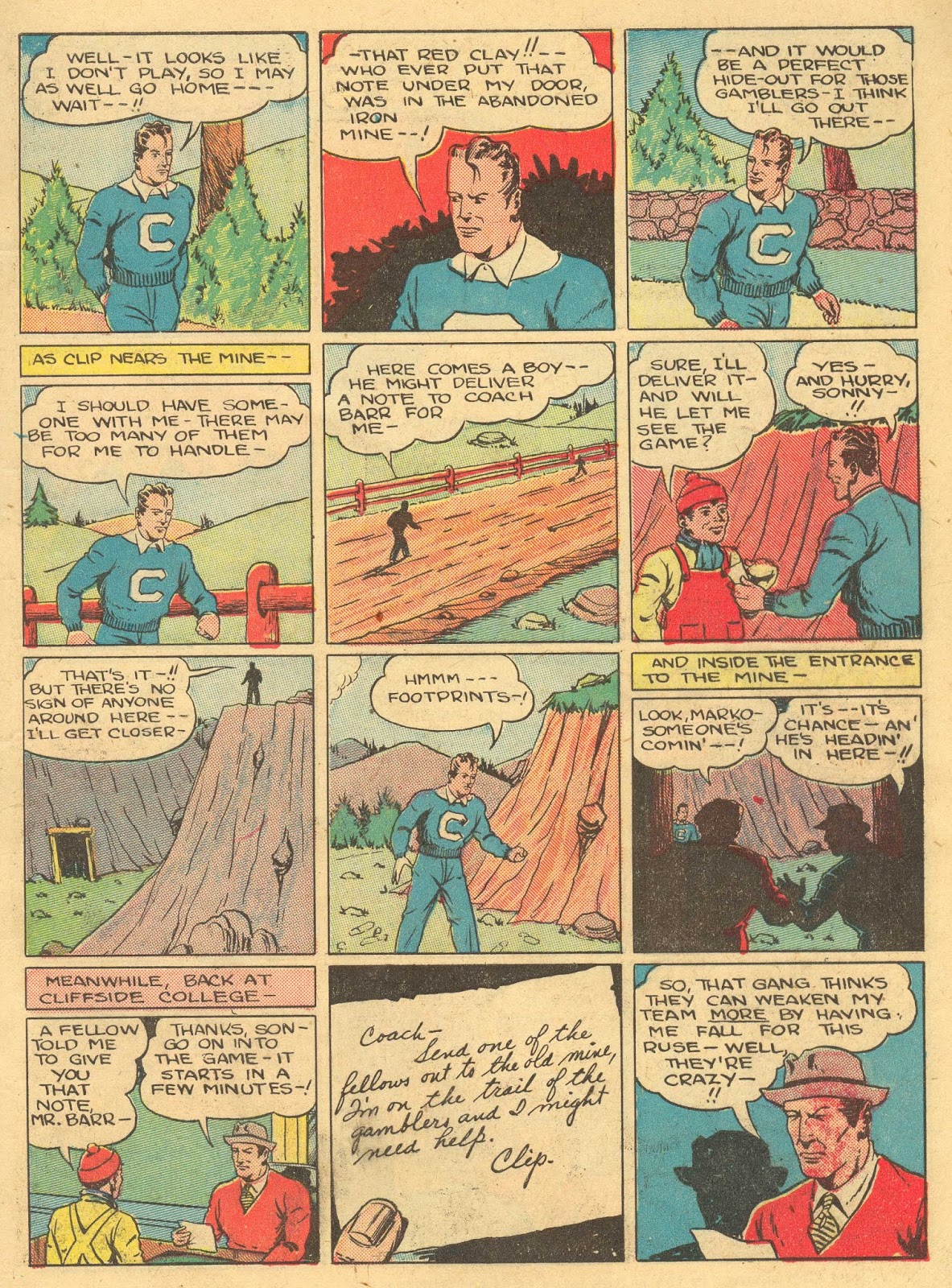
Don't play like Clip.
If Smash Comics didn't already have Will Eisner work in it, Vernon Henkel's Wings Wendall would look much more impressive. Here, as with Eisner's Espionage, Vernon did not shy away from making very clear anti-Nazi messages.
But what I'm more interested in is that the bad guys have the "more powerful car," and what the best way is to have a game mechanic reflect that. Honestly, I've been struggling with this since the very beginning. Is a Car +1 going to move faster? Provide a better AC to the driver/passengers? If I ever decide to assign hit points to cars (a notion I've toyed with in the past), does it get more hp? There are just too many variables to a car, or should a "+1" reflect a slight increase to all of them...?
This sort of thing happens in my H&H campaigns all the time. Okay, maybe not an Army Air Forces bomber, but my players will show up with crazy-heavy armament to face bad guys I just gave a pistol to defend themselves with.
This is Philpot Veep, another feature we don't visit often. This is a goofy feature with some goofy perspective problems going on here, but I share it because fake babies may be a mobstertype we need to consider adding. Or would this just be a half-pint? He's even shorter than most children, but he seems unusually tough for his size, but would that still make him 1/2 HD...?
Unless I've forgotten something, I don't think we ever had a home town for Invisible Hood before, but now we have Glenport. I wish I could find a real Glenport so we could pin down what state this takes place in. Is Glenport our first fictional city for a superhero?
There wasn't much suspense to this mystery about the disappearing safes, but we do get to see a group of bad guys all wearing asbestos suits.
What kind of drug is IH giving to that driver??
Also, instead of acetylene torches, the bad guys have "fire-pistols." Which I'd stat the same anyway.
(Scans courtesy of Digital Comic Museum.)
Labels:
Archie O'Toole,
campaign time,
challenge level,
Clip Chance,
clues,
hideouts,
illumination,
Invisible Justice,
locations,
new mobsters,
Philpot Veep,
transport trophies,
trophy items,
Wings Wendall
Wednesday, February 6, 2019
Marvel Mystery Comics #4 - pt. 2
Namor says normal mermen can't live outside of water for more than five hours. I hesitate to include that in their H&H
stats because it seems unique to Antarctic mermen. Of course, Namor
also says his conscience can't abide 38 Americans being held prisoner,
after just ordering his men to kill lots and lots of Germans, so maybe
being out of water too long affects his thinking (which is actually a
similar conclusion to what John Byrne proposed in his 1990s' Namor
series).Namor's quest for the missing Americans means taking a two-week leave of absence from his own navy as he searches the North Sea ship by ship (if the Emperor wasn't in his hip pocket, Namor would probably be facing dereliction of duty charges).
Namor's trunks are described as "woolen" in this story, defying the Silver Age practice of drawing them with scales.
The admiral of Namor's fleet is named Naka. Somehow, Namor contacts Naka telepathically. He never displays this ability again.
So anyway, the scenario is that Namor has found the Americans on a freighter guarded by two submarines and needs to get them all safely out of the North Sea. Namor could probably just smash both submarines on his own, but for some reason he frees the Americans first and lets them capture one of the two subs and attack the other, while Namor stays busy breaking the chains that hold the freighter and telepathically contacting Naka -- stuff he could have been doing either before or after.
Players may be tempted to take fewer personal risks and leave supporting cast in charge of side missions -- and it's their right to do so. Such side missions should not be guaranteed success, however, or players will always rely on them.
In the Masked Raider's story, the Raider is on his way to help old prospector Luke. Luke is distracted by one outlaw in front of him while two other outlaws sneak up behind him. When Luke loses the surprise turn to them he surrenders...but why? We've seen plenty of examples of bad guys coming up behind Heroes with guns, only to have their guns swatted away after a fast pivot. But...what if that was only available to Heroes? What if facing was only an issue for non-Heroes, and they automatically lose initiative when facing the wrong way...?
The new feature in this issue is Electro, the Marvel of the Age. No, not the Spider-Man villain -- this is a robot. Dr. Zog can control Electro long distance with his thought transfer helmet.
Previously, size was always relevant with robots, with larger robots being more powerful, but Electro is man-sized and super-powerful because it has levels in the superhero class. We observe it not only wrecking things, but using the Outrun Train power to hit 100 MPH. Since robots aren't a playable race, but androids are, I would probably build Electro as that.
I find it interesting that, when Zog wants to recruit men of good character to help him in his campaign as operatives, he doesn't pick them out himself -- he contracts an employment agency to find them. This could be something other Heroes might try.
Zog gives each of his operatives a wireless telephone apparatus -- basically a tiny cellphone.
Electro's first mission is to rescue a kidnapped child actress being held for ransom in a deserted roadhouse. While you'd imagine most deserted buildings used as hideouts to be run-down or ominous-looking, this one -- The Purple Slipper -- appears only recently closed down and still has a huge, gaudy cut-out of a shoe up on the roof. The roadhouse is one-story, with a smaller extension of the building on one side.
Dick Gardner, Zog's Operative #3, is a rare hero who checks keyholes. Curiously, Dick tries to save the girl himself without summoning Electro, only calling for help once he's captured. If Dick is a Hero character being played, then this could be an example of a greedy player wanting all the trophies for himself (he wouldn't have to worry about splitting XP in first edition, when it wasn't divided between Heroes). If Dick is Supporting Cast, then this could be a good example of SCM's being unreliable help sometimes.
When Electro shows up at the Purple Slipper, the robot crashes through a window rather than a wall. Which makes sense -- it would have been more dramatic to come in through the wall, unless he failed his wrecking things roll against the harder obstacle.
Bullets don't faze Electro, but this is probably the Nigh-Invulnerable Skin power if Electro is an android superhero (androids don't have an Armor Class as good as robots do). That would make two powers observed, so Electro would be a 2nd level superhero (since superheroes start getting powers at 1st level in 2nd edition).
Ferret, Mystery Detective, is the first Hero to make Greenwich Village his home. He's a well-known author and private investigator -- and players are free to choose occupations like that at the time of Hero creation. Ferret is friends with the police commissioner, which a player can also choose in 2nd ed. because humans get a free SCM at the start of the game (to balance against the other character races).
(Issue read at Marvel Unlimited.)
Labels:
campaign time,
Electro,
facing,
Ferret Mystery Detective,
hideouts,
Masked Raider,
mobsters,
new powers,
new trophies,
powers,
races,
scenarios,
Sub-Mariner,
Superhero,
Supporting Cast Members
Saturday, December 8, 2018
Thrilling Comics #1 - pt. 2
Returning to Dr. Strange's debut adventure (already in progress), we find Strange has activated either the Imperviousness or the Invulnerability power. He grapples two men at once, which he could do if he has activated Multi-Attack.
Here, we also get a great example of how the power Raise Car can be used offensively, by tossing it and its occupants over a cliff.
It really looks like the "mysterious figure" is also grappling two opponents at the same time, even though there is no further evidence that this guy is a superhero.
What appears to have happened is that a wandering good man (1st level superhero) just happened to come by and see a chance to do a good deed. Of course, what makes this much more interesting is that Togo is a third-party agent, ingratiating himself into the supporting cast in order to spy on them.
Which reminds me that, non-Heroes should have the option of waving the Supporting Cast recruitment roll and volunteering to become SCMs, if it makes sense for them to do so.
Strange says the address and stamp are on the letter, but I suspect what he meant is that they are on the envelope. A stamped envelope is a great clue to find at the scene of a crime.
Not to put too big a spoiler out there, but Strange should be suspicious that a police commissioner has enough free time for long ocean voyages...
Not buffed with Different Physical Structure (to boost his saves), Strange easily falls victim to the sleeping poison in his food.
The shark could be a random wandering encounter, but as often as sharks seem to show up every time in this situation, I think we have to assume that the Editor just likes to have this happen.
Superheroes shouldn't be able to "tear apart" living things (that sounds like wrecking things), but it is also possible that the shark just ran out of hit points while being grappled.
The plane swooping down at just that moment, immediately after a shark encounter, is unlikely a wandering encounter. One does not normally roll for wandering encounters during combat turns unless there are lots of mobsters in that area. This event just screams Editor intervention. Perhaps Strange legitimately made his SCM roll for Parker, at least.
By now, Strange's player should be expecting that everyone he encounters was planned out by the Editor -- and some Editors do prefer to work that way.
Strange fails an encounter reaction check, but a bribe gets him a new encounter reaction check from one of them.
Okay, punching planes out of the sky does look pretty cool...but it is pretty hard to believe that any pilot would intentionally fly that close to another plane. Maybe we need a new power called Extend Melee Range? Or, this could be the power Wreck at Range (since he is wrecking the planes), and the punching is only flavor text.
Stationary rayguns have enormous range, as is demonstrated in entries of the 2nd edition Basic book.
Being hit by a vehicle normally does (ahem) a boatload of damage, see the Basic book for examples of ramming damage.
Although the encounter with the huge constrictor snake seems to come directly after landing, Strange's Invulnerability power might still be active then, which would negate any suspense from this encounter.
Strange uses Flurry of Blows vs. the giant crocodiles. It seems like Strange has an awful lot of power slots available to him, but there may be some time compression in the telling of this story, as I hinted at about the previous page. He may be swimming towards the island on the say after fighting the serpent.
(Scans courtesy of Digital Comic Museum.)
Here, we also get a great example of how the power Raise Car can be used offensively, by tossing it and its occupants over a cliff.
It really looks like the "mysterious figure" is also grappling two opponents at the same time, even though there is no further evidence that this guy is a superhero.
What appears to have happened is that a wandering good man (1st level superhero) just happened to come by and see a chance to do a good deed. Of course, what makes this much more interesting is that Togo is a third-party agent, ingratiating himself into the supporting cast in order to spy on them.
Which reminds me that, non-Heroes should have the option of waving the Supporting Cast recruitment roll and volunteering to become SCMs, if it makes sense for them to do so.
Strange says the address and stamp are on the letter, but I suspect what he meant is that they are on the envelope. A stamped envelope is a great clue to find at the scene of a crime.
Not to put too big a spoiler out there, but Strange should be suspicious that a police commissioner has enough free time for long ocean voyages...
Not buffed with Different Physical Structure (to boost his saves), Strange easily falls victim to the sleeping poison in his food.
The shark could be a random wandering encounter, but as often as sharks seem to show up every time in this situation, I think we have to assume that the Editor just likes to have this happen.
Superheroes shouldn't be able to "tear apart" living things (that sounds like wrecking things), but it is also possible that the shark just ran out of hit points while being grappled.
The plane swooping down at just that moment, immediately after a shark encounter, is unlikely a wandering encounter. One does not normally roll for wandering encounters during combat turns unless there are lots of mobsters in that area. This event just screams Editor intervention. Perhaps Strange legitimately made his SCM roll for Parker, at least.
By now, Strange's player should be expecting that everyone he encounters was planned out by the Editor -- and some Editors do prefer to work that way.
Strange fails an encounter reaction check, but a bribe gets him a new encounter reaction check from one of them.
Okay, punching planes out of the sky does look pretty cool...but it is pretty hard to believe that any pilot would intentionally fly that close to another plane. Maybe we need a new power called Extend Melee Range? Or, this could be the power Wreck at Range (since he is wrecking the planes), and the punching is only flavor text.
Stationary rayguns have enormous range, as is demonstrated in entries of the 2nd edition Basic book.
Being hit by a vehicle normally does (ahem) a boatload of damage, see the Basic book for examples of ramming damage.
Although the encounter with the huge constrictor snake seems to come directly after landing, Strange's Invulnerability power might still be active then, which would negate any suspense from this encounter.
Strange uses Flurry of Blows vs. the giant crocodiles. It seems like Strange has an awful lot of power slots available to him, but there may be some time compression in the telling of this story, as I hinted at about the previous page. He may be swimming towards the island on the say after fighting the serpent.
(Scans courtesy of Digital Comic Museum.)
Tuesday, June 19, 2018
Silver Streak Comics #2 - pt. 4
There is absolutely no game mechanic that would explain how Duke just happens to be on the same road as the kidnappers at this particular moment; it's just a handout from the Editor.
Shooting people inside a moving vehicle is possible during a chase scene in Hideouts & Hoodlums, but negative modifiers for cover and speed are need to be taken into account. Duke's player must have rolled really high.
Throwing your gun after you run out of bullets is what happens when the Editor just keeps rolling really high for morale saves.
Duke makes an unusual choice, letting the hoodlum/thugs get away so he can go after Hix. But...how does Duke know that neither of these guys is Hix? Did he ever see a picture of the man, between panels? And he's so confident neither of them is Hix in disguise? I suspect Duke's player is meta-gaming here, and figures this isn't a likely place for a boss battle to take place.
The 6' hedge leading straight up to the house is convenient cover!
The falling beam, poised to fall and hit anyone coming in the entrance, was a trap.
It turns out Hix is a supervillain! Here he uses the power Extend Missile Range I, turning Duke into a missile. It's possible he also used Spook Bad Guys on the thugs earlier, meaning Hix is at least 2nd level (shameful man).
There is a serious design flaw in this hideout -- if you're going to install steel doors to keep people out, it's not a good idea to leave open transoms above them.
It's an interesting tactic here; most villains rig their hideouts to explode, but Hix went with slowly burning it down and then making it explode. It definitely gives him more time to escape that way!
I'm calling shenanigans on those porch roof physics, though. If their weight was really too much for the roof, they would go right through, not make it "gradually sag" to the ground.
Mister Midnite is a curious feature. These bad guys are called "The Little Men." Some of them look really weird, and the one with the mohawk definitely has fangs, but it's still unclear if these are just ugly midgets with woman issues or if this is supposed to be some non-human race.
The brute they use called "Noman" (long before THUNDER Agents!) appears to be undead, but let's wait and see if that turns out to be true.
Noman is given several colorful descriptors, but brute is perhaps the most telling for H&H. My entry on thugs may say something about how brutes are thugs who specialize in unarmed combat.
Now, bear in mind that Carruthers here is a superhero, so his embarrassingly fast smackdown is telling. In first edition, this would be proof that superheroes cannot use their powers when out of costume. But in second edition I removed that restriction because there were so many exceptions to it. I still think we can explain this, though, as an example of how low level Mister Midnite is, and being low level means Heroes are vulnerable. Particularly if he rolled poorly for starting hit points, it is not inconceivable for a first-level Hero to go down in one hit.
It's almost impossible to follow what is happening in the first half of this page. What is the nature of this trail that is so easy for Mister Midnite to follow, but the police haven't bothered to yet? Mister Midnite stops time...and then just appears at the hideout entrance?
It's possible that Mister Midnite has used the power Find Evidence -- as-written, it does not find trails, but I have had players ask for a more lax interpretation of the power so it can be used like this.
And as for the time stop...perhaps the Editor has agreed to ignore how much time it would take to follow the trail, in keeping with the flavor of Midnite's power. There is no hard and fast mechanic to timekeeping when out of combat; mostly it is just the Editor making common sense decisions over how long something should take.
I'm amused by the narrator pretending that he meant to get captured. I think it's pretty clear that Mister Midnite is a bit of a wuss and did not wind up in chains on purpose...
(Scans courtesy of Digital Comic Museum.)
Labels:
campaign time,
cover,
dressing,
Duke Kelly Ace Inspector,
flavor text,
low-level play,
metagaming,
Mister Midnite,
mobsters,
morale,
powers,
Superhero,
supervillains,
traps,
vehicular combat
Friday, March 10, 2017
Mystery Men Comics #5 - pt. 2
Billy Bounce The Kid Detective is not a superhero, so when he exhibits superpowers here, it must be from the potion he drank and not simply flavor text for how he got his powers.
Billy wrecks the door as a door -- the fact that it is made of steel does not make it harder to wreck (though if there were two or more qualifiers -- like it was solid steel and extra-thick, then I might bump it up to the machines category). The fact that Billy is able to walk right through it means that he rolled really, really well for wrecking and this is reflected in the flavor text.
Having the strength of 50 men would let Billy lift 5,000-10,000 lbs. -- but it's telling that he determines this measure not by lifting things (relegated to temporary use Raise powers in H&H), but by his capacity for wrecking things.
The duration of the potion would have lasted longer in rest or exploration turns, but when Billy moves to combat turns switch to short combat turns (1 minute in 1st edition and 30 seconds in 2nd edition), which burns through turn-based durations quickly. It also affords for more dramatic scenes like this, when powers fade out in mid-combat.
Minya Konka is a real place, and gives us a better idea of where in China Richard Kendall fights Chen Chang.
The drug Chen Chang gives to the tigers seems an awful lot of like a Potion of Animal Control/Friendship.
If the villain recites the address to where he'll be hiding in front of witnesses, he's either trying to lure someone into a trap or he's really stupid.
Richard has a fickle Editor here, penalizing him one moment for not watching how River Lily opened the secret door she escaped through, and then gifting him with an easy escape from the tiger and a lucky run-in with Chen Chang. The Editor might have been justified about the secret door, for Richard was clearly distracted and should probably not get to automatically notice things under these circumstances.
If Richard's player asked for a save vs. plot to make the wardrobe fall on top of the tiger, then the Editor was just tossing in a bonus freebie for it shattering the window.
It seems unlikely in this instance that Chen Chang is a wandering encounter, as hardly any time has passed since the last encounter. It's more like they were getting close to the end of their playing session, so the Editor forced a showdown.
Unbelievably, Richard falls for a perspective trick and runs into a wall ala Wile E. Coyote. I can't believe that anyone would do that in a serious adventure story, unless there was actually some kind of illusion spell masking the wall.
This is the first story to use a race around the world as its plot. The first aerial circumnavigation of the globe was in 1924 and, true to this story, the route does require stops in Alaska, Russia, and London. Bear in mind that, though it's possible to make the trip in 23 days with today's planes, the first trip took over five months. So, for a 1939 campaign, the race might be the whole campaign.
The narrator calls these robbers, but by their weapon choice (knives), I wonder if they wouldn't be better statted as bandits...?
I'm not sure I get this -- because Wing was behind, he missed the polar head winds? But if the winds had slowed Basil down, then Wing would have caught up to him and been caught in the same winds...unless Wing had time to go around the winds? More likely, Wing pulled ahead thanks to one or more skill checks, and this was some of the flavor text that explained it.
(Scans courtesy of Digital Comic Museum)
Billy wrecks the door as a door -- the fact that it is made of steel does not make it harder to wreck (though if there were two or more qualifiers -- like it was solid steel and extra-thick, then I might bump it up to the machines category). The fact that Billy is able to walk right through it means that he rolled really, really well for wrecking and this is reflected in the flavor text.
Having the strength of 50 men would let Billy lift 5,000-10,000 lbs. -- but it's telling that he determines this measure not by lifting things (relegated to temporary use Raise powers in H&H), but by his capacity for wrecking things.
The duration of the potion would have lasted longer in rest or exploration turns, but when Billy moves to combat turns switch to short combat turns (1 minute in 1st edition and 30 seconds in 2nd edition), which burns through turn-based durations quickly. It also affords for more dramatic scenes like this, when powers fade out in mid-combat.
Minya Konka is a real place, and gives us a better idea of where in China Richard Kendall fights Chen Chang.
The drug Chen Chang gives to the tigers seems an awful lot of like a Potion of Animal Control/Friendship.
If the villain recites the address to where he'll be hiding in front of witnesses, he's either trying to lure someone into a trap or he's really stupid.
Richard has a fickle Editor here, penalizing him one moment for not watching how River Lily opened the secret door she escaped through, and then gifting him with an easy escape from the tiger and a lucky run-in with Chen Chang. The Editor might have been justified about the secret door, for Richard was clearly distracted and should probably not get to automatically notice things under these circumstances.
If Richard's player asked for a save vs. plot to make the wardrobe fall on top of the tiger, then the Editor was just tossing in a bonus freebie for it shattering the window.
It seems unlikely in this instance that Chen Chang is a wandering encounter, as hardly any time has passed since the last encounter. It's more like they were getting close to the end of their playing session, so the Editor forced a showdown.
Unbelievably, Richard falls for a perspective trick and runs into a wall ala Wile E. Coyote. I can't believe that anyone would do that in a serious adventure story, unless there was actually some kind of illusion spell masking the wall.
This is the first story to use a race around the world as its plot. The first aerial circumnavigation of the globe was in 1924 and, true to this story, the route does require stops in Alaska, Russia, and London. Bear in mind that, though it's possible to make the trip in 23 days with today's planes, the first trip took over five months. So, for a 1939 campaign, the race might be the whole campaign.
The narrator calls these robbers, but by their weapon choice (knives), I wonder if they wouldn't be better statted as bandits...?
I'm not sure I get this -- because Wing was behind, he missed the polar head winds? But if the winds had slowed Basil down, then Wing would have caught up to him and been caught in the same winds...unless Wing had time to go around the winds? More likely, Wing pulled ahead thanks to one or more skill checks, and this was some of the flavor text that explained it.
(Scans courtesy of Digital Comic Museum)
Labels:
Billy Bounce,
campaign time,
Chen Chang,
durations,
history lesson,
locations,
mobsters,
new trophies,
saving throws,
scenarios,
secret doors,
tricks,
trophy items,
Wing Turner,
wrecking things
Thursday, February 9, 2017
Amazing Man Comics #7 - pt. 1
I suppose this bears sharing just for being such an innovative splash page for its time, but the other reason for inclusion is the date on the newspaper. This issue was cover dated November 1939, but on sale in October. This is the first time a comic book story has conclusively taken place at the time of the cover date.
Note how Amazing Man has no vision-related powers, relying on ordinary binoculars to see from his plane. I suspect he's buffed himself with a power like Get Tough before engaging the mountain lions.
That's also very un-mountain lion-like behavior, by the way...
Amazing Man still has no costume, confounding my game rules that says all superheroes have to be in costume. Stop it, Aman!
Amazing Man's bruised cheek and bloody elbow suggest that he did not bother with defensive buffing before the fight.
If John is still in Arizona, then this state capital must be Phoenix. The most famous dam in Arizona would be Hoover Dam, but it was not the newest one in 1939; that would be the lesser known Bartlett Dam.
It's growing increasingly hard to explain away Amazing Man's "green mist" ability as just flavor text for another power. This is really more of an Assume Gaseous Form power, allowing John Aman to pass through barriers without wrecking them, and just generally spook people when they see him as a swirling cloud.
The two mobsters here are Latino males, but refreshingly non-stereotyped.
It's not clear if Amazing Man can cross distances quickly in gaseous form or if he can teleport in that form. He does seem to be able to control whether he is visible or invisible while gaseous.
I'm puzzled by this armored plane. As far as I know, armored planes as a fad that proved unpopular in WWI because the armor slowed the planes down too much. I wonder if Bill Everett meant "fighter plane" instead of armored plane here.
Here we see planes are outfitted with fire extinguishers and we see Amazing Man using a Leap power -- but more interestingly we can see a change of intention. It appears that John is about to try putting out the fire when he goes "Nuts to this -- I'm goin' for broke!" and decides to try something crazy and aggressive instead of rational and defensive. This kind of game play usually makes for more interesting game play, yet players may avoid such gutsy tactics for fear of failure. Here, the Editor does not seem to have penalized John's player at all for changing intentions. Perhaps he's even awarded him a bonus for trying something so bold -- or this success could just be lucky dice rolls. John did have to hit the plane in mid-leap (normal attack roll), followed by a wrecking things roll vs. the plane.
Hitting a plane with a fire extinguisher would not normally give one a bonus, though.
Amazing Man demonstrates the powers Feather Landing and Resist Fire here.
It takes John 15 minutes to do a search, when searches are usually handled in 10 minute exploration turns in game.
Amazing Man murders two mobsters here in cold blood. He's clearly Chaotic in Alignment, so I also wouldn't be surprised if he stole that motorcycle from the previous page and planned to keep it for a trophy item, rather than just borrow it.
(Scans courtesy of Digital Comic Museum)
Note how Amazing Man has no vision-related powers, relying on ordinary binoculars to see from his plane. I suspect he's buffed himself with a power like Get Tough before engaging the mountain lions.
That's also very un-mountain lion-like behavior, by the way...
Amazing Man still has no costume, confounding my game rules that says all superheroes have to be in costume. Stop it, Aman!
Amazing Man's bruised cheek and bloody elbow suggest that he did not bother with defensive buffing before the fight.
If John is still in Arizona, then this state capital must be Phoenix. The most famous dam in Arizona would be Hoover Dam, but it was not the newest one in 1939; that would be the lesser known Bartlett Dam.
It's growing increasingly hard to explain away Amazing Man's "green mist" ability as just flavor text for another power. This is really more of an Assume Gaseous Form power, allowing John Aman to pass through barriers without wrecking them, and just generally spook people when they see him as a swirling cloud.
The two mobsters here are Latino males, but refreshingly non-stereotyped.
It's not clear if Amazing Man can cross distances quickly in gaseous form or if he can teleport in that form. He does seem to be able to control whether he is visible or invisible while gaseous.
I'm puzzled by this armored plane. As far as I know, armored planes as a fad that proved unpopular in WWI because the armor slowed the planes down too much. I wonder if Bill Everett meant "fighter plane" instead of armored plane here.
Here we see planes are outfitted with fire extinguishers and we see Amazing Man using a Leap power -- but more interestingly we can see a change of intention. It appears that John is about to try putting out the fire when he goes "Nuts to this -- I'm goin' for broke!" and decides to try something crazy and aggressive instead of rational and defensive. This kind of game play usually makes for more interesting game play, yet players may avoid such gutsy tactics for fear of failure. Here, the Editor does not seem to have penalized John's player at all for changing intentions. Perhaps he's even awarded him a bonus for trying something so bold -- or this success could just be lucky dice rolls. John did have to hit the plane in mid-leap (normal attack roll), followed by a wrecking things roll vs. the plane.
Hitting a plane with a fire extinguisher would not normally give one a bonus, though.
Amazing Man demonstrates the powers Feather Landing and Resist Fire here.
It takes John 15 minutes to do a search, when searches are usually handled in 10 minute exploration turns in game.
Amazing Man murders two mobsters here in cold blood. He's clearly Chaotic in Alignment, so I also wouldn't be surprised if he stole that motorcycle from the previous page and planned to keep it for a trophy item, rather than just borrow it.
(Scans courtesy of Digital Comic Museum)
Tuesday, February 7, 2017
Adventure Comics #44 - pt. 1
The Sandman makes a reference to growing up in Hilltown. There is a Hilltown Township in Pennsylvania, corroborating my growing suspicion that the Sandman is based out of Philadelphia.
The Sandman calls his butler "Feathers."
After being shot by The Face, The Sandman has to spend a week convalescing/healing.
The Sandman can pick a lock.
The Sandman's gas gun has a range of at least 10'.
In an interesting twist, the Sandman's best lead in finding the face is that his costumes are too authentic. He's able to find his costume supplier and track down The Face from there. It's an interesting angle that is largely forgotten in later stories with disguise villains.
For the only time ever, The Sandman deliberately murders a foe.
Fang Gow returns to harass Barry O'Neill -- mainly because Barry was floundering for direction without his nemesis, I'd guess. Gow has invented a potion of wax transformation that seems to be permanent, or at least has a very long duration. The potion is administered by syringe, and in 2nd edition H&H will clearly specify that potions do not just have to be drank.
Gow has some new real estate, operating out of a French castle, but he's so confident that the main entrance only has one guard! Maybe the rest were just on their coffee break, because a "horde" of yellow peril hoodlums are available for Gow to summon later.
The Federal Men story starts with Steve Carson getting a lead on a case, then not getting any further with it for months before a second plot hook comes his way. The smuggler's hiding place is a nod to the Sherlock Holmes story, "The Adventure of the Mazarin Stone."
The Socko Strong story gets a much easier start, with Socko showing up for a photography assignment only to, luckily, spot the person he'd come to photograph tied up through the basement window. Why the thugs abducting the young man would leave him within sight of a window facing the front of the house is beyond me, but without it Socko would never have known something was up and there would be no adventure. So, either Socko has to roll to spot the victim through the window, or he's a plot hook character and is automatically encountered.
The Captain Desmo story is stolen from "The Most Dangerous Game," perhaps the most-stolen story ever. Count Ogreoff has ape-men following him. Desmo is pretty ruthless with offing Ogreoff's ape-men, pushing one off a cliff and rolling a boulder over the others. I think I've covered pushing in previous blog posts -- but, to review, pushing off a cliff requires a failed save vs. science after a successful attack. Rolling a boulder takes a save vs. plot to get a boulder rolling, with a cumulative -1 penalty for each person you expect the boulder to hit (and then each of them gets a save vs. missiles). Desmo is attacked by a constrictor snake before the second wave of ape-men. The second wave switches tactics and overbear him with numbers, assigning a cumulative penalty to his saving throw vs. science for each successful hit on him.
(Sandman read in Golden Age Sandman Archives, the rest read in summary at DC Wiki).
The Sandman calls his butler "Feathers."
After being shot by The Face, The Sandman has to spend a week convalescing/healing.
The Sandman can pick a lock.
The Sandman's gas gun has a range of at least 10'.
In an interesting twist, the Sandman's best lead in finding the face is that his costumes are too authentic. He's able to find his costume supplier and track down The Face from there. It's an interesting angle that is largely forgotten in later stories with disguise villains.
For the only time ever, The Sandman deliberately murders a foe.
Fang Gow returns to harass Barry O'Neill -- mainly because Barry was floundering for direction without his nemesis, I'd guess. Gow has invented a potion of wax transformation that seems to be permanent, or at least has a very long duration. The potion is administered by syringe, and in 2nd edition H&H will clearly specify that potions do not just have to be drank.
Gow has some new real estate, operating out of a French castle, but he's so confident that the main entrance only has one guard! Maybe the rest were just on their coffee break, because a "horde" of yellow peril hoodlums are available for Gow to summon later.
The Federal Men story starts with Steve Carson getting a lead on a case, then not getting any further with it for months before a second plot hook comes his way. The smuggler's hiding place is a nod to the Sherlock Holmes story, "The Adventure of the Mazarin Stone."
The Socko Strong story gets a much easier start, with Socko showing up for a photography assignment only to, luckily, spot the person he'd come to photograph tied up through the basement window. Why the thugs abducting the young man would leave him within sight of a window facing the front of the house is beyond me, but without it Socko would never have known something was up and there would be no adventure. So, either Socko has to roll to spot the victim through the window, or he's a plot hook character and is automatically encountered.
The Captain Desmo story is stolen from "The Most Dangerous Game," perhaps the most-stolen story ever. Count Ogreoff has ape-men following him. Desmo is pretty ruthless with offing Ogreoff's ape-men, pushing one off a cliff and rolling a boulder over the others. I think I've covered pushing in previous blog posts -- but, to review, pushing off a cliff requires a failed save vs. science after a successful attack. Rolling a boulder takes a save vs. plot to get a boulder rolling, with a cumulative -1 penalty for each person you expect the boulder to hit (and then each of them gets a save vs. missiles). Desmo is attacked by a constrictor snake before the second wave of ape-men. The second wave switches tactics and overbear him with numbers, assigning a cumulative penalty to his saving throw vs. science for each successful hit on him.
(Sandman read in Golden Age Sandman Archives, the rest read in summary at DC Wiki).
Labels:
Barry O'Neill,
campaign time,
Captain Desmo,
Federal Men,
grappling,
healing,
hideouts,
locations,
mobsters,
new trophies,
player tips,
plot hooks,
prototypes,
range,
Sandman,
saving throws,
skills,
Socko Strong
Wednesday, November 23, 2016
Superman #2
Superman catches a man jumping off a bridge in mid-leap and "receives the brunt of the shock when they strike water." Which seems odd because falling in water is usually safe in comic books. If Heroes can take a hit for someone else, can they also take falling damage for someone else?
Superman fails to recognize ex-heavyweight champion of the world, Larry Trent, right away. Is recognizing others a skill that needs to be checked?
Superman uprooting a tree is a use of the Raise Car power. It's not clear if Superman is using make-up or a power to disguise himself. The narrator says he punches out 11 boxers at once (even though we only see 6 in the panel), which has to be the Flurry of Blows power. When another man he punches out mistakes Superman's fist for a sledge hammer, Superman might have been using the Get Tough power to buff his damage. He later uses Super-Senses to hear every word being said from a rooftop away.
I'm not sure what to make of Superman's ability to resist a hot foot. Resist Fire? Super-Tough Skin? Or can he ignore it because a lit match would do even less than a point of damage? He's definitely using Super-Tough Skin his second time in the ring.
He tells Larry that he plans to impersonate him for several months. That's really different, as most adventures only take days, if not just hours, to finish.
When Barnes accidentally punches himself out in the ring, there's no game mechanic justifying that happening; the Editor just throws that in because it's funny.
Demonstrating that Superman isn't yet a Lawful paragon of virtue, he takes a drugged drink from corrupt manager Tom Croy and forces Tom to drink it himself. Luckily, it wasn't lethal poison.
Superman is surprisingly wrecking-lite in the first story in this issue. He does "jam his hand over the" muzzle of a gun to make it explode, which would probably be treated as wrecking things.
In the second adventure, "Superman Champions Universal Peace", Superman shows no suspicion when Professor Runyan demonstrates how his new formula for poison gas can penetrate a gas mask and kill a monkey, but it can't penetrate the glass jar Runyan conducts the experiment in.
When mobsters show up at Runyan's office and threaten him, Superman does everything right -- giving the mobsters some figurative rope, following them from a distance to find out where they operate from, and goes off to perform his civilian duties as Clark Kent with no since of urgency, since the mobsters gave Runyan 24 hours. That the mobsters "cheated" and killed Runyan early could have felt unfair to Superman's player, and discouraged him from not hitting first and asking questions later in the future.
The mobsters are actually spies from "Boravia" -- probably meant to be Bolivia. Curiously, Bolivia had never had a civil war, like what happens in this story, though it does seem to predict the 1949 Bolivian Civil War.
When the spy leader, Bartow wrecks the controls for his plane and it crashes, his two henchmen emerge practically unscathed, suggesting again that crashes are almost never lethal in comic books.
For one of the only times in comic book history, a bomb lands next to Superman and knocks him unconscious (he forgot those defensive buff powers!).
Is Superman using Invisibly Fast when he fools the firing squad in "Boravia"? He's definitely using Imperviousness when he does let them shoot him. When he starts fighting back, he wrecks a tank gun (treat as a truck). He collects aircraft bombs, temporarily, as trophy items, but then uses them right away.
Now, how high is Superman jumping when he leaps up to attack a blimp? He appears to be above the clouds, but WWII-era blimps didn't typically go that high; the Hindenburg's cruising altitude was only 650' up. Leap I could reach that height, and what appear to be clouds might just be smoke from the munitions factory Superman destroyed. Lastly, I would say that blimps wreck as if generators.
Superman again shows he has a cruel, non-Lawful streak. When Lubane tries to use the deadly poison gas in a desperate attempt to kill both himself and Superman, Superman saves himself with the Different Physical Structure power, then just watches as Lubane dies by his own hand.
At the Bolivian (excuse me, "Boravian") capital, Superman wrecks the load-bearing pillars in the conference hall to force the sides to come together -- or else! I would treat load-bearing pillars as cars, for wrecking purposes.
In the third adventure, "Superman and the Skyscrapers", Superman is able to hide in shadows despite the bright colors of his costume/uniform (a skill check and/or a surprise roll -- considering how long Superman remains unseen, I would probably have required both).
Even though Superman is supposedly a well-known public figure by now, the skyscraper saboteur fails to identify Superman's distinctive appearance and mistakes him for a detective. Maybe recognizing others really is a difficult skill!
Superman's encounter with the skyscraper saboteur is harder to explain in H&H terms than one might think. Curiously, the saboteur gets off three shots with a revolver before Superman can close with him, despite already being at close range. Even with an automatic, the saboteur can't get off more than two shots per turn, meaning that Superman merely saunters up to the saboteur for one full turn, then loses or forfeits initiative in the next turn to take more shots (all he's protected from by his Imperviousness power) before getting his turn. But Superman doesn't get to attack because the saboteur moves after attacking and before Superman gets to go. Now, in 1st ed. H&H, that is actually how it works, with movement split into two phases before and after attacks. In 2nd ed., though, I planned to simplify things and keep movement all in one action at the beginning of the combat turn. Maybe I'm erring, though...?
Superman uses Extend Missile Weapon I to toss a living person -- which we've seen before, but not thrown straight up into the air. It's a clever way to break the power so that it does more damage, as Butch Grogan's bodyguard flies up at least 30' and would take 3-18 points of damage upon falling. Ultimately, Superman uses the 4th level power, Bounce Back Blows just to take out Butch's one bodyguard -- a pretty excessive act. Just having the power means Superman is at least an incredible man (6th level superhero).
Superman is interrogating Butch Grogan out in the street when a beat cop comes up to question them both. Both Superman and Butch feel the need to escape, and it's telling that Superman is the one who gets shot at.
When Superman finally tracks down Butch's boss, he encounters a trapped hallway where photo-electric cells trigger bombs along the hallway as soon as Superman passes by them. Since "only a swift sideward leap saves Superman from annihilation", he must have buffed only with Imperviousness and not Invulnerability.
(Issue read in Superman Archives v. 1.)
Superman fails to recognize ex-heavyweight champion of the world, Larry Trent, right away. Is recognizing others a skill that needs to be checked?
Superman uprooting a tree is a use of the Raise Car power. It's not clear if Superman is using make-up or a power to disguise himself. The narrator says he punches out 11 boxers at once (even though we only see 6 in the panel), which has to be the Flurry of Blows power. When another man he punches out mistakes Superman's fist for a sledge hammer, Superman might have been using the Get Tough power to buff his damage. He later uses Super-Senses to hear every word being said from a rooftop away.
I'm not sure what to make of Superman's ability to resist a hot foot. Resist Fire? Super-Tough Skin? Or can he ignore it because a lit match would do even less than a point of damage? He's definitely using Super-Tough Skin his second time in the ring.
He tells Larry that he plans to impersonate him for several months. That's really different, as most adventures only take days, if not just hours, to finish.
When Barnes accidentally punches himself out in the ring, there's no game mechanic justifying that happening; the Editor just throws that in because it's funny.
Demonstrating that Superman isn't yet a Lawful paragon of virtue, he takes a drugged drink from corrupt manager Tom Croy and forces Tom to drink it himself. Luckily, it wasn't lethal poison.
Superman is surprisingly wrecking-lite in the first story in this issue. He does "jam his hand over the" muzzle of a gun to make it explode, which would probably be treated as wrecking things.
In the second adventure, "Superman Champions Universal Peace", Superman shows no suspicion when Professor Runyan demonstrates how his new formula for poison gas can penetrate a gas mask and kill a monkey, but it can't penetrate the glass jar Runyan conducts the experiment in.
When mobsters show up at Runyan's office and threaten him, Superman does everything right -- giving the mobsters some figurative rope, following them from a distance to find out where they operate from, and goes off to perform his civilian duties as Clark Kent with no since of urgency, since the mobsters gave Runyan 24 hours. That the mobsters "cheated" and killed Runyan early could have felt unfair to Superman's player, and discouraged him from not hitting first and asking questions later in the future.
The mobsters are actually spies from "Boravia" -- probably meant to be Bolivia. Curiously, Bolivia had never had a civil war, like what happens in this story, though it does seem to predict the 1949 Bolivian Civil War.
When the spy leader, Bartow wrecks the controls for his plane and it crashes, his two henchmen emerge practically unscathed, suggesting again that crashes are almost never lethal in comic books.
For one of the only times in comic book history, a bomb lands next to Superman and knocks him unconscious (he forgot those defensive buff powers!).
Is Superman using Invisibly Fast when he fools the firing squad in "Boravia"? He's definitely using Imperviousness when he does let them shoot him. When he starts fighting back, he wrecks a tank gun (treat as a truck). He collects aircraft bombs, temporarily, as trophy items, but then uses them right away.
Now, how high is Superman jumping when he leaps up to attack a blimp? He appears to be above the clouds, but WWII-era blimps didn't typically go that high; the Hindenburg's cruising altitude was only 650' up. Leap I could reach that height, and what appear to be clouds might just be smoke from the munitions factory Superman destroyed. Lastly, I would say that blimps wreck as if generators.
Superman again shows he has a cruel, non-Lawful streak. When Lubane tries to use the deadly poison gas in a desperate attempt to kill both himself and Superman, Superman saves himself with the Different Physical Structure power, then just watches as Lubane dies by his own hand.
At the Bolivian (excuse me, "Boravian") capital, Superman wrecks the load-bearing pillars in the conference hall to force the sides to come together -- or else! I would treat load-bearing pillars as cars, for wrecking purposes.
In the third adventure, "Superman and the Skyscrapers", Superman is able to hide in shadows despite the bright colors of his costume/uniform (a skill check and/or a surprise roll -- considering how long Superman remains unseen, I would probably have required both).
Even though Superman is supposedly a well-known public figure by now, the skyscraper saboteur fails to identify Superman's distinctive appearance and mistakes him for a detective. Maybe recognizing others really is a difficult skill!
Superman's encounter with the skyscraper saboteur is harder to explain in H&H terms than one might think. Curiously, the saboteur gets off three shots with a revolver before Superman can close with him, despite already being at close range. Even with an automatic, the saboteur can't get off more than two shots per turn, meaning that Superman merely saunters up to the saboteur for one full turn, then loses or forfeits initiative in the next turn to take more shots (all he's protected from by his Imperviousness power) before getting his turn. But Superman doesn't get to attack because the saboteur moves after attacking and before Superman gets to go. Now, in 1st ed. H&H, that is actually how it works, with movement split into two phases before and after attacks. In 2nd ed., though, I planned to simplify things and keep movement all in one action at the beginning of the combat turn. Maybe I'm erring, though...?
Superman uses Extend Missile Weapon I to toss a living person -- which we've seen before, but not thrown straight up into the air. It's a clever way to break the power so that it does more damage, as Butch Grogan's bodyguard flies up at least 30' and would take 3-18 points of damage upon falling. Ultimately, Superman uses the 4th level power, Bounce Back Blows just to take out Butch's one bodyguard -- a pretty excessive act. Just having the power means Superman is at least an incredible man (6th level superhero).
Superman is interrogating Butch Grogan out in the street when a beat cop comes up to question them both. Both Superman and Butch feel the need to escape, and it's telling that Superman is the one who gets shot at.
When Superman finally tracks down Butch's boss, he encounters a trapped hallway where photo-electric cells trigger bombs along the hallway as soon as Superman passes by them. Since "only a swift sideward leap saves Superman from annihilation", he must have buffed only with Imperviousness and not Invulnerability.
(Issue read in Superman Archives v. 1.)
Subscribe to:
Posts (Atom)