Showing posts with label disguise. Show all posts

Sunday, January 31, 2021

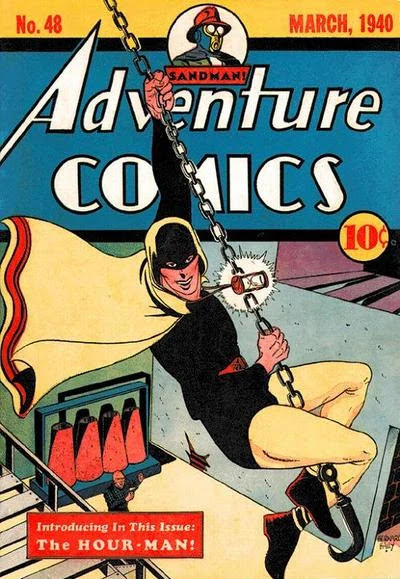
Adventure Comics #48 - pt. 3

When we left off with Socko Strong, he was confronting Monte on the wing of a flying plane about Monte's attempts to kill him. In a clever trick, even though both parachutes are actually fine, Socko pretends he switched parachutes on Monte to give him the "sabotaged" one. You would think Socko would use this trick to make Monte confess, but instead Socko pushes him off the wing to panic him, just to pay him back.

Moving on to Steve Conrad, Adventurer, we find Steve on a cruise where he spots and recognizes 'Singapore Sal,' a notorious jewel thief (perhaps after making an INT ability score check?). When she leaves the deck, Steve is surprised she didn't notice him, suggesting they've met before (and letting us know that Steve had surprise in that encounter?). Sal's partner is called Slick -- he's almost surely a slick hoodlum. Steve comes up with a pretty clever trick where he has his comic sidekick slip a handwritten, signed note by Steve under the door, then listen to the two of them talk about their plans through the door after they read it. 

The next wrinkle in the story is that Steve tries to stop the valuable jewels on the ship from being stolen. The would-be thief appears to be Slick, but he's wearing a mask and, surprisingly, he manages to get away from Steve easily after just hitting him once with a sap (and not even a head blow at that). When Steve confronts Slick he discovers it wasn't him -- Slick is not wearing the same jacket and hasn't had time to change it. Although the wrinkle requires a bit of railroading to let the thief escape, it winds up being a pretty interesting wrinkle. The clue turns out to be the cord Steve tore off the thief; he doesn't know where he's seen it before until he remembers it was holding another passenger's monocle in place (if the player had trouble thinking of this, maybe he was allowed to "remember" after an INT check). 

The only other thing I'm going to say about the Steve Conrad story is that it is extremely verbose with big word balloons in almost every panel.

Am I just going to have to accept that it's a lot easier to throw a missile weapon hard enough to pin it into a wall in comics than real life? In Rusty and His Pals, Rusty manages to throw a spear -- and it's not really a spear, it's just called a spear in the story but it's clearly a lance -- across a room, knocks a man's gun out of his hand, sails right past him, and still hits the wall hard enough to become embedded into it. Did I mention Rusty looks like he's 11 years old? You know...sure, why not. Embedding in the wall is just flavor text at the end of the combat turn that doesn't affect the disarming attack or anything in the following turn. 

Having cleared the bad guys out of the house, they consider the clue they have, that they're supposed to look "behind Stevenson," and then they figure out that there's something in the library behind a copy of Treasure Island -- a clever clue, so long as no one felt like reading it and took it back to their room, of course. Behind the book is a button that opens a secret door. The boys realize they need to consider illumination issues behind the secret door so they all fetch candles. They mysterious passage looks straight out of D&D, leading to a small room with a chair, desk, and a small chest on the desk. The desk contains both a clue, a journal, and a secret clue concealed in a false top -- a single sheet of paper, the contents of which we'll find out next issue.

In Anchors Aweigh, we hear about the trick of putting cotton in your nose to make it look broader, when disguising yourself as someone with a broader nose. There is an interesting wrinkle to the story where Kerry finds out the man he's impersonating has a wife who he has to push away without making her suspicious. The last page, though, is terribly confusing. When the Naval officers burst in on the smugglers' headquarters, they leave the driver tied up in the elevator. The driver, trying to escape, makes the elevator go down with his feet. Somehow, the elevator doors do not close on their own (did elevators not have automatic doors at this time?), so the boss smuggler backs up to the elevator and falls. But...somehow he falls onto the driver at the bottom of the shaft and not onto the roof of the elevator car. Were there ever roofless elevators?

Lastly, Cotton Carver and Deela crash-land in a petrified valley where the challenge of this scenario is finding food! On day 2, they find a tree with edible berries (skill check to identify they are not poisonous?). Hunting for meat, Cotton knows he will run out of bullets soon, so he builds a bow. The terrain gets progressively worse for them; they come across a chasm thousands of feet deep filled with hot geysers, and at their backs they encounter three ape men armed with warclubs weighted for throwing. The ape men seem unusually intelligent and manage to defeat Cotton, then carry them away down to the bottom of the chasm by leaping from branch to branch growing out of the rock wall. Cotton was only stunned and cowardly shoots the ape men in the back (I guess with his last bullets?). Too bad he didn't try to talk to the ape men, because it seems like they could talk. They probably also were responsible for making the stairs they find, and the tall ladders that lead to the top of a volcanic cone. The volcanic cone is dangerous because of poisonous fumes in the air. Both of them make saving throws vs. poison and Deela fails, faints, and falls off the ladder. Cotton grabs her with an attack roll, then makes a Strength check, probably with a significant penalty (-5? More?) to continue climbing the ladder one-handed, while holding Deela with the other.

(Read at readcomiconline.to)


Friday, January 29, 2021

Adventure Comics #48 - pt. 2

And we're back with what I promised, a look at this issue's installment of Federal Men. In it, the FBI gets a hot tip that counterfeiters are working in Northville, and in an unusual way -- a fake $1,000 bill is mailed to them anonymously, but came from Northville. Of course, we're given no indication as to where Northville is but, since so many comic book stories have a New York City orientation by now, it stands to reason that "Northville" means somewhere North of NYC, so...maybe it's actually Albany? Or even Poughkeepsie? Ah well, it's all speculation...

The plot is one we've seen before and will see again -- the hero stumbles across a crime school where a professor (or professors) teach classes on forgery, safe cracking, and killing in exchange for a cut of future profits. This one is pretty expensive -- a complete course costs $5,000, plus 25% of your take for the first year. I would be really leery of allowing a real game mechanic benefit to this.

Steve Carson (our hero) disguises himself as a "tough" by smoking a cigarette, going without shaving, and possibly darkening his eyebrows. He's caught -- not because he looks just like Steve Carson, but because he gets fingerprinted and the Professor somehow has all federal men's fingerprints on file.

Fitting in with the dark themes at DC Comics this month, the deathtrap is a suicide machine -- you're strapped in, with a gun in your hand, and the machine makes you squeeze the trigger and shoot yourself in the head. Without wrecking things, it's a pretty foolproof deathtrap -- so the only way out for Steve is to have one of the hoodlums turn on the Professor and free him. The twist is that the hoodlum did it -- and sent the fake $1,000 bill to tip off the feds -- not out of any altruism, but revenge because he was about to be expelled.

By now, the Sandman has been downgraded from billionaire Wesley Dodds to millionaire Wesley Dodds. Wesley is shown smoking a pipe, and the Sandman carries binoculars for the first, if not only time, in this issue.

Dian Belmont is in love with Wesley already, if her letter to him is written honestly. Her father, the D.A., learns Wesley is the Sandman in this story and seems cool with it, even though the Sandman was wanted by the police in the past.

The Sandman is shown jumping safely from a second floor window. Should stunts be able to lessen falling damage? Maybe. Maybe...half damage per 10', per stunt?

The Belmonts own a Chris-Craft -- Chris-Craft Boats was an American manufacturer of boats that was founded by Christopher Columbus Smith. This page is a good commercial for them -- it's fleet, and can easily catch up to a yacht. 

When Sandman searches Judge Quick he finds a letter in a secret pocket. I'm not sure how you conceal a "secret pocket" on your person. A pocket inside your jacket certainly wouldn't qualify as "secret." Maybe it's sewn to the inside of his pant leg...? The letter is a major clue without even reading it, because it smells of one of the suspects' perfume. 

Sandman climbs a wine-covered trellis (it's called a ladder, but it's pretty clearly a trellis) to an upstairs window, which should be a basic skill check, maybe even with a bonus if the trellis is sturdy. Dian, the Woman in Evening Clothes (and that's including high heels, no doubt) climbs it right after him, and that's got to be an expert skill check.

In one panel, the gas from his gas gun is referred to as "deadly."   

In Socko Strong, Socko is trapped in a deathtrap underwater, but he finds a trapdoor that serves as the drain for this pool. It feeds to an underground stream and Socko is swept into it. He emerges, "finally," on the bank of a river. But how long was he underwater? Were there pockets of air for him, or did he hold his breath the whole time? We're not told, but those details can mean life or death in a realistic campaign. 

The next day, while shooting a film, the guide wire snaps on a heavy arc lamp, and the lamp is about to fall on a small girl. "The entire group all stands motionless in frozen horror -- except for Socko..." Now, there's two possible explanations for that. One is that, as the only Hero present on the scene, the Editor is making sure none of the other characters on the scene can upstage him. Or, the Editor used surprise rolls to determine if anyone was surprised by the falling arc lamp, or perhaps Socko surprises the falling arc lamp, giving him even more time to act.

In an interesting twist, the father of the girl was paid to kill off Socko by sabotaging his parachute for the next scene to film. Doing the good deed pays off and saves Socko.  

(Read at readcomiconline.to)


Monday, January 18, 2021

Detective Comics #37 - pt. 2

*sigh* "Spy" used to be so good when it was Jerry Siegel and Joe Shuster working on it. Ever since Maurice Kashuba started drawing it it's been so boring, I wonder if Siegel's name is only contractually on it and he's not actually writing it anymore.  

The plot here is that a bomb blows up a "conference of government officials," with no specifics as to the nature of the conference or the level of the officials present. Forensic evidence points to a suspect, which our hero Bart Regan collects from the scene, which seems odd because you would think a forensic specialist instead of a spy would be collecting evidence. 

An assassin tries to shoot Bart in the back, but facing doesn't matter in Hideouts & Hoodlums; if you win the initiative roll, you can turn around and deck someone behind you, just like Bart does. 

Undercover, Bart tries to join Ligoni's mob, what we would call a terrorist organization today. Ligoni is a skilled knife thrower and tests his new recruits by throwing knives at them until they flinch. Bart stands still for 16 knives before Ligoni gives up. I would use two mechanics for this: one is rolling to attack Bart with each throw. Since he's trying to miss, a successful "hit" becomes a miss. The other is requiring a save vs. plot from Bart to see if he flinches. If I was really mean, I'd make him make 16 different saves, but the odds would really be against him then. I would have him roll once and, if he missed, the number he rolled is the number of knives he can withstand without flinching. Then, to be fair, I would roll randomly (on a 20-sided die) to see how many knives Ligoni throws.

During the initiation, a mobster walks in who knows Bart and recognizes him immediately. Bart was "disguised" only with a change of clothes to look like a criminal, which is not enough to warrant a mobster having to make a saving throw to see through it.

Whimsically, the newspaper headline saying the bombers were captured is from The Daily Star, the newspaper Superman then worked for. This could be seen as the first cross-title continuity between Action Comics and Detective Comics.

In Cosmo, the Phantom of Disguise, Cosmo's friend is a ship captain tasked with delivering unspecified "chemicals" to England. I immediately thought this was suspicious and did some digging and saw that we did send chemicals to England -- illegal mustard gas -- in 1943. We never do learn if it's that type of chemical being delivered.

It normally took a steamship 15 days to reach England from New York then, but the captain seems to suggest it will take 1 whole month with the circuitous route they planned around the "war-infested areas," which actually does sound like quite a reasonable precaution.

Cosmo, in disguise, hears talk of mutiny on board the ship (after a skill check for listening?). In a clever bit, Cosmo pretends to shoot the captain with a blank cartridge, then dumps a dummy overboard, so the mutineers will trust him and the captain can still move about the ship. Less clear is how Cosmo further distracts the mutineers with an explosion timed to when he drops the dummy in the water. Are the explosives inside the dummy? And if so, wouldn't dumping them in the ocean stop them from detonating? The story should have ended with the captain rallying the loyal crew for a big fight, but the story is running out of pages, so the mutineers all flee to the life boats, but Cosmo punches out the ringleaders before they can board the boats (why the ring leaders wait so long, until all the other mutineers are at sea, before leaving the ship is not clear).

The Crimson Avenger returns! A rich man's daughter has been kidnapped, so the Crimson Avenger goes to work -- as reporter, Lee Travis. He apparently finds no useful clues, so he comes back that night as the Crimson Avenger and, at gunpoint, forces the dad to tell him where the drop point for the ransom money is. His only plan now is to follow the kidnappers' car from the drop point (are police not doing the same?). 

The twist is that the kidnappers' hideout is a mansion in the suburbs. The Avenger even gives us the address for the mansion, 704 West Highway, "Scarchester." That sounds like Dorchester, Massachusetts to me. When he gets there, though, all the Avenger does is point a gun at the five kidnappers and wait for the police to arrive. Boring, and the art is terrible. What a bad comeback!


Monday, August 31, 2020

Feature Comics #30 - pt. 2

We're looking at the second half of this issue of Feature Comics today, and are still in this month's Dollman feature. If you can't guess, Dollman has snuck aboard a German submarine since we last saw him. If you ignore the dynamic layouts and just concentrate on what Dollman is doing on this page, you'll realize there's nothing here he couldn't have done at full-size, backing my contention that a shrinking power is nothing but flavor text.

Now, he did, on the previous page, conceal himself in a crate too small for a normal-sized person to hide in...but the Editor could easily have changed the scale of the crates to fit the Hero.
I know where this is! the highest suspension bridge in the world was the Royal Gorge Bridge in Colorado from 1929 until 2001.

I am really impressed by the wrinkle in this story, that Rance leaves the time bomb intact to give the story a time limit. It's not really clear why. What would make this work so much better is if the time bomb wasn't safe to defuse, so the only way to do so is to find the man who left the bomb in the time they have available and trick him into defusing i for them. Which is almost exactly how this story goes, except for the necessity factor.
This is more of what I like from this story - not only finding out who the villain was, but finding out his backstory, looking for things to exploit so they can trick him instead of beating him up. It's all so ingenuously done that I would probably wind up giving Cameron a penalty to his save vs. plot to see through the disguise (the distance and bad lighting probably help too, so, -3?).
Here's an example of expert level sleight of hand from a non-adventure character. But I was more interested in sharing this page for the unusual word "bohunks." I don't know if you all knew this already, but bohunks is actually a racial slur, referring to an immigrant from central or southeastern Europe, especially a laborer.
We haven't looked at educational filler in a while. Things like this are very useful because, when I'm deciding how high or how far a Hero should be able to leap without some kind of buffing (either by skill or power or spell), I will look to world records, but of course world records keep going up over time. It's hard to believe that the pole vault record was "only" 14' back in 1940; now it stands at 20'!
We're jumping from there into Charlie Chan, where the artist does a great job of getting Warner Oland's likeness with all the shading. Here, Charlie lands on the nature of the bad guys' scheme from two clues. I've spoken about this before on the blog, how difficult it can be sometimes to distinguish the Editor misspeaking from deliberately leaving a clue in dialogue. The better clue, for a RPG, is having Chan realize the binoculars are expensive. I'm not even sure if one should need a skill check to determine that; I would think it would be obvious if a pair of binoculars was fancy enough to be expensive.
This page tells me pigeon blood rubies are worth twice what diamonds are worth. I wish it also told me what diamonds were worth in 1940, as that would be a good cipher for figuring out what all other gemstones were worth. Interestingly, I can find this information online, but only going back to 1960.

You don't hear about "pigeon blood" rubies often, probably because it is as violent as it sounds. Pigeon Blood Ruby meaning is primarily associated with its color that matches exactly with the blood drawn from a freshly killed pigeon.
I'm currently running a campaign where one of the Heroes is working to become a professional boxer, so I found this installment of Slim and Tubby particularly interesting. At first glance it seems that Slim needs a license and bond to become a boxer, but that's not true; he needs a license and a surety bond to work as a boxing promoter, something that's still true today (Slim is looking to become a promoter to promote his own boxing career).

We also see robbers armed with sub-machine guns here (well, sort of -- they never leave the car, but we're told they are that well-armed).

(Scans courtesy of Digital Comic Museum.)

Friday, May 8, 2020

Smash Comics #8 - pt. 2

I don't care for any other features in Smash Comics as much as Espionage, but that doesn't mean we can't glean anything useful from them. Let's start with Abdul the Arab, our "hero"/traitor to his people, who helps the British steal his nation's oil...

We always pause to examine maps. Kuwait is not drawn by accident inside Iraq's borders; Kuwait had been annexed back into Iraq in 1938. Riyadh is the capital of Saudi Arabia.


This is an unusual scenario for a RPG, since it can't be solved by violence. Abdul has to prove Holden is stealing Rice's oil (in a Western setting, you could substitute cows for oil and run the same scenario) by getting a confession or finding the hidden pipeline, and by diving the work between himself and his sidekick, he gets both.


I can't verify that there is such a thing as a Cambridge Arsenal, let alone one holding 20,000 tons of high explosives. That seems like a really dangerous building to put that close to London.

Transatlantic flights did not fly every day in 1940, which can delay a scenario that takes place across the ocean. 


Here's an image of what appears to be a briefcase-sized short wave radio. 1940 Heroes can't easily carry these on them, but if they keep them in their cars they can split up and still communicate.


Heroes can often be notoriously hard to trap when they travel overly cautious, with all their gear and trophy items with them. The trick, then, is to get them to lower their guard and feel safe. Trap them while they don't yet know they've reached the hideout.


Yeah...that is one unconvincing ghost, what with his legs sticking out under the sheet. I know I've always said disguise needs to be really easy in comic books, but I might give the mobsters a +2 bonus to their saves vs. plot to see through this one.
We're going to skip ahead into the Hugh Hazard and His Iron Man adventure that follows. All the backstory you need to know here is that the Batzis are Nazis, Hugh knows they are responsible for sabotage here in the U.S., and he figured out they are keeping in touch via radio. He lucks onto their short wave -- I can't see that being a skill check; perhaps he just has a random 1 in 6 chance of catching one of their messages per rest turn, like a wandering encounter on the radio.

Now, I don't exactly get how this works, but if you connect a super-seper iconoscope to a teleradio, you can get a visual image of the person speaking, even if that person was only recorded with sound. Who knew?

"Krautville" sounds like a racist name for any town with a large German population in it...
Bozo has the Dig power, so that means he functions as at least a 6th-level superhero. And yet...we are treated to Bozo using the "Look behind you!" trick like a grade school prankster. I would say it's amazing that the old guy doesn't hear the propeller right over his head and know that Bozo is still there, only...well, then we also have to overlook that this tiny propeller can make a large robot fly.  I guess you could give the guy a save vs. plot to see if he falls for it or not, but I think a +4 bonus seems reasonable too.
This page kind of undersells this tactic, but a time-tested method of keeping the Hero from capturing the villain until later in the scenario is to have something happen that the Hero has to leave right now to stop. A Lawful or Neutral Hero should then have to save vs. plot to stay and defeat the villain early (maybe Chaotic too, depending on how much is at stake).

(Scans courtesy of Digital Comic Museum.)

Tuesday, October 8, 2019

Prize Comics #1 - pt. 5

I haven't tackled a five-parter in a long time, but I had a lot to say about this issue.

We're going to pick up not long after where I left off with K the Unknown and we will, as usual, discuss it in terms of RPG game mechanics. As anyone who's ever read a previous post knows, I wrote the RPG Hideouts & Hoodlums and feel it does a spectacular job of  emulating the early history of comic books -- which I prove post after post on this blog.

And yet...K, getting stunned on the first hit by a thrown paperweight just doesn't match up with the hit point model of incremental defeat that H&H uses. It seems more like every hit has a random chance of delivering a stun. And, as I think about it, I see this all the time against bad guys and animals; only Heroes are usually incrementally defeated. And it does give me pause.

This page also highlights the importance of checking every mobster you defeat for disguises.
I'll give K this, the finale is worthy of a James Bond movie, with the hero and villain struggling upright on a speeding bobsled -- in fact, it predates the bobsled chase in On Her Majesty's Secret Service by 23 years!

I would think that two men grappling on a moving bobsled would wind up getting thrown off almost immediately, but in-game would be fine with giving each a save vs. science each turn to stay put, with a penalty to their save on the hairpin curve.
If Buck Brady of the F.B.I. seems science fictional, it's because of the absence of 1,000-dollar bills out there today. The U.S. government stopped making the bills by 1946, and finally recalled them all in 1969, so I've never seen one in my life.
I decided to share this page to talk about players choosing the direction of the scenario, because I read this I couldn't help but think, if this was a game I was playing, I would have had Buck follow the car rather than search her room. Now, if I was the Editor instead, I could leave a clue in the room telling the player where the old lady was going, and hopefully the player will get the hint that it's important to go to that location...
In this case, the Editor seems to have decided to move the planned encounter back to the hotel room. On one hand, it makes the villain seem smarter, guessing Buck was coming, but on the other hand it makes the Editor seem like he's unfairly using his knowledge of the player's actions against them. A way around that might be to let the player attempt to save vs. plot to find the hotel room abandoned.

Here is the oddly-already-a-cliche of the man dressed as an old woman, but with the switcheroo that the Hero then uses the same disguise.
I'm impressed by the daring involved in piloting your boat into a police boat just to get their attention. A mean Editor could well give you a chance of sinking the police boat, and then where will you be?

The final story we're going to look at is Storm Curtis of the U.S. Coast Guard. I'm showing you this page for two reasons: one, it's more fun playing a character with interests other than crime-fighting 24/7. Give your Hero a hobby, either one you already know about, or one you're willing to research.

And two, check out that grappling hook gun! This is much closer to what a real grapple gun looks like than what Batman has carried since the 1980s, though I'm not convinced grapple guns were that small and handheld in 1940; there could still be some artistic license at play here.
Paper and pencils are good things to find on a defeated mobster, as are cigarettes.

Note the use of "espy" in panel 2, a word I don't think was even in common usage then!
Those are really convenient clues to find in someone's pocket!

Personally, I find the chief spy encounter anticlimactic, but it's certainly surprising and good to pull on your players once.

I think it's amusing how Curtis sort of bumbled into this whole spy ring, like a player getting a lot of railroading help from his Editor.

Comics.org doesn't say who the artist is here, but I suspect Dick Briefer. What do you think?

(Scans courtesy of Digital Comic Museum.)

Friday, July 19, 2019

Adventure Comics #47 - pt. 1

It's been nine months since I've last covered the early adventures of the Sandman! This is what happens when I cover so many titles, in such detail...

This story opens with a newspaper article detailing a murder the Sandman is about to investigate. The article is signed by Ogden Whitney, who's been drawing this feature since last issue. Ogden is good, but Bert Christman and Craig Flessel were just that much better...

I'm not surprised that Wesley Dodds was friends with the dead man, as Wesley has one of the richest backstories of early comic book heroes and knows practically everyone. Gardner Fox is starting to tinker with that backstory, though, changing Dodds from a billionaire to a millionaire. And this is the issue where he gives Wesley is his first partner. Being big on strong, equal female partners, it is hardly surprise that Dian Ware is an expert safecracker and resourceful enough to have learned or deduced the Sandman's secret identity (though it's never revealed how). Known as "The Lady in Evening Clothes," Dian even sounds like a mysteryman (or a Victorian one).

The murder weapon is a Corson repeater. I can't find any evidence that's a real thing, but I'm fine with that. I was way too specific about firearms in 1st edition Hideouts & Hoodlums and pulled back from that in 2nd ed.

Sandman still shows some willingness to act in a Chaotic manner, gassing the District Attorney when he won't cooperate and give the evidence back that Sandman already gave to him.

In a firefight with two mobsters armed with sub-machine guns, we see simultaneous initiative, with Sandman gassing them just as one of them shoots Sandman in the shoulder. We also see that Sandman has no control over who is knocked out within the area of effect of the gas, as Dian goes down too. Sandman is weakened by his injury, gradually losing consciousness, which is not a condition covered by the rules, and it takes him a week to recover (players can thank me ignoring this in the rules later!).

Trigger, the killer, is held on $1,000 bond, but for breaking and entering (the police haven't nailed him on murder yet). 

When Sandman confronts Black Bill, Trigger's boss, he mentions Bill isn't as fast as he used to be (more of that backstory I enjoy so much).

Sandman is still not widely recognized on sight; District Attorney Belmont's butler doesn't recognize Sandman by costume until Dian introduces him.

Belmont has three detectives on guard duty in his house, all armed with sub-machine guns. Surely they are not there full-time, but I don't know how Belmont anticipated Sandman coming.

In a nice twist, Dian turns out to be D.A. Belmont's daughter. Unfortunately, as soon as this happens she is "domesticated" and never shows her safecracking skills again. That Wesley falls for her is evident in that he lets her take off his mask and kiss him where her father might see.

Moving on to Barry O'Neill...I'm not sure when Barry went from assisting the French police to working with French espionage, but it seems to have been a gradual transition.  Of course it starts in Paris, because all adventures in France feature Paris. The Village of Vereux is misspelled as Veraux (intentionally?), while Polmere seems entirely fictional.

Barry is able to win initiative against the fake Inspector Le Grand, despite the fact that the doppelganger has a gun trained on Barry's back already; more proof that facing is of little importance for Hideouts & Hoodlums. The doppelganger must have had only a superficial resemblance to Le Grand, as he had to wear a partial face mask to conceal the rest. That the doppelganger is known as Number 37 by his fellow spies suggest that there are at least 37 spies in this spy ring.

Barry scores a direct hit with a grenade and blows up a building. Area of effect damage does not normally need a direct hit, and certainly doesn't for damaging structures. This may be only flavor text, describing how Barry rolled really well for damage.

The spies' car has a concealed radio transmitter in it, which is something good to add to the add-ons list for transport trophies.

(Sandman story read in Golden Age Sandman Archives vol. 1, the rest read at readcomiconline.to.)

Wednesday, July 3, 2019

Detective Comics #36 - pt. 1

It's been awhile since we last checked in on The Batman. This is still the pre-Robin Batman that I'm not particularly fond of. Bill Finger's The Batman, probably at Bob Kane's insistence, is a dark, menacing figure who is not opposed to killing by any means at hand.

Like many a Superman adventure of the time, this scenario starts with a wandering encounter -- a dying plot hook character escapes from a speeding car within sight of the Batman.  Batman's player is smart and has him search the body for clues!

True to the tropes of the Mysteryman class, the police catch him standing over the body and assume the Batman is a murderer. They even try to shoot him down without even bothering to tell him to surrender first!

Later, as Bruce Wayne, the Batman solves a clue and figures out that Professor Hugo Strange is up to something. The description that Bruce gives to himself of Hugo Strange resembles Sherlock Holmes' Moriarty.

Now, some people feel that, since the Batman already knows of Hugo Strange, that means this story was published out of order with the next Hugo Strange tale in Batman #1, but another possibility is that readers were supposed to understand from this that Hugo's first true appearance, in the 1934 Doc Savage novel, The Monsters, was canon for Batman's world.

The Batman, aware from the G-Man's notebook where Strange's first robbery will be, takes a big risk by disguising himself as the night watchman. Had the plan been to kill the night watchman, we wouldn't have a Batman today. But it does work out perfectly for him, as the robbers relax their guard and leave only one armed while the rest move boxes -- a perfect time for the Batman to attack and get one free turn of action while the mobsters would drop their boxes and go for their weapons. Better, he gets a surprise turn, on which he decks the guard and drops him, and then wins initiative on the first regular turn and takes out two mobsters (with low hit points) with his punches (two attacks because they are unarmed). It appears he is taking out four at once, but this must be turn-compression and showing his attacks on subsequent turns as well.

After the battle ends, the Batman shoots a gun into the air to bring the police, but it is not clear if it is his gun, or if he just picked up a mobster's gun.

The next night, Hugo thinks nine-to-one odds will be enough to stop the Batman, and it almost isn't. It appears that a single lucky head blow takes him out, but it could have been a gradual reduction of hit points throughout the battle.

Bucking villain tradition, Hugo does not put the Batman in a deathtrap, but plans to torture him with a whip while chained up instead. I suppose, eventually, that could kill him, so maybe it's just not a particularly efficient deathtrap. The Batman escapes by wrecking the chains. The Batman is a perplexing man (4th level Mysteryman) by now, so for him to wreck the category of machines (for chains), he needs to only roll a 4 or higher on 2 dice. I would also rule that he only gets one chance before Strange figures out what he's trying and stops fooling around with him.

The Batman is shown keeping a vial of sleeping gas in his utility belt.


(Read in Batman Archives vol. 1.)

Sunday, March 17, 2019

Wonderworld Comics #10 - pt. 1

I certainly like it when Hideouts & Hoodlums perfectly emulates the look and feel of comic books from the golden age...but there are certain stories that make me go, hmm, maybe strict emulation could be taken too far. Case in point: should tanks be allowed to burrow through the center of the Earth, as a "shortcut" from Mongolia to Florida? Not only is that completely impossible, but it's so impossible that air dropping tanks from above would be relatively easy in comparison.

That said, I like that we get our invasion started in Florida for a change. The story imagines a Fort Blane in southern Florida, near the Everglades, but southern Florida only has Navy and Coast Guard bases in it for real.
A superhero using his wrecking things ability would not be unbelievable, except that we just saw (on a page I skipped over) the tanks shrugging off bombs dropped from airplanes like they were nothing. Is there some special vulnerability to fire to these tanks, and if so, how did they ever make it through the heat as they drew closer to the Earth's core?

And yet, there must be a known vulnerability to fire in the design, or there would be no reason for the men to have asbestos suits with them (unless they were anticipating the Flame showing up?).

10-to-1 odds seems too much for the Flame, though he uses Get Tough on at least four of them before taking off.
Oh, come on, Flame! What did that poor huge (5 HD?) alligator ever do to you? It looks like it was only trying to give you a hug to me, you murdering bum! And why do you only afterwards get the idea to use your flame to drive off the others? (Common sense morale check, at the Editor's discretion.)
More evidence of how easy disguise is in comic books: despite the fact these are see-thru helmets, no one questions the fact that one of the men is wearing the Flame's mask under his helmet.
The Flame can now wreck dams, which means he is at least 6th level -- not a surprise, since we've already seen him use the high-level Teleport through Focus power. He's only been published in enough pages to warrant being 3rd level by now, so there are plenty of brevet ranks in play here (if not for the teleport power, it would be possible that his flame-gun is a trophy item that wrecks at a higher level, and that the gun is not itself just flavor text describing how he uses his powers).

As loony as this story has been...that is one gorgeous page of art.
Here's that Teleport through Focus power we were just talking about! It would appear that we are talking about a range that can take him halfway around the world...but we also don't have to assume that the Flame made this trip in just one jump. Perhaps it took him days to teleport from open flame to open flame until he got to Mongolia.

Genghis Khan villains are apparently high kickers. I'm not sure how that makes a game mechanics difference, but it sure looks impressive!


 A very rare example of a sword being used as a missile weapon.

Despite being a relatively inexperienced superhero, the Flame already commands the respect of the U.S. Army.

It should not surprise you to learn that Evergreen Chasm is not a real place. Florida is relatively free of chasms. Sinkholes, on the other hand...
Not the first time we've seen plot hook characters literally crash into the Heroes.

Nor is the first time we've seen Heroes feel they have to escape bad weather by heading indoors, no matter how spooky the building looks (save vs. plot required).

That still looks like Eisner to me, but comics.org tells me this is Bob Powell doing a good Eisner impersonation.  I'm impressed by the sense of space in the castle interior. The door knocker, the height of the door and ceilings, the rafters, and the blazing chandelier are all dressing details for a good hideout.


Yarko, despite having gone spell-to-spell with the Devil already, can't overcome this one guard. Granted, the grappling rules are not kind towards magic-users (with their low attack bonuses), and perhaps we've finally discovered Yarko's weakness here, that he needs his hands free to cast spells.

Poof! is a 1st-level spell in 2nd ed. H&H. It only works on one person, so this is perhaps a higher-level version (Poof II?) that allows multiple people to disappear. It's also possible that more pf them than just the baron is casting versions of this spell.
 (Scans courtesy of Comic Book Plus.)


Monday, March 4, 2019

Action Comics #21 - pt. 2

'Chuck' Dawson's adventure starts with an interesting variation on the "message in a bottle" -- as someone chucks a flask containing a written warning into the canyon Chuck is traveling through. Like any good plot hook, the warning only encourages him to investigate and he uncovers kidnappers. Unfortunately, the story includes the racist stereotype that "half-breeds" are evil.

"Clip" Carson takes place in Algiers, the capital city of Algeria. Rescuing a man from attackers serves as both good deed and plot hook for Clip, as he winds up working as a guard on a caravan for the man he rescued. In a plot twist, the man told Clip he was delivering food to a sheikh, but is secretly an arms dealer; further, he plans to have Clip killed after the delivery, so he can't tell anyone he delivered arms to the sheikh. The sheikh's people are called "touregs" by the narrator, but what was meant was Touareg or Tuareg -- a Berber ethnicity indigenous to the Sahara region.

Because disguise is such an easy skill in comic books, staining your skin to look dark with a cigarette and water should be a basic skill check (as improbable as it may seem...).

This story is the first time I've seen the term "tractor car;" I suspect what the author means is a four-wheel drive vehicle, which were around but uncommon circa 1940 (in the late '30s they were considered luxury cars and produced by BMW and Mercedes-Benz). Clip tells us his tractor car can go 40 MPH over sand.

The "Clip" Carson art is much improved this issue by Sheldon Moldoff.

Tex Thompson is back home from his Africa adventures, home probably being Texas, even though the narrator never tells us so. This one's a murder mystery, and it's intriguing at first that the retired colonel is murdered right in front of Tex. Unfortunately, the clues are easy (why send a wooden figure to the victim made out of a special wood only you own?) and the explanation for where the knife came from is far from convincing. Also, there's the whole uncomfortably racist, nonhuman look of Gargantuan.

The Three Aces adventure starts in Alaska at the building of a Koyokuk Dam. I don't believe there is such a facility, though the Koyokuk River is real. None of the action takes place there, but it establishes that one job for aviators in their downtime is aerial photography. The Three Aces leave and fly over an unnamed mountain range, but in Alaska there are only three to choose from, the Alaskan Range, the Aleutian Range, and the Brooks Range.

Uncharacteristic of most fighter-types in comics, when Gunner, Fog, and Whistler arrive in town and see a fight in progress, but don't know the story behind it, they use nonviolent attacks like tripping and disarming to end the fight without hurting anyone.

The Three Aces help an old prospector who tells of his friend's find in the Mummy Range. It sounds made up, but there is such a place as Mummy Range -- only it's in Colorado, not Alaska. There is a Bald Peak in Alaska, so the old man's story is soon back on track.

Fred Guardineer's Zatara teams up with "Lord Ralway" in this month's story, but the dialogue strongly implies that Ralway is actually Lord Baskerville, of Sherlock Holmes fame. Sherlock Holmes is name checked as a real person, making this the first time he is added to DC canon.

Zatara casts a Levitate/Telekinesis spell powerful enough to lift a car into the air. He projects his astral form from his jail cell after being detained in a murder investigation. His astral form is invisible, but he can speak and be heard. His astral form can also fly and move through walls. Bizarrely, Zatara's astral form is able to carry Tong on its back, though perhaps he is simply levitating Tong directly behind him.

Zatara turns the bars of his cell into people, which seems ridiculously overpowered for a spell, even if it only lasts 1 turn. He turns a man into a salt cellar (what we would call a shaker today). Another man he ages by about 20 years. He turns the murdered body into a statuette so he's easy to carry. Tong -- who is way too understandable about this -- gets turned into a blood hound so he can sniff out Ralway's trail.

With another spell he causes all gun barrels to twist in a specific area. With another spell he gazes into a room he hasn't entered yet (Wizard Eye?). With another spell he teleports two people to him. With yet another spell he causes three large buckets of molten lead to appear in the room. He casts Cure Light Wounds on Tong, but we've seen him do that before. Lastly, he casts a spell something like Bigby's Grasping Hand to catch the two fleeing bad guys.

In a real surprise, Zatara says his magic has little effect on birds, so he is worried about three trained condors. There's no way to make the game mechanics do this without setting arbitrary weaknesses to spells, but that's not entirely unreasonable, as I've already added them to some of the race options.

Lastly, I would not put much stock in condors as a palpable threat, assigning them maybe 1/2 HD.

(Read at fullcomic.pro)


Monday, November 12, 2018

War Comics #1 - pt. 1

This is an interesting filler page; I'm skeptical that these numbers are accurate, but they're probably close enough that you could use these to keep track, as a roster of enemy planes, in a war-themed campaign.
This is Scoop Mason, War Correspondent. Scoop and "Sleepy" Samson make their expert skill checks, as they can tell these shells are duds just by looking at them.

Does Baron Treville need to make any kind of roll to identify Scoop and Sleepy? He's seen them before and they have only changed clothes. On the other hand, a costume is also a change of clothes. I would, however, rule that the saving throw required to identify a disguised person would be waved under these circumstances.


This is not the first time we've seen someone jump from a height into a car and land safely on this blog. Am I going to have to make this a thing? Maybe save vs. science and take no damage if you land in a car?
Not the first time we've seen carrier pigeons used in comics, but perhaps the first time they were owned by the Hero.

Now, think about this in context -- because this is during the period of American non-involvement in the war, it's okay that Scoop's solution to the scenario is to reveal Treville is selling dud armaments to the Germans. Two years later, the scenario would be tricking the Germans into taking the dud armaments.

This is 1940, remember, so an employer taking advantage of his position to sexually harass an underling of the opposite sex is still funny.

More interesting is the fact that No Man's Land, as described here, sounds an awful lot like Wonder Woman's Paradise Island, well in advance of its debut.


This is the stereotype of the Russian anarchist that has served as the Hideouts & Hoodlums anarchist since Supplement I: National.
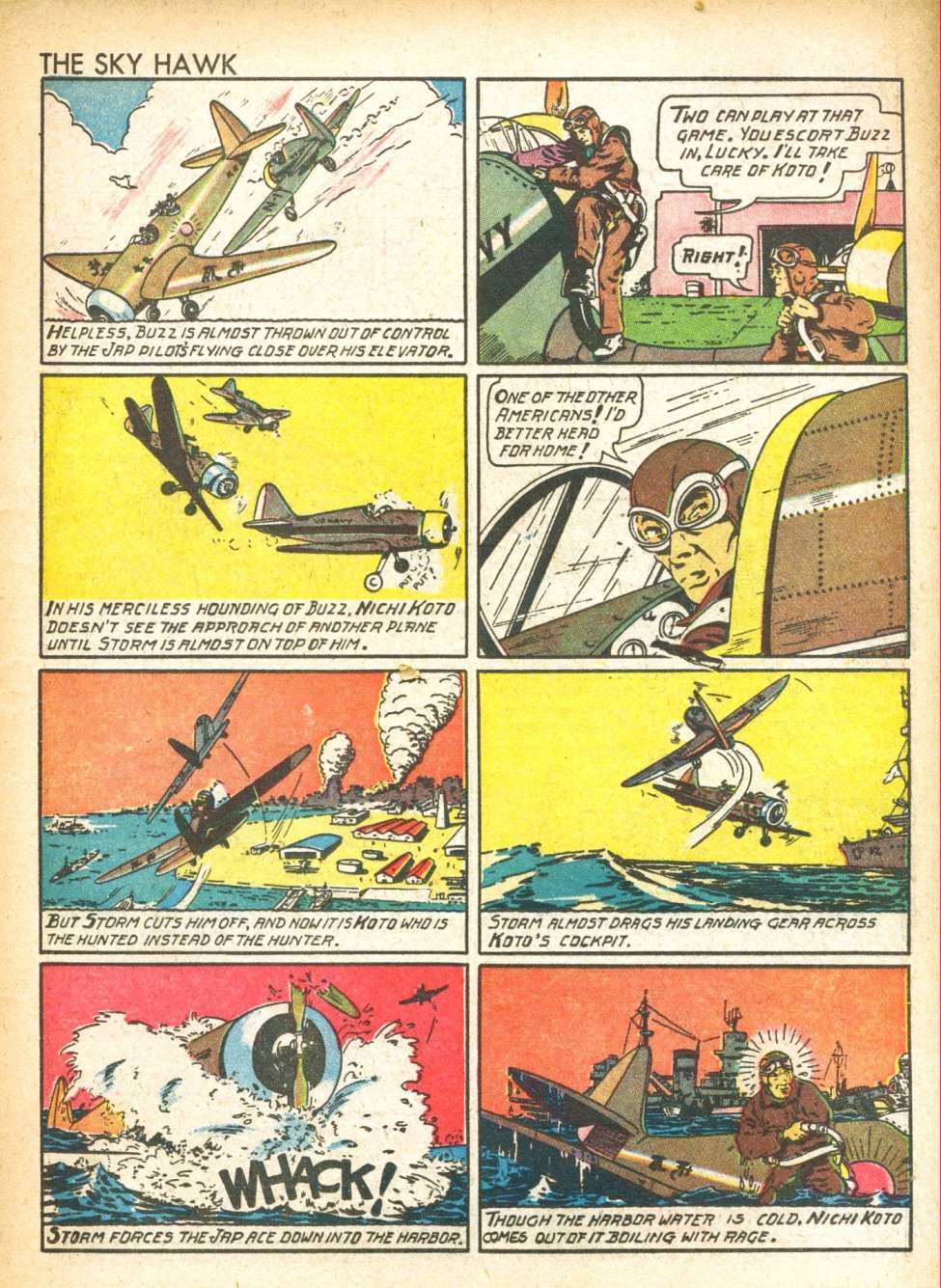
Sky Hawk is essentially DC's Red, White, and Blue played more serious. A $50,000 bribe is more money than most players would need to bait them into a scenario, but it's interesting how Allen, Lane, and Magee all turn it down.

Allen remembers something very suddenly at the end, almost as if he had asked the Editor if he knew anything about Ah Fong and was told he would if he made a save vs. plot.
Not all Heroes in the same group need to be of the same Alignment. Note how Allen is Lawful and won't think of being bribed, while Magee is Neutral and, being more of a mercenary, wishes they had been given separate checks to cash.
This is an interesting scenario because the Japanese are clearly the antagonists in this story, but America is still officially neutral in their war on China, so they have to dogfight without shooting at each other.

Forcing down a plane is a special kind of stunt where the pilot still has to burn a stunt slot, but instead of getting an automatic success, the opposing pilot then has to fail a save vs. science to avoid being forced to land.

Also note that neither the Chinese nor the Japanese in this story are depicted in stereotypical racist ways.

(Scans courtesy of Comic Book Plus.)