Showing posts with label Captain Jim. Show all posts

Friday, November 13, 2015

New Adventure Comics #27

This issue starts off with the latest installment in the Captain Jim and the Texas Rangers serial. Captain Jim and Bob have been looking for the kids Rusty and Spike for an awful long time now. Part of this is due to how good Rusty and Spike are at hiding, which fits well with the half-pint race introduced in The Trophy Case v. 2 no. 4.  The issue also comes up of gun range, and verifies that rifles have longer ranges than pistols. This is true in the real world, of course, but it's good to know what is factual in comic books and doesn't need to be glossed over in the abstractness of Hideouts & Hoodlums' combat rules.

Detective Sergeant Carey of the Chinatown Squad is still in China, where the soldiers there are the good guys and Carey and his friends are helping them root out bandits. The bandit leader, Sin Fu, has a lair inside a dormant volcano. The soldiers know about the cave complex visibly accessible from outside and have found the caves are all dead ends; the true entrance to his lair is a secret door made to look like part of the rock slope, and opens by being pushed in by a heavy weight (or much force). Sadly, the strip ends abruptly and we have no sense of what the interior of the hideout is like, save that is has a holding cell for prisoners (which keeps the army from just blowing up the volcano).

Captain Desmo fights with lengths of chain, snapping them like whips, in his installment.  Even improvised weapons should do normal weapon damage.

Just like Zatara four posts ago, Nadir the Master of Magic uses a gun in this installment -- though, really, Nadir hasn't cast a spell in so long we can barely call him a Magic-User at this point. He might just be a Fighter with a magic item or two.

(Available to read at Comic Book Archives)

Friday, September 11, 2015

New Adventure Comics #23

The Adventures of Steve Conrad includes, if not the first, at least one of the first dives off a balcony to swing on a chandelier in comic books. As much as a staple as this is of the action genre in general, I almost hate to attach any game mechanics to it. A roll, perhaps a save vs. science, could tell you if the jump-and-swing was carried off with aplomb or not.


Nothing says "Run for your lives!" quite like having turtles chasing you. Granted, these "army-turtles" are large in size (and look more like tortoises, really). I might be generous and assign these 2+1 HD, a 9 Move, an AC 4, and have those beaks do 1-8 damage.


Bob (from Captain Jim of the Texas Rangers) here gives us a demonstration of what constitutes a concealed door vs. a secret door.  A trap door that is covered by something that can easily be moved is a concealed door. A door in the ceiling, made to look like a riveted metal plate, is a secret door. The fact that Bob has to search for a means of opening it clinches that it is a secret door.  Concealed doors should be easier to find than secret doors.


Here, from the serial Monastery of the Blue God, is a textbook example of Heroes beating up mobsters and then searching them for loot to keep as trophies. They are so clearly excited about a star sapphire on a gold chain because it is probably worth considerably more XP than the mobsters themselves were worth.


This is from Robin Hood.  Literary adaptations will rarely be the focus of this blog, but this page brings up the interesting question: can a single arrow that does 1d6 damage kill a stag? By combat rules, unlikely. A stag, as a combatant, would have about 3 HD, 10-11 hit points on average, and do about 2-8 points of damage in a charge -- stats that should give any archer pause. However, if the archer was firing from far enough away that the stag could not possibly reach the archer soon, or the stag immediately missed a morale save and would not be fighting, the Editor could rule the stag is a noncombatant, and so the killing can be described with flavor text.


Illumination can be tricky to referee as the Editor; when you're imagining the scene, you're trying to picture everything. Dim or no illumination at the scene then requires you to filter out detail from the scene as you're describing it to the players, creating an extra step for you to keep track of.

Another thing to keep track of is the number of things that shed light that can be seen at great distances away. Here, we're reminded that even cigarettes may give your opponents away at a half-mile range.


Sandor's player asks us, "Can I have Sandor pick up a guy, toss him into a group of other guys, and knock them all down?"

As a general rule of thumb, you should not allow Fighters to make any kind of special attacks that they would gripe about you using on them. Would they complain if one mobster could knock over all the Heroes with one well-placed attack?

Note that Superheroes could buff themselves with Multi-Attack or Flurry of Blows and pull off this stunt.

As common as leopards are becoming (this is the third time I've discussed them here), they really need an entry in the mobsters section of the next edition.


Lastly, we have Detective Sergeant Carey of the Chinatown Squad, who encounters an unusual trap. It's a tripwire trap that sets off explosives -- but it's not meant to harm the intruders; the explosives are set off further down the tunnel, destroying any evidence there before it can be found.

(Scans courtesy of Comic Book Archives)


Tuesday, August 25, 2015

New Adventure Comics #21

I'm still playing catch-up on this title, so this is actually the issue of New Adventure Comics from November 1937 and, hopefully, I'll be able to review December 1937 next.

Captain Jim of the Texas Rangers shares a little history lesson for you on how common it used to be for men to write their names in their hats. A good clue if your Heroes happen to find a hat at a crime scene!


Note that the cowboy here is surprised, but his horse isn't. Normally, the Editor only rolls surprise once for each side, but if a Supporting Cast Member (particularly an animal SCM) has extra-keen senses, then that could be reflected in a second surprise roll for that side.


In the Golden Dragon serial, Reilly is frustrated that he can't find a secret door. Actually, he knows the secret door is there -- he just saw some mobsters open and shut it on the previous page. What he can't find is the way to open the secret door. Of course, if there is no opening mechanism on this side, no number of search rolls will find it.

Instead, Reilly could choose to try non-Superhero wrecking, but a stone door would have a very good saving throw and he is probably wary of attracting wandering mobsters for however long that could take.


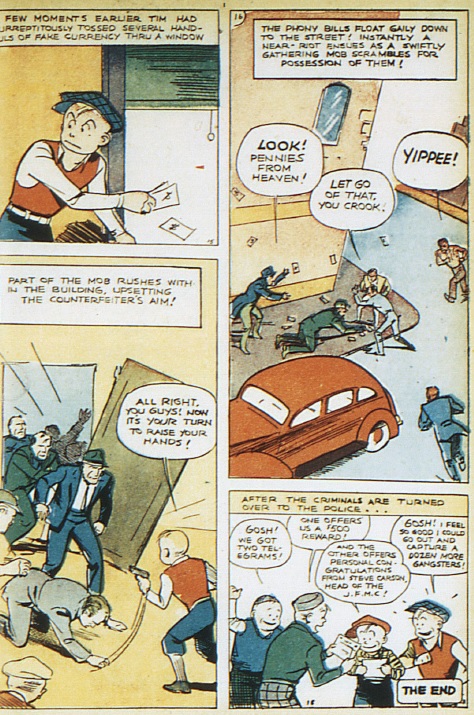
This month's Federal Men is again devoted to the Junior Federal Men Club (J.F.M.C.). This installment makes crime-fighting look like easy employment; no sooner have the police taken their prisoners then Steve Carson of Federal Men telegrams them congratulations, and another telegram promises them a $500 reward. This system could level up Heroes fast!


There are arguments for and against keeping track of ammo in a H&H gunfight.  A quick argument against: mundane "bean counting" runs counter to the fantasy elements of comic book action; a quick argument for: Cal n' Alec, counting bullets to know when their opponent's gun is empty.


Nadir has a magic crystal ball with an interesting limitation -- it can only be used between 3 am and dawn!  Time restrictions, race restrictions (like, only a merman can operate it), and items that can only be activated by destroying other items (like draining the magic out of lesser magic items) are all more inventive ways to keep a powerful trophy item from being too powerful, without saying it can only be used once per day, or it only has x number of charges.


What's this?  Nadir, Master of Magic, using guns! That's a big no-no for Magic-Users. But he's not really using them, is he? He's just holding them and, perhaps, planned to bluff his way through an encounter holding them, but wouldn't be able to hit the broad side of a barn with them.

I had a similar situation in an earlier H&H campaign, where a player wanted his Magic-User to carry a bow and arrows. He accepted that he would have no chance to hit with them in combat; he just wanted them for how he envisioned his character.


Another magic item, and this one's a new one -- Nadir apparently has a Ring of Alertness, that keeps him from being surprised.


Sandor encounters a lion here who treats him as if he already knew him. It's possible, actually, that Sandor had encountered this lion before and recruited it as a SCM, either behind the scenes or during some earlier installment I've forgotten or never got to read. An Editor can also, at his discretion, allow a player to make up SCMs from his backstory. The Editor must be careful, though, to consider the implications and how the Hero might benefit. Having a lion for a friend could be an unfair advantage over the other Heroes.

(Scans courtesy of Comic Book Archives)

Wednesday, August 12, 2015

New Adventure Comics #20

I didn't realize when I covered the October 1937 stories that I had access to New Adventure Comics #20, so I'm covering it just a tad out of order...

This page of Captain Jim of the Texas Rangers doesn't give us much of a sense of scale for that "gigantic" rattlesnake, but this could be the first giant poisonous snake in comics that isn't from a "tall tale"-like story.


This probably won't ever become an official Hideouts & Hoodlums rule, but if you ever miss a cowboy with an attack roll that's only 1 number off -- it should shoot off his hat.


There's a lot of grappling attacks going on here on this page. In some game systems, the player of Ian Murray would have to pick a different, specific grappling move each turn, each with different game mechanics attached to it. In H&H, the Editor has more latitude and is expected to describe the fight based on the dice rolls.  This seems to be a particularly vicious fight, so both sides must be rolling very well to hit and for damage...


There might be some exceptions I would make to my above statement, like in the case of a flip/throw attack, since this attack is unusual in that it leaves the opponent prone instead of held.


It's difficult to have a realistic rate of fire for missile weapons -- even for comic book realism -- and have any kind of game balance that would make Heroes reasonably choose melee over missile weapons. Here Ian cracks off 2-3 shots per combat turn with a single-shot rifle. Two shots would be possible if he was 4th level or higher in H&H.


This issue's installment of Federal Men is dedicated to the demonstrating the value of having half-pints as your Supporting Cast Members. Heroes like Steve Carson can recruit half-pints via ham radio! Half-pints loyal to Heroes are ever-vigilant for signs of crimes, and may be willing to put themselves in danger flattening tires and tripping robbers.


A history/technology lesson here from Monastery of the Blue God for anyone who had trouble picturing what a wireless radio looked like in the 1930s. This is not as portable as an iphone...


A patient Hero is just two lucky rolls away from finding the average secret door -- one roll to find the door and the second roll to find the way to open it. The impatient Hero, though (like Nadir, Master of Magic) finds the door, and then wrecks his way through it with a pick axe (using the non-Superhero wrecking rules, unless a Superhero obviously).


If there was a contest for best feature in this issue, The Adventures of Steve Conrad just won it. Behold the glory of natives riding trained alligators.

(Scans courtesy of Comic Book Archives)


Saturday, May 23, 2015

New Adventure Comics #14

Captain Jim knows that being caught in the path of a stampede is bad news. Rather than roll to hit for every horse in the stampede, I would require a save vs. plot to avoid falling in the path of the stampede and needing saving, followed by a save vs. plot to avoid death by trampling.


I just recently had a Hideouts & Hoodlums-related discussion of what people carried in their wallets circa 1940.  Sure enough, they carried business cards!

Detective Sergeant Carey and his co-worker know to come to a hideout prepared; one has a flashlight and the other has a hat -- good for sticking through doors and seeing if they get attacked (save vs. plot for mobsters to avoid getting fooled by that).


The most atmospheric stuff you can put in a scenario to make it spooky is the stuff you can't just fight. In the Gold Dragon, someone is clearly going around lighting candles in rooms behind their backs. Letting players worry about who they are and how many of them are doing it could be scarier than actually running into a gold dragon.  Or not...


This is from an adaptation of She that takes some liberties; I don't recall Haggard's She having actual magic powers, but She's definitely a Magic-User in this version.

Overcome Death must be a pretty powerful spell -- I would consider 7th level. You would never die from natural aging or grow old naturally if protected by this spell.

It's unclear what else she's casting. It seems like a powerful version of Crystal Ball, but maybe the reflection in the water is just a Phantasmal Force?

It seems pretty clear that She is casting Hold Person here; the nature of the spell being a gaze attack is likely flavor text.


In Federal Men, we see that disarming shots can be attempted even by half-pints.

(Scans courtesy of Comic Book Plus)