Showing posts with label Sandman. Show all posts

Friday, January 29, 2021

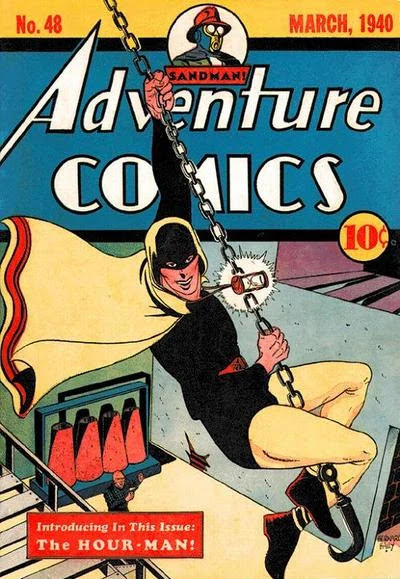
Adventure Comics #48 - pt. 2

And we're back with what I promised, a look at this issue's installment of Federal Men. In it, the FBI gets a hot tip that counterfeiters are working in Northville, and in an unusual way -- a fake $1,000 bill is mailed to them anonymously, but came from Northville. Of course, we're given no indication as to where Northville is but, since so many comic book stories have a New York City orientation by now, it stands to reason that "Northville" means somewhere North of NYC, so...maybe it's actually Albany? Or even Poughkeepsie? Ah well, it's all speculation...

The plot is one we've seen before and will see again -- the hero stumbles across a crime school where a professor (or professors) teach classes on forgery, safe cracking, and killing in exchange for a cut of future profits. This one is pretty expensive -- a complete course costs $5,000, plus 25% of your take for the first year. I would be really leery of allowing a real game mechanic benefit to this.

Steve Carson (our hero) disguises himself as a "tough" by smoking a cigarette, going without shaving, and possibly darkening his eyebrows. He's caught -- not because he looks just like Steve Carson, but because he gets fingerprinted and the Professor somehow has all federal men's fingerprints on file.

Fitting in with the dark themes at DC Comics this month, the deathtrap is a suicide machine -- you're strapped in, with a gun in your hand, and the machine makes you squeeze the trigger and shoot yourself in the head. Without wrecking things, it's a pretty foolproof deathtrap -- so the only way out for Steve is to have one of the hoodlums turn on the Professor and free him. The twist is that the hoodlum did it -- and sent the fake $1,000 bill to tip off the feds -- not out of any altruism, but revenge because he was about to be expelled.

By now, the Sandman has been downgraded from billionaire Wesley Dodds to millionaire Wesley Dodds. Wesley is shown smoking a pipe, and the Sandman carries binoculars for the first, if not only time, in this issue.

Dian Belmont is in love with Wesley already, if her letter to him is written honestly. Her father, the D.A., learns Wesley is the Sandman in this story and seems cool with it, even though the Sandman was wanted by the police in the past.

The Sandman is shown jumping safely from a second floor window. Should stunts be able to lessen falling damage? Maybe. Maybe...half damage per 10', per stunt?

The Belmonts own a Chris-Craft -- Chris-Craft Boats was an American manufacturer of boats that was founded by Christopher Columbus Smith. This page is a good commercial for them -- it's fleet, and can easily catch up to a yacht. 

When Sandman searches Judge Quick he finds a letter in a secret pocket. I'm not sure how you conceal a "secret pocket" on your person. A pocket inside your jacket certainly wouldn't qualify as "secret." Maybe it's sewn to the inside of his pant leg...? The letter is a major clue without even reading it, because it smells of one of the suspects' perfume. 

Sandman climbs a wine-covered trellis (it's called a ladder, but it's pretty clearly a trellis) to an upstairs window, which should be a basic skill check, maybe even with a bonus if the trellis is sturdy. Dian, the Woman in Evening Clothes (and that's including high heels, no doubt) climbs it right after him, and that's got to be an expert skill check.

In one panel, the gas from his gas gun is referred to as "deadly."   

In Socko Strong, Socko is trapped in a deathtrap underwater, but he finds a trapdoor that serves as the drain for this pool. It feeds to an underground stream and Socko is swept into it. He emerges, "finally," on the bank of a river. But how long was he underwater? Were there pockets of air for him, or did he hold his breath the whole time? We're not told, but those details can mean life or death in a realistic campaign. 

The next day, while shooting a film, the guide wire snaps on a heavy arc lamp, and the lamp is about to fall on a small girl. "The entire group all stands motionless in frozen horror -- except for Socko..." Now, there's two possible explanations for that. One is that, as the only Hero present on the scene, the Editor is making sure none of the other characters on the scene can upstage him. Or, the Editor used surprise rolls to determine if anyone was surprised by the falling arc lamp, or perhaps Socko surprises the falling arc lamp, giving him even more time to act.

In an interesting twist, the father of the girl was paid to kill off Socko by sabotaging his parachute for the next scene to film. Doing the good deed pays off and saves Socko.  

(Read at readcomiconline.to)


Friday, July 19, 2019

Adventure Comics #47 - pt. 1

It's been nine months since I've last covered the early adventures of the Sandman! This is what happens when I cover so many titles, in such detail...

This story opens with a newspaper article detailing a murder the Sandman is about to investigate. The article is signed by Ogden Whitney, who's been drawing this feature since last issue. Ogden is good, but Bert Christman and Craig Flessel were just that much better...

I'm not surprised that Wesley Dodds was friends with the dead man, as Wesley has one of the richest backstories of early comic book heroes and knows practically everyone. Gardner Fox is starting to tinker with that backstory, though, changing Dodds from a billionaire to a millionaire. And this is the issue where he gives Wesley is his first partner. Being big on strong, equal female partners, it is hardly surprise that Dian Ware is an expert safecracker and resourceful enough to have learned or deduced the Sandman's secret identity (though it's never revealed how). Known as "The Lady in Evening Clothes," Dian even sounds like a mysteryman (or a Victorian one).

The murder weapon is a Corson repeater. I can't find any evidence that's a real thing, but I'm fine with that. I was way too specific about firearms in 1st edition Hideouts & Hoodlums and pulled back from that in 2nd ed.

Sandman still shows some willingness to act in a Chaotic manner, gassing the District Attorney when he won't cooperate and give the evidence back that Sandman already gave to him.

In a firefight with two mobsters armed with sub-machine guns, we see simultaneous initiative, with Sandman gassing them just as one of them shoots Sandman in the shoulder. We also see that Sandman has no control over who is knocked out within the area of effect of the gas, as Dian goes down too. Sandman is weakened by his injury, gradually losing consciousness, which is not a condition covered by the rules, and it takes him a week to recover (players can thank me ignoring this in the rules later!).

Trigger, the killer, is held on $1,000 bond, but for breaking and entering (the police haven't nailed him on murder yet). 

When Sandman confronts Black Bill, Trigger's boss, he mentions Bill isn't as fast as he used to be (more of that backstory I enjoy so much).

Sandman is still not widely recognized on sight; District Attorney Belmont's butler doesn't recognize Sandman by costume until Dian introduces him.

Belmont has three detectives on guard duty in his house, all armed with sub-machine guns. Surely they are not there full-time, but I don't know how Belmont anticipated Sandman coming.

In a nice twist, Dian turns out to be D.A. Belmont's daughter. Unfortunately, as soon as this happens she is "domesticated" and never shows her safecracking skills again. That Wesley falls for her is evident in that he lets her take off his mask and kiss him where her father might see.

Moving on to Barry O'Neill...I'm not sure when Barry went from assisting the French police to working with French espionage, but it seems to have been a gradual transition.  Of course it starts in Paris, because all adventures in France feature Paris. The Village of Vereux is misspelled as Veraux (intentionally?), while Polmere seems entirely fictional.

Barry is able to win initiative against the fake Inspector Le Grand, despite the fact that the doppelganger has a gun trained on Barry's back already; more proof that facing is of little importance for Hideouts & Hoodlums. The doppelganger must have had only a superficial resemblance to Le Grand, as he had to wear a partial face mask to conceal the rest. That the doppelganger is known as Number 37 by his fellow spies suggest that there are at least 37 spies in this spy ring.

Barry scores a direct hit with a grenade and blows up a building. Area of effect damage does not normally need a direct hit, and certainly doesn't for damaging structures. This may be only flavor text, describing how Barry rolled really well for damage.

The spies' car has a concealed radio transmitter in it, which is something good to add to the add-ons list for transport trophies.

(Sandman story read in Golden Age Sandman Archives vol. 1, the rest read at readcomiconline.to.)

Tuesday, October 30, 2018

Adventure Comics #46 - pt. 1

This month's Sandman feature teases out more information from Wesley Dodds' past; now we know he was on a rowing team at university -- without any clue as to which university, or when (though it was likely '32 or earlier, since we know he was piloting in '33).

The Sandman keeps his costume in a trunk in a closet. He owns at least two cars -- which makes sense for a billionaire, and we know the license plate on one is B7501. He carries a pocket light in this adventure, in addition to his gas gun. The gas gun is shown to have a range of at least 15'. He also still carries a pouch of sand to scatter as his calling card.

On the scene of his old college roommate's death, Sandman makes a basic skill check to spot blood on the floor, a basic skill check to hide in shadows (in some situations this would be an expert skill check, but it's in a living room with lots of furniture), and when he (apparently) fails a pick locks check, he simply removes the locked door from its hinges.

The murder suspect fails to recognize the Sandman on sight and calls him "mystery man" instead (she knows his Hero class!). The Sandman hints that he might resort to torture on her to find out what he wants to know, but he shows no sign of following through on it. She honks his car horn, summoning a policeman, and it is true that making extra noise can trigger sooner wandering encounter checks. In the end, her intuition tells her she can trust him and he buys her story -- sense motive skill checks?

At the Coin's lair, the Sandman is able to shoulder open a (apparently) locked door. The Coin sounds like a cool name, but he turns out to be a rather ordinary counterfeiter, his only gimmick being cross-dressing as an old woman for a disguise.

Barry O'Neil is still trying to rescue Jean Le Grand from lions. A lion claws at Barry, but only shreds off his shirt. There is a rich history of pulp heroes being men in torn shirts -- should there be a rule about losing your shirt to soak up damage? If so, I would only implement it for flavor and allow it to soak up no more than 1 point.

The lions (there were three) do not all attack Barry right away; something important to remember about Neutral mobstertypes is that they do not have to want to attack, or even continue attacking from turn to turn. Encounter reaction checks are just as important as morale saves for determining this.

In typical racism of the times, Fang Gow's Chinese followers seem unable to identify a plane on sight, with one of them calling it a "great bird."

In unusually tough odds for an early comic book adventure, Barry finds their escape next blocked by at least 16 bloodthirsty/yellow peril hoodlums, and naturally he is captured.

Fang Gow's castle is said to be 50 kilometers south of "Dyon" France, which probably stands for Dijon, France. That puts them somewhere in the SaĆ“ne-et-Loire department in the region of Bourgogne. Inspector Le Grande plans a rescue mission made up entirely of non-Hero characters, which is spotted by a lookout on its way to the castle. Fang Gow has the bridges leading to his castle dynamited and rings the castle wall with machine guns, but his sentries fail to spot Le Grande and his men scaling the castle walls under cover of darkness. A terrific battle ensues, which must have been incredibly boring for Barry's player, as he has to sit it out and be rescued only once it's all over. Fang Gow, of course, uses an escape tunnel and gets away.

(Sandman story read in Golden Age Sandman Archives; the rest read at fullcomic.pro)


Wednesday, February 14, 2018

Adventure Comics #45

The Sandman's starts with him sneaking into a nightclub to investigate the rumors that the popular singer is being threatened with abduction; he overhears that this is a ruse concocted by her manager while concealed in her wardrobe. The Sandman's player doesn't have to make a skill check to hide because he's clearly out of sight. Now, if Gloria had opened her wardrobe, then the player would need to make a skill check to remain hidden (or rely on the Editor's surprise rolls).

Now, some heroes would just beat up her husband at that point and leave him for the police, but The Sandman has only heard the confession; he has no evidence of it. So he abducts Gloria and tries to force a second confession out of her. It's interesting that she does not recognize The Sandman by his distinctive mask, but only by the handful of sand he shows her as a clue. Mystery men may only be recognized by their calling cards, then, unless the non-Hero makes a save vs. plot.

For the first and only time, The Sandman is seen working with a Japanese servant named Toki (an actual Japanese name too!). It is unclear if Toki is one of Wesley Dodds' many employees (the man is a billionaire, after all) or if he works for, or is simply helping The Sandman. The Sandman's hideout is referred to, but we only see one room of it (it looks like a bedroom).

The Sandman cracks a combination lock, probably as an expert skill. We also see that he wears a wristwatch under his glove.

The story is incredibly confusing, being condensed into too few pages. The husband, Rendle, is up to more than Sandman had first guessed. At Rendle's office, Sandman has to face off against two hoodlums and what appears to be a corrupt beat cop. One of the hoodlums is armed with a Tommy gun; he misses Sandman at close range before succumbing to Sandman's gas gun (evidence of how hard it is for a low-Hit Die mobster to hit a target). Pursuing Rendle to a steamer ship which Rendle plans to use to skip the country, Sandman is briefly stunned by being clubbed over the back of the head, but recovers quickly (something I had to account for in the mechanics of 2nd edition).

Barry O'Neil, in his story, appears to have finally outlived Fang Gow (who is shown on his tombstone to had lived to be 69). Fang Gow's age could be as fake as his death, though, as he had apparently taken a Potion of Feign Death and is revived with an Antidote Potion. Meanwhile, Jean Le Grande has been the victim of an extremely slow-moving deathtrap -- a plant has been given to her that attracts a certain type of bug with a deadly bite. Patient hoodlums have to wait until, via proximity and coincidence, she happens to get bitten while tending the flower (maybe a save vs. plot each time she watered it?).

To search for Fang (after finding out he was still alive), Barry flies over Paris and the surrounding countryside for hours, looking for places that look like hideout cliches -- like old castles -- and spying on them with binoculars. Of course, he's lucky that Fang did not go underground, or simply stayed indoors. Unluckily for Jean, Fang is outside watching three lions in his courtyard play cat and mouse with her. I'm not sure how Barry is going to defeat the lions next issue, but I can hazard a disappointing guess that he's going to shoot them all dead.

In Federal Men, a racketeer named Rutska kills a man and only has to pay $5,000 bail. After he kills again and skips bail, the unnamed city this takes place in offers a reward for $25,000 just for information that will lead to his arrest.

Rutska uses a zip-line to escape from the rear window of his boardinghouse hideout, but dies when the line breaks and he crashes into a telephone pole. This could be a good trick for Heroes, zip-lines that have a 1 or 2 in 6 chance of snapping under a full man's weight.

Socko Strong's story begins with a wrinkle on the amnesia cliche: Socko is hit by a car and gets amnesia, but the gamblers who rescue him don't know it and tell him who he is right away. The gamblers aren't evil, but slick opportunists and convince Socko that he had already promised to take a dive in his next fight, for altruistic reasons (skirting the issue of whether amnesia can alter Alignment nicely).

In a virtually unprecedented move, Biff Bronson from More Fun Comics guest stars in this story. Biff and Socko turn out to be old friends and Biff removes the amnesia by punching Socko unconscious (the story goes to great pains to establish how evenly matched they are in the boxing match until Biff sucker-punches him.

Captain Desmo's adventure in India involves "natives" again, though these well-armed natives defy the traditional stereotype. This scenario is different than usual because the natives are a complication rather than the main adversaries; Desmo has to deliver a serum for cholera to a besieged outpost.

Skip Schuyler, while exploring the Arctic, takes a 20' fall, but because he lands in snow he is "shaken, but unhurt." 


(Sandman story read in Golden Age Sandman Archives, the rest read at readcomiconline.to)


Tuesday, February 7, 2017

Adventure Comics #44 - pt. 1

The Sandman makes a reference to growing up in Hilltown. There is a Hilltown Township in Pennsylvania, corroborating my growing suspicion that the Sandman is based out of Philadelphia.

The Sandman calls his butler "Feathers."

After being shot by The Face, The Sandman has to spend a week convalescing/healing.

The Sandman can pick a lock.

The Sandman's gas gun has a range of at least 10'.

In an interesting twist, the Sandman's best lead in finding the face is that his costumes are too authentic. He's able to find his costume supplier and track down The Face from there. It's an interesting angle that is largely forgotten in later stories with disguise villains.

For the only time ever, The Sandman deliberately murders a foe.

Fang Gow returns to harass Barry O'Neill -- mainly because Barry was floundering for direction without his nemesis, I'd guess. Gow has invented a potion of wax transformation that seems to be permanent, or at least has a very long duration.  The potion is administered by syringe, and in 2nd edition H&H will clearly specify that potions do not just have to be drank.

Gow has some new real estate, operating out of a French castle, but he's so confident that the main entrance only has one guard! Maybe the rest were just on their coffee break, because a "horde" of yellow peril hoodlums are available for Gow to summon later.

The Federal Men story starts with Steve Carson getting a lead on a case, then not getting any further with it for months before a second plot hook comes his way.  The smuggler's hiding place is a nod to the Sherlock Holmes story, "The Adventure of the Mazarin Stone."

The Socko Strong story gets a much easier start, with Socko showing up for a photography assignment only to, luckily, spot the person he'd come to photograph tied up through the basement window. Why the thugs abducting the young man would leave him within sight of a window facing the front of the house is beyond me, but without it Socko would never have known something was up and there would be no adventure. So, either Socko has to roll to spot the victim through the window, or he's a plot hook character and is automatically encountered.

The Captain Desmo story is stolen from "The Most Dangerous Game," perhaps the most-stolen story ever. Count Ogreoff has ape-men following him.  Desmo is pretty ruthless with offing Ogreoff's ape-men, pushing one off a cliff and rolling a boulder over the others. I think I've covered pushing in previous blog posts -- but, to review, pushing off a cliff requires a failed save vs. science after a successful attack. Rolling a boulder takes a save vs. plot to get a boulder rolling, with a cumulative -1 penalty for each person you expect the boulder to hit (and then each of them gets a save vs. missiles). Desmo is attacked by a constrictor snake before the second wave of ape-men. The second wave switches tactics and overbear him with numbers, assigning a cumulative penalty to his saving throw vs. science for each successful hit on him.

(Sandman read in Golden Age Sandman Archives, the rest read in summary at DC Wiki).


Friday, December 30, 2016

Adventure Comics #43

I don't have access to anything from this issue but the Sandman story. So here's to a short post!

The Sandman is vacationing in the South Seas. Granted, when you're a billionaire you probably can just hop in a plane and do stuff like that, but it seems an unusual player choice for a character supposedly motivated to stopping urban crime in the States. In fact, it strikes me as a scenario where the player didn't get to choose, but had an introduction prepared by the Editor that sets up the scenario.

Wesley, interestingly, keeps an ordinary gun in his plane for protection. Which would make sense if he was looking to conceal his secret identity, but he also has his mask and some gas bombs in the plane, so...

Wesley doesn't seem to have any regrets over the two natives he shoots and presumedly kills in this story. He gets involved when he sees a house with 14 white people in it surrounded by 200 hostile natives. On the plus side, he doesn't go in with guns blazing and kills more natives. Instead, he drops flares and gas bombs from his plane to confuse the natives and shake their morale. Which makes sense and is good tactics...but with this kind of story, you just know he has to land afterwards and try to pass himself off as a god to the superstitiously naive natives. I suppose you could attach game mechanics to this with encounter reaction rolls...or maybe this is tied to their morale failure. "Sure, sure, we'll say you're a god -- just stop dropping flares and gas bombs on us!"

A girl Wesley rescues in this story -- the plot hook character who leads him to the besieged house -- is named Australia. I can't help but wonder if there is some implied geopolitical allegory to this story, but I'm too ignorant of Australian history to know.

((Sandman story read in Golden Age Sandman Archives.))


Monday, October 31, 2016

Adventure Comics #42

The adventures of The Sandman continue, and he's got to have one of the best fleshed-out, yet little-known, backstories in all of early comic book history. Here, we learn that Wesley Dodds was in the U.S. Navy Air Corps as of 1933. We also get backstory SCMs for Wes -- Dr. Clyde Dunlap and "Happy" O'Shea. Supporting Cast Members can be assigned like that by the Editor as a story demands, though players should be discouraged from just "saying" they have old friends they can call on for help.

In this case, Clyde and Happy even know about Wes being The Sandman. It does not seem to be implied that the Sandman identity extends back to '33, so they likely learned about it from him sometime since then.

Wes, Clyde, and Happy all have access to fighter planes. Wes is a billionaire in his backstory, but has likely not had time to accumulate the $20,000+ he would need to purchase a fighter plane in game play. This has to be another hand-out from the Editor for this scenario.

The scenario has the three good guy fighter planes up against four bad guy biplanes. The good guys start out with the advantage of surprise and use the aviation stunt Out of the Sun against them. They immediately fail their primary objective, though, to protect an eighth plane in the air full of innocent passengers. Luckily, the passenger plane has more hit points because it only goes down from complications, while the biplanes are weaker and crash violently instead.

Hideouts & Hoodlums will, eventually, be able to play out a scenario just like that.

Wes has a gas bomb -- different from his gas gun -- that he uses for the only time in this story.

In Barry O'Neil's adventure, he uses not one but three aviator stunts -- Wing Walking, Deadstick, and Improvised Landing.

Then Barry picks up a crate and hits two thugs with it at once -- not possible by the H&H rules, unless these are actually weaker hoodlums instead of 2 HD thugs.

Barry passes up the chance to search Krull's ship for loot by blowing it up with mines first. The scenario kind of demanded it, since other ships were in jeopardy, but Barry's player might be ticked off about that.

Socko Strong meets an ape-man (that's getting a stat entry in 2nd ed.) and sails to its lost world island. The lost world seems, for some reason, limited to a valley on the island that you have to climb a cliff and cross a fallen tree over a gorge to get to. The valley is somehow big enough to support both a tyrannosaurus rex and a stegosaurus with food. Both of these dinosaurs will likely be left out of the basic book, for being just too big and dangerous.

Captain Desmo and Gabby are up against cultists (also getting an entry in 2nd ed.). probably with thugs and assassins (another 2nd ed. add) mixed in. The bad guys have a simple deathtrap for Gabby, tossing him into a pit full of cobras.

Anchors Aweigh puts Don and Red in an unusual situation; they find themselves in an unbeatable scenario, if the scenario is wrongly interpreted as a "save the ship" scenario. The torpedo is too close to the ship for them to do anything about, so this is a survival scenario -- at least initially.

Don and Red meet Admiral Cato, our first bonafide Napoleon character (we've seen some mad scientists so far with Napoleon complexes, but they all fit the mad scientist mold better). From the summary I have to read, I don't know what all of Cato's weapons are, but some of them appear to be poison gas bombs.

Don and Red can't figure a way out of this underwater lair they are trapped in, so they come up with a rather clever plan. After sabotaging the oxygen supply for the hideout, Cato's henchmen fail their morale saves and offer to come up with a way out of the hideout for them.

Sometimes the bigger picture of world war is just going to be backdrop for your H&H stories. The Skip Schuyler story takes place in a Chinese city just as it's being bombed by the Japanese -- but the story doesn't really have anything to do with that. The scenario starts when Skip rescues a boy who serves as the plot hook to uncover the kidnapping of an American reporter. The reporter has a guard guarding her (guards were statted in the first H&H module and will be in 2nd ed. too).

Rusty, of Rusty and His Pals, is menaced by yellow peril hoodlums serving a Fu Manchu villain. Fu Manchu is guarded by guards, but Steve -- Rusty's adult pal -- shows up, makes his save vs. plot, and is able to ignore the guards and go straight after the Fu Manchu villain, Chen Fu. Steve still loses, though, and is placed in a complex deathtrap. He's tied on a plank over a pit full of metal spikes, with a pendulum blade swinging down at him from above (I presume Steve is under the plank and the pendulum  blade is to cut the rope and drop him in the pit, though the trap seems like it would work just as well if Steve was on top of the plank and the blade is coming down to cut him).

Cotton Carver has to rescue his friends when they are kidnapped by cultists and taken to be sacrificed. Cotton tracks them through a forest and starts shooting the cultists, but his friends still get dumped into a pit with water in the bottom. He dives in and they all get sucked by an undertow into a subterranean cavern that opens to the sky (? -- hollow world settings confuse me). The "god" of the cultists is a brontosaurus. Like the earlier dinosaurs mentioned, this is way too big and dangerous for the basic book. And yet...Cotton somehow kills it by catching it in a grass fire. Infused with massive amounts of experience points, Cotton and his friends enter a kingdom defended by medieval-esque knights. Do knights need to be their own mobster type?

(Sandman story read in Golden Age Sandman Archives, summaries of the rest read at DC Wikia.)


Monday, October 3, 2016

Adventure Comics #41 - pt. 1

There's a bit of controversy over the second Sandman story in this issue. The Sandman pulls a mobster underwater, beats him up, and then we never see that mobster again. The author summarizing stories for DC Wikia believes that Sandman must have drowned the man, making this the Sandman's first kill (despite the narrator's claims that the Sandman has never committed a crime). Thank goodness I had access to The Golden Age Sandman Archives to corroborate these things! I don't think any definitive conclusion can be drawn from that page. We never see the end of that underwater battle. For all we know, before the Sandman surfaces again, he leaves the mobster safely unconscious on a nearby dock.

When Sandman does resurface, the girl he's rescuing says she's "heard a lot about" him, which seems unlikely if this is only his third mission ever. Like with the magic-users and superheroes we've seen so far, there is ample precedent for allowing Heroes to begin with more than 0 xp, or even whole "brevet ranks" (called "big bang levels" in Supplement V).

The Sandman spends much of this adventure out of costume -- retaining his gas mask, but otherwise wearing only a bathing suit and a shoulder holster for his gas gun. At some points he is wearing a coat and hat over his bathing suit. Mysterymen do not seem to need to always be in costume as much as superheroes do.

Barry O'Neill, in his adventure, is in Tunisia -- a welcome departure for me from the habit of creating fictional countries (a personal pet peeve of mine).  Cecil Krull is a great villain name -- too bad it was just an alias.  "Cecil" is a spy, but we already knew spies needed to be a mobster type.

Steve Carson of Federal Men has been slumming for awhile now, but it seems like Jerry Siegel decided to go all out for this issue. An entire town dies, strangely, during a snowfall -- raising the stakes from Steve's recent adventures of stopping crooks. Mobrune is a prophet-like figure who predicts other towns will be hit by the killer snow to be purged of wickedness. As those towns are later hit, Mobrune grows a cult around him (making me wonder if cultist should be a mobster type). Mobrune is actually using a poison gas that is catalyzed by cold air, and the snow is just incidental. A bit bloodthirsty for my liking, but otherwise a plot!

Two of the benefits of a Western campaign (the same with many fantasy campaigns, really) is that a) a trope of the genre is that the Hero is always moving and, b) in a remote environment, any encounter is worthy of description. Which is good because, under normal circumstances an old man looking to go home to see his son -- as Jack Woods meets -- would not seem like much of a plot hook in a busy city.

The bandits Jack Woods meet do something interesting and different -- they just let Jack go, trusting that they've intimidated him enough that he would stay away!

Speaking of different, Socko Strong and his friend Jerry Indutch are shipwrecked on a primitive island but, instead of focusing on getting off the island, Socko and Jerry form ties to the islanders and seem ready to settle down! Socko wins a job as a bodyguard and Jerry has eyes on the chief's daughter. That's creative, proactive roleplaying! The natives use poisoned spears, so the native mobster type needs a 1 in 6 chance of having poisoned weapons.

Should a film projector be a trophy item? Hmm...

Captain Desmo and Gabby are dealing with thugs - the Indian thugs (or Thugees) the word originated with. These thugs are treated as natives, swarming over an Indian city (a fictional city? I can't find a real Jeddur). Since the natives have a huge number advantage, Desmo "has" to resort to wiping them out with a grenade, and the cliche of cutting a primitive bridge over a chasm.

(Sandman read in Golden Age Sandman Archives v. 1, the rest read as summaries at DC Wikia.)


Friday, August 12, 2016

Adventure Comics #40

We've already seen The Sandman once, but here he is, debuting in his regular berth for the first time, Adventure Comics. There's a delightful slow build to the story after Wesley Dodds gets his plot hook. He spends some time mulling it over, while lounging in the dark in his smoking jacket. We meet his butler, Humphries. We get some unusual insight into Wesley's character, when he puts a doll representing himself in his bed, as if psychologically transferring his identity before becoming The Sandman. Before The Batman, The Sandman is the first crimefighter to have a secret underground laboratory (but not an underground lair; that would The Clock).

The Sandman is shown mixing his own chemicals for his gas gun. Last time, I said I was comfortable not giving Sandman levels in the Scientist class, but here he really does seem to be earning at least one level.

There's also a very interesting caption about color. "Then he dons all black apparel", the caption says, yet The Sandman is wearing yellow gloves, an orangish- tan coat, and a purple cape. It seems clear that authors had little input on the coloring of their own characters; the caption was overruled, but the wording was left there anyway.

The Sandman uses stealth (move silently?) to sneak around unobserved, climbing to get to an upper story window, and finds a secret door.

Another interesting detail is that the smell of his sleep gas reminds its victim of violets.

In Barry O'Neill's ongoing adventure, he has just been doused with gasoline and Count Guniff is about to light him on fire - but it turns out he had the wrong bucket and that was just water. A little help from the Editor, or game mechanics? I have had a player suggest the save vs. plot should work like that, with the player suggested an alternate explanation and allowing the player to roll for it. I'm personally opposed to giving the player veto power over the game Editor...but that does seem to be a reasonable explanation for what I've read here...

Steve Carson of Federal Men has fallen far from taking on giant robots to being knocked unconscious by two counterfeiters, one hitting him with a block of wood. I do envision Hideouts & Hoodlums to be a game that can move effortlessly between challenge levels. Maybe I shouldn't be entirely opposed to hoodlums having a special ability of "backstabbing" Heroes for additional damage, and a quick knockout...

Bulldog Martin is overpowered by three thugs (a pretty tough encounter for a solo, low-level Fighter!), but escapes from being tied up by rope by carrying a nail file on him. He foils a plot to murder a racehorse with a fake camera that can shot a poison needle (trophy weapon, but pretty useless to a Hero if you don't allow them to use poison).

Skip Schuyler is in Hawaii, helping a scientist who has made tiny explosives with the power of artillery shells. We also see a good hiding place to search in a scientist's house, the inside of a lampshade.

Rusty and His Pals is at a climactic scene rarely seen in comics -- an earthquake is destroying the island the whole scenario is taking place on, there's a single seaplane that can get people off, and various factions are racing to get to it. One could make a board game out of this scenario. Combat plays a minor part, but it's movement rate that really wins the scenario here.

Anchors Aweigh is on a new scenario. Don and Red get captured by thugs (that seems to happen a lot -- thugs are tough!) and are left in an uncommon deathtrap -- an island that will flood when the tide comes in, and then sharks will show up. They're tied up so they can't swim away, but escape using the old "focusing light with a pair of glasses". I don't think we need an escape artist game mechanic; rather, any idea you come up with to get out of ropes should just automatically work.

There's also an octopus -- and a normal one, not a giant one!

(Sandman adventure read in Golden Age Sandman Archives vol. 1; summaries of the rest read at DC Wikia.)


Thursday, July 14, 2016

New York World's Fair #1

It's June 1939 and the New York World's Fair is making the rounds in a lot of comic books, but none made especially for the fair like this issue was.

Superman visits the World's Fair. Being mid-1939, Clark Kent is still a Cleveland, Ohio reporter writing for the Daily Star, but he's a veteran correspondent on three continents already.

Superman demonstrates his leaping ability in this story, uses the powers Hold Train, Raise Building, Raise Car (to uproot a tree), Race the Bullet, and Outrun Train in that order.

"Chuck Warner Goes to the New York World's Fair" is interesting in where it focuses, not on famous landmarks from the fair, but the less known presence of track and field events at the fair. Unless I hear a lot more interest soon in the sports genre of early comic books, though, I don't plan on including any new game mechanics for racing or high jumping. These can all be lumped into a static skill roll, where you have a 1 or 2 in 6 chance of doing slightly better than the person you're competing against.

"Hanko Goes to the World's Fair" is a tall tale story that has Hanko's horse tightrope walking from the ground to the top of the Trylon and then he and his horse falling safely from the top of it. This reminds me of Dell's Pecos Bill strip, another tall tale hero I ignored when I went through those issues -- though maybe I shouldn't have? There's nothing in the description I just gave that couldn't be explained away by superhero powers. And a cowboy costume could be a distinctive superhero uniform in modern times. So maybe tall tale cowboys are actually early examples of the superhero class, if not the genre?

I've not been keeping track of how many times I've seen a hoodlum slip out of a hold by slipping out of his coat, like one does in the Scoop Scanlon adventure here. As common as it is, maybe it should be a special move for slick hoodlums?

Slam Bradley and Shorty Morgan visit the World's Fair and get a poison dart thrown at them for their trouble. Heroes will not be allowed to use poison, but there needs to be clear rules for villains' use of poison. Poison will often be potentially lethal -- like the save or die variety -- though death does not need to occur right away. And there will be ways of countering poison (magic, antivenom, sucking out the poison,...).

Someone tries to pick Shorty's pocket too. Picking pockets is a static skill (those skills will not be totally static in 2nd edition, they will just improve slowly). If it fails, roll surprise normally. If the would-be thief failed but still has surprise, the attempt was not noticed. Otherwise, the attempt is noticed.

Slam finds a secret compartment in a fireplace. Even though he knows where to search, he doesn't know what he's looking for, so he has to roll to find the secret compartment (like searching for a secret door). Though, since the fireplace is such a small area, I would also be okay with giving him a +1 or even a +2 situational modifier on his roll.

The Sandman's debut adventure I wrote about previously here.  I'll add some notes here, though.

It doesn't really matter if you want to say your brand new hero is a millionaire or a billionaire -- you'll still have the same starting money and all the rest of your money will be tied up in investments, long-term bonds, or somewhere else where you can't touch it during game play.

The Sandman is said to be an inventor in this story, but his raygun is only a plot hook, not something he ever uses. I'm comfortable with skipping giving him levels in Scientist.

There's no game mechanic right now for Sandman's "queer intuition of danger". I would treat that as a failed surprise roll by the other side, had anyone been actually trying to attack him. Instead, he just seems to sense something amiss is about to happen.

Sandman uses his gas gun several times, but we never see it affect more than two at a time.

The Zatara adventure presents some interesting posers. When Zatara and Tong are falling and Zatara catches them with a "magic stair-case" -- what the heck is that? A Mass Fly spell? Or am I literally to take this as a Create Stairs spell? No, maybe it is Mass Fly, because he uses that spell for sure a few pages later.

Zatara uses some sort of illusion spell to make it appear that he drinks a punch bowl full of liquor. He casts a Mass Reduce Persons spell that shrinks three people at a time down to six inches tall.

Zatara casts a spell on himself that renders him heavier than lead so he can't be knocked off his feet. Instead of doing the same thing for Tong, he turns Tong to stone. I bet Tong said "Gee, thanks a lot, boss!" all sarcastic after that one.

Zatara appears to conjure a private train, but maybe that's just a coincidence that it shows up when it does.

Zatara casts a spell that makes a soldier go "up in smoke". Disintegrate? He also casts Bestow Curse, so that anything a man puts on becomes rags.

He uses his now-familiar spell that polymorphs weapons.

He casts a Mass Telekinesis spell to move two people into the air.

He casts Enlarge on himself, supposedly until he's a mile tall, but I'm not buying that, Zatana! I bet you're 25' tall and just exaggerating a whole lot.

(Read in DC Rarities Archives)