Showing posts with label hidden lands. Show all posts

Wednesday, April 4, 2018

Fight Comics #1 - pt. 3

I somehow skipped this page of Kayo Kirby last time, even though there's something rather interesting here. In the consummables subsection of the trophy section, there should be an entry for adrenalin, with the benefit being that it gives you 1-6 bonus hit points temporarily.


This is the unfortunately named Kinks Mason. Kinks is a test diver, wearing a new kind of diving helmet, when he gets caught in an apparently supernatural undertow that pulls him deep underwater (supernatural because, just panels earlier, he announced he was only two fathoms, or 12', deep).

Here we find it's pulled him into a lost world setting that's a bit unusual, being in an enormous air-filled grotto deep underwater. The barrier of sunken ships blocking the entrance serve as a nice transition between worlds.

A carnivoplant looks a lot like the creeper vines I introduced in first edition.  This is a large, maybe even a huge creeper vine and with 5 vines I would give it 1-3 attacks per turn.

The phosphomites are tougher to stat. They look like giant sea urchins, so they probably do sea urchin-y type stuff in battle. They appear to be helping Kinks, but maybe they are just a wandering encounter that turned up in the middle of combat and attacked a random party.

The goor are definitely non-humans, though I don't see any particular way to stat them except maybe as orc substitutes. It's interesting that the first of the Gor novels, Tarnsman of Gor, is 26 years away at this point.


By virtue of having rescued a princess (I guess) of the Procono people, Kinks is suddenly an admiral leading their navy. The navy rid on the back of giant "tauserus", which look vaguely like large Plesiosaurs, and are big enough to have tank turret-like structures mounted on their backs (though it's not clear how they keep from falling off...unless the tanks are somehow grafted to their skin...?). Anyway, that's a pretty powerful navy for a 1st-level fighter to be leading!

Note the map showing, roughly, the layout of this hidden realm.

Granted, Kinks did put himself at considerable risk in that scenario, so giving him the chance to leave with all the gold he can carry may seem like an okay reward. Gold was worth $34 per ounce in 1940, so if he left with 50 lbs, that would be over $27,000 -- way more than he needs to level up. So, it's really up to the Editor if he wants Kinks' player to have that much this soon...


This is Big Red McLane, and I love how all he has to do to get a job in 1940 is to put up his dukes. I think that's how we know Mr. Farlow is a plot hook character instead of a random character who would have rolled on the encounter reaction chart for this job interview. "Oh, no experience? (*rolls*) Don't call us, Mr. McLane, we'll call you."


Here I'm stuck wondering a couple of things. Is cutting down a tree so that it falls on someone an attack, or a trap? Does the lumberjack roll to hit (attack), or does Big Red roll a saving throw (trap)? And either way, how much damage should a tree falling on you do? If falling does 1-6 damage per 10', is it safe to assume that a 60' tall tree should do 6-36 points of damage?


Big Red is certainly a capable fighter. He appears to be making two attacks simultaneously each time, which is odd. In the first battle, when everyone is fighting unarmed, then Big Red is entitled to two attacks, but I don't think my rules let him split them between targets like that. And in the second battle, when people are using improvised weapons, that should slow the combat down to 1 attack per turn (oh...unless improvised weapons should not count against that -- I like this idea, because it allows barroom brawls with the occasional chairs and bottles to proceed at the same pace).

Note that Big Red can hit hard enough to knock his opponents prone. The punching rules don't account for that yet (unless these gangsters just happened to have 3 hit points or less), and it's something I'll have to work on (maybe for a future supplement, unless I accumulate enough material to need an Advanced Hideouts & Hoodlums Editor's Guide someday).

(Scans courtesy of Comic Book Plus.)


Friday, March 23, 2018

Jungle Comics #1 - pt. 2

We return to check on Tabu today. We see him perform some tree climbing so uncanny that I hesitate to say that could even be done in Hideouts & Hoodlums as an expert-level skill; that is more likely the power Wall-Crawling in action.

Jungle Torment might be a magic-user spell in the making here. For the duration, up to 7 targets cannot rest and must make morale saves each turn. Seems like a good 1st level spell to soften up opponents.

Still going easy on them at first, Tabu decides to use Gust of Wind on their torches. Then he starts to get serious and lets loose with Insect Plague, a 4th level spell. Insect Plague hasn't made its way into any H&H product yet, but you can bet it'll be in the AH&H Heroes Handbook whenever I'm done with that. It will do continuous damage to whoever is caught in the swarm, so either these explorers have really good hit points or they escape from the swarm pretty quickly.

Since that pool of slime looks like green slime, I'm very tempted to include green slime now in the AH&H Mobster Manual (now in progress!).

It's unclear if this tiger is huge, in the sense that it has extra Hit Dice, or it just looks huge to someone when it's advancing menacingly on you in the wild (I'd probably think it was huge too!). Apes and tigers have both already been statted for H&H.

It's harder to say what's going on here, since we can't see where these paralyzing thorns are coming from. Is there some monstrous form of plant life that should fire paralyzing thorns? Or should this be a new spell? Or are the thorns simply flavor text for a Mass Paralysis spell? I'm leaning towards the first option, simply because there is not a lot of plant life you can fight in H&H compared to animals and people.


I'm going to have to call shenanigans here. Yes, I'm all for making Gust of Wind a more useful spell (and feel I did more to increase its effectiveness in H&H already), making it strong enough to bend over trees so that they can knock over people seems like it would be way too powerful, almost on par with an Earthquake spell (which, frankly, is where I thought Fletcher was going with that at the bottom of the last page).

Oh, it's not green slime after all! They climb out unharmed.

I cheated and used that illustration of the giant snakes as a hydra in Supplement I: National, but I'm pretty sure that's meant to be two giant snakes.The next page reveals that they are constrictor snakes.

Here we see evidence that the Leap powers allow for safe downward movement, though a controlled leap is different from a fall and I'm not sure if I'd allow this to protect heroes from falling damage (I've gone both ways in game play).

Tabu, still just showing off, demonstrates Polymorph Self and Transmute Mud to Rock (the latter spell has not debuted in H&H yet.) The jungle tree-vine was statted in Supplement I: National (I believe), based on this very picture.

I'll have to review my stats and make sure I gave the tree-vine the ability to stretch out its vines before entangling.

Tabu levels up!


So many animals in old comics are killed in one shot that it's refreshing to see an elephant just take the hit and keep moving.

I don't think any game mechanics are behind this accidental entangling; more likely, this is set-up for the scenario instead of part of the scenario.


Here's more evidence that Jon Dale's player isn't in control of his actions yet -- just what is the rationale for climbing to the top of the plateau? In his shape, after being dragged, you would think he would choose the easier journey of going around it.

This is the second story in the same comic about a hidden land of secret white people in Africa. I'm guessing the authors were inspired by the Prester John legend, although it might be just good old-fashioned racism.

600 years would put these Norsemen as coming from the 15th century, which is really late for Thor-worshipping Norsemen. Of course, maybe this is not the first generation of them isolated in Africa, which may explain how they got their own religion wrong and think Thor takes human sacrifices.

Still no idea how a Norsewoman manages to go by the name of Camilla.

Potions of longevity belong in H&H. But if it's that volatile, how is it safe to drink...?

Daily sacrifices? These people make the Mayans seem mild-mannered.

The reference to electrodes tells us that these Norsemen have had enough contact with the outside world to at least catch them up to 19th century science. They probably also heard that modern society doesn't approve of human sacrifice, but just didn't care.

(Scans courtesy of Digital Comic Museum.)


Sunday, February 12, 2017

Amazing Man Comics #7 - pt. 4

In an unprecedented move for this blog, I'm going to spend a fourth day looking at this issue, because there's so many pages I think we should look at from it.

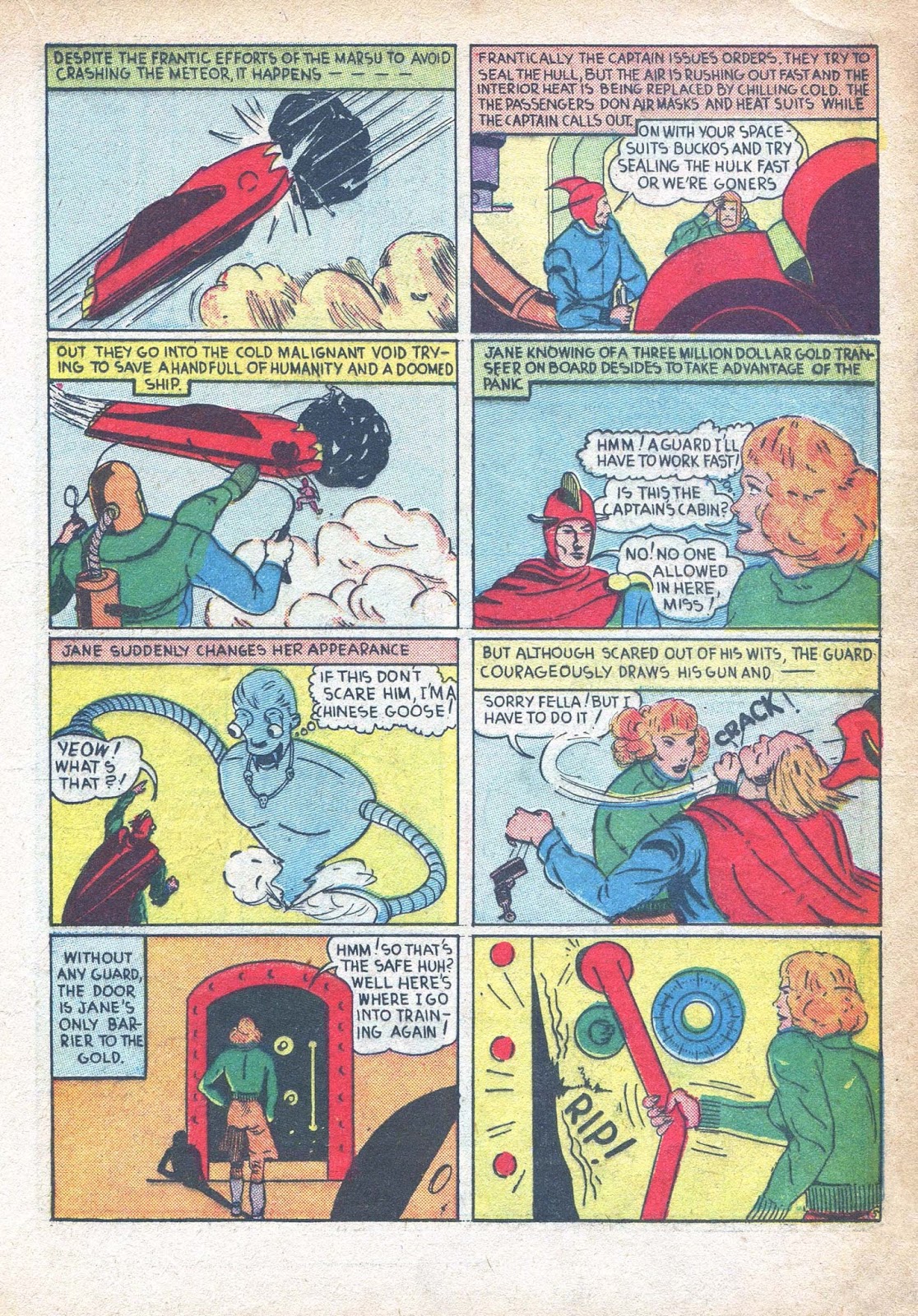
Up to this point, I was thinking the Magician from Mars would be, you know, a magic-user. And she is -- but, there's growing evidence here that she has two classes and is also a superhero. At first I was overlooking the jumping through a wall as creative flavor text for the spell Passwall, but jumping through walls and taking super-leaps? This has "superhero"written all over her now.

Also note how easily they just happen to encounter a meteor, just one day out from Mars. Despite the vastness of space, wandering encounters can come just as frequently in space as they would anywhere else (I would roll once per rest turn,1 in 6 chance).

Jane uses the spell Phantasmal Image, or maybe the power Change Self, here, but the guard makes his morale save and stays put.

It's a little odd that the Martians use dollars as currency, but maybe our narrator is just translating their term for us.

Make no mistake; our "hero" Jane is robbing the ship of its gold. She wrecks her way into the vault to take it.


Remember that Mending spell she used on the vase? Apparently it's much more powerful than that. Has to be at least a 2nd level, if not a 3rd level spell. In fact, it may be almost as powerful as the 4th level power Raise Building.


Because Jane has stolen $3 million in gold, but donates half to a worthy cause, maybe in That Other Game we could call that Chaotic Neutral with Good tendencies.

Infantile paralysis, of course, refers to polio. It's useful for dating this adventure that polio is still around, since it was wiped out in the U.S. by vaccines from 1955-1979.


This is Minimidget -- and Ritty, who doesn't get billing. Here, armed with a mini-spear, MM demonstrates how it can be set to receive a charge, just like you can do with spears in the Advanced version of That Other Game.

Surprisingly, this is the first weasel we see in comics. Against normal sized foes, a weasel isn't going to be anymore of a threat than an owl, though giant-sized versions of each are tempting.

I include this page, not because I enjoy seeing weasel's murdered in grisly fashion, but because this is the first indication that there might be super strength in Minimidget's "super-midget body."  There is no discussion of anything science-y, like density, and in fact his strength might wind up being nothing that adrenaline can't explain.


Chuck Hardy visits the royal palace of the Aquatanians (but not true mermen) in this issue, and we get some sense of its layout here. From the previous page, we know the outside entrance is one long staircase flanked with green dragon statues. Inside we have this brightly-colored checkered hallway flanked by columned arcades. It seems that the hall empties into a surprisingly small audience chamber, dominated by a long table worthy of the Justice Society of America. The next page actually shows how large the audience chamber is, with the table on a large checkerboard dais. Overlooking the throne room is an observation gallery where commoners can sit and watch their rulers, but a heavy curtain can be drawn over the balcony in case they need privacy.

The king probably rules by virtue of being the only person who can sit comfortably in a throne with upright seashells for armrests. There are multiple wings to the palace, including this one where the king's advisers have their private rooms.

This page explains the geography of the hollow world of Aquatania.  Roara must be a constantly active volcano to light their world, which seems a pretty dangerous situation to live in. That the frog men live in the cold side of Aquatania seems to defy biology, but they are only frog-like in appearance, I guess.


This page establishes that Mighty Man is only 12' tall -- when he seemed to be more like 18' tall in his first appearance -- and reveals that the Valley of the Giants is in Nevada.

(Scans courtesy of Digital Comic Museum)


Monday, October 31, 2016

Adventure Comics #42

The adventures of The Sandman continue, and he's got to have one of the best fleshed-out, yet little-known, backstories in all of early comic book history. Here, we learn that Wesley Dodds was in the U.S. Navy Air Corps as of 1933. We also get backstory SCMs for Wes -- Dr. Clyde Dunlap and "Happy" O'Shea. Supporting Cast Members can be assigned like that by the Editor as a story demands, though players should be discouraged from just "saying" they have old friends they can call on for help.

In this case, Clyde and Happy even know about Wes being The Sandman. It does not seem to be implied that the Sandman identity extends back to '33, so they likely learned about it from him sometime since then.

Wes, Clyde, and Happy all have access to fighter planes. Wes is a billionaire in his backstory, but has likely not had time to accumulate the $20,000+ he would need to purchase a fighter plane in game play. This has to be another hand-out from the Editor for this scenario.

The scenario has the three good guy fighter planes up against four bad guy biplanes. The good guys start out with the advantage of surprise and use the aviation stunt Out of the Sun against them. They immediately fail their primary objective, though, to protect an eighth plane in the air full of innocent passengers. Luckily, the passenger plane has more hit points because it only goes down from complications, while the biplanes are weaker and crash violently instead.

Hideouts & Hoodlums will, eventually, be able to play out a scenario just like that.

Wes has a gas bomb -- different from his gas gun -- that he uses for the only time in this story.

In Barry O'Neil's adventure, he uses not one but three aviator stunts -- Wing Walking, Deadstick, and Improvised Landing.

Then Barry picks up a crate and hits two thugs with it at once -- not possible by the H&H rules, unless these are actually weaker hoodlums instead of 2 HD thugs.

Barry passes up the chance to search Krull's ship for loot by blowing it up with mines first. The scenario kind of demanded it, since other ships were in jeopardy, but Barry's player might be ticked off about that.

Socko Strong meets an ape-man (that's getting a stat entry in 2nd ed.) and sails to its lost world island. The lost world seems, for some reason, limited to a valley on the island that you have to climb a cliff and cross a fallen tree over a gorge to get to. The valley is somehow big enough to support both a tyrannosaurus rex and a stegosaurus with food. Both of these dinosaurs will likely be left out of the basic book, for being just too big and dangerous.

Captain Desmo and Gabby are up against cultists (also getting an entry in 2nd ed.). probably with thugs and assassins (another 2nd ed. add) mixed in. The bad guys have a simple deathtrap for Gabby, tossing him into a pit full of cobras.

Anchors Aweigh puts Don and Red in an unusual situation; they find themselves in an unbeatable scenario, if the scenario is wrongly interpreted as a "save the ship" scenario. The torpedo is too close to the ship for them to do anything about, so this is a survival scenario -- at least initially.

Don and Red meet Admiral Cato, our first bonafide Napoleon character (we've seen some mad scientists so far with Napoleon complexes, but they all fit the mad scientist mold better). From the summary I have to read, I don't know what all of Cato's weapons are, but some of them appear to be poison gas bombs.

Don and Red can't figure a way out of this underwater lair they are trapped in, so they come up with a rather clever plan. After sabotaging the oxygen supply for the hideout, Cato's henchmen fail their morale saves and offer to come up with a way out of the hideout for them.

Sometimes the bigger picture of world war is just going to be backdrop for your H&H stories. The Skip Schuyler story takes place in a Chinese city just as it's being bombed by the Japanese -- but the story doesn't really have anything to do with that. The scenario starts when Skip rescues a boy who serves as the plot hook to uncover the kidnapping of an American reporter. The reporter has a guard guarding her (guards were statted in the first H&H module and will be in 2nd ed. too).

Rusty, of Rusty and His Pals, is menaced by yellow peril hoodlums serving a Fu Manchu villain. Fu Manchu is guarded by guards, but Steve -- Rusty's adult pal -- shows up, makes his save vs. plot, and is able to ignore the guards and go straight after the Fu Manchu villain, Chen Fu. Steve still loses, though, and is placed in a complex deathtrap. He's tied on a plank over a pit full of metal spikes, with a pendulum blade swinging down at him from above (I presume Steve is under the plank and the pendulum  blade is to cut the rope and drop him in the pit, though the trap seems like it would work just as well if Steve was on top of the plank and the blade is coming down to cut him).

Cotton Carver has to rescue his friends when they are kidnapped by cultists and taken to be sacrificed. Cotton tracks them through a forest and starts shooting the cultists, but his friends still get dumped into a pit with water in the bottom. He dives in and they all get sucked by an undertow into a subterranean cavern that opens to the sky (? -- hollow world settings confuse me). The "god" of the cultists is a brontosaurus. Like the earlier dinosaurs mentioned, this is way too big and dangerous for the basic book. And yet...Cotton somehow kills it by catching it in a grass fire. Infused with massive amounts of experience points, Cotton and his friends enter a kingdom defended by medieval-esque knights. Do knights need to be their own mobster type?

(Sandman story read in Golden Age Sandman Archives, summaries of the rest read at DC Wikia.)


Saturday, October 29, 2016

Amazing Man Comics #5 - pt. 3

And there are still more characters to introduce from this issue!  Next is Chuck Hardy In the Land beneath the Sea.  Yes, it's a hollow world campaign, this time set under the South Pacific, and can only be reached when a volcano causes a fissure on the ocean floor to open. How the entire ocean doesn't start pouring into the hollow world and drown everyone there is never explained.

What is explained to us is that this is a salamandron -- which, I'm guessing, is like a cross between a salamander and a dimetrodon. It sure looks big and fearsome, but sure doesn't last long against Chuck (unless he just happened to pick up a magical Axe of Salamandron Slaying...?).


Someone's been reading a lot of Edgar Rice Burroughs.  The science continues to remain goofy, but as long as your players are fine with that, let the environment give their Heroes any bonuses you feel comfortable with.


Speaking of "lost world" settings, here we get another smaller example of that in Mighty Man -- which is ironic, given that this is a lost Valley of the Giants. It's hard to get a sense of scale from that close-up of a deer, but Sonny says it is twice normal size. The trees are supposed to be twice normal size too (though how can you really tell with a tree?). The scale of the building suggests its occupant will be more than twice human size, though.


Here's an origin story ripe for abuse -- if staying in this valley turns people into giants, then what's to stop your Heroes from just choosing to stay here for 5-10 years of game time, and then go out and stomp all over your campaign world?  Unless it's the growing process that killed everyone else off, of course.

Although Mighty Man says he's the son of normal humans, he's close to the right size to be a moon giant (appearing in 2nd ed.).

(Scans courtesy of Digital Comic Museum)

Tuesday, October 4, 2016

Adventure Comics #41 - pt. 2

Anchors Aweigh starts with a wandering encounter instead of a plot hook -- a known spy just happens to walk by! But it's to lure Lt. Com. Don Kerry and Red into a trap. It's a goofy sort of trap, though, as they run into a glass wall that somehow knocks them unconscious. How fast were they running?

Don and Red wake up in a deathtrap an hour later. Sin Yen, the spy, has them in an arena where they'll have to fight monstrous beasts until Don tells Sin what he wants to know. The first opponent is a large ape; at 7' tall, the ape should be 4 or 4+1 HD (being halfway in size between an ordinary ape and a prehistoric ape). Other opponents include a spider-snake (it's a huge spider with a snake tail, I guess, not sure what the advantage of that combination is!), and an octo-dile (a crocodile with eight tentacles -- new version of a carrion crawler, anyone?).  Further complicating the trap is more traps within the trap, including spiked pit traps, and a glass wall that slides down so one half of the arena can be flooded with water.

Skip Schuyler is given an interesting scenario to problem solve his way through: hi-tech cattle rustlers are using planes to make cattle stampede away from ranches, and then rounding the cattle into trucks, and guarding the trucks with machine guns. Interestingly, Skip doesn't even try to stop all the rustlers; he considers the pilot the weak link and goes after the rustler's plane. He engages the pilot repeatedly in a recklessly dangerous game of chicken with a plane of his own and causes enough failed morale saves that he forces the pilot to land. Then Skip hits the pilot with a rock and ignites the gas in the plane so the rustlers can't use it anymore. Skip is apparently fine with letting the local law handle the guys with machine guns...

In Rusty and His Pals, Rusty and his pals are lost at sea and spend three days drifting until a ship bound for Liverpool passes them and picks them up. Plot contrivance, or random encounter? Could the Editor have planned for several options, or even just rolled randomly between a choice of ports? Or was the next adventure pre-set for Liverpool?

I suspect the last option, as there's a bad guy waiting for them in Liverpool with a connection to their last adventure. Indeed, it's often a good idea to have at least one bad guy per scenario with a connection to the last adventure, as it helps keeps the adventures linked into an overarching campaign.

Cotton Carver meets a priestess who takes him through a secret door from the Shrine of Dagan to an underground river and a magic boat that travels on its own with just a command. They reach a magic gate that also opens when a command word is spoken (should I treat that as a trophy item too?). Elara the Priestess takes Cotton to a castle and a tomb where she gives him a magic sword called "Malar". Malar is the only weapon that can kill the Scarlet Seeress -- and that is the quest she gives him! She also gives him a "good luck" bracelet (a luckstone?).

Cotton journeys through an underground forest (how does that work? Is this a hollow world setting?). He is caught in a trap (a giant glass jar) and ...hypnotized? Charmed? ... by the Scarlet Seeress. The Seeress just leaves then to go lead her army towards world domination. Later, an old man uses a magic divining plate (like a crystal ball) to show Cotton where his sword went to while he was asleep, then offers to drive Cotton after the Seeress in his magic flying ...car?

I don't know what to make out of the "dark horde" the Seeress leads. Dark-skinned men? Demons? It's so hard working from summaries!

(Read as summaries at DC Wikia.)

Monday, July 18, 2016

Adventure Comics #39

Barry O'Neill begins having post-Fang Gow adventures, though Count Guniff seems to be cut from the same mold. Indeed, when Guniff traps O'Neill and LeGrand in a water trap, Barry would have been within his rights to go "What, again?"

Two things worth pointing out from this story: one, it is one of the first time in comic books where the hero runs out of bullets; and, two, Guniff's second death trap for O'Neill and LeGrand is a much simpler affair -- he douses them with gasoline and is going to brings a match towards them. That's a pretty serious death trap -- serious enough that I'd probably have it do 1-10 points of damage per minute to heroes until they can somehow extinguish themselves (like a save vs. science to smother the flames by stop, drop, and rolling).

Cotton Carver continues exploring his Don Dixon-like lost world environment. One thing to notice is that the hideout/dungeon Cotton is exploring is taking him down quite a few levels, by stairs and slides, but his encounters are not getting significantly more challenging. He gets to a dead end where he cannot proceed without having a special stone with him that fits into an indentation in the wall -- a classic dungeon trick.

Cotton fights a half-cat, half-man called a Watcher. Watchers must be pretty tough; this thing takes multiple arrow hits without going down, and is probably at least 3 Hit Dice. They're also Lawful because, if you defeat one and leave it alive, it agrees to repay the life-debt by serving you (or maybe Cotton just had cat treats in his pocket).

The animated statue Cotton meets seems straight out of Dungeons & Dragons. I wonder if it's a living statue, a golem, or if I'm going to be disappointed next issue by it getting explained away as ventriloquism...

In Federal Men, we learn more about how reefer works in the comic book world. It's "the drug that causes the smoker to lose all moral restraint". So, if you smoke marijuana and fail a save vs. science, you become okay with killing others (just like most of my players) and don't have to save vs. plot before you can take a life.

Jack Woods (fresh over from More Fun Comics) faces a bandit and an unusual dilemma -- a victim who isn't glad he was saved. Soon he's confronted with another dilemma much like one I recently used in my Monday night campaign. The Hero is hired to deliver something under suspicious circumstances. Does the Hero do the job and go home, investigate the sender, or investigate the receiver? It's a nice scenario because the Hero is free to choose and shouldn't be railroaded into investigating one before the other.

Steve Malone finds a cuff link. This is important because a cuff link is never mentioned in a story unless it's a clue.  If your Editor so much as says "cuff", you'd better be ready to take notes.

Steve does a lot of searching. He finds the first cuff link searching by a gong (not where you'd normally expect to find one), but finds the second one searching a bedroom where you'd expect to find one (maybe at a +1 bonus then?). There is a secret compartment hidden in a model castle and, unless the Hero has reason to suspect it's there, the chance of finding it is the same as a secret door.

Tom Brent is sailing down a jungle river, seeing no natives, but they see him and track his boat's movement. Which might not bear mentioning, except that there seems to be a lot of natives and they evade being noticed for quite some time. Maybe natives need to have a better (3 in 6?) chance of surprise?

The Skip Schuyler story has him pitching for the Yankees during a special game for charity. Which might not bear mentioning, except that it's so rare for a real baseball team to be named, and real players (Lou Gehrig and Joe DiMaggio) cameo. Of course, in your home campaigns, whether you go with real historical figures, characters obviously based on real historical figures (with similar names, like Jim DiMaggia?), or entirely fictional characters is entirely up to you.

In Anchors Aweigh, because the Editor clearly doesn't have a new plot for them lined up, Don and Red decide to go hunt up some experience points, literally, by hunting crocodiles off the Panama Canal. They meet a wandering encounter while hunting who turns out to be a mad engineer who makes bombs (I can't decide if that qualifies him to be a mad scientist (Book II), a madman (Supplement V), or even an anarchist (Supplement I). Once the encounter has been rolled up, the Editor has to think up an excuse for the engineer to be there, so he concocts a plot on the spot for foreign powers to have hired him to blow up the Canal.

(Summaries read at DC Wikia)


Wednesday, July 6, 2016

Popular Comics #40

The Hurricane Kids are lost on a hidden land/lost world island. You can tell that it is by the over-sized fauna and, of course, the presence of dinosaurs. But what kind of dinosaurs? Some variety of carnosaur, it seems. I wonder if I should keep dinosaurs equally generic in Hideouts & Hoodlums, so one carnosaur entry could represent a variety of species.


Although also unnamed, this is likely a pteranodon (or simply pterosaurs if I want to keep labels more generic). Pteranodons are strong fliers and need some special ability for snatching and flying away with people.


Toby might be a surprising source for a consideration of the undead -- but what exactly is that thing Oomog is fighting, and what can it do? It is called both a spook and a ghost in the text. If it is a ghost, then ghosts can be hit by normal attacks (or perhaps only by powerful opponents, of 4+ HD, using normal attacks). Or perhaps spooks are something else, a weaker version of a ghost. Spooks can fly, spook people, and turn invisible, but nothing else (no other special defenses in particular).

I think the mobsters are onto something here. Horned toads may not be dangerous, but I always thought they were creepy. If nothing else, they're good hideout dressing.


From Shark Egan, a rare appearance of a huge eel (not a giant eel, and not an electric eel either). I gave giant conger eels 3 Hit Dice in Supplement II, so a huge eel should have 1+1 Hit Dice.


The Masked Pilot must be using the Aviator stunt Wing Walking to climb out safely onto the tail assembly. He then offers a good suggestion for investigators with bombs -- or any hi-tech item -- to search for clues. Every component has a chance of containing the manufacturer's name or mark on it. Find out who bought the pieces, and you may find the maker.


Here's an early precedent for rubber masks being able to fool people in comic books.


From filler called George Clark's Carnival, I thought this was a pretty good joke.

(Scans from Comic Book Plus)


Sunday, April 17, 2016

Adventure Comics #35

In this installment of Barry O'Neill, Barry dives underwater and the bad guys assume he's dead because he stayed under so long. Villains seem to be terrible at underestimating how long Heroes can stay underwater -- so much so that they should have to save vs. plot to avoid making this cliched mistake.

Doctors are treated as a Lawful mobster-type in Supplement V: Big Bang because they have special abilities in comics -- one found here is the ability to quickly concoct antidotes. Dr. Bonfil crafts an antidote for Fang Gow's hypnosis drug in less than a day.

Shades of the Savage Land!  Cotton Carver's adventures debut in this issue. When forced to land on Antarctica, Cotton is saved by a group of people from the lost world of Mayala, a tropical valley long ago found and settled by both the Mayans and Incas (who are rival tribes here now). Though the natives have seen gunpowder weapons before, they have none of their own and Cotton's six-shooters make him a fearsome foe for the natives (and awfully handy for a solo campaign!).

It is unclear how Mayala can only be entered by swimming underwater, if the valley is open to the sky -- unless it is assumed that Mayala is a "hollow world" setting like Pellucidar.

Sleeping gas takes out an entire bank-full of people in this installment of Federal Men. This will be neither the first nor the last instance of sleeping gas being shown to be much more effective in the comics than it is in real life. The amnesia-suffering Steve Carson seems to have no trouble acquiring this super-sleeping gas, as well as gas masks for his gang, despite the absence of such things from the starting equipment list. Though perhaps we are just not privy to the separate adventure Steve went on to find these trophy items.

In Dale Daring, Don and Dale seek shelter in a cave from an approaching storm. The weird thing about storms is that, in real life, everyone rushes out of them, but there is little in-game reason to do so. Is your Hero going to take damage from getting wet? Is the Editor going to pull out all the stops on that storm and start pummeling Heroes with lightning strikes? Probably neither -- and yet Heroes should have to save vs. plot to resist the urge to seek shelter.

Tod Hunter becomes the second Hero in comics to suffer amnesia (since the other is Steve Carson, they both happen in the same comic book!). Maybe there needs to be a 1% chance every time someone is reduced to zero hit points and recovers of suffering temporary amnesia.

Large gorillas are strong enough to wreck things, at least against doors.

Both the Dale Daring and Rusty and His Pals installments revolve around finding something in the back of a cave -- a pile of stolen ivory and a secret door to a hidden lair respectively. It makes me think Hideouts & Hoodlums needs a random table for random cave contents.

In Rusty and His Pals, the villains have a seaplane. The villains also benefit from the Heroes lighting a fire in the cave, serving as a reminder for the Editor that any light source the Heroes rely on can be seen by mobsters some distance away (and vice versa).

(Summaries read at DC Wikia)

Tuesday, February 23, 2016

The Funnies #27

Captain Easy is on a new adventure. His plot hook came to him from a mystery lady who slipped it in his pocket. Was that the pilfer skill of a 3+ level Mysteryman, or a skill everyone should have? I could see femme fatales being statted as Mysterymen...


This strikes me as a fun trap to even use on Heroes. At a dead end the Heroes find a hatch they can open. They pull open the hatch and out pops a boxing glove to smack them in the face.   One person takes 1d6 damage, and everyone gets a good laugh.


I kind of like this idea for a twist on the cowboy vs. horse rustlers scenario -- horse rustlers transporting via river barges. I also like that it takes place on a real river, as opposed to some generic locale.

With such panoramic vistas it would pay to use photos as visual aids.


I don't really want to keep discussing this story in Ben Webster's Page, but I keep thinking of more things to say. "Snakes and centipedes and lizards and toads" is a wandering encounter chart for deserts -- which would be challenging if these were giant animals.

The missing link uses the magic word "Tamaruntch" to make Mary Jane not scared. A Remove Fear spell? Is the missing link a Magic-User?

Lost cities are a tricky business. How would planes not spot a brightly-colored city in the middle of a desert, even with cliffs around it. All I can say for certain is that the missing link is casting a Knock spell. He's at least 3rd level!


On this page the missing link even admits to using magic.

The gates cannot be magically opened from the inside -- an interesting bit of hideout dressing.


Shrapnel rifle?  I'm not sure what that is. A shotgun? Just a rifle shooting shrapnel bullets?


This gag filler is called Hold Everything.  I feel the same way about hockey.

(Scans courtesy of Comic Book Plus)