Showing posts with label campaign moods. Show all posts

Saturday, July 24, 2021

Speed Comics #7 - pt. 3

 We're back with Ted Parrish, the Man of 1000 Faces as he crosses over into a wizard duel in a Ditko-esque magical landscape...oh, what's that? Scarlo is jumping and not flying in panel 3? Panel 6 is just horribly drawn, with a big, long perspective line inked as it vanishes into a solid chimney and the rest of the roof behind him just vanishes because the artist got lazy? Well, that's disappointing.


Speaking of disappointing...as the Editor in a Hideouts & Hoodlums scenario, it behooves you to ensure that the players feel like their presence in the scenario made a positive impact; that they wouldn't have been better off just standing back and letting the police do their job. You know, like how Ted totally bungles capturing Scarlo alive here, when the two officers might have stopped him had Ted not got in the way. 

But there will be times when the dice rolls go so badly for the players that terrible results will happen, and then you need to have in-game consequences. You know, like how Ted must surely be wanted for manslaughter now.

Now we're going to jump all the way to the last page of Biff Bannon. Dick Briefer is going full-on Mad Magazine (only 11 years earlier) here with the frantic pace, zany humor, and exaggerated violence. That got me thinking about the H&H rules for modifying campaign mood to fit the style of comic book story you want to tell. If you wanted to run combat in zany mode, maybe every attack should push at double distance in addition to damage (instead of replacing damage), and you could hit as many targets as you want with the same attack so long as the method or results would be funny and inventive. 

I don't think this would work for campaign play, as there would soon be no suspense about whether the good guys win (it wouldn't be funny if the bad guys could hit as many people as they wanted), but it would be fun to try in a one-shot scenario.

And now I'm jumping full steam ahead into Lt. Jim Cannon and the mystery of the needlessly elaborate plot device. I mean, you can sink a ship with icebergs, or you can sink a ship with mines, but does putting the mines on the icebergs really do any extra good? If anything, it makes the mines easier to spot, which is what happens here.

Maybe I'm just so incredulous because Devilfish is such a non-threatening name for a villain. Anything-fish doesn't sound villainous. "You may call me...the Goldfish!"


That does look like a really long submarine. The longest submarine in WWII was Japan's I-400-class sub; at 400' long it held the record for two decades.


This is from Landor Maker of Monsters, and this installment is a weird, soap opera-y one that our Hero (and his girlfriend) doesn't barge into until the second to last page. What's interesting here is that Creeta is clearly an android, with steel wires controlling her body inside, and her weakness is the screw in her neck that ...well, I'm not sure how it kills her exactly, but turning it seems to do a lot of damage to her.

Bob Powell seems to be really rushing the art here too. He could do much better.
This is from Munson Paddock's Mars Mason. Mars is an interplanetary mailman because, you know, we're never going to have some kind of electronic delivery system in the future. Comic book science is as goofy as ever here, with that heat radiation wave that is somehow different than radio waves, but that's nothing compared to a ship from Jupiter leaving after a ship from Earth and moves fast enough to intercept it before it reaches Mars. I think we're going to have to accept that the Jupiter Men have extremely long range teleport technology. 

What really works here is the creative alien design work and, even more interestingly, the villain name Killraye. That is great and suddenly I want to use it (though I'd probably drop the e).   

This, this is one of the reasons why the AH&H Mobster Manual is still not done after all these years. I'll be reading "new" comics and it's the same old human bad guys, blah blah blah, and I'll be thinking I've seen everything new I'm going to see -- and then Mars Mason fights Jupiter Men. Now the Mobster Manual has to include these! This is marvelously inventive, with the spiky heads and strange growths in their faces (are those fangs? Short tentacles? Something else? Who knows!). Their bodies seem to be separated into two halves sort of shaped like wings, which would seem to make sense for a lifeform evolving on a gas giant (if the gravity wasn't so crushing), each side ending in five appendages like giant fingers. Each appendage ends in a tool, either a club or a hook, that I'm guessing are not natural (but you never know in comic book space).  


This first panel makes it look like their heads can detach. Maybe the heads are the only real part and the rest of the body is just something they wear? Crazy.

Almost as exciting is the multi-ray torture machine. Which ray will it be? Sounds like this item needs a random table, although apparently the differences are just flavor text and all of them eat out your vital organs. 

If you're feeling cheated because Mars has to get rescued, keep in mind he's only a mailman. 

(Scans courtesy of Comic Book Plus.)


Tuesday, December 10, 2019

Jumbo Comics #13 - pt. 4

I've got time for one more rant session -- I mean review! -- of this issue of Jumbo Comics.

Wilton of the West is in Skull Valley, which is an actual place out in Utah. It should also sound familiar because of the White Boy in Skull Valley strip we already reviewed a few years back on this blog.

Drinking water does not restore hit points in Hideouts & Hoodlums, but giving water to a dehydrated person can count as first aid, and that does heal back 1 hp.


I'll skip most of the story; this page reminds us that the cowboy genre is often set in modern day times, so you can include modern cars in your stories.

I don't know how you jump off a horse into a speeding car, but I wouldn't make that easy. It should require an attack roll vs. a low AC, like maybe 2, or even 0.


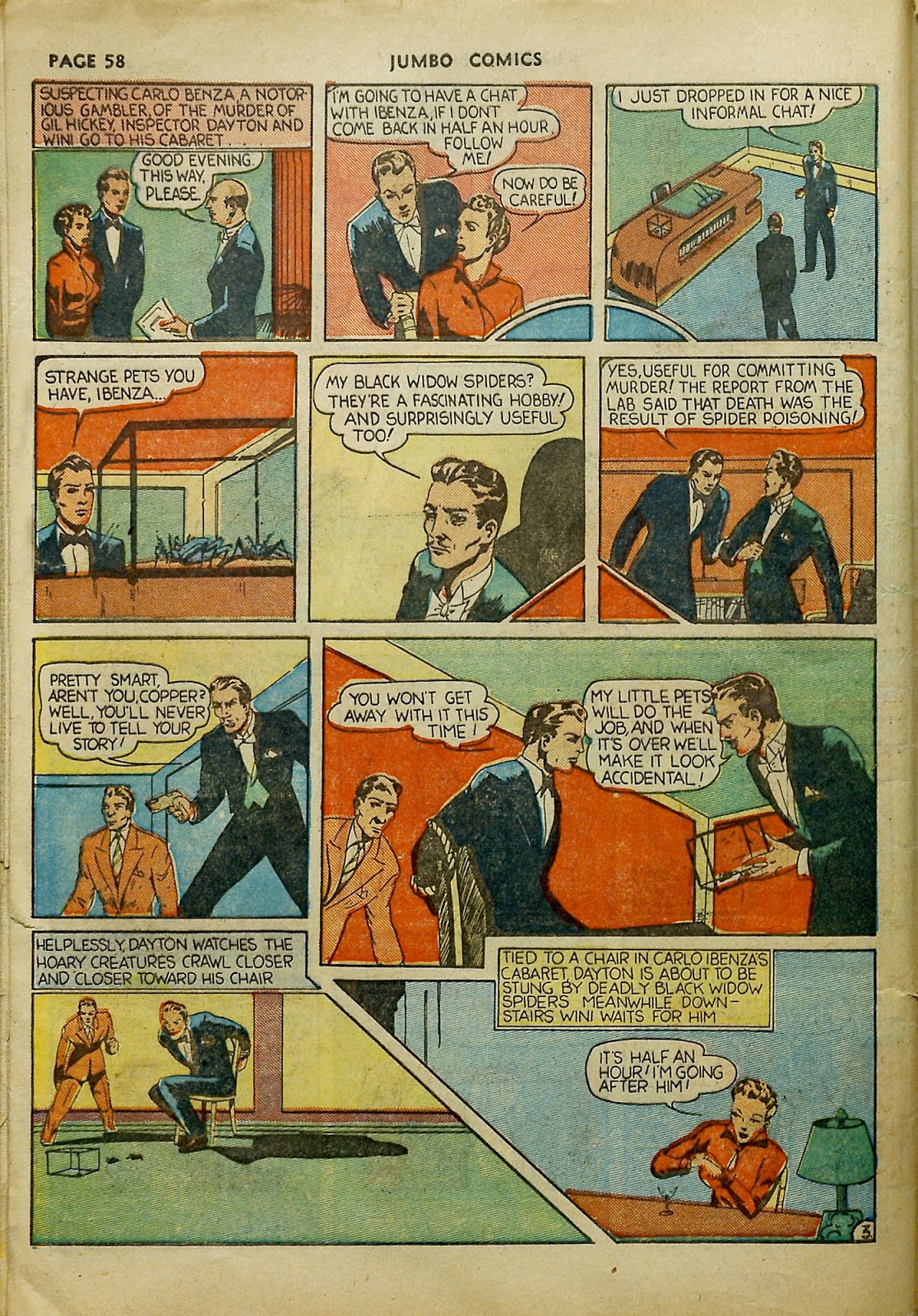
Jumping ahead, this is our final story, Inspector Bancroft. Bancroft has been given a lot more supporting cast this story, including a fiancee and...well, I don't know what relationship those two kids are supposed to be to Bancroft or Wini, but they don't figure into the plot anyway.

Lumps of jelly used for containers in medicine that melt in heat are good clues to find in a poisoning murder.

"Swanky!" That's a word you don't see often enough in comic books. 
Bancroft gets incredibly lucky here; his accusation comes way out of left field, and all Benza has to do is deny it and Bancroft has no evidence. Things like this always seem to go incredibly easy for the Heroes in Golden Age comic books, so in a H&H campaign, if you accuse a mobster of a crime, that mobster has to save vs. plot or confess.

The author, "George Thatcher" (likely a pen name), likes unusual words, so he gives us "hoary creatures." I'm not sure if he's referring to the color of the spiders or how old they are...

But speaking of spiders, why place them so far from Bancroft, instead of, you know, throwing them in his lap? It seems like a particularly poor deathtrap, if the spiders choose to go in a different direction. 
Keep in mind, as you're reading this, how badly Bancroft has failed at this scenario. He gets captured. He fails to get himself out of his deathtrap. He fails to capture the killer. He doesn't even phone for the police himself; Wini does all of this for him. The moral is, it's okay to fail when you're playing H&H. You're still a Hero as long as you tried.
If I was Wini, I would be hesitant to untie him too. If Dayton had just stood by and let the cops take him, Benza would have gone to jail. Well, maybe. I mean, Dayton still has nothing on him for the murder other than a confession that Dayton has no corroboration for.

But punching him gives Benza the opportunity he needs to try and run, and the cops are so enraged by this that they don't even shout "Stop or we'll shoot" first. This lack of due process and vigilante justice, though, is entirely appropriate for Golden Age campaigns.

(Scans courtesy of Digital Comic Museum.)

Monday, July 30, 2018

All-American Comics #9

Moving on to #9...

In Gary Concord the Ultra-Man, we see more of the future of the 22nd century, when Gary Sr. wakes up from suspended animation (remember that Gary Jr., reading all this, is still in 2239).  Cities in the future are domed, with bridges and subway tubes all situated well above the tree line. The environment surrounding Washington, D.C. is now heavily forested. The atmosphere is safe for trees, but poisonous for humans (too much carbon dioxide?). This condition is not natural, but induced by the warlords of Rebborizan as a sort of chemical warfare.

Their airships are "energized" by cosmic rays, allowing them to easily exceed 600 MPH. Despite their technological advances, no one in the future is prepared for Gary's invention of ...incendiary pellets.  Is this the big secret weapon that will bring peace he was bragging about last issue?? The incendiary weapons are unusual in that Gary can generate a Wall of Fire out of them.  Oh, and thinks get dark too...he marries the daughter of the Ming-like warlord Rebborizan (good luck figuring out what nationality that is), she gives birth to Gary Jr., but Reb kills her and then Gary Sr. strangles his father-in-law to death.

Reb's warlords come up with a defense against the incendiary pellets. We never see it; maybe it's water.  Later, Gary Sr. beats them by reversing the effects of the foam that made him big and strong and makes the warlords and all their people "weak, meek, and docile."

Red, White, and Blue's installment takes place at the Port of Dutch Harbor on Unalaska Island -- which sounds completely made-up, but is an actual place! But first, it begins at the Seattle office of G2. I believe the West Coast G2 HQ was in California in a previous issue; now there are two offices. Since Dutch Harbor and Unalaska Island are real, I had to check to see if Brent University is real too, but it does not appear to be. Red, White, and Blue have to travel 12 hours by plane to Unalaska, which also seemed incredulous to me, but I checked and Los Angeles to Unalaska is 10 1/2 hours by plane these days in jets, so 12 hours in a monoplane is actually not unreasonable.

The three of them are attacked in the night by four Japanese spies. Red just happens to be awake and spoils their ambush (save vs. plot to be awake, followed by a normal surprise roll?). The spies take advantage of the darkness, both being harder to hit, but also harder to identify later when half of them escape. The boys don't even bother interrogating their two prisoners, because they it's easy to figure out why they attacked given the scenario; this is a race against time between the two nations to lay claim to an island that has risen among the Aleutian Islands.

One of the spies who got away is much more interesting than your run-of-the-mill foreign spy. Shiroku is a giant of a Japanese man, standing almost 7' tall, and he uses a bow and arrow and claims to "never miss." I would definitely attach some levels in Fighter to this character. Shiroku is even an authentic Japanese name!  I love how much more research went into these Red, White, and Blue stories than in the average 1940 comic book. Sabotage (the running theme in this feature) causes one of the pontoons on their seaplane to leak, and three panels are spent on how they have to unbalance the plane to get the pontoon in the air so they can fix it (good problem-solving details for players who enjoy that sort of thing). No mention is made of how they fix the leak in the oil tank.

The scenario continues past them reaching the island first; now they have to hold it. A Japanese plane shows up and bombs their seaplane, then lands and the crew gets out to look for Red, White, and Blue, while leaving one guard behind at the plane. Blooey sneaks up and takes out the guard, who's rifle shot brings the others running. Red uses a tripwire trap and falling prone to lessen their numbers by one more, so they only have to take out four soldiers in melee combat.

Later, in an anti-climactic epilogue, the boys return to Dutch Harbor, encounter Shiroku, and Blooey takes him down with a lucky sucker punch. Boo!  Poor Shiroku!


(Read at fullcomic.pro)


Tuesday, November 7, 2017

Wonderworld Comics #8 - pt. 2

It seems that Yarko the Great has cast two spells here; the first seems to be a Telepathy spell, allowing two people to contact each other over distances, and the second seems like a Read Curse spell, that allows him to identity the curse on the dead woman.

I am going to do some limb-climbing, though, and suggest that we don't really need either new spell. We can assign "curse identifying" to Detect Magic. And the telepathy used here could have been as easily accomplished using two telephones, so I suggest that this instance of telepathy could be flavor text, created at the Editor's discretion, to get the plot rolling. Now, does this set a precedent for Yarko being able to use telepathy in the future? Not necessarily, particularly in a game system where powers and spells are chosen from day to day and not set in stone. And comic books themselves were always being inconsistent.

I ran a scenario in my JSA campaign based on this story (the Atom was killed by a cursed item, but the Spectre got them permission to go to the Valley of Death and retrieve his soul), so I'm particularly excited to get to it on the blog finally.

Here we see Yarko laying down some powerful spells, starting with Teleport and ending with Planar Shift. In the middle, he seems to rely on Enlargement for the intimidation factor. It's unclear if Yarko is commanding her with just the force of his words, or with a Charm Person spell.

For the boatman, I planned to use the stats of a Charonadaemon from the old Monster Manual II (luckily the JSA didn't choose to fight him). The little flying creatures over the river I statted as spined devils and vargouilles from the same book. I had to do this appropriation because I had not created anything too close to these yet in Hideouts & Hoodlums and, since they don't actually do anything in the story, I would have had to make stuff up from scratch anyway.

Burning Pain is actually covered by the yaksha demon in Supplement III: Better Quality. Lucky coincidence?

The JSA managed to avoid Fear by slaying Burning Pain with missile weapons and not exploring the ledge where Pain was. Fear I had planned to stat at the time as an apparition from the Fiend Folio, but in 2nd ed. H&H, I plan to have a new undead mobster type called the spectral killer.


Horror was evaded the same way. Because of the wailing shriek, I planned to stat Horror as a banshee/groaning spirit.


I skipped this scene, replacing it with The Atom and some other souls being found on a beach, guarded by an angel/deva that had to be persuaded to let him go. I was fearful of the players choosing to run down the hall of time and all de-aging themselves into babies, or encountering Death, choosing to fight him, and wind up getting all killed.

Why isn't Yarko de-aged? I guess he made his saving throw.

Will Eisner's moral lesson about vanity makes this heavy stuff for a 1939 comic book.

And then, on the opposite side of heavy, we have Shorty Shortcake. The poisonous snake in the bed was already an old enough cliche by 1939 to poke fun at it here.

Shorty is right on the border, with Seaweed Sam and Archie O'Toole, between being too ridiculous to consider running a H&H game based on it, but having just enough interesting ideas in it to make it impossible to ignore. Should snakes have to make morale saves if they see two reflections? Nope. Should people be able to tie snakes into lassos? Probably not. Should sailors be able to make blinding spit attacks with chewing tobacco? That's just interesting and plausible enough to consider -- and would be a special attack that makes a sailor mobster type more interesting.

But Mr. Mizzen is no ordinary sailor-mobster; he must be of the superhero class. Here he demonstrates nigh-invulnerable skin and, if the fourth panel can be taken seriously, the high-level power Super Punch. Mizzen must be high enough in level that the 20 to 1 odds by the end of page must not be too great (and I would probably have a superhero be at least 4th level, a remarkable man, before taking on odds like that alone).


Okay, if you ignore the overpowered notion of being able to punch people forward through time, and the subtle racism suggesting all Latinos are lazy, panel 3 suggests that the superhero class should have some disadvantage to it (like powers only being able to work in the morning). Right now, in second edition, disadvantages are only tied to race -- the thinking being that classes already have a balancing mechanism tied to experience point progression, and the only real unbalancing danger is when you combine the alien race and the superhero class together.

(Scans courtesy of Digital Comic Museum.)


Monday, April 24, 2017

Buck Rogers in the 25th Century: The Complete Newspaper Dailies: Volume 1, 1929-1930 - pt. 1

I've been reading and reviewing Famous Funnies almost since the start of this blog, but have never read the Buck Rogers installments because they have all been excised from the public domain issues online. That doesn't mean I don't have access to Buck Rogers, though, as I have recently picked up this first volume in the reprint series.

How old is Buck? We know he's over 400 years old because he was in suspended animation for 400 years. He was also 20 years old when the Great War ended. If the first two panels take place in the then-present day of 1929, before he travels to the future, then he was 31 when he was trapped in the mine with the peculiar gas.

A passage that caves in and traps you with peculiar gas that puts you in suspended animation for 400 years is quite a trap.

Buck's first battle is with half-breeds because...yeah, Buck Rogers is pretty racist.

Buck's first trophy item is a jumping belt that he takes from one of the half-breeds he defeats (possibly kills, though the story isn't clear). The jumping belts make you weigh 1/30 your normal weight and let you make 300' standing high or long jumps.

The Mongol Empire that has conquered North America in this future world has anti-gravity technology, but have not been able to master miniaturization like the North Americans have (almost the exact opposite of which continent mastered miniaturization in the real world). So, while the Mongols don’t have jumping belts, they do have large armored airships. There seems to be no distinction between the U.S. and Canada anymore in the future, so everyone Buck encounters for awhile who is not Mongolian or a half-breed is a North American. Native Americans are, interestingly, finally on even footing with the white man, as their “org zones” (territories) are no more primitive than anyone else’s.

Weapons are also distinctly different for each culture. The North Americans have rocket pistols that shoot exploding bullets. It’s hard to say how to stat them, really, as they seem to miss an awful lot. Perhaps rocket guns would just be +1 guns and exploding bullets would do…2-8 points of damage? The Mongols use disintegrator rays. They are devastatingly effective when within range -- airships and giant mortars might have a 1-mile range -- while hand-held disintegrators have terribly short range, maybe half that of a rocket pistol. It’s unclear how much damage a Mongol disintegrator would do to a person, but the big ones wreck like mighty men (7th level superheroes).

The North Americans have an electro-hypnotic chair that they use to find out if someone is telling the truth. The Mongols use surgery instead, removing the parts of the brain able to tell lies (although they seem to still be able to withhold information, sometimes -- save vs. science to do so?). Other than jumping belts, rocket pistols, and electro-hypnotic chairs, the North Americans live exactly like early 20th century people (even flying in single-prop biplanes, though ones that could be flown by remote control). The reason for that seems to be that the Mongols, when they took over, took all technology away from the Americans. After about 50 years of that, the Mongols started to settle down in just the western U.S., leaving the east coast free for the Americans to begin slowly rebuilding their cities, their culture and their technology. But they fast forward past some technology, like past bows and arrows back to guns. Wilma has never seen a bow and arrow until Buck makes them.

That is not to say that all ancient weapons are unknown in the future. When Buck’s jealous rival Killer Kane challenges him to a duel, Kane’s weapon is a mace, while Buck goes for a more “modern” rifle and bayonet.

The Mongols eat synthetic food, though it isn’t clear what that means. Genetically modified? Theirs is the only culture that watches television; instead of prepared programming, though, Mongols entertain themselves by spying on each other (since their TVs work like crystal balls). All work in the Mongol mines is automated (at least they don’t use slave labor!).

Further evidence of how easy disguise is, going all the way back to the beginning of comic strips -- Buck Rogers only has to wear oriental clothing to disguise himself as a Mongol; apparently his face doesn't give him away at all.

Though Mongol soldiers use disentegrator rayguns, ordinary patrolmen in their cities use a gas gun that is shaped like a large syringe. The gas is simply pushed out with the handle at the back, so it can’t have a very effective range.

The Mongols also have glider cars that look like one-room huts with rocket tubes bending downwards from the sides of the “car”. Other than levitation, the glider cars have not yet been shown to do anything else.

Demonstrating how racy even all ages fare could be in the 1920s-30s, it is implied that Wilma would be drugged so she couldn’t resist the Mongol emperor having his way with her.

Wednesday, February 8, 2017

Adventure Comics #44 - pt. 2

Rusty and His Pals explore Chen Fu's Liverpool opium den. As it typical for waterfront hideouts, there is a trapdoor leading down to a water level, where a motorboat awaits for a swift getaway.

In Anchors Aweigh, Don Kerry is a Lieutenant-Commander (I don't recall what his rank was before, but I don't think it was that high. Promotion through leveling!  In this installment, Don and Red attack gambling boats with grenades and machine guns, showing that your players can never be too ruthless for a Golden Age campaign.

In Cotton Carver's generic version of Pellucidar, he's gifted a magic sword that is explained like this: "encased inside the tiny ridge of the blade was a small drop of mercury. When the blade is held up to strike, the mercury rushes into the hilt making it seem lighter, then when it is brought downward, it slips in to the blade's tip making the blow harder and nearly unblockable."  It sounds like neither magic nor physics to me, but do we really need a better explanation for how a Sword +1 works?

Cotton easily takes out all opponents with his magic sword, but this installment features a rare instance of a Hero losing consciousness from environmental cold damage.

(Sandman read in Golden Age Sandman Archives, the rest read in summary at DC Wiki).

Monday, April 4, 2016

Feature Funnies #17

This is from The Clock Strikes, and that's not shoes in that shoebox -- that's radium!  This is 1939 and not too many people understand how radiation works, so it's not important that it work right in your 1939 campaign either.


That clever Clock figured out a good way to earn an extra 100 xp for a good deed in the middle of the scenario, extorting that charity check out of the good doctor!


This is Espionage -- always a favorite of mine, but I share this page to point out two things. One is the implied license to kill given to Black X. This is one of the good guys, but as of 1939, it was still okay for the good guys to kill. That would make some of my more bloodthirsty players very happy!

Also, using the torn pieces of paper as a passkey like that is a good idea worth stealing for an espionage-themed scenario.

Predating James Bond by 15 years, Black X has a wealth of super-spy weapons such that Q might have come up with, as inventoried in Supplement IV: Captains, Magicians, and Incredible Men.  Here we see the tear gas pen, good for temporarily incapacitating foes at point blank range.

We also see how volatile technology is when it makes a scene more dramatic.  The wrecking things rules has a note about wrecked generators setting hideouts on fire, but really it should apply to any machine, even when being wrecked by non-Superheroes.

This sword fight might be an example of a parry rule in play, or it might just be flavor text -- it's hard to say with parrying. The ability to go "full defense" and get an Armor Class adjustment is still asked for by my players, and Hideouts & Hoodlums will probably keep Parry as a game mechanic.

I'm not sure how jumping out of a high window into your car would negate taking any damage -- although it would, admittedly, look really cool and that's often reason enough for players to want to do something. Perhaps the Editor just rolled low falling damage.

This is from Gallant Knight. The panther's spring attack is more like tripping/overbearing -- a grappling attack that definitely needs to be accommodated in the rules and, apparently, usable by even non-intelligent foes.


This is a rather clever ploy from The Gallant Knight's player -- if he manages a positive or friendly result from an encounter reaction check, he could force some morale saves with this ploy. Since there is a large force of men involved here, the Editor could hand-wave individual morale saves and just say, oh, 30% of the men make their morale saves.


There's nothing particularly adventurous in this installment of Dixie Dugan, but I was struck by the similarity between this scenario and the video game franchise Animal Crossing, where you do favors for animals and retrieve loaned items in exchange for trophies -- and realized that one could play a Dixie Dugan H&H campaign based on this same premise!

(Scans courtesy of Comic Book Plus)


Saturday, March 26, 2016

Star Ranger Funnies v. 2 #1

You wouldn't think someone would give these things much thought, but I have long wondered, if hillbillies were a mobster type, how to stat them differently. Apparently, hillbillies would have a big bonus to save vs. poison.


Strong drink has strange effects on people in comic book campaigns that are light in mood. In this instance, moonshine can make people save vs. science or jump right out of their clothes.


This is actually sound combat strategy (provided no one can shoot you while you're knocking the bee hives down the hill).


And just when I was thinking that everyone should have a chance to track, here comes the Frontier Mysteryman, the Ermine, making a case for tracking being a special skill.  Or maybe everyone should have a chance to cover their tracks, and then only a special tracker can still track covered tracks...?


This is so subtle that I almost missed it. We start the page in broad daylight. The sheriff is measured for a coffin and -- the implication is -- he punches the guy out cold. The guy is seen later, at night, coming around. Now, this is clearly a joke page, but it's still the first evidence I've seen of Hideouts & Hoodlums getting healing right from the start; that healing is very slow and takes hours to get a hit point back.

(Scans courtesy of Comic Book Plus)

Saturday, February 20, 2016

Star Comics #16

At least I still have some primary sources to work from!

This is a gag filler called Davy Jones, but it's also a passable adventure scenario. Davy doesn't do any fighting, but the deckhand does and he seems to be remarkably high-level -- he kills all three sharks between this last panel and the next one, with his bare hands.

I would not normally recommend a supporting cast character be able to overshadow the main character, but if we considered the roles reversed and Davy the useless sidekick, this makes more sense.

One of the nice things about campaigning with a light tone is that wandering encounters don't have to make a lot of sense. A tiger on a deserted island? Sure, why not?


This is new sports genre hero Brad Donovan, worth noting here only because I think it's great that the ringleader of this crime ring is an old lady with a pet duck. I can't wait to roleplay this character!


This is from Carl Burgos' The Last Pirate (like Bill Everett, Carl also worked at Centaur before Timely).  I'm not sure why firing the cannons would make them ruined, unless the crew just doesn't know how to reload them -- or, what if all gunpowder weapons were treated like wands with charges; once they run out of charges, they're no good any more and have to be discarded? It would be another way to restrict over-reliance on guns in Hideouts & Hoodlums...

(Scans courtesy of Comic Book Plus)


Tuesday, January 12, 2016

Popular Comics #33

We move into October 1938 now and start with this offering from Dell.  I don't actually have a lot to say about it, but I'm going to share some of it anyway.

Among the gag filler is this panel -- I'm really surprised it took this long to see the cliche of the "Indian rope trick".  Still...Hideouts & Hoodlums is going to need a Rope Trick spell.


I like this Shark Egan; it's got dynamic art and a fast-paced story.  We also learn why it's not always a good idea to keep a crate full of grenades in your plane -- because someone else might find their way into your plane.

We also see that it's awful hard to hit even a target the size of a boat with a grenade, when thrown from a fast moving plane. This matches up with the penalties to hit at high speeds given in the vehicular combat rules of Book III: Underworld and Metropolis Adventures.


And I'm sharing this page only because I think it's funny. I would not expect any Editor to ever let this work in H&H, no matter how light the mood of the campaign was. Now, in a game like Toon, then this could work...

(Scans courtesy of Comic Book Plus)

Sunday, December 20, 2015

The Funnies #23

I never thought I'd be starting a post here with a Captain Easy image quite like this one, but appropriate language is an issue worth bringing up, I think. There's a word right smack dab in the middle of these nine panels that, for much of comic book history, you wouldn't have seen in print. Now, this is clearly the exception -- I've had 231 posts before this one, reporting on comics that contained nothing this crude/colorful in them. I guess the point here is that, comic book purists don't have to kick that one player who lets slip the occasional crude/colorful word out of their gaming group after all.
Globetrotting Hideouts & Hoodlums campaign face a serious dilemma -- how fast do you gloss over travel? Do you establish a sense of place for each locale at the risk of bogging down the game and losing your momentum? On the other hand, do you rattle off names and images as fast as Roy Crane did here, on a speedy trip across Europe?


Should riders always be able to get their mounts to attack? No, a mount should be treated like any Supporting Cast Member outside the player's control. The Editor should make an encounter reaction roll each turn to judge the animal's temperament and willingness to engage in hostile acts (maybe with some modifiers, like a -1 per level of the Hero?).


Map handouts are useful for your players, even if you can only draw a rough map. It's important to include any relevant information they need to solve the scenario on the map.


This is interesting to me. Jack leaps and tackles Rufe off his horse. Obviously, Jack rolled to hit. Then some other mechanic came into play, like maybe a save vs. science for Rufe to keep from being unhorsed. Now, how I would play it, Jack would then control the action and wind up on top when they landed -- but in the story Rufe reverses and winds up on top.   What happened there, in game mechanics?  Rufe counter-attacked with grapple in the same turn and also hit. But how to determine which has the advantage over the other?

One way would be to compare to hit rolls, with the higher roll having the advantage. Another would be to compare saving throws, with the worst save vs. science winding up on bottom. Or, since both combatants hit their target numbers, and are normally not penalized for not going x number higher than the target number, simply roll a d6, with evens being Jack on top and odds being Rufe on top. You only have to go so far into using dice rolls for fairness; a lot of the time, dice rolls actually represent the chaotic randomness of combat that the Hero can't control.

(Scans courtesy of Digital Comic Museum)