Showing posts with label hear noise. Show all posts

Monday, October 25, 2021

Amazing Mystery Funnies #19 - pt. 1

Followers of Great Scott! Press are probably aware that I've been working with the Fantom of the Fair much more recently than the last time he came up on this blog. This is ahead of where I am in reprinting his stories and...whew, this one is probably going to need some serious reworking before I would use it. I was never a huge Paul Gustavson fan, but I like his stuff a lot more than whatever fill-in artist this is (I've seen on Comic Book Plus this might be Al Anders or Will Roland). 

I think it's interesting that the Fantom has left New York for Maine because, in my fiction pieces detailing some of his backstory, he came to New York (and the new world) through Newfoundland and spent some time there, and maybe this was him heading back that way. Also -- plug here for the next issue of Funny Picture Stories where that Newfoundland story will be published -- plug plug! 

This is convenient, but also really weird and creepy, that the Fantom was hanging out in this guy's house for no other reason than to eavesdrop on his conversation with himself. 

But how "near" does the Fantom need to be to hear that? There is no exact limit in the rules for distance, but a common sense ruling from any Editor should tell you he would need to be inside the house or just outside an open window from the house at the furthest. But is the Fantom using a spell, like Clairaudience? Or a magic crystal ball off-panel to scry? But that still brings us back to the question: why was the Fantom monitoring this man?

I like the carnival setting because it seems a natural progression from stories set at a fair. 

Just like it's hard to believe the Fantom just happened to hear that conversation, suspecting Professor Trepper was a near-impossible leap in logic without using some sort of magic spell. Divination? 
 
The narration of panel 5 is interesting. Is the narrator unsure if the Fantom was surprised or not, or is only talking from Agar's perspective? 


Trepper has called in some roustabouts to help him, but as soon as one of them goes down the rest all fail their morale save, which was probably a single roll for the whole group. 


We're going to jump off of that pedestrian story and gaze upon the works of Basil Wolverton. Ooooo.  Ahhhhh. Seriously, those panels 5 and 6 are gorgeous. I've got nothing game mechanic-y to say about this page, so just enjoy.


One of the standard tropes of bad science fiction is to take Earth resources, give them an extra adjective, and then try to pass them off as something exotic and alien. True, green diamonds would be something new on Earth and probably really valuable, but what practical value would they have worth interplanetary travel for...?

We now know Mercury stopped being volcanically active 3.5 billion years ago, but Wolverton was right about it having volcanoes!

We learn that atom-needle pistols are more powerful than flame guns.

Thermo armor -- trophy armor that makes the wearer immune to heat damage.

I wonder how much $1 billion will feel like in the future. Assuming inflation never ends, I'm guessing it's going to be worth more like millions today, and that makes interplanetary diamond mining even less plausible. 

But -- oooh! We get a new monster, the vulkite, which looks exactly like an alien wyvern.

Here we get an explanation for what atom-needle pistols can do -- the ammunition explodes (like little atomic bombs?) once they're inside you. That seems like it must do a lot of damage -- at least 4-24? 

We also learn that vulkites have really good Armor Class because of their "heat-hardened hide" -- so maybe 1 point better than a wyvern -- and they are probably immune to heat and fire too. 

It's weird how a wooden door is surviving just fine on Mercury...

Mercurians are sure cool-looking and quite villainous, but stat-wise I can't see any reason in the story to stat them as anything other than human. I mean, he might as well be human since he can't do anything special.

Now, Mercurian Mole-Men, on the other hand, are really sneaky and have "deft movements." I would probably give them a low AC, fast Movement rate, and a good chance to pick pockets or perform sleight of hand.

(Scans courtesy of Comic Book Plus.)


Saturday, May 18, 2019

Pep Comics #2 - pt. 1

We're back to MLJ and my second favorite MLJ superhero, The Shield!

As you can see here, today's adventure is going to take place in (and en route to) "Porto Rico."  Now, this may seem on the face of it to be one of those times where the comic book writers fictionalized a country name by changing it slightly, but it actually was called Porto Rico from 1898 to 1931! (Our author here, Harry Shorten, may have been just nine years behind the times...)
I understand the cabin doors on a boat are pretty thick, so maybe it makes sense that the Shield needs a special device to listen at one. It might make even more sense when you consider that the Shield is wearing a mask with extra ear covering on it. Yet, I am hesitant to introduce too many negative modifiers to skill checks. I would especially hate to penalize someone for coming up with an inventive, but impractical, superhero costume.

Instead of referring to the villains outright as Germans, they are just called "Nordics" here.
We've been seeing superheroes jumping out of planes in movies a lot lately, but the Shield might have been the first. He lands safely, partly because he's landing in water and water landings are almost always safe in comic books...but, just in case, it might help to have a Feather Landing power activated.
I'm sharing this page, not so much because it informs us, so much as because it confuses me. In panel 5, a man yells, "A hit!" but we don't actually see the shell connect. Does the man just think it was a hit, but is mistaken? What does it mean that the Shield "escaped?" Did he dodge, or did the shell bounce off him?

I'm going to have to toss out here now that I'm not really a fan of the earliest Shield stories, and I can't wait for Irv Novick's art to improve (it does, later).
The Shield has the Super-Tough Skin power activated, or his armor grants him the Super-Tough Skin power. We also have examples of Wrecking Things being used (door category, mainly), and possibly a stacking of Extend Missile Range I and Multi-Attack to get that throw that knocks over multiple crew members (should be no more than three, though).
"Done Went McGinty" is a 1889 song written by Joseph Flynn; this is its comic book debut, and possibly only appearance of the song.

Shield is likely protected by one of the higher level defensive buffing powers, at least Imperviousness, to shrug off grenades like that.
I'm not really sure what the Shield's plan is here...but I suspect he buffed himself with Resist Fire, and then figured if he had flaming kerosene all over his body...he would set the enemy ship ablaze and sink it? It seems like it would be a lot easier just to land on the other ship and start wrecking it, but I have to admit this is pretty visually interesting.
That paralysis raygun sure came out of nowhere -- but that's very appropriate for Hideouts & Hoodlums, a game where you might not even know what trophy items are going to come into play until you roll up the encounter. Or, to look at it from the other direction, golden age comic books like this are perfectly emulated through randomness. 

The sharks are encountered in a group of at least four.
Being moist protects you from rays? I'd have an easier time believing that he just made his saving throw this time.

Panel 4 shows off the awkwardness of the Shield's thong-back costume.

Speaking of his costume, where do you suppose the pocket is located where he kept that shield-shaped calling card?

(Scans courtesy of Digital Comic Museum.)

Saturday, April 20, 2019

Tip Top Comics #6

Today we're going to go way, way back to catch something we missed before -- that comicbookplus.com actually has a pretty good collection of Tip Top Comics, from United Features.  Now we're going to be taking a detour backwards for a while and catch up.

And we'll be starting all the way back to Oct. 1936 for this blast from the past (if some of this gives you deja vu, it's because most of these features were also published in Comics on Parade). And first, I'm just going to show you this page of gag filler because I think half of it (all the left half too) is really funny.

In the middle of this silly page is some interesting problem-solving when it comes to crossing a chasm, or preventing others from crossing a chasm behind you.
I thought I should include this because it's so hard for people today to wrap their minds around how difficult cross-country communication used to be. "Six bits" is 75 cents -- almost the cost of a meal back then -- to make one long distance phone call.
I think I've written before about using "punk" as another name for wimpy hoodlums, the mobstertype at the absolute bottom of that particular hierarchy.

But I'm interested in this notion behind wedding feasts. A spell that would allow you to control someone once you have access to their table scraps? What would you even call that? Charm through Leftovers? But it does bear more thought...
Hideouts & Hoodlums players who come from a D&D tradition often know to listen at doors, but how many of them also sniff at doors? The chances of detecting something would be the same (= basic skill check), but the question here is, should it apply to a smell check coming from two rooms away? Depending on the strength of the odor, I might upgrade it to an expert skill check, or make it ineligible for a check at all.
Price check: $10 dresses.
This is an interesting point. Normally, there is no restriction on movement in combat, but should that always be true while grappling? As a general rule, I like encouraging movement in combat; it keeps things interesting to not be standing in one place the whole battle. So I would say that your opponent has to have at least a partial hold on you to curtail your movement.
We see a surprisingly few giant squids in comic books; most artists seemed to prefer making giant octopi instead.

I really like that design of a diving bell with mechanical arms. Half-robot maybe?
The mushroom is a Consumable of Diminution.

This also makes me want to run the classic D&D module Dungeonland, but for H&H...

(Scans courtesy of Comic Book Plus.)

Sunday, February 24, 2019

Crackajack Funnies #20 - pt. 2

And we return with Freckles, which surprises me sometimes with its continued relevance to this blog. Here we see how easy it is to find treasure in the game -- particularly when the treasure is meant as a plot hook, and then you can literally snag it up anywhere.
An interesting code of colored lights for villains to use to communicate with each other.
I think I've mentioned elsewhere how natives need a better chance of hearing noise.

The cowboy genre has lots of reasons for bad guys to want to take someone's ranch by force, but this may be the first time the bad guys have wanted the ranch so they can turn around and sell it to the government. Won't the joke be on them if the government declares eminent domain on the ranch and builds the dam anyway!
Do natives also need a better chance of hiding in shadows, or should that apply to half-pints?
Sleight of hand is a skill you don't often see bad guys using, but this outlaw is an expert -- managing to move his hands over to an exposed axe right in front of Red and still goes unnoticed.
We haven't visited our old friend Myra North in awhile. Most male heroes solve problems with their fists; Myra solves this one with just her shoulder! I wrote recently about how a character should be able to sacrifice his chance at an attack to modify someone else's attack roll upwards, but here is an example of someone foregoing her attack to modify someone's attack roll downwards.

It's also interesting that this scene hinges on wind direction, an element often neglected in stories and RPG scenarios.

"Forcing away" needs to become a stunt in dog fights between aviators; basically a push attack, but without contact between the planes.
Power dive is already an aviation stunt, but I should probably write something about this tactic, of playing chicken with airplanes. It would apply equally to cars; the non-Hero/non-Heroes involved have to make morale saves or swerve out of the way. The Hero then has to make a save vs. science to pull out (or hit the brakes) in time to avoid the collision. Of course, the goal is to make your opponents swerve so hard that they crash, so they have to make saves vs. science if they fail their morale saves, crashing if they fail again (just not into you).
Blowguns are a surprisingly rare weapon in comic books.
According to Clyde Beatty, clowns have a soothing effect on crowds. Perhaps Heroes should bring clowns with them so their allies will all get a bonus to morale saves.

(Scans courtesy of Comic Book Plus.)

Monday, January 2, 2017

Amazing Man Comics #6 - pt. 3

Returning to The Congo War-Drum serial, we see a special ability for natives that we've never seen before -- apparently they can hypnotize themselves so they will continue to fight without needing to roll for morale. It's an interesting premise, perhaps better for berserkers than natives, and I'm not sure if I'll add it to natives or not.

This is Chuck Hardy in the Land beneath the Sea. While finishing the mobster section for Hideouts & Hoodlums 2nd edition, I was routinely reminded of the lack of dangerous plant life in the earliest comics. But now we have, at last, the carnivorous strangle-plant. It actually looks a lot like the D&D monster, the roper, but without an eye. I would make this at least a 5-6 Hit Die mobster.


Chuck is in a particularly challenging campaign setting; not only is he encountering 5-6 Hit Die mobsters already at 1st level, but all he's got to arm himself with are loose stones he can throw. And finding fresh drinking water that won't kill him is even a challenge.


The Aquatanians are really just ordinary humans, with antennae on their foreheads for flavor text. They have an unusual steam-based technology. There's no indication yet that their rifles are particularly advanced (probably air rifles, given the theme), but the pneumatic tube subway is rather remarkable, unless Chuck is exaggerating its speed.


From the one-shot story, The Ivy Menace, I now have an embarrassment of riches when it comes to deadly plant life. These strangling vines are almost identical to the "creeper vines" in Book II.  Glad I called it!

The difference is, strangling vines keep growing at a crazy fast rate, as if it can regenerate lost hit points (even from fire), and grows through the cycle of large, huge, and giant. The only way to stop it is to destroy the plant at the roots.

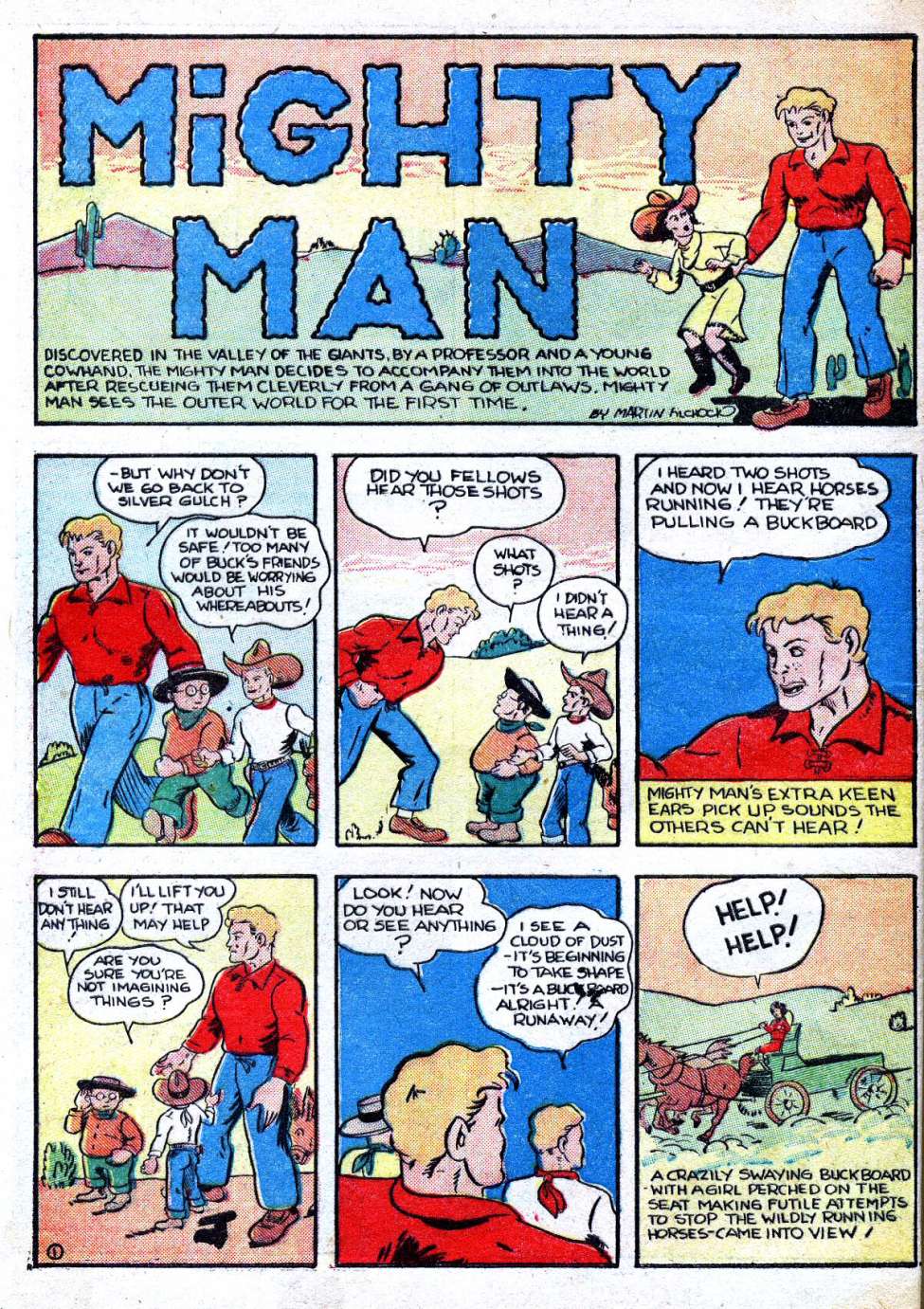
Giants have keener than human hearing (3 in 6 chance to hear noise?).


I either need to upgrade the Movement rate for giants, or Mighty Man is using the Outrun Train power here.


Wrecking through the outside wall is like wrecking cars on the wrecking things table. Hoisting up the water tower is one of the Raise powers, though, and given how heavy all that water is it might be one of the big ones like Raise Bridge.

(Scans courtesy of Comic Book Plus.)


Saturday, August 27, 2016

Crackajack Funnies #14

We haven't checked in on Dan Dunn in awhile. Here, I'm interested in the double protection of having a secret room, behind a secret door, and a second concealed door behind a painting in the secret room. But can we distinguish between secret and concealed doors here? We don't actually see the first secret door behind the bookcase; it's just described to us. If the bookcase is only blocking a normal door, then I would call that a concealed door. But if it looked like blank wall behind the bookcase until you pulled a lever disguised to look like a book on the shelf, causing it to slide open, then you have a secret door.

Slade missed his save vs. plot to see through Dan's act, but Fallon made his. It's worth pointing out that a disguise doesn't have to be a fake mustache or stage make-up; it can be trying to pass yourself off as someone else.

This reminds me of the Cowboy stunt Jump into Saddle (from Supplement III), and also reminds me that Jump into Saddle could have explained how Abdul the Arab could have leaped down into a moving car in the post I did on Smash Comics #1 two days ago.


Only a hoodlum who's never read Treasure Island would skip searching a crutch.

But I'm more interested here in Peggy's Mother's concern about her jewelry being all fakes. Granted, this is a non-Hero character, but if it was a Hero, how would I handle this? A successful appraisal check tells her they're fake, but a failed roll only tells her she doesn't know for sure yet.

In Hideouts & Hoodlums I don't tell you who should make the dice rolls, leaving that up to each Editor to decide. Often, I like to let players make their own encounter reaction rolls. I normally do let them make their own skill checks -- but I can see situations, like appraisal, where a secret check by the Editor might make more sense. Then the players have to react to what the Editor tells them, instead of what they know from the dice roll.

The nice thing about this escape plan is that there's no time crunch involved. If the cistern had been filling up with water, that would be another thing, but because the three of them can try the human pyramid trick as many times as they want, there's no reason not to just wave game mechanics, say it works, and reward Easy's player for his good idea.


From Myra North, Special Nurse, we learn that artificial respiration was much different in the 1930s! It makes you wonder how first aid ever worked back then. No wonder it doesn't give you immediate hit points back in H&H!


I just had to share this because it's pretty cool. Myra North must have at least one level in Fighter. Here she takes on a spy armed with a gun, using only a pair of scissors, and still wins!


Sound-proof doors in hideouts is something to consider. It would waste a lot of players' hear noise rolls during a hideout-clearing expedition. On the other hand, it would also keep mobsters from being able to hear combat in their neighbors' rooms and lend aid.

(Scans courtesy of Digital Comics Museum)