Poor hippo! I hate this cover...
Barry O'Neill and Fang Gow definitely hate each other. Ol' Fang has Barry in a familiar death trap -- "the 'Water Cure' - drops slowly fall on his forehead, which will eventually cause insanity, then death." I have never understood how that would actually work, but it's enough of a genre staple that it must at least work in Hideouts & Hoodlums. But how, exactly? Since it's obviously not an impatient man's trap, I'd say the victim would have to save vs. plot every four hours to avoid going temporarily insane. Then the victim would have to save vs. plot every four hours to avoid going permanently insane. Then the victim would have to save vs. plot every four hours to escape death.
Fang Gow's followers are described as bandits.
Cotton Carver and Volor the Dwarf are overwhelmed by the "reed men", so called because their skin is green like reeds. In situations like this, when "new" mobster types are clearly just "reskinned" humans, I do not plan to give them their own stats; reed men sound an awful lot like natives to me.
The bigger issue is, how to overwhelm foes with superior numbers in H&H? If, say, 100 natives all try to pile onto a Hero, do you only roll to attack for the 9 who can immediately surround him, or take the collective pushing force, weight, and mass of the whole crowd into account? I here propose rolling to attack for all of them, and giving the Hero a -1 penalty to save vs. science for every hit after the first to avoid being pinned. Even high-level Heroes will have to avoid confronting huge mobs now!
Steve Carson of Federal Men is being led out into a field by three gunmen who plan to shoot him down. No slow death trap, no source of cover -- it looks like Steve's Editor has either decided to stop going easy on him or is ready to end the solo campaign! But Steve's player is smart and comes up with a good plan, to ask the hoodlums which is in charge and get them to fight each other. Given the life-and-death nature of the situation, I might just give him a win and let the trick fool the hoodlums, to reward him for his creativity. But if I was feeling less merciful, I might roll a save vs. plot for the hoodlums to determine if they fall for it or not.
Tod Hunter runs afoul of a jealous wizard with a new magic potion -- Potion of Suggestion (makes him vulnerable to everything said to him, as if the Suggestion spell) -- and a new spell, Life Link. I'd say this spell has to be maybe 7th level, as it's pretty powerful; the Magic-User links his life to someone else and if one dies, the other dies too. Tod gets Dispel Magic cast on him too.
Dale Daring seems a little useless in her scenario; she's surrounded by a company of fighters of up to 4th level (F4 = lieutenant). Still, every good die roll can be important in a scenario, and Dale is able to make the listen check that everyone else fails and allows her to hear the poachers coming.
Captain Desmo is hidden world-exploring and encounters a "prehistoric crocodile." I'm not sure how big it looks in the comic book, but prehistoric crocodiles could weigh up to 8 tons -- we're talking maybe a 30 Hit Die crocodile here. I'm guessing the author had something less dangerous in mind -- maybe a giant crocodile should only go up to 15 Hit Dice? Regardless, Desmo and Gabby wisely run from it.
The human natives need Desmo's help against giants called the Mudas -- and the summary writer wasn't kidding when he called them giants. One of them apparently picks up Desmo in his hand! So we're talking frost giant size here, if not cloud giant size. And yet...the natives manage to bring these giants down with mostly spears? Something seems amiss here to me. I would probably stat the Mudas as hill giants to make them more killable. And I do plan on weeding out some of the giant types from H&H, so it'll be important to watch how many I recognize here in the blog.
Tom Brent, in a rare stand-alone story...is captured by an old man with a shotgun and misses out on most of his own scenario, as the local police catch the smugglers who threatened him. If you ever have a session of H&H that goes badly for you, you can take some consolation if it didn't go Tom Brent-level bad.
(Summaries read at DC Wikia)
An exploration of the Golden Age of Comics, through the lens of Hideouts & Hoodlums, the comic book roleplaying game.
Showing posts with label Dale Daring. Show all posts
Saturday, May 28, 2016
Wednesday, May 11, 2016
Adventure Comics #36 - pt. 1
We rejoin Barry O'Neill's supporting cast, Jean Le Grand, collapsing from exhaustion, heat, and dehydration in the desert. It has already been pointed out on this blog that Hideouts & Hoodlums has no game mechanic for exhaustion, and that environmental damage should be accounted for by hit point loss. Does this story make me want to revisit that? No, because unusual effects can be assigned to supporting cast always at the discretion of the Editor. If it was the hero, Barry, suffering -- or more examples to that effect -- then I might need to work harder at emulating those conditions.
Barry O'Neill goes in disguise and it's a merchant disguise he's apparently worn before. Maybe disguises could be treated like outfits that can just be bought -- merchant disguise, old lady disguise, hoodlum disguise, etc.
Cotton Carver is still on a lost world adventure. He enters the domain of the White Warriors -- some pretty wimpy warriors who still have some remarkable advanced technology for some reason. They have paralyzing ray guns (though maybe not all their soldiers do), and some of them ride around in something called a "Vicla" -- a red tornado (no, not the Red Tornado, she comes later!) -like ...thing that you float inside and control by thought. The Vicla goes fast, but not extremely fast (maybe a 24 Move?), and seems to offer little cover (soft cover?) to the occupant.
Cotton also encounters a dwarf that sounds like he's straight out of Tolkien's Middle Earth.
Tod Hunter moves through a trapped temple in his adventure. One of the traps is a heated floor ("Volcanically" heated -- so hot enough to do 1-10 damage? I recently used a similar trap in one of my home campaigns, where the floor magically burst into fire under people's feet if two or more people entered it).
Tod runs into a magic-user, but we have to wait until the next installment to find out what spells the magic-user can cast.
No game referee likes it when the players bring along too much help. A squad of cops or a couple of G-Men take some of the element of danger off of the heroes and makes the game less challenging for the players. Dale Daring and Don Brewster take that notion and crank it up a notch when they have trouble with a bunch of ivory smugglers -- and recruit an entire Naval regiment to aid them (Dale must have rolled 12 on her encounter reaction check!). The Editor can do two things at that point; he can either kiss his scenario good-bye, or he can up the threat level. In this story, the smugglers -- who had a hard enough time with Dale and Don in the past four installments of this story -- suddenly have mines they can use to try and sink the approaching naval vessels.
Don and Dale also use a cabin cruiser, which makes another transportation item that needs to be statted.
Captain Desmo flies into the Himalayas this time and encounters a new threat we haven't seen before in comics -- cold damage to planes. It's true, I have considered assigning hit points to vehicles for vehicular combat. I don't know how that would work yet. Hit points for living things is based on the mechanic of 1 hit point = 30 lbs of weight (roughly), but that would make for cars with 100 hp! Maybe the weight allowance would double for each hp -- so 1 hp = 30 lbs, 2 hp = 60 lbs, 3 hp = 120 lbs, and so on. That would put the average 1940 car around 8 hp, but a small passenger plane would be far more vulnerable with 4-5 hit points.
Regardless, another way to deal with this would be to simply tell Capt. Desmo's player that ice is forming on the wings, and ask him to save vs. plot or something bad might happen because of this.
Desmo hires guides and porters once his mountain trek starts. Obviously, porters are there to keep heroes from traveling encumbered, while guides give you extra rolls for noticing things along the way, like tracks, concealed cave mouths, and so on.
The footing is treacherous on the mountain, though. There is probably a 2 in 6 chance of someone falling into a snow-concealed crevice (like Irma Gladstone almost does in the story), so the more guides and porters you bring, the more likely you are that someone is going to fall, in that circumstance.
(Summaries read from DC Wikia)
Barry O'Neill goes in disguise and it's a merchant disguise he's apparently worn before. Maybe disguises could be treated like outfits that can just be bought -- merchant disguise, old lady disguise, hoodlum disguise, etc.
Cotton Carver is still on a lost world adventure. He enters the domain of the White Warriors -- some pretty wimpy warriors who still have some remarkable advanced technology for some reason. They have paralyzing ray guns (though maybe not all their soldiers do), and some of them ride around in something called a "Vicla" -- a red tornado (no, not the Red Tornado, she comes later!) -like ...thing that you float inside and control by thought. The Vicla goes fast, but not extremely fast (maybe a 24 Move?), and seems to offer little cover (soft cover?) to the occupant.
Cotton also encounters a dwarf that sounds like he's straight out of Tolkien's Middle Earth.
Tod Hunter moves through a trapped temple in his adventure. One of the traps is a heated floor ("Volcanically" heated -- so hot enough to do 1-10 damage? I recently used a similar trap in one of my home campaigns, where the floor magically burst into fire under people's feet if two or more people entered it).
Tod runs into a magic-user, but we have to wait until the next installment to find out what spells the magic-user can cast.
No game referee likes it when the players bring along too much help. A squad of cops or a couple of G-Men take some of the element of danger off of the heroes and makes the game less challenging for the players. Dale Daring and Don Brewster take that notion and crank it up a notch when they have trouble with a bunch of ivory smugglers -- and recruit an entire Naval regiment to aid them (Dale must have rolled 12 on her encounter reaction check!). The Editor can do two things at that point; he can either kiss his scenario good-bye, or he can up the threat level. In this story, the smugglers -- who had a hard enough time with Dale and Don in the past four installments of this story -- suddenly have mines they can use to try and sink the approaching naval vessels.
Don and Dale also use a cabin cruiser, which makes another transportation item that needs to be statted.
Captain Desmo flies into the Himalayas this time and encounters a new threat we haven't seen before in comics -- cold damage to planes. It's true, I have considered assigning hit points to vehicles for vehicular combat. I don't know how that would work yet. Hit points for living things is based on the mechanic of 1 hit point = 30 lbs of weight (roughly), but that would make for cars with 100 hp! Maybe the weight allowance would double for each hp -- so 1 hp = 30 lbs, 2 hp = 60 lbs, 3 hp = 120 lbs, and so on. That would put the average 1940 car around 8 hp, but a small passenger plane would be far more vulnerable with 4-5 hit points.
Regardless, another way to deal with this would be to simply tell Capt. Desmo's player that ice is forming on the wings, and ask him to save vs. plot or something bad might happen because of this.
Desmo hires guides and porters once his mountain trek starts. Obviously, porters are there to keep heroes from traveling encumbered, while guides give you extra rolls for noticing things along the way, like tracks, concealed cave mouths, and so on.
The footing is treacherous on the mountain, though. There is probably a 2 in 6 chance of someone falling into a snow-concealed crevice (like Irma Gladstone almost does in the story), so the more guides and porters you bring, the more likely you are that someone is going to fall, in that circumstance.
(Summaries read from DC Wikia)
Labels:
Barry O'Neill,
Captain Desmo,
Cotton Carver,
Dale Daring,
disguise,
Editor's tips,
environments,
hirelings,
hit points,
new mobsters,
new trophies,
saving throws,
Tod Hunter,
transportation,
traps,
vehicular combat
Sunday, April 17, 2016
Adventure Comics #35
In this installment of Barry O'Neill, Barry dives underwater and the bad guys assume he's dead because he stayed under so long. Villains seem to be terrible at underestimating how long Heroes can stay underwater -- so much so that they should have to save vs. plot to avoid making this cliched mistake.
Doctors are treated as a Lawful mobster-type in Supplement V: Big Bang because they have special abilities in comics -- one found here is the ability to quickly concoct antidotes. Dr. Bonfil crafts an antidote for Fang Gow's hypnosis drug in less than a day.
Shades of the Savage Land! Cotton Carver's adventures debut in this issue. When forced to land on Antarctica, Cotton is saved by a group of people from the lost world of Mayala, a tropical valley long ago found and settled by both the Mayans and Incas (who are rival tribes here now). Though the natives have seen gunpowder weapons before, they have none of their own and Cotton's six-shooters make him a fearsome foe for the natives (and awfully handy for a solo campaign!).
It is unclear how Mayala can only be entered by swimming underwater, if the valley is open to the sky -- unless it is assumed that Mayala is a "hollow world" setting like Pellucidar.
Sleeping gas takes out an entire bank-full of people in this installment of Federal Men. This will be neither the first nor the last instance of sleeping gas being shown to be much more effective in the comics than it is in real life. The amnesia-suffering Steve Carson seems to have no trouble acquiring this super-sleeping gas, as well as gas masks for his gang, despite the absence of such things from the starting equipment list. Though perhaps we are just not privy to the separate adventure Steve went on to find these trophy items.
In Dale Daring, Don and Dale seek shelter in a cave from an approaching storm. The weird thing about storms is that, in real life, everyone rushes out of them, but there is little in-game reason to do so. Is your Hero going to take damage from getting wet? Is the Editor going to pull out all the stops on that storm and start pummeling Heroes with lightning strikes? Probably neither -- and yet Heroes should have to save vs. plot to resist the urge to seek shelter.
Tod Hunter becomes the second Hero in comics to suffer amnesia (since the other is Steve Carson, they both happen in the same comic book!). Maybe there needs to be a 1% chance every time someone is reduced to zero hit points and recovers of suffering temporary amnesia.
Large gorillas are strong enough to wreck things, at least against doors.
Both the Dale Daring and Rusty and His Pals installments revolve around finding something in the back of a cave -- a pile of stolen ivory and a secret door to a hidden lair respectively. It makes me think Hideouts & Hoodlums needs a random table for random cave contents.
In Rusty and His Pals, the villains have a seaplane. The villains also benefit from the Heroes lighting a fire in the cave, serving as a reminder for the Editor that any light source the Heroes rely on can be seen by mobsters some distance away (and vice versa).
(Summaries read at DC Wikia)
Doctors are treated as a Lawful mobster-type in Supplement V: Big Bang because they have special abilities in comics -- one found here is the ability to quickly concoct antidotes. Dr. Bonfil crafts an antidote for Fang Gow's hypnosis drug in less than a day.
Shades of the Savage Land! Cotton Carver's adventures debut in this issue. When forced to land on Antarctica, Cotton is saved by a group of people from the lost world of Mayala, a tropical valley long ago found and settled by both the Mayans and Incas (who are rival tribes here now). Though the natives have seen gunpowder weapons before, they have none of their own and Cotton's six-shooters make him a fearsome foe for the natives (and awfully handy for a solo campaign!).
It is unclear how Mayala can only be entered by swimming underwater, if the valley is open to the sky -- unless it is assumed that Mayala is a "hollow world" setting like Pellucidar.
Sleeping gas takes out an entire bank-full of people in this installment of Federal Men. This will be neither the first nor the last instance of sleeping gas being shown to be much more effective in the comics than it is in real life. The amnesia-suffering Steve Carson seems to have no trouble acquiring this super-sleeping gas, as well as gas masks for his gang, despite the absence of such things from the starting equipment list. Though perhaps we are just not privy to the separate adventure Steve went on to find these trophy items.
In Dale Daring, Don and Dale seek shelter in a cave from an approaching storm. The weird thing about storms is that, in real life, everyone rushes out of them, but there is little in-game reason to do so. Is your Hero going to take damage from getting wet? Is the Editor going to pull out all the stops on that storm and start pummeling Heroes with lightning strikes? Probably neither -- and yet Heroes should have to save vs. plot to resist the urge to seek shelter.
Tod Hunter becomes the second Hero in comics to suffer amnesia (since the other is Steve Carson, they both happen in the same comic book!). Maybe there needs to be a 1% chance every time someone is reduced to zero hit points and recovers of suffering temporary amnesia.
Large gorillas are strong enough to wreck things, at least against doors.
Both the Dale Daring and Rusty and His Pals installments revolve around finding something in the back of a cave -- a pile of stolen ivory and a secret door to a hidden lair respectively. It makes me think Hideouts & Hoodlums needs a random table for random cave contents.
In Rusty and His Pals, the villains have a seaplane. The villains also benefit from the Heroes lighting a fire in the cave, serving as a reminder for the Editor that any light source the Heroes rely on can be seen by mobsters some distance away (and vice versa).
(Summaries read at DC Wikia)
Labels:
amnesia,
Barry O'Neill,
campaign ideas,
cliches,
Cotton Carver,
Dale Daring,
dressing,
hidden lands,
illumination,
mobsters,
Rusty and His Pals,
saving throws,
Steve Carson Federal Men,
Tod Hunter,
trophies
Friday, April 1, 2016
Adventure Comics #34
Fang Gow purchases a mind control drug in this installment of Barry O'Neill. The drug has to be injected (at least in this form). Worth discussing here is the nature of mind control and what it can and cannot force someone to do. Characters in stories with their minds controlled, even supporting cast, often shake off the effects at the last moment for maximum dramatic effect. In this case, it is notable that Inspector Le Grand is not able to shake off the effect. Evidence of saving throws?
In Tom Brent, the First Mate gets shot when Tom dodges a bullet -- proof both of the save vs. missiles rule, and the dangers of shooting into a melee. The story also involves a shipboard mutiny...Hideouts & Hoodlums briefly touches on Loyalty as a game mechanic, but it is basically just treated as Morale under another name. Loyalty might need to be expanded on in 2nd edition, particularly in terms of how it could cause mutinies among supporting cast members.
Steve Carson of Federal Men goes on a car chase. I've talked before about using hit points and combat for ending car chases, but there needs to be a competing mechanic of evasion at work too. Can Steve make an evasion roll before his opponents shoot up his car? I don't want evasion to just be a single roll, though, because that's boring. Maybe evasion should work in degrees, so the first successful roll moves you from short range to medium, the next roll could move you from medium to long range - or back to short range if you bungle the roll. It needs more thought.
Dale Daring and her boyfriend encounter a trap that consists of a pit/crevice. The unusual thing here is that the pit is not covered or concealed in any way, but the Heroes may fall into the pit because the uneven floor around it is not safe to walk on.
Tod Hunter faces cannibals. I had once considered treating cannibals as its own mobster type, but decided to lump them under Natives instead. There is also an 8' gorilla in this story. In the normal/large/huge/giant categories for animal-mobsters, would an 8' gorilla be large or huge? I would think it would fall somewhere in between, but would probably side conservatively with making it a "large ape", so that "giant ape" could still be something more King Kong-sized. Also, we know from this story that apes should get a crushing hug attack and a bite attack.
In The Gold Dragon -- we finally see the gold dragon. It's been a long set-up for this (this is the 29th episode), so much so that this is not our first dragon in comics at this point, or even our second. It is the first dragon to fit the dragon types found in H&H, though the gold dragon has, luckily, always been found in the game since Book II: Mobsters & Trophies.
Anchors Aweigh reminded me of several issues this month. One is keeping track of ammo -- because being on your last bullet should be a suspenseful moment for every Fighter relying on guns. Two is fatigue from running. H&H has a fatigue rule that is more combat-oriented; it needs to apply to running as well. Three is when Marshall's last shot fails to frighten off the natives because of their large numbers -- morale needs to be modified so that number encountered affects morale saves.
(Summaries from DC Wikia)
In Tom Brent, the First Mate gets shot when Tom dodges a bullet -- proof both of the save vs. missiles rule, and the dangers of shooting into a melee. The story also involves a shipboard mutiny...Hideouts & Hoodlums briefly touches on Loyalty as a game mechanic, but it is basically just treated as Morale under another name. Loyalty might need to be expanded on in 2nd edition, particularly in terms of how it could cause mutinies among supporting cast members.
Steve Carson of Federal Men goes on a car chase. I've talked before about using hit points and combat for ending car chases, but there needs to be a competing mechanic of evasion at work too. Can Steve make an evasion roll before his opponents shoot up his car? I don't want evasion to just be a single roll, though, because that's boring. Maybe evasion should work in degrees, so the first successful roll moves you from short range to medium, the next roll could move you from medium to long range - or back to short range if you bungle the roll. It needs more thought.
Dale Daring and her boyfriend encounter a trap that consists of a pit/crevice. The unusual thing here is that the pit is not covered or concealed in any way, but the Heroes may fall into the pit because the uneven floor around it is not safe to walk on.
Tod Hunter faces cannibals. I had once considered treating cannibals as its own mobster type, but decided to lump them under Natives instead. There is also an 8' gorilla in this story. In the normal/large/huge/giant categories for animal-mobsters, would an 8' gorilla be large or huge? I would think it would fall somewhere in between, but would probably side conservatively with making it a "large ape", so that "giant ape" could still be something more King Kong-sized. Also, we know from this story that apes should get a crushing hug attack and a bite attack.
In The Gold Dragon -- we finally see the gold dragon. It's been a long set-up for this (this is the 29th episode), so much so that this is not our first dragon in comics at this point, or even our second. It is the first dragon to fit the dragon types found in H&H, though the gold dragon has, luckily, always been found in the game since Book II: Mobsters & Trophies.
Anchors Aweigh reminded me of several issues this month. One is keeping track of ammo -- because being on your last bullet should be a suspenseful moment for every Fighter relying on guns. Two is fatigue from running. H&H has a fatigue rule that is more combat-oriented; it needs to apply to running as well. Three is when Marshall's last shot fails to frighten off the natives because of their large numbers -- morale needs to be modified so that number encountered affects morale saves.
(Summaries from DC Wikia)
Labels:
ammunition,
Anchors Aweigh,
Barry O'Neill,
car chases,
Dale Daring,
evasion,
Federal Men,
Gold Dragon,
loyalty,
mind control,
missile attacks,
mobsters,
new mobsters,
saving throws,
Tod Hunter,
Tom Brent,
traps
Monday, March 14, 2016
Adventure Comics #33
Last issue I'll be looking at from 1938!
In Anchors Aweigh, we're reminded that natives are often depicted as being expert trackers (though in the wilderness, not necessarily in urban environments), and should have some kind of bonus for doing that (or be treated like the explorer class for tracking).
Tom Brent's adventure apparently takes place in a real city in China, Ningbo. Tom pulls the ol' pull-the-rug-out trick on his attacker, which is so commonplace that it should probably only require a straight save vs. plot to avoid. Further, Tom shows remarkable ingenuity at searching bodies for treasure -- even looking inside somebody's glass eye for a missing diamond (and finding it there!).
This issue's Federal Men adventure is the first time in comic books that a starring character suffers amnesia. I suppose every comic book character gets amnesia eventually -- but I would hesitate to allow even a 1% chance per injury of player-Heroes suffering amnesia, as it is difficult to roleplay and disruptive to ongoing scenarios.
The Dale Daring adventure seems remarkable only in that the natives are armed with guns for a change, instead of primitive weapons.
(Summaries of this issue's stories read at DC Wikia)
In Anchors Aweigh, we're reminded that natives are often depicted as being expert trackers (though in the wilderness, not necessarily in urban environments), and should have some kind of bonus for doing that (or be treated like the explorer class for tracking).
Tom Brent's adventure apparently takes place in a real city in China, Ningbo. Tom pulls the ol' pull-the-rug-out trick on his attacker, which is so commonplace that it should probably only require a straight save vs. plot to avoid. Further, Tom shows remarkable ingenuity at searching bodies for treasure -- even looking inside somebody's glass eye for a missing diamond (and finding it there!).
This issue's Federal Men adventure is the first time in comic books that a starring character suffers amnesia. I suppose every comic book character gets amnesia eventually -- but I would hesitate to allow even a 1% chance per injury of player-Heroes suffering amnesia, as it is difficult to roleplay and disruptive to ongoing scenarios.
The Dale Daring adventure seems remarkable only in that the natives are armed with guns for a change, instead of primitive weapons.
(Summaries of this issue's stories read at DC Wikia)
Friday, February 19, 2016
Adventure Comics #32
These are dark days for this blog, for that amazing resource Comic Book Archives has finally had its plug pulled by a vengeful DC Comics. Which means we're back to secondary sources for much of DC history not currently collected in Archive editions.
What I can tell you about this issue is that, apparently, Barry O'Neill picks up where he left off last time in Fang Gow's flooded room trap. Barry quickly finds a way to deactivate the trap and, it does make sense to have a way of deactivating the trap in the same room as the trap -- for the meta-gaming reason of helping Heroes stay alive, as well as the practical reason of allowing villains to deactivate their own traps if they happen to get caught in them.
A hideout burns down in Steve Carson's Federal Men adventure. Players will always have to weight carefully the option of burning the hideout down. Will innocents be harmed? Will valuable trophies by damaged or destroyed? Do the mobsters have an escape route to get out, or will they charge out and attack the Heroes en masse? Would the Heroes have an easier time going in and picking off the bad guys room-by-room? In this case, the fire is accidental and caused by a dropped cigarette. Smoking rates really peaked post-War, but smoking was still very popular in the pre-War years. Smoking mobsters could be as big a danger to master criminals as Heroes.
Dale Daring, in her adventure, deals with the touchy subject of colonization, South American rubber plantations, and slave-like labor. Bear in mind that this is 1938, so Dale's progressive position is that the natives should be treated well and not beaten -- not paid a fair wage, allowed to unionize, or other modern considerations. Players should not be penalized for approaching these issues from a modern perspective, but neither should they be penalized for putting themselves in the mindset of the times.
The Captain Desmo adventure pits him against bandits and, like many earlier comic books, treats "bandits" as an ethnic/cultural role. Also like in some comic books, these bandits are well-armed with both rifles and machine guns.
Pre-Aragorn, Steve in Rusty and His Pals uses pillows stuffed in a bed to fool an assassin. This seems to be such an old trick that it must work on most people, unless they make a save vs. plot (like seeing through a disguise).
(Summaries read at the DC Comics Wiki)
What I can tell you about this issue is that, apparently, Barry O'Neill picks up where he left off last time in Fang Gow's flooded room trap. Barry quickly finds a way to deactivate the trap and, it does make sense to have a way of deactivating the trap in the same room as the trap -- for the meta-gaming reason of helping Heroes stay alive, as well as the practical reason of allowing villains to deactivate their own traps if they happen to get caught in them.
A hideout burns down in Steve Carson's Federal Men adventure. Players will always have to weight carefully the option of burning the hideout down. Will innocents be harmed? Will valuable trophies by damaged or destroyed? Do the mobsters have an escape route to get out, or will they charge out and attack the Heroes en masse? Would the Heroes have an easier time going in and picking off the bad guys room-by-room? In this case, the fire is accidental and caused by a dropped cigarette. Smoking rates really peaked post-War, but smoking was still very popular in the pre-War years. Smoking mobsters could be as big a danger to master criminals as Heroes.
Dale Daring, in her adventure, deals with the touchy subject of colonization, South American rubber plantations, and slave-like labor. Bear in mind that this is 1938, so Dale's progressive position is that the natives should be treated well and not beaten -- not paid a fair wage, allowed to unionize, or other modern considerations. Players should not be penalized for approaching these issues from a modern perspective, but neither should they be penalized for putting themselves in the mindset of the times.
The Captain Desmo adventure pits him against bandits and, like many earlier comic books, treats "bandits" as an ethnic/cultural role. Also like in some comic books, these bandits are well-armed with both rifles and machine guns.
Pre-Aragorn, Steve in Rusty and His Pals uses pillows stuffed in a bed to fool an assassin. This seems to be such an old trick that it must work on most people, unless they make a save vs. plot (like seeing through a disguise).
(Summaries read at the DC Comics Wiki)
Saturday, January 30, 2016
New Adventure Comics #31 - part 1
Barry O'Neill takes it slow while moving through hideouts. He tests the walls, pulls on anything suspicious, like rings set in walls -- and finds secret doors that way!
In the first room behind the secret door, Barry finds two cobras. Luckily, even though Barry came disguised, he still has a concealed flashlight and weapon.
In the room is a note for Barry from his nemesis, Fang Gow. An Editor can always do this too, retroactively placing notes wherever the Heroes are, as if the nemesis anticipated them. Just be careful not to go too far with this, if the Heroes went somewhere really unexpected.
The tunnel after the cobra room is trapped -- it swiftly fills with water. I assume the secret door Barry used to get in can't be opened from this side. I'll have to wait until next month to find out how he gets out!
Tom Brent, in his adventure, is captured, but his captors forget to search him and leave a weapon on him. This same situation happened in one of my Hideouts & Hoodlums campaigns; in that case, the player asked for a chance of having a weapon left unfound on his person, so I gave him a save vs. plot to make that happen.
Tom makes the smart move of capturing the leader and making all his henchmen stand down, rather than fight his way through everyone. It's the safer move, anyway. I'm not sure I'd allow full experience awards for the henchmen for it, even though he's technically defeated them this way.
Players often want to get to where they need to go as early as possible. Tell them that they have a midnight rendezvous and they'll show up at 6 pm and start staking out the place. The same holds true for Steve Carson of Federal Men, who thinks the 4-hour car ride from Washington, D.C. to New York City is too long and flies there instead. Knowing this, the Editor can plan more scenarios that require a time crunch.
On the other hand, if the scenario has high stakes, like a kidnapped child who will be killed if the Heroes do not find him in time, it's best to keep from setting a definite deadline, so the Heroes can always show up at the last minute and save him.
In Dale Daring, the Heroes shockingly take a moment to check their guns to see if they still have any ammo left. One is empty, but the other is okay.
I have suggested several "fixes" over the years for good ways to more easily keep track of remaining ammo during combat. One of them was to roll randomly, 1d6, to see how many turns you can shoot before running out of bullets. That seems to be what happened here, in Dale Daring, given the disparity between their ammo situations.
In Cal n' Alec, Cal wants Alec to go ahead because Cal thinks he sees quicksand and Alec doesn't. Sounds like spotting dangerous terrain needs to be a random chance, just like finding secret doors.
Cal n' Alec is a gag strip, so I don't know how seriously to take this, but it takes Cal five hours to dig a 25' deep pit.
As Captain Desmo's India adventure continues, a bounty is set for him at 20 gold pieces. Which is odd because, by 1938, India already was using the silver Rupee as its unit of currency.
Desmo wins two battles against the thieves by failed morale saves -- once after mowing down enough of them with a machine gun, and then later by mowing down their leader with a machine gun.
(This issue can be read at Comic Book Archives)
In the first room behind the secret door, Barry finds two cobras. Luckily, even though Barry came disguised, he still has a concealed flashlight and weapon.
In the room is a note for Barry from his nemesis, Fang Gow. An Editor can always do this too, retroactively placing notes wherever the Heroes are, as if the nemesis anticipated them. Just be careful not to go too far with this, if the Heroes went somewhere really unexpected.
The tunnel after the cobra room is trapped -- it swiftly fills with water. I assume the secret door Barry used to get in can't be opened from this side. I'll have to wait until next month to find out how he gets out!
Tom Brent, in his adventure, is captured, but his captors forget to search him and leave a weapon on him. This same situation happened in one of my Hideouts & Hoodlums campaigns; in that case, the player asked for a chance of having a weapon left unfound on his person, so I gave him a save vs. plot to make that happen.
Tom makes the smart move of capturing the leader and making all his henchmen stand down, rather than fight his way through everyone. It's the safer move, anyway. I'm not sure I'd allow full experience awards for the henchmen for it, even though he's technically defeated them this way.
Players often want to get to where they need to go as early as possible. Tell them that they have a midnight rendezvous and they'll show up at 6 pm and start staking out the place. The same holds true for Steve Carson of Federal Men, who thinks the 4-hour car ride from Washington, D.C. to New York City is too long and flies there instead. Knowing this, the Editor can plan more scenarios that require a time crunch.
On the other hand, if the scenario has high stakes, like a kidnapped child who will be killed if the Heroes do not find him in time, it's best to keep from setting a definite deadline, so the Heroes can always show up at the last minute and save him.
In Dale Daring, the Heroes shockingly take a moment to check their guns to see if they still have any ammo left. One is empty, but the other is okay.
I have suggested several "fixes" over the years for good ways to more easily keep track of remaining ammo during combat. One of them was to roll randomly, 1d6, to see how many turns you can shoot before running out of bullets. That seems to be what happened here, in Dale Daring, given the disparity between their ammo situations.
In Cal n' Alec, Cal wants Alec to go ahead because Cal thinks he sees quicksand and Alec doesn't. Sounds like spotting dangerous terrain needs to be a random chance, just like finding secret doors.
Cal n' Alec is a gag strip, so I don't know how seriously to take this, but it takes Cal five hours to dig a 25' deep pit.
As Captain Desmo's India adventure continues, a bounty is set for him at 20 gold pieces. Which is odd because, by 1938, India already was using the silver Rupee as its unit of currency.
Desmo wins two battles against the thieves by failed morale saves -- once after mowing down enough of them with a machine gun, and then later by mowing down their leader with a machine gun.
(This issue can be read at Comic Book Archives)
Labels:
ammunition,
Barry O'Neill,
Cal n' Alec,
Captain Desmo,
Dale Daring,
digging,
Editor's tips,
environments,
Federal Men,
hideouts,
history lesson,
mobsters,
player tips,
saving throws,
secret doors,
Tom Brent,
traps
Friday, December 4, 2015
New Adventure Comics #28 - part 2
Tod Hunter, Jungle Master, and his English gentleman sidekick Tommy, are exploring a temple hideout. In a room concealed behind a curtain is a lit and smoking incense brazier and a raised dais used, not for sacrifice, but for sleeping by the high priestess. While Zara the High Priestess wields a scimitar, her followers (there are at least eight of them) fight with primitive spears and hand axes (and half of them only wear loin clothes).
The sacrificial room is a huge chamber with a tall wooden idol carved to look like a sitting demon -- not too far different from the iconic cover of the 1978 Advanced Dungeons & Dragons Players Handbook! The corridors are lit with torches held in sconces. A corridor leading from the sacrificial room runs to a circular arena that can be watched through barred gates. The entrance is trapped so that a steel shutter falls down over the entrance behind them, and then a lion can be released into the arena. Because the High Priestess is watching, this must be a deathtrap.
Dale Daring is in need of rescue in the mountain hideout of a bandit chieftain. Because the bandits are Asian, her boyfriend Don decides to disguise himself by staining his skin yellow and putting transparent tape around his eyes to make them almondine. And because this is a comic book, the disguise has a good chance of working.
We also see a torture chamber with a rack and a suspended cauldron for boiling oil.
Detective Sergeant Carey of the Chinatown Squad is a bit of a jerk. Instead of investigating their suspect's room himself, he sends his Supporting Cast Member,"Sleepy", to do it. Sleepy is actually fairly clever; when confronted by the suspect, Sleepy pretends to be a two-bit crook eager to make any kind of a deal to avoid a "fourth offense" and a lifetime sentence (it would be interesting, if I had the time, to investigate which states had four-strikes-and-you're-out laws for repeat offenders in the 1930s).
Carey is a bit of a risk-taker too. He suspects dope is being smuggled in a coffin, so to prove it, he throws pepper into the coffin and waits to hear a sneeze...which would have been awkward if any part of his theory had turned out to be wrong.
The Robin Hood serial continues to be surprisingly accurate. Friar Tuck fights with a broadsword and a buckler (small round shield), both of which would have been common fighting tools in the 1100s, when Robin Hood supposedly lived. It does suggest, in this installment, that hound dogs should have good Armor Classes, as the Friar's hound dogs are shown being able to dodge arrows.
(This issue can be read at Comic Book Archives)
The sacrificial room is a huge chamber with a tall wooden idol carved to look like a sitting demon -- not too far different from the iconic cover of the 1978 Advanced Dungeons & Dragons Players Handbook! The corridors are lit with torches held in sconces. A corridor leading from the sacrificial room runs to a circular arena that can be watched through barred gates. The entrance is trapped so that a steel shutter falls down over the entrance behind them, and then a lion can be released into the arena. Because the High Priestess is watching, this must be a deathtrap.
Dale Daring is in need of rescue in the mountain hideout of a bandit chieftain. Because the bandits are Asian, her boyfriend Don decides to disguise himself by staining his skin yellow and putting transparent tape around his eyes to make them almondine. And because this is a comic book, the disguise has a good chance of working.
We also see a torture chamber with a rack and a suspended cauldron for boiling oil.
Detective Sergeant Carey of the Chinatown Squad is a bit of a jerk. Instead of investigating their suspect's room himself, he sends his Supporting Cast Member,"Sleepy", to do it. Sleepy is actually fairly clever; when confronted by the suspect, Sleepy pretends to be a two-bit crook eager to make any kind of a deal to avoid a "fourth offense" and a lifetime sentence (it would be interesting, if I had the time, to investigate which states had four-strikes-and-you're-out laws for repeat offenders in the 1930s).
Carey is a bit of a risk-taker too. He suspects dope is being smuggled in a coffin, so to prove it, he throws pepper into the coffin and waits to hear a sneeze...which would have been awkward if any part of his theory had turned out to be wrong.
The Robin Hood serial continues to be surprisingly accurate. Friar Tuck fights with a broadsword and a buckler (small round shield), both of which would have been common fighting tools in the 1100s, when Robin Hood supposedly lived. It does suggest, in this installment, that hound dogs should have good Armor Classes, as the Friar's hound dogs are shown being able to dodge arrows.
(This issue can be read at Comic Book Archives)
Wednesday, November 4, 2015
New Adventure Comics #26
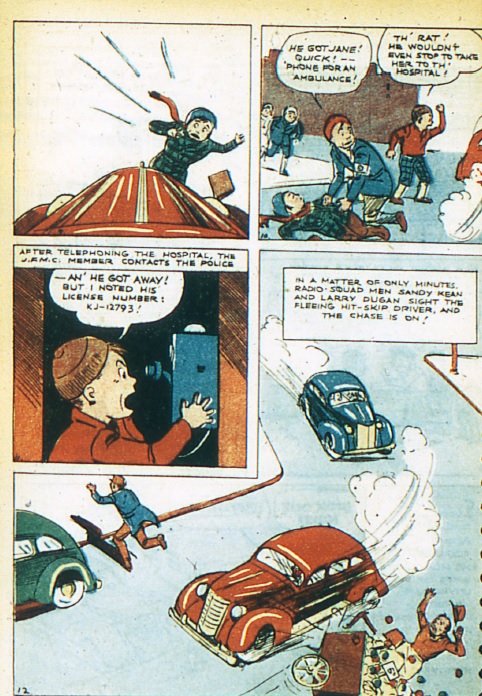
The first crossover in comic book history was not Batman and Superman. It was not the Shield and the Wizard. It was this installment of Federal Men, guest-starring Sandy Kean of Radio Squad -- even though they never leave the car and we are only told the radio squad is in there. One month before introducing Superman, Siegel and Shuster were already building a shared universe for their characters.
Nadir, Master of Magic, is probably the most reluctant caster of spells of all magicians -- or an actual first-level Magic-User with only one spell. In this installment, we find Nadir doing nothing more remarkable than climbing a tree. But -- a palm tree? That should be nearly impossible to climb as he's shown doing it. Could this be the first instance of the spell Spider Climb in comic books...?
This is The Adventures of Rusty and His Pals, the feature Bob Kane did before Batman. It makes the intriguing suggestion that there are both good and bad pirates. The pirates statted in Book II: Mobsters & Trophies were definitely the bad type. I wonder what good pirates would be like...?
There are all kinds of situations that keep popping up in the comics that Hideouts & Hoodlums, as yet, has no rules to handle. Case in point, how many miles one can cover per day on foot, and how long one can force a march before becoming exhausted. The closest there is are the fatigue rules for combat.
Off-hand, I'd rule that you can move 25 miles in a day, +1 mile for every made save. vs plot.
This is from new feature Captain Desmo. Yesterday I was talking about campaign moods and how dark Golden Age comics could get. It doesn't get much darker than this last panel, with the newlyweds discussing her suicide to avoid a fate worse than death if captured...
Does Captain Desmo really have grenades? As an Aviator, he has access to the stunt Bomb, which lets him act like he has grenades to drop from his plane. There are several stunts that Aviators can use to "give themselves" trophy-like items that not only exist as flavor text, but can affect combat temporarily.
Also note, Fighter-types can smoke cigarettes.
I was thinking I might be able to make some point about this page in regards to using cover in combat, or "concealing" trophy weapons where they can be easily found if needed -- but, really, I think I'm going to share this page because I would always put down Centaur for being so racist, but DC could be really racist too.
(Scans courtesy of Comic Book Archives)
Nadir, Master of Magic, is probably the most reluctant caster of spells of all magicians -- or an actual first-level Magic-User with only one spell. In this installment, we find Nadir doing nothing more remarkable than climbing a tree. But -- a palm tree? That should be nearly impossible to climb as he's shown doing it. Could this be the first instance of the spell Spider Climb in comic books...?
This is The Adventures of Rusty and His Pals, the feature Bob Kane did before Batman. It makes the intriguing suggestion that there are both good and bad pirates. The pirates statted in Book II: Mobsters & Trophies were definitely the bad type. I wonder what good pirates would be like...?
There are all kinds of situations that keep popping up in the comics that Hideouts & Hoodlums, as yet, has no rules to handle. Case in point, how many miles one can cover per day on foot, and how long one can force a march before becoming exhausted. The closest there is are the fatigue rules for combat.
Off-hand, I'd rule that you can move 25 miles in a day, +1 mile for every made save. vs plot.
This is from new feature Captain Desmo. Yesterday I was talking about campaign moods and how dark Golden Age comics could get. It doesn't get much darker than this last panel, with the newlyweds discussing her suicide to avoid a fate worse than death if captured...
Does Captain Desmo really have grenades? As an Aviator, he has access to the stunt Bomb, which lets him act like he has grenades to drop from his plane. There are several stunts that Aviators can use to "give themselves" trophy-like items that not only exist as flavor text, but can affect combat temporarily.
Also note, Fighter-types can smoke cigarettes.
I was thinking I might be able to make some point about this page in regards to using cover in combat, or "concealing" trophy weapons where they can be easily found if needed -- but, really, I think I'm going to share this page because I would always put down Centaur for being so racist, but DC could be really racist too.
(Scans courtesy of Comic Book Archives)
Labels:
Aviator,
campaign moods,
Captain Desmo,
Dale Daring,
Detective Sergeant Carey,
fatigue,
Federal Men,
mobsters,
Nadir,
new spells,
racism,
Radio Squad,
Rusty and His Pals,
saving throws,
stunts,
travel,
world-building
Sunday, October 4, 2015
New Adventure Comics #25
When the police arrive, Dale's word isn't even questioned. This is just the sort of "soft mechanic" (no numbers involved) that I had envisioned for level titles having. Had Dale been of a lower title than the police arriving, then he would have needed to persuade them through roleplaying and the Editor would have needed to roll a positive encounter reaction roll.
This installment of Robin Hood brings up an interesting issue -- if all ranges for missile weapons are the same (and they are, as previously described in Book I, but now found in Book III), then how does one win an archery contest of distance? When a variable amount of distance is needed, I would add the results of a d20 roll to the ranges listed.
Make no mistake, this ape doesn't know Steve Conrad from Adam, yet he immediately leaps in to help. It should not be possible to automatically attract Supporting Cast Members without even trying, so this is clearly a freebie from the Editor, who realized too late that he'd made the scenario too challenging.
It would seem that a dagger between the eyes, killing a leopard, might be proof of a critical hit mechanic in place in H&H. I am still biased against the notion, though I'll try to keep an open mind. The situation could also be explained by the leopard just having unusually low hit points.
(Scans courtesy of Comic Book Archives)
Subscribe to:
Posts (Atom)