Showing posts with label missile attacks. Show all posts

Sunday, January 31, 2021

Adventure Comics #48 - pt. 3

When we left off with Socko Strong, he was confronting Monte on the wing of a flying plane about Monte's attempts to kill him. In a clever trick, even though both parachutes are actually fine, Socko pretends he switched parachutes on Monte to give him the "sabotaged" one. You would think Socko would use this trick to make Monte confess, but instead Socko pushes him off the wing to panic him, just to pay him back.

Moving on to Steve Conrad, Adventurer, we find Steve on a cruise where he spots and recognizes 'Singapore Sal,' a notorious jewel thief (perhaps after making an INT ability score check?). When she leaves the deck, Steve is surprised she didn't notice him, suggesting they've met before (and letting us know that Steve had surprise in that encounter?). Sal's partner is called Slick -- he's almost surely a slick hoodlum. Steve comes up with a pretty clever trick where he has his comic sidekick slip a handwritten, signed note by Steve under the door, then listen to the two of them talk about their plans through the door after they read it. 

The next wrinkle in the story is that Steve tries to stop the valuable jewels on the ship from being stolen. The would-be thief appears to be Slick, but he's wearing a mask and, surprisingly, he manages to get away from Steve easily after just hitting him once with a sap (and not even a head blow at that). When Steve confronts Slick he discovers it wasn't him -- Slick is not wearing the same jacket and hasn't had time to change it. Although the wrinkle requires a bit of railroading to let the thief escape, it winds up being a pretty interesting wrinkle. The clue turns out to be the cord Steve tore off the thief; he doesn't know where he's seen it before until he remembers it was holding another passenger's monocle in place (if the player had trouble thinking of this, maybe he was allowed to "remember" after an INT check). 

The only other thing I'm going to say about the Steve Conrad story is that it is extremely verbose with big word balloons in almost every panel.

Am I just going to have to accept that it's a lot easier to throw a missile weapon hard enough to pin it into a wall in comics than real life? In Rusty and His Pals, Rusty manages to throw a spear -- and it's not really a spear, it's just called a spear in the story but it's clearly a lance -- across a room, knocks a man's gun out of his hand, sails right past him, and still hits the wall hard enough to become embedded into it. Did I mention Rusty looks like he's 11 years old? You know...sure, why not. Embedding in the wall is just flavor text at the end of the combat turn that doesn't affect the disarming attack or anything in the following turn. 

Having cleared the bad guys out of the house, they consider the clue they have, that they're supposed to look "behind Stevenson," and then they figure out that there's something in the library behind a copy of Treasure Island -- a clever clue, so long as no one felt like reading it and took it back to their room, of course. Behind the book is a button that opens a secret door. The boys realize they need to consider illumination issues behind the secret door so they all fetch candles. They mysterious passage looks straight out of D&D, leading to a small room with a chair, desk, and a small chest on the desk. The desk contains both a clue, a journal, and a secret clue concealed in a false top -- a single sheet of paper, the contents of which we'll find out next issue.

In Anchors Aweigh, we hear about the trick of putting cotton in your nose to make it look broader, when disguising yourself as someone with a broader nose. There is an interesting wrinkle to the story where Kerry finds out the man he's impersonating has a wife who he has to push away without making her suspicious. The last page, though, is terribly confusing. When the Naval officers burst in on the smugglers' headquarters, they leave the driver tied up in the elevator. The driver, trying to escape, makes the elevator go down with his feet. Somehow, the elevator doors do not close on their own (did elevators not have automatic doors at this time?), so the boss smuggler backs up to the elevator and falls. But...somehow he falls onto the driver at the bottom of the shaft and not onto the roof of the elevator car. Were there ever roofless elevators?

Lastly, Cotton Carver and Deela crash-land in a petrified valley where the challenge of this scenario is finding food! On day 2, they find a tree with edible berries (skill check to identify they are not poisonous?). Hunting for meat, Cotton knows he will run out of bullets soon, so he builds a bow. The terrain gets progressively worse for them; they come across a chasm thousands of feet deep filled with hot geysers, and at their backs they encounter three ape men armed with warclubs weighted for throwing. The ape men seem unusually intelligent and manage to defeat Cotton, then carry them away down to the bottom of the chasm by leaping from branch to branch growing out of the rock wall. Cotton was only stunned and cowardly shoots the ape men in the back (I guess with his last bullets?). Too bad he didn't try to talk to the ape men, because it seems like they could talk. They probably also were responsible for making the stairs they find, and the tall ladders that lead to the top of a volcanic cone. The volcanic cone is dangerous because of poisonous fumes in the air. Both of them make saving throws vs. poison and Deela fails, faints, and falls off the ladder. Cotton grabs her with an attack roll, then makes a Strength check, probably with a significant penalty (-5? More?) to continue climbing the ladder one-handed, while holding Deela with the other.

(Read at readcomiconline.to)


Saturday, May 9, 2020

Smash Comics #8 - pt. 3

Panels like this first one are so useful for figuring out how fast Heroes move. He's flying from New York City to Washington, D.C. -- about 220 miles as the crow flies -- and makes it in 22 minutes. That makes it really easy to figure out Bozo can fly at a staggering 600 MPH -- that's the 3rd-level Race the Bullet power.

Lifting the car is the 1st-level Raise Car power. Coupling that with a flying power makes it even more deadly. Since Bozo seems to have reached cloud altitiude, that puts him at approximately 16,000'.  Now, the Fly powers, as written, have no maximum altitude, so the only distinction is how long it takes to reach cloud level. Even at Fly I, this would only take about 4 1/2 minutes. At Fly II, this would take just over 2 minutes.

Taking no damage from a car exploding probably requires the 4th-level Invulnerability power.
If Bozo has returned to New York City, there is no Bird Airport there, nor even a name close to that.

Traps are usually ineffective if the Heroes have to touch something they have no reason to touch. I can't imagine what Hugh is hoping to accomplish by having Bozo lift the cable. Adolph is clearly inside the shack, not behind the cable!
20,000 volts is not going to melt Bozo, guys. That's a fairly standard amount of volts; your car's spark plug can take it. Now, interestingly, in a more hi-tech setting, Bozo would be full of electronics and 20,000 volts might mess with his systems. But in 1940, robots are chiefly mechanical contrivances, like clockwork automatons. So this trap isn't really doing anything but giving him electrified lariats to kill people with.
Let's jump ahead into Chic Carter. Chic's adventures in Moldavia are finally over and he's back in New York City trying to catch murderers.  Now, by all rights, this scenario should be over before it begins. Chic decides to beat up someone acting like a security guard of the professor he needs to talk to. Now, had Brenda screamed first, Chic could be trying to get in faster to save her, but since she screams after, Chic is just punching anyone who touches his arm.

More seriously, Hideouts & Hoodlums currently has no mechanic for making an attack roll miss against someone else. It doesn't seem like we can ascribe this to flavor text, since saving Lansing's life is vital to the story and why Lansing trusts Chic to take over the investigation. It's possible we could use the parry rules to slightly modify someone else's Armor Class from missile attacks.
Now, this is not a tactic I recommend most players using. Chic has a hunch thieves will come for the valuables in the safe room that night, so he remains locked in the safe room to ambush them. Is that safe room air tight? That's something Chic's player should ask first, in case he's wrong and the thieves wait another night. 
Redundancies are a good way to slow Heroes down, if not discourage them from getting to where they want to get into (players tend to be stubborn like that). Here, we have a wall safe, inside a safe room, each with its own combination.

Dousing the lights gives everyone a penalty to hit, but the open window means positioning is very important in this combat.
That is one amazing hunch Kent gets. Based only on Jenkins' testimony that he didn't know why he pulled the lever, Kent decides he must have been controlled by a VOODOO MASTER!! Instead of a garden-variety hypnotism. Or, you know, lying and being bribed to pull the lever. Somehow, looking at blueprints helped Kent reach this conclusion too, though I suspect the Editor fed this hint to Kent's player during setting up the scenario.
The Invisible Hood remembers to bring a rope and grappling hook on jobs where he thinks he'll need them...though if he's invisible, and the gate is open, I don't know why he takes the time to scale the wall...
I like the trap of the crystal ball next to the throne that casts blinding light at the flip of a switch. But, how does this make him visible? If bright light foils his invisibility, then he's not really invisible so much as camouflaged.

How stupid does a villain have to be to, in the middle of monologing, point out the very switch that can blow up his hideout?

The battle axe is a good choice to help with wrecking things. I might be inclined to give him a +1 bonus with the axe. Though, maybe that should come with a 2 in 6 chance of taking 1-4 points of damage when smashing something electrical...

(Scans courtesy of Digital Comic Museum.)

Monday, April 27, 2020

Marvel Mystery Comics #5 - pt. 2

We're still in Prince Namor, the Sub-Mariner's story in this issue. Namor is heading home! Golden Age Comic book readers know that Namor's home wasn't an Atlantis off the North American Atlantic Coast, but an icy realm under Antarctica. Namor is in the North Seas and says it is 9,000 miles from the North Sea to Antarctica. Bill Everett was either a good guesser or he spent some time with a map working that out. He is actually only a little off; it's 9,500 miles. He says the submarine can make it there in two days; assuming 24-hour travel, that means a speed of roughly 200 MPH; that's almost four times the fastest real submarine speed.

Namor refers to his uncle, the king, as "Holy one," suggesting that royalty is divinity in their culture.

Namor travels via his own power from Antarctica back to New York, a journey of roughly 9,100 miles that he makes in three days, and meaning Namor can travel an average of 126 MPH (though he is said to make this journey by air and water, so it's impossible to say how much of this reflects his swimming and how much his flying speed).

Namor does not yet spend all his time in just swim trunks; he returns to New York in a shirt, pants, gloves, and cloak. Anticipating Edna Mode and her "no capes!" advice, Namor's cloak is caught in the landing gear of a passing plane while he's flying away from police and this knocks him out -- either from the cloak collar strangling him or being buffeted by wings against the side of the plane, though I favor the first explanation. This makes no game mechanic sense, though, as he should have easily been able to use his wrecking things ability to tear the cloak before it choked him or led him to being buffeted unconscious. Unless, Namor was considered surprised by the situation, giving the cloak's strangulation a free surprise turn in which he could not react. It is still harsh, if not unlikely, to say Namor would run out of air in just 30 seconds (the time of a surprise turn in 2nd edition Hideouts & Hoodlums).

Actually, Namor is only stunned and when he recovers, he uses "jiu-jitsu" to throw a fireman trying to grapple him. It's unlikely Namor has any direct knowledge of Japanese wrestling moves, but it's not like the Japanese invented the idea of flipping someone over their shoulder.

Namor fails his saving throw vs. chloroform and is knocked out by a really brave ambulance driver and taken into police custody.

Based only on a sergeant's permission, Betty Dean gets Namor released into her custody. Namor is uncharacteristically forgiving of his treatment by the police, pledging to work with them if he is deputized.

At that same time, a subway "accident" floods the tunnel at "5th street." In Midtown, this is likely the 5th Avenue-59th Street Subway Station. There, he uses "the strength of 100 whales" to tip the subway cars upright. I don't know how to measure the strength of 100 whales, but we could talk about the weight of 100 whales, with 100 of the smallest whales (dwarf sperm whales) weighing 25 tons total. This would be a 4th-level Raise power. By watching for air bubbles, he can find submerged passengers to rescue without having to make a search skill check (or does so at a bonus, since the bubbles should be easier to see).

Finding the hole that is the source of the flood, Namor flies into it with "his usual impulsiveness," showing Everett had a strong idea of Namor's character that has stayed with him for 80 years. The hole was made by three robbers trying to drill into the "Treasury," which we would know today as Federal Hall National Memorial. When Namor comes across a vault door, he thinks it will be hard for him to open, but he rips it open easily. Inside he finds the men and beats them up, breaking their bones in the process. The gold vault under Federal Hall was protected by a reservoir of water that they drilled and drained into the subway tunnel.

Next up is The Masked Raider. MR comes to talk to a troubled sheriff, but the sheriff mistakes him for an outlaw and draws on MR. MR is able to close the distance and punch him, despite the gun being pulled on him at range. So, in H&H, random initiative has to take priority over a more reasonable order of attack (not all missiles first, then melee).

MR uses an interesting tactic to lure out the bad guys in town, hanging a threatening sign from an arrow in town as the bad guys have been doing, and then following whoever sees it and looks suspicious. The bad guys plan to off the sheriff with poisoned arrows (the plan is to make gullible locals think Indians did it), but the Masked Raider shoots the head off the first arrow before it's fired and the bad guys all fail a morale save. That was one lucky roll, particularly since MR had to have been at long range to be out of sight; I would have said only a natural 20 would have made that shot.

Next up is Electro, the Marvel of the Age. In it, Professor Zog summons two of his twelve agents (he must have an 18 Charisma to have such a large supporting cast -- unless Zog is a non-Hero character and only his operatives are being played) and assigns them an international mission. He must be using code, though, because he describes a country called "Molivia" being attacked by a country called "Torpis." Molivia is easy -- that has to be a poorly disguised Bolivia. Torpis is going to be trickier. If we go by number of syllables, it has to be Brazil, Chile, or Peru. And yet...if we go by history, this whole story was likely inspired by the Chaco War of 1932-1935, suggesting a renewal of fighting between Bolivia and Paraguay. And yet again...when they finally get to "Molivia" it looks very European, and has a king instead of a president, so...who knows!

The brutality of war is illustrated by dead women and children in the street -- though the figures lack any gory details.

The radio controls for Electro have fantastic range -- 4,336 miles, in fact, if the operatives are summoning Electro from Sucre, capital city of Bolivia (called "Braka" in this story). It is unclear how long it takes Electro to fly the distance; it is possible there is some story compression before and during the siege of the city. Regardless, Electro does make it the entire way without needing to refuel, or that, if statted as a superhero, his Fly power has a remarkably long duration.

At the scene of the siege, machine gun bullets bounce off Electro, suggesting he has the Imperviousness power activated. When cannonballs and bombs dropped from planes fail to harm Electro, we know he has the Invulnerability power activated. Electro's wrecking things ability makes short work of the army, allowing him to even wreck "huge" tanks. If the tanks are truly of abnormal size, I would shift them up one category to battleships. Tanks were not used during the real Chaco War.

In the end, Torpis' dictator, Kalph Belgri commits suicide when his invasion fails, perhaps anticipating Hitler's famous suicide. No one committed suicide after the Chaco War.

(Read at readcomicsonline.to)


Thursday, July 11, 2019

Fight Comics #2 - pt. 1

Ah, George Tuska...how much better I like his 1970s work. With Young George, you can almost see the Eisner influence there, but the figures are so stiff in almost every panel...

There is no Lolaii Island, but from the spelling it seems clearly a stand-in for a Hawaiian island.
Popeye's love for spinach, clearly the reference here, goes all the way back to 1932.
A rare use of "birds," sometimes used for crackpots and oddballs, but here sarcastically used for obviously bad people.

Manoa is not an island, but a valley on the island of Oahu, near Honolulu. Now, it would make more sense for this story to start near a major city like Honolulu, and move away from there to a more isolated island, but apparently these were lazy pirates.

Oahu does have coves, like the map does, which makes it even likelier to be the location.


I'm a bit surprised that both Shark and the girl are so eager to shoot the whipper while Daddy is right on the other side of him. I mean, it almost makes sense for Shark because he has no personal stake in this, in case he misses and hits Daddy, but the daughter too? She must be really confident...
Since Shark would still be a 1st-level fighter (beat cop), being beaten by four-to-one odds seems, statistically, extremely likely.
Now, Shark could have rushed Skinny at any time, except that he clearly missed his save vs. plot and had to fight his way through the underlings first.

Koa is the Hawaiian word for warrior.
Pre-modern Hawaiian hunters used bows, but Hawaiian soldiers used slings. Of course, this is 1940, so they'd actually be wearing modern clothes and carrying guns in real life.
I can find no evidence that Hawaiian soldiers ever used poison.
Shared for the prize purse after five months of professional fighting, which is good news for Heroes who want some side money between adventures.

(Scans courtesy of Digital Comic Museum.)

Wednesday, March 27, 2019

Feature Comics #29 - pt. 2

I sure hope those cows are okay!

Rance Keane goes over the evidence and finds the hard-to-miss one -- the railroad spike has been removed -- and one that feels a bit like overreach -- because he only finds the print from a right shoe, he presumes that there was only a right shoe. Odd that he isn't suspicious about not seeing the marks from a cane or crutch at the scene. Did he think the saboteur just hopped around?
Rance not only thinks he has the right to go snooping under the beds of people he suspects, but if he finds two matching shoes he thinks he has irrefutable evidence. This reminds me of a school of thought when it comes to game refereeing which advocates having no planned solution to a problem, but just go along with whatever solution the players come up with.
A rare instance of a hatchet being used as a missile weapon, and of a male supporting cast member fainting (failed morale save, not a failed loyalty save).


This is Captain Fortune climbing around, finding that even on cliffs there can be encounter areas. The skeleton with the warning pinned to it is great hideout dressing.
Slim and Tubby encounter bad guys with an unusual strategy -- they lose on purpose, to make the good guys look bad. In certain circumstances (like this boxing ring) it could work.
And we'll wrap up with Spin Shaw, who's in an aerial dogfight with unidentified, but possibly Japanese, planes. The fighting maneuver most used in this fight appears to be a wingover, though it is never named by the narrator. I just found this Wikipedia entry, which I will definitely have to incorporate in the Heroes Handbook.
Forcing a pilot to crash is, interestingly, not listed among the basic fighting maneuvers I linked to above.
I'm not sure a parachute would just pop open and spread out like that...in fact, I'm inclined to doubt it (save vs. science to make it happen?). I'm also not sure how swinging overhead keeps Spin from getting shot at; more likely he just won initiative that turn.

(Scans courtesy of Digital Comic Museum.)

Sunday, March 17, 2019

Wonderworld Comics #10 - pt. 1

I certainly like it when Hideouts & Hoodlums perfectly emulates the look and feel of comic books from the golden age...but there are certain stories that make me go, hmm, maybe strict emulation could be taken too far. Case in point: should tanks be allowed to burrow through the center of the Earth, as a "shortcut" from Mongolia to Florida? Not only is that completely impossible, but it's so impossible that air dropping tanks from above would be relatively easy in comparison.

That said, I like that we get our invasion started in Florida for a change. The story imagines a Fort Blane in southern Florida, near the Everglades, but southern Florida only has Navy and Coast Guard bases in it for real.
A superhero using his wrecking things ability would not be unbelievable, except that we just saw (on a page I skipped over) the tanks shrugging off bombs dropped from airplanes like they were nothing. Is there some special vulnerability to fire to these tanks, and if so, how did they ever make it through the heat as they drew closer to the Earth's core?

And yet, there must be a known vulnerability to fire in the design, or there would be no reason for the men to have asbestos suits with them (unless they were anticipating the Flame showing up?).

10-to-1 odds seems too much for the Flame, though he uses Get Tough on at least four of them before taking off.
Oh, come on, Flame! What did that poor huge (5 HD?) alligator ever do to you? It looks like it was only trying to give you a hug to me, you murdering bum! And why do you only afterwards get the idea to use your flame to drive off the others? (Common sense morale check, at the Editor's discretion.)
More evidence of how easy disguise is in comic books: despite the fact these are see-thru helmets, no one questions the fact that one of the men is wearing the Flame's mask under his helmet.
The Flame can now wreck dams, which means he is at least 6th level -- not a surprise, since we've already seen him use the high-level Teleport through Focus power. He's only been published in enough pages to warrant being 3rd level by now, so there are plenty of brevet ranks in play here (if not for the teleport power, it would be possible that his flame-gun is a trophy item that wrecks at a higher level, and that the gun is not itself just flavor text describing how he uses his powers).

As loony as this story has been...that is one gorgeous page of art.
Here's that Teleport through Focus power we were just talking about! It would appear that we are talking about a range that can take him halfway around the world...but we also don't have to assume that the Flame made this trip in just one jump. Perhaps it took him days to teleport from open flame to open flame until he got to Mongolia.

Genghis Khan villains are apparently high kickers. I'm not sure how that makes a game mechanics difference, but it sure looks impressive!


 A very rare example of a sword being used as a missile weapon.

Despite being a relatively inexperienced superhero, the Flame already commands the respect of the U.S. Army.

It should not surprise you to learn that Evergreen Chasm is not a real place. Florida is relatively free of chasms. Sinkholes, on the other hand...
Not the first time we've seen plot hook characters literally crash into the Heroes.

Nor is the first time we've seen Heroes feel they have to escape bad weather by heading indoors, no matter how spooky the building looks (save vs. plot required).

That still looks like Eisner to me, but comics.org tells me this is Bob Powell doing a good Eisner impersonation.  I'm impressed by the sense of space in the castle interior. The door knocker, the height of the door and ceilings, the rafters, and the blazing chandelier are all dressing details for a good hideout.


Yarko, despite having gone spell-to-spell with the Devil already, can't overcome this one guard. Granted, the grappling rules are not kind towards magic-users (with their low attack bonuses), and perhaps we've finally discovered Yarko's weakness here, that he needs his hands free to cast spells.

Poof! is a 1st-level spell in 2nd ed. H&H. It only works on one person, so this is perhaps a higher-level version (Poof II?) that allows multiple people to disappear. It's also possible that more pf them than just the baron is casting versions of this spell.
 (Scans courtesy of Comic Book Plus.)


Friday, August 24, 2018

Keen Detective Funnies v. 3 #1 - pt. 2


No, this isn't a black and white reprint; Centaur was still having financial difficulty at the beginning of 1940 and could not afford to put color on every page.

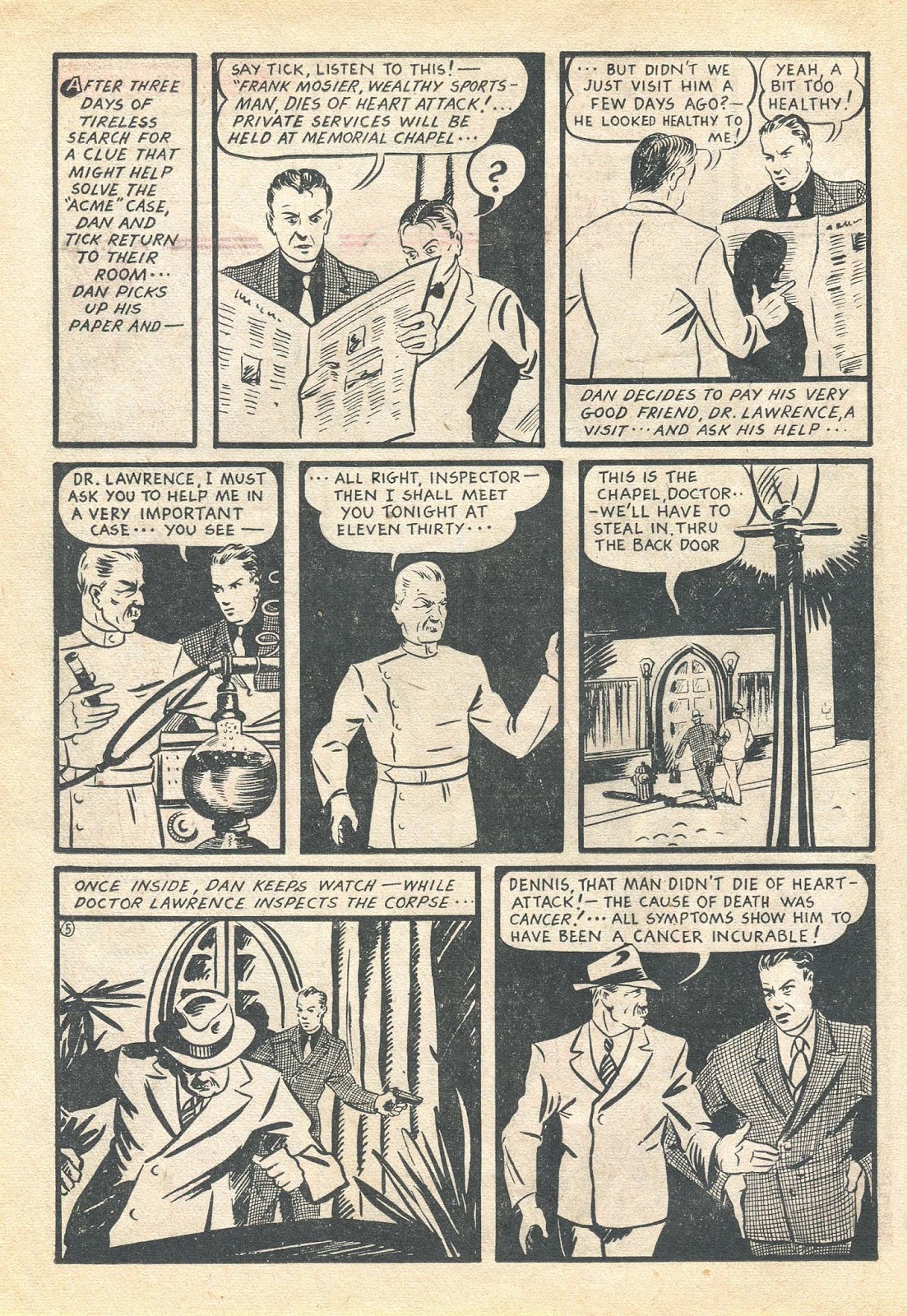
Dan Dennis shows you that G-Men did not have to observe rules or laws in comic books. Here, rather than getting a warrant for an autopsy in a sterile medical lab, Dan sneaks a complicit medical examiner into a private funeral home and has the examiner perform one in the dark. Interesting verdict on that autopsy -- unless it was skin cancer, there would be no outwardly visible sign of cancer. I wonder how much cutting up the examiner did.

This is Ed Colton. It's interesting how many similarities there are between this scenario and the Masked Marvel story I shared from yesterday, despite that being a mysteryman story and this being a cowboy story.

Ed lays out a good series of clues that can be gathered at a crime scene.


In order to pull off this bluff, Ed took a deliberate 10' fall into a gulch in order to look injured.

I guess there were not too many ranches with plane hangars in the area, so solving the "who done it" part of this mystery was relatively easy. Finding one of them conveniently holding the murder weapon in the hangar certainly helps.

By making it a tripod-mounted weapon, the Editor has made it virtually impossible to use in melee range, to Ed's benefit.

I laughed at first when confronted with the term "liquid oxygen," but it is a real thing and has apparently been used in rocket fuel in the past.

Of course, the caption is way too long, taking up an entire panel, and includes a lot of detail we just do not need to understand the story.


This is Dean Masters, D.A. There are three ways to handle that trick where he sneaks the tear gas grenade out of his pocket. The player could either make a sleight of hand check (basic skill check) to palm the grenade, rely on surprise rolls, or even just rely on initiative rolls to see if he could set it off before Louie could take an action.


Dean tricks Sam into going out into the hallway and getting shot. My first inclination was to say Sam had to save vs. plot to resist fast-talk, but there's not really anything here to resist. Instead, I would say this is an encounter reaction check situation.


Dean wisely doesn't fire into the crowd -- if he rolls low, he runs a risk of hitting a civilian (there's no game mechanic penalty, by the way, for shooting a civilian, but there could be in-game repercussions, like him losing his job.

Sam takes three bullets before he goes down. With those hit points, he must be a master criminal!

Scenario map (though, admittedly, not very detailed).


This is Captain Forsyth & Sergeant Maclean, Spy Hunters -- a title almost longer than its own feature. Here, we see bandits. We are told they are Arab bandits, but counter to typical racism of the day, there are no visual cues to the bandit leader being an Arab, other than a caption telling us.

$50,000 is a fortune in 1940 money.

(Scans courtesy of Digital Comic Museum.)

Friday, July 20, 2018

All-American Comics #2-4

In Bobby Thatcher, Bobby and his friends are setting up for the night in an old abandoned cabin when they stumble across a secret compartment in the fireplace, containing a box of old letters and a simple treasure map.

Skippy is pranked with a trick camera that squirts blinding ink.

On to #3...

This month's Red, White, and Blue is the first story to take place in Baja California, Mexico. The story moves to Hermosillo, Mexico, showing that someone really paid attention to his atlas -- just maybe not the artist, as we never get a sense of Hermosillo being such a big city. The three of them also "dicker" (a rare word for bartering or bargaining) for horses to get to Hermosillo instead of taking a car or train, which probably was not necessary in 1940.

Instead of answering to some office in Washington, D.C., Red, White, and Blue are headquartered out of a San Diego G2 intelligence office. I can neither confirm nor deny that such an office existed in real life.

Red learns a lesson from Whitey about reading both sides of secret notes for clues.

Blooey stops a plane from taking off by standing on the tail and making it too heavy (let's assume for now that is how it would work). He's not using any real skill to do it, he's just resisting the science of wind resistance that would normally sweep him off. That's why this would be a passive saving throw instead of an active skill check. I would still allow a mysteryman to burn a stunt to do it automatically.

Skippy tells us that butter went for 24 or 25 cents per lb.

Ma Hunkel and the Hunkel Family debut in Scribbly this month. While Scribbly's family always seemed like how Sheldon Mayer imagined gentile families lived, the Hunkels are a breath of fresh air and the truest-feeling New York ethnic ghetto dwellers since Moon Mullins

In Mystery Men of Mars, Alan empties his pockets. Many times after defeating hoodlums, Heroes will pause to search their pockets. I even put a table for random pocket contents in adventure module RT1 Palace of the Vamp Queen.  In this story, Alan has 56 cents, a knife, and a slide rule in his pockets. Funny, but I never would have thought of a slide rule!

When the three men are thrown in a cell, they are locked in with what appears to be an automated stenotype machine that records their every word, but turns out to be a talking computer. Although drawn comically, the concepts here are pretty advanced for their time.

It's an interesting story detail that the Professor establishes communication with the Martians by solving math problems with them.

Mutt & Jeff tells us you could buy a dozen eggs for 40 cents, or a dozen cracked eggs for 25 cents -- which says a lot about how poor people were in the '30s.

In Ben Webster, we learn that "all the jack" was slang for "all the money."

On to #4...

No sooner are Red, White, and Blue assigned to investigate saboteurs, than a saboteur tries to drop a cement block from a roof onto their heads. It seems obvious that the cement block would have done considerably more than just the standard weapon damage of 1-6 points of damage, and probably more like 3-18.  The block appears to be a 5' cube, which I would only allow to hit one target. Further, even though the saboteur has a more passive role in the attack once gravity takes over, timing is a critical issue in the attack and so I would require an active attack roll, rather than just passive saving throws from the targets.

Another point to consider is, does a Hero's save vs. missiles apply here, after the attack roll? The missile is larger than average -- almost large enough to count as an area effect attack -- but is also slower than bullets. I would allow the save.

Blooey comically says "Well blow me down!" -- a line Popeye would already be famous for.

The saboteurs are an oddly multicultural bunch; one uses the Italian word "signor," while another uses the French exclamation "sapristi," and still another uses the Latin word "amici."  Either the author grabbed words at random, the saboteurs are deliberately trying to throw people off as to what country they are from, or there are an awful lot of countries engaged in this conspiracy!

A "highpowered launch" sounds like a trophy item motorboat that goes faster than normal (Boat +1?).

This adventure takes our boys to Honolulu (via Pearl Harbor, though the story does not pause there), where there is another G2 office.

In Mystery Men of Mars, some of the Martian bug-men are revealed to be robots, and it is not clear if all of them are actually robots.

Daisybelle teaches us that ice cream cones only cost a nickel.

According to Reg'lar Fellers, movies cost 25 cents -- but there might be a free gift for attending, like a shaving cup.


(Scans courtesy of fullcomic.pro/read-comic-online.)

Monday, May 21, 2018

Top-Notch Comics #2 - pt. 3

This is Stacey Knight M.D. still, even though it looks like a more nautical-themed hero's adventure. Here, we see hoodlums in 1940 are still torn between traditional sailboats and modern patrol boats.


Brass knuckles are a popular weapon for heroes in Hideouts & Hoodlums, but there is little evidence of them being used in comics. Here is a rare instance of a mobster using them.

Stacey must have surprisingly narrow hips to squeeze through a porthole. I'd give him a save vs. science or he'd do 1 point of damage to himself and get stuck.


Splash pages were rare things in 1940. The feature is Air Patrol and the narration makes it clear that this was a random encounter with at least 3 aviators. It's also clear that these are Nazi planes by the swastikas, an image most comics shied away from still this early in 1940.


I'm struck, on this page, by how hard it is for people to hit their targets with missiles. The anti-aircraft gun is a powerful weapon, but fired by 1st level fighters, only has a 50/50 chance of hitting (less, if the modifiers for hitting moving targets at great speed, found in 1st edition, are used). The depth charges, against a stationary submarine, should have been an easy hit, but then the same modifiers could apply to dropping from above. Area of effect damage does not seem to impact vehicles, only direct hits.


I offer this page as evidence that skills, like identifying counterfeit money, need to get better as heroes gain experience, like Experience Points.


Not a bad strategy, pretending to be a delivery boy so Swift can listen outside the door of the hideout. Bad guys often happen to be saying something important just when Heroes might be listening.


Joe's not very smart. Tony just told him that there's a cop in the pit, but Tony doesn't seem at all suspicious when he sees Don Carlos below. We've long seen that disguises work really well in comic books, but even here I might give the thug a +1, or even a +2, as a common sense modifier to his save vs. plot to see through this deception.


Here's a nice dystopian future for those who like such things: a New York in the year 2000 where rocket cars race along really high overpasses without guardrails. I think they've solved overcrowding in this future!


Hmm. Now, they just left 1940 because taxis were too dangerous, but they are happy to fight to the death against overwhelming numbers of Martian invaders.

And the Earth forces are so desperate for fighters that they're willing to take in a man dressed like a Viking. This actually reminds me of so many RPG campaigns where the DM/GM/Referee/Editor had a fixed story line and tried to shoehorn all the player characters into it, even though some of the players insisted on making gonzo characters that don't fit into that story line.

(Scans courtesy of Digital Comic Museum.)