Showing posts with label inspirations. Show all posts

Wednesday, September 25, 2019

Prize Comics #1 - pt. 1

Today we're going to be looking at just the first feature from Prize Comics' flagship title.

Power Nelson is Superman transposed to Buck Rogers' setting -- the sort of mash-up one normally expects to see in fanfiction, but was quite common in the Golden Age of Comics, when creators routinely stole from each other.

So, according to this, we've already had WWIII by 1982. That doesn't seem so far-fetched, as far as the Cold War had escalated by 1980-1982. What's far-fetched is that the "Mongols" (long since subsumed into Chinese, so it would really be China invading us) were in any position to do this by 1982. Now, by 2020...
Remember when New York looked like this in 1982?

Did I saw Superman crossed with Buck Rogers? Well, this origin story also anticipates Captain America, though with Cap we were told why there would only be one man endowed with his abilities. Here, we're told "only one" can be given these powers, with no further explanation. Did they run out of ingredients for super-soldier serum...?
I love the last panel on this page. The Mongol Army is supposedly this all-powerful world-conquering force, but they make their soldiers pay for their own weapons. First chink in the armor revealed!
The author of this story remains unknown, but he is well-versed in pulp literature, including John Carter. From A Princess of Mars we learned the code of the futuristic soldier, always using the sword first before the rocket pistol.

---

We don't get to see the rocket pistol in action, but if it can really blast someone to atoms then that would be a "save or die" situation, most likely, rather than dealing points of damage.

Power uses the power Extend Missile Range here, to throw the soldier so high in the air.


Power is going to slowly go through the Superman catalog of powers, as all the initial superheroes in comic books did...though, while others will try to show Superman up, Power under-performs. Instead of Raise Car, he only hefts a motorcycle -- I mean, a rocket cycle over his head. Now, I can't tell how heavy these cycles are supposed to be, but I suspect they might fall within the generous encumbrance rules for Hideouts & Hoodlums, and not require an actual power expenditure.

---

I also like that first panel, and how it looks like a Shriner parade!

---

Let's start our discussion of this page with the number of attackers who can surround you in melee. There are eight positions for man-sized attackers around a target. If the target's back is to a wall, that number drops to five. So, sure, seven members of the famous Death's Head Division can stand around Nelson and try to block him from moving, but they can't all attack him at once.

So, how does "blocking him from moving" work, as a game mechanic? If five of them were pressed into melee range around him, they would all get free bonus attacks on him as he tried to move out of that position. However, since they are outside of melee, he can move towards a corner of their semi-circle where no more than four would be within sword reach.

Complicating matters is that some of the soldiers have guns instead of swords. Guns give them the advantage that they don't have to be within melee range to attack, but they lose the advantage of the free bonus attack if he tries to move past a missile weapon.

On the other hand, it gives them the advantage after moving past them that they can simply turn and shoot once he's outside of melee again without having to chase after him.

And before moving on to this next page, I want to talk about the cool rocket-roller tank. We don't know much about it, but I'm guessing that's a forward-mounted raygun, since the barrel is too narrow for any kind of significant missile. Since it's rocket-powered, it must move much faster than a real tank (maybe a 75 Move?) And that roller is probably a little more effective than normal treads for running people over (+1 to hit?), and clearly has an intimidation factor to it, but since most of the weight of the tank isn't resting directly above it, I would say damage might be as low as 4-24 points.

I'll keep it brief about this page: nobody in 1940 seemed to have a clue how powerful atomic weapons would be. Here it takes three to damage a city block.
In any campaign based on 1940-era science,atomic weapons will be just powerful explosives, maybe doing twice the damage of a grenade.

"What a man!" Some of these panels are just unintentionally hilarious.

Let's talk about why Power doesn't just bust out of those chains and attack the emperor on the spot. Can he? By H&H rules, when you recover from being stunned, your wrecking things ability returns to you at full-strength. Is that not the case here, or is Power simply biding his time? It might make sense to do so if he is out of defensive buffing powers (or simply had none prepared for the day) and down to 6 hp or less.
In a futuristic setting, it's fun to take familiar landmarks and turn them into something else; and Yankee Stadium as a gladiatorial arena is quite brilliant, I think.

(Scans courtesy of Digital Comic Museum.)

Thursday, August 8, 2019

Planet Comics #2 - pt. 4

Last post on this issue! We're still looking at Captain Nelson Cole of the Solar Force. On this page, their tiny fleet encounters floating radium asteroids. Instant destruction within 1,000 miles? I don't know about that...how about giving them a saving throw vs. poison at least? Saving throws don't work like that for inanimate objects like spaceships, but if the crew all dies, that's effectively the same as destruction, right...?
Skipping ahead...Nelson is the sole survivor of his entire fleet and when he arrives on the planet they were heading for, he gets upgraded with magic trophies. How awkward it would have been had more crew survived than there was magic trophies to go around to!

So, one, it's a pretty weird shift to go from a science fiction story into a magic-fantasy story. Weirder, he's given a fake mustache and told he has to pretend to be this world's Zorro now. What a mid-campaign shift!
Two-headed giants are already planned to be in the Mobster Manual, but this one at 40' tall might mean revising the entry to be tougher.

In Hideouts & Hoodlums terms, it's possible that Nelson/Torro hasn't been given actual trophy items at all, but has been allowed to switch classes to Superhero. Or maybe one or more of the items gives him levels in Superhero. Because the first thing he does seems very much like the 1st-level power Feather Landing. And then he wrecks things on the tree with his magic whip.
Wrecking things in front of mobsters provokes a morale save, as we see here.

"Boy, let me tell ya all about what my magic clothes can do! And don't get me started on what my socks and underwear are capable of..."

This makes me even more strongly suspect that "Torro" is a superhero now using flavor text to describe how his powers work -- because it seems a lot like he's describing Nigh-Invulnerable Skin, Leap I (well, technically, a much higher level Leap power, but maybe he's exaggerating), and wrecking things to me. Or maybe the clothes give him 1 level in Superhero, and the whip gives him another.
And lastly, we're going to jump ahead to the final feature, Auro, Lord of Jupiter. Again, there's a lot of John Carter of Mars influence here, right down to how common apes are just wandering around.

Auro is likely another superhero, buffed with one of the Get Tough powers, to be able to beat a gorilla bare-handed like that.
It's going to take weeks for that bite wound to heal? Does Auro have an immune system deficiency, or is he just making that up to score pity points from Ava?

Actually, if he was statted as an alien, and needed to have a racial weakness, I would allow slow healing to be his -- though I can't imagine a player choosing such an agregious handicap.
So the game mechanic question here is, is there a combat penalty for fighting with one hand behind your back? Technically, no, and judging by this page, there shouldn't be. However, I think an Editor would be well within his rights to assign a -1 penalty to attacks, and maybe a -2 penalty to grappling, while one-armed.

(Scans courtesy of Comic Book Plus.)

Saturday, June 29, 2019

Zip Comics #1 - pt. 4

Moving on, this is Captain Valor. If the art looks above average to you, it's because this is by Mort Meskin, the Jack Kirby before Jack Kirby was Jack Kirby.

Does the writing hold up to the art? Let's consider the stool. A stool is a perfectly good clubbing weapon. Valor could have just handed the stool to Ronnie. Instead he breaks one leg off. He doesn't even break three legs off and pass the weapons around; he tosses the rest of the stool aside. And then he leads with the stool leg, when he's actually holding a gun? He could have taken the first guard prisoner and used him as a hostage.


===

Finding grenades in the saddle bags is a huge lucky break. Too lucky? He blows up at least 15 pursuers with that last grenade (definitely possible, since I had lowered damage and extended blast radius on grenades in 2nd edition), slowing down Ho Tsin's army enough that our Heroes can ride out well ahead of their pursuers.

We don't see much of the chase scene, but losing line-of-sight is an example of an obstacle to overcome during a chase.

I suspect Valor is exaggerating about a million, though in a wilderness setting, numbers encountered could be in the hundreds.

===

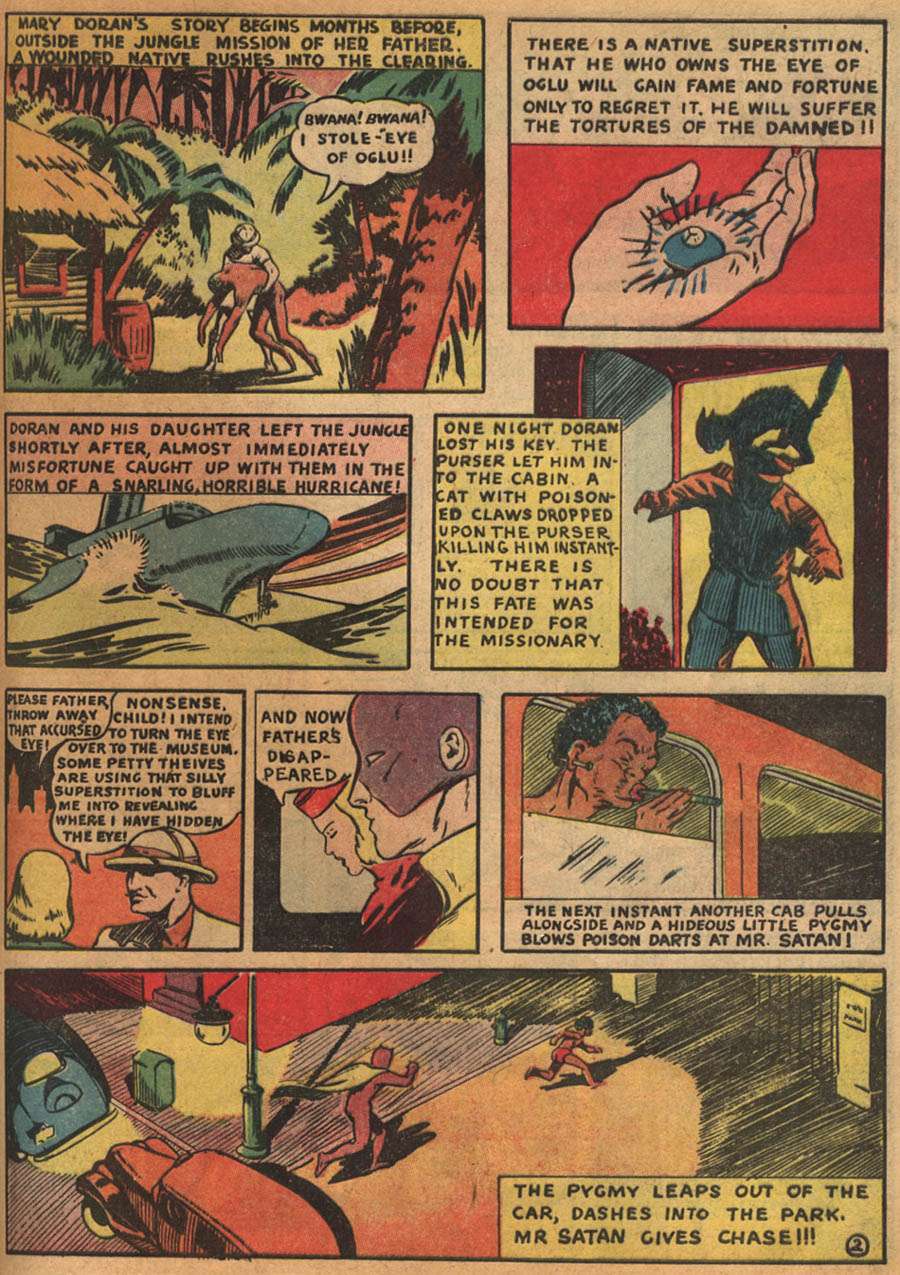
This is Mr. Satan, what would be a pretty standard pulp feature, except that it reaches deep for its inspirations. This page alone evokes both The Moonstone and The Sign of Four.
Now this page strikes me as odd. You'll note that Mr. Satan chokes the guard unconscious, but when more mobsters show up ...they find blood? I'm having trouble even figuring out how that happened, unless the guard hit his head when he went down...?
Mr. Satan appears to be hitting two bad guys at once, but I think we have to account for some time compression in that panel and he's hitting them on separate turns.

Is it relevant that Dudley Bradshaw likes to go to the gym? It is, because it speaks to what Heroes do in their downtime. Should it have some game mechanic benefit if you go to the gym? Probably not...but if enough game time passed and a fighter or mysteryman had not been to the gym, I might be willing to assign a temporary penalty to attack rolls...


Lastly, this is Zatara -- oops, no it's not, but a clumsy imitation Zatara named Zambini the Magician. Here we see Zambini can cast Snake Charm and, I'm guessing, Hypnotic Pattern (though we never see a pattern, just its effects).

We also see him using his "wand" -- a boomerang amulet -- to cast spells. The boomerang aspect is a bit forced.

Thank goodness he doesn't say "I'll rub my boomerang amulet and find out who sent the snake!" from in bed.
Here Zambini seems to be casting the spell Fumble.

Some of his spells -- but not all of them -- require command words. They look like they say something backwards, like Zatara's spellcasting, but they don't.

And then he casts Reduce Person...
...and, presumedly, Charm Person, so the spy chief will serve him.

Mass Polymorph is going to be a tough spell on this game; it seems fairly common, but it should be a high-level spell for what it can do. Normally I would say, okay, let's make a weaker version with just a very short duration, but these guys stay pigeons long enough to coat a statue. This would be an 8th level spell, meaning Zambini has a whopping 15 brevet ranks.

Or, he used his already cast Hypnotic Pattern to make them think they were pigeons, then used Charm Animal to make two real pigeons do what he made the two men think they were doing. Convoluted, yes, but more feasible in a balanced campaign world.
The Basic book made it clearer than 1st edition Hideouts & Hoodlums did that magic-users needed to be limited by something -- either verbal, somatic, or material components. Zambini has a unique weakness -- human contact. That may seem pretty rough, but essentially, someone's touch could do the same for the first three examples -- covering the mouth during verbal components, swatting the fingers out of alignment on somatic components, or batting the material components to the floor. And grappling always halts spellcasting, though I did not clarify this enough in the rules.
The last spell is actually a power, Turn Gun on Bad Guy. I think this is the second time I've seen this, so there does need to be a spell.

Incidentally, the countries here are "Ritania" and "Hundanian," clearly meant to be European countries. Hundanian must be a stand-in for Germany, though Ritania is less clear -- Germany had so many enemies by 1940!

Saving a king and getting knighted are high honors for a rookie Hero. I would personally have waited longer and built up to this.

(Scans courtesy of Comic Book Plus.)

Wednesday, April 24, 2019

Tip Top Comics #10, 12

Still reviewing Tip Top Comics #10, from Feb. 1937. It is packed with United Features' also-ran comic strips -- though, to be fair, it was headlined by L'il Abner and Hal Foster's gorgeous Tarzan, but I just don't have access to those pages.
Which is why we're concentrating on strips like Chris Crusty, a strip that not even the most resolute platinum age comic strip fans talk about, but we're talking about it here because I am fascinated by this tiny gum vending machine which, if it did exist, must have predated the gumball machine we know and love but never use today.

This Joe Jinks strip is so meta that we can't ignore it on a blog as meta as this one. While Joe complains that bad things never happen as often in the comics as they do in real life, it begs the question -- for us, looking at it from a RPG perspective -- how many bad things do we want to have happen in our game sessions, in order to simulate real life?
I don't have an answer to that, as it's something for each Editor and his players to decide on as a group. When I'm running a game, I prefer to emulate real life as much as possible, with comic book characters and tropes just inserted into it as if it all made sense. But even I see that if you heap too many challenges onto your players -- without equal rewards -- they are going to be discouraged.

In Broncho Bill, we get a tactical suggestion of setting a grass fire to serve as a distraction, and
perhaps Bill can be forgiven for taking such an extreme resort since a life is at stake. And yet, from our modern sensibilities, it may rankle to see him run the risk of starting a fire that could get out of control and cause wide environmental damage. And herein lies a difficult call for the Editor and the use of the save vs. plot mechanic to restrict non-Heroic activity -- do you restrict according to the standards of the day, or our modern standard of heroism?

Let's leave aside such heavy questions to look at
Billy Make-Believe for (ahem) a spell. We have seen tree-like creatures before in comic books, but this is the closest to Tolkien's ents I have yet seen. And this is for sure the first appearance of Jack Frost in any comic book. He certainly looks comical, with his icicle nose, and he has fairy wings despite being a taller than Billy.

Not only Billy Make-Believe, but Peter Pat is turning into a font for new mobster-types -- except, as much as I'd love to stat that pink thing, what should I call it? A turtlesaurus? 

Besides that, the tactic of tying the rope to


the turtlesaurus and having it pull the door open for them is pretty clever.

The only time I ever see gryphons in comic books seems to be from adaptations of Alice in Wonderland. Does this mean I need to stat mock turtles too? Should they be distant cousins of turtlesaurs?

Jumping into issue #12, this installment of Hawkshaw the Detective borrows more than usual from Sherlock Holmes, with the action being borrowed almost wholly from the story "The Adventure of the Empty House." And yet...this tiny strip also, in a way, anticipates Batman and how so many of his adversaries
have psychological hangups. One could imagine this foe being called The Pinner, if Batman faced him...

Another bizarre critter in this issue's Peter Pat! Maddeningly, these inventing animals are never given names. What do I call this? A Cheetah-Bull? It looks tough, but Peter backs it into a corner, drops a net on it, and it's completely out of the fight on the next page.  2 Hit Dice, maybe?

The madman is called a "monster," and I did stat madmen in Supplement V: Big Bang. I'll have to make sure they are featured in the Mobster Manual.
When looking for hideout dressing for scary rooms, perhaps I'll draw inspiration from this page of Fritzi Ritz.

(Scans courtesy of Comic Book Plus.)

Monday, August 22, 2016

Smash Comics #1 - pt. 1

We continue the exciting (cover date) month of August 1939, when a lot of companies first started adding new titles to jump on the sales boost that Superman had begun. Today, we find Quality Comics finally putting a second title out in the field.

Smash Comics leads with Espionage, the best feature from Feature Comics. This story is an allegory for Germany and Europe obviously, and carries with it some significant alternate history for South America. Editors can be free to shake up world history as much as they want in their campaigns.


For some reason Black X is called Black Ace in this story.

Disguise is clearly central to being a Spy, and is the primary ability of the Spy class.

Black X/Ace's strategy is borrowed straight from "A Scandal in Bohemia". Feel free to borrow from the classics when running or playing in your Hideouts & Hoodlums campaigns.

I usually give Will Eisner credit for having well-thought out his stories, but this one seems a little lacking. If Koran's empire extends only as far north as Brazil, then does it make sense for the freedom fighters to be in Colombia, outside the empire? And how did Mara Hani get there ahead of Black X/Ace? I could imagine players crying foul there.


The numbness in Black X/Ace's arm seems to be mere flavor text, as it doesn't seem to be affecting his fighting ability any.

Jaguars we've seen before, and were statted in Supplement III.


Another example of a Hero taking "months" to recover from injuries, while a mobster dies from conditions that, for a Hero, could have been avoided with simple first aid and rest.


I include this page of Philpot Veep, Master Detective for three reasons. One, the inside joke on the wanted poster in the background about G. Brenner (long-time readers will recognize that as the creator of The Clock!); two, $8.65 is apparently a reasonable price for a radio, with tubes, in 1939; and three, the casual reference to Sherlock Holmes' infamous cocaine addiction.


Interestingly, we saw this same panel of the gar-wrestling man in another comic book, from a different publisher! This title from Quality and Fiction House's Jumbo Comics both had the Will Eisner shop in common -- does this mean both comic books were produced by his shop? Or was Eisner able to re-sell the already-published page because no one paid attention to the educational filler?

Swordfish were also covered here. A 450 lb. swordfish would only qualify as a large, 2 Hit Dice, swordfish.

This is Chic Carter, Ace Reporter, the new feature from Vernon Henkel, who we've seen before doing Gallant Knight.

A monogrammed broken watch fob is a good clue for an Editor to let Heroes find.

Players will know when they got a good encounter reaction roll, when the police walks in on their Heroes, catches them compromising a crime scene, and still just lets them walk away.

This is not a tactic I would normally recommend, since there's a good chance the bad guys will try harder to lose you. But if you're confident in your driver, you might want to make it easy to let the bad guys know you're tailing them, so they'll stop and attack you or try to capture you.

(Scans courtesy of Comic Book Plus)


Thursday, December 3, 2015

New Adventure Comics #28 - part 1

We're still a bit ahead from this title headlining with the Sandman, so this issue begins with "Anchors Aweigh", a brand new Don Winslow clone (the lead character's name is even Don Kerry!).

Like I observed recently, aviator stunts seem to be something every comic book character masters as soon as they sit in a plane. Here, we see the stunt Power Dive, as described in The Trophy Case v. 1 no. 7

Although Hideouts & Hoodlums is the Golden Age Comic Book Roleplaying Game, Editors need not limit themselves to American comic books, or even comic books for inspiration. The "Anchors Aweigh" story seems inspired by the Tintin comic strip adventure "The Crab with the Golden Claws", combined with the Raymond Chandler story "Nevada Gas".

Tom Brent is also a new character debuting this issue. He's a sailor; I have not felt sailors need their own character class yet. The ones I've read so far are either Fighters or (in Popeye's case) Superheroes. Tom Brent is definitely of the Fighter persuasion. The mood of the story is dark, with heroin smugglers being the villains, and a stash of morphine being used to frame Tom. It is also unusual for taking place in Marseilles, France, rather than the U.S. Note that France won't be conquered for almost another two years.

It's only 1938 and it's already been too long since Steve Carson of Federal Men has had a cool adventure. This serial, vs. The Cobra, might change that. We've already got a hideout set-up here, with a concealed trapdoor in the back room of a flower shop leading into a deep shaft with ladder rungs in the wall. At the bottom is a trapped metal door -- touch it and you're shocked unconscious (or forced to save vs. science to avoid being stunned).

A death trap awaits Steve in the lair of the master criminal -- a fight with a large cobra that is not only a poisonous snake but, curiously, a constrictor snake as well (maybe it's a mutant!).  How do we know it's a death trap instead of a normal combat? Because of its placement in the storyline (after Steve is powerless in The Cobra's clutches).

Nadir, Master of Magic continues to go around not using magic.  Sure, he claims he's giving a lady he rescued a potion to dispel the hypnotism placed on her, but I can't help but think that "potion" is really just a bit of brandy, or maybe even just a strong coffee. He does, however, seem to have a magic Ring of Evil Detection and he uses the Crystal Ball again he used in his first appearance.

Captain Desmo continues to vex me; the man fights way beyond the abilities of someone who should, at this stage, only be a first level Fighter. He exhibits the special ability of "combat machine" (multiple attacks vs. weak foes) as a Fighter of at least third level, and I can't easily guess how big a penalty to the die roll to assign to not only a disarming shot, but one that shatters a dagger with the bullet.

In this story, Desmo picks up his first supporting cast sidekick, Brooklyn-born Gabby McGuire, who is probably a first-level Fighter. Desmo also happens to know a Hindu mystic named Seyah Ashear, but Seyah is more of a Detective than a Magic-User, using clues to induce information for Desmo, rather than divination spells. Knowing a Detective as a Supporting Cast Member is very handy for players who aren't good at picking up on clues on their own.

(This issue can be read at Comic Book Archives)