Showing posts with label player tips. Show all posts

Tuesday, October 6, 2020

Popular Comics #49 - pt. 3

UGHH...the new Blogger is so terrible, I hate to even work with it. We'll see if I can plow through and at least finish this issue.

Captain Tornado finally earns some points -- despite how Jane is dressed, he keeps his eyes facing nice and high -- and then promptly tosses them away with senseless violence. "Giant eyes! I can't even see what it is, if it's dangerous or not, or what it's intentions are -- but I'm a'gonna shoot it anyway!"  
That's a pretty dynamic first panel for a strip this otherwise...well, I still don't know what to make of this strip. Let's try to work it out together, shall we? 

Pro: Moon Mountain Manor sounds like a great name for an adventure module.

Pro: Although the Village of Rose Hollow seems to be fictional, there is a Rose Hollow Valley in Baxter County, Arkansas that is near the Ozarks.

Con: A minor quibble, but newspapers don't print their headlines in color.

Pro? Con?: The story turns conventions on their head by having the unattractive scientist in the lonely laboratory overlooking the village be the hero instead of the villain.

Con: The laughably named Mancho Phyroe. Mancho makes me think our hero is Spanish, but what to make of Phyroe...?

Using field glasses to read cablegrams at a distance is a sound tactic.

"Yugrarvia" surely refers to the then-Kingdom of Yugoslavia.
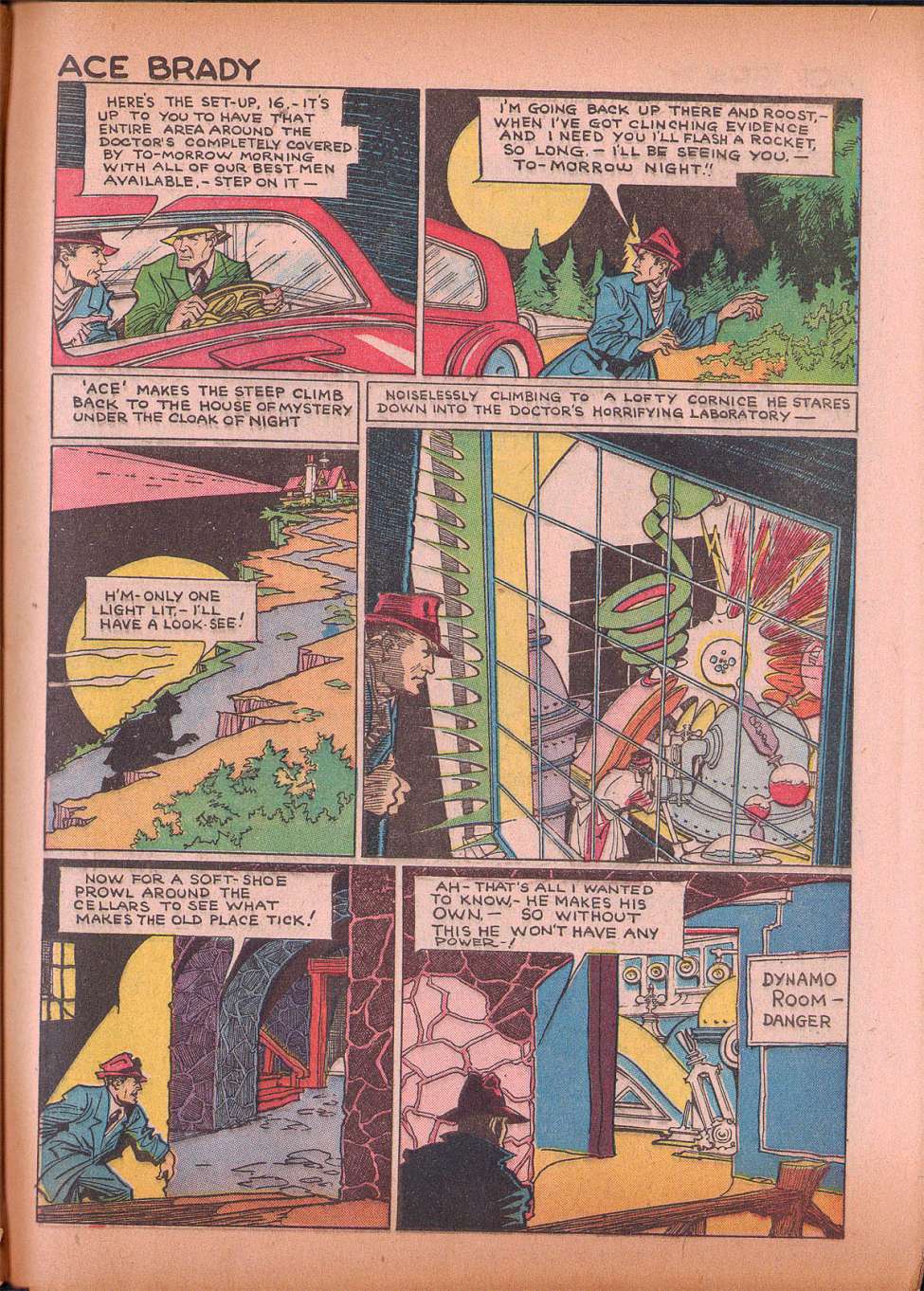
This page brings up a good point about the importance of thinking about where your hideouts are getting their electricity. If from the local power grid, it is too easy for the Heroes to turn that power off, but if the hideout has its own dynamo, you must place it somewhere. 

I am wondering what is supposed to be so "horrifying" about that laboratory. It looks more "intriguing" than anything.

"Soft-shoe prowl" is a cool term.
This is a rare occurrence of a Hero using a chimney to navigate vertically through a hideout, but it is a good idea to be prepared for this in-game.

I'm amused by, not only how the death ray says "death ray" on it, but that he's advertising it took nine tries to perfect it. 

There are no unexplored frequency bands in the vicinity of the X-ray; those are ultraviolet rays and gamma rays.

1,000 miles is a crazy long range for trophy weapons, but not that unusual in the comics. Consider carefully its effect on game balance, since players can get their hands on these. 
Wing-walking was a stunt for Aviators in 1st edition Hideouts & Hoodlums.

Gas tanks exploding is a fairly critical complication for aerial combat.
Shark is smart to rescue his opponents, as it does give him people to question for information.

In 1940, the "medical magic of the hypodermic" likely refers to morphine.

Here is a rare occasion of Asians speaking an actual foreign language instead of broken English.
The Syndicate sounds like a criminal organization, but here seems to be refer to a national alliance (the Axis, perhaps?). It does not seem to be a coincidence that the bad guys here seem to be Japanese.

Being able to throw destroyers against the Heroes does make it a seriously high-level challenge.
 
(Scans courtesy of Comic Book Plus.)

Wednesday, August 26, 2020

Feature Comics #30 - pt. 1

It's been a long time since we last checked in with Quality Comics' flagship title. Here, the Clock (sans mask) investigates how a car was tricked into careening off the road, and anticipates the movie Goldfinger by 24 years.

That the Clock wakes up after 30 minutes suggests that he was simply stunned and recovers 1-6 turns later, but the Editor has decided to make those 10-minute exploration turns (which the Editor can do, at his discretion).
Monogrammed cigarettes must have been a novelty item of decades past.

That's also quiet an expose in the newspaper, that the dead man was a FBI man with secret industrial mobilization plans on him. I bet the FBI was wanting to keep that a secret. Industrial mobilization was, of course, a real thing, and had been ongoing since Sept. 1939 in the U.S.
I've seen this in games before, paying kids to run messages for you. In a pre-modern age it can be more reliable than technology for communication, though it could put the kids in danger.

Panel 3 is a good example of how easy it is for Heroes to scale walls, even in dress shoes and tuxedos, while carrying canes in one hand.
This is Lena Pry and we haven't looked in on this comic strip in a dog's age. I include this bit because of the discussion of relief checks, which was another real thing. The Agricultural Adjustment Act (AAA) was a United States federal law of the New Deal era designed to boost agricultural prices by reducing surpluses. The government bought livestock for slaughter and paid farmers subsidies not to plant on part of their land.
The Great Bear Lake is a real lake. It is the largest lake entirely in Canada, the fourth-largest in North America, and the eighth-largest in the world. Moose Creek is also real, running through Ontario.

There really is a Nugget City in the Yukon, but it's a RV park and, I suspect, doesn't date back as far as 1940. It's possible that "Nugget City" is a euphemism for the Town of Dawson, which was at the center of the Klondike Gold Rush.
This is Spin Shaw and Spin is in an unusual gaming situation that I've only seen once before in a Star Wars session; Spin is "grounded" by a captain who doesn't want him involved in the scenario, so part of the scenario becomes finding a way to get into the rest of the scenario. Here, Spin's player wisely finds a use for his plane that nothing else can do, forcing the captain's hand to let him take off. No dice rolls should be needed to judge a situation like this, and the player should certainly be rewarded for ingenuity.
Unlike Reynolds of the Mounted, which was surprisingly easy to place in the real world, San Luray seems to be entirely fictional. There actually is an archipelago called the Barren Islands -- but it's in Alaska, and it's very unlikely that this adventure takes place there. "Barren Islands" was surely meant to sound evocative, but also generic enough that they could be anywhere.
The cliche of the hollow statue that can be made to appear to be talking to its worshipers is as old as racism in adventure fiction. I include this example, though, because of the added details, like the density of the foliage concealing the entrance (find as secret door?), the fact that the entrance is a "queer opening" because it's much smaller than a normal door, and the shots of the interior show that the body has just one hollow column leading up to a small floored room in the head.
Eisner makes a point of showing us that Dollman is a good fighter at full-size to explain how he is still so capable at tiny size. Why I share this particular page, though, is for the use of "tomahawk" to describe a sap/blackjack. This may be purely a joke, as I can find no evidence that tomahawk was ever a slang term for a sap or blackjack.

(Scans courtesy of Digital Comic Museum.)

Tuesday, June 30, 2020

Crackajack Funnies #21 - pt. 1

It feels like forever since I last reviewed a Dell Comic, so it's pretty exciting to come back around to Crackajack Funnies and all the comic strip reprints here.

First up is Don Winslow of the Navy. I always share a page that shows a code in use, but this one also shows that a code stencil is a random item you might pick out of a hoodlum's pockets someday.
 After that stirring anti-war speech, Admiral Warburton uses "scotch" as a verb in a way I'm not familiar with. This use is defined as "decisively put an end to."

It's also real handy, being given an assignment by your commanding officer, and finding out the hard work of getting started has already been done for him. This makes a lot of sense in a comic strip format, when things have to move quickly, or a home campaign when you don't have many hours to play per session.
Innocent soul that I am, I had to look up "half-caste" to see if that was an actual thing. It's just another way of saying "half-breed," or "a person whose parents are of different races." Yeah, it's pretty racist.

The main reason you're seeing this page, though, is for the idea of tucking your secret notes into the visor of your hat. Noticing the thickness of the visor and thinking that's suspicious enough to investigate is like rolling a 1 for a secret door.
I'm not going to make you look at very much of Looney Luke this time, as it's really insulting towards American Indians.

There are some peculiar features to this page worth pointing out. One is Luke going all the way back to the 14th century to meet Indians; I wonder how Wingsmith happened to choose that century.

Despite these appearing to be Plains Indians, they have a mix of teepee and pueblo housing.

I don't think this is right, Indians practicing mummification. Indian mummies have been found, but mummified through natural processes. The most famous may be the Spirit Cave Mummy found in Nevada -- but that was in 1940, and these reprints usually run two years behind their original newspaper runs. So I wonder what earlier mummy was found that inspired this strip.
Interrupting the melodrama of Myra North is this explanation of a verbal code between mobsters. Myra was even nice enough to write out the explanation for us!
For a feature with "stratosphere" in the title, it's surprising to find them exploring caves this month.

In Hideouts & Hoodlums, you don't have to be a dwarf or gnome to detect sloping passages (I would make it a basic skill check).

The science here isn't terrible -- it is most likely that the Native Americans originated in Asia, maybe 20,000 years ago. The big question is, would primitive people from the stone age have been able to carve out a tunnel that smooth and carve idols like that? Probably not.
It takes them a few days to build a shack (how handy that their plane was full of nails!). It takes them almost a week to repair a radio transmitter. Useful to know if I ever revise my inventing things rules.
This feature went from cave exploring to an aerial dogfight so fast I think I have whiplash!

A cowling is the removable covering of a vehicle's engine, most often found on automobiles, motorcycles, aircraft, and on outboard boat motors. On planes, cowlings are used to reduce drag and to cool the engine.
Ah, Roy Crane, how I've missed you!

Here we learn that Flo's skirt is just the right length. I mean -- we learn that it's a good idea, if you're a hero running a business, or just staffing your secret lair with ordinary people, to wire-tap your own phones in case one of your own people turns disloyal. Boy, that Roy Crane art is distracting!

(Scans courtesy of Digital Comic Museum.)


Thursday, May 7, 2020

Smash Comics #8 - pt. 1


It's good to be back around to Quality Comics again. Not that we haven't seen plenty of Will Eisner over at Fiction House and Fox, but I have a special love for Espionage, and I think Will did too. There's a lot of good anti-war messages in Eisner's early work, and here we see a pretty good summary of how terrible the war in Europe is going so far, with accurate dating for Germany's early conquests and only the curious prediction that they would move to China next.  The prediction that Germany's army would be stymied at France will turn out to be disastrously false over the course of just four days, two months after the cover date of this comic. 


Eisner put a lot of work into this story -- almost as much as he will soon into The Spirit -- so we won't skip a page of it.  Luckily, I think we can find something to talk about on every page.

Here, in the final panel, we see the value of relying on random rolls to see if anything turns up in a search. Just saying "I check the closet" shouldn't give you an automatic success, though being specific should give you a bonus.

We don't often get treated to foreign languages in American comics, but the German in panel 9 is asking "Where is the one we are looking for?"


I'm not convinced the name of the former high official of the German intelligence would have been common knowledge to an American in 1940, but we know today that this is likely General Kurt von Schleicher, who was head of the Ministry of Defense until Hitler changed it to the Ministry of War in 1935.


I think it's interesting that Black X refuses to take on the same plot hook from one character, but will take it if given by another. This reminds me of a player I have right now.

Saarbrücken is the capital and largest city of the state of Saarland, Germany. Saarbrücken is Saarland's administrative, commercial and cultural centre and is next to the French border.
There are great details here, from the strategy of substituting for a corpse to get on an ambulance (I'm guessing he let them make sure the man was dead first, then created a distraction and replaced the corpse on the stretcher), to needing to shave because it took so many days just to cross the French-German border. Panels 1-3 are great action scenes, while panels 8 and 9 are dramatically angled. And yet, despite 12-panel pages, it hardly feels crowded on the page.

Koblenz, spelled Coblenz before 1926, is a German city situated on both banks of the Rhine where it is joined by the Moselle.
When the secrets Gale is carrying are revealed, they don't sound that valuable to me.

It seems incredible that Madam Doom just happens to be hanging out at this particular guardpost when Black X happens by. Still, it's very comic book-y if you insert a recurring villain into your wandering encounter table every so often.
I wouldn't say it's incredible, but perhaps remarkable (forgive me, I've been playing more Marvel Super Heroes lately) that the shrapnel blast somehow misses both Gale and Black X, but does enough damage to kill the driver. I suppose they were outside the "save for half" radius and in a "save for none" radius.
 Batu uses...the Phantasmal Image spell? It's been a loooong time since I first discussed in Supplement IV if Batu is an example of psionics or not, and we don't have to revisit that here. Just enjoy some delightful character moments, followed by one of Eisner's signature anti-war messages direct to the reader in the final panel.

And, as an added bonus...it's been a long time since I last shared single panel comic strips. I like these two, particularly the one on the right. I had to think about it about as long as that girl is...

(Scans courtesy of Digital Comic Museum.)


Tuesday, January 14, 2020

Whiz Comics #2(b) - pt. 2

Before I get back to the next feature, the discerning reader may be left wondering how this issue can be #2(b). That's because they printed two #3's, forgetting that they started numbering the series with #2! This is actually the first #3...but I'm calling it #2(b) because I can.

Next up is Ibis the Invincible! Again, this story proves problematic for H&H, or rather, we have to make allowance for Ibis' wand, the Ibistick, to have extra powers of its own besides holding Ibis' allotment of magic spells, and it can transfer magic-user abilities to anyone who holds it. The nameless thief who swipes the Ibistick is able to cast Wall of Stone and something that seems like an advanced version of the Dig spell, since it makes a chasm between him and Ibis -- although cast at a high-enough level, maybe there is no difference.

More difficult to explain is when the thief is using the Ibistick to make piles of gold for himself, as there's no spell for that -- or is there? Maybe the Ibistick interprets what you ask for into the closest equivalent spell. So it's casting Fool's Gold for him, or maybe creating illusionary gold with a Phantasmal Image spell.

Somehow, Ibis trips on a loose floorboard while charging up to tackle the thief. I'm guessing that's flavor text associated with a botched die roll, though if I was playing Ibis, I wouldn't be too happy if my Editor told me I tripped like a clumsy idiot just rushing into a room.

The Ibistick has another nice feature: it has decided that Ibis is its true owner, making it the first intelligent magic item in comic books (not a magic sword!). As such, any spell cast with the Ibistick at Ibis is turned back on the caster. The spell is Turn Flesh to Gold, a variant on Turn Flesh to Stone.

Meanwhile, Ibis' love Taia is trapped in an airtight glass case, but with enough air that she is little harmed during the long minutes Ibis is chasing the thief. Once he has the Ibistick he dissolves the glass. It is not clear why he didn't just break the glass with a rock.

Ibis is correct that the ancient city of Thebes is gone, though how he learned that when he had just recently awoke in this millennium. Ibis recreates the city of Thebes, which could be nothing short of a 9th level Wish spell.

I'm sure I've shared this opinion before in regards to Zatara, but comic book magic-users are usually ridiculously broken, and Ibis is strongly in that category. Sure, breaking out a 9th level spell to make Taia happy is deeply romantic and probably worthwhile to both of them, but after she is foolishly kidnapped by Arabs, Ibis polymorphs their plane into a falcon and then a horse -- all to do what he could have accomplished by simply following the plane in the first place. This new Chain Polymorph spell (for lack of a better name) is probably also 9th level.

Ibis has little to worry about from desert nomads, but he still wastes powerful polymorph spells on them, including a Mass Polymorph spell (also 9th level?) that turns a group of armed men ("Arab cut-throats" = bloodthirsty hoodlums?) into geese. Polymorphing a bullet into an apple is an unusual trick -- and there is more to it than transformation, because Ibis' spell is able to drain it most of its momentum. He casts the same spell soon thereafter, turning a dagger into a dove. This must be another new spell, Polymorph Missiles (5th level spell?), and perhaps it is not a one-shot spell but a duration spell that allows him to temporarily transform any missile weapons aimed at him into living things and steal them of their momentum until the spell ends.

In Lance O'Casey, we learn that Lance's home is on Maloana Island, which isn't a real island as far as I can tell -- but it does have a nice South Seas sound to it. Lance's boat is called the Brian Boru; I don't recall if we learned that last time or not.

Lance gets a visit from a plot hook character, a native who says he knows where to find giant pearls -- and then conveniently gets lost during a typhoon. At this point, out in the ocean and surrounded by islands, Lance could be at the beginning of a "sandbox"-type campaign, where he could explore the islands in any order he wants. And maybe it was meant to be that way, except that he finds the "giant pearls" island first try out of the box.

On the island, Lance encounters a "renegade half-breed." Golden Age comic books seemed to love making half-breeds villains, but we're going to rise above that and ignore it in Hideouts & Hoodlums. Instead, we're going to stat him as a pirate, because he looks like a pirate. Actually, with an eyepatch and skull and crossbones tattooed on his chest, he would look like a pretty fearsome villain had he been drawn better.

The story takes a surprise twist when, instead of rescuing slaves from the pirate-slaver, one of the slaves frees himself, captures the pirate, and tosses him to the sharks -- then Lance finally takes action and dives in to save the pirate! To save the pirate, he has to kill a shark and punch out the slave who justifiably wants this bad guy dead. This is not that rare in RPG scenarios, that you just don't know what is going to motivate your players, or at least it's not what you planned.  Unfortunately, what's really going on in the story is that Lance saved the half-breed because he was half-white, and he likes how the natives call him "white master" now.

Further disgusting me about this story, Lance is rewarded by the slaves with a giant pearl, despite the fact that he just sided against them. And it turns out that he didn't even want to keep the giant pearl, he just wanted to find one. I do not like Lance O'Casey...

From a telegram, we learn that Dan Dare is based out of Sea Castle, Florida, another of those places that sounds real but really isn't. This might also make Dan the first comic book hero based in Florida.

This month's adventure takes Dan to San Francisco, California. Dan wisely takes a plane to California, since it's such a long trip, and appears to have a small passenger plane of his own that he pilots on the trip. A truck tries to hit his taxi once he's in San Francisco, seemingly on purpose, but Dan simply notes the event and does nothing about it (once again, not that rare for RPG players to ignore your planned encounters and just keep moving!). 

Dan, being a renowned private eye, was summoned to investigate an extortion letter that's surprisingly easy to figure out, as the dumb hoodlums (should that be its own mobstertype?) left a fingerprint on the letter -- that amazingly wasn't obscured when Dan held the letter with his own bare hand.

The next day, Dan tours San Fransciso's "Barbary Coast" neighborhood, a red-light district that hadn't actually existed since the 1910s, but was still featured in popular culture into the 1970s.


The villain, at least, is memorable. Dynamite Davis was horribly disfigured in an explosion and now has gray skin, no hair, and no ears, and not much left of a nose. Yet he compensates by wearing nice suits and sitting in a throne in his underground hideout, just waiting for someone to accidentally find him. He even has his own Asian sidekick named Taxi.

Dan seemingly just happens to stumble across the barbershop over Davis' hideout by dumb luck. The solution of how he got there comes at the end and, while slightly more satisfying, is still suspect. Somehow, Dan recognized the paper the ransom letter was written on as the kind of paper used in barbershops (and even if that was a thing, who's to say Davis didn't just steal the paper from one?), and on just a hunch he suspected the chauffeur was in on it and trusted the chauffeur would drive him to a trap (which was true, the barber had a trapped chair on top of a pit trap, just in case something like this happened).

(Read at readcomiconline.to)


Thursday, January 2, 2020

Silver Streak Comics #3 - pt. 3

We're still looking at Ace Powers, who I thought was a private eye, but it looks like he's actually a police officer. Or maybe this patrolman in the car just owes Ace a big favor? Or should be considered one of his supporting cast members?

That last panel...some of the artwork is terrible in this feature...

---

I'm sure this scene has played out in plenty of gangster movies and TV shows, with the car conveniently flipping right after the driver is shot, like there was some symbiotic relationship between driver and car. But I'm not going to talk about that so much as the tommy guns and facing. Because, if you're firing out the side window of a car, should you be able to aim straight ahead?  Normally, and I've said this before on this blog, facing is largely irrelevant to the Hideouts & Hoodlums combat system, but there are common sense occasions when facing can't be ignored, like when you're sneaking up from behind, or like when you have to lean out a window to shoot sideways. I think I'd be charitable in giving the mobsters only a -1 penalty to hit.

---
The clearest picture of a 1940 drivers license I've ever seen. Looks remarkably like the ones we have today!
Now we're going to move on to our next feature, Dickie Dean, a half-pint scientist. In a very rare instance, we not only learn what city Dickie is from, but we learn his exact address from that letter!


This machine is a two-in-one mad science trophy. See if you can follow this: sound waves don't ever disappear, but keep echoing back to their original source for weeks, just too faint to be normally heard. And shadows last just as long, but you can't see them under normal lighting conditions! If you can swallow that kind of science, you could include this invention in your next campaign!
The first panel suggests the kind of world-altering change that super science would bring to the campaign world, if it was followed through on.

We never learn what kind of improvements Dickie plans to make to the machine. It's hard to imagine what else it could be made to do.

I did have rules in 1st edition H&H for inventing things, but it didn't cover improving things.
I love this page; a Hero who doesn't use brute strength or even something sharp to free himself from being tied up. He burns the house down around him!

---

Now we're going to jump to the next feature, which is Sgt. Drake.


This chauffeur should be statted as a guard, since his uniform can be stolen once he's knocked out.
As if we didn't have enough mad science in this issue, we now have a radio-controlled plane...which is really weird, because Drake is in the plane. Why he is controlling it with his radio instead of, say, manual controls, is deeply puzzling.

(Scans courtesy of Comic Book Plus.)

Saturday, April 6, 2019

Popular Comics #48 - pt. 3

The sports genre doesn't get a lot of attention on this blog, and Wally Williams gets even less (in fact, debuting here on the blog), but this story deserves special attention. Instead of the college kids fending for themselves, they unrealistically approach Wally's grandpa and ask him for help.

How old is Gramps? Gramps claims to have worked with Mark Twain, which may sound off, but Samuel Clemens died in 1910. Someone who was 18 in 1910 would be only 48 now in 1940. This bears in keeping in mind, when considering who your Heroes might have known in their backstories...
And Gramps actually has some good ideas. This underground newspaper is a sort of pre-Internet crowdsourcing for crime prevention.
I'm not sure if $10 is a reasonable rental price for a wagon and two horses in 1940, but it is for at least this old geezer.

This page raises other questions. Can a pea shooter/slingshot launch a dart? How great an effect would a small dose of carbolic acid have on an elephant?  If a person drank carbolic acid, it would cause acute gastroenteritis (inflammation of the stomach and intestines), leading to vomiting, collapse and death -- but only on a failed saving throw.

This is where game mechanics surrounding poison kind of break down in the game. The effects described always assume human mass; not only should increased Hit Dice allow mobsters to shake off the effects of poison, but should lessen the effect of poison when it does take effect. But how to adjudicate that?

I share this page so we could talk about movement rates. Can a charging elephant really overtake horses pulling a wagon? There are a lot of unknowns here, like how much weight the wagon is loaded down with, but generally speaking - an elephant runs up to 16-25 MPH. How this translates into movement rate is that an elephant would have a Move of 21, but with a skill check can manage a burst of speed that raises it to 24 (both for convenience and because of precedent, movement rates are rounded off to the nearest divisible of 3).

A horse can run up to 30 MPH; if we assume that the wagon halves their movement, that brings us down to 15. So, yes, even if the horses make their skill checks and the elephant fails its check, the elephant would still win. Of course, if the wagon was very light, this might not be the case.

(Scans courtesy of Digital Comic Museum.)


Monday, April 1, 2019

Miracle Comics #1 - pt. 4

Sigh. I like to think of myself a moderately capable artist myself, good enough to recognize good art when I see it and be rankled by bad art. And this is really, really bad art. Like, had no business ever being published bad.

What is even going on in that first panel? The Masked Angel brags he never misses and then...misses? Or did he shoot the man in the wrist? That's how the guy is holding his wrist, but the gun wasn't pointed anywhere near it.

And that car in panel 4! The arms in panel 6! Ugh!
The dialogue isn't that bad, and this isn't the first story I've read recently to make this weird mistake, but if you are playing a mysteryman and baiting the police with notes -- don't handwrite them! Especially if the police captain knows you and has probably seen your handwriting already.
The last feature is Pinky Parker. It's a pretty slight story, but I'm including it because of this well-orchestrated and yet pretty implausible escape from a trap. One, that the bad guys would make the mistake of trapping Pinky and his copy friend in a closet with a gas jet in it. Two, that the peashooter can fit into the gas jet and still reach the transom (must be a bendy straw). Three, that the other room would fill with gas and not the closet, despite the transom being open the whole time. It's like the Editor listened to his players' idea to escape, shrugged his shoulders, and said "Sure, just save vs. plot and it all happens that way."
And maybe this bugs me most of all. With no other evidence on which to hold them, Pinky asks the conductor to search their pockets and then tells the conductor he put them there, as proof his story is true. He could have said that after anything was pulled out of the pockets.

(Scans courtesy of Comic Book Plus.)