We're back with Jaxon of the Jungle, just in time to see Jaxon go up against wild pigs! These boars look small enough to be juvenile boars, which makes it even more unseemly when he starts gutting one. There's got to be better ways to earn experience points, Jaxon!
Note how Tarpe doesn't, to her credit, draw blacks as caricatures, though we see plenty of stereotypical behavior, like being superstitious, cowardly, and on a later page, prone to alcoholism.
The constrictor snake is obviously a random encounter. But is the village? Editors who are not working from detailed maps sometimes randomly generate details as significant as village placement, or even just make it all up as they go. However, since this particular village figures into the plot, it seems more likely to have been premeditated.
This page, combined with the last, suggests that fatigue can be relieved by a short nap, or rest.
That poor native guard only wanted to come in and discuss the poems of Lewis Carroll with them, and look how they treat him!
I'm generally opposed to guns in both comic books and RPGs, even though I had to include them in Hideouts & Hoodlums to emulate their consistent usage, and the fact that my players love using them. Something I am okay with guns being used for in-game is holding your enemies at bay, by creating a line of fire that is dangerous for them to cross.
Any attack on a plane can cause a complication, even if it's a flaming spear.
"Scattering" isn't a game mechanic that guns can do, directly. Rather, they failed a morale save because they were being shot at by someone they could not attack back (not a situation covered in the rules, but a common sense reason to give a morale save).
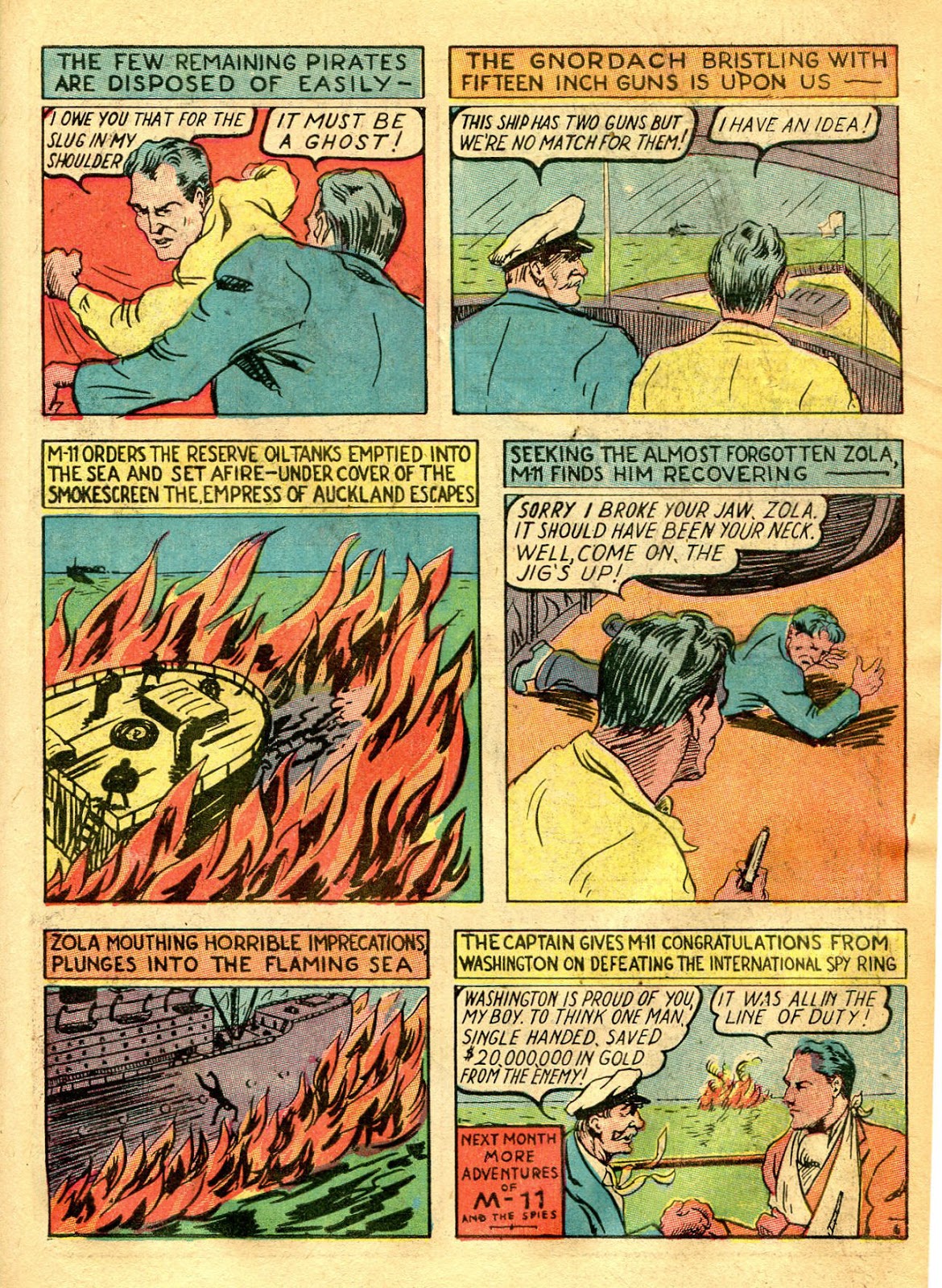
Moving on, we'll join the debut of M-11. This page interests me for several reasons. One, "Empress of Auckland" feels like such a realistic name, I wondered if there really was a ship called this. Not that I found, but I did find a plane called The Empress of Auckland, a Douglas DC-6B, that would later fly, starting in 1961!
And that $200 million in gold is not that unrealistic either, as over 140 tons of gold were transported to the U.S. in the early days of WWII. The unlikely part is it all coming on just one ship.
A villain with no fingernails on one hand is a creepy detail to use in your games!
How do you pull off someone's glove, using game mechanics? I think it would be sleight of hand, practiced as a skill. If you're just forcefully yanking it off without any attempt to go unnoticed, I might call that a basic skill check with a -1 bonus modifier, but if you were trying to pull the glove off so that the wearer doesn't notice, that would be an expert skill check.
I've talked about extenuating circumstances to add saving throws for additional penalties in addition to taking damage (like if you're leaning over a railing), as well as rolling to hit to grab something, before, and won't go into detail about them again this time.
The H&H rules do talk about using fire to create boundaries that are damaging to cross, but this is a different scenario where the fire is being used to create a boundary a vehicle won't cross. And it does make sense, if crossing the line of fire triggers a complication check, which is the way I'm still leaning towards handling damage vs. vehicles.
And the last story we're going to look at today is K the Unknown, a mysteryman in uncommonly orange long underwear.
I share this page because a good tactic for the Editor is to have mobsters doing more than just attack the Heroes; it gives the players more to react to and make decisions about during encounters. Here, K has to stay and fight or head after Terry.
K uses a smart tactic to lure a mobster outside and question him alone, rather than beard them all in their lair and then try and get answers.
Judging by what's on the table on the last panel, we might be dealing with drunken hoodlums here.
(Scans courtesy of Digital Comic Museum.)
An exploration of the Golden Age of Comics, through the lens of Hideouts & Hoodlums, the comic book roleplaying game.
Showing posts with label fatigue. Show all posts
Friday, October 4, 2019
Prize Comics #1 - pt. 4
Labels:
complications,
Editor's tips,
fatigue,
fire,
firearms,
history lesson,
Jaxon of the Jungle,
K the Unknown,
mobsters,
morale,
racism,
Secret Agent M-11,
skills,
tactics,
villains,
wandering encounters
Monday, December 10, 2018
Thrilling Comics #1 - pt. 3
And we're back with more of Dr. Strange! If this feature seems unusually long, it's because it is! It runs on for a record-breaking 37 pages and was probably intended for the first three issues, but I'm guessing the new publisher, Better Publications, didn't have enough other material to get a full anthology out.
We get an example of wrecking things in panel 2, unarmed combat (2 attacks vs. unarmed foes) in panel 3, but now we have to decide what to do about panel 4. Is the Faceless Phantom using Invisibility (as I first thought, but now seems increasingly unlikely), the spell Poof! (disappearing in a swirling purple mist is very Poof!-like), or is this a new power of Intangibility? Or, is intangibility just flavor text for Imperviousness?
What's more important is that, without Super-Senses, a superhero is practically powerless in the dark. Had the lights stayed on, there was no way anyone would have been able to spirit Victoria away from him again.
I don't know about you, but I'm getting kind of annoyed with these early superheroes killing every animal they encounter. What is with that?
The hidden aeroplane is dropped trophy loot, meant for the Hero to find.
It would be nice if I could tell from this blurry picture how many natives it takes to "hopelessly outnumber" Strange. Very likely, they just keep coming at him in waves until the durations end on all his buffing powers.
What doesn't emulate well in Hideouts & Hoodlums is not being able to wreck things, and getting back his defensive powers. I have considered putting a cap on how often per day a superhero can wreck things, and maybe he wasted them all on wrecking spears and shields in the big fight.
As for getting his powers back, maybe he was a prisoner for 8 hours, giving him time to get his power slots refilled, but it doesn't make sense to waste 1 turn of a high-level power protecting himself from the fire when he could just bust the ropes by flexing his muscles instead. Even ignoring game mechanics and looking at this from a story perspective, it doesn't make much sense.
Poisonous snakes can be encountered in groups up to 7, when found in their dens, which are apparently sometimes at the bottom of 20' deep pits.
Pushing attacks must always work on superheroes, no matter how defensively they are buffed up.
Wha?? The delta ray gun is only a rifle? That's the weapon that had a range of about a mile?
Amazingly, after killing a tiger in one hit, Strange is unable to save himself from seven poisonous snakes without help. Perhaps he burnt through all his powers fighting the natives.
The Faceless Phantom had a pen and paper on him in the jungle, and took the time to write Strange a note? Or was he so cocky he wrote the note in advance?
Again, Strange failed a save vs. poison and was kept asleep.
Watch this plot hole about the stolen Alosun. Despite not having his Alosun, he will be displaying superpowers repeatedly for the rest of the story (and don't forget how he recovered his powers while tied to a stake without taking more Alosun). The Alosun is clearly flavor text and does not affect him game mechanics-wise in any way.
Tropical hurricanes need to be on outdoor wandering encounter lists when out at sea. As must giant octopi (naturally).
Almost as bad as all this animal killing is how they never even stand a chance against the Hero. If anything killed the superhero genre, it's probably the lack of suspense that engendered.
Without any fatigue rules tied to movement, there is no game mechanic stopping Strange from swimming a few miles without even needing to buff with a power.
If I was Strange's player, I would call shenanigans on my Editor for this agent of the Faceless Phantom, who just happens to be near the beach where Strange just happens to wash up on shore. How the Faceless Phantom could possibly anticipate that Strange's plane was downed by a hurricane and had to swim to Florida, instead of arriving at an airport, is beyond suspicious.
And speaking of that hurricane, what happened to the hurricane that was just miles away from mainland Florida a little while ago? Now there's not even a tropical storm on the coast.
I skipped a page where the Phantom's men tried to off Strange by crashing another train into his (they were two well-drawn trains at that). The crash gave him amnesia - a comic book staple so common that I finally included it in 2nd edition (p. 90) of the Basic book, but only under head blows.
The amnesia was only temporary and the hobos all got beat up on the pages I skipped over.
By now, you've probably figured out that I'm not a fan of this story, over all. One of the things I do like about it occurs here -- Strange's failure to stop the Faceless Phantom earlier has campaign-changing consequences. Now, weeks later, New York City is in a state of terror, besieged by FP's mobster henchmen.
Oh, and Strange picks up a kid sidekick. This is kind of a big deal because this is two months before Robin debuts in Detective Comics, making Jerry one of the first kid sidekicks, and the first one for a superhero.
(Scans courtesy of Digital Comic Museum.)
We get an example of wrecking things in panel 2, unarmed combat (2 attacks vs. unarmed foes) in panel 3, but now we have to decide what to do about panel 4. Is the Faceless Phantom using Invisibility (as I first thought, but now seems increasingly unlikely), the spell Poof! (disappearing in a swirling purple mist is very Poof!-like), or is this a new power of Intangibility? Or, is intangibility just flavor text for Imperviousness?
What's more important is that, without Super-Senses, a superhero is practically powerless in the dark. Had the lights stayed on, there was no way anyone would have been able to spirit Victoria away from him again.
I don't know about you, but I'm getting kind of annoyed with these early superheroes killing every animal they encounter. What is with that?
The hidden aeroplane is dropped trophy loot, meant for the Hero to find.
It would be nice if I could tell from this blurry picture how many natives it takes to "hopelessly outnumber" Strange. Very likely, they just keep coming at him in waves until the durations end on all his buffing powers.
What doesn't emulate well in Hideouts & Hoodlums is not being able to wreck things, and getting back his defensive powers. I have considered putting a cap on how often per day a superhero can wreck things, and maybe he wasted them all on wrecking spears and shields in the big fight.
As for getting his powers back, maybe he was a prisoner for 8 hours, giving him time to get his power slots refilled, but it doesn't make sense to waste 1 turn of a high-level power protecting himself from the fire when he could just bust the ropes by flexing his muscles instead. Even ignoring game mechanics and looking at this from a story perspective, it doesn't make much sense.
Poisonous snakes can be encountered in groups up to 7, when found in their dens, which are apparently sometimes at the bottom of 20' deep pits.
Pushing attacks must always work on superheroes, no matter how defensively they are buffed up.
Wha?? The delta ray gun is only a rifle? That's the weapon that had a range of about a mile?
Amazingly, after killing a tiger in one hit, Strange is unable to save himself from seven poisonous snakes without help. Perhaps he burnt through all his powers fighting the natives.
The Faceless Phantom had a pen and paper on him in the jungle, and took the time to write Strange a note? Or was he so cocky he wrote the note in advance?
Again, Strange failed a save vs. poison and was kept asleep.
Watch this plot hole about the stolen Alosun. Despite not having his Alosun, he will be displaying superpowers repeatedly for the rest of the story (and don't forget how he recovered his powers while tied to a stake without taking more Alosun). The Alosun is clearly flavor text and does not affect him game mechanics-wise in any way.
Tropical hurricanes need to be on outdoor wandering encounter lists when out at sea. As must giant octopi (naturally).
Almost as bad as all this animal killing is how they never even stand a chance against the Hero. If anything killed the superhero genre, it's probably the lack of suspense that engendered.
Without any fatigue rules tied to movement, there is no game mechanic stopping Strange from swimming a few miles without even needing to buff with a power.
If I was Strange's player, I would call shenanigans on my Editor for this agent of the Faceless Phantom, who just happens to be near the beach where Strange just happens to wash up on shore. How the Faceless Phantom could possibly anticipate that Strange's plane was downed by a hurricane and had to swim to Florida, instead of arriving at an airport, is beyond suspicious.
And speaking of that hurricane, what happened to the hurricane that was just miles away from mainland Florida a little while ago? Now there's not even a tropical storm on the coast.
I skipped a page where the Phantom's men tried to off Strange by crashing another train into his (they were two well-drawn trains at that). The crash gave him amnesia - a comic book staple so common that I finally included it in 2nd edition (p. 90) of the Basic book, but only under head blows.
The amnesia was only temporary and the hobos all got beat up on the pages I skipped over.
By now, you've probably figured out that I'm not a fan of this story, over all. One of the things I do like about it occurs here -- Strange's failure to stop the Faceless Phantom earlier has campaign-changing consequences. Now, weeks later, New York City is in a state of terror, besieged by FP's mobster henchmen.
Oh, and Strange picks up a kid sidekick. This is kind of a big deal because this is two months before Robin debuts in Detective Comics, making Jerry one of the first kid sidekicks, and the first one for a superhero.
(Scans courtesy of Digital Comic Museum.)
Labels:
amnesia,
campaign ideas,
darkness,
Dr. Strange,
fatigue,
mobsters,
number appearing,
power recovery,
pushing,
saving throws,
SCMs,
trophy placement,
unarmed combat,
wandering encounters,
wrecking things
Friday, July 6, 2018
Pep Comics #1 - pt. 4
This is still Bentley of Scotland Yard, and I share it to point out something I had long thought was obvious, but perhaps should not have assumed it -- that facing is unimportant when considering if one side has surprise or not.
This is Press Guardian and he does not make the mistake of assuming the police already searched and found all the clues -- he wants in there to make his own search checks!
You would think a reporter would want more corroborating evidence before going to press, but okay...
In an unexpected twist, Flash Calvert seems to be the Hero of our story, but when a costumed mysteryman shows up, he's neither Flash nor seems to have any connection to him -- he's just a wandering encounter!
A mix of gangsters and thugs are ready to teach Flash a lesson about not doing a better job on his skill checks while tying up bad guys.
Unusual for the comics, we see this adventure is dated -- it takes place on either December 1 or 7 (I'm having trouble reading that number), 1939.
This is The Midshipman. Again, it makes me think that vehicles need hit points for combat, in case they are directly attacked during chases.
This also points out that fatigue rules, which have only been applied to combat so far, should apply to chases too.
Can strength stop heat damage? Since this is just conversation between two characters, and not hard evidence, I'm be fine with dismissing it.
But the propping up of the falling girder, that looks an awful lot like an ability score check (where you roll under your Strength score to succeed), definitely more than it looks like a skill check or a saving throw (mechanics actually used in Hideouts & Hoodlums). Officially, H&H does not use ability score checks, but an Editor could use them anyway, if he feels the situation warrants it.
$250 seems like a pretty sweet pot for a first-time fight.
Although we are told that Hogan is using "tricks" and "dirty work," it doesn't appear to me he's doing anything other than throwing punches that would do normal damage.
In the Golden Age, not every story has to end with the bad guys being turned over to the police!
(Scans courtesy of Digital Comic Museum.)
This is Press Guardian and he does not make the mistake of assuming the police already searched and found all the clues -- he wants in there to make his own search checks!
You would think a reporter would want more corroborating evidence before going to press, but okay...
In an unexpected twist, Flash Calvert seems to be the Hero of our story, but when a costumed mysteryman shows up, he's neither Flash nor seems to have any connection to him -- he's just a wandering encounter!
A mix of gangsters and thugs are ready to teach Flash a lesson about not doing a better job on his skill checks while tying up bad guys.
Unusual for the comics, we see this adventure is dated -- it takes place on either December 1 or 7 (I'm having trouble reading that number), 1939.
This is The Midshipman. Again, it makes me think that vehicles need hit points for combat, in case they are directly attacked during chases.
This also points out that fatigue rules, which have only been applied to combat so far, should apply to chases too.
Can strength stop heat damage? Since this is just conversation between two characters, and not hard evidence, I'm be fine with dismissing it.
But the propping up of the falling girder, that looks an awful lot like an ability score check (where you roll under your Strength score to succeed), definitely more than it looks like a skill check or a saving throw (mechanics actually used in Hideouts & Hoodlums). Officially, H&H does not use ability score checks, but an Editor could use them anyway, if he feels the situation warrants it.
$250 seems like a pretty sweet pot for a first-time fight.
Although we are told that Hogan is using "tricks" and "dirty work," it doesn't appear to me he's doing anything other than throwing punches that would do normal damage.
In the Golden Age, not every story has to end with the bad guys being turned over to the police!
(Scans courtesy of Digital Comic Museum.)
Labels:
ability checks,
Bentley of Scotland Yard,
chases,
clues,
fatigue,
hit points,
Kayo Ward,
Midshipman,
mobsters,
Press Guardian,
prices,
Strength,
surprise,
vehicular combat,
wandering encounters
Monday, April 18, 2016
Detective Comics #24
In Spy, preserving the U.S. neutrality is crucial to the mission. Bart and Sally get caught and wind up treading water in the middle of the ocean. How long they can tread water is not clear by the Hideouts & Hoodlums rules. Luckily it didn't come up, because a U.S. submarine just happens by and picks them up. But how? Is the submarine just a wandering encounter, a planned encounter, or did the Editor fudge and make it happen to save them?
Crime Never Pays is filler material. It talks about how dental work is nearly as reliable at identifying bodies as fingerprints by 1939. There's a good tip about how hoodlums often keep the same nicknames even when they're using aliases. There's also a claim that the FBI convicts 98% of everyone they bring to trial.
In The Mysterious Doctor Fu Manchu, I learn that Fu Manchu-types have a paralyzing gaze!
Bruce Nelson gets in a shootout with a thug.
The only installment I plan to talk about from this issue is Slam Bradley, which still takes place in 2 billion AD. Jerry Siegel makes some remarkable predictions here. One is uplifted animals that can walk and talk like humans, a common science fiction staple today, and two is communicators sewn into shirts that you just press to activate, such as seen decades later in Star Trek: the Next Generation. Jerry also wisely predicts that our modern languages would be unintelligible that far into the future, but luckily people wear thought translators (I guess so they don't have to wear out their lips with talking?).
Another curious feature in the future, which could be a good trick to feature in a mad scientist's hideout, is a room that has to be entered from above. If you fall through the room, you fall slowly, as if through a "jelly-like substance". It isn't clear if there's really a column of jelly there, or if the anti-gravity effect just feels like moving through jelly, but it's an interesting detail regardless.
Slam fights a monster that seems to be ogre-sized, with metal claws. His opponent also seems to have the Super-Tough Skin power activated!
In the far distant future, death is reversible and Shorty is brought back to life as a routine matter. Heroes with access to a time machine could essentially be immortal, going into the far future whenever they need to be resurrected.
One of Siegel's misfires on future tech is motorized propeller shoes that let people walk on air. But - ow! -- what if one of your legs brushed against the other? Sounds like 1-6 points of damage to me, followed by falling damage.
(Issue read here)
Crime Never Pays is filler material. It talks about how dental work is nearly as reliable at identifying bodies as fingerprints by 1939. There's a good tip about how hoodlums often keep the same nicknames even when they're using aliases. There's also a claim that the FBI convicts 98% of everyone they bring to trial.
In The Mysterious Doctor Fu Manchu, I learn that Fu Manchu-types have a paralyzing gaze!
Bruce Nelson gets in a shootout with a thug.
The only installment I plan to talk about from this issue is Slam Bradley, which still takes place in 2 billion AD. Jerry Siegel makes some remarkable predictions here. One is uplifted animals that can walk and talk like humans, a common science fiction staple today, and two is communicators sewn into shirts that you just press to activate, such as seen decades later in Star Trek: the Next Generation. Jerry also wisely predicts that our modern languages would be unintelligible that far into the future, but luckily people wear thought translators (I guess so they don't have to wear out their lips with talking?).
Another curious feature in the future, which could be a good trick to feature in a mad scientist's hideout, is a room that has to be entered from above. If you fall through the room, you fall slowly, as if through a "jelly-like substance". It isn't clear if there's really a column of jelly there, or if the anti-gravity effect just feels like moving through jelly, but it's an interesting detail regardless.
Slam fights a monster that seems to be ogre-sized, with metal claws. His opponent also seems to have the Super-Tough Skin power activated!
In the far distant future, death is reversible and Shorty is brought back to life as a routine matter. Heroes with access to a time machine could essentially be immortal, going into the far future whenever they need to be resurrected.
One of Siegel's misfires on future tech is motorized propeller shoes that let people walk on air. But - ow! -- what if one of your legs brushed against the other? Sounds like 1-6 points of damage to me, followed by falling damage.
(Issue read here)
Wednesday, November 4, 2015
New Adventure Comics #26
The first crossover in comic book history was not Batman and Superman. It was not the Shield and the Wizard. It was this installment of Federal Men, guest-starring Sandy Kean of Radio Squad -- even though they never leave the car and we are only told the radio squad is in there. One month before introducing Superman, Siegel and Shuster were already building a shared universe for their characters.
Nadir, Master of Magic, is probably the most reluctant caster of spells of all magicians -- or an actual first-level Magic-User with only one spell. In this installment, we find Nadir doing nothing more remarkable than climbing a tree. But -- a palm tree? That should be nearly impossible to climb as he's shown doing it. Could this be the first instance of the spell Spider Climb in comic books...?
This is The Adventures of Rusty and His Pals, the feature Bob Kane did before Batman. It makes the intriguing suggestion that there are both good and bad pirates. The pirates statted in Book II: Mobsters & Trophies were definitely the bad type. I wonder what good pirates would be like...?
There are all kinds of situations that keep popping up in the comics that Hideouts & Hoodlums, as yet, has no rules to handle. Case in point, how many miles one can cover per day on foot, and how long one can force a march before becoming exhausted. The closest there is are the fatigue rules for combat.
Off-hand, I'd rule that you can move 25 miles in a day, +1 mile for every made save. vs plot.
This is from new feature Captain Desmo. Yesterday I was talking about campaign moods and how dark Golden Age comics could get. It doesn't get much darker than this last panel, with the newlyweds discussing her suicide to avoid a fate worse than death if captured...
Does Captain Desmo really have grenades? As an Aviator, he has access to the stunt Bomb, which lets him act like he has grenades to drop from his plane. There are several stunts that Aviators can use to "give themselves" trophy-like items that not only exist as flavor text, but can affect combat temporarily.
Also note, Fighter-types can smoke cigarettes.
I was thinking I might be able to make some point about this page in regards to using cover in combat, or "concealing" trophy weapons where they can be easily found if needed -- but, really, I think I'm going to share this page because I would always put down Centaur for being so racist, but DC could be really racist too.
(Scans courtesy of Comic Book Archives)
Nadir, Master of Magic, is probably the most reluctant caster of spells of all magicians -- or an actual first-level Magic-User with only one spell. In this installment, we find Nadir doing nothing more remarkable than climbing a tree. But -- a palm tree? That should be nearly impossible to climb as he's shown doing it. Could this be the first instance of the spell Spider Climb in comic books...?
This is The Adventures of Rusty and His Pals, the feature Bob Kane did before Batman. It makes the intriguing suggestion that there are both good and bad pirates. The pirates statted in Book II: Mobsters & Trophies were definitely the bad type. I wonder what good pirates would be like...?
There are all kinds of situations that keep popping up in the comics that Hideouts & Hoodlums, as yet, has no rules to handle. Case in point, how many miles one can cover per day on foot, and how long one can force a march before becoming exhausted. The closest there is are the fatigue rules for combat.
Off-hand, I'd rule that you can move 25 miles in a day, +1 mile for every made save. vs plot.
This is from new feature Captain Desmo. Yesterday I was talking about campaign moods and how dark Golden Age comics could get. It doesn't get much darker than this last panel, with the newlyweds discussing her suicide to avoid a fate worse than death if captured...
Does Captain Desmo really have grenades? As an Aviator, he has access to the stunt Bomb, which lets him act like he has grenades to drop from his plane. There are several stunts that Aviators can use to "give themselves" trophy-like items that not only exist as flavor text, but can affect combat temporarily.
Also note, Fighter-types can smoke cigarettes.
I was thinking I might be able to make some point about this page in regards to using cover in combat, or "concealing" trophy weapons where they can be easily found if needed -- but, really, I think I'm going to share this page because I would always put down Centaur for being so racist, but DC could be really racist too.
(Scans courtesy of Comic Book Archives)
Labels:
Aviator,
campaign moods,
Captain Desmo,
Dale Daring,
Detective Sergeant Carey,
fatigue,
Federal Men,
mobsters,
Nadir,
new spells,
racism,
Radio Squad,
Rusty and His Pals,
saving throws,
stunts,
travel,
world-building
Saturday, September 19, 2015
Detective Comics #12
Speed Saunders is in a cross-genre tale here in the Mythic West. But aside from the pretty scenery and racism, the real lesson here is how long a fight can last in a comic book story -- 60 one-minute combat turns.
I thought Hideouts & Hoodlums needed fatigue rules for realism, and to keep combats from going on too long, but I didn't want to overdue it so there's only some minor penalties after too many consecutive turns. Past that, I did nothing with exhaustion, or setting a maximum number of turns you can fight. It looks like I made a good call.
Larry Steele finds out the danger of hanging out with people who have 100' deep pits ending in pools of lime behind their closet doors. It's the fall that kills, doing 10d6 damage. Lime is dangerous, but not that dangerous; immersion would do maybe 1 point of damage per hour. The lime is clearly there just to remove evidence.
Here, Larry loses control of his car and crashes. Though Book III: Underworld & Metropolis Adventures has some guidelines for vehicular combat, I never wrote anything for car chases, or a mechanic for losing control of a car. My article on plane mishaps (The Trophy Case no. 8) comes closest and some of it might be applicable here, with some creative fudging.
The Slam Bradley story has an interesting twist -- there's a waterfall and no one falls down it! The trope, of course, is that waterfalls never hurt anyone in stories, but it should. There's also an interesting chase scene, with running across floating logs. I should think that's a lot tougher to do than it looks in the scene, maybe requiring a save vs. science at a -2 penalty?
(Scans courtesy of Comic Book Archives)
I thought Hideouts & Hoodlums needed fatigue rules for realism, and to keep combats from going on too long, but I didn't want to overdue it so there's only some minor penalties after too many consecutive turns. Past that, I did nothing with exhaustion, or setting a maximum number of turns you can fight. It looks like I made a good call.
Larry Steele finds out the danger of hanging out with people who have 100' deep pits ending in pools of lime behind their closet doors. It's the fall that kills, doing 10d6 damage. Lime is dangerous, but not that dangerous; immersion would do maybe 1 point of damage per hour. The lime is clearly there just to remove evidence.
Here, Larry loses control of his car and crashes. Though Book III: Underworld & Metropolis Adventures has some guidelines for vehicular combat, I never wrote anything for car chases, or a mechanic for losing control of a car. My article on plane mishaps (The Trophy Case no. 8) comes closest and some of it might be applicable here, with some creative fudging.
The Slam Bradley story has an interesting twist -- there's a waterfall and no one falls down it! The trope, of course, is that waterfalls never hurt anyone in stories, but it should. There's also an interesting chase scene, with running across floating logs. I should think that's a lot tougher to do than it looks in the scene, maybe requiring a save vs. science at a -2 penalty?
(Scans courtesy of Comic Book Archives)
Wednesday, June 24, 2015
More Fun Comics #21 - pt. 1
I wish we had more of an overhead visual of the layout of this island, because it sounds like an interesting locale for a remote hideout on, not just one, but spread out over a chain of small, uncharted islands. The building that looks like a covered bridge apparently conceals the entrance to the administrative building, which must be mostly underground.
And the hideout is extensively deep, with an elevator needing to go down to where The Brain keeps his lair.
Should punches stun temporarily? There are slim precedents in That Other Game, particularly an old Dragon magazine article I can recall, for setting a small percentage chance of punches stunning, in addition to causing damage.
For this particular instance we don't need it. In this combat, the captain goes first in turn 1, throwing his knife, and then Wing Brady punches at the end of the turn.
At the beginning of turn 2, Wing wins the initiative and attacks first. The captain misses -- but, the results of that miss can be explained away as anything by the Editor using flavor text. "Stunned temporarily" would be a good excuse for the Editor rolling a 1 to hit.
It does seem that H&H needs to have fatigue/exhaustion rules for scenes like this.
Barry O'Neill is going to learn his lesson from this scene -- always disable your enemy's transportation if you find it outside the hideout (or, if you have time, steal it first!).
I might give Mark Marson and his pal a +1 bonus to their saves vs. poison for having smashed the window first.
It seems very unlikely to me that kicking a bear would knock it off-balance. This seems like more flavor text to explain how the bear managed to miss a prone opponent (which the bear has a +2 bonus to hit!).
(Scans courtesy of Comic Book Plus)
And the hideout is extensively deep, with an elevator needing to go down to where The Brain keeps his lair.
Should punches stun temporarily? There are slim precedents in That Other Game, particularly an old Dragon magazine article I can recall, for setting a small percentage chance of punches stunning, in addition to causing damage.
For this particular instance we don't need it. In this combat, the captain goes first in turn 1, throwing his knife, and then Wing Brady punches at the end of the turn.
At the beginning of turn 2, Wing wins the initiative and attacks first. The captain misses -- but, the results of that miss can be explained away as anything by the Editor using flavor text. "Stunned temporarily" would be a good excuse for the Editor rolling a 1 to hit.
It does seem that H&H needs to have fatigue/exhaustion rules for scenes like this.
Barry O'Neill is going to learn his lesson from this scene -- always disable your enemy's transportation if you find it outside the hideout (or, if you have time, steal it first!).
I might give Mark Marson and his pal a +1 bonus to their saves vs. poison for having smashed the window first.
It seems very unlikely to me that kicking a bear would knock it off-balance. This seems like more flavor text to explain how the bear managed to miss a prone opponent (which the bear has a +2 bonus to hit!).
(Scans courtesy of Comic Book Plus)
Friday, May 8, 2015
Western Picture Stories #2
100th post!
Unfortunately, it's not a big one, as I don't have more than a portion of this issue available to me to read.
It starts out with our second of many Will Eisner stories I'll be looking at. This one starts with a map! There's not much to it, but it might help with a Mythic West-themed campaign.
Like the killer handed a canteen at the edge of the desert, a Hero might -- in hopefully very rare instances -- wonder how long he can get by without food or water. As an Editor, I'm not overly comfortable with the thought of making Heroes die of thirst...but if I was going for realism, I would probably make Heroes save vs. science each rest-turn to avoid dehydration in extreme conditions, with failure meaning becoming fatigued. After that, a missed save would make the Hero too weak to fight. After that, a missed save would make the Hero too weak to move unaided.
Now, in the average Hideouts & Hoodlums scenario, if a bad guy draws two pistols on you, your first inclination may not be to surrender. He still has to roll to hit, only has a chance to hit with one of them, and then you still get a save vs. missiles to dodge, right?
And yet, Heroes surrender at odd times in stories all the time. Sometimes it's because the writer needs the main character to sit still long enough to hear some juicy exposition. Sometimes it's to add suspense to the story with a deathtrap. Sometimes it's just to draw out the story longer.
The first two of those three reasons are legitimate excuses for an Editor to ask for a save vs. plot from Heroes to avoid surrendering. Some players might balk at this, but it is VERY comic book-ish.
Unfortunately, it's not a big one, as I don't have more than a portion of this issue available to me to read.
It starts out with our second of many Will Eisner stories I'll be looking at. This one starts with a map! There's not much to it, but it might help with a Mythic West-themed campaign.
Like the killer handed a canteen at the edge of the desert, a Hero might -- in hopefully very rare instances -- wonder how long he can get by without food or water. As an Editor, I'm not overly comfortable with the thought of making Heroes die of thirst...but if I was going for realism, I would probably make Heroes save vs. science each rest-turn to avoid dehydration in extreme conditions, with failure meaning becoming fatigued. After that, a missed save would make the Hero too weak to fight. After that, a missed save would make the Hero too weak to move unaided. Now, in the average Hideouts & Hoodlums scenario, if a bad guy draws two pistols on you, your first inclination may not be to surrender. He still has to roll to hit, only has a chance to hit with one of them, and then you still get a save vs. missiles to dodge, right?
And yet, Heroes surrender at odd times in stories all the time. Sometimes it's because the writer needs the main character to sit still long enough to hear some juicy exposition. Sometimes it's to add suspense to the story with a deathtrap. Sometimes it's just to draw out the story longer.
The first two of those three reasons are legitimate excuses for an Editor to ask for a save vs. plot from Heroes to avoid surrendering. Some players might balk at this, but it is VERY comic book-ish.
Monday, February 23, 2015
Popular Comics #6 - pt. 2
Popular Comics always seems to give me a lot to talk about!
Today we start off with a page of The Gumps. I'm not sure if anyone is ever going to run an arctic-based Hideouts & Hoodlums campaign, but it could happen, so I better talk real quick about movement through snow and dogsled speed.
Thick snow slows a man on foot down, from a Move of 60 ft./turn down to, most likely 30 ft./turn (depending on conditions). A dogsled can, initially, haul at a speed of 65 ft./turn and keep this rate of speed up for 1d6 hours (with an "exploding die" -- on a 6, the dogs can be kept going another 1d6 hours at the same speed). Eventually, a dogsled is going to slow down to a speed of 40 ft./turn.
But, the real advantage of the dogsled isn't speed; it's avoiding fatigue. A man on foot, walking at speed through heavy snow, is going to be constantly fatigued. A man riding on a dogsled is always fresh and vital.
Bear in mind that the revised version of H&H is going to have slightly different Movement rules and may or may not have a fatigue rule...
Long before Daredevil, Moon Mullins here introduces us to the first boomerang in comic books. The boomerang is going to be a standard equipment weapon in the next edition of H&H.
Don Winslow U.S.N. goes diving in this installment, wearing an antique diving suit (or, by the 1940s, is already an antique) and carrying an electric lamp. The flashlight is standard equipment in H&H, but how the electric light is carried should be mere flavor text.
No, the more interesting thing here is the natural trap of the undertow. An Editor could go one of two ways here: either making the diver make a save vs. science each turn (exploration turns) underwater to avoid being swept off in the undertow, or make an item save vs. non-Superhero wrecking (as found in the back of Book II: Mobsters & Trophies) each turn until the line is broken.
Captain Nimbo is not a very impressive villain name, but that suit of diving armor Nimbo is wearing certainly is. I would probably treat that as a flak jacket, or Armor Class 5.
Water moccasins are rare in comics, but one of the more dangerous snakes one is likely to run into in a realistic scenario. Although they only have 1 hit point (1/6 HD), their bite requires a save vs. poison or the victim will be stunned by pain for 1d6 turns.
A giant water moccasin, though, would be up to 24 ft. long, have 1+1 HD, and a potentially lethal bite. Wait to see if that makes it into the next edition!
And, lastly, in the horrendously named White Boy in Skull Valley, we see more environmental affects on characters in the game, this time in a dust storm. Each turn spent in a dust storm without adequate shelter or protection, a Hero should have to save vs. science for each of these conditions: blinded for 1d6 turns, deafened for 1d6 turns, or choking for 1d4 points of damage!
It is also worth pointing out that, under normal conditions, wind does not affect one's chance to hit with missile weapons at all. Particularly strong gusts, however, like before a dust storm, may confer some penalty at the Editor's discretion.
Today we start off with a page of The Gumps. I'm not sure if anyone is ever going to run an arctic-based Hideouts & Hoodlums campaign, but it could happen, so I better talk real quick about movement through snow and dogsled speed.
Thick snow slows a man on foot down, from a Move of 60 ft./turn down to, most likely 30 ft./turn (depending on conditions). A dogsled can, initially, haul at a speed of 65 ft./turn and keep this rate of speed up for 1d6 hours (with an "exploding die" -- on a 6, the dogs can be kept going another 1d6 hours at the same speed). Eventually, a dogsled is going to slow down to a speed of 40 ft./turn.
But, the real advantage of the dogsled isn't speed; it's avoiding fatigue. A man on foot, walking at speed through heavy snow, is going to be constantly fatigued. A man riding on a dogsled is always fresh and vital.
Bear in mind that the revised version of H&H is going to have slightly different Movement rules and may or may not have a fatigue rule...
Long before Daredevil, Moon Mullins here introduces us to the first boomerang in comic books. The boomerang is going to be a standard equipment weapon in the next edition of H&H.
Don Winslow U.S.N. goes diving in this installment, wearing an antique diving suit (or, by the 1940s, is already an antique) and carrying an electric lamp. The flashlight is standard equipment in H&H, but how the electric light is carried should be mere flavor text.
No, the more interesting thing here is the natural trap of the undertow. An Editor could go one of two ways here: either making the diver make a save vs. science each turn (exploration turns) underwater to avoid being swept off in the undertow, or make an item save vs. non-Superhero wrecking (as found in the back of Book II: Mobsters & Trophies) each turn until the line is broken.
Captain Nimbo is not a very impressive villain name, but that suit of diving armor Nimbo is wearing certainly is. I would probably treat that as a flak jacket, or Armor Class 5.
Water moccasins are rare in comics, but one of the more dangerous snakes one is likely to run into in a realistic scenario. Although they only have 1 hit point (1/6 HD), their bite requires a save vs. poison or the victim will be stunned by pain for 1d6 turns.
A giant water moccasin, though, would be up to 24 ft. long, have 1+1 HD, and a potentially lethal bite. Wait to see if that makes it into the next edition!
And, lastly, in the horrendously named White Boy in Skull Valley, we see more environmental affects on characters in the game, this time in a dust storm. Each turn spent in a dust storm without adequate shelter or protection, a Hero should have to save vs. science for each of these conditions: blinded for 1d6 turns, deafened for 1d6 turns, or choking for 1d4 points of damage!
It is also worth pointing out that, under normal conditions, wind does not affect one's chance to hit with missile weapons at all. Particularly strong gusts, however, like before a dust storm, may confer some penalty at the Editor's discretion.
Labels:
Believe It or Not,
Don Winslow U.S.N.,
environments,
fatigue,
Gumps,
Moon Mullins,
movement,
new mobsters,
new trophies,
starting equipment,
traps,
trophies,
weapons,
Whiteboy in Skull Valley
Subscribe to:
Posts (Atom)