An exploration of the Golden Age of Comics, through the lens of Hideouts & Hoodlums, the comic book roleplaying game.
Showing posts with label Detective Sergeant Carey. Show all posts
Friday, October 12, 2018
More Fun Comics #51 - pt. 3
Betty, who helps Flying Fox search for her father, uses field glasses (a starting equipment item).
Rather than shoot down her "father" in a dogfight, FF uses a stunt to force his opponent to land. Landing on the island, FF has to fight his way out of a jam. He punches a gunman and, in a rare instance, the punch neither disarms nor knocks out his opponent. FF has to grapple and throw him on the next turn. Betty, meanwhile, trips the mobster disguised as her father and that does succeed at disarming him.
The disguise, when it's knocked off, is a mask that doesn't look like it would have fooled anyone. Worse, the villain's name turns out to be Bayou Borg, one of the worst villain names I've ever seen.
Detective Sergeant Carey is asked by an auto racer to investigate a death threat against him, then watches from the sidelines (with the binoculars from his starting equipment) when the racer's car crashes and the man dies. Remember, in the Golden Age, it's okay to fail and let innocent people die! The killer conveniently leaves two clues behind where he'd sniped the racer's tire -- his rifle and a wrench. Carey's sidekick Sleepy makes an expert skill check and appraises the wrench, realizing it is of foreign make (or an automatic skill check if it has foreign writing on it). When the killer tries to drive away in his race car, Carey has no compunction against shooting out the tire, the same way the first racer was killed (though the killer survives -- must have made a save vs. science!).
Sergeant O'Malley of the Red Coat Patrol has an unusual problem -- he encounters a group of bandits -- seven in number -- that he determines is too large for him and his sidekick Black Hawk to handle. Forced to resort to tactics, he uses the old "roll boulders down on them" trick -- but not to hit them (which is what most players would have done). Instead, the boulders are to knock out the ledge in front of and behind the bandits. If I had to referee that scene, I might use wrecking things for the boulders (maybe at O'Malley's level, or with a slight bonus), or I might just allow it outright because it's such a clever and nonviolent solution.
Black Hawk shows us that you can lasso a person falling past you from a higher ledge, that the rope does not swing the falling person into the cliff with enough force to do any serious damage, and that the momentum of the faller does not pull the lassoer over the ledge.
Bulldog Martin is asked to investigate a supposedly haunted house that a cute lady friend has inherited. It's a perfect low-level haunted house adventure, as most of it is just spooky noises that can be explained away (an open bottle left "under the eaves" so wind will blow into it, and a loud speaker hidden in the fireplace that plays "oooooo" noises). Bulldog finds the amplifier only by searching the walls and finding a concealed wire leading towards the fireplace.
It's obvious that the fake undead is digging for buried treasure in the yard because of all the upturned earth. Bulldog pretends to find the treasure, putting $2,000 of his own money at risk, and then gets robbed when the fake undead uses a secret door to take him by surprise. Bulldog has to spend time searching for the method of opening the secret door, even though he knows where it is. When he fails his roll, he decides to bash the secret door in with a sledge hammer instead. He wrecks through the secret door with such a good roll that the Editor rules that he can hit the fake undead guy hiding on the other side.
(Read at fullcomic.pro)
Labels:
chance of failure,
Detective Sergeant Carey,
disarming,
disguise,
falling,
Flying Fox,
grappling,
mobsters,
number appearing,
Red Coat Patrol,
saving throws,
skills,
starting equipment,
stunts,
tactics,
wrecking
Tuesday, October 9, 2018
More Fun Comics #50 - pt. 2
We left off with King Carter exploring Ali Ghazi's palace. There is a pit in the middle of a hallway that leads to an underground stream.Confronting Ali in a shrine, King arms himself with a sword and engages him in melee. Ali triggers a trap that makes four poisonous snakes drop from a trap door in the ceiling.
Not all guards are bad, as evidenced in The Buccaneer (and backed up by the Alignment of guards in The Mobster Manual). Dennis is leading the rightful king and a small band of loyal followers towards the castle (again, it's weird this takes place in the West Indies), but a guard gives them fair warning not to come any closer or they will be shot at. Politely warned, they all turn around and go away (but plot how to come back later).
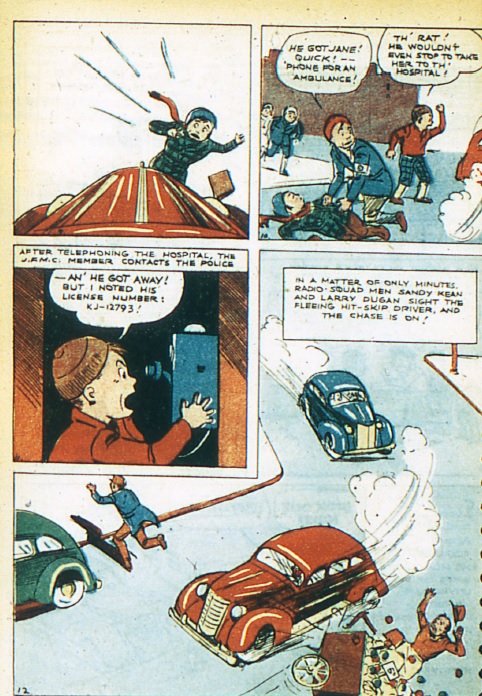
In Radio Squad, we learn that Sandy and Larry are not only patrol partners, but they share an apartment together, and share a car. They fail to encounter any random mobsters all day while on patrol, but happen upon car thieves in their own garage! Head blows are easy enough to deliver that they can even be synchronized; Sandy and Larry are both knocked out that way at the same time. Later, after trailing a crooked businessman back to the thieves' hideout, they are captured by armed lookouts (crooked businessmen and lookouts are both statted in The Mobster Manual).
Lt. Bob Neal is going to be testing several science trophies on his submarine today, including advanced Scuba gear, a machine that turns water into breathable air (Machine of Water Breathing), and a drill "powered by the ocean" (?), that can "literally go through anything" (so, wrecks as a 9th level superhero?). Bob is in constant danger during testing these inventions; the Machine of Water Breathing doesn't work and he has to be rescued before he suffocates, and while testing the drill a "monstrous ray fish" bumps his air hose and fouls it. Giant devil rays are in The Mobster Manual (maybe I should include a note about how they like to foul air hoses). Oh, and Bob finds gold in the volcanic ruins around Hawaii, as unlikely as that seems.
The Flying Fox story has some rather obvious flaws in it. There's supposedly a mystery to how transport planes are being forced to land and their pilots killed, but when FF puts himself in danger, it becomes apparent that the air bandits shoot at the planes. How was that not evident sooner -- did no one think to examine the planes for bullet holes? This is the first story where the term "Immelmann" is used, to refer to the Immelmann turn invented in WWI (and I first learned about from playing Dawn Patrol). FF defeats a "giant guard" on his way into the air bandits' hideout, but we never actually see all of the guard and what we do see of him in the panel does not make him look very giant.
Detective Sergeant Casey is solving the case of who is murdering the jurists who convicted a dead man. His strategy is to have police openly guard every jurist but one, luring the killer to that one, and then disguising himself as the vulnerable jurist. To build suspense for the reader, Casey refuses to confide his plan to his captain, which I can't imagine a police captain actually allowing.
(Read at fullcomic.pro)
Not all guards are bad, as evidenced in The Buccaneer (and backed up by the Alignment of guards in The Mobster Manual). Dennis is leading the rightful king and a small band of loyal followers towards the castle (again, it's weird this takes place in the West Indies), but a guard gives them fair warning not to come any closer or they will be shot at. Politely warned, they all turn around and go away (but plot how to come back later).
In Radio Squad, we learn that Sandy and Larry are not only patrol partners, but they share an apartment together, and share a car. They fail to encounter any random mobsters all day while on patrol, but happen upon car thieves in their own garage! Head blows are easy enough to deliver that they can even be synchronized; Sandy and Larry are both knocked out that way at the same time. Later, after trailing a crooked businessman back to the thieves' hideout, they are captured by armed lookouts (crooked businessmen and lookouts are both statted in The Mobster Manual).
Lt. Bob Neal is going to be testing several science trophies on his submarine today, including advanced Scuba gear, a machine that turns water into breathable air (Machine of Water Breathing), and a drill "powered by the ocean" (?), that can "literally go through anything" (so, wrecks as a 9th level superhero?). Bob is in constant danger during testing these inventions; the Machine of Water Breathing doesn't work and he has to be rescued before he suffocates, and while testing the drill a "monstrous ray fish" bumps his air hose and fouls it. Giant devil rays are in The Mobster Manual (maybe I should include a note about how they like to foul air hoses). Oh, and Bob finds gold in the volcanic ruins around Hawaii, as unlikely as that seems.
The Flying Fox story has some rather obvious flaws in it. There's supposedly a mystery to how transport planes are being forced to land and their pilots killed, but when FF puts himself in danger, it becomes apparent that the air bandits shoot at the planes. How was that not evident sooner -- did no one think to examine the planes for bullet holes? This is the first story where the term "Immelmann" is used, to refer to the Immelmann turn invented in WWI (and I first learned about from playing Dawn Patrol). FF defeats a "giant guard" on his way into the air bandits' hideout, but we never actually see all of the guard and what we do see of him in the panel does not make him look very giant.
Detective Sergeant Casey is solving the case of who is murdering the jurists who convicted a dead man. His strategy is to have police openly guard every jurist but one, luring the killer to that one, and then disguising himself as the vulnerable jurist. To build suspense for the reader, Casey refuses to confide his plan to his captain, which I can't imagine a police captain actually allowing.
(Read at fullcomic.pro)
Labels:
Alignment,
Aviator,
Bob Neal,
Buccaneer,
chance of failure,
Detective Sergeant Carey,
Flying Fox,
head blows,
hideouts,
King Carter,
mobsters,
new trophies,
Radio Squad,
scenarios,
stunts,
traps,
wandering encounters
Monday, October 1, 2018
More Fun Comics #49 - pt. 2
The Buccaneer picks up with a sword duel about to begin between Dennis and Dr. Killmen -- which would be a pretty good name for a supervillain! Instead, Killmen lasts about one melee turn before getting run through. Such are the vagaries of randomly generated combat results! Dennis is trying to get the crown prince of Natria back on the throne, Natria being a fictional country on some island near Mexico, despite it looking an awful lot like Europe.
In Radio Squad (another feature ruined by lackluster post-Shuster art), Sandy and Larry are called to the scene of a stabbing, but can't reach the fleeing suspect because of people in the way. This would be an example of a "slowing obstacle," as defined on page 113 of the Basic rulebook, in the chase section. Outside, Sandy and Larry "take aim," and unload their pistols in the suspect's direction as he climbs a fire escape to the roof. Granted, the fire escape probably gives him cover and hence an Armor Class bonus, but this illustrates how there is a good chance of missing even for fourth level fighters (by my page count conversion, Sandy is just shy of 10,000 XP now and is a "lieutenant" for level title).
Sandy, Larry, and the guy they are pursuing all jump down through a skylight and seemingly land unharmed in the apartment below, demonstrating that a jump/controlled fall maybe should not cause damage. Sandy and Larry, twice, enter the apartment without a search warrant. Larry is shot in the arm and takes a week to heal from his injury.
Lieut. Bob Neal of Sub 662 is sent from Panama to Honolulu for maneuvers, but the scenario quickly becomes fighting ruffian/kidnappers in an alley hand-to-hand. They fail their surprise attempt on Bob and one of them gets thrown (grappling result), then punched out. The scientist he rescues lives on "Kolawura" Island, which could just be a typo for Kolavara Island. "Mt. Palolo" erupts while they're there; Palolo Valley is where Ka'au Crater is. An interesting twist to the scenario (which seems to have no connection to the kidnapping attempt) is the volcanic eruption, forcing the submarine off its maneuvers to evacuate people from the island. Sadly, the native Hawaiians are treated like primitives.
Bob takes precautions like pouring water on himself and wearing a wet handkerchief over his face before approaching a fire. I'm not sure that should have any affect on if he takes damage. It could translate into a saving throw bonus, but there's not a save vs. fire damage under normal circumstances, only against magical fire. Bob takes "a few days" to recover from smoke inhalation.
The Flying Fox tangles with two "rough hombres," but I hesitate to stat them as anything other than fighters. The hombres/ruffians work for air pirates, some of whom are armed with sub-machine guns.
Detective Sergeant Carey is needed on a murder investigation because Captain Dart, who looks pretty long in the tooth, might be getting a little senile. Dart has his suspects -- dancing girls at a nightclub -- reenact their dance to pinpoint the killer, without even considering that the killer could guess the purpose of this and switch places with another dancer. Carey seems a little loopy too, he seems to not be able to resist saying the word "voodoo" every other panel, just because it's the theme of the nightclub.
Luckily, Carey just happens to know the bartender. Maybe he really did meet the bartender and add him to his SCM list during downtime between scenarios, but something that recently came up in our message board game was the possibility of switching out a SCM you already have after a successful save vs. plot. This is not an official Hideouts & Hoodlums rule, but it does not run counter to the spirit of the rules.
(Read at fullcomic.pro)
In Radio Squad (another feature ruined by lackluster post-Shuster art), Sandy and Larry are called to the scene of a stabbing, but can't reach the fleeing suspect because of people in the way. This would be an example of a "slowing obstacle," as defined on page 113 of the Basic rulebook, in the chase section. Outside, Sandy and Larry "take aim," and unload their pistols in the suspect's direction as he climbs a fire escape to the roof. Granted, the fire escape probably gives him cover and hence an Armor Class bonus, but this illustrates how there is a good chance of missing even for fourth level fighters (by my page count conversion, Sandy is just shy of 10,000 XP now and is a "lieutenant" for level title).
Sandy, Larry, and the guy they are pursuing all jump down through a skylight and seemingly land unharmed in the apartment below, demonstrating that a jump/controlled fall maybe should not cause damage. Sandy and Larry, twice, enter the apartment without a search warrant. Larry is shot in the arm and takes a week to heal from his injury.
Lieut. Bob Neal of Sub 662 is sent from Panama to Honolulu for maneuvers, but the scenario quickly becomes fighting ruffian/kidnappers in an alley hand-to-hand. They fail their surprise attempt on Bob and one of them gets thrown (grappling result), then punched out. The scientist he rescues lives on "Kolawura" Island, which could just be a typo for Kolavara Island. "Mt. Palolo" erupts while they're there; Palolo Valley is where Ka'au Crater is. An interesting twist to the scenario (which seems to have no connection to the kidnapping attempt) is the volcanic eruption, forcing the submarine off its maneuvers to evacuate people from the island. Sadly, the native Hawaiians are treated like primitives.
Bob takes precautions like pouring water on himself and wearing a wet handkerchief over his face before approaching a fire. I'm not sure that should have any affect on if he takes damage. It could translate into a saving throw bonus, but there's not a save vs. fire damage under normal circumstances, only against magical fire. Bob takes "a few days" to recover from smoke inhalation.
The Flying Fox tangles with two "rough hombres," but I hesitate to stat them as anything other than fighters. The hombres/ruffians work for air pirates, some of whom are armed with sub-machine guns.
Detective Sergeant Carey is needed on a murder investigation because Captain Dart, who looks pretty long in the tooth, might be getting a little senile. Dart has his suspects -- dancing girls at a nightclub -- reenact their dance to pinpoint the killer, without even considering that the killer could guess the purpose of this and switch places with another dancer. Carey seems a little loopy too, he seems to not be able to resist saying the word "voodoo" every other panel, just because it's the theme of the nightclub.
Luckily, Carey just happens to know the bartender. Maybe he really did meet the bartender and add him to his SCM list during downtime between scenarios, but something that recently came up in our message board game was the possibility of switching out a SCM you already have after a successful save vs. plot. This is not an official Hideouts & Hoodlums rule, but it does not run counter to the spirit of the rules.
(Read at fullcomic.pro)
Labels:
Bob Neal,
Buccaneer,
chance to hit,
chases,
damage,
Detective Sergeant Carey,
Flying Fox,
healing,
jumping,
levels,
locations,
mobsters,
racism,
Radio Squad,
scenarios,
SCMs,
unarmed combat,
villains,
weapons
Tuesday, December 13, 2016
More Fun Comics #48
This is a special installment -- not because of this being a particularly good or useful comic book, but the way I was able to read the contents. Yes, this is the first issue that I've read during a Youtube video perusal of its contents.
Detective Sergeant Carey investigates an ape attack, but it turns out to be a fake ape. I've already talked about statting pseudo-undead in Hideouts & Hoodlums, but I can think of more examples of fake animals. Does "fake animal" need to be a mobster type?
"Boxcar Tourists" is a one-shot gag strip, but it features a fairly believable $5,000 reward for an arsonist/bank robber/kidnapper(tax evader/cusser).
Bulldog Martin outraces camels on the back of an ostrich. I never thought I would have to stat ostriches for H&H, but two years ago I wouldn't have thought I would have to stat goats either. I would probably give an ostrich 2 Hit Dice, with a Move of 30. Camels, on the other hand, would have a Move of only 24. Technically, since H&H has no encumbrance rules for animals (unless one assumed the one encumbrance table applied equally to everything), the ostrich would always win no matter how heavy Bulldog Martin is. On the other hand, an Editor would be within his rights to apply common sense modifiers, accounting for the ostrich's weaker strength, and make it a much closer race.
(Video courtesy of Youtube.)
Detective Sergeant Carey investigates an ape attack, but it turns out to be a fake ape. I've already talked about statting pseudo-undead in Hideouts & Hoodlums, but I can think of more examples of fake animals. Does "fake animal" need to be a mobster type?
"Boxcar Tourists" is a one-shot gag strip, but it features a fairly believable $5,000 reward for an arsonist/bank robber/kidnapper(tax evader/cusser).
Bulldog Martin outraces camels on the back of an ostrich. I never thought I would have to stat ostriches for H&H, but two years ago I wouldn't have thought I would have to stat goats either. I would probably give an ostrich 2 Hit Dice, with a Move of 30. Camels, on the other hand, would have a Move of only 24. Technically, since H&H has no encumbrance rules for animals (unless one assumed the one encumbrance table applied equally to everything), the ostrich would always win no matter how heavy Bulldog Martin is. On the other hand, an Editor would be within his rights to apply common sense modifiers, accounting for the ostrich's weaker strength, and make it a much closer race.
(Video courtesy of Youtube.)
Tuesday, May 24, 2016
More Fun Comics #42
I'm working from summaries again, so I'm just going to assume these details are right...
Wing Brady takes to Algiers for a new scenario. I was at first doubtful about globe-trotting scenarios in Hideouts & Hoodlums, as my online campaign crashed and burned after a long trip to China, but more recent scenarios run in France, England, Norway, Cuba, and Trinidad have gone much better. And it's good to show players how big the "sandbox" can be in a H&H campaign.
Closer to home, Detective Sergeant Carey investigates an aquarium, which I suppose serves as a nice excuse to serve up some aquatic-themed encounters. The only one I know of that Carey has in this scenario is with a crocodile.
This scenario of Radio Squad deals with half-pints, how their alignment is initially Chaotic, and Heroes can do good deeds by converting them to a better alignment (a much bigger xp award than capturing half-pints!).
Gary Hawkes, meanwhile, is engaged in an exchange of heavy firepower with mobsters. He survives having multiple grenades lobbed at him -- which is possible. Even though grenades are area effecting weapons, there is always the chance of them bouncing or rolling out of range before going off. I would roll to hit for the mobsters and, if they missed by a lot (more than 5?), I would give Gary a save vs. science for no damage instead of just half damage.
Gary, in retaliation, takes to a plane and drops bombs on the mobsters. This is almost exactly like my last H&H session, where the Heroes discovered the "joys" of attacking mobsters safely from up above. To future Editors facing the same issue, I offer the following advice: 1) the higher up the Heroes are, the greater their chance of missing should be, 2) if there are opportunities for concealment around, mobsters will use it to hide, if not to try and help them escape, 3) let the mobsters give as good as they get -- instead of sitting on the ground and letting the bombs drop on their heads, let them move to a concealed plane and take to the air. Turn the encounter into an aerial dogfight! And 4) do not forget (like I did) to stock your hideouts with flying foes.
Summaries from the Comics Odyssey blog.
Wing Brady takes to Algiers for a new scenario. I was at first doubtful about globe-trotting scenarios in Hideouts & Hoodlums, as my online campaign crashed and burned after a long trip to China, but more recent scenarios run in France, England, Norway, Cuba, and Trinidad have gone much better. And it's good to show players how big the "sandbox" can be in a H&H campaign.
Closer to home, Detective Sergeant Carey investigates an aquarium, which I suppose serves as a nice excuse to serve up some aquatic-themed encounters. The only one I know of that Carey has in this scenario is with a crocodile.
This scenario of Radio Squad deals with half-pints, how their alignment is initially Chaotic, and Heroes can do good deeds by converting them to a better alignment (a much bigger xp award than capturing half-pints!).
Gary Hawkes, meanwhile, is engaged in an exchange of heavy firepower with mobsters. He survives having multiple grenades lobbed at him -- which is possible. Even though grenades are area effecting weapons, there is always the chance of them bouncing or rolling out of range before going off. I would roll to hit for the mobsters and, if they missed by a lot (more than 5?), I would give Gary a save vs. science for no damage instead of just half damage.
Gary, in retaliation, takes to a plane and drops bombs on the mobsters. This is almost exactly like my last H&H session, where the Heroes discovered the "joys" of attacking mobsters safely from up above. To future Editors facing the same issue, I offer the following advice: 1) the higher up the Heroes are, the greater their chance of missing should be, 2) if there are opportunities for concealment around, mobsters will use it to hide, if not to try and help them escape, 3) let the mobsters give as good as they get -- instead of sitting on the ground and letting the bombs drop on their heads, let them move to a concealed plane and take to the air. Turn the encounter into an aerial dogfight! And 4) do not forget (like I did) to stock your hideouts with flying foes.
Summaries from the Comics Odyssey blog.
Friday, December 4, 2015
New Adventure Comics #28 - part 2
Tod Hunter, Jungle Master, and his English gentleman sidekick Tommy, are exploring a temple hideout. In a room concealed behind a curtain is a lit and smoking incense brazier and a raised dais used, not for sacrifice, but for sleeping by the high priestess. While Zara the High Priestess wields a scimitar, her followers (there are at least eight of them) fight with primitive spears and hand axes (and half of them only wear loin clothes).
The sacrificial room is a huge chamber with a tall wooden idol carved to look like a sitting demon -- not too far different from the iconic cover of the 1978 Advanced Dungeons & Dragons Players Handbook! The corridors are lit with torches held in sconces. A corridor leading from the sacrificial room runs to a circular arena that can be watched through barred gates. The entrance is trapped so that a steel shutter falls down over the entrance behind them, and then a lion can be released into the arena. Because the High Priestess is watching, this must be a deathtrap.
Dale Daring is in need of rescue in the mountain hideout of a bandit chieftain. Because the bandits are Asian, her boyfriend Don decides to disguise himself by staining his skin yellow and putting transparent tape around his eyes to make them almondine. And because this is a comic book, the disguise has a good chance of working.
We also see a torture chamber with a rack and a suspended cauldron for boiling oil.
Detective Sergeant Carey of the Chinatown Squad is a bit of a jerk. Instead of investigating their suspect's room himself, he sends his Supporting Cast Member,"Sleepy", to do it. Sleepy is actually fairly clever; when confronted by the suspect, Sleepy pretends to be a two-bit crook eager to make any kind of a deal to avoid a "fourth offense" and a lifetime sentence (it would be interesting, if I had the time, to investigate which states had four-strikes-and-you're-out laws for repeat offenders in the 1930s).
Carey is a bit of a risk-taker too. He suspects dope is being smuggled in a coffin, so to prove it, he throws pepper into the coffin and waits to hear a sneeze...which would have been awkward if any part of his theory had turned out to be wrong.
The Robin Hood serial continues to be surprisingly accurate. Friar Tuck fights with a broadsword and a buckler (small round shield), both of which would have been common fighting tools in the 1100s, when Robin Hood supposedly lived. It does suggest, in this installment, that hound dogs should have good Armor Classes, as the Friar's hound dogs are shown being able to dodge arrows.
(This issue can be read at Comic Book Archives)
The sacrificial room is a huge chamber with a tall wooden idol carved to look like a sitting demon -- not too far different from the iconic cover of the 1978 Advanced Dungeons & Dragons Players Handbook! The corridors are lit with torches held in sconces. A corridor leading from the sacrificial room runs to a circular arena that can be watched through barred gates. The entrance is trapped so that a steel shutter falls down over the entrance behind them, and then a lion can be released into the arena. Because the High Priestess is watching, this must be a deathtrap.
Dale Daring is in need of rescue in the mountain hideout of a bandit chieftain. Because the bandits are Asian, her boyfriend Don decides to disguise himself by staining his skin yellow and putting transparent tape around his eyes to make them almondine. And because this is a comic book, the disguise has a good chance of working.
We also see a torture chamber with a rack and a suspended cauldron for boiling oil.
Detective Sergeant Carey of the Chinatown Squad is a bit of a jerk. Instead of investigating their suspect's room himself, he sends his Supporting Cast Member,"Sleepy", to do it. Sleepy is actually fairly clever; when confronted by the suspect, Sleepy pretends to be a two-bit crook eager to make any kind of a deal to avoid a "fourth offense" and a lifetime sentence (it would be interesting, if I had the time, to investigate which states had four-strikes-and-you're-out laws for repeat offenders in the 1930s).
Carey is a bit of a risk-taker too. He suspects dope is being smuggled in a coffin, so to prove it, he throws pepper into the coffin and waits to hear a sneeze...which would have been awkward if any part of his theory had turned out to be wrong.
The Robin Hood serial continues to be surprisingly accurate. Friar Tuck fights with a broadsword and a buckler (small round shield), both of which would have been common fighting tools in the 1100s, when Robin Hood supposedly lived. It does suggest, in this installment, that hound dogs should have good Armor Classes, as the Friar's hound dogs are shown being able to dodge arrows.
(This issue can be read at Comic Book Archives)
Friday, November 13, 2015
New Adventure Comics #27
This issue starts off with the latest installment in the Captain Jim and the Texas Rangers serial. Captain Jim and Bob have been looking for the kids Rusty and Spike for an awful long time now. Part of this is due to how good Rusty and Spike are at hiding, which fits well with the half-pint race introduced in The Trophy Case v. 2 no. 4. The issue also comes up of gun range, and verifies that rifles have longer ranges than pistols. This is true in the real world, of course, but it's good to know what is factual in comic books and doesn't need to be glossed over in the abstractness of Hideouts & Hoodlums' combat rules.
Detective Sergeant Carey of the Chinatown Squad is still in China, where the soldiers there are the good guys and Carey and his friends are helping them root out bandits. The bandit leader, Sin Fu, has a lair inside a dormant volcano. The soldiers know about the cave complex visibly accessible from outside and have found the caves are all dead ends; the true entrance to his lair is a secret door made to look like part of the rock slope, and opens by being pushed in by a heavy weight (or much force). Sadly, the strip ends abruptly and we have no sense of what the interior of the hideout is like, save that is has a holding cell for prisoners (which keeps the army from just blowing up the volcano).
Captain Desmo fights with lengths of chain, snapping them like whips, in his installment. Even improvised weapons should do normal weapon damage.
Just like Zatara four posts ago, Nadir the Master of Magic uses a gun in this installment -- though, really, Nadir hasn't cast a spell in so long we can barely call him a Magic-User at this point. He might just be a Fighter with a magic item or two.
(Available to read at Comic Book Archives)
Detective Sergeant Carey of the Chinatown Squad is still in China, where the soldiers there are the good guys and Carey and his friends are helping them root out bandits. The bandit leader, Sin Fu, has a lair inside a dormant volcano. The soldiers know about the cave complex visibly accessible from outside and have found the caves are all dead ends; the true entrance to his lair is a secret door made to look like part of the rock slope, and opens by being pushed in by a heavy weight (or much force). Sadly, the strip ends abruptly and we have no sense of what the interior of the hideout is like, save that is has a holding cell for prisoners (which keeps the army from just blowing up the volcano).
Captain Desmo fights with lengths of chain, snapping them like whips, in his installment. Even improvised weapons should do normal weapon damage.
Just like Zatara four posts ago, Nadir the Master of Magic uses a gun in this installment -- though, really, Nadir hasn't cast a spell in so long we can barely call him a Magic-User at this point. He might just be a Fighter with a magic item or two.
(Available to read at Comic Book Archives)
Wednesday, November 4, 2015
New Adventure Comics #26
The first crossover in comic book history was not Batman and Superman. It was not the Shield and the Wizard. It was this installment of Federal Men, guest-starring Sandy Kean of Radio Squad -- even though they never leave the car and we are only told the radio squad is in there. One month before introducing Superman, Siegel and Shuster were already building a shared universe for their characters.
Nadir, Master of Magic, is probably the most reluctant caster of spells of all magicians -- or an actual first-level Magic-User with only one spell. In this installment, we find Nadir doing nothing more remarkable than climbing a tree. But -- a palm tree? That should be nearly impossible to climb as he's shown doing it. Could this be the first instance of the spell Spider Climb in comic books...?
This is The Adventures of Rusty and His Pals, the feature Bob Kane did before Batman. It makes the intriguing suggestion that there are both good and bad pirates. The pirates statted in Book II: Mobsters & Trophies were definitely the bad type. I wonder what good pirates would be like...?
There are all kinds of situations that keep popping up in the comics that Hideouts & Hoodlums, as yet, has no rules to handle. Case in point, how many miles one can cover per day on foot, and how long one can force a march before becoming exhausted. The closest there is are the fatigue rules for combat.
Off-hand, I'd rule that you can move 25 miles in a day, +1 mile for every made save. vs plot.
This is from new feature Captain Desmo. Yesterday I was talking about campaign moods and how dark Golden Age comics could get. It doesn't get much darker than this last panel, with the newlyweds discussing her suicide to avoid a fate worse than death if captured...
Does Captain Desmo really have grenades? As an Aviator, he has access to the stunt Bomb, which lets him act like he has grenades to drop from his plane. There are several stunts that Aviators can use to "give themselves" trophy-like items that not only exist as flavor text, but can affect combat temporarily.
Also note, Fighter-types can smoke cigarettes.
I was thinking I might be able to make some point about this page in regards to using cover in combat, or "concealing" trophy weapons where they can be easily found if needed -- but, really, I think I'm going to share this page because I would always put down Centaur for being so racist, but DC could be really racist too.
(Scans courtesy of Comic Book Archives)
Nadir, Master of Magic, is probably the most reluctant caster of spells of all magicians -- or an actual first-level Magic-User with only one spell. In this installment, we find Nadir doing nothing more remarkable than climbing a tree. But -- a palm tree? That should be nearly impossible to climb as he's shown doing it. Could this be the first instance of the spell Spider Climb in comic books...?
This is The Adventures of Rusty and His Pals, the feature Bob Kane did before Batman. It makes the intriguing suggestion that there are both good and bad pirates. The pirates statted in Book II: Mobsters & Trophies were definitely the bad type. I wonder what good pirates would be like...?
There are all kinds of situations that keep popping up in the comics that Hideouts & Hoodlums, as yet, has no rules to handle. Case in point, how many miles one can cover per day on foot, and how long one can force a march before becoming exhausted. The closest there is are the fatigue rules for combat.
Off-hand, I'd rule that you can move 25 miles in a day, +1 mile for every made save. vs plot.
This is from new feature Captain Desmo. Yesterday I was talking about campaign moods and how dark Golden Age comics could get. It doesn't get much darker than this last panel, with the newlyweds discussing her suicide to avoid a fate worse than death if captured...
Does Captain Desmo really have grenades? As an Aviator, he has access to the stunt Bomb, which lets him act like he has grenades to drop from his plane. There are several stunts that Aviators can use to "give themselves" trophy-like items that not only exist as flavor text, but can affect combat temporarily.
Also note, Fighter-types can smoke cigarettes.
I was thinking I might be able to make some point about this page in regards to using cover in combat, or "concealing" trophy weapons where they can be easily found if needed -- but, really, I think I'm going to share this page because I would always put down Centaur for being so racist, but DC could be really racist too.
(Scans courtesy of Comic Book Archives)
Labels:
Aviator,
campaign moods,
Captain Desmo,
Dale Daring,
Detective Sergeant Carey,
fatigue,
Federal Men,
mobsters,
Nadir,
new spells,
racism,
Radio Squad,
Rusty and His Pals,
saving throws,
stunts,
travel,
world-building
Wednesday, September 23, 2015
New Adventure Comics #24
We're going to start off today staring into the face of 1930s racism again. Here, in this page from The Golden Dragon, we see that "yellow peril" can cover multiple ethnicities.
Hideouts & Hoodlums has always danced on that dangerous edge of recognizing, but not embracing, the racism of the early comic books. Hence, Book II: Mobsters and Trophies having an entry for savages. Now, if I really wanted to dance perilously over that edge, I could include giving savages an "unholy shriek" that prompts morale saves, as seen here in Captain Quick.
Although it may look like I'm sharing this page to talk about racial stereotyping again, I'm off that subject -- and much more interested in the ladder in the shaft, concealed inside a fake vase, that leads into hidden catacombs. A great hideout entrance!
How do you know when a leopard should only miss by an inch, like in this page of Sandor and the Lost Civilization? It's not a H&H rule, but what I've long done is treat the number I missed by "to hit" on my d20, -1, to be the number of inches the attack missed by. So, if I rolled I needed a 10 to hit, but rolled a 7 or 8, my leopard only missed by 1 inch. If I'd rolled a 9, then the leopard did connect, but did no damage (maybe it tore his pants?).
(Scans courtesy of Comic Book Archives)
Hideouts & Hoodlums has always danced on that dangerous edge of recognizing, but not embracing, the racism of the early comic books. Hence, Book II: Mobsters and Trophies having an entry for savages. Now, if I really wanted to dance perilously over that edge, I could include giving savages an "unholy shriek" that prompts morale saves, as seen here in Captain Quick.
Although it may look like I'm sharing this page to talk about racial stereotyping again, I'm off that subject -- and much more interested in the ladder in the shaft, concealed inside a fake vase, that leads into hidden catacombs. A great hideout entrance!
How do you know when a leopard should only miss by an inch, like in this page of Sandor and the Lost Civilization? It's not a H&H rule, but what I've long done is treat the number I missed by "to hit" on my d20, -1, to be the number of inches the attack missed by. So, if I rolled I needed a 10 to hit, but rolled a 7 or 8, my leopard only missed by 1 inch. If I'd rolled a 9, then the leopard did connect, but did no damage (maybe it tore his pants?).
(Scans courtesy of Comic Book Archives)
Friday, September 11, 2015
New Adventure Comics #23
The Adventures of Steve Conrad includes, if not the first, at least one of the first dives off a balcony to swing on a chandelier in comic books. As much as a staple as this is of the action genre in general, I almost hate to attach any game mechanics to it. A roll, perhaps a save vs. science, could tell you if the jump-and-swing was carried off with aplomb or not.
Nothing says "Run for your lives!" quite like having turtles chasing you. Granted, these "army-turtles" are large in size (and look more like tortoises, really). I might be generous and assign these 2+1 HD, a 9 Move, an AC 4, and have those beaks do 1-8 damage.
Bob (from Captain Jim of the Texas Rangers) here gives us a demonstration of what constitutes a concealed door vs. a secret door. A trap door that is covered by something that can easily be moved is a concealed door. A door in the ceiling, made to look like a riveted metal plate, is a secret door. The fact that Bob has to search for a means of opening it clinches that it is a secret door. Concealed doors should be easier to find than secret doors.
Here, from the serial Monastery of the Blue God, is a textbook example of Heroes beating up mobsters and then searching them for loot to keep as trophies. They are so clearly excited about a star sapphire on a gold chain because it is probably worth considerably more XP than the mobsters themselves were worth.
This is from Robin Hood. Literary adaptations will rarely be the focus of this blog, but this page brings up the interesting question: can a single arrow that does 1d6 damage kill a stag? By combat rules, unlikely. A stag, as a combatant, would have about 3 HD, 10-11 hit points on average, and do about 2-8 points of damage in a charge -- stats that should give any archer pause. However, if the archer was firing from far enough away that the stag could not possibly reach the archer soon, or the stag immediately missed a morale save and would not be fighting, the Editor could rule the stag is a noncombatant, and so the killing can be described with flavor text.
Illumination can be tricky to referee as the Editor; when you're imagining the scene, you're trying to picture everything. Dim or no illumination at the scene then requires you to filter out detail from the scene as you're describing it to the players, creating an extra step for you to keep track of.
Another thing to keep track of is the number of things that shed light that can be seen at great distances away. Here, we're reminded that even cigarettes may give your opponents away at a half-mile range.
Sandor's player asks us, "Can I have Sandor pick up a guy, toss him into a group of other guys, and knock them all down?"
As a general rule of thumb, you should not allow Fighters to make any kind of special attacks that they would gripe about you using on them. Would they complain if one mobster could knock over all the Heroes with one well-placed attack?
Note that Superheroes could buff themselves with Multi-Attack or Flurry of Blows and pull off this stunt.
As common as leopards are becoming (this is the third time I've discussed them here), they really need an entry in the mobsters section of the next edition.
Lastly, we have Detective Sergeant Carey of the Chinatown Squad, who encounters an unusual trap. It's a tripwire trap that sets off explosives -- but it's not meant to harm the intruders; the explosives are set off further down the tunnel, destroying any evidence there before it can be found.
(Scans courtesy of Comic Book Archives)
Nothing says "Run for your lives!" quite like having turtles chasing you. Granted, these "army-turtles" are large in size (and look more like tortoises, really). I might be generous and assign these 2+1 HD, a 9 Move, an AC 4, and have those beaks do 1-8 damage.
Bob (from Captain Jim of the Texas Rangers) here gives us a demonstration of what constitutes a concealed door vs. a secret door. A trap door that is covered by something that can easily be moved is a concealed door. A door in the ceiling, made to look like a riveted metal plate, is a secret door. The fact that Bob has to search for a means of opening it clinches that it is a secret door. Concealed doors should be easier to find than secret doors.
Here, from the serial Monastery of the Blue God, is a textbook example of Heroes beating up mobsters and then searching them for loot to keep as trophies. They are so clearly excited about a star sapphire on a gold chain because it is probably worth considerably more XP than the mobsters themselves were worth.
This is from Robin Hood. Literary adaptations will rarely be the focus of this blog, but this page brings up the interesting question: can a single arrow that does 1d6 damage kill a stag? By combat rules, unlikely. A stag, as a combatant, would have about 3 HD, 10-11 hit points on average, and do about 2-8 points of damage in a charge -- stats that should give any archer pause. However, if the archer was firing from far enough away that the stag could not possibly reach the archer soon, or the stag immediately missed a morale save and would not be fighting, the Editor could rule the stag is a noncombatant, and so the killing can be described with flavor text.
Illumination can be tricky to referee as the Editor; when you're imagining the scene, you're trying to picture everything. Dim or no illumination at the scene then requires you to filter out detail from the scene as you're describing it to the players, creating an extra step for you to keep track of.
Another thing to keep track of is the number of things that shed light that can be seen at great distances away. Here, we're reminded that even cigarettes may give your opponents away at a half-mile range.
Sandor's player asks us, "Can I have Sandor pick up a guy, toss him into a group of other guys, and knock them all down?"
As a general rule of thumb, you should not allow Fighters to make any kind of special attacks that they would gripe about you using on them. Would they complain if one mobster could knock over all the Heroes with one well-placed attack?
Note that Superheroes could buff themselves with Multi-Attack or Flurry of Blows and pull off this stunt.
As common as leopards are becoming (this is the third time I've discussed them here), they really need an entry in the mobsters section of the next edition.
Lastly, we have Detective Sergeant Carey of the Chinatown Squad, who encounters an unusual trap. It's a tripwire trap that sets off explosives -- but it's not meant to harm the intruders; the explosives are set off further down the tunnel, destroying any evidence there before it can be found.
(Scans courtesy of Comic Book Archives)
Labels:
Captain Jim,
Detective Sergeant Carey,
flavor text,
Golden Dragon,
illumination,
mobsters,
Monastery of the Blue God,
new mobsters,
Robin Hood,
Sandor,
secret doors,
Steve Conrad,
traps,
trophies,
unarmed combat
Saturday, May 23, 2015
New Adventure Comics #14
Captain Jim knows that being caught in the path of a stampede is bad news. Rather than roll to hit for every horse in the stampede, I would require a save vs. plot to avoid falling in the path of the stampede and needing saving, followed by a save vs. plot to avoid death by trampling.
I just recently had a Hideouts & Hoodlums-related discussion of what people carried in their wallets circa 1940. Sure enough, they carried business cards!
Detective Sergeant Carey and his co-worker know to come to a hideout prepared; one has a flashlight and the other has a hat -- good for sticking through doors and seeing if they get attacked (save vs. plot for mobsters to avoid getting fooled by that).
The most atmospheric stuff you can put in a scenario to make it spooky is the stuff you can't just fight. In the Gold Dragon, someone is clearly going around lighting candles in rooms behind their backs. Letting players worry about who they are and how many of them are doing it could be scarier than actually running into a gold dragon. Or not...
This is from an adaptation of She that takes some liberties; I don't recall Haggard's She having actual magic powers, but She's definitely a Magic-User in this version.
Overcome Death must be a pretty powerful spell -- I would consider 7th level. You would never die from natural aging or grow old naturally if protected by this spell.
It's unclear what else she's casting. It seems like a powerful version of Crystal Ball, but maybe the reflection in the water is just a Phantasmal Force?
It seems pretty clear that She is casting Hold Person here; the nature of the spell being a gaze attack is likely flavor text.
In Federal Men, we see that disarming shots can be attempted even by half-pints.
(Scans courtesy of Comic Book Plus)
I just recently had a Hideouts & Hoodlums-related discussion of what people carried in their wallets circa 1940. Sure enough, they carried business cards!
Detective Sergeant Carey and his co-worker know to come to a hideout prepared; one has a flashlight and the other has a hat -- good for sticking through doors and seeing if they get attacked (save vs. plot for mobsters to avoid getting fooled by that).
The most atmospheric stuff you can put in a scenario to make it spooky is the stuff you can't just fight. In the Gold Dragon, someone is clearly going around lighting candles in rooms behind their backs. Letting players worry about who they are and how many of them are doing it could be scarier than actually running into a gold dragon. Or not...
This is from an adaptation of She that takes some liberties; I don't recall Haggard's She having actual magic powers, but She's definitely a Magic-User in this version.
Overcome Death must be a pretty powerful spell -- I would consider 7th level. You would never die from natural aging or grow old naturally if protected by this spell.
It's unclear what else she's casting. It seems like a powerful version of Crystal Ball, but maybe the reflection in the water is just a Phantasmal Force?
It seems pretty clear that She is casting Hold Person here; the nature of the spell being a gaze attack is likely flavor text.
In Federal Men, we see that disarming shots can be attempted even by half-pints.
(Scans courtesy of Comic Book Plus)
Subscribe to:
Posts (Atom)