Showing posts with label role-playing. Show all posts

Friday, October 11, 2019

Amazing Mystery Funnies #18 - pt. 1

Speed Centaur? Really? You're going to make me read Speed Centaur, first thing? Sigh..

Now, to be fair, this scenario seems as preposterous on the face of it as a centaur superhero. What would the Axis Forces possibly want with U.S. horses circa 1940? It turns out there actually is a real story like this.

"Hop on my back and ride me, trusty sidekick!" How did  Fredric Wertham miss this?
What the waaah? Since when can centaurs fly? I guess I'm modifying the centaur record in the Mobster Manual again!
I've never heard of such a killer horse -- but killer horse seems almost like a worthy mobstertype for Hideouts & Hoodlums! It also appears here that killer horses can attack with both 1 bite and 1 kick in the same turn. Speed beats the killer horse with grappling.
I'm interested in this page for the first panel. Reel is able to gamely perform a move worthy of a movie stuntman; but keep in mind Reel's training is as a cameraman. So when did he become such a capable acrobat and marksman?

On an earlier post, I speculated about Supporting Cast and at what point they can become classed and I may have missed the obvious; as soon as they become Supporting Cast to a Hero, they become important enough to gain a class, even if they only had a mundane profession before. 


Killer horses will chase after you if you run!

...It's been as hard as ever taking Speed Centaur seriously, but perhaps this could illustrate, instead, that Supporting Cast animals can be given very specific and out-of-their-character tasks, like running down and trampling someone.
Phew! Moving on to The Inner Circle now. There's not a lot of game-relevant material here, although I'm curious to see if any of those newspapers really exist...

Long before The New York Bulletin became a fake newspaper in the Marvel Netflix Universe, it was a real New York newspaper, running from 1840 to 1850! There was a London daily called The Courier, but I can't find that there was a London Daily Courier. The Montreal Post-Telegram is completely bogus.

Next, I'm noticing how widely different the value of the gold stolen is between countries. How close are those exchange rates?


No, there was $4 to the pound, so the London Daily Courier should be reporting 200,000, not 250,000 pounds. The Canadian numbers are even worse; the Canadian dollar was only worth 10% more than a U.S. dollar in 1940, so the Montreal Post Telegram should say 55,000, not what looks an awful lot like 500,000!

I tried to also do a little research on why damage to the conning tower, specifically, would keep a sub from being able to submerge. I don't think it's because the hit was on the tower, per se, but any hole in the sub is going to take on water.

Leaving those Circle Boys behind on their boats, let's jump ahead to Jon Linton, the thinking man's Buck Rogers (well, sorta...).

I suppose there's something comforting in knowing that notes handwritten in cursive are still going to be a thing in the future.

Jon's trick here seems a bit too obvious to me, but I suppose when you're dealing with a narcissist like Trump -- er, I mean Satan -- it's easy to play on his vanity and get him to think you're on his side.

In game play, this can be difficult, particularly if the player and Editor don't see the character's motivations the same way.

If the Editor felt, Jon's player is misinterpreting what I'm going for, he could prompt his player with a skill check or Wisdom check (we've talked about unofficially using ability score checks in H&H before) and correct him if he succeeds - or, simply change the way the villain's character to match player expectations, if that makes things easier.

I love how Harry Campbell, even if he doesn't always get the science right, certainly makes a game try of it. Here he fairly accurately predicts safe atomic energy plants, with 2 million volts being possible if the plant has up to six transformers. He also accurately understands reboot time.

(Scans courtesy of Comic Book Plus.)

Wednesday, August 29, 2018

Action Comics #20 - pt. 1

And we're back to Superman! This is the first Superman story of 1940 and the last Superman story in DC's Action Comics Archives vol. 1.

Superman starts it off with the Raise Bridge power, then becomes Clark Kent for the main plot. As Clark, he lassos an assassin and pulls him off a high ledge (for 1-6 falling damage). This is the plot hook to get Superman to meet actress Dolores Winters. When he next meets Dolores and she does not recognize him, there is no game mechanic involved in that -- it is a purely role-played situation.

Then something very unusual happens for Superman -- he misses a plot hook. When he sees that Dolores is having a big party on a yacht, he decides not to go. Most players would see that as a plot hook. By passing it up, Superman misses an easy chance to stop the Ultra-Humanite early.

When Superman says Ultra's request for $5 million is the "greatest mass kidnapping ever attempted," I can't find any evidence to prove him wrong.

Superman does a minor leap, wall-climbs up to a high window, and "X-ray visions" a piece of paper inside (though I'm not sure how he would read using X-rays, maybe he is actually using his telescopic vision, which would fall under the Super-Senses power in 2nd edition).

It was never explained how Ultra made the paper materialize in the room. Or why an invention that could do that would not itself be worth $5 million.

Superman is able to stay underwater for over 2 hours. This is the Hold Breath power.

Ultra has a submarine that can fire magnetic ray beams. This invention is also, apparently, not worth $5 million. When assigning $ values to trophy items in 2nd edition, I did hesitate to set them too low, but comics bear out that mad science is never as valuable as crime.

Superman stops Ultra by using the Wreck at Range power to smash a generator at a distance. Then he uses Gust of Wind to blow out Ultra's torch.

Ultra manages to elude Superman by simply jumping into the water. You would think that this would not be much of a stumbling block for someone who can move at super-speed, use telescopic vision, and hold his breath for hours, but clearly Superman's power durations had ended already and he was all out of prepared powers that would help.

And that's the Superman installment.

In Pep Morgan, Pep not only saves the life of racing pilot Jimmy Dee but, recognizing him as a plot hook character, invites him to stay at his house. Jimmy uses some slang, such as the common "crate" for plane, and the uncommon "cop" to mean win (as in "cop that race"). Pep has to climb out onto a plane in flight, later, and climb up to the pilot's seat. In 1st edition, this would have been an aviator stunt called Wing Walking. Now, it's an expert skill check. We know Pep is not a mysteryman (or at best a low-level mysteryman) because he does not have a stunt to burn for an automatic skill check at the end, and he has to wake up Jimmy to get him to land the plane.

Speaking of slang, "Chuck" Dawson uses the phrase "fade out" to refer to his horse not wanting to approach something (so "fade out" must mean "back off" or "back away"). Another cowboy refers to Chuck's gun as his "hardware."

Next is "Clip" Carson, Soldier-of-Fortune. Summarizing his recent adventures, we see he has dealt with a wild lioness, hostile natives, and a "gigantic" serpent (though it does not look like a particularly large constrictor snake). The narrator claims Carson keeps his native porters loyal through "iron will," but actually he threatens to shoot them like a cold-blooded killer any time they talk about deserting him. Carson somehow escapes the stabbing he kinda deserves by "luckily" rolling over in his sleep just in time. It seems like a generous Editor to even require an attack roll in such a situation; I would personally rule it as an automatic hit for maximum damage. Carson gets away with the "last request" stalling tactic when about to be killed by making a successful encounter reaction roll. Carson's trip during the final battle is dramatic, but unsupported by the rules, since it looks like he fumbled (and Hideouts & Hoodlums uses no fumble charts for combat).

(Superman read in Action Comics Archive v. 1; the rest read at fullcomic.pro.)


Sunday, August 19, 2018

Wonderworld Comics #9 - pt. 4

Years ago, I was running a superhero campaign online set in 1955 and was corrected by a player who pointed out that banks did not have security cameras in 1955. I learned a lot about historical accuracy in role-playing games since then. However -- this single page of Mob Buster Robinson shows me how 1940-era technology could replicate a security camera, at least by comic book logic (comically, because of some weird coloring, it looks like the camera is wearing a French beret).

This is "Spark" Stevens of the Navy (and his friend, Chuck). This might be the first adventure to take place on the Virgin Islands. The girl is a tour guide, giving boat tours for $1. It unlikely the madman is a descendant of Lafitte, Lafitte's only son having died about nine years after Jean Lafitte's death.

The situation here could have been an interesting roleplaying opportunity. One stranger offers the Heroes a drink, another stranger tells them it is poisoned. Who do they believe? Having the first one be a pirate and then having him crack his sword while killing the second stranger seems to make the answer too obvious.

Weapon breakage is something I would rather Hideouts & Hoodlums not adjudicate through game mechanics. Depending on where the weapon came from and what condition it was in, I might allow it to break under unusual circumstances, but tied to flavor text rather than dice rolls (it seems too much like a fumble mechanic, otherwise).

More evidence of even ordinary fighters being able to use wrecking things and climbing skill. Without multi-classing everyone, the solution was to make those mechanics open to everyone (as they became in 2nd edition).

Being soaking wet does not seem to inhibit their climbing ability at all.

Chuck sexually harasses the tour guide girl upon rescuing her. I like how she looks shocked, rather than happy, at the ambush kiss.

This is the first we see of the five "returning" thugs. Maybe they realized they forgot their rifles in the arsenal and were coming back for them.

(Scans courtesy of Digital Comic Museum.)


Monday, July 9, 2018

Marvel Mystery Comics #3 - pt. 3

In American Ace, Wade Perry rescues a girl and gets a new mission from this plot hook character -- deliver her to her sister, 60 miles away, so she can tell her sister their parents are dead. It turns out to be a super-easy trip, as his plane is fast and they make the trip too quickly for the Editor to roll up any wandering encounters along the way.

Instead of speeding off on another scenario, though, Wade spends a whole week of down time just hanging out with the girls and their grandparents on their farm. Now, maybe Wade's player is just playing it smart...figures a war scenario is too dicey, so he's safer just hanging out here, earning some XP for including supporting cast members in the story, and hoping for more chances to rescue them for more XP. Or maybe his player just really enjoys role-playing.

But eventually, regardless of which it is, he tires of his character having no action here and decides to leave. Now the Editor gets that wandering encounter check he'd been waiting for!  He rolls up three enemy fighter planes.  Three-to-one odds are tough for low-level Heroes and are too much for Perry. Luckily, he survives, and revenge is a good motive to get players into more dangerous scenarios.

The third "episode" of the Adventures of Ka-Zar the Great provides a map showing us that Ka-Zar's adventures are firmly planted in the Belgian Congo. Again, Ka-Zar demonstrates an ability to speak with animals, which either must become a special ability of an explorer class, or just written off as part of the jungle/Tarzan genre.

This is a different adventure for Ka-Zar, as there is no "villainous" person or animal in it. Steve Hardy is a rival explorer, collecting animals for zoos. Ka-Zar is at cross-purposes and wants to free the animals, but without harming Steve. By waiting until nightfall, Ka-Zar only has to gain surprise against one guard and simply open all the cages. Of course, had the dice rolls gone against him, the guard would have woke the whole camp and Ka-Zar would have been quickly outnumbered. Sometimes, the result of just a few dice rolls can determine if a whole scenario is going to be easy or hard.

The wild animals released include a hog, a stork, a leopard, and an elephant. Boars, leopards, and elephants have all been statted for H&H, and storks...probably don't need to be. Curiously, Steve never just follows the tracks of the missing animals. Ka-Zar must have swept all evidence of tracks away?  When Steve goes hunting a rhino (also statted already), Ka-Zar attacks Steve's native porters and makes them all fail a morale save.

Ka-Zar is using a bow and arrow in this scene and manages a wounding shot, being careful not to kill the porter. I've not considered doing this before, but maybe H&H could allow Heroes to set a maximum damage they want to do. Or maybe that would just work with non-firearm damage. It bears more thought.

On his way home from that adventure (presumedly because the artist had another page to fill), Ka-Zar has a wandering encounter with a hostile leopard (apparently not the same one he'd saved earlier).

(Read at Marvel Unlimited.)


Thursday, June 28, 2018

Superman #3

The first story opens on a half-pint slipping out of a state orphanage, then later being overcome by "hunger, fatigue, and heat."  The 1st ed. Hideouts & Hoodlums rules covered fatigue, and this blog has talked before about how hot it needs to be to induce heat damage, but I've never talked about a mechanic for tracking how long someone can go in the game without food.

Since someone can go 21-40 days without food (but with water; let's assume the little tyke at least found some drinkable water), even 1 hit point loss per 4 days without food would incapacitate most normal people. So would someone who can go 40 days have more than 10 hit points? Or should saving throws be incorporated at some point to begin staving off starvation damage?  Another possibility would be to treat starvation as being poisoned instead of taking damage. In this instance, you would take no hit point loss, but might have to make a save vs. science each day after 11 or die.

Somehow, Clark Kent is walking to work when he sees the boy lying on the railroad tracks, unconscious; this is particularly odd because there seem to be very few buildings around. This is during the time Clark still worked in Cleveland, Ohio, for the Daily Star.  Could Clark have been a suburbanite, choosing to walk into the city each day?

Superman uses the Quick Change power -- to ensure he can appear as Superman and still beat the train to the boy -- and then the Outrun Train power. He then takes a "giant leap" to clear the train, but since a locomotive can't be taller than 20', this could be Leap I or even just the less capable leaping of the alien race.

Clark/Superman has earned 100 XP for saving the orphan. It is up to the Editor if feeding the orphan is worth additional XP; I would rule that it is not, as it is still the same encounter.

It is worth pointing out that the orphan, Frankie Dennis, had been walking for two days, meaning the orphanage was not in Cleveland.   No direct clue is given as to what direction Frankie came from, but he is heading to the right in the panels, which could be interpreted as east. And, in two days on foot, Frankie could have come from as far away as Toledo.

Superman's thought balloons at the Daily Star offices suggest that, at least at this time, he doesn't really feel genuine affection for Lois Lane, but is pretending as part of his act of being Clark Kent. Superman may have a strong sense of justice, but he is not a warm, affectionate person -- he sends Frankie back into the orphanage to "gather evidence," even though Frankie has warned him that he might get beaten.


While questioning the children in the orphanage, Lois is able to see through the children's attempts to deceive her. I would like to avoid using game mechanics for interactions like this; a good Editor can perform as the children (with as many tells as he wants) and allow the players to make their own interpretations.

Superman goes to great lengths to gather evidence of wrongdoing at the orphanage -- not of child neglect, but of mismanagement and graft. It seems another example of callousness on Superman's part, though perhaps he just has his own ideas of what will get the orphanage superintendent in more legal trouble. Lois is actually the one who shows up to rescue the children.

Returning to the orphanage, Superman displays Raise Car and Sleeping Nerve Pinch to stop the superintendent, then wrecks things to get through the bars into the attic.

Lois is unconscious from smoke inhalation, while Frankie is still fine. It seems unlikely that Frankie has more hit points, so it makes me think smoke inhalation should get a save vs. science to resist, and Frankie was just luckier. The fact that Lois was only momentarily stunned also suggests it was not hit point damage.

The second story in the issue is a reprint from Action Comics #5.  The third story is a reprint from Action Comics #6.

The last story features Lois slipping a note out of a thug's pocket without him noticing. It seems to prove that even non-Heroes have fairly good chances of performing "thiefly" skills -- though I would not be opposed to statting Lois with at least one level in Mysteryman.

Something the rules don't cover at present is a passive perception skill (like the current version of D&D has), which allows others to witness Lois' sleight of hand (as two of the thug's friends do). I might skip that and leave this to the saving throw mechanic; if there is a chance of Lois being observed, she has to make a save vs. plot to avoid being spotted while performing her skill.

Superman saves Lois with wrecking things (vs. door), Race the Bullet, and Super-Tough Skin. This means Superman is at least a fantastic man (level 5 Superhero) at this point.  He also carries a motorboat while leaping, demonstrating that two powers (Raise Car and Leap) could be active at the same time.

(Read in Superman Archives vol. 1)


Sunday, May 13, 2018

Speed Comics #4 - pt. 4

This is Smoke Carter, and here is some interesting evidence that helmets should count as armor for Armor Class.

Police were apparently already doing psychological profiling in 1940, so best to head to the police department and read up on those rogues galleries!


This story did a lot to inform my write-up of the arsonist for the Mobster Manual. The arsonist write-up first appeared in Supplement V: Big Bang, but I've since lowered his morale save ("I'll burn before I'll let you take me!") and added a passage about using 1-6 cigarettes to start a fire.


Poor New York City. Before getting famously razed by the Sub-Mariner, NYC was razed by ...a bunch of guys in asbestos suits using flamethrowers? Here, we see his killers have suits that are both fireproof and bulletproof (combining the function of two different trophy items). Those seem to be especially effective flamethrowers with increased range.


This looks a lot like the vampiric robots from Mercury that debuted in The Trophy Case v. 1 #2. Not sure why the brain needs a window.


When I add this robot variant to the Mobster Manual, I'll have to include a note about how fire can make the robot run amok. It needs the Raise Car power too.

Texas Tyler may think this town is unfriendly, but they sure are equal opportunity employers! I can't think of another example of an Hispanic female bartender in all of 20th century fiction.

I also don't think recognizing unfriendliness would be a skill check; things like this are best observed through roleplaying.


We haven't seen one of these filler pages in a while. They're handy for plane trivia that could affect statting them later.


This is Spike Marlin, as the mug tells us. Sometimes I see evidence for allowing critical successes in the game. In this instance, the mug not only identifies Spike Marlin, but know his secret profession too -- sounds like he rolled a 20 on his save vs. plot!


On the prior page, Spike had an automatic pistol in hand, but was disarmed by being grappled from behind. I include this page instead to illustrate that an entire brawl ensues afterwards, and not one person goes for the gun, which must still be laying there on the deck. There has to be a reason, like maybe it takes a full melee turn to pick up a dropped weapon and leaves the picker-upper effectively prone for that turn.

(Scans courtesy of Comic Book Plus.)


Sunday, February 19, 2017

Silver Streak Comics #1 - pt. 1

Here we are, finally at December 1939, and with our first comic book from Lev Gleason, or Your Guide Publications, as the company was called this early.

Comics had plenty of yellow peril villains by now -- Fang Gow, Chen Chang, and even Fu Manchu -- but none as monstrous as the Claw until now.

Ricca is a fictional South Seas island. Judging by its population of 10,000, it must be a medium-sized island; Fiji and the Solomon Islands far eclipsed it in population at the time, while 10,000 was well above the populations of Easter Island or the Pitcairn Islands. The name may itself be an inside joke, since the artist here is Don Rico.

How big is The Claw?  When I statted the clawed giant for Book II, I arbitrarily set them at 12' tall, but gave them the ability to grow to 100' tall. Here, in his very first appearance, Claw seems to be 50' tall -- and possibly immune to heat.


The flames actually seem to be behind the throne, but that could be some kind of trick. When The Claw expands to what appears to be hundreds of feet tall, that could be some kind of trick too. A projected image of some kind? The "hypnotic hum" is telling -- maybe some sort of mass hypnosis, making everyone think they see a giant that size?


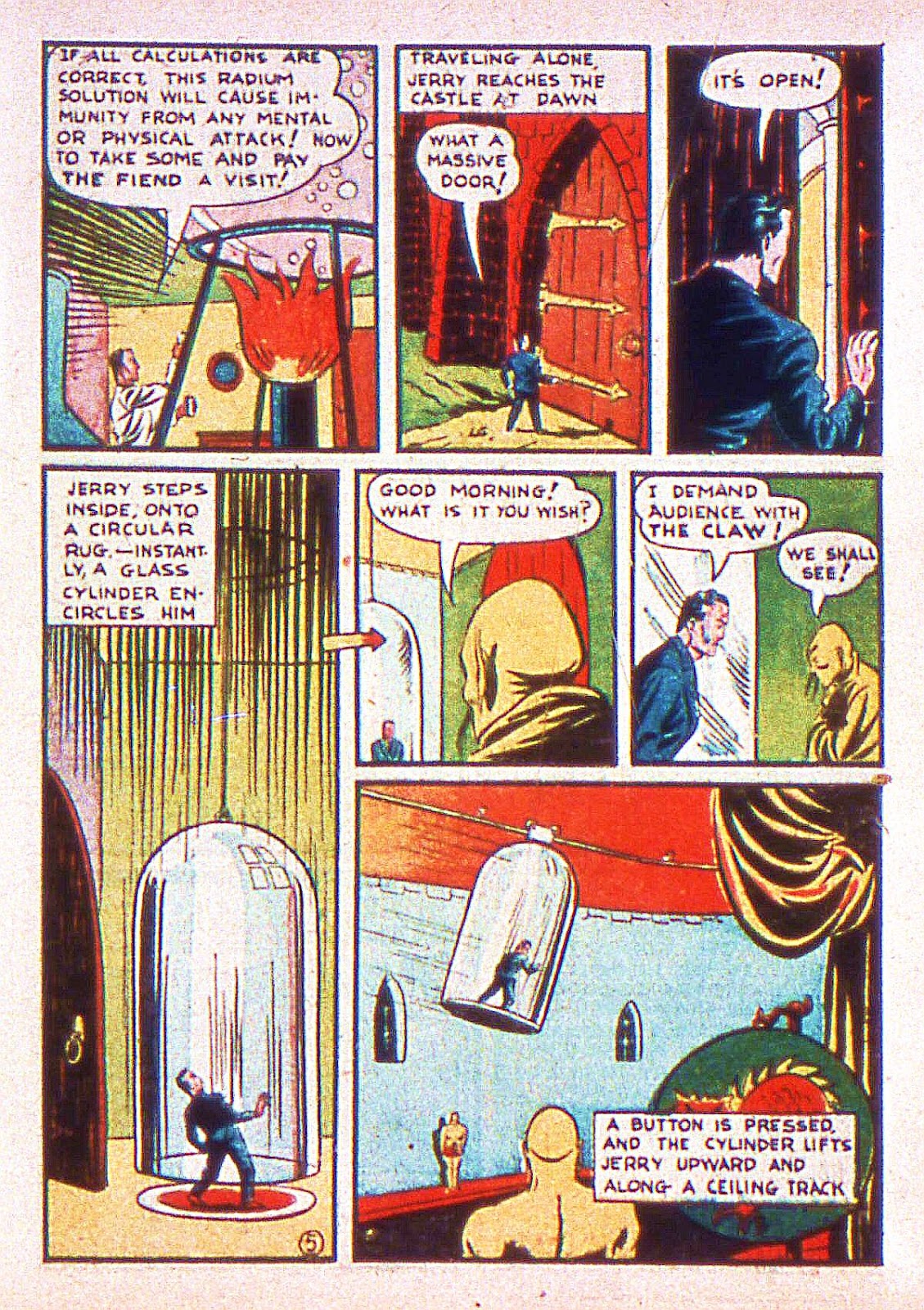
Jerry Morris has a humdinger of a potion there -- a potion of invulnerability that also protects from mind-controlling attacks. What a superhero he would make if he just made more of the stuff!

The trap is a rather clever twist on the dropping cage cliche, since this cage becomes portable.


What is described here sounds an awful lot like the spell Nightmares from Supplement III, but with a reversed version called Happiest Dreams. Other than its addictive quality, it's unclear what game mechanic effects happy dreams would give.

This also means The Claw is at least a warlock (5th level magic-user).


Is a leach-boat going to need to become a trophy item? There's a pretty good description here of how it works.

Acetylene torches have been on the trophy list since Book II.


The lethal qualities of carbon monoxide make it ideal for traps, if not a weapon, Since it would count as a poison, I wouldn't let Heroes use it.

Gas masks, on the other hand, are super handy. Some Heroes build their whole personas around their gas masks. Here is a chance for Jerry to pick up five of them in one haul!

We also see that Jerry's potion lasts at least a full day here -- which seems like a really long duration, until you realize Jerry spent most of that in rest turns.

This is why Jerry isn't a superhero -- superheroes are usually selfish with the source of their power and keep it to themselves. Jerry makes an invulnerability potion, and just hands out samples to anyone who agrees to go fight beside him.  Good way to keep morale high, Jerry!

This trap, with liquid fire raining from the ceiling, looks like it would be pretty deadly if you don't happen to have an invulnerability potion in your system.

In an unusual, if not singular occurrence, the good guys are rendered invulnerable, but not their clothing. There could obviously be some hilarious role-playing opportunities here.

(Scans courtesy of Digital Comic Museum)


Sunday, October 30, 2016

Comics on Parade v. 2 #6

I have the rare opportunity to peruse a United Features comic book again, and this one starts with a surprisingly adventurous scenario in Abbie an' Slats!

I've talked before about the difficulty of scenarios requiring navigating burning buildings. One thing that should never be difficult, though, is for a woman to get a man to do something by calling his manhood into question. That doesn't even require an encounter reaction check.


The previous page featured Abbie and this page has Slats on it. This page reminds me of the importance of roleplaying well-rounded characters for the Heroes to interact with. Personality quirks, like being a busybody, could later work out to the Heroes' advantage.


Brass knuckles are very popular weapons in Hideouts & Hoodlums -- but this, surprisingly, is the first time I've seen them in the comics (and this is The Captain and the Kids).


Speaking of starting equipment, Ella Cinders reminds me about smelling salts. These are, apparently, invaluable for reviving fainting women, but fainting isn't in the game mechanics so we're not concerned with that. Normal smelling salts cannot revive a person unconscious from injuries. Could a trophy item version of smelling salts do that? But then, a normal, non-trophy first aid kit can already do that. So what do we need smelling salts for again...?


You probably wouldn't be able to guess from looking at it, but that's a grizzly bear menacing the half-pints in Broncho Bill. It does present me with some interesting ideas, though...should there be a morale save required whenever meeting something with x number of Hit Dice more than you have? Should morale, in at least this instance, apply to Heroes? And should being petrified with fright be a possible morale failure result?


Billy Make-Believe features a pack of wolves, but correctly points out that wolves do not attack unless hungry.

(Scans courtesy of Comic Books Plus)


Thursday, October 20, 2016

Action Comics #16

Let's start with Superman.

Catching a falling man isn't really a big deal for Superman, and probably only needs a successful "attack" roll to scoop the man up.

The early Superman doesn't seem to care all that much if anyone figures out his secret identity. Not only does he wear no mask and conceals no fingerprints, but the windows on his apartment have sheer curtains. You'd think he'd at least use shades for more privacy!

This is the first story to call Superman's port of call "Metropolis", beginning the trend of fictional cities in the superhero genre.

The police commissioner in this story is a corrupt politician, despite the fact that most police are statted as fighters.

$5,000 was apparently a good night's haul for a casino-club.

The gamblers in this story don't seem to have any special abilities worth statting differently than slick hoodlums, other than to give them a better chance of rigging games.

Superman turns down the chance to collect XP for keeping the money in exchange for the good deed award for giving it all away to poor people.

Racketeers seem to have even less special abilities than gamblers.

Superman wrecks gambling establishments, both with a hammer and his bare hands. Since he's not wrecking the buildings themselves, I'd probably treat this as a wrecking doors roll (and at Superman's current level, he probably doesn't even need to roll for that anymore).

Superman picked up a fixed deck of cards to fool the gamblers, and then keeps it as a trophy.

Pep Morgan's adventure has an unusual angle -- Hero playing bodyguard. Can an Editor pull off a session where the Hero has to spend a week living with another character, waiting to see if any harm comes to him or her (her, in this case)? Only if the Editor creates an engaging character, and the player really likes to roleplay.  Otherwise, the scenario will quickly fast forward to the first whiff of danger. This is part 2 of a 4-part story arc where Pep is employed by a Mr. Smith, who keeps handing Pep plot hooks.

Pep, despite being just a college student, is already a pipe smoker and goes to bed early enough that he's asleep at 11:30 pm when mobsters try to abduct Mr. Smith's daughter, Mary. Something wakes Pep up in time, though (save vs. plot?) so he can come pummel the kidnappers with his fists until they surrender. One of the kidnappers falls over from being pummeled, which isn't supported by the game mechanics, although an Editor could rightly say the circumstances warranted it since the man was carrying Mary and would be unbalanced (maybe a save vs. science to avoid falling over).

Slings and arrows (of outrageous fortune!) are being hurled at Marco Polo in his adventure, but the more effective weapon seems to be the dropped rocks falling on the bandits in the ambush at the end. If the rocks are heavy enough that they have to be pushed over instead of thrown, it could be considered a trap and do more than normal missile weapon damage. Maybe 1-8 points?

Clip Carson deals with a fake mummy in an Egyptian tomb, but it's a trick -- the mummy is a "robot" (really, more like animatronics) and it's voice was from a concealed record player behind it. Clip is in the Pyramid of Cheops -- aka the Great Pyramid of Giza -- looking for a secret treasure room that was apparently missed by 9th century looters and 19th century archaeologists. Interestingly, a rival -- a corrupt sergeant from the occupying British Army -- found the treasure room before them and has convinced the natives to guard it by posing as Cheops in a rubber mask. Maybe those natives have been in the stale air of the pyramid too long...

For the Chuck Dawson summary I'm reading says Chuck is framed by thugs, which is an odd mobster type choice for a Western adventure. Maybe these are outlaws?

Tex Thompson's adventure has an interesting spin to it as well. Tex is asked by the French government to infiltrate a spy ring, to find out who their mole is in the French government. In eight more months, things would be getting a lot more exciting in France if Tex stuck around that long.

Zatara has his first encounter with aliens from another planet (he's already fought aliens from another dimension). He encounters them as if a random wandering encounter -- or at least he encounters the teleport beam that scoops up a random farmer while Zatara and Tong are out on an evening stroll together.

Zatara investigates at the local observatory, where the aliens somehow push him into a teleport beam and he winds up on Saturn. The Saturnians look an awful lot like the Martian Manhunter, 16 years before his debut! Despite having super technology that allows instantaneous interplanetary travel, the Saturnians fight with lassos. Zatara meets their warlord and convinces him to leave Earth alone by showing him a Phantasmal Image of the planet Earth attacking the planet Saturn. Saturnians are very impressionable.

(Superman adventure read in Superman: Action Comics Archive v. 1; select pages were read on the Babbling about DC Comics blog; the rest read in summary either at DC Wikia or Mike's Amazing World.)


Tuesday, October 11, 2016

Smash Comics #2 - pt. 3

This is The Invisible Hood -- and here we have a rare example of a Hero using chloroform! I'll probably have to add this to the minor trophy list, with a note about how you need surprise on someone, or a successful grappling hold, to administer chloroform.

Yeah, I don't get how IH looks at that classified ad and just happens to know that a mobster wrote it. Some weird hunch? Information IH knows that the writer forgot to share with us...?

Up to this point, The Invisible Hood was only figuratively invisible. The captured scientist sprays his hood (really, his whole robe/gown) with an invisibility spray. It's an improved invisibility that doesn't end when you attack either.

You know you're dealing with a shy introvert when he turns invisible and raves that it's the best thing that's ever happened to him.


Well before a scientist died after creating Captain America, we see what a death sentence giving trophy items to Heroes is for scientists. I should probably include something about that in the write-up for scientists in 2nd edition...


Doing the questioning is Wings Wendall of the Military Intelligence.  He catches the sergeant in a slip-up, but that's difficult to roleplay in actual game play. If the Editor slips up while speaking in-character, was it intentional or a mistake? If the Editor does make a mistake, is he prepared to alter the story to match the mistake, or backpedal?

Note that the sergeant was bribed with only $500 to commit sabotage he knew would kill someone.

(Scans courtesy of Digital Comic Museum)

Monday, October 3, 2016

Adventure Comics #41 - pt. 1

There's a bit of controversy over the second Sandman story in this issue. The Sandman pulls a mobster underwater, beats him up, and then we never see that mobster again. The author summarizing stories for DC Wikia believes that Sandman must have drowned the man, making this the Sandman's first kill (despite the narrator's claims that the Sandman has never committed a crime). Thank goodness I had access to The Golden Age Sandman Archives to corroborate these things! I don't think any definitive conclusion can be drawn from that page. We never see the end of that underwater battle. For all we know, before the Sandman surfaces again, he leaves the mobster safely unconscious on a nearby dock.

When Sandman does resurface, the girl he's rescuing says she's "heard a lot about" him, which seems unlikely if this is only his third mission ever. Like with the magic-users and superheroes we've seen so far, there is ample precedent for allowing Heroes to begin with more than 0 xp, or even whole "brevet ranks" (called "big bang levels" in Supplement V).

The Sandman spends much of this adventure out of costume -- retaining his gas mask, but otherwise wearing only a bathing suit and a shoulder holster for his gas gun. At some points he is wearing a coat and hat over his bathing suit. Mysterymen do not seem to need to always be in costume as much as superheroes do.

Barry O'Neill, in his adventure, is in Tunisia -- a welcome departure for me from the habit of creating fictional countries (a personal pet peeve of mine).  Cecil Krull is a great villain name -- too bad it was just an alias.  "Cecil" is a spy, but we already knew spies needed to be a mobster type.

Steve Carson of Federal Men has been slumming for awhile now, but it seems like Jerry Siegel decided to go all out for this issue. An entire town dies, strangely, during a snowfall -- raising the stakes from Steve's recent adventures of stopping crooks. Mobrune is a prophet-like figure who predicts other towns will be hit by the killer snow to be purged of wickedness. As those towns are later hit, Mobrune grows a cult around him (making me wonder if cultist should be a mobster type). Mobrune is actually using a poison gas that is catalyzed by cold air, and the snow is just incidental. A bit bloodthirsty for my liking, but otherwise a plot!

Two of the benefits of a Western campaign (the same with many fantasy campaigns, really) is that a) a trope of the genre is that the Hero is always moving and, b) in a remote environment, any encounter is worthy of description. Which is good because, under normal circumstances an old man looking to go home to see his son -- as Jack Woods meets -- would not seem like much of a plot hook in a busy city.

The bandits Jack Woods meet do something interesting and different -- they just let Jack go, trusting that they've intimidated him enough that he would stay away!

Speaking of different, Socko Strong and his friend Jerry Indutch are shipwrecked on a primitive island but, instead of focusing on getting off the island, Socko and Jerry form ties to the islanders and seem ready to settle down! Socko wins a job as a bodyguard and Jerry has eyes on the chief's daughter. That's creative, proactive roleplaying! The natives use poisoned spears, so the native mobster type needs a 1 in 6 chance of having poisoned weapons.

Should a film projector be a trophy item? Hmm...

Captain Desmo and Gabby are dealing with thugs - the Indian thugs (or Thugees) the word originated with. These thugs are treated as natives, swarming over an Indian city (a fictional city? I can't find a real Jeddur). Since the natives have a huge number advantage, Desmo "has" to resort to wiping them out with a grenade, and the cliche of cutting a primitive bridge over a chasm.

(Sandman read in Golden Age Sandman Archives v. 1, the rest read as summaries at DC Wikia.)


Tuesday, March 15, 2016

Jumbo Comics #5

Welcome to 1939!  We start the year off returning to Fiction House already and their premier title, Jumbo Comics. What can we learn from this issue that we can apply to Hideouts & Hoodlums?

In Hawks of the Seas, Will Eisner was reinventing the pacing of comic book stories. Here we see one of, if not the, first use of a cutaway scene within a page to something else going on that the reader needs to see, but the main character has no knowledge of.

These intermissions are a useful narrative tool, but a H&H Editor will have to think hard about whether to use them in a campaign. Will the players benefit from understanding the Editor's story better, without using their player knowledge to their advantage? It takes a mature group of players to be able to play that way.

Further, this issue marks the first time we've really had a good sense of where Hawks of the Seas takes place. It always seemed to be the West Indies, but now we can narrow it down to the Bahamas.

Dr. Snyde here kills one of his own henchmen with a single blow, which should be impossible in H&H -- he would be unconscious and need a second blow to kill him. Of course, perhaps a second blow occurs between panels. Or maybe the "not yet dead at zero hp" rule needs to be amended so it does not apply to non-Heroes. Or, maybe this needs to be a special rule where master criminals can kill their own henchmen automatically.


It seems clear that Budah is meant to be a djinn, which means that djinn cannot be hit by normal weapons (or at least Budah can't).

It's interesting that the trap can be deactivated and escaped just by touching sections of the wall.  It seems particularly odd since people trapped in a flooding room would naturally be touching the walls, either trying to find a way out or try to climb out. I would allow two search rolls in this case, one for each spot (opening the door without turning off the water first could make for a very wet hideout!).

I've previously discussed what to call the type of thing that Zula is. He was called a bogeyman previously by another character, but in this issue the narrator specifically calls him a monsterman.

There is a lot of visual detail here for describing the dressing in a mad scientist's laboratory.

The robot here is said to be 30' tall, but it seems even the narrator is exaggerating, because it only appears to be twice as tall as Zula. Since the robot can shoot lightning, I would suggest it is a huge version of a copper robot, as detailed in Book II: Mobsters and Trophies).

Though scientists suspected the moon was barren and lifeless in 1939, it couldn't prove this was true yet. That left a lot of leeway for making the moon anything you wanted it to be. If you want there to be valleys filled with cream cheese and giant lettuce plants, or just wind, water, and trees like on Earth, then you can do that in a Golden Age campaign.


This is clearly not Will Eisner, but I wonder if it inspired his strip, Espionage, for Quality?  ZX-5 acts a lot like Black X here, and his exchange with the unnamed highness reminds me of the chemistry between Black X and Madam Doom.

For H&H purposes, I want to point out the battle of bluffs going on here. In certain editions of certain games, one would resolve this with rolling dice, higher bluff roll wins. I am glad H&H isn't like that. I am much more interested in seeing how a player responds to a bluff, and how well he or she can bluff back. I would probably still roll an encounter reaction roll, but try to factor that in to a reasonable response to the bluff in that situation.

Here we seem to have examples -- albeit racist ones -- of bloodthirsty hoodlums (which first appeared in The Trophy Case, but also snuck into one earlier printing of Book II).  Ali Pasha also seems to be demonstrating psionics; it looks a lot like Mass Domination.  Am I going to have to include psionics in 2nd edition?


 Lastly, this is from Wilton of the West, and we get to see that old chestnut -- the "shoot your own arrow" trick. Lucky dice rolling, or flavor text? This would be up to the Editor. Is it important to the story that Wilton split his arrow to impress the other guests? Then his player could be asked to roll to attack the target (with the same AC to hit the bulls-eye as it was the first time).  If not, then this is just something to do while waiting for the encounter at the end of the page and can be hand-waved as successful.

(Scans courtesy of Digital Comic Museum)