We're going to speed through the rest of this issue today, picking up where we left off with Larry Kane. This old castle is so like Old School dungeon design, with random layouts that don't make much real world sense -- like coming in through the main entrance and finding a long hallway lined with doors instead of, oh, maybe a foyer or something.
I didn't know this, but a garret is an attic that's been finished so it can be lived in.
Well, darn! Instead of some spooky ghosts, it's just some mobsters making all the noises. From the descriptions, if I was running this as a Hideouts & Hoodlums scenario (and don't think I wouldn't!), I would stat them as two robbers and a thug. Though I would personally shake things up in this story by having mobsters and undead in the house -- much like my Palace of the Vamp Queen module.
Spoilers: Larry wins. So let's jump ahead to the next feature, Spy A-5 (we're also told his name is Storm King, but that feels an awful lot like an alias as well).
The story is pretty run-of-the-mill, with this being like the eighth or ninth story I've read about an inventor with a stratoplane since I started reading these stories. The only thing worth considering here, then, is the game mechanic issue of the splashing-liquid-in-their-faces-to-distract-them trick. If I was a fan of the new edition of D&D and its mechanic of advantage and disadvantage, I might say the distraction gives them a disadvantage on their next attacks. While the mechanic is clearly popular with today's players, it's a big game-changer in that it alters the dice rolls far more than a small modifier does. I would have to say it goes against the flavor of H&H.
Speaking of flavor...the other use for this trick is simply flavor text to explain how Storm wins initiative on that turn. In H&H, the dice rolls determine the result, and then the result is described; you don't normally pick the result you want and then the mechanics help you get that result (although there are situational modifiers that will give you a 5-20% bonus).
Anyway, on to this next page. First, I wanted to point out that the mobsters are able to use escape artistry as a skill; normally we only see that working for Heroes.
We see corners being used for hard cover. We also see a Hero taking a rare hit and needing first aid afterwards.
For game balance, sometimes it's good to introduce trophy items with a built-in drawback, and this stratosphere has a doozy. Unless the pilot can keep the fuel mixing just right (skill check? Per take-off?), the plane explodes for, I'm guessing, a lot of dice of damage.
And now we get to Fantom of the Fair, and a really nice location for a hideout. I can imagine some cool, water-based traps in that place.
Is Dr. Loy babbling, or does he have voice-activated machinery?
So how tough are these things? We're not talking about golem-level tough if Loy can mass produce a thousand of them. Probably not even gargoyle-level tough, to make them immune to normal weapons. Rather, I'd say they have good Armor Class and that's why the bullet doesn't harm him.
But what to call them? Loy calls them his masterpieces, but that's a terrible name for a mobstertype. "Weird hideous creature" is too long. I would shorten that, then, to The Weird.
Although the weird are undoubtedly tough, their chief advantage against The Fantom seems to be only numbers. I would give them maybe 2, no more than 3, Hit Dice.
The Fantom has gone from a mysterious figure with a fascinating backstory to just some redheaded guy in long underwear and cape. Or is the Fantom in disguise, as he definitely seemed to have black hair in his earliest appearances...?
I had to look up "water bubbler" and learned that it's a slang term for a water fountain, used in New England.
That the weird melt into puddles when hit with water makes them pretty useless, but also easy for low-level Heroes to face.
Fantom's chemical analysis seems like a longshot, depending on a) the weird's creator to not be from some foreign country, or smuggle the chemicals into the country, and b) that they were all made in the last six months.
And what is up with that ugly cowl the Fantom is wearing? It's like he has a red condom pulled down over his head...
(Scans courtesy of Comic Book Plus.)
An exploration of the Golden Age of Comics, through the lens of Hideouts & Hoodlums, the comic book roleplaying game.
Showing posts with label mobster placement. Show all posts
Wednesday, October 16, 2019
Tuesday, July 23, 2019
Adventure Comics #47 - pt. 2
Moving on to Jerry Siegel's Federal Men...so often, it's
senators or generals being bumped off in comic books that it's novel
when a government employee with a distinctly different job title is
going to be killed. This one is particularly novel, because the position
of "Commissioner of National Functions" seems entirely fictional. Even
the "Eastern Exposition" is fake, which is weird because it almost
surely refers to the New York World's Fair, and DC has already had
plenty of stories referring to the New York World's Fair by name.
The plot is a little strange; Steve Carson is knocked out and left in a house with a dying man. Normally, in a story, this is to frame someone for the murder, but the story never goes there.
===
Another wrinkle is that the murderer isn't a spy, but an anarchist (which have been statted for the game since Supplement I).
At one point, Steve appears to get two completely different actions, taking a warning shot to alert the commissioner and then attacking the murderer/anarchist before the m/a gets to act. Normally, if the bad guy knows you're there, you don't get a surprise attack. I believe, even though the m/a clearly knows Steve is there, Steve still gets a surprise action because the warning shot is so unexpected. Then Steve wins initiative on his first turn of regular combat.
===
Socko Strong is in Hollywood starring in a boxing movie. The director is Solly Lloyd and the rival star is Monte Swift, neither of which sounds familiar and are likely not stand-ins for any particular real life people. Monte is able to bribe someone on set to put Socko in danger for just $100. Later, Solly throws a party at his castle -- that's right, he's one of those eccentric rich people who have medieval castles built for them in the U.S., and he's even had deathtraps built into it, purely for his own amusement. Monte traps Socko in a pit with a locked cover that he can fill up with water.
Captain Desmo's enemy, Vasili Gerke, has taken a precaution that few game referees use because in most uses it would seem anticlimactic, but he has guards stationed outside his hideout, tasked with shooting at anyone escaping. One exit has a single sniper watching it, while another exit has a machine gun nest stationed over it.
Having escaped via swimming, and his sidekick Gabby having taken on too much water, Desmo has to perform artificial respiration, which in 1940 still means tipping someone face down and holding them by the ribs.
Desmo uses some unusual dialogue, once saying "We're one rifle to the good," which is either poorly written dialogue or maybe an archaic way of saying "We're one rifle better off than we were." He also uses the phrase "bite the dust," being the first time I've encountered this in a comic book.
Desmo can be a jerk, blaming the two guards that he knocks off a cliff to their deaths for "getting so close to the edge."
===
Does using a gun grant a bonus to a wrecking things roll? Perhaps it should, to justify why Heroes would go the trouble when the noise can so clearly alert the entire hideout (as it does in this story).
Steve Conrad is back after a long break. Steve Conrad's adventure is a bit risque, with him trying to rescue a woman who is grabbed off the street and dragged into a brothel. How do Steve and his sidekick Chang know it's a brothel from outside...? Steve, like a player who's being too cautious for his Editor's plot hooks to work, backs down when the brothel's side entrance is guarded by six yellow peril hoodlums. Only when he reads later in the paper that the girl is the police commissioner's daughter is he shamed into investigating further.
Maybe it's understandable that Steve chickened out earlier; when he comes back, he is bonked over the head and captured immediately. The Editor scales down the scenario to make it less challenging, but goes too far; after Chang rescues Steve, they find all the bad guys are on opium highs and easily tied up.
(Read at readcomiconline.to.)
The plot is a little strange; Steve Carson is knocked out and left in a house with a dying man. Normally, in a story, this is to frame someone for the murder, but the story never goes there.
===
Another wrinkle is that the murderer isn't a spy, but an anarchist (which have been statted for the game since Supplement I).
At one point, Steve appears to get two completely different actions, taking a warning shot to alert the commissioner and then attacking the murderer/anarchist before the m/a gets to act. Normally, if the bad guy knows you're there, you don't get a surprise attack. I believe, even though the m/a clearly knows Steve is there, Steve still gets a surprise action because the warning shot is so unexpected. Then Steve wins initiative on his first turn of regular combat.
===
Socko Strong is in Hollywood starring in a boxing movie. The director is Solly Lloyd and the rival star is Monte Swift, neither of which sounds familiar and are likely not stand-ins for any particular real life people. Monte is able to bribe someone on set to put Socko in danger for just $100. Later, Solly throws a party at his castle -- that's right, he's one of those eccentric rich people who have medieval castles built for them in the U.S., and he's even had deathtraps built into it, purely for his own amusement. Monte traps Socko in a pit with a locked cover that he can fill up with water.
Captain Desmo's enemy, Vasili Gerke, has taken a precaution that few game referees use because in most uses it would seem anticlimactic, but he has guards stationed outside his hideout, tasked with shooting at anyone escaping. One exit has a single sniper watching it, while another exit has a machine gun nest stationed over it.
Having escaped via swimming, and his sidekick Gabby having taken on too much water, Desmo has to perform artificial respiration, which in 1940 still means tipping someone face down and holding them by the ribs.
Desmo uses some unusual dialogue, once saying "We're one rifle to the good," which is either poorly written dialogue or maybe an archaic way of saying "We're one rifle better off than we were." He also uses the phrase "bite the dust," being the first time I've encountered this in a comic book.
Desmo can be a jerk, blaming the two guards that he knocks off a cliff to their deaths for "getting so close to the edge."
===
Does using a gun grant a bonus to a wrecking things roll? Perhaps it should, to justify why Heroes would go the trouble when the noise can so clearly alert the entire hideout (as it does in this story).
Steve Conrad is back after a long break. Steve Conrad's adventure is a bit risque, with him trying to rescue a woman who is grabbed off the street and dragged into a brothel. How do Steve and his sidekick Chang know it's a brothel from outside...? Steve, like a player who's being too cautious for his Editor's plot hooks to work, backs down when the brothel's side entrance is guarded by six yellow peril hoodlums. Only when he reads later in the paper that the girl is the police commissioner's daughter is he shamed into investigating further.
Maybe it's understandable that Steve chickened out earlier; when he comes back, he is bonked over the head and captured immediately. The Editor scales down the scenario to make it less challenging, but goes too far; after Chang rescues Steve, they find all the bad guys are on opium highs and easily tied up.
(Read at readcomiconline.to.)
Labels:
Captain Desmo,
challenge level,
deathtraps,
Federal Men,
firearms,
hideouts,
mobster placement,
mobsters,
names,
number appearing,
plot hooks,
prices,
slang,
Socko Strong,
Steve Conrad,
surprise,
wrecking things
Wednesday, April 17, 2019
Jungle Comics #2 - pt. 3
We're still looking at Captain Terry Thunder of the Congo Lancers ("Terry" has been added to the title since last issue). I like that fifth panel; in a RPG scenario, each man's secret could be shared with the player only and, although the published scenario here was all combat, in game everyone could have the secondary goal of trying to figure out everyone else's secret past through roleplaying.
This is Wambi, the Jungle Boy. Wambi has the ability, like most jungle explorers seem to do, of summoning animals. Here, we see nine monkeys encountered at once.
Wambi, forced to choose between the people who raised him and some white guys he just met last issue, chooses to betray his own people. Okay, sure, they turn out to be slavers -- but those slavers wiped your bottom when you are a baby, kid!
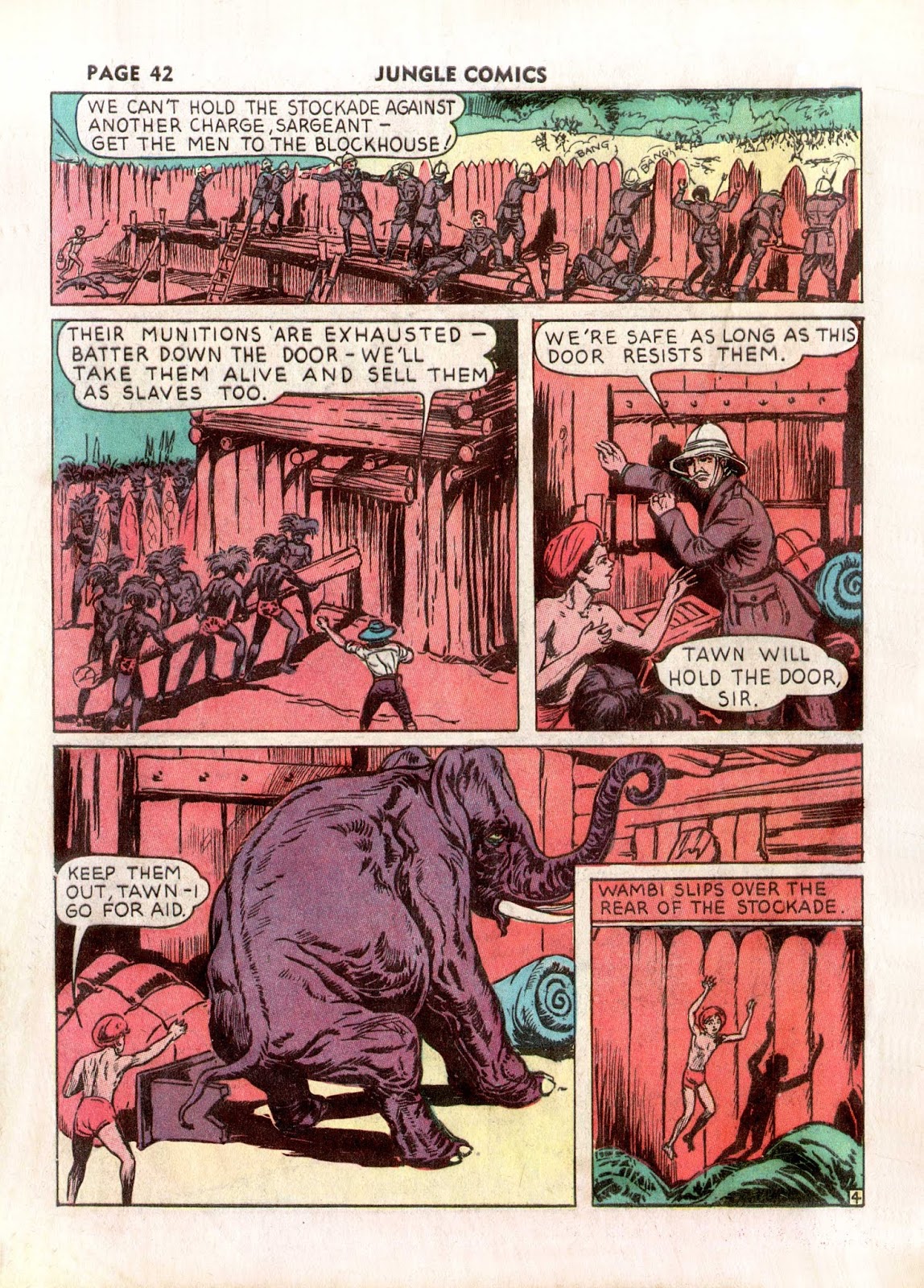
Speaking of number appearing, here we see at least 40 natives, and is probably meant to represent much more than that.
"What the devil? How did the elephant get in my blockhouse? And how is there room for him in here? Is he sitting on all my men?"
Of course, in the early days of D&D, you could put 20 orcs in a 10' x 10' room and no one batted an eye, but nowadays you should put a little more sense into spaces than that...
This is from Roy Lance, a feature best remembered for its good sense of geography and ethnography. The Riffians are indeed a real people, also known as Riyafa or Rwafa, and a Berber-speaking people of Northwestern Africa. Everyone has heard of Ethiopia today, but that might have been an obscure country in 1940. The Zulu are a Bantu ethnic group of Southern Africa and the largest ethnic group in South Africa. Not surprisingly, the author cannot name a real cannibal or pygmy people from Africa.
This page is all kinds of wrong -- Joan is being spanked, with a native gleefully watching, for being a free thinker and feeling like she shouldn't have to obey a man. 1940 was a tough time to be a woman.
The map is serviceable, though, with a mix of real locales, like the Congo River and Stanley Falls, with names that I can't verify are real. Twice, upon seeing Wakuna in this story, I thought "Wakanda...?" Probably not intentionally similar.
Now, seeing all the "primitives" running in fear from a film projection might seem racist to you, but bear in mind this trick also works on Scooby Doo. It just seems to be a given of the comic genre that visual and audio trickery is much more compellingly realistic than it would be in real life. So, as the Editor, keep an open mind when your players try nonsense like this.
This is from Simba, King of Beasts. It takes a lot of imagination to picture a water buffalo being the deadly nemesis of a lion, but now I'm just going to have to make sure to stat water buffalo -- and make them nasty!
I included this page because I realized there were actually few examples I had found so far in comics of outdoor tracking. This was the primary ability of the 1st edition explorer class, but maybe that can't be justified by direct emulation after all...
(Scans courtesy of Digital Comic Museum.)
This is Wambi, the Jungle Boy. Wambi has the ability, like most jungle explorers seem to do, of summoning animals. Here, we see nine monkeys encountered at once.
Wambi, forced to choose between the people who raised him and some white guys he just met last issue, chooses to betray his own people. Okay, sure, they turn out to be slavers -- but those slavers wiped your bottom when you are a baby, kid!
Speaking of number appearing, here we see at least 40 natives, and is probably meant to represent much more than that.
"What the devil? How did the elephant get in my blockhouse? And how is there room for him in here? Is he sitting on all my men?"
Of course, in the early days of D&D, you could put 20 orcs in a 10' x 10' room and no one batted an eye, but nowadays you should put a little more sense into spaces than that...
This is from Roy Lance, a feature best remembered for its good sense of geography and ethnography. The Riffians are indeed a real people, also known as Riyafa or Rwafa, and a Berber-speaking people of Northwestern Africa. Everyone has heard of Ethiopia today, but that might have been an obscure country in 1940. The Zulu are a Bantu ethnic group of Southern Africa and the largest ethnic group in South Africa. Not surprisingly, the author cannot name a real cannibal or pygmy people from Africa.
This page is all kinds of wrong -- Joan is being spanked, with a native gleefully watching, for being a free thinker and feeling like she shouldn't have to obey a man. 1940 was a tough time to be a woman.
The map is serviceable, though, with a mix of real locales, like the Congo River and Stanley Falls, with names that I can't verify are real. Twice, upon seeing Wakuna in this story, I thought "Wakanda...?" Probably not intentionally similar.
Now, seeing all the "primitives" running in fear from a film projection might seem racist to you, but bear in mind this trick also works on Scooby Doo. It just seems to be a given of the comic genre that visual and audio trickery is much more compellingly realistic than it would be in real life. So, as the Editor, keep an open mind when your players try nonsense like this.
This is from Simba, King of Beasts. It takes a lot of imagination to picture a water buffalo being the deadly nemesis of a lion, but now I'm just going to have to make sure to stat water buffalo -- and make them nasty!
I included this page because I realized there were actually few examples I had found so far in comics of outdoor tracking. This was the primary ability of the 1st edition explorer class, but maybe that can't be justified by direct emulation after all...
(Scans courtesy of Digital Comic Museum.)
Labels:
Captain Thunder and the Congo Lancers,
Explorer,
locations,
map,
mobster placement,
mobsters,
new mobsters,
number appearing,
Roy Lance,
scenarios,
sexism,
Simba,
tactics,
tracking,
Wambi
Tuesday, September 4, 2018
Blue Ribbon Comics #3 - pt. 1
Back now to early MLJ and, remarkably, another reason to visit with Rang a Tang the Wonder Dog. And it's not for anything that Rang has done yet, but for this interesting transition of the term bandit. Long-time readers here (if there is such a thing) will recall that bandit was long used as a racist term for non-white or Latino criminals. But lately I've been seeing "bandit" used much more as it's used here, as synonymous with bank robbers. I wonder what changed in 1939 to make that happen?
A dropped hat is a good clue circa 1940, as hats could still be purchased then at specialty stores and might be more easily traced back to their owners.
Instead, Speed must be hungry because he decides to go have lunch first. This is the first use of the terms "lunchroom" and "luncheonette" in comics, terms that have been cast aside in favor of "diners" today.
Bandits are now also synonymous with gangsters. Cut it out, guys, or you're going to take away all my mobstertypes!
Still unresolved is, is Rang a playable Hero, or Speed's supporting cast?
You wouldn't think this page would present such a game mechanics problem, but what causes Speed's crash, game mechanics-wise? Is his inability to see where he's going a randomly generated complication or obstacle to overcome during the car chase? Or is the complication triggered by the car taking damage during the chase? Could Speed's hit points apply to both himself and his car during a chase scene (the answer is a weak yes -- yes, hit points are highly abstract, but on the other hand there is no precedent for treating them so broadly)?
We also see that bodies of water do not necessarily stop tracking (at least not for dogs).
This first issue is older than RPGs and goes back to war games -- do you let the players know exact measurements, so they know where missile ranges end, or make them guess? There is no definitive way to rule on this and Hideouts & Hoodlums Editors could go either way.
Very unusual for a RPG scenario, Hy (our hero "Speed") finds the boss villain outside the hideout, rather than after exploring much of it. The gang's chief and at least one other are thugs, making them tougher than bandit/robber/gangsters. Because Hy is low level, two thugs are more than a match for him.
Now this is a little crazy, and why I find it hard to believe Rang is an ordinary dog. This is the second time he's leapt through an upstairs window, making me think Rang should be statted as an alien instead of a real dog.
Hy, now I know you don't really care about this dog at all anymore. We know those mobsters have at least two guns between them. And you're making your dog run towards them, with dynamite in his mouth? How about dropping the dynamite out a window on the other side of the house, where he won't get shot at?
Okay, as crazy random as this page seems to be, it actually could play out this way in Hideouts & Hoodlums. Even though Rang cannot get to the boat without running past the three men on the dock, there's still a chance of the dog getting surprise. Maybe all their backs were turned for three seconds.
The mobsters are not "paralyzed," but stunned by the explosion (because they made their saves to avoid being unconscious longer when reduced to zero hp). They are all stunned for a random amount of time, but it is possible to roll the same recovery time for all three of them. Since they recover hp after recovering from a stun, it's possible for them to be winning this fight.
And...yeah, I'm not really sure what to make of this page. The local police force has planes, and elite squad of parachutists, and extra parachutes for rescue dogs? What do they even need low-level Heroes for around here?
This page is from the next feature, Stuart Logan. The artist is unknown, and Stuart Logan never appeared again, which is doubly tragic because this looks really good. I've also never considered searching a scabbard for dust before to find out when the blade was drawn.
(Scans courtesy of Digital Comic Museum.)
A dropped hat is a good clue circa 1940, as hats could still be purchased then at specialty stores and might be more easily traced back to their owners.
Instead, Speed must be hungry because he decides to go have lunch first. This is the first use of the terms "lunchroom" and "luncheonette" in comics, terms that have been cast aside in favor of "diners" today.
Bandits are now also synonymous with gangsters. Cut it out, guys, or you're going to take away all my mobstertypes!
Still unresolved is, is Rang a playable Hero, or Speed's supporting cast?
You wouldn't think this page would present such a game mechanics problem, but what causes Speed's crash, game mechanics-wise? Is his inability to see where he's going a randomly generated complication or obstacle to overcome during the car chase? Or is the complication triggered by the car taking damage during the chase? Could Speed's hit points apply to both himself and his car during a chase scene (the answer is a weak yes -- yes, hit points are highly abstract, but on the other hand there is no precedent for treating them so broadly)?
We also see that bodies of water do not necessarily stop tracking (at least not for dogs).
This first issue is older than RPGs and goes back to war games -- do you let the players know exact measurements, so they know where missile ranges end, or make them guess? There is no definitive way to rule on this and Hideouts & Hoodlums Editors could go either way.
Very unusual for a RPG scenario, Hy (our hero "Speed") finds the boss villain outside the hideout, rather than after exploring much of it. The gang's chief and at least one other are thugs, making them tougher than bandit/robber/gangsters. Because Hy is low level, two thugs are more than a match for him.
Now this is a little crazy, and why I find it hard to believe Rang is an ordinary dog. This is the second time he's leapt through an upstairs window, making me think Rang should be statted as an alien instead of a real dog.
Hy, now I know you don't really care about this dog at all anymore. We know those mobsters have at least two guns between them. And you're making your dog run towards them, with dynamite in his mouth? How about dropping the dynamite out a window on the other side of the house, where he won't get shot at?
Okay, as crazy random as this page seems to be, it actually could play out this way in Hideouts & Hoodlums. Even though Rang cannot get to the boat without running past the three men on the dock, there's still a chance of the dog getting surprise. Maybe all their backs were turned for three seconds.
The mobsters are not "paralyzed," but stunned by the explosion (because they made their saves to avoid being unconscious longer when reduced to zero hp). They are all stunned for a random amount of time, but it is possible to roll the same recovery time for all three of them. Since they recover hp after recovering from a stun, it's possible for them to be winning this fight.
And...yeah, I'm not really sure what to make of this page. The local police force has planes, and elite squad of parachutists, and extra parachutes for rescue dogs? What do they even need low-level Heroes for around here?
This page is from the next feature, Stuart Logan. The artist is unknown, and Stuart Logan never appeared again, which is doubly tragic because this looks really good. I've also never considered searching a scabbard for dust before to find out when the blade was drawn.
(Scans courtesy of Digital Comic Museum.)
Monday, July 23, 2018
All-American Comics #4-6
From the tail end of #4...
From Hop Harrigan, I learned that air mail pilots were required to be armed.
Spot Savage, a humor/adventure strip with an odd sense of humor, has had Spot locked up in an insane asylum, in a straight jacket, for one week of "game time" now. I can't imagine any players being happy with that game session.
Moving on to #5...
From Red, White, and Blue, we learn that a live turkey is worth $4. We see the boys, on leave, playing banko, which as late as the 1980s was still another name for the game of bingo. They also play the card game hearts. While searching a room for clues, they find money and a note hidden in a hollow ashstand (a stand for an ashtray to sit on). Instead of spies, they seem to be opposing anarchists this time. The chief anarchist calls them "cannon fodder," which is amusing because the term gets thrown around a lot in RPG games. It's also interesting to me that they go to a carnival with a shooting gallery and an old mill ride, as both figure into the upcoming adventure module RT2 Adventures in Fun World. Policeman Mike Flynn (another old friend of Red's) joins them as Supporting Cast this time, and is helpful at catching all the lookouts posted by the anarchists. Lastly, it is interesting that after beating up the anarchists, the policeman admits that the only charge they can charge them with is for concealed weapons. This could be another good reason for Heroes to go into scenarios barehanded instead of using weapons.
According to Reg'lar Fellers, admission to an all-you-can-eat strawberry-eating festival would be $1. I wonder how common those were.
Ben Webster meets an inventor who has put together a thought radio. It can record and play back someone's thoughts, but the person has to be standing about 5' in front of the radio and has to stand still for at least 1 melee turn. It even works on animals. Curiously, people they meet are quick to believe in the thought radio, rather than suspect Ben and his friend of some kind of hoax.
In Mystery Men of Mars, the Martian pill-bug men have a melting ray that looks sort of like a planetarium projector. It is revealed that Ted's gun is an automatic, and he has to change the clip between throwing slugs into advancing Martians. In fact, so many Martians fall to his vicious onslaught that the bodies become stacked up too high for more Martians to enter the tunnel. I suspect that Ted is making a lousy first impression of Earthlings for them.
Hop Harrigan runs afoul of an arsonist, a mobster type that debuted in Supplement V and will be in the 2nd edition Mobster Manual. Hop can't escape the deathtrap the arsonist puts him in and would have died, but a new character (Gerry) shows up and saves him, then becomes a temporary Supporting Cast Member for next issue. Because Hop's cheap plane (he'll get fancier ones later) is still lined with paper, he has to be very careful about burning embers falling on it and combusting his whole plane.
In Bobby Thatcher, a half-pint is able to kick open a stuck door. For that matter, Gerry was a half-pint too and was able to do pushing "damage" to Hop to land him in a fountain after his clothes caught on fire. Being young and small does not affect their abilities much -- except in Scribbly, Scribbly is so sickened by a dollar cigar that he's effectively stunned.
In Spot Savage, the "Duchess" breaks into a safe and finds $60,000 in negotiable bonds.
In Scribbly, we learn that Scribbly earned $8 a week as an office boy, plus $2 for every cartoon of his that got published.
I don't know if I've ever gleaned RPG material out of Toonerville Folks before, but this one page tells me that a carpenter would work to fix a shed for $7 back in the '30s.
And on to #6!
In Red, White, and Blue, it appears that Doris lives with her aunt, and that Whitey still lives at home with his parents. Blooey has a pet parrot that stays with him like a Supporting Cast Member. Of course, the parrot saves the day later by repeating something it hears. Red is thwarted from snooping at a window by a noisy cat, which in this instance is just as effective as a watchdog. The bad guys are saboteurs again, but since they are all kind of Japanese-looking, this time they are spies. There are five spies, and one of them has a sub-machine gun. The leader has a pistol and knife and goes by "The Eye." Although much of the fight happens off-panel, Blooey beats a saboteur with a shovel so hard that the man has to go the hospital.
(Read at fullcomic.pro.)
From Hop Harrigan, I learned that air mail pilots were required to be armed.
Spot Savage, a humor/adventure strip with an odd sense of humor, has had Spot locked up in an insane asylum, in a straight jacket, for one week of "game time" now. I can't imagine any players being happy with that game session.
Moving on to #5...
From Red, White, and Blue, we learn that a live turkey is worth $4. We see the boys, on leave, playing banko, which as late as the 1980s was still another name for the game of bingo. They also play the card game hearts. While searching a room for clues, they find money and a note hidden in a hollow ashstand (a stand for an ashtray to sit on). Instead of spies, they seem to be opposing anarchists this time. The chief anarchist calls them "cannon fodder," which is amusing because the term gets thrown around a lot in RPG games. It's also interesting to me that they go to a carnival with a shooting gallery and an old mill ride, as both figure into the upcoming adventure module RT2 Adventures in Fun World. Policeman Mike Flynn (another old friend of Red's) joins them as Supporting Cast this time, and is helpful at catching all the lookouts posted by the anarchists. Lastly, it is interesting that after beating up the anarchists, the policeman admits that the only charge they can charge them with is for concealed weapons. This could be another good reason for Heroes to go into scenarios barehanded instead of using weapons.
According to Reg'lar Fellers, admission to an all-you-can-eat strawberry-eating festival would be $1. I wonder how common those were.
Ben Webster meets an inventor who has put together a thought radio. It can record and play back someone's thoughts, but the person has to be standing about 5' in front of the radio and has to stand still for at least 1 melee turn. It even works on animals. Curiously, people they meet are quick to believe in the thought radio, rather than suspect Ben and his friend of some kind of hoax.
In Mystery Men of Mars, the Martian pill-bug men have a melting ray that looks sort of like a planetarium projector. It is revealed that Ted's gun is an automatic, and he has to change the clip between throwing slugs into advancing Martians. In fact, so many Martians fall to his vicious onslaught that the bodies become stacked up too high for more Martians to enter the tunnel. I suspect that Ted is making a lousy first impression of Earthlings for them.
Hop Harrigan runs afoul of an arsonist, a mobster type that debuted in Supplement V and will be in the 2nd edition Mobster Manual. Hop can't escape the deathtrap the arsonist puts him in and would have died, but a new character (Gerry) shows up and saves him, then becomes a temporary Supporting Cast Member for next issue. Because Hop's cheap plane (he'll get fancier ones later) is still lined with paper, he has to be very careful about burning embers falling on it and combusting his whole plane.
In Bobby Thatcher, a half-pint is able to kick open a stuck door. For that matter, Gerry was a half-pint too and was able to do pushing "damage" to Hop to land him in a fountain after his clothes caught on fire. Being young and small does not affect their abilities much -- except in Scribbly, Scribbly is so sickened by a dollar cigar that he's effectively stunned.
In Spot Savage, the "Duchess" breaks into a safe and finds $60,000 in negotiable bonds.
In Scribbly, we learn that Scribbly earned $8 a week as an office boy, plus $2 for every cartoon of his that got published.
I don't know if I've ever gleaned RPG material out of Toonerville Folks before, but this one page tells me that a carpenter would work to fix a shed for $7 back in the '30s.
And on to #6!
In Red, White, and Blue, it appears that Doris lives with her aunt, and that Whitey still lives at home with his parents. Blooey has a pet parrot that stays with him like a Supporting Cast Member. Of course, the parrot saves the day later by repeating something it hears. Red is thwarted from snooping at a window by a noisy cat, which in this instance is just as effective as a watchdog. The bad guys are saboteurs again, but since they are all kind of Japanese-looking, this time they are spies. There are five spies, and one of them has a sub-machine gun. The leader has a pistol and knife and goes by "The Eye." Although much of the fight happens off-panel, Blooey beats a saboteur with a shovel so hard that the man has to go the hospital.
(Read at fullcomic.pro.)
Labels:
Ben Webster,
clues,
history lesson,
Hop Harrigan,
mobster placement,
mobsters,
new mobsters,
new trophies,
pacing,
prices,
Red White and Blue,
Reg'lar Fellers,
SCMs,
Scribbly,
Spot Savage,
stunning,
treasure,
weapons
Wednesday, March 29, 2017
Jumbo Comics #11 - pt. 1
After a long pause I see I was still shuffling through December 1939. Here we rejoin Sheena, throwing a party for guests, when they are ambushed by natives. The natives are described as giants, but I've talked before about how that term is thrown around too loosely in comics and needn't be taken seriously.
The natives ambushing the dancers are enjoying light cover (bushes don't have enough mass to count as hard cover), but also may be firing from darkness (despite the fact we can see them on the page). In 1st edition there was the distinction of them firing from dim light that was half as good as firing from darkness (-2 to be hit vs. -4), but I dislike that rule and have discarded it for being too subjective. In 2nd ed., it's either dark or it isn't.
Now, 8' tall humans...maybe at this point I do need to consider statting them different. Not sure how to distinguish them from real giants, though. Pseudo-giants?
I don't stat lionesses any differently from male lions.
The story gives us no clue how Bob manages to scale that sheer wall, but apparently he does it with ease. Maybe it really is as sloped as it appears to be.
That's a rhino charging through the wall, showing that rhinos have a pretty good wrecking things chance (equal to extraordinary men, 3rd level superheroes, at least). In all my years of playing That Other Game, I never considered making a rhino an indoor encounter -- but look, I have a precedent for that now!
"Little rascal"? That chimp just saved your bacon, Sheena. Show a little respect! It must be a little embarrassing when the Editor has to rush in with an animal supporting cast member to save the day, though -- to be fair -- the Editor really had no business putting them up against a rhino at their level in the first place. Keep appropriate challenge levels in mind!
This is The Hawk (of the Seas), and it raises an interesting point for me that not every encounter needs to go straight to combat after surprise is rolled. Some opponents might only want to attack under surprise conditions, disengaging and coming at the Hero(es) later from another angle.
Though guns can be disarmed through the least efforts and at a distance, disarming a sword takes attacking in melee, this time with grappling.
Despite outnumbering the Hawk five to one, these pirates still stupidly attack him one at a time. Of course, this makes solo play much easier.
Bad guys may feign death so they can sneak away when the Heroes aren't looking. This isn't a skill so much as it's the bad guy taking advantage of the Hero being too busy to check for signs of life.
And here we have an example of the Hero using disguise to sneak into the hideout.
Under certain circumstances -- like being the only person in the room with a gun -- the Hero can force morale saves to happen by not attacking, but just threatening to.
(Scans courtesy of Comic Book Plus.)
The natives ambushing the dancers are enjoying light cover (bushes don't have enough mass to count as hard cover), but also may be firing from darkness (despite the fact we can see them on the page). In 1st edition there was the distinction of them firing from dim light that was half as good as firing from darkness (-2 to be hit vs. -4), but I dislike that rule and have discarded it for being too subjective. In 2nd ed., it's either dark or it isn't.
Now, 8' tall humans...maybe at this point I do need to consider statting them different. Not sure how to distinguish them from real giants, though. Pseudo-giants?
I don't stat lionesses any differently from male lions.
The story gives us no clue how Bob manages to scale that sheer wall, but apparently he does it with ease. Maybe it really is as sloped as it appears to be.
That's a rhino charging through the wall, showing that rhinos have a pretty good wrecking things chance (equal to extraordinary men, 3rd level superheroes, at least). In all my years of playing That Other Game, I never considered making a rhino an indoor encounter -- but look, I have a precedent for that now!
"Little rascal"? That chimp just saved your bacon, Sheena. Show a little respect! It must be a little embarrassing when the Editor has to rush in with an animal supporting cast member to save the day, though -- to be fair -- the Editor really had no business putting them up against a rhino at their level in the first place. Keep appropriate challenge levels in mind!
This is The Hawk (of the Seas), and it raises an interesting point for me that not every encounter needs to go straight to combat after surprise is rolled. Some opponents might only want to attack under surprise conditions, disengaging and coming at the Hero(es) later from another angle.
Though guns can be disarmed through the least efforts and at a distance, disarming a sword takes attacking in melee, this time with grappling.
Despite outnumbering the Hawk five to one, these pirates still stupidly attack him one at a time. Of course, this makes solo play much easier.
Bad guys may feign death so they can sneak away when the Heroes aren't looking. This isn't a skill so much as it's the bad guy taking advantage of the Hero being too busy to check for signs of life.
And here we have an example of the Hero using disguise to sneak into the hideout.
Under certain circumstances -- like being the only person in the room with a gun -- the Hero can force morale saves to happen by not attacking, but just threatening to.
(Scans courtesy of Comic Book Plus.)
Labels:
challenge level,
climbing,
combat modifiers,
disarming,
disguise,
Hawks of the Seas,
mobster placement,
mobsters,
morale,
number appearing,
Sheena Queen of the Jungle,
surprise,
tactics,
visibility
Friday, February 24, 2017
Speed Comics #3 - pt. 2
Turn Gun on Bad Guy -- or Turn Missiles, as I'm going to call it in 2nd ed.
It takes the 4th level power Raise Bridge to lift enough tonnage to flip a heavy tank.
Shock must have at least two 4th level powers, which would make him at least an 8th level superhero (7th in 2nd edition). That's a lot of brevet ranks for someone only on his third adventure.
There won't be any tank-sized trophy weapons in the 2nd ed. basic book -- but if there were, flame-thrower tanks would be too cool to leave out. There are three flame-thrower tanks in total, to which Shock is immune. So, is that the Resist Fire power, or does his Invulnerability power have an impossibly long (by 1st ed.) duration?
Either Shock was still taking partial damage from the liquid fire, or the duration ended on his defensive buffing power(s).
Shock seems fully recovered by the time he wakes up, but he'd be at 2 hit points after an 8-hour rest in 1st ed. and no more than 6 hit points in 2nd edition.
He also uses wrecking things and a Leap power.
It can't be easy snapping a small lead coin in half between your fingers, as you wouldn't be able to get much leverage on it. This might wreck as a machine.
Note that there's no reason for Shock to suspect these are fake coins. His snapping it in half, then, would seem to be a symbolic gesture that just got really lucky.
It's never clear if the aggressor nation is Germany or Italy.
There's a category for wrecking tanks, so a tank gun should probably be right under that (trucks category).
Once again Shock uses Turn Missiles -- but today is a new day, so he has his powers prepared fresh again.
This is Crash, Cork, and the Baron again, and an example of some poor planning. The plot hook is that they've spotted a known wanted criminal with a $4,000 price on his head and go after him. They do it in three separate planes, each with a good chance of getting damaged in the course of the scenario. Their odds of coming out ahead in this scenario seem pretty low -- though they are probably hoping to pick up additional treasure while looting his hideout.
Crash runs into a constrictor snake, but successfully evades the encounter by running away. The hyena cub poses no serious threat, except for alerting the guard -- sort of like the purpose of shriekers in That Other Game!
I was not familiar with the word "kraal", so I had to look it up.
(Scans courtesy of Comic Book Plus)
Subscribe to:
Posts (Atom)