Showing posts with label Steve Carson Federal Men. Show all posts

Friday, August 12, 2016

Adventure Comics #40

We've already seen The Sandman once, but here he is, debuting in his regular berth for the first time, Adventure Comics. There's a delightful slow build to the story after Wesley Dodds gets his plot hook. He spends some time mulling it over, while lounging in the dark in his smoking jacket. We meet his butler, Humphries. We get some unusual insight into Wesley's character, when he puts a doll representing himself in his bed, as if psychologically transferring his identity before becoming The Sandman. Before The Batman, The Sandman is the first crimefighter to have a secret underground laboratory (but not an underground lair; that would The Clock).

The Sandman is shown mixing his own chemicals for his gas gun. Last time, I said I was comfortable not giving Sandman levels in the Scientist class, but here he really does seem to be earning at least one level.

There's also a very interesting caption about color. "Then he dons all black apparel", the caption says, yet The Sandman is wearing yellow gloves, an orangish- tan coat, and a purple cape. It seems clear that authors had little input on the coloring of their own characters; the caption was overruled, but the wording was left there anyway.

The Sandman uses stealth (move silently?) to sneak around unobserved, climbing to get to an upper story window, and finds a secret door.

Another interesting detail is that the smell of his sleep gas reminds its victim of violets.

In Barry O'Neill's ongoing adventure, he has just been doused with gasoline and Count Guniff is about to light him on fire - but it turns out he had the wrong bucket and that was just water. A little help from the Editor, or game mechanics? I have had a player suggest the save vs. plot should work like that, with the player suggested an alternate explanation and allowing the player to roll for it. I'm personally opposed to giving the player veto power over the game Editor...but that does seem to be a reasonable explanation for what I've read here...

Steve Carson of Federal Men has fallen far from taking on giant robots to being knocked unconscious by two counterfeiters, one hitting him with a block of wood. I do envision Hideouts & Hoodlums to be a game that can move effortlessly between challenge levels. Maybe I shouldn't be entirely opposed to hoodlums having a special ability of "backstabbing" Heroes for additional damage, and a quick knockout...

Bulldog Martin is overpowered by three thugs (a pretty tough encounter for a solo, low-level Fighter!), but escapes from being tied up by rope by carrying a nail file on him. He foils a plot to murder a racehorse with a fake camera that can shot a poison needle (trophy weapon, but pretty useless to a Hero if you don't allow them to use poison).

Skip Schuyler is in Hawaii, helping a scientist who has made tiny explosives with the power of artillery shells. We also see a good hiding place to search in a scientist's house, the inside of a lampshade.

Rusty and His Pals is at a climactic scene rarely seen in comics -- an earthquake is destroying the island the whole scenario is taking place on, there's a single seaplane that can get people off, and various factions are racing to get to it. One could make a board game out of this scenario. Combat plays a minor part, but it's movement rate that really wins the scenario here.

Anchors Aweigh is on a new scenario. Don and Red get captured by thugs (that seems to happen a lot -- thugs are tough!) and are left in an uncommon deathtrap -- an island that will flood when the tide comes in, and then sharks will show up. They're tied up so they can't swim away, but escape using the old "focusing light with a pair of glasses". I don't think we need an escape artist game mechanic; rather, any idea you come up with to get out of ropes should just automatically work.

There's also an octopus -- and a normal one, not a giant one!

(Sandman adventure read in Golden Age Sandman Archives vol. 1; summaries of the rest read at DC Wikia.)


Sunday, April 17, 2016

Adventure Comics #35

In this installment of Barry O'Neill, Barry dives underwater and the bad guys assume he's dead because he stayed under so long. Villains seem to be terrible at underestimating how long Heroes can stay underwater -- so much so that they should have to save vs. plot to avoid making this cliched mistake.

Doctors are treated as a Lawful mobster-type in Supplement V: Big Bang because they have special abilities in comics -- one found here is the ability to quickly concoct antidotes. Dr. Bonfil crafts an antidote for Fang Gow's hypnosis drug in less than a day.

Shades of the Savage Land!  Cotton Carver's adventures debut in this issue. When forced to land on Antarctica, Cotton is saved by a group of people from the lost world of Mayala, a tropical valley long ago found and settled by both the Mayans and Incas (who are rival tribes here now). Though the natives have seen gunpowder weapons before, they have none of their own and Cotton's six-shooters make him a fearsome foe for the natives (and awfully handy for a solo campaign!).

It is unclear how Mayala can only be entered by swimming underwater, if the valley is open to the sky -- unless it is assumed that Mayala is a "hollow world" setting like Pellucidar.

Sleeping gas takes out an entire bank-full of people in this installment of Federal Men. This will be neither the first nor the last instance of sleeping gas being shown to be much more effective in the comics than it is in real life. The amnesia-suffering Steve Carson seems to have no trouble acquiring this super-sleeping gas, as well as gas masks for his gang, despite the absence of such things from the starting equipment list. Though perhaps we are just not privy to the separate adventure Steve went on to find these trophy items.

In Dale Daring, Don and Dale seek shelter in a cave from an approaching storm. The weird thing about storms is that, in real life, everyone rushes out of them, but there is little in-game reason to do so. Is your Hero going to take damage from getting wet? Is the Editor going to pull out all the stops on that storm and start pummeling Heroes with lightning strikes? Probably neither -- and yet Heroes should have to save vs. plot to resist the urge to seek shelter.

Tod Hunter becomes the second Hero in comics to suffer amnesia (since the other is Steve Carson, they both happen in the same comic book!). Maybe there needs to be a 1% chance every time someone is reduced to zero hit points and recovers of suffering temporary amnesia.

Large gorillas are strong enough to wreck things, at least against doors.

Both the Dale Daring and Rusty and His Pals installments revolve around finding something in the back of a cave -- a pile of stolen ivory and a secret door to a hidden lair respectively. It makes me think Hideouts & Hoodlums needs a random table for random cave contents.

In Rusty and His Pals, the villains have a seaplane. The villains also benefit from the Heroes lighting a fire in the cave, serving as a reminder for the Editor that any light source the Heroes rely on can be seen by mobsters some distance away (and vice versa).

(Summaries read at DC Wikia)

Monday, March 14, 2016

Adventure Comics #33

Last issue I'll be looking at from 1938!

In Anchors Aweigh, we're reminded that natives are often depicted as being expert trackers (though in the wilderness, not necessarily in urban environments), and should have some kind of bonus for doing that (or be treated like the explorer class for tracking).

Tom Brent's adventure apparently takes place in a real city in China, Ningbo. Tom pulls the ol' pull-the-rug-out trick on his attacker, which is so commonplace that it should probably only require a straight save vs. plot to avoid. Further, Tom shows remarkable ingenuity at searching bodies for treasure -- even looking inside somebody's glass eye for a missing diamond (and finding it there!).

This issue's Federal Men adventure is the first time in comic books that a starring character suffers amnesia. I suppose every comic book character gets amnesia eventually -- but I would hesitate to allow even a 1% chance per injury of player-Heroes suffering amnesia, as it is difficult to roleplay and disruptive to ongoing scenarios.

The Dale Daring adventure seems remarkable only in that the natives are armed with guns for a change, instead of primitive weapons.

(Summaries of this issue's stories read at DC Wikia)

Friday, February 19, 2016

Adventure Comics #32

These are dark days for this blog, for that amazing resource Comic Book Archives has finally had its plug pulled by a vengeful DC Comics. Which means we're back to secondary sources for much of DC history not currently collected in Archive editions.

What I can tell you about this issue is that, apparently, Barry O'Neill picks up where he left off last time in Fang Gow's flooded room trap. Barry quickly finds a way to deactivate the trap and, it does make sense to have a way of deactivating the trap in the same room as the trap -- for the meta-gaming reason of helping Heroes stay alive, as well as the practical reason of allowing villains to deactivate their own traps if they happen to get caught in them.

A hideout burns down in Steve Carson's Federal Men adventure.  Players will always have to weight carefully the option of burning the hideout down. Will innocents be harmed? Will valuable trophies by damaged or destroyed? Do the mobsters have an escape route to get out, or will they charge out and attack the Heroes en masse?  Would the Heroes have an easier time going in and picking off the bad guys room-by-room?  In this case, the fire is accidental and caused by a dropped cigarette. Smoking rates really peaked post-War, but smoking was still very popular in the pre-War years. Smoking mobsters could be as big a danger to master criminals as Heroes.

Dale Daring, in her adventure, deals with the touchy subject of colonization, South American rubber plantations, and slave-like labor. Bear in mind that this is 1938, so Dale's progressive position is that the natives should be treated well and not beaten -- not paid a fair wage, allowed to unionize, or other modern considerations. Players should not be penalized for approaching these issues from a modern perspective, but neither should they be penalized for putting themselves in the mindset of the times.

The Captain Desmo adventure pits him against bandits and, like many earlier comic books, treats "bandits" as an ethnic/cultural role. Also like in some comic books, these bandits are well-armed with both rifles and machine guns.

Pre-Aragorn, Steve in Rusty and His Pals uses pillows stuffed in a bed to fool an assassin. This seems to be such an old trick that it must work on most people, unless they make a save vs. plot (like seeing through a disguise).

(Summaries read at the DC Comics Wiki)

Wednesday, August 26, 2015

New Adventure Comics #22

I'm doing New Adventure Comics twice in a row to catch up, so this is the December 1937 issue.

And we'll start with Steve Carson of Federal Men, who's helping out the local police on a case (because different levels of law enforcement cooperate perfectly in the comics) and is able to crack a safe, despite safe cracking being "not exactly" in his line. More evidence that skills like cracking safes (picking locks?) should be available to everyone, or at least as one-use stunts.


Further, here Steve Carson applies make-up to disguise himself like an expert.

Previously, I would have bet money that Steve Carson was a good example of the Fighter class...but with these new skills on display, maybe he's a better fit for the Detective class, which appeared in The Trophy Case v. 2 no. 6.


This page is from the Monastery of the Blue God serial. Our Heroes see tat old stone tower and think it would make a nice place to sleep. I see that old stone tower and think it calls out for exploration!  There could even be a multi-level hideout under a spooky old tower like that.

This page also gives us a mini-history lesson, revealing that inflatable air mattresses were around in the late '30s.

New feature star, G-Woman, is pretty lucky here to have a charitable Editor. There is no game mechanic reason why kicking someone in the knee should make them drop their gun.


(Scans courtesy of Comic Book Archives)

Tuesday, August 25, 2015

New Adventure Comics #21

I'm still playing catch-up on this title, so this is actually the issue of New Adventure Comics from November 1937 and, hopefully, I'll be able to review December 1937 next.

Captain Jim of the Texas Rangers shares a little history lesson for you on how common it used to be for men to write their names in their hats. A good clue if your Heroes happen to find a hat at a crime scene!


Note that the cowboy here is surprised, but his horse isn't. Normally, the Editor only rolls surprise once for each side, but if a Supporting Cast Member (particularly an animal SCM) has extra-keen senses, then that could be reflected in a second surprise roll for that side.


In the Golden Dragon serial, Reilly is frustrated that he can't find a secret door. Actually, he knows the secret door is there -- he just saw some mobsters open and shut it on the previous page. What he can't find is the way to open the secret door. Of course, if there is no opening mechanism on this side, no number of search rolls will find it.

Instead, Reilly could choose to try non-Superhero wrecking, but a stone door would have a very good saving throw and he is probably wary of attracting wandering mobsters for however long that could take.


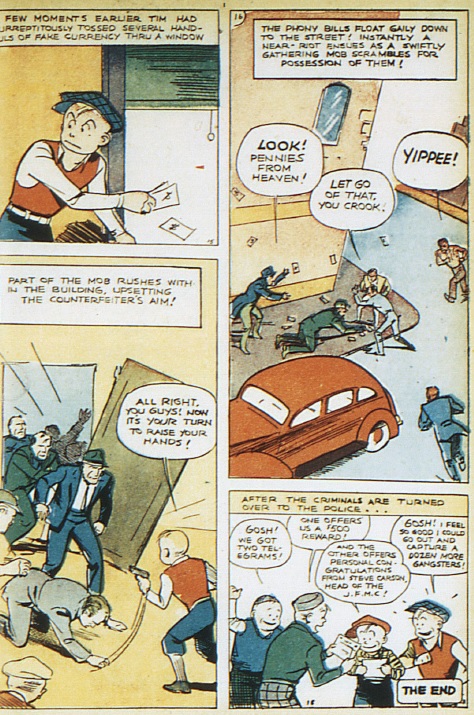
This month's Federal Men is again devoted to the Junior Federal Men Club (J.F.M.C.). This installment makes crime-fighting look like easy employment; no sooner have the police taken their prisoners then Steve Carson of Federal Men telegrams them congratulations, and another telegram promises them a $500 reward. This system could level up Heroes fast!


There are arguments for and against keeping track of ammo in a H&H gunfight.  A quick argument against: mundane "bean counting" runs counter to the fantasy elements of comic book action; a quick argument for: Cal n' Alec, counting bullets to know when their opponent's gun is empty.


Nadir has a magic crystal ball with an interesting limitation -- it can only be used between 3 am and dawn!  Time restrictions, race restrictions (like, only a merman can operate it), and items that can only be activated by destroying other items (like draining the magic out of lesser magic items) are all more inventive ways to keep a powerful trophy item from being too powerful, without saying it can only be used once per day, or it only has x number of charges.


What's this?  Nadir, Master of Magic, using guns! That's a big no-no for Magic-Users. But he's not really using them, is he? He's just holding them and, perhaps, planned to bluff his way through an encounter holding them, but wouldn't be able to hit the broad side of a barn with them.

I had a similar situation in an earlier H&H campaign, where a player wanted his Magic-User to carry a bow and arrows. He accepted that he would have no chance to hit with them in combat; he just wanted them for how he envisioned his character.


Another magic item, and this one's a new one -- Nadir apparently has a Ring of Alertness, that keeps him from being surprised.


Sandor encounters a lion here who treats him as if he already knew him. It's possible, actually, that Sandor had encountered this lion before and recruited it as a SCM, either behind the scenes or during some earlier installment I've forgotten or never got to read. An Editor can also, at his discretion, allow a player to make up SCMs from his backstory. The Editor must be careful, though, to consider the implications and how the Hero might benefit. Having a lion for a friend could be an unfair advantage over the other Heroes.

(Scans courtesy of Comic Book Archives)

Wednesday, August 12, 2015

New Adventure Comics #20

I didn't realize when I covered the October 1937 stories that I had access to New Adventure Comics #20, so I'm covering it just a tad out of order...

This page of Captain Jim of the Texas Rangers doesn't give us much of a sense of scale for that "gigantic" rattlesnake, but this could be the first giant poisonous snake in comics that isn't from a "tall tale"-like story.


This probably won't ever become an official Hideouts & Hoodlums rule, but if you ever miss a cowboy with an attack roll that's only 1 number off -- it should shoot off his hat.


There's a lot of grappling attacks going on here on this page. In some game systems, the player of Ian Murray would have to pick a different, specific grappling move each turn, each with different game mechanics attached to it. In H&H, the Editor has more latitude and is expected to describe the fight based on the dice rolls.  This seems to be a particularly vicious fight, so both sides must be rolling very well to hit and for damage...


There might be some exceptions I would make to my above statement, like in the case of a flip/throw attack, since this attack is unusual in that it leaves the opponent prone instead of held.


It's difficult to have a realistic rate of fire for missile weapons -- even for comic book realism -- and have any kind of game balance that would make Heroes reasonably choose melee over missile weapons. Here Ian cracks off 2-3 shots per combat turn with a single-shot rifle. Two shots would be possible if he was 4th level or higher in H&H.


This issue's installment of Federal Men is dedicated to the demonstrating the value of having half-pints as your Supporting Cast Members. Heroes like Steve Carson can recruit half-pints via ham radio! Half-pints loyal to Heroes are ever-vigilant for signs of crimes, and may be willing to put themselves in danger flattening tires and tripping robbers.


A history/technology lesson here from Monastery of the Blue God for anyone who had trouble picturing what a wireless radio looked like in the 1930s. This is not as portable as an iphone...


A patient Hero is just two lucky rolls away from finding the average secret door -- one roll to find the door and the second roll to find the way to open it. The impatient Hero, though (like Nadir, Master of Magic) finds the door, and then wrecks his way through it with a pick axe (using the non-Superhero wrecking rules, unless a Superhero obviously).


If there was a contest for best feature in this issue, The Adventures of Steve Conrad just won it. Behold the glory of natives riding trained alligators.

(Scans courtesy of Comic Book Archives)


Saturday, May 23, 2015

New Adventure Comics #14

Captain Jim knows that being caught in the path of a stampede is bad news. Rather than roll to hit for every horse in the stampede, I would require a save vs. plot to avoid falling in the path of the stampede and needing saving, followed by a save vs. plot to avoid death by trampling.


I just recently had a Hideouts & Hoodlums-related discussion of what people carried in their wallets circa 1940.  Sure enough, they carried business cards!

Detective Sergeant Carey and his co-worker know to come to a hideout prepared; one has a flashlight and the other has a hat -- good for sticking through doors and seeing if they get attacked (save vs. plot for mobsters to avoid getting fooled by that).


The most atmospheric stuff you can put in a scenario to make it spooky is the stuff you can't just fight. In the Gold Dragon, someone is clearly going around lighting candles in rooms behind their backs. Letting players worry about who they are and how many of them are doing it could be scarier than actually running into a gold dragon.  Or not...


This is from an adaptation of She that takes some liberties; I don't recall Haggard's She having actual magic powers, but She's definitely a Magic-User in this version.

Overcome Death must be a pretty powerful spell -- I would consider 7th level. You would never die from natural aging or grow old naturally if protected by this spell.

It's unclear what else she's casting. It seems like a powerful version of Crystal Ball, but maybe the reflection in the water is just a Phantasmal Force?

It seems pretty clear that She is casting Hold Person here; the nature of the spell being a gaze attack is likely flavor text.


In Federal Men, we see that disarming shots can be attempted even by half-pints.

(Scans courtesy of Comic Book Plus)


Monday, April 20, 2015

New Adventure Comics #12

Nomads are an obscure mobster-type in Hideouts & Hoodlums Book II: Mobsters and Trophies and one I always debated over including; there just didn't seem to be much I had that set them apart from brigands. Now I can see that nomads should, instead, stand out as the only mobster type that specializes in horseback combat.


As the Gold Dragon serial shows, "gold pieces" can still turn up as a form of treasure in a modern-day adventure -- at least ones taking place outside the U.S.


Sometimes I just ignore silly creatures in the funny strips, but the tree cobra seems like an interesting idea, so -- why not? -- I'll talk about the elephog as well.  The elephog, an evolutionary dead-end that includes characteristics of elephants and giant hogs, would be a 9 HD monster.  A tree cobra, on the other hand, would likely be no more than 2 HD, with its poisonous bite being more dangerous than its combat abilities.

The Spy character class debuted in The Trophy Case v. 2 no. 5 and remains unplaytested, to my knowledge.  Spies, as Sandor demonstrates, make useful allies, even if just Supporting Cast Members.  Spies should also have a higher than normal chance to hear noises, as demonstrated here.


I normally ignore imaginary tales/dream sequences...but it seems this imaginary glimpse into the year 3000 was meant to be taken seriously.  Some standard equipment items we can expect our police to have by then include "thought vibrators" (not as dirty as it sounds) that detect evil thoughts over a long range, one-man space flyers, and ingestible transmitters that allow their superiors to hear everything around them (not unlike dashboard cams).

Also standard issue are invisibility bills and a hypodermic needle that injects some sort of sleeping poison.  Invisibility pills are the one thing already found in H&H (Book II, of course!).


(Scans courtesy of Comic Book Plus)

Thursday, March 26, 2015

New Comics #10

I don't have a lot of content access to this issue, but what I do have is a doozy -- the four-page installment of Federal Men.  This continues from the last issue, so I've already discussed giant robots.  This installment calls it a metal colossus and I wonder if that would not be a good name for a distinctly different construct-type mobster. Perhaps 20 HD, with destructive wrecking beams it can shoot from its eyes at 1-2 targets per turn?  With permanent Imperviousness (like the 3rd level power)? 

Note to self: if I ever become a mad scientist, leave all access hatches to my giant robots locked!


Metal colossi can be found in groups of 1-3! 

I would treat wrecking an entire underground hideout of this size as "dams" on the wrecking things table, though, really, even a smaller hole punched in the side of it would cause some serious flooding.


(Scans courtesy of Four-Color Shadows blog))

Monday, March 16, 2015

New Comics #9

Steve Carson of Federal Men enters the hideout of the Invisible Empire this time -- an artificial island that can rise and sink beneath the surface. And is super-roomy!


Hideouts & Hoodlums has giant robots (giant gold and silver robots are in Book II: Mobsters & Trophies), but none as large as this monster (gargantuan?) robot, which has to be at least 50' tall. I've talked before about things sometimes being too unfeasibly big in the comics for Heroes to realistically deal with in a roleplaying game, and this would seem to be another example. Still...maybe the giant robots could have been a little taller in my game...


And now there's Steve Conrad on Dolorosa Isle to consider, but...what are those?  Mermen?  Aquatic ghouls? I may need to see more to puzzle this one out.

(Scans courtesy of Babblings about DC Comics and Days of Adventure blogs.)

Tuesday, March 3, 2015

New Comics #7

I don't have much content of New Comics #7 to review, but this installment of Steve Carson of Federal Men contains a good tip for beginning Heroes. If it bothers you that you can't start the game with a sub-machine gun, then go undercover in an invasion squad. They'll give you a sub-machine gun -- and then you can turn it on them and get the sub-machine gun and the XP for the entire squad!

(Scan courtesy of the Days of Adventure blog)

Tuesday, February 24, 2015

New Comics #6

All I'm going to talk about today is Steve Carson of Federal Men, and how Siegel and Shuster went so over the top in this and the following installments that it might break this blog.

The purpose of this blog is, you may recall, to highlight how to make use of published material from the comic books of the 1930s in your home Hideouts & Hoodlums campaigns, how those comic books can illuminate certain aspects of playing or running H&H, or how reading these old stories inspired the creation of H&H.

And then you get pages like this, with a giant tank that must be at least five stories tall and looks to be the size of the Capitol Building.

Now, some genre items in the early comics are completely ignored, having no story potential for action- and adventure-oriented campaigning. But this, so clearly serving as a bridge between the G-Man adventure genre and the superhero genre coming two years from here, cannot just be ignored.

Now, anyone with some experience running a roleplaying game knows that players tend to do what is best for their characters rather than what is best for the scenario, so while you might be seeing a giant tank as a great challenge for a mid-level group of Heroes (and it would be), your players would more likely be thinking, If we can just take out the crew, we're going to have a giant tank for the rest of the campaign! 

So, where does that leave us?  Should H&H have a giant tank, available as a trophy?  Bear in mind that, although combat is fairly abstract in H&H, there is still a potentially infinite progression from easy to beat to difficult to beat. A 100 Hit Die mobster is roughly 100 times harder to beat than a 1 HD mobster. So an Editor concerned with game balance should consider an upper threat limit. This limit could be completely arbitrary, but it would be a plus if it was somehow grounded in science, or otherwise somehow rationalized, because that helps us suspend disbelief during our game sessions.

Let's consider the scaling we use for mobsters, which sometimes come in normal size, or large/huge/giant variants -- and then apply that to tanks. Since an "average" WWI tank (assuming we're all on the same page and running pre-WWII H&H campaigns) weighed 15-17 tons, a large one would weigh approx. 32 tons, a huge tank 64 tons, and a giant tank 128 tons. That would put a K-Wagen super-heavy tank in the giant category, and that was only 10 ft. tall!

So, using any sense of scaling compatible with H&H, a giant tank the size we see above is flat out impossible, and not sensible to put into a H&H scenario.  We could, however, assume that some exaggeration for emphasis is going on in the above story, that only a super-heavy tank of the K-Wagen variety is involved, and the scenario would still play out the same, with the tank threatening the Capitol Building.

None of this yet addresses the radium gas bomb that ends the scenario and kills the tank crew. Radiation was poorly understood by comic book writers of the 1930s (heck, even past the 1960s!) and should be treated as flavor text only.  I would instead treat this as "ordinary" poison gas, with an unmodified save vs. poison or die.

(Scan courtesy of Babblings about DC Comics)

Tuesday, January 20, 2015

New Comics #2

It's 1936 now, still 2 1/2 years before Superman!  Like New Comics #1, I don't have access to the contents of this issue.  However, if this source is to be believed, then the Steve Carson, Federal Men serial here features the first appearance of a corrupt beat cop (an evil 1st-level Fighter).


I still don't have access to the whole issue, but I found this blog that gives me a whole lot more to go on.  Yes, Steve Carson does go up against a corrupt beat cop -- the first in comics -- in this story.  He also talks an accomplice into changing sides. The mechanic for this would be an encounter reaction roll, though in some circumstances a morale save might be more appropriate.