Showing posts with label surprise. Show all posts

Wednesday, March 22, 2023

Fight Comics #4 - pt. 2

We return to Kinks Mason to find he's...well, improvising a club to bet a pirate captain with, I have no problem with that, but using a cape, underwater, to distract swordfish like a bullfighter...that seems problematic to me...


...especially since Kinks does it to pull off this trick, which I find flat-out impossible. I know, as a good Editor, I should be encouraging my players to come up with clever solutions and give them a chance to work, but sometimes you need to consider the mood, or tone, you want for your campign and if the idea is compatible. 


We're jumping ahead now into the futuristic adventures of Saber. How can you tell it's the future? Well...there's that weird machine next to his desk, and that weird machine hanging from the ceiling. And no clutter!

Saber unlikely has active powers buffing him in panel 3. The spies failed to gain surprise, which allowed Saber to "size up the situation." Saber appears to be using Leap I, but the distance crossed is no different than what he could have reached running, so the leap is flavor text.

Saber is rolling great for damge to knock out one person per punch, but it is possible without buffing. It is also possible he is buffed with the Get Tough power. 

Saber fails his saving throw vs paralysis.  

It's nice that, in the future, spies will all wear uniforms so you can tell they are spies.

It's unclear if Saber is saying he "must get out of here" from within his jail cell because he is frustrated with the speed of the judicial system or because his cell is somehow Saber-proofed. He doesn't look like he's trying very hard to escape, but maybe we missed all his wrecking things checks.

It's also unclear why that exchange with the guard had to happen through telepathy; I would be comfortable with handwaving that as flavor text, since it doesn't really impact the story whether they spoke out loud or not.


An electo-mort seems to be short for electric mortar, though I can think of several better names for the weapon than that, like an electro-mortar, e-mortar, or - heck - why not just call it a raygun?

500-foot leaps are covered by the Leap I power...but the rules as written are intentionally vague as to what the lifting capacity is while leaping. If my explanation for the leap power is my super-strong leg muscles, then maybe I should be able to carry more than someone who can leap because their magic belt lets them float. The important thing is to reach a decision between player and Editor and remain consistent.

"That just about finishes everyone in this stronghold! Oh, that's the wrong building? I just murdered dozens of sunbathers? Oops!" It never ceases to amaze me when I find someone arguing that heroes didn't kill in the golden age, because people like Saber had absolutely no compunctions stopping them from casual slaughter. There is absolutely zero consideration of bringing these traitors in for trial going on here; it's more like -- ooo, this is easy!

It's very gracious of Saber to give credit to Lt. Chandler, but I think we can trace a lot of his success to the absurdly deadly weapons Saber keeps finding, and that the spies have nothing compatible. The spies/sunbathers on the rooftop apparently had no weapons to fire back. While Saber is zipping around with an atomic disintegrator, the enemy ships are just trying to ram his - the equivalent of letting your 1940-era Heroes arm themselves with sub-machine guns, while the mobsters are armed with sticks and broken bottles. 


This is the second half of a two-page strip called Slug-Nutty Sam. The end gag isn't particularly good, but neither would the fall be lethal in Hideouts & Hoodlums; falling damage always leads to unconsciousness, except for falls resulting from deathtraps. And that is assuming an average or higher damage roll for the fall; a three-story fall could still be as little as 3 points of damage if the rolls are lucky enough.


Wang Chi and Chin Lo are surprisingly realistic Chinese names...so it's all the more disappointing that this story takes place in Mongolia. Although most Westerners, even at the time, thought of Mongolia as a province of China, Mongolia was more closely aligned with the Soviet Union than to China at this time.

The twist plot - that the Heroes are recruited by the bad guy under false pretenses - is worth pointing out, and an exciting scenario alternative when used sparingly.

Shanghai is probably a thousand miles from where "Wang Chi" lives; that's a long distance to travel to recruit the Americans. Geopolitically, the story makes little sense; Wang would be better off and have a shorter route to go heading north/northwest to recruit some Soviet pilots. 

Again, when you ignore these particulars, the plot itself is clever, using your own gunmen to convince Chip an innocent man is the enemy.

(Scans courtesy of Digital Comic Museum.)


Tuesday, December 14, 2021

Zip Comics #3 - pt. 5

More Captain Valor today, with Mort Meskin showing off his skill with crowd scenes, though hampered by some really racist depictions and sometimes sketchy details. I bring this to your attention, though, for panel 1, so we can talk about the two ways to set up a fight scene. Version 1 is that it occurs in "real time," with the crew arriving onto the deck in waves as they can reach it. Version 2 is that you set the scene with all the fighters already in the scene and then start the clock again. 


And we're jumping out of Captain Valor already into the next story, Mr. Satan. Holy cow, this scene is gory. There's actual blood everywhere! These bad guys are brutal...but the point of sharing here is the second to last panel, where Mr. Satan runs out, grabs the girl, and escapes unseen. But unseen by how many? We only see that one guy, but there must be a lot of other killers around. Is it fair to say this can be explained away as a surprise turn, a moving silently skill check, or maybe both to reflect the difficulty of no one happening to see him?  
 

The panels seem to be in the wrong order here...Mr. Satan should probably try to get that woman to safety first, instead of leaving her alone in a tunnel and going out to look for clues. 

What else can we gather from this page? Superhero costumes, despite appearing to have no pockets, must have room for matches or a lighter on them somewhere, or Mr. S would never have got that giant fire lit so fast. 

Also, we learn that rocks used as improvised weapons don't have to be very big.
That seems, at first, to be a clever twist about the sheriff, and having them both wind up on the tracks makes it seem extra surprising when the big reveal happens, but...why did it happen? Is he showing off his confidence in his men, that they would not betray him by tying him up for real? Is the deception part of trying to get Mr. Satan to reveal when the payrolls are "going to ride," and if so, why not try to trick him into telling while still on the tracks? Or he could have revealed himself as leader sooner, never been tied down, and still used the threat of the train to coerce Mr S into giving up the info? But on the other hand, if the robbers don't know when the payroll is coming, why are they so sure a train is coming soon? 

And if Mr. Satan knew the national guard was coming, why go back early to scout with the sheriff without them?

If it wasn't already obvious, Mr. Satan would be statted as a mysteryman. His "spectacular leap" and snatching Doris out of the car and jumping out in time both qualify as mysteryman stunts.


Now we're going to jump into the next story with Zambini the Miracle Man, and this is a prime example of everything wrong with the magician genre: if your magic-user is so powerful that Satan himself has to plot against him while he's on vacation so his guard is down -- then your magic-user is too powerful.

As if to illustrate this, Satan causes a tidal wave to threaten Zambini's ship and, instead of simply calming the waters, Zambini freezes "the oceans." Way to alter Earth's climate there, Zam! 

More interesting are these devil men...let's see if I need to stat them! Hmm...I guess not -- they get mass polymorphed into penguins on the very next page before they can do anything!

Mass Polymorph is, of course, going to be a Hideouts & Hoodlums spell. I think I've determined before it would have to be a ninth level spell, even though it gets cast an awful lot in comic books.

Sure, Zambini could have just cast Resist Fire on himself instead of conjuring asbestos...although, perhaps he did cast Resist Fire and this is how it manifested? Previously, we've seen Zatara cast a healing spell that made a first aid kit appear. The conceit here is that magic takes whatever form is most familiar to the caster. 

Really, Zambini? You're traveling into Dante's Inferno and your only concern is how long the trip is taking you?

And is he really trapped in a net, or just relaxing on a hammock?  
 
Whoa, whoa, whoa - take a close look at that Cage of Flesh. The bars are made up of human forearms, each grasping the next one in the row. That is crazy grizzly -- but also just the thing to impress veteran D&D players, accustomed to dungeons full of grizzly things. That it seems to contain an anti-magic field is just icing on the cake.


Who's the fool, Satan? You just told them to push the flammable cage into fire. 

The "docile" rabbits tracks with how polymorph works (or at least the spells of 4th level and above; H&H has lower level polymorph spells this won't apply to), as there should be a chance of losing your mind/personality to the new form. Otherwise, these would be satanic rabbits!

I'm not going to show you the rest of this crazy story, but here's two spoilers: one, Zambini meets a dinosaur down there, either brought down there in prehistoric times as a pet, or the story is suggesting that's where dinosaurs all went when they died?

Lastly, Satan is killed, which is a pretty crazy ending for just your third issue. 

(Scans courtesy of Comic Book Plus.)


Thursday, September 30, 2021

Top-Notch Comics #4 - pt. 2

We're back and, if you've been waiting on me to finish the Wizard's story, here it is -- the Wizard defeats the "Bundonian" sub by lifting it out of the water. That's right, he can lift at least 750 tons over his head, without even firm ground underneath him. As unlikely as that is, I have to wonder if he's not actually using some form of levitation -- contra-gravity discs attached to the hull -- and then is pretending to hold it up just for the showmanship of it? Or, hey, I'd even be willing to accept some combination of the two. 

This ending brings up the issue of what to do in your Hideouts & Hoodlums campaigns when it's well before 1945, but your heroes have already forced Germany, or your German-analog country, to surrender. One possibility is to just keep replacing them with German-analog countries ("Bundonia surrenders...but the next day their neighbors Caledonia declares war on Europe!"). Or the country reneges on their surrender, finding some excuse to invalidate it and then continues the war effort. Or, you and your players agree to a campaign where nothing the Heroes do has an impact on continuity between sessions, as if the world resets each session (very much like many golden age comic books, though I don't recommend this so much for fun campaign play). 

But you didn't come back to hear more about the Wizard, you came back for Dick Storm. Because who can resist Dick Storm? 

Here we find an unimaginatively named Chile analog called Chilan, with an unusual history. It's not too surprising that, 22 years after the 1918 pandemic, people were still worried about plagues, but Chile had not had its own plague during the intervening years. 

I wonder what the president thinks Dick Storm is going to be able to do about a plague. Shouldn't he talking to a doctor instead?


Here is a great example of Hideouts & Hoodlums' abstract combat system, and at the same time an argument against specific hit locations. At point blank range, the assassin could probably hit Dick Storm anywhere, but panel 2 seems to make it appear the bullet is going to land in his right arm or stomach. In panel 3, the bullet lands in his left arm. 

That is the worst outfit for an assassin ever. Maybe not; I suppose pink pajamas would make him stand out even more.

Rana is surprised to see how quickly Dick Storm stands erect.

Pruvians is almost certainly an analogue for Peruvians. In reality, Chile and Peru had been at peace since 1883.

"I have a plan but you need to turn your army over to me for a few days."

"Sure, what could go wrong?"

"I'll also need access to all your bank accounts. And -- heeyyy...if you're Chileans, why is your daughter blonde?"
"Rana! Despite parading around in a cocktail dress, you've managed to sneak past my entire air force and reached that plane!"

Dick swings into action! Honestly, I can't even make fun of this stuff anymore because now I think the author is in on all the jokes.


To their credit, these soldiers have had about five minutes of uninterrupted stare-up-a-dress-time as the parachutists descend, but their thoughts are entirely on Dick Storm when they reach the ground. 

The fact that the general is still standing there unarmed in panel 7 as Dick Storm is attacking him seems to suggest Dick is enjoying a surprise round, but I don't think the circumstances here would have warranted a surprise roll. Rather, I think Dick won initiative and the Editor had made no statement yet of the general's intentions. It's also possible that the general is holding his gun in the shadows of his uniform; his whole right hand seems malformed, as if hastily drawn.

In a chase sequence, the desk in the way would be considered a complication to overcome, but in a combat sequence, this panel is correct; in H&H, you can ignore obstacles in your way during melee, unless you choose to incorporate them into your flavor text (or, obviously, if you plan to pick it up and use it as a weapon!).

I remember this scene from the first Indiana Jones movie. Plane propellers are nasty weapons; I'd put this at least in the range of 3-12 damage, so no wonder the soldiers are running. 


You might have guessed that Dick Storm's plan turns out perfectly and Chile surrenders after Dick arranges for a lot of them to die. So we're going to jump way ahead towards the end of the next story featuring Moore of the Mounted. Here we see an example of a trap as a wandering encounter. This page also shows us a good example of Lawful and Chaotic Alignments and how they differ in this scenario.

Technically Sgt. Moore is right; an Olympic skier can achieve downhill speeds of ten times someone running on foot, but the average speed of the average skier is more like 2 1/2 times faster (Movement rate 30 as opposed to 12).


And now we're going to make one last jump into the next story, Streak Chandler of Mars. I think from just this one page you can tell the backstory borrows heavily from Flash Gordon, with the wrinkle of the gangsters forcing them all to leave. Streak's problems are a frequent staple of the sports genre. The art isn't very good, but doesn't Streak look awful old to be a college football player?

(Scans courtesy of Digital Comic Museum.)


Saturday, September 4, 2021

Target Comics #3 - pt. 2

The first page of this story (which I didn't share last time) reveals that Bull's-Eye Bill is "of the Target Range - Arizona." Here we get a reference to Florence, which seems like our first big clue as to where in Arizona we are...though, on second thought, just mentioning the jail there doesn't necessarily mean we're near it. There's also the slight chance he means Florence, Colorado or Florence, Texas, but Florence, Arizona is definitely the largest and most important of the three Florences.

Oh look, the "good guy gets his hat shot off" trope!


The outlaws fail their morale saves. Losing half their numbers triggers a morale save, as does being threatened with guns by a fighter.


We're going to jump ahead to the next story, Lucky Byrd, Flying Cadet. The glossary of cadet slang could be useful for an aviation-themed campaign, but I think it's more remarkable that the author felt that camouflage was a term young readers would not be familiar with. Of course, everyone knows camouflage today, but could that be because we had to endure the disastrous fashion sense of the 1980s and the rise of camouflage pants?

Here, Byrd makes a skill check and is able to recognize the type of motor he's hearing. Granted, that's of limited usefulness, unless it also tells him what kind of plane he's hearing.

"Kerwhooomm" is a strange noise for a plane to make.

A nice twist with the cowboy is that he comes in all belligerent, like there's going to be a fight, but then turns out to be quite reasonable. This could be the result of good role-playing from Byrd's player, or a random encounter reaction roll.

I think I know what this "Randolph" is Byrd mentions -- Randolph Air Force Base in Universal City, Texas. Which, you know, has a nice generic comic book city sound to it, like Metropolis. Uvalde is a small city in Texas, so that works out too.  

This is a Harry Campbell story; Harry either lived out west or was very well-informed about life out west, as I've noticed before reading his Dean Denton stories.


I'm not sure if powerful magnets would be the most efficient method of opening a hangar door or not; I'm in the future, 81 years later, and my garage door still doesn't open that way. But I give Harry credit for always trying to ground his stories in science.

I'm normally perfectly comfortable with accents being spelled out, but it's bothering me a little this time because that accent seems like it would sound French to me. I'm curious why Harry thought the French would be sabotaging the American airplane industry...?


Lucky Byrd is right! First, the guard falls for the feigning sickness routine (save vs. plot to make that happen). Second, he wins that fight while still on the ground (granted, he appears to get a surprise attack followed by winning initiative on the first normal turn of combat). Third, shooting the door controls just happens to make it go down, when it could have just as easily not moved at all. As an Editor, if I didn't already have a random table for those controls, I'd try to come up with at least four results for shooting the controls (door goes down, controls explode, another door opens, nothing happens) and roll randomly on it.


That scientific explanation for the invisible plane is pretty sound; invisibility is explained much the same way in modern science fiction. Kudos, Harry!


And before we go we'll just peak in on the next T-Men story. Although called "Return of the Octopus," this is first time we've seen him and this is the first villain (of many) to be called Octopus (or some variation on that).

(Scans are courtesy of Comic Book Plus.)


Sunday, June 6, 2021

Prize Comics #2 - pt. 4

Things don't get better in the following Secret Agent M-11 story. The Secret Service want to know who this spy works for so they let him escape, but they do so in a really obvious way, letting him bolt past three people for the exit and having no one block the exits. The spy should be suspicious, but instead goes straight to his bosses working for the "Hugonian" -- Hungarian? -- government. The question is, why wasn't the spy followed? Or did they try and he eluded them?

The bad guys have a familiar tactic here, but M-11 uses an unusual one, so unusual that I'm not entirely sure what I'm seeing. Does M-11 carry a pouch of sugar with him to use as a blinding weapon? And why sugar? There are so many more irritating irritants he could be carrying. 


M-11's sugar fixation just gets weirder. Sugar is way too soluble
to be left on the road and expect anyone to be able to see it later. 

Then there's the carrier pigeon. If M-11 just followed them inside, when did the ambassador have time to attach the papers to a pigeon?


I'm just going to jump into the Black Owl story that follows and, nope, it doesn't get better. This is the Black Owl's debut story and it's not off to a good start. Beyond the silly mask and the horrible racism here, we have the Black Owl beating a suspect to get information instead of using his brains to find where the woman he was following went, and then when two yellow peril hoodlums start attacking him, instead of fighting back right away, he knocks over a shelf first. Why this would distract them from fighting him escapes me, unless the Black Owl figured something on the shelf was sacred to them and would upset them? But that seems unlikely, since not that much thought is being put to anything else in this story.

I include it mainly for the appearance of a copper. Coppers debuted in an early issue of The Trophy Case in order to explain how police officers sometimes make things worse for the heroes in comic books, and this is a perfect example. Black Owl was about to have everything wrapped up, but the copper comes 
along and, to escape his bad luck, Black Owl has to flee.

Observing from outside is a tactic you would think Black Owl would have tried first, and yet the secret gambling den doesn't seem to be on high alert despite the fact that there had just been a vigilante break-in and a police raid 30 minutes earlier. One guard at the door, with one more for back-up, isn't very secure for all those rich guests to gamble in secret. 

I have problems with this page too. I know, when have you liked any page in this issue, Scott? Good point, reader.

First of all, I disapprove of the use of torture by heroes. At least it's clear that all the information is questionable, as the hoodlum seems to be rambling intentionally until Black Owl is standing right over that pit trap.

About that pit trap, it seems odd to me that Black Owl and the hoodlum were standing so far apart that only Black Owl is now close to it. I suppose there should be a random chance of falling into a trap and the hoodlum was just luckier at his roll.

It gets really confusing past that. How did Black Owl avoid getting hurt in the fall (or was it just a really lucky die roll for damage)? How is no one else aware of the trap door opening and just go on about their torturing business? I know, I know, it

could just be lucky dice rolls again (this time for surprise), but there have got to be times when common sense should overrule dice rolls.

I tried to look up if "wire vest torture" was a real thing, but kept getting nothing but BDSM hits...

Next up is Buck Brady of the FBI. It's a pretty standard "hunt down the escaped convicts" scenario. Danford Prison seems as made-up as "The Daily Blurb" for a newspaper (though not that generic, at least). Which is odd because the action then swings to real-life Wichita, Kansas instead of, you know, Cityville, Kansas, or something like that.

Gosh, no investigation skills required for this mission. They're just walking down the street and a plot hook jumps out at them!

The art on this strip is terribly amateurish, but the layout work is sometimes inspired, particularly panels 2 and 4 on this page. 

Unless the law was really different back in 1940, I would think Buck would have to show a badge or something before commandeering that car. 

Apparently the chase goes on for so long that they are in Oklahoma by now, as this area looks way too mountainous to be around Wichita. Next page makes this geography even more suspicious, when the mobsters' hideout is in a box canyon. 

Buck's plan of parachuting into the canyon either depended on the mobsters sleeping during the daytime, having their radio up so loud that they couldn't hear a plane overhead, or getting a lucky surprise roll.

The mobsters blame the wind for all their missed bullets, but I think this is an excellent example of the "save vs. missiles" mechanic from Hideouts & Hoodlums in action.

This is also an excellent example of grappling attempted by multiple combatants, which is explained in the 2nd edition grapping rules (though it's been awhile, so I had to re-read it to make sure just now!). 

(Scans courtesy of Digital Comic Museum.)


Friday, January 29, 2021

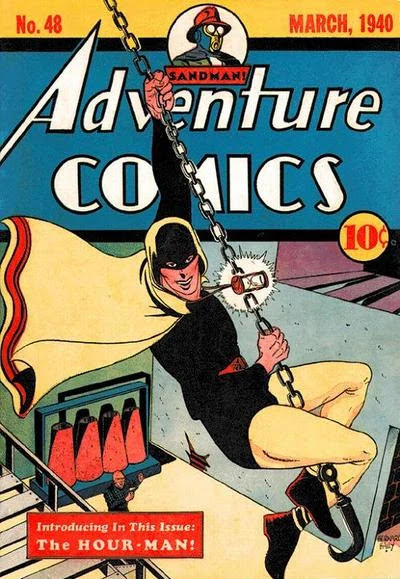
Adventure Comics #48 - pt. 2

And we're back with what I promised, a look at this issue's installment of Federal Men. In it, the FBI gets a hot tip that counterfeiters are working in Northville, and in an unusual way -- a fake $1,000 bill is mailed to them anonymously, but came from Northville. Of course, we're given no indication as to where Northville is but, since so many comic book stories have a New York City orientation by now, it stands to reason that "Northville" means somewhere North of NYC, so...maybe it's actually Albany? Or even Poughkeepsie? Ah well, it's all speculation...

The plot is one we've seen before and will see again -- the hero stumbles across a crime school where a professor (or professors) teach classes on forgery, safe cracking, and killing in exchange for a cut of future profits. This one is pretty expensive -- a complete course costs $5,000, plus 25% of your take for the first year. I would be really leery of allowing a real game mechanic benefit to this.

Steve Carson (our hero) disguises himself as a "tough" by smoking a cigarette, going without shaving, and possibly darkening his eyebrows. He's caught -- not because he looks just like Steve Carson, but because he gets fingerprinted and the Professor somehow has all federal men's fingerprints on file.

Fitting in with the dark themes at DC Comics this month, the deathtrap is a suicide machine -- you're strapped in, with a gun in your hand, and the machine makes you squeeze the trigger and shoot yourself in the head. Without wrecking things, it's a pretty foolproof deathtrap -- so the only way out for Steve is to have one of the hoodlums turn on the Professor and free him. The twist is that the hoodlum did it -- and sent the fake $1,000 bill to tip off the feds -- not out of any altruism, but revenge because he was about to be expelled.

By now, the Sandman has been downgraded from billionaire Wesley Dodds to millionaire Wesley Dodds. Wesley is shown smoking a pipe, and the Sandman carries binoculars for the first, if not only time, in this issue.

Dian Belmont is in love with Wesley already, if her letter to him is written honestly. Her father, the D.A., learns Wesley is the Sandman in this story and seems cool with it, even though the Sandman was wanted by the police in the past.

The Sandman is shown jumping safely from a second floor window. Should stunts be able to lessen falling damage? Maybe. Maybe...half damage per 10', per stunt?

The Belmonts own a Chris-Craft -- Chris-Craft Boats was an American manufacturer of boats that was founded by Christopher Columbus Smith. This page is a good commercial for them -- it's fleet, and can easily catch up to a yacht. 

When Sandman searches Judge Quick he finds a letter in a secret pocket. I'm not sure how you conceal a "secret pocket" on your person. A pocket inside your jacket certainly wouldn't qualify as "secret." Maybe it's sewn to the inside of his pant leg...? The letter is a major clue without even reading it, because it smells of one of the suspects' perfume. 

Sandman climbs a wine-covered trellis (it's called a ladder, but it's pretty clearly a trellis) to an upstairs window, which should be a basic skill check, maybe even with a bonus if the trellis is sturdy. Dian, the Woman in Evening Clothes (and that's including high heels, no doubt) climbs it right after him, and that's got to be an expert skill check.

In one panel, the gas from his gas gun is referred to as "deadly."   

In Socko Strong, Socko is trapped in a deathtrap underwater, but he finds a trapdoor that serves as the drain for this pool. It feeds to an underground stream and Socko is swept into it. He emerges, "finally," on the bank of a river. But how long was he underwater? Were there pockets of air for him, or did he hold his breath the whole time? We're not told, but those details can mean life or death in a realistic campaign. 

The next day, while shooting a film, the guide wire snaps on a heavy arc lamp, and the lamp is about to fall on a small girl. "The entire group all stands motionless in frozen horror -- except for Socko..." Now, there's two possible explanations for that. One is that, as the only Hero present on the scene, the Editor is making sure none of the other characters on the scene can upstage him. Or, the Editor used surprise rolls to determine if anyone was surprised by the falling arc lamp, or perhaps Socko surprises the falling arc lamp, giving him even more time to act.

In an interesting twist, the father of the girl was paid to kill off Socko by sabotaging his parachute for the next scene to film. Doing the good deed pays off and saves Socko.  

(Read at readcomiconline.to)


Tuesday, December 1, 2020

Slam-Bang Comics #1 - pt. 3

Hello! We're back, still looking at the Lucky Lawton feature. We could talk about the oddly rectangular word balloons (the very next page goes back to rounded corners), or the terrible coloring job on this page, but I'm going to focus on the "no guns" law, which was actually quite common in the "Old West," and is something we badly need more of today. Personally, I would like to run a "no guns" H&H campaign, but I know that wouldn't emulate the comics well.


If you've followed this blog long enough, you've probably seen plenty of examples where the artist just seems to be guessing what an animal looks like without using a reference. The artist here is Hal Sharp, and I have a feeling Hal owned a dog; Pal is in real dog poses every time we see him.

Lucky does the smart thing, circling the perimeter instead of barging right into the bank. 

Also note how not going solo gives Lucky twice the chance to detect the activity in the bank that he would have had walking along alone.


There are two ways to achieve Lucky's noiselessness. One, he can make a skill check to move silently. The other is that he trust to his surprise roll and, if successful, means he must have been moving silently. Since chance of surprise is normally 2 in 6, it seems like that would be easier for most Heroes (unless Lucky is a mysteryman using a stunt, but I doubt it). 

Combat in the dark adds a greater level of challenge, what with the -4 penalties to hit. Just by not flipping the lights on, every unarmored combatant is now effectively at AC 5. Now, from the panel art it appears that there is plenty of light coming in through those front windows, making the scene only dimly lit, but this could just be artistic license so we can see more than five black panels with word balloons in them.

And yet, in this scene, the bandits are silhouetted in front of the windows, so it wasn't really that dark after all? And the remaining band sees Lucky in the darkness now? To emulate this scene, we need a new mechanic for eyes adjusting to darkness after a certain, or maybe random, number of combat turns. 

Although the rest of this story is seemingly set in the Old West, the remaining bandit's hat looks suspiciously modern.

The bad coloring job on the lower half of this page might be fooling me, but it appears that the rancher is wearing his bandana up over his mouth. I only mention it because I see so many people wearing their masks wrong like that these days...


There aren't game mechanics on display here, but I like how Lee is a scientist/explorer. Both were classes in Hideouts & Hoodlums 1st edition, and while both classes did get playtested in my campaigns, no one ever thought to combine those two.

My initial reaction was that having the slavers be Arabs was racist, but while there have been many white slavers through history, there was a strong tradition of slavery in the Middle East, with several countries not outlawing it until 1970. Also in the writer's favor, Ali and Hassan are real Arabic names, and not gibberish names meant to sound Arabic (I know, some golden age writers set the bar really low!).

Wow, we're in pure fantasy territory at this point. First, there's no way a plane explodes, and someone sitting in that plane falls from that wreckage completely unharmed. This should be a save for half damage situation at best. 

Then, there's no way someone's coat would be big enough to create enough wind drag necessary to cushion his fall, so there's more damage Lee should have taken by now. I think we're looking at the tune of 55d6 damage at this point - and that's assuming the plane was at a near dangerously low altitude for flying.

As unlikely it is that all the spear attacks Lee left himself open to while charging the pygmies missed, it is even more impossible for him, game mechanically, to push the leader onto a spear, unless the Editor was house ruling a fumble mechanic. More likely, this is just a freebie from the Editor.
Neutralizing poison is really easy in Lee's world. All you have to do is stick someone with a knife and the poison leaks right out of you! If I was willing to implement this as a new rule (and I'm not), for every point of damage you do to the wound, you would give the recipient a new saving throw. 


The pygmies are very patient in indulging Lee's rampant passive-aggressive racism. "Uh...ever heard of donkeys? The domestication of donkeys started in Africa. And we know what iron is, iron smelting and forging technologies were discovered in Nigeria as early as the 6th century BC. Bricks too, since about 7,000 BC. And just what are you whittling? A giant banjo?"


I am so torn on this page. On one hand, I think it's great that, for once, a lion shows up in a story and the Hero wants to capture it alive instead of stabbing it to death, or snapping its jaws, or shooting it. But that he wants it so he can perform experiments on its brain doesn't sit well with me, even though I get that the author is trying to offer a scientific explanation for how the jungle Hero is able to talk to animals. 

(Scans courtesy of Digital Comic Museum.)