We rejoin Don in Anchors Aweigh as he's lowering himself into the dark hold of a ship and praying "he wouldn't land on anything sharp cornered." It's true that, while the base damage for falling is 1-6 points per 10' fallen, the Editor is free to lower this for falling on soft terrain, or raise it for falling on sharp, or otherwise more dangerous, terrain.
In the hold of the ship, Don takes a quick look around and manages to appraise the value of the cartridges being smuggled in the hold at a quarter of a million dollars. The first edition Hideouts & Hoodlums rules say nothing about appraisal (the implication being that everyone could do it automatically), but the second edition will treat it as a basic skill everyone has a chance to perform.
The first sailor who comes down into the hold is said to have "the agility of a monkey" and "runs down the rope ladder". I'm tempted to add sailor as a mobster type, with the ability to climb up and down ropes and ladders faster than an ordinary person (or just give that ability to pirates).
In Tom Brent's adventure, Tom practices that most important of player tips -- when you have important papers to deliver, meet your contact first without the papers on you, in case something goes wrong.
When Tom tries to escape from the clutches of the fake consul, a guard has his rifle trained on Tom. Tom is somehow able to pick up the other guard and throw him at the rifleman before he can fire a shot. Now, it's possible that Tom won surprise, got a free action (the grapple), and then won initiative on the first regular turn of combat. Or, Tom picked up the first guard during his first turn, but the rifleman refused to fire because firing into a melee has a chance of hitting your ally if you miss.
Tom is captured again and tortured for information -- specifically, he is hung from his thumbs and whipped while shirtless. I would not expect an Editor to have to go into that much detail; torture can be glossed over and summarized by a save vs. science to resist. I would, ironically, require this save once per 4-hour "rest" turn.
In the adventure of Steve Carson of Federal Men, our story opens on the trial of three men accused of treason, with the judge saying "I regret that the sentence for treason carries only a twenty year penalty!" Actually, according to the U.S. Constitution, treason can be punished with death. It is, however, appropriate for the courts to be more lenient in a comic book universe, as this allows a lot more repeat appearances by the same villains (something that will become more of an issue starting with the Silver Age).
A wanted poster shown to Steve shows a $500 reward for a wanted criminal.
When Steve is about to lose a fight, he is saved by a boy who throws a baseball and beans the mobster in the back of the head. I would normally allow a full grown man to do 1-3 points of damage with an improvised missile like a baseball; for a half-pint, I would probably restrict damage to 1 point of damage. Of course, the mobster could be on his last hit point from the unarmed combat with Steve before the baseball hits him.
Later, another half-pint Junior Federal Man thwarts an attempt on his own life by having rigged an alarm system for his bedroom -- anyone climbing the drain pipe outside his window pulls a string that causes a ball to drop and land on the boy's sleeping head to wake him -- after which the boy can bash the intruder with a baseball bat while the intruder is prone and hanging from the window ledge. If this comic strip -- and the movie Home Alone -- has taught us anything, it's that half-pints should be good at setting traps and alarms.
Nadir, Master of Magic, deals with river pirates in his adventure. They are well-equipped pirates, piloting speedboats and armed with sub-machine guns; they might be better statted as robbers than as pirates, since robbers tend to be more hi-tech. Nadir defeats them with a Charm Person spell on their leader, who Nadir gets to sound a retreat.
Later, Nadir is ambushed by peculiar attackers using a noose. I would say that a noose could do normal 1-6 points of damage on a hit, but only if the hit occurs during a surprise attack. If the victim is somehow unable to free himself, he will continue to take damage each combat turn.
Cal n' Alec is a joke strip about two old prospectors, but they remind me of played characters in this installment. Frustrated that their mine was buried in a dynamite explosion, they briefly decide to swear off prospecting. This can happen to players too, who can feel disgruntled by too much failure in a game scenario. In the end, though, Cal and Alec bite on their next plot hook when a stranger runs up and hands them a map -- and stalwart players will often bite on that next plot hook too.
Incidentally, I'm not keen on preparing any game mechanics to determine the extent of a cave-in when a mine is hit by dynamite. There just needs to be things for the Editor to wing as he goes along.
Another example is The Adventures of Desmo and Gabby. Gabby loses his wallet during a fight. There does not need to be a game mechanic to check for seeing if you lose something from your pockets during fights. Sometimes, players just need to accept that their Editor has a story-based reason to make something happen.
Tod Hunter, Jungle Master, finds rubies worth $5,000 each, which is 10 times what I guessed rubies were valued at in Book III: Underworld and Metropolis Adventures (in the gem table previously found in Book II: Mobsters and Trophies). Guess I may have to revisit that!
(This issue can be read at Comic Book Archives)
An exploration of the Golden Age of Comics, through the lens of Hideouts & Hoodlums, the comic book roleplaying game.
Showing posts with label Nadir. Show all posts
Monday, January 11, 2016
New Adventure Comics #30
Labels:
Anchors Aweigh,
Cal n' Alec,
combat,
falling damage,
flavor text,
history lesson,
mobsters,
Nadir,
new mobsters,
player tips,
prices,
skills,
spells,
Steve Carson,
Tod Hunter,
Tom Brent,
torture,
weapon damage
Wednesday, December 23, 2015
New Adventure Comics #29
Anchors Aweigh! picks up where it left off last issue, with our Don Winslow-clone investigating El Diablo. El Diablo has somehow slipped poison slips of paper to Don Kerry's prisoners and the chief suspect is an old friend of Don's. This is a good position to put your players in -- do they stand by their Hero's supporting cast, or turn on them when things look bad?
Later, Don and Red are listening to clues from a nearby group of sailors in a joint, but one of the sailors notices them listening. Hideouts & Hoodlums definitely has a game mechanic for hearing noise, but not for the reverse -- and it does not make sense to simply reverse the mechanic (it should be easier to hear noise through a door, for example, than to hear someone listening through a door). The Editor may have to play this one by ear -- are circumstances right to be observed listening? -- and then resolve it with a save vs. plot for the Hero.
This story also gives us an explanation for why not to have hoodlums immediately use guns in a fight -- for fear that the sound will bring the police.
Don overhears the name of a ship captain who might be in league with El Diablo. But how to find the ship captain? Don asks around, claiming to have a message for the captain from El Diablo. It's a clever and daring plan -- exactly the kind that Editors should give a good chance to work.
Tom Brent's adventure has a crew mutiny, two jewel thieves, a diamond worth $50,000, and a suspect who turns out to be a police inspector doing his own secret investigation. I particularly like this last wrinkle. Could it be a cure for Heroes who shoot first and ask questions later?
The next adventure of Steve Carson of Federal Men is an unusual one in that it takes place just before a Presidential inauguration ceremony -- which means it took place two years earlier in 1936 or two years later in 1940! Time can be a fluid thing in a roleplaying campaign -- it can take place over days or it can take place over years, but generally campaigns follow sequential time. This does not always need to be the case, as I wrote about in Supplement V: Big Bang.
Nadir, Master of Magic, continues to show an aversion to actually using magic. He gets through a locked door, not with a spell, but with a skeleton key. He gets around by "powerful sedan" instead of by spell. Instead of turning invisible, he hides behind curtains. He does cast a Detect Thoughts spell.
Captain Desmo starts this new adventure by flying overhead when he sees travelers being attacked. Luckily he has two grenades for his sidekick to toss over the side of his plane. Then Desmo and Gabby use the oldest trick in the book, disguising themselves (in this case wearing Arabic robes, even though this is supposed to be India) so they can get in to see the big boss. The boss is guarded by a fighter who must be at least 9' tall (I would stat him as an ogre, then).
In Tod Hunter, Jungle Master, the primitives we met last time are called tribesmen here (a better name than natives or savages, maybe?). From the arena we observed last time, the prison cells are only reachable via an underground stream that requires Tod and crew to travel by raft. Past the stream is a maze of tunnels that seem to go on for miles. And yet, the trip back to the throne room seems to take no time at all -- perhaps they find a shortcut back. In the throne room are large urns, axes and spears mounted on the walls, hanging masks, and statues -- including a giant statue of the tribe's bald, fanged god that must be at least 30' tall. Tod is able to climb the statue and find a secret door leading through the statue's arm. The statue (I believe we learned it was wooden last time) is hollow and can be navigated inside by ladder. There is a secret room in the head where a crazy old man with a scimitar can speak through amplifiers and imitate the god.
Dale Daring's boyfriend Don is able to conceal a sub-machine gun under a cloak.
In The Golden Dragon, it's very unclear if the men are attacked by undead skeletons, or men dressed to look like skeletons, Scooby Doo-style. Regardless, a woman present is so frightened that she is paralyzed with fright. I'm thinking that everyone, even Heroes, will have to make morale saves when first encountering the undead, and non-Heoes will have to make morale saves when first encountering people pretending to be undead.
(This issue can be read at Comic Book Archives)
Later, Don and Red are listening to clues from a nearby group of sailors in a joint, but one of the sailors notices them listening. Hideouts & Hoodlums definitely has a game mechanic for hearing noise, but not for the reverse -- and it does not make sense to simply reverse the mechanic (it should be easier to hear noise through a door, for example, than to hear someone listening through a door). The Editor may have to play this one by ear -- are circumstances right to be observed listening? -- and then resolve it with a save vs. plot for the Hero.
This story also gives us an explanation for why not to have hoodlums immediately use guns in a fight -- for fear that the sound will bring the police.
Don overhears the name of a ship captain who might be in league with El Diablo. But how to find the ship captain? Don asks around, claiming to have a message for the captain from El Diablo. It's a clever and daring plan -- exactly the kind that Editors should give a good chance to work.
Tom Brent's adventure has a crew mutiny, two jewel thieves, a diamond worth $50,000, and a suspect who turns out to be a police inspector doing his own secret investigation. I particularly like this last wrinkle. Could it be a cure for Heroes who shoot first and ask questions later?
The next adventure of Steve Carson of Federal Men is an unusual one in that it takes place just before a Presidential inauguration ceremony -- which means it took place two years earlier in 1936 or two years later in 1940! Time can be a fluid thing in a roleplaying campaign -- it can take place over days or it can take place over years, but generally campaigns follow sequential time. This does not always need to be the case, as I wrote about in Supplement V: Big Bang.
Nadir, Master of Magic, continues to show an aversion to actually using magic. He gets through a locked door, not with a spell, but with a skeleton key. He gets around by "powerful sedan" instead of by spell. Instead of turning invisible, he hides behind curtains. He does cast a Detect Thoughts spell.
Captain Desmo starts this new adventure by flying overhead when he sees travelers being attacked. Luckily he has two grenades for his sidekick to toss over the side of his plane. Then Desmo and Gabby use the oldest trick in the book, disguising themselves (in this case wearing Arabic robes, even though this is supposed to be India) so they can get in to see the big boss. The boss is guarded by a fighter who must be at least 9' tall (I would stat him as an ogre, then).
In Tod Hunter, Jungle Master, the primitives we met last time are called tribesmen here (a better name than natives or savages, maybe?). From the arena we observed last time, the prison cells are only reachable via an underground stream that requires Tod and crew to travel by raft. Past the stream is a maze of tunnels that seem to go on for miles. And yet, the trip back to the throne room seems to take no time at all -- perhaps they find a shortcut back. In the throne room are large urns, axes and spears mounted on the walls, hanging masks, and statues -- including a giant statue of the tribe's bald, fanged god that must be at least 30' tall. Tod is able to climb the statue and find a secret door leading through the statue's arm. The statue (I believe we learned it was wooden last time) is hollow and can be navigated inside by ladder. There is a secret room in the head where a crazy old man with a scimitar can speak through amplifiers and imitate the god.
Dale Daring's boyfriend Don is able to conceal a sub-machine gun under a cloak.
In The Golden Dragon, it's very unclear if the men are attacked by undead skeletons, or men dressed to look like skeletons, Scooby Doo-style. Regardless, a woman present is so frightened that she is paralyzed with fright. I'm thinking that everyone, even Heroes, will have to make morale saves when first encountering the undead, and non-Heoes will have to make morale saves when first encountering people pretending to be undead.
(This issue can be read at Comic Book Archives)
Labels:
Anchors Aweigh,
campaign time,
Captain Desmo,
disguise,
Editor's tips,
Federal Men,
hear noise,
hideouts,
mobsters,
Nadir,
player tips,
spells,
Supporting Cast Members,
Tod Hunter,
Tom Brent,
trophy weapons
Thursday, December 3, 2015
New Adventure Comics #28 - part 1
We're still a bit ahead from this title headlining with the Sandman, so this issue begins with "Anchors Aweigh", a brand new Don Winslow clone (the lead character's name is even Don Kerry!).
Like I observed recently, aviator stunts seem to be something every comic book character masters as soon as they sit in a plane. Here, we see the stunt Power Dive, as described in The Trophy Case v. 1 no. 7.
Although Hideouts & Hoodlums is the Golden Age Comic Book Roleplaying Game, Editors need not limit themselves to American comic books, or even comic books for inspiration. The "Anchors Aweigh" story seems inspired by the Tintin comic strip adventure "The Crab with the Golden Claws", combined with the Raymond Chandler story "Nevada Gas".
Tom Brent is also a new character debuting this issue. He's a sailor; I have not felt sailors need their own character class yet. The ones I've read so far are either Fighters or (in Popeye's case) Superheroes. Tom Brent is definitely of the Fighter persuasion. The mood of the story is dark, with heroin smugglers being the villains, and a stash of morphine being used to frame Tom. It is also unusual for taking place in Marseilles, France, rather than the U.S. Note that France won't be conquered for almost another two years.
It's only 1938 and it's already been too long since Steve Carson of Federal Men has had a cool adventure. This serial, vs. The Cobra, might change that. We've already got a hideout set-up here, with a concealed trapdoor in the back room of a flower shop leading into a deep shaft with ladder rungs in the wall. At the bottom is a trapped metal door -- touch it and you're shocked unconscious (or forced to save vs. science to avoid being stunned).
A death trap awaits Steve in the lair of the master criminal -- a fight with a large cobra that is not only a poisonous snake but, curiously, a constrictor snake as well (maybe it's a mutant!). How do we know it's a death trap instead of a normal combat? Because of its placement in the storyline (after Steve is powerless in The Cobra's clutches).
Nadir, Master of Magic continues to go around not using magic. Sure, he claims he's giving a lady he rescued a potion to dispel the hypnotism placed on her, but I can't help but think that "potion" is really just a bit of brandy, or maybe even just a strong coffee. He does, however, seem to have a magic Ring of Evil Detection and he uses the Crystal Ball again he used in his first appearance.
Captain Desmo continues to vex me; the man fights way beyond the abilities of someone who should, at this stage, only be a first level Fighter. He exhibits the special ability of "combat machine" (multiple attacks vs. weak foes) as a Fighter of at least third level, and I can't easily guess how big a penalty to the die roll to assign to not only a disarming shot, but one that shatters a dagger with the bullet.
In this story, Desmo picks up his first supporting cast sidekick, Brooklyn-born Gabby McGuire, who is probably a first-level Fighter. Desmo also happens to know a Hindu mystic named Seyah Ashear, but Seyah is more of a Detective than a Magic-User, using clues to induce information for Desmo, rather than divination spells. Knowing a Detective as a Supporting Cast Member is very handy for players who aren't good at picking up on clues on their own.
(This issue can be read at Comic Book Archives)
Like I observed recently, aviator stunts seem to be something every comic book character masters as soon as they sit in a plane. Here, we see the stunt Power Dive, as described in The Trophy Case v. 1 no. 7.
Although Hideouts & Hoodlums is the Golden Age Comic Book Roleplaying Game, Editors need not limit themselves to American comic books, or even comic books for inspiration. The "Anchors Aweigh" story seems inspired by the Tintin comic strip adventure "The Crab with the Golden Claws", combined with the Raymond Chandler story "Nevada Gas".
Tom Brent is also a new character debuting this issue. He's a sailor; I have not felt sailors need their own character class yet. The ones I've read so far are either Fighters or (in Popeye's case) Superheroes. Tom Brent is definitely of the Fighter persuasion. The mood of the story is dark, with heroin smugglers being the villains, and a stash of morphine being used to frame Tom. It is also unusual for taking place in Marseilles, France, rather than the U.S. Note that France won't be conquered for almost another two years.
It's only 1938 and it's already been too long since Steve Carson of Federal Men has had a cool adventure. This serial, vs. The Cobra, might change that. We've already got a hideout set-up here, with a concealed trapdoor in the back room of a flower shop leading into a deep shaft with ladder rungs in the wall. At the bottom is a trapped metal door -- touch it and you're shocked unconscious (or forced to save vs. science to avoid being stunned).
A death trap awaits Steve in the lair of the master criminal -- a fight with a large cobra that is not only a poisonous snake but, curiously, a constrictor snake as well (maybe it's a mutant!). How do we know it's a death trap instead of a normal combat? Because of its placement in the storyline (after Steve is powerless in The Cobra's clutches).
Nadir, Master of Magic continues to go around not using magic. Sure, he claims he's giving a lady he rescued a potion to dispel the hypnotism placed on her, but I can't help but think that "potion" is really just a bit of brandy, or maybe even just a strong coffee. He does, however, seem to have a magic Ring of Evil Detection and he uses the Crystal Ball again he used in his first appearance.
Captain Desmo continues to vex me; the man fights way beyond the abilities of someone who should, at this stage, only be a first level Fighter. He exhibits the special ability of "combat machine" (multiple attacks vs. weak foes) as a Fighter of at least third level, and I can't easily guess how big a penalty to the die roll to assign to not only a disarming shot, but one that shatters a dagger with the bullet.
In this story, Desmo picks up his first supporting cast sidekick, Brooklyn-born Gabby McGuire, who is probably a first-level Fighter. Desmo also happens to know a Hindu mystic named Seyah Ashear, but Seyah is more of a Detective than a Magic-User, using clues to induce information for Desmo, rather than divination spells. Knowing a Detective as a Supporting Cast Member is very handy for players who aren't good at picking up on clues on their own.
(This issue can be read at Comic Book Archives)
Labels:
Anchors Aweigh,
Aviator,
Captain Desmo,
combat machine,
deathtraps,
disarming,
Federal Men,
Fighter,
hideouts,
inspirations,
mood,
Nadir,
new mobsters,
new trophies,
settings,
stunts,
Tom Brent,
traps,
trophy items
Wednesday, November 4, 2015
New Adventure Comics #26
The first crossover in comic book history was not Batman and Superman. It was not the Shield and the Wizard. It was this installment of Federal Men, guest-starring Sandy Kean of Radio Squad -- even though they never leave the car and we are only told the radio squad is in there. One month before introducing Superman, Siegel and Shuster were already building a shared universe for their characters.
Nadir, Master of Magic, is probably the most reluctant caster of spells of all magicians -- or an actual first-level Magic-User with only one spell. In this installment, we find Nadir doing nothing more remarkable than climbing a tree. But -- a palm tree? That should be nearly impossible to climb as he's shown doing it. Could this be the first instance of the spell Spider Climb in comic books...?
This is The Adventures of Rusty and His Pals, the feature Bob Kane did before Batman. It makes the intriguing suggestion that there are both good and bad pirates. The pirates statted in Book II: Mobsters & Trophies were definitely the bad type. I wonder what good pirates would be like...?
There are all kinds of situations that keep popping up in the comics that Hideouts & Hoodlums, as yet, has no rules to handle. Case in point, how many miles one can cover per day on foot, and how long one can force a march before becoming exhausted. The closest there is are the fatigue rules for combat.
Off-hand, I'd rule that you can move 25 miles in a day, +1 mile for every made save. vs plot.
This is from new feature Captain Desmo. Yesterday I was talking about campaign moods and how dark Golden Age comics could get. It doesn't get much darker than this last panel, with the newlyweds discussing her suicide to avoid a fate worse than death if captured...
Does Captain Desmo really have grenades? As an Aviator, he has access to the stunt Bomb, which lets him act like he has grenades to drop from his plane. There are several stunts that Aviators can use to "give themselves" trophy-like items that not only exist as flavor text, but can affect combat temporarily.
Also note, Fighter-types can smoke cigarettes.
I was thinking I might be able to make some point about this page in regards to using cover in combat, or "concealing" trophy weapons where they can be easily found if needed -- but, really, I think I'm going to share this page because I would always put down Centaur for being so racist, but DC could be really racist too.
(Scans courtesy of Comic Book Archives)
Nadir, Master of Magic, is probably the most reluctant caster of spells of all magicians -- or an actual first-level Magic-User with only one spell. In this installment, we find Nadir doing nothing more remarkable than climbing a tree. But -- a palm tree? That should be nearly impossible to climb as he's shown doing it. Could this be the first instance of the spell Spider Climb in comic books...?
This is The Adventures of Rusty and His Pals, the feature Bob Kane did before Batman. It makes the intriguing suggestion that there are both good and bad pirates. The pirates statted in Book II: Mobsters & Trophies were definitely the bad type. I wonder what good pirates would be like...?
There are all kinds of situations that keep popping up in the comics that Hideouts & Hoodlums, as yet, has no rules to handle. Case in point, how many miles one can cover per day on foot, and how long one can force a march before becoming exhausted. The closest there is are the fatigue rules for combat.
Off-hand, I'd rule that you can move 25 miles in a day, +1 mile for every made save. vs plot.
This is from new feature Captain Desmo. Yesterday I was talking about campaign moods and how dark Golden Age comics could get. It doesn't get much darker than this last panel, with the newlyweds discussing her suicide to avoid a fate worse than death if captured...
Does Captain Desmo really have grenades? As an Aviator, he has access to the stunt Bomb, which lets him act like he has grenades to drop from his plane. There are several stunts that Aviators can use to "give themselves" trophy-like items that not only exist as flavor text, but can affect combat temporarily.
Also note, Fighter-types can smoke cigarettes.
I was thinking I might be able to make some point about this page in regards to using cover in combat, or "concealing" trophy weapons where they can be easily found if needed -- but, really, I think I'm going to share this page because I would always put down Centaur for being so racist, but DC could be really racist too.
(Scans courtesy of Comic Book Archives)
Labels:
Aviator,
campaign moods,
Captain Desmo,
Dale Daring,
Detective Sergeant Carey,
fatigue,
Federal Men,
mobsters,
Nadir,
new spells,
racism,
Radio Squad,
Rusty and His Pals,
saving throws,
stunts,
travel,
world-building
Tuesday, August 25, 2015
New Adventure Comics #21
I'm still playing catch-up on this title, so this is actually the issue of New Adventure Comics from November 1937 and, hopefully, I'll be able to review December 1937 next.
Captain Jim of the Texas Rangers shares a little history lesson for you on how common it used to be for men to write their names in their hats. A good clue if your Heroes happen to find a hat at a crime scene!
Note that the cowboy here is surprised, but his horse isn't. Normally, the Editor only rolls surprise once for each side, but if a Supporting Cast Member (particularly an animal SCM) has extra-keen senses, then that could be reflected in a second surprise roll for that side.
In the Golden Dragon serial, Reilly is frustrated that he can't find a secret door. Actually, he knows the secret door is there -- he just saw some mobsters open and shut it on the previous page. What he can't find is the way to open the secret door. Of course, if there is no opening mechanism on this side, no number of search rolls will find it.
Instead, Reilly could choose to try non-Superhero wrecking, but a stone door would have a very good saving throw and he is probably wary of attracting wandering mobsters for however long that could take.
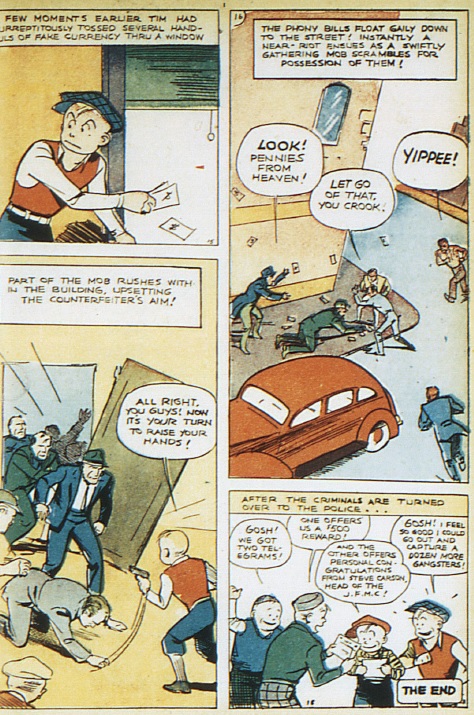
This month's Federal Men is again devoted to the Junior Federal Men Club (J.F.M.C.). This installment makes crime-fighting look like easy employment; no sooner have the police taken their prisoners then Steve Carson of Federal Men telegrams them congratulations, and another telegram promises them a $500 reward. This system could level up Heroes fast!
There are arguments for and against keeping track of ammo in a H&H gunfight. A quick argument against: mundane "bean counting" runs counter to the fantasy elements of comic book action; a quick argument for: Cal n' Alec, counting bullets to know when their opponent's gun is empty.
Nadir has a magic crystal ball with an interesting limitation -- it can only be used between 3 am and dawn! Time restrictions, race restrictions (like, only a merman can operate it), and items that can only be activated by destroying other items (like draining the magic out of lesser magic items) are all more inventive ways to keep a powerful trophy item from being too powerful, without saying it can only be used once per day, or it only has x number of charges.
What's this? Nadir, Master of Magic, using guns! That's a big no-no for Magic-Users. But he's not really using them, is he? He's just holding them and, perhaps, planned to bluff his way through an encounter holding them, but wouldn't be able to hit the broad side of a barn with them.
I had a similar situation in an earlier H&H campaign, where a player wanted his Magic-User to carry a bow and arrows. He accepted that he would have no chance to hit with them in combat; he just wanted them for how he envisioned his character.
Another magic item, and this one's a new one -- Nadir apparently has a Ring of Alertness, that keeps him from being surprised.
Sandor encounters a lion here who treats him as if he already knew him. It's possible, actually, that Sandor had encountered this lion before and recruited it as a SCM, either behind the scenes or during some earlier installment I've forgotten or never got to read. An Editor can also, at his discretion, allow a player to make up SCMs from his backstory. The Editor must be careful, though, to consider the implications and how the Hero might benefit. Having a lion for a friend could be an unfair advantage over the other Heroes.
(Scans courtesy of Comic Book Archives)
Captain Jim of the Texas Rangers shares a little history lesson for you on how common it used to be for men to write their names in their hats. A good clue if your Heroes happen to find a hat at a crime scene!
Note that the cowboy here is surprised, but his horse isn't. Normally, the Editor only rolls surprise once for each side, but if a Supporting Cast Member (particularly an animal SCM) has extra-keen senses, then that could be reflected in a second surprise roll for that side.
In the Golden Dragon serial, Reilly is frustrated that he can't find a secret door. Actually, he knows the secret door is there -- he just saw some mobsters open and shut it on the previous page. What he can't find is the way to open the secret door. Of course, if there is no opening mechanism on this side, no number of search rolls will find it.
Instead, Reilly could choose to try non-Superhero wrecking, but a stone door would have a very good saving throw and he is probably wary of attracting wandering mobsters for however long that could take.
This month's Federal Men is again devoted to the Junior Federal Men Club (J.F.M.C.). This installment makes crime-fighting look like easy employment; no sooner have the police taken their prisoners then Steve Carson of Federal Men telegrams them congratulations, and another telegram promises them a $500 reward. This system could level up Heroes fast!
There are arguments for and against keeping track of ammo in a H&H gunfight. A quick argument against: mundane "bean counting" runs counter to the fantasy elements of comic book action; a quick argument for: Cal n' Alec, counting bullets to know when their opponent's gun is empty.
Nadir has a magic crystal ball with an interesting limitation -- it can only be used between 3 am and dawn! Time restrictions, race restrictions (like, only a merman can operate it), and items that can only be activated by destroying other items (like draining the magic out of lesser magic items) are all more inventive ways to keep a powerful trophy item from being too powerful, without saying it can only be used once per day, or it only has x number of charges.
What's this? Nadir, Master of Magic, using guns! That's a big no-no for Magic-Users. But he's not really using them, is he? He's just holding them and, perhaps, planned to bluff his way through an encounter holding them, but wouldn't be able to hit the broad side of a barn with them.
I had a similar situation in an earlier H&H campaign, where a player wanted his Magic-User to carry a bow and arrows. He accepted that he would have no chance to hit with them in combat; he just wanted them for how he envisioned his character.
Another magic item, and this one's a new one -- Nadir apparently has a Ring of Alertness, that keeps him from being surprised.
Sandor encounters a lion here who treats him as if he already knew him. It's possible, actually, that Sandor had encountered this lion before and recruited it as a SCM, either behind the scenes or during some earlier installment I've forgotten or never got to read. An Editor can also, at his discretion, allow a player to make up SCMs from his backstory. The Editor must be careful, though, to consider the implications and how the Hero might benefit. Having a lion for a friend could be an unfair advantage over the other Heroes.
(Scans courtesy of Comic Book Archives)
Subscribe to:
Posts (Atom)