Showing posts with label Jack Woods. Show all posts

Monday, October 3, 2016

Adventure Comics #41 - pt. 1

There's a bit of controversy over the second Sandman story in this issue. The Sandman pulls a mobster underwater, beats him up, and then we never see that mobster again. The author summarizing stories for DC Wikia believes that Sandman must have drowned the man, making this the Sandman's first kill (despite the narrator's claims that the Sandman has never committed a crime). Thank goodness I had access to The Golden Age Sandman Archives to corroborate these things! I don't think any definitive conclusion can be drawn from that page. We never see the end of that underwater battle. For all we know, before the Sandman surfaces again, he leaves the mobster safely unconscious on a nearby dock.

When Sandman does resurface, the girl he's rescuing says she's "heard a lot about" him, which seems unlikely if this is only his third mission ever. Like with the magic-users and superheroes we've seen so far, there is ample precedent for allowing Heroes to begin with more than 0 xp, or even whole "brevet ranks" (called "big bang levels" in Supplement V).

The Sandman spends much of this adventure out of costume -- retaining his gas mask, but otherwise wearing only a bathing suit and a shoulder holster for his gas gun. At some points he is wearing a coat and hat over his bathing suit. Mysterymen do not seem to need to always be in costume as much as superheroes do.

Barry O'Neill, in his adventure, is in Tunisia -- a welcome departure for me from the habit of creating fictional countries (a personal pet peeve of mine).  Cecil Krull is a great villain name -- too bad it was just an alias.  "Cecil" is a spy, but we already knew spies needed to be a mobster type.

Steve Carson of Federal Men has been slumming for awhile now, but it seems like Jerry Siegel decided to go all out for this issue. An entire town dies, strangely, during a snowfall -- raising the stakes from Steve's recent adventures of stopping crooks. Mobrune is a prophet-like figure who predicts other towns will be hit by the killer snow to be purged of wickedness. As those towns are later hit, Mobrune grows a cult around him (making me wonder if cultist should be a mobster type). Mobrune is actually using a poison gas that is catalyzed by cold air, and the snow is just incidental. A bit bloodthirsty for my liking, but otherwise a plot!

Two of the benefits of a Western campaign (the same with many fantasy campaigns, really) is that a) a trope of the genre is that the Hero is always moving and, b) in a remote environment, any encounter is worthy of description. Which is good because, under normal circumstances an old man looking to go home to see his son -- as Jack Woods meets -- would not seem like much of a plot hook in a busy city.

The bandits Jack Woods meet do something interesting and different -- they just let Jack go, trusting that they've intimidated him enough that he would stay away!

Speaking of different, Socko Strong and his friend Jerry Indutch are shipwrecked on a primitive island but, instead of focusing on getting off the island, Socko and Jerry form ties to the islanders and seem ready to settle down! Socko wins a job as a bodyguard and Jerry has eyes on the chief's daughter. That's creative, proactive roleplaying! The natives use poisoned spears, so the native mobster type needs a 1 in 6 chance of having poisoned weapons.

Should a film projector be a trophy item? Hmm...

Captain Desmo and Gabby are dealing with thugs - the Indian thugs (or Thugees) the word originated with. These thugs are treated as natives, swarming over an Indian city (a fictional city? I can't find a real Jeddur). Since the natives have a huge number advantage, Desmo "has" to resort to wiping them out with a grenade, and the cliche of cutting a primitive bridge over a chasm.

(Sandman read in Golden Age Sandman Archives v. 1, the rest read as summaries at DC Wikia.)


Monday, July 18, 2016

Adventure Comics #39

Barry O'Neill begins having post-Fang Gow adventures, though Count Guniff seems to be cut from the same mold. Indeed, when Guniff traps O'Neill and LeGrand in a water trap, Barry would have been within his rights to go "What, again?"

Two things worth pointing out from this story: one, it is one of the first time in comic books where the hero runs out of bullets; and, two, Guniff's second death trap for O'Neill and LeGrand is a much simpler affair -- he douses them with gasoline and is going to brings a match towards them. That's a pretty serious death trap -- serious enough that I'd probably have it do 1-10 points of damage per minute to heroes until they can somehow extinguish themselves (like a save vs. science to smother the flames by stop, drop, and rolling).

Cotton Carver continues exploring his Don Dixon-like lost world environment. One thing to notice is that the hideout/dungeon Cotton is exploring is taking him down quite a few levels, by stairs and slides, but his encounters are not getting significantly more challenging. He gets to a dead end where he cannot proceed without having a special stone with him that fits into an indentation in the wall -- a classic dungeon trick.

Cotton fights a half-cat, half-man called a Watcher. Watchers must be pretty tough; this thing takes multiple arrow hits without going down, and is probably at least 3 Hit Dice. They're also Lawful because, if you defeat one and leave it alive, it agrees to repay the life-debt by serving you (or maybe Cotton just had cat treats in his pocket).

The animated statue Cotton meets seems straight out of Dungeons & Dragons. I wonder if it's a living statue, a golem, or if I'm going to be disappointed next issue by it getting explained away as ventriloquism...

In Federal Men, we learn more about how reefer works in the comic book world. It's "the drug that causes the smoker to lose all moral restraint". So, if you smoke marijuana and fail a save vs. science, you become okay with killing others (just like most of my players) and don't have to save vs. plot before you can take a life.

Jack Woods (fresh over from More Fun Comics) faces a bandit and an unusual dilemma -- a victim who isn't glad he was saved. Soon he's confronted with another dilemma much like one I recently used in my Monday night campaign. The Hero is hired to deliver something under suspicious circumstances. Does the Hero do the job and go home, investigate the sender, or investigate the receiver? It's a nice scenario because the Hero is free to choose and shouldn't be railroaded into investigating one before the other.

Steve Malone finds a cuff link. This is important because a cuff link is never mentioned in a story unless it's a clue.  If your Editor so much as says "cuff", you'd better be ready to take notes.

Steve does a lot of searching. He finds the first cuff link searching by a gong (not where you'd normally expect to find one), but finds the second one searching a bedroom where you'd expect to find one (maybe at a +1 bonus then?). There is a secret compartment hidden in a model castle and, unless the Hero has reason to suspect it's there, the chance of finding it is the same as a secret door.

Tom Brent is sailing down a jungle river, seeing no natives, but they see him and track his boat's movement. Which might not bear mentioning, except that there seems to be a lot of natives and they evade being noticed for quite some time. Maybe natives need to have a better (3 in 6?) chance of surprise?

The Skip Schuyler story has him pitching for the Yankees during a special game for charity. Which might not bear mentioning, except that it's so rare for a real baseball team to be named, and real players (Lou Gehrig and Joe DiMaggio) cameo. Of course, in your home campaigns, whether you go with real historical figures, characters obviously based on real historical figures (with similar names, like Jim DiMaggia?), or entirely fictional characters is entirely up to you.

In Anchors Aweigh, because the Editor clearly doesn't have a new plot for them lined up, Don and Red decide to go hunt up some experience points, literally, by hunting crocodiles off the Panama Canal. They meet a wandering encounter while hunting who turns out to be a mad engineer who makes bombs (I can't decide if that qualifies him to be a mad scientist (Book II), a madman (Supplement V), or even an anarchist (Supplement I). Once the encounter has been rolled up, the Editor has to think up an excuse for the engineer to be there, so he concocts a plot on the spot for foreign powers to have hired him to blow up the Canal.

(Summaries read at DC Wikia)


Tuesday, September 29, 2015

More Fun Comics #30 - pt. 1

Just when I was convinced that "hide in shadows" should be a class-based instead of a race-based special ability, a page like this comes along, where Sandra of the Service is shown to be hiding in shadows.  So what's going on here? Can all humans hide in shadows after all? Should this be a special ability for the Spy class, or is Sandra a Mysterman? Is hiding in shadows going to become a stunt accessible to many classes?

The only thing I can say with any certainty is that the Spy class (an unofficial class from The Trophy Case) will not make the cut into 2nd edition Hideouts & Hoodlums.  It may be too specific an archetype, while Hero classes should be broad enough to be used for more than one. Also I've just received no feedback from players interested in playing one.


Good call, Sandra. If your player had been careless enough to have you shoot into a dark room, crowded with combatants, I would have rolled randomly to hit any target, friend or foe, regardless of how well you rolled on your attack roll.


I'm still unsure if Doctor Occult is public domain or not, so I'm going to continue to err on the side of not sharing these next pages -- which is a shame, because we see a lot of H&H-relevant material in them.

An old soothsayer performs a seance, not unlike the seance ability of the Trickster class (from The Trophy Case v. 1 no. 4). The trickster is more likely to end up as a mobster-type in 2nd edition than a Hero class.

The seance goes wrong and summons an elemental. Elementals, in Dr. Occult's world, are supernatural and composed of ectoplasm instead of an alchemical element.  Elementals can possess people.

We also observe Dr. Occult and the elemental-possessed soothsayer in a contest of wills -- an optional rule for Magic-Users that debuted in The Trophy Case. A slightly altered version just appeared in Supplement V: Big Bang.

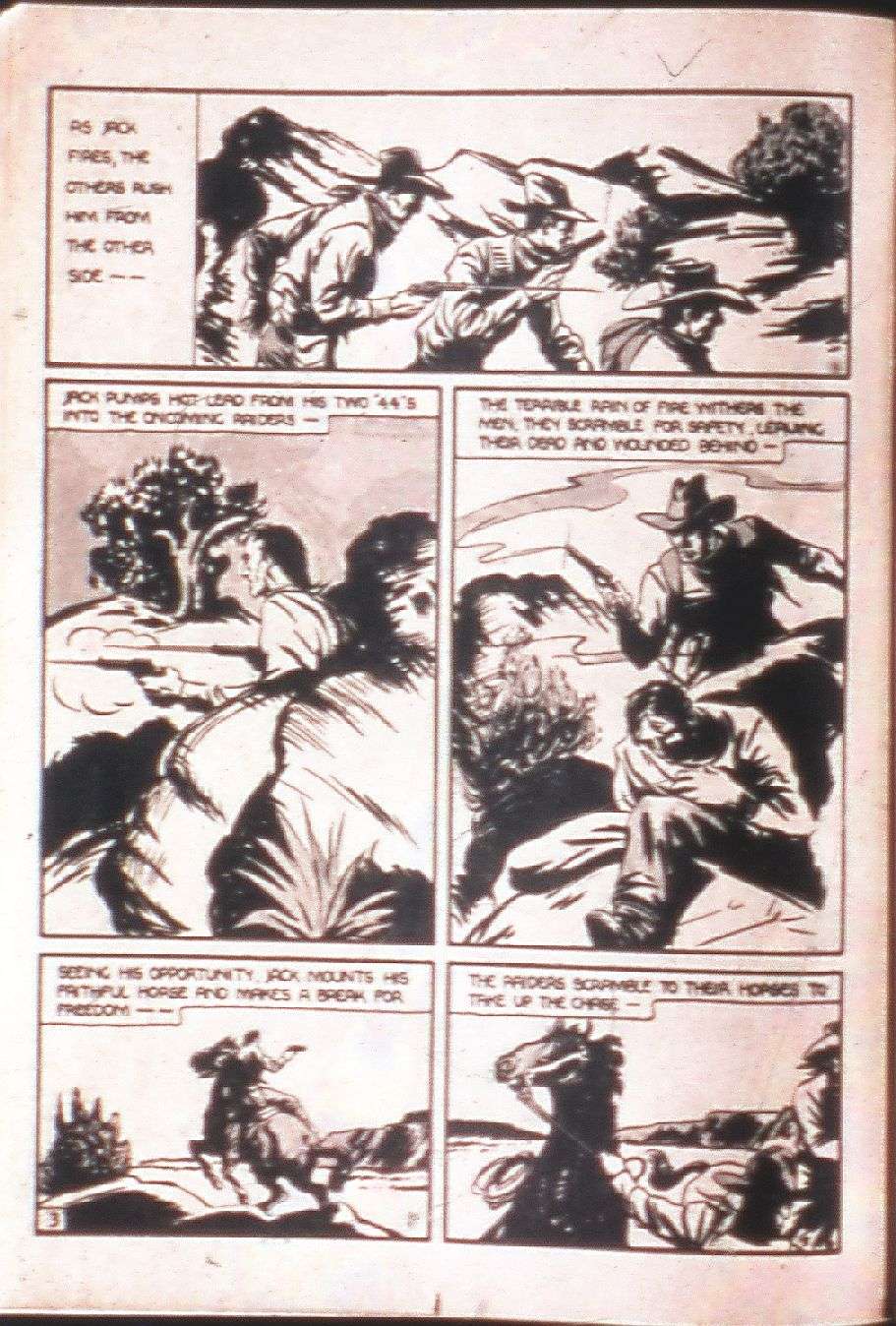
Meanwhile, Jack Woods reminds me that I should have made a Cowboy Stunt called Make Shoot at Hat. For 1 turn, all opponents must save vs. plot or shoot at the exposed hat instead of the concealed Hero.


Comic books seldom specify what type of gun is being used, and I now see it as an error that I specified so many types of historical guns on the starting equipment list. That said, this page clearly refers to Jack's weapons as being .44's, and are probably Winchester .44 revolvers.


Some amounts of climbing, like up a steep, rugged slope, or maybe even the side of a building, should be accessible to all Heroes. This, though...climbing a sheer wall, straight out of water? This has to be a special skill -- either performed by a Mysteryman (which Brad Hardy doesn't seem to be) or a stunt usable by Fighters (as Brad Hardy definitely seems to be).


It really seems like Wing Brady's player rolled a fumble in this combat. Criticals and fumbles are house rules in some games, and official rules in others. I have decided to avoid both for H&H -- I would rather the Editor control the flavor text of what happens in combat, bearing in mind the mood of the campaign he is aiming for.


(Scans courtesy of Comic Book Plus)


Saturday, September 5, 2015

More Fun Comics #28

We'll start off discussing this issue with the Dr. Occult story, "Vampire Venom". Occult is the first man in comic books to deal with vampires (and this is his second outing against them!), so this strip should be seen as authoritative on the subject. We see that vampires can appear from out of nowhere (probably had been in gaseous form), and that they can have bat wings even when in human form. It turned within sight of their graves, they flee back to their graves rather than fleeing further.

In Pirate Gold, Dennis (there just aren't enough Heroes named Dennis) uses a whip to disarm. Given how common disarming is in comic books, I'm still inclined to say this is a combat maneuver that should be open to everyone and not a game mechanic specific to whips.


This page from Bob Merritt gives you a good idea of how large the scope of a war on crime could be in your H&H campaign. This isn't an enemy nation's air force in the sky -- this is a "gangster fleet". I'm counting at least 26 planes in that remarkable panel, each probably equipped with at least a machine gun. Looks like a battle for high-level Heroes...


This page of Johnnie Law supports an idea I've been having for an optional rule, where a head blow would have a chance of temporarily knocking out someone, This would have to be entirely different from the hit point mechanic, where being reduced to zero hp means a long recovery. Perhaps the attack roll would have to score 5 or more better than needed to hit, with the stated indication of going for a head blow, and the target would have to fail a save vs. science or be rendered unconscious for only 1-20 minutes?


This panel with "constant firing" is making me think of an optional rule for suppressive, or covering, fire. It would keep combatants from being able to move through an area, while not directly targeting any particular combatant.


A shot, like this one in Jack Woods, I would normally consider as evidence of the Trick Shot stunt for Cowboys.  However, it should be possible to make this shot even in a campaign without stunts or the Cowboy class. It might require a lucky hit roll vs. AC -1, however...


Brad Hardy's environment is a mix of the mundane and the fantastic. The intelligent races tend to be humans of a different color, like the grey people. Animals might be mundane, like pythons, or fantastic, like the bull-boar (which is itself just two animals combined). I would, at a guess, make the bull-board 3 HD, with a goring attack with that unicorn-like horn that would do 2-8 damage.


(Scans courtesy of Comic Book Plus)

Tuesday, July 21, 2015

More Fun Comics #24

Sometimes things don't go as planned in a Hideouts & Hoodlums scenario. Sandra of the Secret Service can attest to that. Here, she and her guy-friend have gotten themselves captured again and can't figure a way out of this. What is an Editor to do?  In unsubtle fashion, you let the Heroes find a sheet of paper with instructions on how to find a secret escape route. There's no official game term for this, but you can call it a freebie.


There are freebies, and there are things the Heroes are willing to pay for. Here, Wing Brady's player could have trusted to the luck of the dice on his encounter reaction roll, but he's decided to sweeten the deal and improve his chances with a $5 bribe. As the Editor of this scenario, I'd be willing to give him a +1 bonus to the roll for the bribe.

Roleplaying should matter, though, so I'd also be willing to give him a -1 penalty to the roll for being kind of a dick. "I gave you five bucks to drive the cat, not to ask questions" indeed!


This month, Brad Hardy learns that there is arm wrestling and there's ultimate arm wrestling. The first one to lose a save vs. science and fall off-balance from the bridge lands on the...well, what is that creature supposed to be, anyway?  Some sort of giant catfish with tentacles? It sort of reminds me of the AD&D monster called the aboleth...


One of the best things about reading these old comic books is when you see a cool idea for an encounter area that you've never seen in a game scenario before. Bat infested caverns might be pretty common place, but ones with "sentinel-like stalagmites" taller than the Heroes? Navigating a maze of stalagmites? Sounds intriguing!


We're still months away from the debut of Superman. We've already seen one prototype, in Dr. Occult. Is Bob Merritt another? Here, he topples boulders and collapses tunnels with just a sword (yes, a ridiculously huge sword!). These feats of strength seem more appropriate for the Superhero's wrecking things game mechanic than anything a Fighter should be able to do...

And, lastly, there's Jack Woods, modern-day cowboy. Low XP-value trophies should be items that are only slightly better than ordinary. So, taking a bad guy's car would not net you any Experience Points, but a high-powered car, that might be worth 100 XP?


(Scans courtesy of Comic Book Plus)

Friday, July 3, 2015

More Fun Comics #22

This isn't so much a playing tip, but this page of Sandra of the Secret Service amused me, reminding me of my new players in a game of Hideouts & Hoodlums, and how tying people up and hiding them in closets was their go-to plan for a significant portion of our first session...


Hey, look! It's another villain, pushed backwards off a cliff and dies!  As often as I'm seeing this, I'm thinking that a "push back" or "bull rush" combat mechanic isn't the solution here. What this needs is an -

Official for H&H: The Falls off a Cliff and Dies Rule

Any time a Hero is about to get killed because of unlucky dice rolls, and you don't want it to happen (because it will spoil the narrative of the story, send a player home unhappy, etc.), you are free to have the Hero's opponent fall off a cliff and die. It is preferable, but not essential, that a cliff actually be present in the scene. 


The bad guy has the drop on our Hero, Wing Brady, his gun pointing right at him. The Hero's intention is to spin around, pick up a stool, and throw it at the gunman before he can pull the trigger. Our Hero is toast, right? Then you haven't read enough comic books. This is precisely why, instead of a realistic initiative system, we need the abstraction of 2 dice rolls, higher roll goes first.

I have no idea what giant vats of boiling oil were used for in 1930s laboratories, let alone futuristic ones. Regardless, they apparently make for good hideout decor.

Now, immersion in boiling oil could be handled in one of two ways by the Editor. One is random damage (1-6, or higher, depending on how hot the oil is) per turn until the immersed is rescued, and the other is a straight save vs. poison or death. The choice might say a lot about what kind of campaign mood the Editor is going for.

The ease with which a panther is killed by one of the Bradley Boys with just a knife is a good argument for going with same damage for everything, and not scaling to an expanded weapon damage system that penalizes the "lowly" knife.

As common as cannibals are in Golden Age comics, I've shied away from using them as a distinct mobster type. Instead, I've lumped them together with other racist portrayals under "Natives" in Book II: Mobsters & Trophies.

Here Brad Hardy encounters some kind of underwater dragon. The real lesson here is, as long as you can count on your players never to turn around and fight, you can throw encounters as big and spectacle-worthy as you like at them. Of course, then it's beholden on you, the Editor, to provide someone else to do the fighting for them.

Hence, mermen with underwater lightning guns.


In a page of Doctor Occult, not shown here, Jerry Siegel shows off his talent for cleverly playing with science fiction motifs again (as we have already seen him do in Federal Men). In the last issue, Dr. Occult was killed. In this issue, a scientist brings him back to life, ala Frankenstein's Monster, only here the mad scientist is more obviously the villain and the "monster" is more obviously the Hero.

The trophy item used to bring the Doctor back must be a mad science raise dead machine.

Proof that cowboys can climb walls. It's not just a Mysteryman skill anymore!


And lastly, a page of Johnnie Law, included here because it's actually an example of good detective work -- using a clue to narrow down a smaller list of suspects, and then meticulously tail each of them.

(Scans courtesy of Comic Book Plus)

Wednesday, June 24, 2015

More Fun Comics #21 - pt. 2

I'm not sure what that is Brad Hardy and his buddy are running away from, but the narrator calls it a "land monster" and it looks an awful lot like a dragon. Maybe dragons don't like water? Kind of makes sense.


Here, Brad stumbles across a hidden land, underwater, surrounded by a coral reef that somehow makes the air breathable down here. This is a perfect idea for getting low-level Heroes into an exotic environment and keeping them safe there (although maybe not safe from deadly fish...).


Jack Woods' player might cry foul here, as a cave-in smacks of railroading the players ("railroading" being a technique where the Editor eliminates all other options from the players to move them in the direction he wants the story to go).

The concealed trap door entrance to a hidden hideout is a nice touch, though.


One could easily spend $3.65 on a taxi ride across town in 1937.


(Scans courtesy of Comic Book Plus)

Wednesday, April 15, 2015

More Fun Comics #17 - pt. 2


Mark Marson of the Inter-Planetary Police is new to me, but there are some familiar tropes here.  The "sun-ray cannon" sounds a lot like a Laser, but is probably meant to be a heatray (since Lasers hadn't been invented yet in the 1930s).  The electro-ray pistol is also already statted for H&H, as an electric raygun.  And pit traps!  Gotta have pit traps.


On this page you can see how the cliched tropes of the adventure genre can be used to make future scenarios feel retro.  The only thing different about this enclosing room trap is the "gripping ray" that acts like telekinesis on Gail.


I'm not sure what I'm reading about in Bob Merritt.  The snaky tentacles in the clouds -- are they going to have some natural explanation for that or not?  And the "bursting hand grenade" in the bottom panel -- I'm no expert on weapons, but I didn't think an exploding grenade normally made that much light.  If it was some sort of magnesium grenade that just gave off blinding light, that would be a pretty neat trophy for Heroes to have.
Speaking of trophies, Brad Hardy and his fellow escapees run into some new trophy weapons -- guns that shoot "poisonous shrapnel darts".  So, 1d6 damage + a save vs. poison.


There is a lot of flavor text in this page long struggle, but I think we can break it down into 3-4 turns of combat.  Turn 1:  grappling on both sides.  Turn 2:  Jack fails to grapple (described by the Editor as falling backwards), and Villa fails to hit with his knife.  Turn 3:  Unsuccessful grappling on both sides; Editor allows them both to get to their feet instead.  Turn 4:  Jack punches Villa, using a special maneuver to push him back.  The Editor may or may not choose to roll a saving throw for the window glass (since it's such a cinematic image, he might just choose to allow it to automatically break). 

Since the knife is ignored after turn 2, turns 3 and 4 could be compressed into 1 turn, since unarmed combat allows for two actions per turn.  They do not both have to be the same action.


Young Jeff is so good at hiding, sneaking, and attacking from behind, he might be a Mysteryman!


Sandy Kean runs afoul of a racketeer!  Should racketeers be their own mobster-type?  Perhaps ones with special connections to corrupt politicians?


(Scans courtesy of Comic Book Plus)


Thursday, April 2, 2015

More Fun Comics #16

It's the last More Fun of 1936 and Sandra of the Secret Service is dodging machine gun fire!  This is why Hideouts & Hoodlums needs the save vs. missiles mechanic -- because Sandra would be toast without it.

Sandra and Lorenz dive into the moat to escape. The rules cover falling damage, but are less specific about falling into water. Editors are free to hand-wave all damage away, reduce, or minimize damage in any way that makes sense in such an instance. Note that reduced damage is a privilege, not a right!  Heroes need to do all they can to minimize their damage; belly-flopping into the moat just to test the Editor should not be given any reduction.


Look out, Spike Spalding, they're searching for you!  Thank goodness you didn't have to bother with putting points into a skill like Hide just so you could have a chance of remaining a fugitive. In H&H, you just tell the Editor that you're hiding and the burden of finding you is entirely on the mobsters. Most everyone has either a 1 or 2 in 6 chance of finding concealed doors, which applies to concealed people too. Of course, some exceptions to this are the Mysteryman, a class with a higher chance of hiding, and the Magic-User, who has even better spells of concealment like Invisibility.


In this month's installment of Dr. Occult, we learn more about the magic belt that he picked up during his Egyptian quest. The belt is controlled by buttons that are pressed on the belt; one button activates a Fly function (as per the spell) and another button activates a petrification function (as per the gaze of a basilisk).  There is no indication of how many times he can use these functions. It is interesting to note that how the magic belt seems to resemble advanced technology, especially since the villainous Koth's origin on the next page is tied to outer space and a downed spacecraft on Earth in eons past. The implications of combining magic with technology were discussed in Supplement IV: Captains, Magicians, and Incredible Men, in the Dr. Fate entry.

It is even more interesting to note that Koth's origin is almost exactly like Superman's; the difference being that Koth didn't land alone, and his spaceship landed on Earth in the primitive, superstitious past. Had a nurturing society taken in Koth instead of slaughtering his shipmates, he wouldn't have wanted to wipe out mankind for eons!

Midshipman Dewey's Editor has created a bit of a poser for himself. Dewey is tied to a mast; he has cover, but not mobility.  Is he still entitled to a save vs. missiles?  I would be inclined to rule 'yes', but at a penalty.


Jack Woods is sort of dealing with a problem I often have when running H&H -- keeping track of ammunition. I am always grateful to the players who do a good job of tracking it for me. For those less fortunate, I have written some tips for "cheating" on ammo tracking in various sources, like allowing a weapon to fire for a random number of turns (determined by a die roll at the beginning of combat). 

Note that Villa isn't trying anything trickier than trying to get a surprise attack when he reaches the top of the stairs. He won't have any better a chance of surprising than anyone else would, though he won't have less because he is acting with caution.


Jack demonstrates the Cowboy stunt, Disarming Shot.  In theory, anyone could try this as a special maneuver, but would have to roll 5 or more higher than needed to hit, and Villa would have to miss a save vs. science.


After all the creatures Don Drake has defeated, these guys with whips must be awful good for Don to surrender!  Interestingly, Don, Betty, and Zira are kept prisoner in a room filled with blinding light, so they cannot see to escape.


The rules don't specifically cover shooting through doors, as happens to Sandy Kean here in Calling All Cars, but it could be assumed that Sandy has hard cover and is effectively invisible (so -2 to hit and -4 to hit).


(Scans courtesy of Comic Book Plus)

Sunday, February 15, 2015

More Fun Comics #10

We rejoins Sandra of the Secret Service, now involved in a Gothic adventure around a spooky old castle!  Not only would the Black Tower and its secret halls be an ideal hideout, but a Silent Watcher would make an interesting mobster-type to encounter...


Jack Woods demonstrates a climb stunt here.  Also, Pancho Villa's henchmen, previously called bandits, are called brigands here. Another RPG distinguished bandits from brigands, suggesting that brigands were evil bandits, while bandits weren't necessarily quite so bad.  Hideouts & Hoodlums follows this model.


A skeptical reader might wonder about two things here -- why Pancho Villa took the time to knock Jack's gun out of his hand instead of just shooting him in the back, and how Jack managed to grapple Pancho without getting shot first.

If we do assume that bandits are Neutral and not Chaotic, and since Pancho is specifically a bandit here and not called a brigand like his henchmen, then Pancho would be naturally more inclined to take Jack prisoner rather than kill him in cold blood.  It will be important to remember, when running H&H, to make sure that most mobsters encountered have goals other than killing Heroes.

The other question is, how did Jack strike first?  One possibility is an Editor that ignored the traditional order of combat and allowed both missile and melee attacks to be decided by the same initiative roll.  Or, the Editor rolled for Pancho first, missed, and then used flavor text to describe it as Jack getting the drop on Pancho, since it made more sense to describe it like that than a miss at point blank range. H&H has that kind of flexibility.

Though Don Drake is on an alien world full of wondrous things, it's interesting how a simple net trap is what does him in.  It's a big net, so if Don was surprised, there wouldn't be much of a chance to run out from underneath it. I might even give him a -1 penalty to his save vs. science to dodge the trap.


Barry O'Neill is wise to worry about the Secret Service seaplane. That deck-gun is probably an autocannon, which was statted in Supplement I: National, and does a doozy amount of damage.

It's interesting how many targets the paralysis ray can be used on at such a short distance. That's one wide-angled ray...


What's interesting here is that the the paralysis raygun is easily thwarted -- because it's plugged in by wires. When planning to use a hi-tech weapon in your campaign, it's important to consider the power source. This isn't so much an issue with magic trophies.


Doctor Occult explains at length about a magic spell that drains years off your victim's life and adds it to your own. It's not the sort of combat- or hideout exploring-related spell you would expect to need in H&H, so it will probably stay off the spell lists, but on a magic scroll, as a one-shot item to be found, this could be an atmospheric addition to an evil necromancer's treasure trove.


Henri Duval is getting overwhelmed by sheet weight of numbers.  Truthfully -- I haven't figured this one out yet. The H&H rules are more geared towards one-on-one grappling combats. Overwhelming with numbers is something I'll still have to work on.

(Scans courtesy of Comic Book Plus at
http://comicbookplus.com/?dlid=11615&b=i)