Showing posts with label level titles. Show all posts

Sunday, June 21, 2020

Zip Comics #2 - pt. 3

We're going to spend some more time on this issue even though, let's face it, it was really only worth reading for Steel Sterling.

We're still on Nevada Jones and...Dice is okay with serving a masked man in his saloon, but it's the "halfbreed" he has trouble with? And this is doubly weird because this is the only time in the story Little Joe is referred to as a half-breed. Is he really only half-Hispanic, or was the author so racist he assumed Hispanics were all half-breeds?

But perhaps the toughest question I have about this page is what an "alkali eater" is. I had to do some reading for this one and, apparently, "alkali" is a term for baking powder, and at least until the 1920s, people thought you should eat baking powder for an upset stomach. I'm so glad someone invented Tums!


I skipped a few pages about the fire and how it was used to cover up a double murder. The clue at the scene was a big piece of ripped fabric. Thank goodness the villain didn't bother changing his vest, despite it having a big and obviously incriminating tear in it.

Again, that's not my real issue with this page. The more troubling thing is that Little Joe murders the villain in cold blood, and only gets a scolding for it. Instead of standing trial he gets a free pass for being the Hero's supporting cast...but that's some messed up ethics there.
We're going to have to swallow hard on some racism for this story too. There's also a lot of almost-nudity on display here. But your takeaway for this page should be that elephants can make grappling attacks, as long as their opponent is also larger than man-sized.
Of all the pages on this post I have problems with, I think I have the most with this one. Kalthar wakes up and says Mano the Elephant "has been slain." Then he gets up and says, "I shall avenge you, Mano!" ...to Mano, "leader of the herd, and only survivor." So...Kalthar only thought Mano was slain? Is this Mano's ghost before him? If all the other elephants are dead, why is it only Mano Kalthar gets upset about? Were all the other elephants jerks and had it coming to them?
Speaking of jerks...Kalthar captures this one native working for the white raiders, questions him (on the previous page I skipped), and after pumping him for information carefully ties up to a tree branch so Kaa the Snake, or some other jungle critter, can come along and feast on him later.

I think the one saving grace of this story is the idea of the bad guys casually chucking dynamite around, which raises this from a low-level scenario to a challenging scenario for mid-level Heroes. At least until the Heroes get their hands on the dynamite.
This is very Hideouts & Hoodlums-like, with the superhero vulnerable until he's had a chance to activate a defensive buffing power (by swallowing certain grains, though that is likely just flavor text). To protect him from dynamite, the buffing power has to at least be Imperviousness, if not Invulnerability, meaning Kalthar is yet another superhero with brevet ranks boosting him past where a superhero should be, experience-wise, after just two appearances.
Hmm...I'm dubious that polo tactics would translate well to air warfare, but I'm not Mike Carr so I'll just let that go as being outside my area of expertise.

The most useful thing about this feature so far has been the captions that explain what planes we're seeing, but we only get this once in this issue, for the Nazi Messerschmitt Pursuit planes. Despite the Germans having the advantage of surprise, it looks like the British have superior numbers -- I count 12 to 9 - so this could be anyone's victory.

Perhaps most interesting on this particular page is a Hero giving advice to a non-Hero, and the non-Hero just choosing to completely ignore it. Sure, this is exactly what would happen in real life if some kid tried to tell his commanding officer what they should do, but it's very rare for comic books.
The casualties are surprisingly high in this story, with eight dead men on the good guy's side, and this has everyone on edge. The two Heroes aren't getting along and, even though they are quickly promoted to squadron commanders, their colonel tells them the news like it's a punishment.

It's also surprising when the boys try to turn down becoming squadron commanders, and it made me wonder what I would do in a H&H campaign if a player refused the level title associated with their next level ("But I don't want to be a commander!"). Do I hand-wave the level title away, or do they reject the new level and stay where they were? I did elude in the 2nd edition basic book that, at higher levels, there would be more than just meeting XP requirements that would need to be met to level...though I haven't actually worked those out yet.
Whoa...Tim went out with Tom's girlfriend, pretending to be Tom the whole time? That's pretty risque; I remember some direct-to-video movies in the 1990s that were like that...

(Scans courtesy of ComicBookPlus.)


Saturday, April 27, 2019

Tip Top Comics #17, 20, 22

Also known as vol. 2, no. 5, 8, and 10. Outside of Tarzan, the strip I can't see because of strict copyright laws, the race for second-best ongoing story line is a contest between Billy Make Believe and Peter Pat. Like The Adventures of Patsy, these were parts of a minor and unsuccessful movement to merge the kids' adventure and fantasy genres. Both Billy and Peter have exciting adventures and reveal themselves to be capable fighters despite being half-pints, though Billy's seem less dangerous, as it is not clear whether his adventures are actually taking place or are only imagined by him, as the title suggests. 

I include this page's How to Make It sub-feature because, of all the mini-craft projects I've seen described in filler material so far, that one about making paper tepees is the only one I've actually done.
 ===

Billy is still fighting toy people (and contributing to racism?). It looks like toy people can be encountered in groups up to 30, and do not have to be human-like in form.

Captain and the Kids gives us wild men, another name for cave men, and reminds us how strong they are. Maybe all cave men should have the Raise Car power?

The reference to state police in Hawkshaw the Detective suggests that, despite being based on Sherlock Holmes, this takes place in the U.S.
Here's an issue we've discussed here before: when do powers/spells/stunts need to be activated? Does the wild man need to have used the Raise Car power to lift that tree out of the ground, or is simply flavor text accompanying the attempt to wreck the rope? It may depend on what comes next. If the wild man simply escapes the tree and ignores it afterwards, the Editor can rule that the tree was lifted out as just flavor text, as it has no bearing on the story. If, however, the wild man tried to pick up the tree and use it as a giant club, then the Editor should rule that a power needed to be used, even if he has to retroactively make that ruling.
We're now on issue # "20"...

This really takes me back to the early days of the blog when I used to keep a running tally of how many goats appeared in the comics. It's true, before there were supervillains, goats seemed to be the supervillains of comic books.

Here we see how little provocation goats need before attacking.
Ella Cinders addresses the issue of language. It's been a Hideouts & Hoodlums rule since the beginning that languages aren't important and all characters speak the same one. Ella Cinders makes it clear (or even more clear, we just assumed so before) that the language we all speak is English.
In a more capable artist's hands that first panel of Fritzi Ritz could have been downright scandalous. But I include this strip not to titillate you, but to point out that fur wraps cost $150 and that, if you're going to haggle, maybe you should wait longer before suggesting furs depreciate in value.
Peter Pat's first big adventure has been wrapped up and he's returning the princess to claim his reward -- and is seemingly very well rewarded too. Peter should be at around 3,000 XP right now, which means his title should be an officer, but colonel seems really high...
 ...but then, it depends on the perks that come with it. Peter, after all, won't be commanding large armies or have access to heavy artillery -- it looks like he gets a fancy helmet and a pony, and the chance to perform in the rodeo.

This page also reminds us that, when developing alien cultures on the fly, all you really need to do is swap out one detail, like pigs for horses at the rodeo.
And we'll wrap up for today on this first share from issue # "22" and Hawkshaw the Detective. It's a rare, early occurrence of bad guys using passwords or phrases to get into their hideouts.

A question to ponder, that I'm not sure how to answer yet: when Heroes are on a stakeout, should they make a save vs. plot or science to determine if they sneeze...?

(Scans courtesy of Comic Book Plus.)

Saturday, March 30, 2019

Miracle Comics #1 - pt. 2

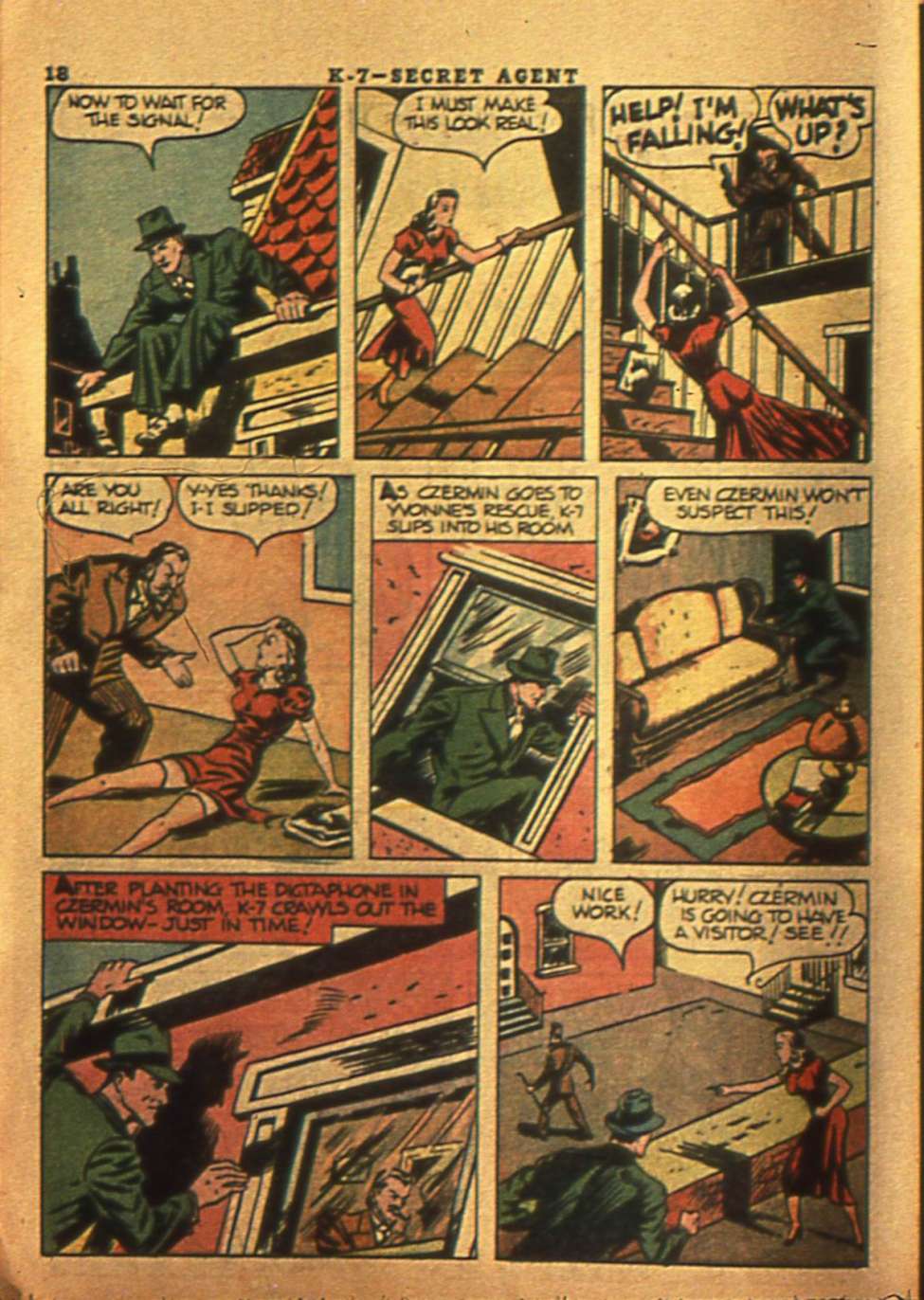
Your scream will be the signal? If I was K-7's supporting cast, that would not inspire confidence in me! (-1 penalty to loyalty checks?)
The question here is, is the villainous Czermin such a gentleman that he rushes to a lady's aid, or does he come rushing to see how high up Yvonne's hose goes? It's chancy, expecting your bad guy to do the right thing; I would ask for a save vs. plot to make sure that ruse worked.
Good thing Yvonne rolled to "hit" that hay cart, or her falling damage would have been 4-24 points and surely knocked her out cold.
This is a curious kind of scenario that you don't see often in comics, where the bad guys defeat themselves and it doesn't really matter if any good guys were there at all. I would not recommend using this often in a Hideouts & Hoodlums campaign.
This is Dash Dixon who, in return for helping a scientist, gets shot up full of drugs and then -- "Oh, I guess I forgot to tell you what I was doing to your body, Dash!" "Don't worry about it, Doc. As long as I don't get cancer from it, it's all good, right?"

Luckily, what happens is that Dash gets to become a superhero. And then he jumps up and hits the ceiling...which is weird because his strength has only tripled. Was he trying to leap 3' in the air for some reason, and then went 9?


A super man? That's a convenient choice of words. No, a super man is the level title for a high-level superhero; Dash is only a 1st level good man right now.

I also can't shake the feeling that Dash is dressed as a bellhop with a diaper over his uniform...
Panel 2 puzzles me, as I can't find any references online to air taxis before the 2000's. How common, then, was this term in 1940?

How high is that plane Dash jumps to? The lowest safe altitude for a plane is generally 500' (higher in heavily populated areas, or if the terrain is higher). Unless that plane is about to land -- and it does appear by its speed lines that it is descending -- then Dash jumps 62.5 times the current world high jump record, which is pretty high for someone who had their strength tripled. This is easily within the range of the Leap I power, though.
What game mechanic would a Hero use to keep from being crushed to death by the tremendous pressure of a plane wheel retracting? I would say hit points would be the main mechanic -- the wheel does crushing damage like being caught in a trap -- maybe 2-12 points of damage (or higher, for a larger plane). You can save vs. science to slip through and dodge the wheel, or activate a Raise power and negate the damage (because you can "lift" the wheel away from you automatically).

I'm having trouble even guessing which real life country the Republic of Scalene is based on. It kind of rhymes with Spain.

I like the secret exit from the basement, hidden inside a large cask -- though the steps in front of it might serve as a giveaway.

(Scans courtesy of Comic Book Plus.)

Saturday, January 19, 2019

Flash Comics #2 - pt. 1

The cover may belong to Hawkman, but the first feature is still the Flash. The story begins on Broadway, during a show of the "Fancy Follies," referring to the Ziegfeld Follies. When the Flash shows up in the story he's just goofing off, showing off his speed by using Race the Car beside Joan's taxi. Joan, on other hand, has already been investigating this string of theater shootings and found their common denominator -- Lord Donelin of Ireland. The Flash upgrades his speed with the Invisibily Fast power so he can search the dressing rooms at the Follies, while Joan correctly goes after Donelin. Joan is either being played by the better player, or the Editor is using the supporting cast to do all of the Flash's work for him.

The Flash's powers seem to have long durations, but he rarely gets into combats and so his powers last in terms of exploration turns (10 minutes each).

Curiously, when Donelin's henchman Goll tries to sneak up on the Flash, Goll opens the door silently, but the Flash hears Goll breathing and foils his surprise anyway (though, really, doesn't it make more sense for Flash to have heard the door...?).

If you're wondering about these names, 1) Gardner Fox wrote this and Gardner often used obscure or made-up names (look at his own!), 2) Theo is likely short for Theodora, a real name (though an obscure one, the 628th most common baby name for girls in 1940), 3) yes, Goll is completely made up. Gardner may have been wanting something that read like "Gaul," or -- being as well-read as he was -- may have been thinking of Lord Dunsany's "gnolles."

When combat does start, Flash might have activated Race the Bullet, or Donelin might have simply missed his attack roll (it's hard to say, except when Flash starts doing fancy tricks like catching the bullets). What he learns is that someone is pulling Donelin's strings and has ordered more hits on showgirls, so he leaves without even tying them up first.

Back at the follies (for a guy with a girlfriend, Jay sure likes to come back to see the showgirls), Flash happens to spot a man in the audience pull a gun. It's possible that he just got lucky and won a surprise roll, but no speed-related powers help with surprise. Perhaps, since the audience member was in a dark theater (though it's not inked that way), Flash had to make a search for concealed check to spot the gunman. Speed-boosting powers can help give a speedster/superhero more search rolls.

A favorite tactic of the Flash is to strip his opponents to their civvies, the thinking being that even bad guys in the 1940s still had their modesty and dignity. Rather than over-complicate things, I would allow a simple hold to strip someone's shirt and pants off.

Flash encounters a trap; a wall panel that mechanically opens on its own, revealing a concealed crossbow that shoots into the room (1/2 HD attack, since it can't turn and aim).

Flash demonstrates that he can dodge five bullets fired from different directions practically simultaneously. The "Race the -" powers simulate this by buffing Armor Class (in theory, any Hero can do this, so long as the guns roll low enough to attack).

Duro is a made-up brand name for imported cigarettes.


This is what I wrote about this story back in The Trophy Case v. 1 #1:

"This story establishes that the Flash's girlfriend, Joan Williams, will remain an important character and at least as effective a partner in crime fighting as Lois Lane is for Superman. Here, Joan introduces the Flash to the showgirl in trouble, deduces the identity of the killer without Flash's help, finds out where the killer is hiding and even (intentionally or not is unclear) leaves a clue for Flash to find and follow her.

"Fox again experiments with other tropes that he will quickly abandon, this time the notion of the Flash leaving little lighting bolts as calling cards or even weapons.

"The best sight gags include the Flash both disarming and undressing an assassin in the theater and the woman in the theater who has to hold her dress down as Flash goes whizzing past. It is odd, though, how quickly this will become
an ongoing theme.

"No. of times unseen to date: 5
No. of bald bad guys to date: 2
No. of men undressed to date: 1"

Next up is Cliff Cornwall, Special Agent. That Gardner Fox wrote the story is evident in that Cliff's girlfriend is named "Lys" -- which has to be either wholly invented or a shortened version of Marlys (the 393rd most popular baby girl name in 1940).

The cliche of Heroes hearing plot hooks on the radio in the form of breaking news announcements is an old one, but here Cliff is flying over Montana (on his way back from last month's Alaskan adventure) when he overhears a radio auction of state secrets. Rather than land and try to figure out where the signal was broadcast from, he decides to fly to Panama because the state secrets come from there (which suggests to my mind that the bad guys would have already left Panama, but then I'm not a spy...). Cliff does not bother informing his superior officers in the FBI about this schedule change; he just does it.

We learn that Cliff is Special Agent G-30 and is high-ranking enough that he can walk in on any military base, announce himself, and demand an audience with their commanding officer. Cliff should still be 1st-level at this point.

The enemy country that is called Kovaria could be Germany, or more specifically the German State of Bavaria.

In Panama, Lys and Cliff separate and agree to meet at "Park Square." Using a generic name meant Gardner didn't have to do more research and find a similar location in Panama City.


In a hallway in Panama, Cliff runs into a femme fatale he's met before, Lolita Devere. He decides to trail her and see where she goes next, which turns out to be a shoemaker's shop (the shop has "SH" in the window, no doubt for "SHOES", instead of "ZA" for "ZAPATOS"). Rather than barge in and find out what she's doing in there, Cliff takes the time to go meet Lys, tell her what's going on, buy a cart full of fruit and a disguise for himself, and when he gets back to the shop just assumes Lolita is still in there (unless he paid a local to watch it for him behind the scenes?).

That night, Cliff leaves Lys trailing Lolita while he breaks into the shoemaker's shop. Just looking through loose paperwork in the shoemaker's shop, he stumbles across the names of the spies (Lolita and a Count Ruthnor) and an offer for $1 million for the Panama plans.

Count Ruthnor shows up, goes down in one punch from Cliff, and Cliff finds a list of code signals on his person. Solving the code (perhaps there was an answer key in those very useful papers he found), he knows that Lolita has orders to drug a U.S. lieutenant at the hotel where Lys has trailed her to. It turns out, they held the auction first but didn't have any plans until now when Lolita drugs the lieutenant and steals them from him. Although there was no mention of them in the papers, Lolita has two more spies working for her (or perhaps a different mobstertype).

(Flash feature read in Golden Age Flash Archives v. 1; the rest read at fullcomic.pro)


Sunday, January 13, 2019

Daring Mystery Comics #2 - pt. 2

We resume with discussing Trojak the Tiger Man, though the page I'm reading now is about the unnamed woman who has turned good from Trojak's presence and has decided to leave her companions to make her way back through the jungle alone. En route, she encounters a random encounter, a lion. Trojak rescues her by grappling the lion to death. I've commented before on how murderous the early golden age heroes were, but it's also worth pointing out that morale checks never seem to come into play; fights are always to the death with animals.

Trojak learns English from the woman in about a week.

There is no game mechanic for Trojak's "strange premonition that something is wrong." Rather, in game play it is more likely a case of the Editor doing a little unsubtle prodding. "So, what do you now? Maybe head back to the village and check up on it...?"

Trojak's tactic of grappling the chieftain and holding him hostage is a sound one.

Instead of summoning animals himself, like by some special cry, Trojak tells his pet tiger to go get help. How the tiger communicated with the lions and elephants who show up with him is unclear.

K-4 and His Sky Devils is the aviation feature in this issue. It is a step above many other aviation features in naming the planes it depicts; we see British Hawkers and American Grummans. Not only that, but we even get K-4's number of kills in war -- 11 in WWI (where he rose to the rank of lieutenant), 33 in the Spanish Civil War, and "dozens" in the "China-Japan conflict." If we award him 100 XP per battle, and assume dozens = 36, that's 8,000 XP, which happens to be exactly enough to make K-4 a lieutenant by the XP chart for fighters.

In an unusual twist, K-4 is only using his plane for transportation for most of this story; as the bulk of it involves him going undercover, masquerading as a German SS officer. K-4 has to get to Kurtzburg, Germany, which is not a real place but probably represents Kutzberg, which is. When K-4 is ID'ed as a spy, he snatches up as many grenades as he can carry from an armory and blows up his way out of an enemy base. Interestingly, of all the strips, this is the one that most seems to have been prepared for serial publication in a newspaper and was reformatted to the comic book page (with frequent recap narrations intact).

Mr. E is a mysteryman. When a rich man with a threatening note tosses it in his fireplace, Mr. E has to win initiative to get to the note before it's consumed by the fire. Of course, being a mysteryman, and not in combat yet, Mr. E can burn a stunt to win initiative. The stakes are high; this is a rare adventure where the bad guys want $1 million.

Mr. E is run off the road on his way back from the old man's mansion and -- here's the really interesting part -- it's an arch-enemy, The Vampire. Apparently, his nemesis has just been trailing him in his own car, waiting for a chance to get even. They have enough of a history that Mr. E recognizes him by voice. The notion of starting your hero with a nemesis baked into your backstory is an intriguing one. Hypothetically, a human Hero could make his nemesis his free supporting cast member, so every time the Editor uses him, the Hero automatically gets an extra 100 XP.


(Comic read at fullcomic.pro)


Monday, October 29, 2018

Detective Comics #35 - pt. 2

Speed Saunders, Ace Investigator is next. Speed calls himself a detective in this story, but by now he should have enough accumulated XP to be a 5th-level captain. He goes against a villain called the Snake Master in this Cuban-/voodoo-themed story. According to this story, Cuba is inhabited by natives who attack with darts. Speed is able to identify hemp rope as coming from Haiti just by looking at it (expert skill check?). Despite darts not having a great range, Speed has darts thrown at him three times before he is finally able to spot the thrower. By using a guide, Speed is able to avoid concealed snake pits on his way to the Snake Master. Not one of the Snake Master's followers has better than darts for weapons, so Speed just waltzes in with a gun and takes out the cult leader.

This month Cosmo, the Phantom of Disguise seems to be all over the place. He starts out looking into the case of a man who escapes jail by appearing to be dead, then he's investigating the murder of a police captain who was looking into the case (weird, that a captain wouldn't have delegated that responsibility), then he's following a Hindu because the captain had mentioned a dragon before he died (even though India isn't known for its dragons), then he's in disguise as a bum, trying to get invited into the home the Hindu went into (why he thought a bum would be invited in, I don't get, but somehow it worked). The best part of the adventure is that the bad guys trap him in a room and talk to him through a bronze dragon statue, as the room slowly fills with poison gas. Cosmo survives by making his saving throw (with some likely modifiers for laying on the floor and covering his mouth with a wet handkerchief  -- wetting the handkerchief in a fish tank was particularly ingenious).

There's a second trap that's not as good -- he drops through a pit trap into a room the floods with water -- but the plot twist is rather clever that Cosmo is saved by city water works employees, investigating that the house was leaking water into the street. It turns out that the owner of the house is the man who escaped jail by using the "Oriental trick" of suspended animation. That doesn't sound like an Oriental trick -- that sounds like a psionic discipline.

Bruce Nelson is continuing an adventure in ...Africa? I forget. He and his native guide Mambu are canoeing along rapids, dodging whirlpools, probably requiring expert skill checks to avoid being in situations where they have to save vs. science to avoid drowning (I would be okay with affording them that double layer of protection because the penalty for failure is so steep). The "white goddess" they rescued last time wakes up after being splashed in the face, something I don't recommend for H&H play, so maybe it just coincidentally coincided with a duration ending.

Bruce learns the name of the "white goddess" and immediately recognizes who her father is. Should recognition be a skill check? The girl, Toni Hutton, was drugged by the natives with something that would knock her out for two days at a time (long duration!).

In Slam Bradley, Slam and Shorty are paid to bodyguard a group of swells on a "slumming tour" of dangerous dives. This should be an example of a situational modifier that increases chance of wandering encounters. Someone is murdered and Slam beats people up until a barkeep gives up the name of the murderers. Slam and Shorty deliver the suspects' names to the police and Shorty is ready to end the scenario, but Slam wants to pursue it further. This is one of the ways that traditional RPGs are so flexible, that the players can decide -- not just the referee -- when the scenario has been successfully completed. Luckily, Slam must have some supporting cast in the FBI, because he is able to just waltz into their HQ and request to see the files on the suspects.

On a crazy whim, Slam decides to sign them both up for the French Foreign Legion just because the suspects used to be Legionnaires (apparently it was for strictly enforced five-year stints too). Now, I'm not a very flexible Editor. When I'm running games, I have a story in mind and when Heroes go too far off the rails, I'm comfortable with just saying there are no leads in that direction. But Slam and Shorty have a very flexible Editor, because he rules that the killers are exactly where they get shipped off to, and even tosses in the wrinkle that one of the suspects is their sergeant!

To get rid of Slam, Sergeant Jensen sends them out into the desert and they are attacked by nomads. Slam, who can usually handle any fight, is overwhelmed by six-to-one odds. In fact, the scenario gets way out of hand and Slam is about to be executed by firing squad, so the Commandant of the Foreign Legion has to ride in at the last moment and save the day for him.

(Read at fullcomic.pro)  


Tuesday, October 23, 2018

Detective Comics #35 - pt. 1

This installment of The Batman infamously opens on Batman standing in a doorway with a smoking gun in his hands -- it has nothing to do with the story, but must have impressed Kane as being a really cool opening panel.

This is, I think, the only story that makes out Bruce to be an amateur writer.

The story is a confusing jumble of racism, as the Batman tangles with Indian natives, working for a Chinese Fu Manchu-like character, who is actually a white man in disguise.

The Batman pauses to announce his presence before springing on two robbers, making me think his initial signature move was making sure bad guys got a good look at his costume before attacking them (and it makes me wonder if I should have rules on changing signature moves over time).

The "Batmobile" (not yet called that) is still only a high-powered roadster the Batman happens to drive.

Sin Fang's henchmen use khopeshes (swords; at least they aren't hatchets). Sin lures the Batman into a trapped room where the door slams shut and it slowly fills with mustard gas. Anticipating the 1960's Batman, the Batman just happens to have an anti-mustard gas pellet in his utility belt (marking the first time something weirdly random is drawn from the utility belt). Utility belts have been a trophy item since Book II: Mobsters & Trophies.

Despite the fact that Sin has lured the Batman into a mobster encounter and a trap already, the Batman still falls into another trap -- this time, a pit trap that is filled with water at the bottom, but there's a pipe in the wall partway down that he can grab at.

The Batman seems unconcerned when he knocks "Sin Fang" out a window to plunge to his death.

Fictional names for foreign countries often change from issue to issue, but this is the second issue in a series of Spy stories where Germany is "Luxor."  Being a spy is easy when you see the ambassador walking down the street and then just have to look through a door transom and you spot him colluding with a submarine commander in person.

Bart Regan uses a "sensitive microphone" to listen to a conversation through a brick wall. He wears a bulletproof vest in his installment.

Tangling with the commander, Bart is grappled, thrown prone, shot at, and knocked out with a blow to his head. The shot narrowly missed his ear -- though combat in Hideouts & Hoodlums is abstract enough that it could have been a "hit" and still caused hit point loss, without causing any physical wound.

Commanders are 7th-level fighters, so Bart is hard-pressed every time they fight. Bart is twice saved by convenient encounters -- the first time by a passing beat cop, and the second time by a rival spy who takes Bart out of the scenario and finishes it himself (poor refereeing!).

Buck Marshall, Range Detective starts off with an unusual premise, making it the best start to a Buck Marshall story yet -- Buck robs a stagecoach! It turns out, Buck is robbing it because he knows robbers are on their way that are too numerous for him to stop (6 to 1 odds), so he appears to rob the coach and tricks the robbers into chasing off after him. Finding their lair, Buck puts aniline powder in all the gloves he finds, so the dye will make their hands and they can be found later. Aniline powder is a real thing.

One of the robbers calls Buck a "gink" -- this is old slang that only means "guy." 

Next up is Steve Malone, District Attorney. This story establishes that Steve is based out of New York, and that his secretary's name is Nancy. Steve has three assistants who serve as supporting cast in this story, but none of them are named.

Ethnic restaurants are not treated with much respect circa 1940; an Italian restaurant is called a "spagetti house" (not my misspelling).

The hideout of the kidnappers Steve is after is only accessible by a bridge. The kidnappers watch the bridge and plan to shoot anyone crossing it, but Steve foils them by swinging hand-or-hand underneath the bridge (basic skill check?)

(Batman story read in The Batman Archives v. 1; the rest read at fullcomic.pro.)


Tuesday, September 25, 2018

More Fun Comics #49 - pt. 1

I have a little catching up to do on on More Fun Comics!

I last left off on issue #48, so we pick up again in #49 with the first feature, Wing Brady. For one thing, if he thought he was on the Mediterranean island of Majorca, then he was wrong -- this is the fictional city of Majoca in the Middle East. Second, he quickly faces the indignity of being disarmed by a monkey. Wing is surprised that the bandit leader, Ali Pascha, takes more punches than his average foe and keeps fighting, since Ali is a higher-level fighter and has more hit points.

Wing is trying to escape when he runs into Ali's first lieutenant, and level titles tell us that lieutenants are 4th level fighters. Instead of punching him for damage, though, Wing converts his damage roll into feet pushed and sends the Lt. falling off a 15' tall wall.

Wing is not the vicious, murdering type of hero. He triggers a morale check for the bandits by shooting a machine gun over their heads instead of at them, then scoops up a grenade and uses it on the gates so his reinforcements can get in, rather than use it on the bandits. Grenade explosions can wreck things, just like Heroes.

Wing refers to himself as a lieutenant in the Foreign Legion, which may be the first time we've heard his rank. He has roughly 18,000 xp so far by my page count (I figure 100 xp per page), and that would actually make him a captain by Hideouts & Hoodlums levels.

Biff Bronson accidentally gets a sandwich and soda delivered to him, and the sandwich contains a cryptically written note about a rendezvous and password. More interestingly, we see that meal deliveries used to be in plain brown paper bags, with the soda arriving in a bottle. When they arrive they are told to put in white hoods -- no, not that kind of white hoods! It's a meeting of industrial spies, bent on stopping a new wonder fiber from upsetting the silk industry. Now that's a plot you don't see recycled often! 

This story is also my first confirmation from a comic book that there were "open all night" drug stores around in the 1940s. Biff disguises someone as a corpse by splashing him with mercurochrome (misspelled without the first 'r') to look like blood. Mercurochrome was a topical antiseptic, no longer in use because -- obviously -- it contains mercury. Biff further uses sleeping pills more like a Potion of Feign Death.

The head spy is called The Master-Mind repeatedly in this story and even escapes to come back, making him one of the earliest recurring villains in comic books.

King Carter is a new Hero, one of those features that takes the cowboy out of the West and puts him in exotic locales, in this case China. And the story begins with shades of North by Northwest, with a plane chasing King while he runs on foot! But it's not a villain chasing him, it's a plot hook character. Red Rogers is one of those "old friends" we've never seen before, who invites King on a special mission to photograph a secret Japanese air-base (it is not specified as a Japanese base, but it was pretty clear who most of our war allies were, even as early as late 1939).

King does some wing walking, a surprisingly aviator-specific stunt for a cowboy, before the plane is shot down. Neither King nor Red have parachutes; when the Aviator class debuted, one of its stunts was Find Parachute. Now (in 2nd edition) that would translate into a skill check, which they both must have missed. Somehow they survive the crash unharmed, despite landing between boulders and a tree.

King and Red are overwhelmed by Japanese soldiers. The art isn't very good, but there appears to be no more than six soldiers present. The Japanese are not depicted well, being given names like Ah-Choo and Yee-Poo, and they are made to be stupid, taking King and Red to their leader without tying them up first, or doing anything but put them in a car with a single gunman watching them. 

(Read at comiconline.me)


Friday, July 27, 2018

All-American Comics #8 - pt. 1

On to #8...

Which starts out with new feature Gary Concord, the Ultra-Man. This is another one of those future adventure stories, this one taking place in 2239, but our first installment is largely flashback to Gary's father -- who was born in 1915!  Gary Concord Sr. (the son in 2239 is really Jr.) was considered a military tactics prodigy by 1936. But after WWII, he became a scientist and worked on an invention until 1950 -- when WWIII happened. The U.S. was invaded; it's not specified by whom.  The invention is confusing too; it creates a scrubbing bubbles-like foam that heals, clears the mind, increases size, strength, and intelligence, and makes you immune to fatigue, but also puts you to sleep ala Buck Rogers.

In Red, White, and Blue, Whitey is knocked unconscious with a vase over the back of the head, then kicked while he's down. According to the rules, if he took additional damage while unconscious, he would be dead. However, one way of interpreting the 2nd edition "zero hit points" rule is that if you are simply stunned while at 0 hp (you made your save vs. plot), then taking additional damage then makes you unconscious (as if you had failed your save).  But then, a third source of damage should then still be lethal.  All of this, by the way, is contradicted by the story, where Whitey is still only stunned, even after what seems to be multiple kicks.

Meanwhile, Red is able to make phone calls to the State Department, Naval Headquarters, and the State Police, and they all just do whatever he asks them to. Red should be a level 4 fighter by now, which makes him a lieutenant, which means his ability to boss people around automatically should be much more limited than this. Red is also able to wreck his way through the roof of a truck in this story.

In Hop Harrigan, we learn that he keeps his plane stocked with a pair of shotguns. When mobsters turn a plane loose on the tarmac to endanger other planes, Hop and his Supporting Cast manage to lasso the plane and pull it to a stop.That's interesting - and surprisingly difficult to moderate using Hideouts & Hoodlums, since it doesn't used opposed rolling. Ability score checks would work, if I had Hop and friends roll under their Strength or less, but I've been super-hesitant to bring that game mechanic into play. What I might do is assign a Hit Die to the plane so it can make a save vs. science each turn to see if it is stopped or not.

In an aerial duel, Hop and Gerry use the Stay in Blind Spot stunt  -- which can't be as hard as I always made stunts out to be, because Gerry, and not Hop, is the pilot here. In fact, maybe all piloting stunts should be basic skills, since non-aviators in comics are able to do them so easily.  Hop, meanwhile, gets a "lucky shot" against the wing-mounted fuel tank with his shotgun. The complication forces the smugglers' plane to land.


Monday, July 2, 2018

Pep Comics #1 - pt. 2

Jack Cole's first superhero, the Comet, shows little of the promise that would come to fruition later with his masterpiece, Plastic Man.  We're already off to some really shaky science here, plus a lot of brevet ranking on our brand new Hero.

Hydrogen is just about as light as matter can get. The closest thing that's "50 times lighter" than hydrogen is an electron.  So, Dickering is shooting electricity into his veins to get his powers -- which actually does sound at least a little more science-y than getting them from injecting gas.

Although we'll soon see the Comet flying, he's demonstrated leaping here because, well, that's what superheroes did this soon after Superman's debut. I'm estimating that yellow building in the background is at least 21 stories below him, which means he is using Leap II, which means he has two brevet ranks and is operating as an extraordinary man (level 3 Superhero) already.

His disintegrator eyebeams are flavor text for wrecking things, combined with the Wreck at Range power.

Hmm...glass is a poor conductor of electricity, so this seems to support my Comet theory further.

I told you that you'd see the Comet flying soon.

This outbreak of typhoid fever recalls the cholera epidemic of Chicago, 1885-1891.


Just like he created his eyebeams by combining the wrecking things mechanic with the Wreck at Range power, the Comet can manage this speed in flight by stacking two other powers together -- Fly (any version) with Race the Plane.  However, if it is unimportant to the scenario how the Hero gets from point A to point B, I usually hand-wave the requirement of burning off a power slot.

The guy at the door is a thug, perhaps the most common mobstertype in early comics!

I think we're getting some wacky science again with the smokescreen...but the game needs a new power for Smokescreen/Fog Cloud (a note for later and the Advanced Hideouts & Hoodlums Heroes Handbook).

I would treat a roof as the robot category for wrecking.

Since The Comet is in melee range, he does not need to use Wreck at Range to wreck the gangster's gun, even though he appears to still be using a missile attack.

The Comet finds the list of names immediately, suggesting he used the power Find Evidence.

Wrecking an entire house would be the same as wrecking a truck (the thought being that so much of the house is combustible, it will burn itself down even if your initial attack doesn't obliterate it).

It could be possible to wreck even more effectively by voluntarily choosing a more difficult wrecking rank.

"Will my eye blasts utterly destroy the whole house?"

"If you want to make it burn down, it wrecks as a truck."

"No, I want to really scare those gangsters; I want to obliterate the house."

"You can do that, but it leaves all the glass behind, if you can wreck at battleship level."

It seems like the Comet was just walking down the street in costume, hoping to run into wandering encounters.

There is no real Tri-State Building that I can tell.

It looks like The Comet is not opposed to murdering.

I'm not sure how you would go about lining the inside of the walls with glass. Wouldn't that require a massive and highly visible reconstruction process?

The Comet is only stunned instead of unconscious (a 2nd edition option). 

I'm not crazy about Heroes being able to wreck bullets in mid-flight...but that could be flavor text to go along with a successful save vs. missiles?

A Superhero can't kill this easily. A high-level Magic-User could with a Death spell. A Superhero could knock them all unconscious with a Blast II spell, then kill them with a second Blast II spell.

Falling damage also doesn't kill, except in a deathtrap. Lifting someone up in the air and dropping them doesn't seem like it's complex enough to count as a deathtrap, and I don't think Heroes should be able to set up deathtraps.


This is Sergeant Boyle. Here's an example of a mobster failing a morale save, really badly.

If Boyle's title here reflects his level title as a Fighter, then he is level 3.
I'm not immediately comfortable with the same bullet being able to shoot two people...but if a gun allows Sgt.  Boyle to have two or more attacks per turn, do bullets expended necessarily have to line up with that? I already have an optional rule where the Editor can secretly roll a die to determine when a gun runs out of ammo, so no 1:1 deal is necessary.

Boyle finds the TNT exactly like a trophy item.

So this page makes me think...the trench is no more than hard cover for the officers, and that's AC 7.  Boyle and the others are hiding out there for what seems like hours. How is it so hard to hit someone with an AC of 7?  I'm not sure if hard cover should be more effective, or if that could be combat imbalancing, or if something else is going on here. It requires more thought.

(Scans courtesy of Digital Comic Museum.)


Wednesday, June 13, 2018

Silver Streak Comics #2 - pt. 2

This strip is called Captain Fearless, but you won't see Capt. Fearless on this page. Dugan seems to be presented as a Supporting Cast Member, but he plays such a significant role in the story that he must be a played Hero.  

The hideout door closes behind Dugan, seemingly of its own accord. This is interesting to me because a staple of Old School D&D is that dungeon doors are resistant to opening, difficult to keep open. Could this be true of H&H hideouts too?

We get a told more than we're shown of Dugan's battle with six yellow peril hoodlums, so it's unclear if Dugan was able to start using the knife on the same turn he disarmed the hoodlum who had held it, or if he had to wait until the next turn. I would wager the latter is the case.

Ting Ling makes a good case for why more hoodlums should not be armed with guns in hideouts.  I'll have to recall it later, as the struggle is constant to downplay the importance of guns in an active Hideouts & Hoodlums campaign.


Dugan must be at least 2nd or 3rd level (a detective or sergeant, by level title), allowing him to come across three off-duty marines and easily recruit them to follow him into combat.


Did I say three?  Because now it seems Dugan has six marines fighting with him (maybe a wandering encounter of marines heard the fighting and joined in?).  This is one well-defended hideout; I count at least 15 yellow peril hoodlums in this fight, and possibly more.


I've not given this much thought yet, but I wonder if there is room for a hoodlum class?  The one on the left definitely seems to be a cowardly hoodlum, while the one on the right, with "more experience," seems to be a robber. I may work on this and see if I can produce an optional hoodlum class by next year's The Trophy Case issue.

Our cowardly hoodlum makes a surprisingly good case for turning to crime in 1940.  We also learn the value of a complete set of silverware in 1940.


Boy, that Aladdin movie sure would have turned out different if the Genie could have just kept his own lamp away from Jafar!  

Like the example in the basic book about how Johnny Thunder's Thunderbolt-genie is a living wand for his spell focus, I think we're seeing the same thing play out here. Tom is casting Minor Telekinesis (a 3rd level spell!) to acquire the gun, but the magic appears to be coming from the Genie.

Normally I go with the narrator when he's naming mobster archetypes, but I've already established this guy is a cowardly hoodlum, so no burglar for you!

I think there's more magic going on here than meets the eye.  Somehow, Tom winds up at the judge's bench right next to the judge.  It makes no sense that any judge would allow this...unless Tom has cast Charm Person on the judge?  

Some subtle legerdemain seems to have allowed Tom to keep the gun he confiscated!  He could have made a skill check for sleight of hand, or maybe he cast a spell and made it invisible.  

Phantasmal Image spells would normally not be permissible in court, but then anything goes once you have the judge charmed!

(Scans courtesy of Digital Comic Museum.)