Showing posts with label ammunition. Show all posts

Friday, July 5, 2019

Detective Comics #36 - pt. 2

Back in time for the tail end of the Batman's first encounter with Hugo Strange! Having escaped Strange's deathtrap/S&M session, the two of them grapple. Remember that Strange is about 6' tall and physically imposing, so it's not an unequal match-up (if Strange is an ultra-mad scientist, then they even have equal Hit Dice!). Strange has an early advantage, establishing a choke hold, but the Batman reverses it; both are perfectly emulated in Hideouts & Hoodlums' grappling rules.

After defeating Strange, the Batman does something that most players don't do in any RPG -- after defeating the main bad guy, he still methodically searches the hideout. In this way he finds a prisoner (that he claims to have always known about, though this is the readers' first time hearing about it), and learns how Strange was inducing fog around the robberies -- with a stolen lightning gun! Now, why he used the lightning gun to make fog and not turn it into a weapon...

No mention is made of what happens to the lightning gun (which looks like a planetarium projector, by the way). It doesn't seem to make it into the Batman's trophy room, and certainly doesn't become part of its arsenal. The Editor of that game session, perhaps just not feeling generous, made it a mad science trophy with very limited charges/uses.

Next up is Bart Regan, Spy. When Jerry Siegel was still drawing this it was my favorite feature, but now....Bart is up against more spies, now from the fictional nation of Tortania. I haven't a clue what country "Tortania" is meant to represent; it could just be a truly generic foreign power. Bart's big clue as to who the spy is, is overhearing him curse in Tortanian, which might be the first time cursing is demonstrated as a series of symbols in a DC comic.

The hunchbacked spy gets the drop on Bart, from behind, but Bart is somehow able to spin around and shoot first. H&H's simple initiative system allows for a lot of leeway like this, though circumstances almost cry out for a common sense adjudication and hand-waving the dice rolls. Perhaps the spy missed on his surprise roll so badly that the Editor said he hadn't even managed to get his shot off yet.

The hunchbacked spy turns out to be a pretty nifty threat; he's wearing a vest lined with dynamite under his coat, making him the first suicide bomber in comicbook history. It's a challenging threat, normally, but this adventure takes place on a boat, so Bart simply pushes the man into the water in time (though, if Bart had lost initiative...). The spy also has a poison pill on him that is confiscated.

Bart administers truth serum to the spy to learn where his hideout is. The hideout appears to be empty, but a secret door opens like a shutter sliding down.

Steve Malone, District Attorney, is hunting down a mobster on the lam, and figures out who the disguised mobster is by the clue of the hairs in his comb. In the ensuing fight, Steve uses a table for a club and the mobster's vamp girlfriend uses this really big candle holder, so vamps are sometimes armed with clubs. Steve doesn't start out the encounter with a gun, but he lifts one off a mobster. In a rare instance, both gunman run out of bullets in the same firefight.

I normally like Speed Saunders, Ace Investigator more than this installment. Speed is on the trail of a jewel thief who calls himself The Spider and leaves toy spiders behind as a calling card. There's even a nice spin where The Spider doesn't break into homes, he convinces rich people to rent from him, unaware of the secret doors he's built into his properties. But the story has some serious flaws. One, The Spider tries a drive-by shooting against Speed, but from his own car licensed in his own name. Two, Speed slaps the man's wife around while The Spider isn't home, and then she still obediently obeys him. Now, there's a nice twist on that, where the wife turns out to be The Spider, dressed as a man, the whole time, and there never was a husband...but I'm not sure Speed knew that when he slapped her...

(Batman story read in The Batman Archives vol. 1; the rest read at readcomiconline)

Tuesday, November 20, 2018

Speed Comics #5 - pt. 1

Made it to February 1940! Man...it's taken me a long time to get through these last few months.

Today we return to Crestwood, which will soon be absorbed by Harvey, and -- holy cow, it's a stegosaurus! Normally, comic book covers back then were more exciting than the actual contents, but I have a good feeling about this one...

Sorry, got distracted. Now, back to the contents!

We start with Shock Gibson doing good deeds. Technically, the first one is a plot hook, not a good deed, so he doesn't get 100 xp just for going to South America. Rescuing the "native" (blacks in South America...?) is definitely a good deed.

Yes, he can deliver a disarming attack even in unarmed combat.


I think someone forgot to tell the artist this was South America.

Here we see a spear, cutlass, and a whip brought into combat, and the whip shown as the most effective. It also seems to function as a missile weapon, attacking before the "natives" can reach melee range.

It's interesting how Heroes have no trouble picking up and using weapons, but they rarely keep them. I wonder if that needs to be a rule, or an optional rule, that a Hero has to save vs. plot to keep any item that doesn't fit the theme of his hero identity.

Knives break on impact against the Super-Tough Skin power; the electrical field is just flavor text.

The attacker fails a morale save and surrenders. Other than having to follow-through on his surrender, he is under no compulsion to do anything else, like not be a racist scumbag any time in the future.


The writer and artist continue to dig themselves into a deeper hole, as the rescued "native" is now named Bombi, which doesn't sound remotely Hispanic.

At least they got animals right, as jaguars and constrictor snakes can both be found in South America (and have both been statted for Hideouts & Hoodlums already). It would certainly make sense to put them on a wandering encounter chart for South American jungles.

I'm not sure cracking a snake like a whip would do it enough damage to kill it, but what I'm really unsure about is how to apply a game mechanic to this. Is this just a grappling attack with a little extra flare added to it? And I'm really not comfortable with allowing grappling to do lethal damage; it should always lead to unconsciousness, I feel.

I had to look this up, but head hunters are/were a thing in South America, and in fact this probably narrows down where the story takes place to Ecuador.

It's hard to say what's the most unrealistic thing in this story, but a contender would have to be the arrow piercing his helmet, and still being in good enough shape that it can be pulled out and reused. Technically, there is no rule in H&H for ammunition recovery, but common sense should prevail here.

The Extend Missile Range power can allow Shock to throw an arrow with the force of a bow. We could, in theory, say that anyone could throw an arrow as an improvised weapon, which only do half-damage (1-3).

Again, the fauna is accurate, as electric eels can be found in South America.

Wha--? Electric eels can drain superpowers? It's hard to even wrap one's brain around the attempt at physics here, but he would have been better off just saying the water diffused his powers.

I have race-based limitations in 2nd edition, but not class-based ones, so it's hard to explain what's happening here in H&H terms. Maybe it's simply Editor's fiat. Maybe we should really treat this as a power-draining eel and stat it!

Super-Tough Skin has the knife-breaking thing baked in because it's already becoming a superhero cliche, but sword-breaking is something else that I can't really explain with the rules yet. Maybe the Editor is treating this as an extension of the knife rule, with a 50/50 chance of it applying to swords too (being, essentially, long knives). Maybe this is just an example of wrecking things, but should Shock still be allowed to wreck while tied up? Perhaps the Editor can allow some leeway here, based on the flavor text the player uses to explain how his wrecking things power works.

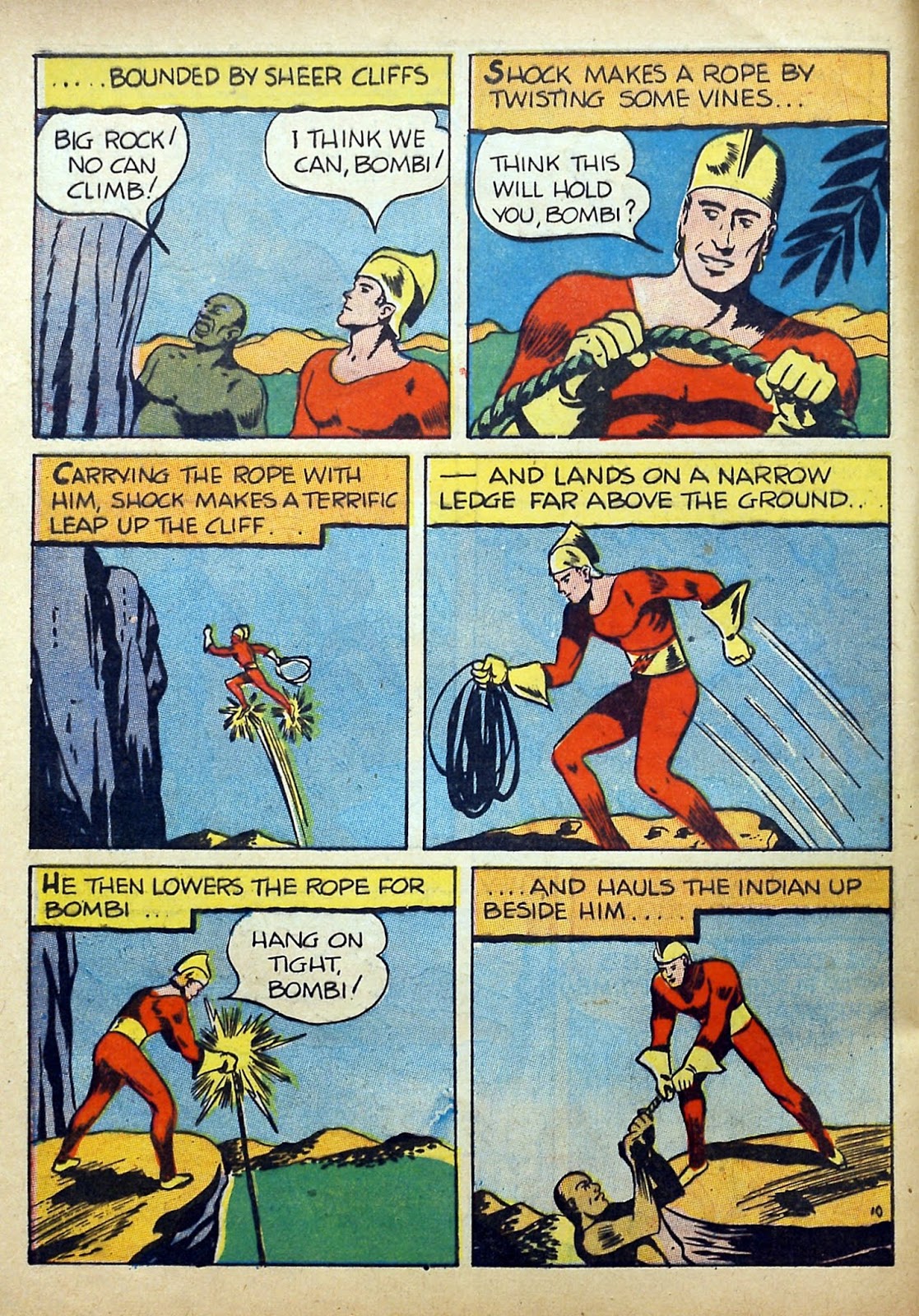
Rope making is a skill that Shock would have to make a skill check for. I would think it's fairly easy work, just time-consuming, so it would require 1 basic skill check per turn. The leap is clearly one of the Leap powers.

It's weird, though, how Shock's hand sparks as he's holding the rope. Is he trying to electrify Bombi while he's climbing...?

And -- at long last -- the payoff! Shock and Bombi finally see dinosaurs!  But that's where we leave off on today, leaving the best parts of the story for tomorrow.

(Scans courtesy of Digital Comic Museum.)


Monday, January 16, 2017

Smash Comics #4 - pt. 3

I'm a fan of John Law the Scientective, so I might be biased in thinking there's a lot of good RPG fodder here. But, hey, it's my blog, right?

Here's a good diagram of how a falling weight trap is triggered.


Every time I think I have this nailed down, that vehicular combat must be handled with a cumulative chance of complications, a page like this happens that makes me think that vehicles should have hit points and suffer attrition just like human combatants. I don't know...maybe it'll wind up a combination of both?


John may be a scientist, but when it comes to fixing things it still takes 10 minutes (1 exploration turn) to fix a broken radio.


Okay, I was all on board with this trap, and the dry ice is a clever touch -- but is 50 lbs. of weight really enough to kill someone? I guess the short answer is, if it's in a deathtrap, it always can. Normally, though, 50 lbs. of force would only do 1-2 points of damage in Hideouts & Hoodlums. Dropped from a height of 10', it would do 1-2 + 1-6 points of damage and could potentially kill. But the ceiling doesn't look that high...?


This is Wings Wendall of the Military Intelligence. Here,  we see his plane get battered by the storm until it runs out of hit points (maybe?). On the mountainside, he meets either a planned encounter or a random encounter of 3-5 wolves. We also see him run out of ammo pretty quickly.


Oh look, it's another one of those rayguns that shoots planes out of the sky! But why would ultra-sonics be particularly useful for that...? Oh well -- remember, the science behind a raygun is only flavor text!

There are no details on what the pilots were drugged with and what exactly the drugs did to them. They seem docile...perhaps like they had the effects of a Charm Person spell on them.

(Scans courtesy of Digital Comic Museum)


Friday, October 7, 2016

Mystery Men Comics #2 - pt. 3

This is from Hemlock Shomes and Dr. Potsam. Although a humor strip, the dressing in this castle -- bones on the floor, shields and crossed swords on the walls -- would work equally well in many hideouts. Also, I'm likely to add a new mobster to Hideouts & Hoodlums, the haunt. It's a harmless poltergeist most of the time, but if it can inhabit a free-standing suit of armor it becomes dangerous.

This is from The Waco Kid. I've heard of guard dogs barking when intruders approach, but guard horses who whinny...?


An example of a gun running empty (ammunition should not be limitless in the game), an example of a chair being more effective than a gun in stopping a fight, and an example of bad guy loot being concealed rather than left out in the open to be claimed.


This is from Inspector Bancroft, Ace Investigator of Scotland Yard, and another example of how you don't need a big bribe to get people to do things that could get them in a lot of trouble. Instead, you just need a good encounter reaction check. Now, if the inspector did have a poor encounter reaction check, he could have produced a much bigger bribe to try to get a bonus. The Editor will have to wing those numbers, based on the circumstances (and how much he wants to milk his players!).


The Inspector likes to keep his nails well-groomed. He also, probably, kept his nail file from being confiscated with a save vs. plot. He "painstakingly" toils at the lock, suggesting that it takes multiple tries. Since he has probably not been in this brig for a full day, I would guess that his Editor is letting him have a fresh try once every exploration turn (10 minutes).


This is the Blue Beetle's second outfit in just his second appearance, and the first to appear to be chainmail armor. Chainmail is treated as a trophy item in H&H, just because it wouldn't have been widely available for sale.

I don't plan to include any game mechanic for ducking and making your opponent hit another opponent behind you -- that seems like a giveaway from the Editor to me.

Long-time followers of H&H will remember when I had to read a whole lot of Blue Beetle for his write-up in Supplement IV and how much I disliked his stories then. I'm not liking them anymore this time around. I find it particularly hard to take him seriously in that last panel, where he's doing the bunny hop to the window.


Blue Beetle is still a mysteryman here, so he burns a stunt to leap into that moving car, but I would not let the stunt also absorb the falling damage from that height. So Blue Beetle -- still a 1st-level mysteryman at this point -- just took 2-12 points of falling damage. His Editor must have rolled snake eyes!


This is Captain Denny Scott of the Bengal Lancers (another long title!). Usually, "bandit" is a racist term for Mexican outlaws in the comics, but we've also seen nomadic warriors in the Middle East called bandits. Here, we get "bandit" being used as synonymous with "slaver" in India.

(Scans courtesy of Comic Book Plus)


Monday, July 18, 2016

Adventure Comics #39

Barry O'Neill begins having post-Fang Gow adventures, though Count Guniff seems to be cut from the same mold. Indeed, when Guniff traps O'Neill and LeGrand in a water trap, Barry would have been within his rights to go "What, again?"

Two things worth pointing out from this story: one, it is one of the first time in comic books where the hero runs out of bullets; and, two, Guniff's second death trap for O'Neill and LeGrand is a much simpler affair -- he douses them with gasoline and is going to brings a match towards them. That's a pretty serious death trap -- serious enough that I'd probably have it do 1-10 points of damage per minute to heroes until they can somehow extinguish themselves (like a save vs. science to smother the flames by stop, drop, and rolling).

Cotton Carver continues exploring his Don Dixon-like lost world environment. One thing to notice is that the hideout/dungeon Cotton is exploring is taking him down quite a few levels, by stairs and slides, but his encounters are not getting significantly more challenging. He gets to a dead end where he cannot proceed without having a special stone with him that fits into an indentation in the wall -- a classic dungeon trick.

Cotton fights a half-cat, half-man called a Watcher. Watchers must be pretty tough; this thing takes multiple arrow hits without going down, and is probably at least 3 Hit Dice. They're also Lawful because, if you defeat one and leave it alive, it agrees to repay the life-debt by serving you (or maybe Cotton just had cat treats in his pocket).

The animated statue Cotton meets seems straight out of Dungeons & Dragons. I wonder if it's a living statue, a golem, or if I'm going to be disappointed next issue by it getting explained away as ventriloquism...

In Federal Men, we learn more about how reefer works in the comic book world. It's "the drug that causes the smoker to lose all moral restraint". So, if you smoke marijuana and fail a save vs. science, you become okay with killing others (just like most of my players) and don't have to save vs. plot before you can take a life.

Jack Woods (fresh over from More Fun Comics) faces a bandit and an unusual dilemma -- a victim who isn't glad he was saved. Soon he's confronted with another dilemma much like one I recently used in my Monday night campaign. The Hero is hired to deliver something under suspicious circumstances. Does the Hero do the job and go home, investigate the sender, or investigate the receiver? It's a nice scenario because the Hero is free to choose and shouldn't be railroaded into investigating one before the other.

Steve Malone finds a cuff link. This is important because a cuff link is never mentioned in a story unless it's a clue.  If your Editor so much as says "cuff", you'd better be ready to take notes.

Steve does a lot of searching. He finds the first cuff link searching by a gong (not where you'd normally expect to find one), but finds the second one searching a bedroom where you'd expect to find one (maybe at a +1 bonus then?). There is a secret compartment hidden in a model castle and, unless the Hero has reason to suspect it's there, the chance of finding it is the same as a secret door.

Tom Brent is sailing down a jungle river, seeing no natives, but they see him and track his boat's movement. Which might not bear mentioning, except that there seems to be a lot of natives and they evade being noticed for quite some time. Maybe natives need to have a better (3 in 6?) chance of surprise?

The Skip Schuyler story has him pitching for the Yankees during a special game for charity. Which might not bear mentioning, except that it's so rare for a real baseball team to be named, and real players (Lou Gehrig and Joe DiMaggio) cameo. Of course, in your home campaigns, whether you go with real historical figures, characters obviously based on real historical figures (with similar names, like Jim DiMaggia?), or entirely fictional characters is entirely up to you.

In Anchors Aweigh, because the Editor clearly doesn't have a new plot for them lined up, Don and Red decide to go hunt up some experience points, literally, by hunting crocodiles off the Panama Canal. They meet a wandering encounter while hunting who turns out to be a mad engineer who makes bombs (I can't decide if that qualifies him to be a mad scientist (Book II), a madman (Supplement V), or even an anarchist (Supplement I). Once the encounter has been rolled up, the Editor has to think up an excuse for the engineer to be there, so he concocts a plot on the spot for foreign powers to have hired him to blow up the Canal.

(Summaries read at DC Wikia)


Friday, April 1, 2016

Adventure Comics #34

Fang Gow purchases a mind control drug in this installment of Barry O'Neill. The drug has to be injected (at least in this form). Worth discussing here is the nature of mind control and what it can and cannot force someone to do. Characters in stories with their minds controlled, even supporting cast, often shake off the effects at the last moment for maximum dramatic effect. In this case, it is notable that Inspector Le Grand is not able to shake off the effect. Evidence of saving throws?

In Tom Brent, the First Mate gets shot when Tom dodges a bullet -- proof both of the save vs. missiles rule, and the dangers of shooting into a melee. The story also involves a shipboard mutiny...Hideouts & Hoodlums briefly touches on Loyalty as a game mechanic, but it is basically just treated as Morale under another name. Loyalty might need to be expanded on in 2nd edition, particularly in terms of how it could cause mutinies among supporting cast members.

Steve Carson of Federal Men goes on a car chase. I've talked before about using hit points and combat for ending car chases, but there needs to be a competing mechanic of evasion at work too. Can Steve make an evasion roll before his opponents shoot up his car? I don't want evasion to just be a single roll, though, because that's boring. Maybe evasion should work in degrees, so the first successful roll moves you from short range to medium, the next roll could move you from medium to long range - or back to short range if you bungle the roll. It needs more thought.

Dale Daring and her boyfriend encounter a trap that consists of a pit/crevice. The unusual thing here is that the pit is not covered or concealed in any way, but the Heroes may fall into the pit because the uneven floor around it is not safe to walk on.

Tod Hunter faces cannibals. I had once considered treating cannibals as its own mobster type, but decided to lump them under Natives instead. There is also an 8' gorilla in this story. In the normal/large/huge/giant categories for animal-mobsters, would an 8' gorilla be large or huge? I would think it would fall somewhere in between, but would probably side conservatively with making it a "large ape", so that "giant ape" could still be something more King Kong-sized.  Also, we know from this story that apes should get a crushing hug attack and a bite attack.

In The Gold Dragon -- we finally see the gold dragon. It's been a long set-up for this (this is the 29th episode), so much so that this is not our first dragon in comics at this point, or even our second. It is the first dragon to fit the dragon types found in H&H, though the gold dragon has, luckily, always been found in the game since Book II: Mobsters & Trophies.

Anchors Aweigh reminded me of several issues this month. One is keeping track of ammo -- because being on your last bullet should be a suspenseful moment for every Fighter relying on guns. Two is fatigue from running. H&H has a fatigue rule that is more combat-oriented; it needs to apply to running as well. Three is when Marshall's last shot fails to frighten off the natives because of their large numbers -- morale needs to be modified so that number encountered affects morale saves.

(Summaries from DC Wikia)


Saturday, January 30, 2016

New Adventure Comics #31 - part 1

Barry O'Neill takes it slow while moving through hideouts. He tests the walls, pulls on anything suspicious, like rings set in walls -- and finds secret doors that way!

In the first room behind the secret door, Barry finds two cobras. Luckily, even though Barry came disguised, he still has a concealed flashlight and weapon.

In the room is a note for Barry from his nemesis, Fang Gow. An Editor can always do this too, retroactively placing notes wherever the Heroes are, as if the nemesis anticipated them. Just be careful not to go too far with this, if the Heroes went somewhere really unexpected.

The tunnel after the cobra room is trapped -- it swiftly fills with water. I assume the secret door Barry used to get in can't be opened from this side. I'll have to wait until next month to find out how he gets out!

Tom Brent, in his adventure, is captured, but his captors forget to search him and leave a weapon on him. This same situation happened in one of my Hideouts & Hoodlums campaigns; in that case, the player asked for a chance of having a weapon left unfound on his person, so I gave him a save vs. plot to make that happen.

Tom makes the smart move of capturing the leader and making all his henchmen stand down, rather than fight his way through everyone. It's the safer move, anyway. I'm not sure I'd allow full experience awards for the henchmen for it, even though he's technically defeated them this way.

Players often want to get to where they need to go as early as possible. Tell them that they have a midnight rendezvous and they'll show up at 6 pm and start staking out the place. The same holds true for Steve Carson of Federal Men, who thinks the 4-hour car ride from Washington, D.C. to New York City is too long and flies there instead.  Knowing this, the Editor can plan more scenarios that require a time crunch.

On the other hand, if the scenario has high stakes, like a kidnapped child who will be killed if the Heroes do not find him in time, it's best to keep from setting a definite deadline, so the Heroes can always show up at the last minute and save him.

In Dale Daring, the Heroes shockingly take a moment to check their guns to see if they still have any ammo left. One is empty, but the other is okay.

I have suggested several "fixes" over the years for good ways to more easily keep track of remaining ammo during combat. One of them was to roll randomly, 1d6, to see how many turns you can shoot before running out of bullets. That seems to be what happened here, in Dale Daring, given the disparity between their ammo situations.

In Cal n' Alec, Cal wants Alec to go ahead because Cal thinks he sees quicksand and Alec doesn't. Sounds like spotting dangerous terrain needs to be a random chance, just like finding secret doors.

Cal n' Alec is a gag strip, so I don't know how seriously to take this, but it takes Cal five hours to dig a 25' deep pit.

As Captain Desmo's India adventure continues, a bounty is set for him at 20 gold pieces. Which is odd because, by 1938, India already was using the silver Rupee as its unit of currency.

Desmo wins two battles against the thieves by failed morale saves -- once after mowing down enough of them with a machine gun, and then later by mowing down their leader with a machine gun.

(This issue can be read at Comic Book Archives)


Tuesday, August 25, 2015

New Adventure Comics #21

I'm still playing catch-up on this title, so this is actually the issue of New Adventure Comics from November 1937 and, hopefully, I'll be able to review December 1937 next.

Captain Jim of the Texas Rangers shares a little history lesson for you on how common it used to be for men to write their names in their hats. A good clue if your Heroes happen to find a hat at a crime scene!


Note that the cowboy here is surprised, but his horse isn't. Normally, the Editor only rolls surprise once for each side, but if a Supporting Cast Member (particularly an animal SCM) has extra-keen senses, then that could be reflected in a second surprise roll for that side.


In the Golden Dragon serial, Reilly is frustrated that he can't find a secret door. Actually, he knows the secret door is there -- he just saw some mobsters open and shut it on the previous page. What he can't find is the way to open the secret door. Of course, if there is no opening mechanism on this side, no number of search rolls will find it.

Instead, Reilly could choose to try non-Superhero wrecking, but a stone door would have a very good saving throw and he is probably wary of attracting wandering mobsters for however long that could take.


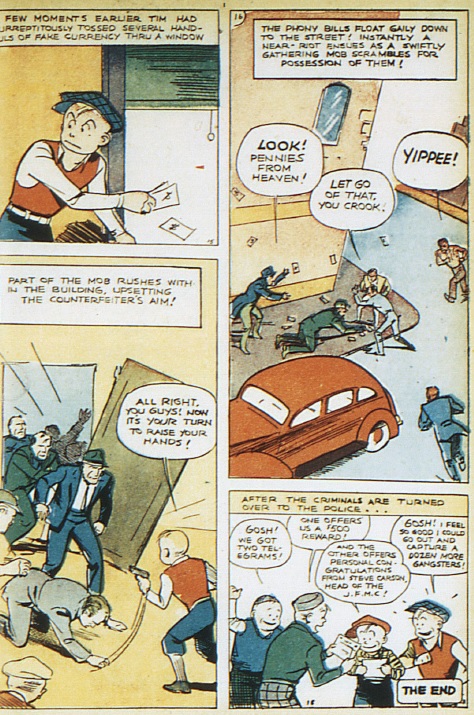
This month's Federal Men is again devoted to the Junior Federal Men Club (J.F.M.C.). This installment makes crime-fighting look like easy employment; no sooner have the police taken their prisoners then Steve Carson of Federal Men telegrams them congratulations, and another telegram promises them a $500 reward. This system could level up Heroes fast!


There are arguments for and against keeping track of ammo in a H&H gunfight.  A quick argument against: mundane "bean counting" runs counter to the fantasy elements of comic book action; a quick argument for: Cal n' Alec, counting bullets to know when their opponent's gun is empty.


Nadir has a magic crystal ball with an interesting limitation -- it can only be used between 3 am and dawn!  Time restrictions, race restrictions (like, only a merman can operate it), and items that can only be activated by destroying other items (like draining the magic out of lesser magic items) are all more inventive ways to keep a powerful trophy item from being too powerful, without saying it can only be used once per day, or it only has x number of charges.


What's this?  Nadir, Master of Magic, using guns! That's a big no-no for Magic-Users. But he's not really using them, is he? He's just holding them and, perhaps, planned to bluff his way through an encounter holding them, but wouldn't be able to hit the broad side of a barn with them.

I had a similar situation in an earlier H&H campaign, where a player wanted his Magic-User to carry a bow and arrows. He accepted that he would have no chance to hit with them in combat; he just wanted them for how he envisioned his character.


Another magic item, and this one's a new one -- Nadir apparently has a Ring of Alertness, that keeps him from being surprised.


Sandor encounters a lion here who treats him as if he already knew him. It's possible, actually, that Sandor had encountered this lion before and recruited it as a SCM, either behind the scenes or during some earlier installment I've forgotten or never got to read. An Editor can also, at his discretion, allow a player to make up SCMs from his backstory. The Editor must be careful, though, to consider the implications and how the Hero might benefit. Having a lion for a friend could be an unfair advantage over the other Heroes.

(Scans courtesy of Comic Book Archives)