Showing posts with label firearms. Show all posts

Monday, February 22, 2021

Master Comics #1 - pt. 3

 This is still Frontier Marshal, and we're being told that every type of criminal -- every mobstertype -- is heading towards Big Savage. Bandits, we've had stats for those in Hideouts & Hoodlums since ...well, not Day 1, but close. Do we need stats for rustlers and fugitives from justice, at least for some future cowboy genre-only supplement (an idea I've toyed with for years now...)? 

I don't know...rustlers shouldn't be especially good at anything other than stealing livestock. Well...a cowboy's horse is livestock. What if a rustler could fight for control of a cowboy's steed, in some variation of the contest of wills mechanic for magic-users? 


Fugitives aren't especially good at anything other than escaping, so...maybe fugitives should have a higher chance of evasion? Maybe a higher skill chance at hiding in shadows?

Mr. Clue is a story I thought I was going to enjoy, about a detective who focuses on solving mysteries solely from the clues left behind at the scene. But this story takes it to ridiculous extremes; by this page, Mr. Clue has been attacked for times -- shot at, flowerpot dropped at him (well....maybe that one is more like a point of damage missed), a rockslide targeting his car as he drives past, and now a safe dropped at him. Mr. Clue could easily stop following his clue and just go after the person dropping things at him (how hard could it be to find someone who dropped a safe?).

Also, I'm going to spare you from the following page, where Mr. Clue reveals how he solved it from a clue that shouldn't have really proven anything.


Streak Sloom? Oh...Streak Sloan! The new comic book feature with the worst title font ever teaches us that whale oil was still extremely valuable in 1940, and that one ship could carry a half-million dollars' worth of it.


The island hideout idea isn't new, or that Sloom -- sorry, Sloan simply has to patrol randomly until he finds it. What's unusual here is that the main villain is the first encounter inside the hideout. It reminds me of the classic D&D module, G3 Hall of the Fire Giant King, where the king's hall is up front in the palace and, if you managed to kill him, the whole rest of the fire giants are thrown into chaos. Like anyone running G3, a lot of reinforcements should, and do, show up quickly here. 


It's disappointing that a super-submarine just means that it has extra storage capacity for transporting whale oil and salmon...though, I suppose if you stocked it with more soldiers, maybe you'd be able to fight back against a coast guard patrol. 

I think the best thing about this story is Black Jack Bannon. He wears the furs of a back woodsman, but thinks of himself as classy, so he smokes a cigarette in a long holder. And that's one intense, smoldering stare in panel 5!


Can you cause a gun to jam just by hitting it? We've seen plenty of evidence of guns being knocked out of people's hands by thrown objects of every size, shape, and weight, but this could be a first for forced jamming. Unless the gun jam is just a coincidence afterwards? 

The realistic-looking telegram at the end is a nice touch.


El Carim is a bit of a trickster. While Jane Grey comes to him in tears about her missing father, El Carim slips some paper into a toaster and then casts Phantasmal Image on his monocle. Or can he really invent magic items? Whatever mechanic you decide to use for scientists, you need to decide if you're going to give that to magic-users too and if you think they need the extra ability.


El Carim casts Protection from Missiles and Rope Trick here. Or perhaps the monocle is a magic item, a Monocle of Bullet Attraction?


By this page I think it's clear that El Carim doesn't actually carry magic items, but these items are flavor text for his spells, like Telekinesis and Hold Person. 

It's so refreshing to see a magic-user getting defeated by a pair of mobsters, just like a normal low-level magic-user would be.

(Scans courtesy of Digital Comic Museum.) 


Saturday, January 23, 2021

Detective Comics #37 - pt. 3

Speed Saunders starts out in odd territory; Speed has been busted down to a beat cop in the suburbs since we last saw him, after being framed as a drunk. This is extra odd because Speed was never a police officer before! He also has a new friend, Patsy Ross. Speed has sunk so low that he doesn't see a way out of this without Patsy's encouragement, becoming his partner as he takes down enough mobsters to get his old job back. It's a really big departure for the feature, practically a reboot. 

You can do that with your Hideouts & Hoodlums heroes too, if everyone agrees. You also have to agree if you want to restart from zero experience points or from some point higher. 

Steve Malone, District Attorney gets involved when a woman is kidnapped for $50,000 ransom. The kidnappers aren't very experienced at this; they write out the random letter by hand. One of the kidnappers uses the phrase "No dope" to mean, "no kidding." 

There is a huge plot hole in the story where Steve plans to find the kidnappers by searching the woods he thinks they might be hiding by plane at night, and parachutes down by the first light he sees in that area. It turns out to be the kidnappers' hideout on the first try, but there is no reason why that should be the case; there could be any number of people with cabins in the woods, and they would naturally have their lights on if it's night.

This story turns really dark; not only do the kidnappers plan to kill the woman once they get the money, but it seems like one of them plans to rape her first before Steve shows up. I've never seen that in a golden age story before, and I don't like it.

Steve conveniently lost his gun when he landed (Oh, I haven't even brought up how low his chances of landing safely in the woods at night should have been!), but that's okay because these are low-hit die hoodlums and guns aren't that effective in their hands. Oops, Steve almost loses anyway, and the kidnapped young lady has to save him by setting the building on fire (it distracts the hoodlums, naturally!). 

Cliff Crosby is a reporter who gets a scoop over the phone - a moll/vamp wants to rat out her partner for the kidnapping of a judge (lots of these anthologies would have theme issues where the stories are all similar). The moll jabs paper into the phone to keep the connection open -- because phones used to work like that. Cliff, instead of being worried for her safety when he hears her partner confront her, brags about what a scoop this is going to be for him. Smooth, Cliff...

Cliff hears the mobsters threaten his moll on the phone, and he's still just threatening her when he shows up after...driving across town? Finding a parking space in the city? 

The mobsters are slavers! Cliff tricks them by saying he needs to call his friend at the office and tell him there was no story here (makes sense), but then they don't notice him tapping out Morse code (harder to believe). 

We know the slave ship is off the Florida coast, but never get a clue where the story started. On board the slave ship, a slaver tries to whip Cliff, and he grabs the whip. I would allow that with a successful attack roll, but the weapon automatically does damage to the grabber. After escaping Cliff throws a knife at a slaver hard enough that his hand is pinned to a metal wall. Had it been a wooden wall, I could see this happening after rolling to attack both the slaver and the wall, or rolling a certain number over what he needs to hit the slaver, but to pierce a metal wall is going to require a wrecking things roll as well.

Amongst the slavers are thugs. The thugs are better armed, with handguns and rifles. One man on the ship has a machine gun, but it's not clear if he's a slaver or a thug.

This issue continues to be really dark. When the Coast Guard shows up, most of the slaves on the ship are dumped overboard, while still chained, and apparently drown. The gangster heading the slavers captured the Coast Guard when he recovers the machine gun, Cliff is taken prisoner, and thrown overboard to a waiting "giant" octopus (maybe a large octopus?). Because Cliff still has a knife on him, he's able to kill the octopus. In a really weird moment, Cliff puts the dead octopus on his head as a disguise so he can sneak on board the ship (warning: this is a racist moment; he scares the "colored lad" with his disguise). 

In the Slam Bradley story, Slam inherits a racehorse, and every cliche about horse racing stories ensues. I'm not going to take the time to cataloging them. The Slam stories have been so lame since Joe Shuster left that I can barely stand to read them.

(Read at readcomiconline.to)


Tuesday, December 1, 2020

Slam-Bang Comics #1 - pt. 3

Hello! We're back, still looking at the Lucky Lawton feature. We could talk about the oddly rectangular word balloons (the very next page goes back to rounded corners), or the terrible coloring job on this page, but I'm going to focus on the "no guns" law, which was actually quite common in the "Old West," and is something we badly need more of today. Personally, I would like to run a "no guns" H&H campaign, but I know that wouldn't emulate the comics well.


If you've followed this blog long enough, you've probably seen plenty of examples where the artist just seems to be guessing what an animal looks like without using a reference. The artist here is Hal Sharp, and I have a feeling Hal owned a dog; Pal is in real dog poses every time we see him.

Lucky does the smart thing, circling the perimeter instead of barging right into the bank. 

Also note how not going solo gives Lucky twice the chance to detect the activity in the bank that he would have had walking along alone.


There are two ways to achieve Lucky's noiselessness. One, he can make a skill check to move silently. The other is that he trust to his surprise roll and, if successful, means he must have been moving silently. Since chance of surprise is normally 2 in 6, it seems like that would be easier for most Heroes (unless Lucky is a mysteryman using a stunt, but I doubt it). 

Combat in the dark adds a greater level of challenge, what with the -4 penalties to hit. Just by not flipping the lights on, every unarmored combatant is now effectively at AC 5. Now, from the panel art it appears that there is plenty of light coming in through those front windows, making the scene only dimly lit, but this could just be artistic license so we can see more than five black panels with word balloons in them.

And yet, in this scene, the bandits are silhouetted in front of the windows, so it wasn't really that dark after all? And the remaining band sees Lucky in the darkness now? To emulate this scene, we need a new mechanic for eyes adjusting to darkness after a certain, or maybe random, number of combat turns. 

Although the rest of this story is seemingly set in the Old West, the remaining bandit's hat looks suspiciously modern.

The bad coloring job on the lower half of this page might be fooling me, but it appears that the rancher is wearing his bandana up over his mouth. I only mention it because I see so many people wearing their masks wrong like that these days...


There aren't game mechanics on display here, but I like how Lee is a scientist/explorer. Both were classes in Hideouts & Hoodlums 1st edition, and while both classes did get playtested in my campaigns, no one ever thought to combine those two.

My initial reaction was that having the slavers be Arabs was racist, but while there have been many white slavers through history, there was a strong tradition of slavery in the Middle East, with several countries not outlawing it until 1970. Also in the writer's favor, Ali and Hassan are real Arabic names, and not gibberish names meant to sound Arabic (I know, some golden age writers set the bar really low!).

Wow, we're in pure fantasy territory at this point. First, there's no way a plane explodes, and someone sitting in that plane falls from that wreckage completely unharmed. This should be a save for half damage situation at best. 

Then, there's no way someone's coat would be big enough to create enough wind drag necessary to cushion his fall, so there's more damage Lee should have taken by now. I think we're looking at the tune of 55d6 damage at this point - and that's assuming the plane was at a near dangerously low altitude for flying.

As unlikely it is that all the spear attacks Lee left himself open to while charging the pygmies missed, it is even more impossible for him, game mechanically, to push the leader onto a spear, unless the Editor was house ruling a fumble mechanic. More likely, this is just a freebie from the Editor.
Neutralizing poison is really easy in Lee's world. All you have to do is stick someone with a knife and the poison leaks right out of you! If I was willing to implement this as a new rule (and I'm not), for every point of damage you do to the wound, you would give the recipient a new saving throw. 


The pygmies are very patient in indulging Lee's rampant passive-aggressive racism. "Uh...ever heard of donkeys? The domestication of donkeys started in Africa. And we know what iron is, iron smelting and forging technologies were discovered in Nigeria as early as the 6th century BC. Bricks too, since about 7,000 BC. And just what are you whittling? A giant banjo?"


I am so torn on this page. On one hand, I think it's great that, for once, a lion shows up in a story and the Hero wants to capture it alive instead of stabbing it to death, or snapping its jaws, or shooting it. But that he wants it so he can perform experiments on its brain doesn't sit well with me, even though I get that the author is trying to offer a scientific explanation for how the jungle Hero is able to talk to animals. 

(Scans courtesy of Digital Comic Museum.)


Friday, May 1, 2020

Mystery Men Comics #8 - pt. 1

After a long spell we check in Fox Comics again and the first feature here is Blue Beetle.

Blue Beetle does what most of my players have always done, try to get to the location before the bad guys. But here the location works against him; with the wide open spaces, the mobsters are too far apart and the second one has an easy free shot at range.

Now, one bullet shouldn't be enough to stop BB; it usually isn't in comics. I have been wondering recently, though, if bullets should do exploding damage to account for instances like this...but on the other hand, firearms are already really deadly in Hideouts & Hoodlums and I hesitate to make them more so.
BB has a temporary Supporting Cast Member in this story; you won't see anymore of Tom.

BB has to take off his heavy mail costume; for the first time a comic book acknowledges that encumbrance can hamper skill checks.

BB must be using a power to keep up with a motorboat, that has a head start, while swimming. I hesitate to create a new swimming-related power, though, when activating Race the Train would accomplish this same thing.
It seems to me that the first mob to use an autogyro to escape from robberies is really smart, but after that people would always be on the lookout for it. The real mistake of this mob is to stay in the air so long that a plane that hadn't even taken off yet when they left the warehouse has time to catch them.
So, in addition to the autogyro, these bank robbers can afford three fighter planes. This reminds me of a lot of Silver Age stories where the super-gizmos the supervillains employ must have been so expensive that there's no way they'll come out ahead from robbing a bank. But that's not comic book logic for you!

It looks like Wing performs two Immelmann turns to get the height advantage on his pursuers, giving him a +1 bonus to hit after performing an expert skill check. As difficult as this seems to be for just a +1, it's more likely that aviators should be able to perform stunts as a free action before attacking.

Catching fire needs to be a common complication for dogfighting.
Panels 3-5 are what a fighting withdrawal looks like after a gunner fails his morale check aboard a plane.

There is currently no game mechanic for whether chutes open.
The atmosphere grows thinner, intensifying the sun's rays and causing terrific heat? Sounds like Dick Briefer predicted the ozone layer depletion! This is Rex Dexter of Mars!

What on Earth was it that exploded that took out two skyscrapers?
Ooo, I'm statting these monsters! Sadly, there is no name for these monsters given other than "new horror." The Tauromen that Reyni is referring to are actually human-like aliens controlling the new horrors, but Tauromen is a pretty cool name and I might keep it for these things instead.

They're pretty big floating heads with three long tentacles and Dumbo-like ears. Are they flapping their ears to fly, or levitating? It's not clear what those dots on the end of their tentacles are for, but I'm going to guess they are little mouths for sucking blood. And those big tusks in their mouths mean fierce bite damage. Let's assign them...6 Hit Dice? Blood drain for 1-8 damage per tentacle? Bites for 2-12? Given their scaly hides, I think we can give them an AC of at least 6, maybe 5 because they can use their tentacles as shields too.
Reyni is one great contact; not only does he hand out plot hooks, but he hands out space charts for how to get there, trophy weapons, and paints your ship!

There is no indication of how fast "zooming" is, but unless this trip takes years, "zooming" must involve folding space, warping space, accessing hyperspace, or creating a stargate.
Despite being called living chains, I'm real hesitant to stat them as mobsters; more likely, this is some technological trap, where the chains ensnare as if alive (attacking as a high HD mobster?). They might even be linked to some kind of computer intelligence that can sense enemies.

(Scans courtesy of Comic Book Plus.)

Friday, October 4, 2019

Prize Comics #1 - pt. 4

We're back with Jaxon of the Jungle, just in time to see Jaxon go up against wild pigs! These boars look small enough to be juvenile boars, which makes it even more unseemly when he starts gutting one. There's got to be better ways to earn experience points, Jaxon!

Note how Tarpe doesn't, to her credit, draw blacks as caricatures, though we see plenty of stereotypical behavior, like being superstitious, cowardly, and on a later page, prone to alcoholism.
The constrictor snake is obviously a random encounter. But is the village? Editors who are not working from detailed maps sometimes randomly generate details as significant as village placement, or even just make it all up as they go. However, since this particular village figures into the plot, it seems more likely to have been premeditated.
This page, combined with the last, suggests that fatigue can be relieved by a short nap, or rest.

That poor native guard only wanted to come in and discuss the poems of Lewis Carroll with them, and look how they treat him!
I'm generally opposed to guns in both comic books and RPGs, even though I had to include them in Hideouts & Hoodlums to emulate their consistent usage, and the fact that my players love using them. Something I am okay with guns being used for in-game is holding your enemies at bay, by creating a line of fire that is dangerous for them to cross.

Any attack on a plane can cause a complication, even if it's a flaming spear.

"Scattering" isn't a game mechanic that guns can do, directly. Rather, they failed a morale save because they were being shot at by someone they could not attack back (not a situation covered in the rules, but a common sense reason to give a morale save).
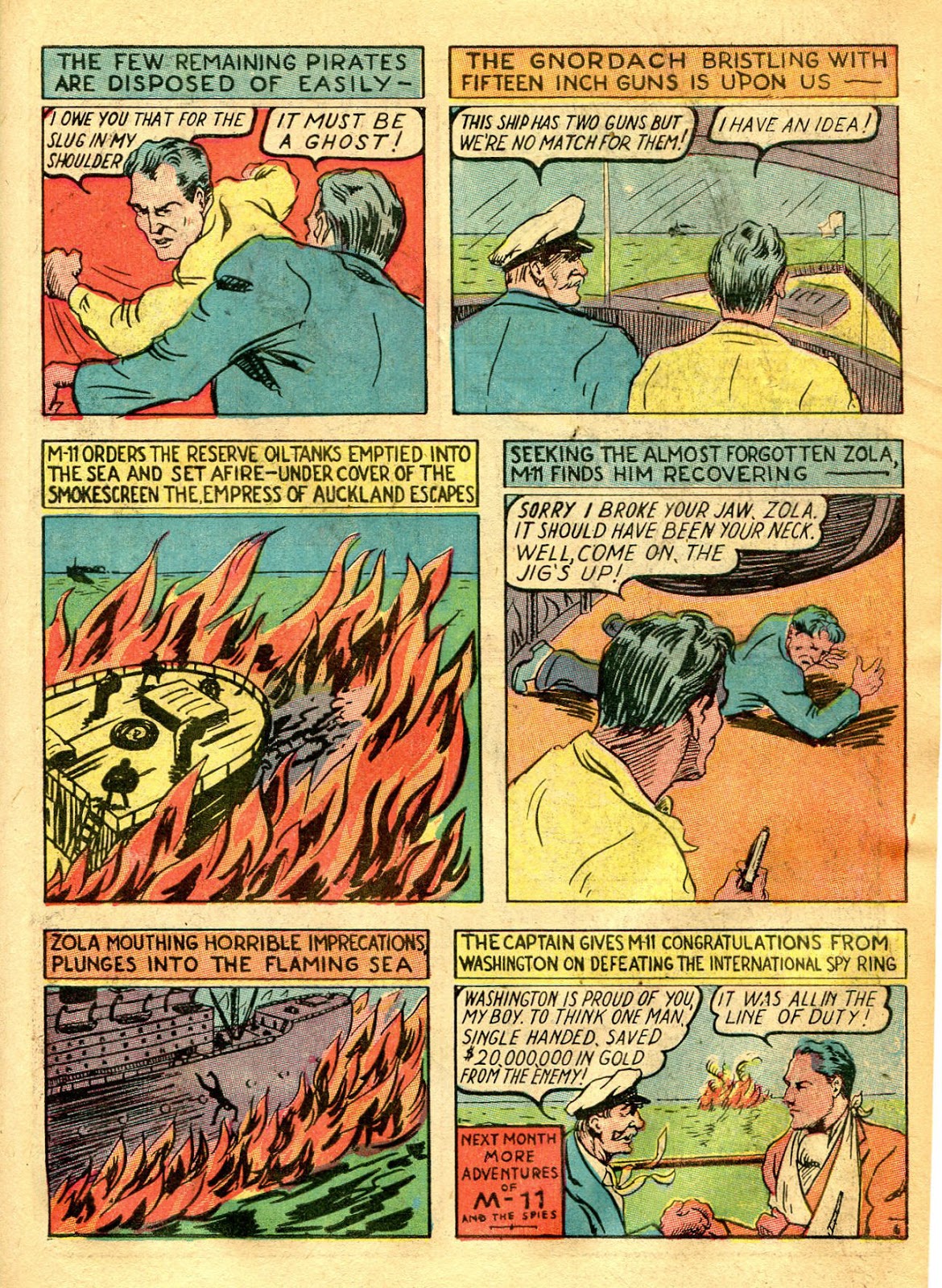
Moving on, we'll join the debut of M-11. This page interests me for several reasons. One, "Empress of Auckland" feels like such a realistic name, I wondered if there really was a ship called this. Not that I found, but I did find a plane called The Empress of Auckland, a Douglas DC-6B, that would later fly, starting in 1961!

And that $200 million in gold is not that unrealistic either, as over 140 tons of gold were transported to the U.S. in the early days of WWII. The unlikely part is it all coming on just one ship.

A villain with no fingernails on one hand is a creepy detail to use in your games!
How do you pull off someone's glove, using game mechanics? I think it would be sleight of hand, practiced as a skill. If you're just forcefully yanking it off without any attempt to go unnoticed, I might call that a basic skill check with a -1 bonus modifier, but if you were trying to pull the glove off so that the wearer doesn't notice, that would be an expert skill check.

I've talked about extenuating circumstances to add saving throws for additional penalties in addition to taking damage (like if you're leaning over a railing), as well as rolling to hit to grab something, before, and won't go into detail about them again this time.
The H&H rules do talk about using fire to create boundaries that are damaging to cross, but this is a different scenario where the fire is being used to create a boundary a vehicle won't cross. And it does make sense, if crossing the line of fire triggers a complication check, which is the way I'm still leaning towards handling damage vs. vehicles.
And the last story we're going to look at today is K the Unknown, a mysteryman in uncommonly orange long underwear.

I share this page because a good tactic for the Editor is to have mobsters doing more than just attack the Heroes; it gives the players more to react to and make decisions about during encounters. Here, K has to stay and fight or head after Terry.
K uses a smart tactic to lure a mobster outside and question him alone, rather than beard them all in their lair and then try and get answers.

Judging by what's on the table on the last panel, we might be dealing with drunken hoodlums here.

(Scans courtesy of Digital Comic Museum.)

Tuesday, September 17, 2019

Keen Detective Funnies #18 - pt. 2

This is still Spark O'Leary, that famous Irish newshawk who doesn't look remotely Irish. In fact, doesn't he look Asian to you? I wonder if he was drawn with the intention of him being Asian, and the publisher decided to paste an Irish name onto him instead, thinking no one would notice or care.

Spark has such an easy time following these clues that it's amazing the feds asked him to pursue this instead of just figuring it out themselves. In fact, there was so much evidence immediately pointing to Kurt that I immediately suspected a red herring; maybe the FBI did too!
---

It's rare to see ordinary mobsters with a really cool trophy weapon, but this unnamed spy has a tear gas gun! I would imagine it has the range and area of effect of a sleep gas gun, but is less effective (temporarily stunning anyone who fails their save vs. poison?).

It's remarkable that as dramatic an escape to a deathtrap as we get on this page is all recapped in panel 4 alone. I'm not sure how you could dodge out of the way fast enough to make someone pushing you fall out of a plane...but it does create a precedent for fumbles being allowed on push attacks!

But panel 5, with him knocking himself out, Scotty in Star Trek V style?
There's no way to emulate that in game rules; I'm not going to make people roll for movement, with a chance of fumbles and hurting themselves. The only way that makes sense is if there was a lot of turbulence on the plane and the Editor required saves vs. science to keep from falling sideways.

Seditious pamphlets is minor loot you can find with certain types of mobsters.

Setting fire to the ship you're standing on is a ballsy move!

Speaking of ballsy playing, I think we all know the real reason Spark wants to find the hideout -- he burnt up all the trophy items on the ship and he needs more loot to level up!

Rigging an entire hideout to blow up is not a recommended tactic, unless you didn't have time to design anything before the next session and you really don't want the players going in there.
---

I'm never sure how much faith to have in these "fact" filler pages, but there's some interesting stuff here, including number of teens arrested in a year (I suppose I could verify that in the FBI's Crime in the U.S. serial, but I'd have to find a depository library to get paper copy of the 1940 issue; I can't find it that early online), where the term "gumshoe" comes from, and which states had no capital punishment circa 1940.

---
C-Man shows the value of questioning, not just one witness at the scene of a crime (and expect the Editor to feed all the information you need through one character -- that's lazy game-mastering!), but up to seven witnesses. Actually, if the Editor assigned a 1 in 6 chance for each witness to have valuable clues, there would be a good statistical chance of getting the information in just 6 witnesses.

---
Cigars with distinctive wrappers, fresh car tracks, footprints, broken twigs, and heel marks are all good examples of clues to use when Heroes are tracking.
Going to jump ahead now to Dudley Dance, a feature about "the greatest crime chaser of all time" and not, as one would expect, a dancer. Here, Dudley tackles -- or rather is tackled by -- one of the earliest werewolves in comics. Or is it another case of a fake werewolf?

---

"Leather hardness of Dance's cheek"? What does the man do to develop such thick cheek calluses that they count as armor? Seems like an Editor that had trouble coming up with believable flavor text on the spot.
Hmm...six shots in rapid succession is possible in Hideouts & Hoodlums, but not for low-level Heroes. I hate giving firearms any advantage, actually, as my personal preference is for two-fisted fighter types, but there is plenty of gun-toting Heroes in these early comic books the H&H game has to emulate.

The story ends with a lot of attempting to explain away the werewolf as something non-supernatural, but it just sounds like he's just describing a tribe of werewolves that live in India to me...and that sounds like a pretty good adventure location for high-level Heroes!


(Scans courtesy of Comic Book Plus.)

Tuesday, July 23, 2019

Adventure Comics #47 - pt. 2

Moving on to Jerry Siegel's Federal Men...so often, it's senators or generals being bumped off in comic books that it's novel when a government employee with a distinctly different job title is going to be killed. This one is particularly novel, because the position of "Commissioner of National Functions" seems entirely fictional. Even the "Eastern Exposition" is fake, which is weird because it almost surely refers to the New York World's Fair, and DC has already had plenty of stories referring to the New York World's Fair by name.

The plot is a little strange; Steve Carson is knocked out and left in a house with a dying man. Normally, in a story, this is to frame someone for the murder, but the story never goes there.

===

Another wrinkle is that the murderer isn't a spy, but an anarchist (which have been statted for the game since Supplement I).

At one point, Steve appears to get two completely different actions, taking a warning shot to alert the commissioner and then attacking the murderer/anarchist before the m/a gets to act. Normally, if the bad guy knows you're there, you don't get a surprise attack. I believe, even though the m/a clearly knows Steve is there, Steve still gets a surprise action because the warning shot is so unexpected. Then Steve wins initiative on his first turn of regular combat.

===

Socko Strong is in Hollywood starring in a boxing movie. The director is Solly Lloyd and the rival star is Monte Swift, neither of which sounds familiar and are likely not stand-ins for any particular real life people. Monte is able to bribe someone on set to put Socko in danger for just $100. Later, Solly throws a party at his castle -- that's right, he's one of those eccentric rich people who have medieval castles built for them in the U.S., and he's even had deathtraps built into it, purely for his own amusement. Monte traps Socko in a pit with a locked cover that he can fill up with water.

Captain Desmo's enemy, Vasili Gerke, has taken a precaution that few game referees use because in most uses it would seem anticlimactic, but he has guards stationed outside his hideout, tasked with shooting at anyone escaping. One exit has a single sniper watching it, while another exit has a machine gun nest stationed over it.

Having escaped via swimming, and his sidekick Gabby having taken on too much water, Desmo has to perform artificial respiration, which in 1940 still means tipping someone face down and holding them by the ribs.

Desmo uses some unusual dialogue, once saying "We're one rifle to the good," which is either poorly written dialogue or maybe an archaic way of saying "We're one rifle better off than we were." He also uses the phrase "bite the dust," being the first time I've encountered this in a comic book.

Desmo can be a jerk, blaming the two guards that he knocks off a cliff to their deaths for "getting so close to the edge."

===

Does using a gun grant a bonus to a wrecking things roll? Perhaps it should, to justify why Heroes would go the trouble when the noise can so clearly alert the entire hideout (as it does in this story).

Steve Conrad is back after a long break. Steve Conrad's adventure is a bit risque, with him trying to rescue a woman who is grabbed off the street and dragged into a brothel. How do Steve and his sidekick Chang know it's a brothel from outside...? Steve, like a player who's being too cautious for his Editor's plot hooks to work, backs down when the brothel's side entrance is guarded by six yellow peril hoodlums. Only when he reads later in the paper that the girl is the police commissioner's daughter is he shamed into investigating further.

Maybe it's understandable that Steve chickened out earlier; when he comes back, he is bonked over the head and captured immediately. The Editor scales down the scenario to make it less challenging, but goes too far; after Chang rescues Steve, they find all the bad guys are on opium highs and easily tied up.


(Read at readcomiconline.to.)


Friday, July 19, 2019

Adventure Comics #47 - pt. 1

It's been nine months since I've last covered the early adventures of the Sandman! This is what happens when I cover so many titles, in such detail...

This story opens with a newspaper article detailing a murder the Sandman is about to investigate. The article is signed by Ogden Whitney, who's been drawing this feature since last issue. Ogden is good, but Bert Christman and Craig Flessel were just that much better...

I'm not surprised that Wesley Dodds was friends with the dead man, as Wesley has one of the richest backstories of early comic book heroes and knows practically everyone. Gardner Fox is starting to tinker with that backstory, though, changing Dodds from a billionaire to a millionaire. And this is the issue where he gives Wesley is his first partner. Being big on strong, equal female partners, it is hardly surprise that Dian Ware is an expert safecracker and resourceful enough to have learned or deduced the Sandman's secret identity (though it's never revealed how). Known as "The Lady in Evening Clothes," Dian even sounds like a mysteryman (or a Victorian one).

The murder weapon is a Corson repeater. I can't find any evidence that's a real thing, but I'm fine with that. I was way too specific about firearms in 1st edition Hideouts & Hoodlums and pulled back from that in 2nd ed.

Sandman still shows some willingness to act in a Chaotic manner, gassing the District Attorney when he won't cooperate and give the evidence back that Sandman already gave to him.

In a firefight with two mobsters armed with sub-machine guns, we see simultaneous initiative, with Sandman gassing them just as one of them shoots Sandman in the shoulder. We also see that Sandman has no control over who is knocked out within the area of effect of the gas, as Dian goes down too. Sandman is weakened by his injury, gradually losing consciousness, which is not a condition covered by the rules, and it takes him a week to recover (players can thank me ignoring this in the rules later!).

Trigger, the killer, is held on $1,000 bond, but for breaking and entering (the police haven't nailed him on murder yet). 

When Sandman confronts Black Bill, Trigger's boss, he mentions Bill isn't as fast as he used to be (more of that backstory I enjoy so much).

Sandman is still not widely recognized on sight; District Attorney Belmont's butler doesn't recognize Sandman by costume until Dian introduces him.

Belmont has three detectives on guard duty in his house, all armed with sub-machine guns. Surely they are not there full-time, but I don't know how Belmont anticipated Sandman coming.

In a nice twist, Dian turns out to be D.A. Belmont's daughter. Unfortunately, as soon as this happens she is "domesticated" and never shows her safecracking skills again. That Wesley falls for her is evident in that he lets her take off his mask and kiss him where her father might see.

Moving on to Barry O'Neill...I'm not sure when Barry went from assisting the French police to working with French espionage, but it seems to have been a gradual transition.  Of course it starts in Paris, because all adventures in France feature Paris. The Village of Vereux is misspelled as Veraux (intentionally?), while Polmere seems entirely fictional.

Barry is able to win initiative against the fake Inspector Le Grand, despite the fact that the doppelganger has a gun trained on Barry's back already; more proof that facing is of little importance for Hideouts & Hoodlums. The doppelganger must have had only a superficial resemblance to Le Grand, as he had to wear a partial face mask to conceal the rest. That the doppelganger is known as Number 37 by his fellow spies suggest that there are at least 37 spies in this spy ring.

Barry scores a direct hit with a grenade and blows up a building. Area of effect damage does not normally need a direct hit, and certainly doesn't for damaging structures. This may be only flavor text, describing how Barry rolled really well for damage.

The spies' car has a concealed radio transmitter in it, which is something good to add to the add-ons list for transport trophies.

(Sandman story read in Golden Age Sandman Archives vol. 1, the rest read at readcomiconline.to.)

Wednesday, July 3, 2019

Detective Comics #36 - pt. 1

It's been awhile since we last checked in on The Batman. This is still the pre-Robin Batman that I'm not particularly fond of. Bill Finger's The Batman, probably at Bob Kane's insistence, is a dark, menacing figure who is not opposed to killing by any means at hand.

Like many a Superman adventure of the time, this scenario starts with a wandering encounter -- a dying plot hook character escapes from a speeding car within sight of the Batman.  Batman's player is smart and has him search the body for clues!

True to the tropes of the Mysteryman class, the police catch him standing over the body and assume the Batman is a murderer. They even try to shoot him down without even bothering to tell him to surrender first!

Later, as Bruce Wayne, the Batman solves a clue and figures out that Professor Hugo Strange is up to something. The description that Bruce gives to himself of Hugo Strange resembles Sherlock Holmes' Moriarty.

Now, some people feel that, since the Batman already knows of Hugo Strange, that means this story was published out of order with the next Hugo Strange tale in Batman #1, but another possibility is that readers were supposed to understand from this that Hugo's first true appearance, in the 1934 Doc Savage novel, The Monsters, was canon for Batman's world.

The Batman, aware from the G-Man's notebook where Strange's first robbery will be, takes a big risk by disguising himself as the night watchman. Had the plan been to kill the night watchman, we wouldn't have a Batman today. But it does work out perfectly for him, as the robbers relax their guard and leave only one armed while the rest move boxes -- a perfect time for the Batman to attack and get one free turn of action while the mobsters would drop their boxes and go for their weapons. Better, he gets a surprise turn, on which he decks the guard and drops him, and then wins initiative on the first regular turn and takes out two mobsters (with low hit points) with his punches (two attacks because they are unarmed). It appears he is taking out four at once, but this must be turn-compression and showing his attacks on subsequent turns as well.

After the battle ends, the Batman shoots a gun into the air to bring the police, but it is not clear if it is his gun, or if he just picked up a mobster's gun.

The next night, Hugo thinks nine-to-one odds will be enough to stop the Batman, and it almost isn't. It appears that a single lucky head blow takes him out, but it could have been a gradual reduction of hit points throughout the battle.

Bucking villain tradition, Hugo does not put the Batman in a deathtrap, but plans to torture him with a whip while chained up instead. I suppose, eventually, that could kill him, so maybe it's just not a particularly efficient deathtrap. The Batman escapes by wrecking the chains. The Batman is a perplexing man (4th level Mysteryman) by now, so for him to wreck the category of machines (for chains), he needs to only roll a 4 or higher on 2 dice. I would also rule that he only gets one chance before Strange figures out what he's trying and stops fooling around with him.

The Batman is shown keeping a vial of sleeping gas in his utility belt.


(Read in Batman Archives vol. 1.)

Friday, April 5, 2019

Popular Comics #48 - pt. 2

We're back with Martan today. He's flying around, judging Earth pilots as they shoot at him, and -- what? Isn't he flying a spaceship? How does he lean his arm out the window?? Did he actually roll down the window, like in a car?

I like the dialogue on that one pilot. I don't think he's using "smack" as a noun, but I can't wait to use that line in a game someday -- "I'm ready to pour 'six rounds of heavy caliber smack into him'!"
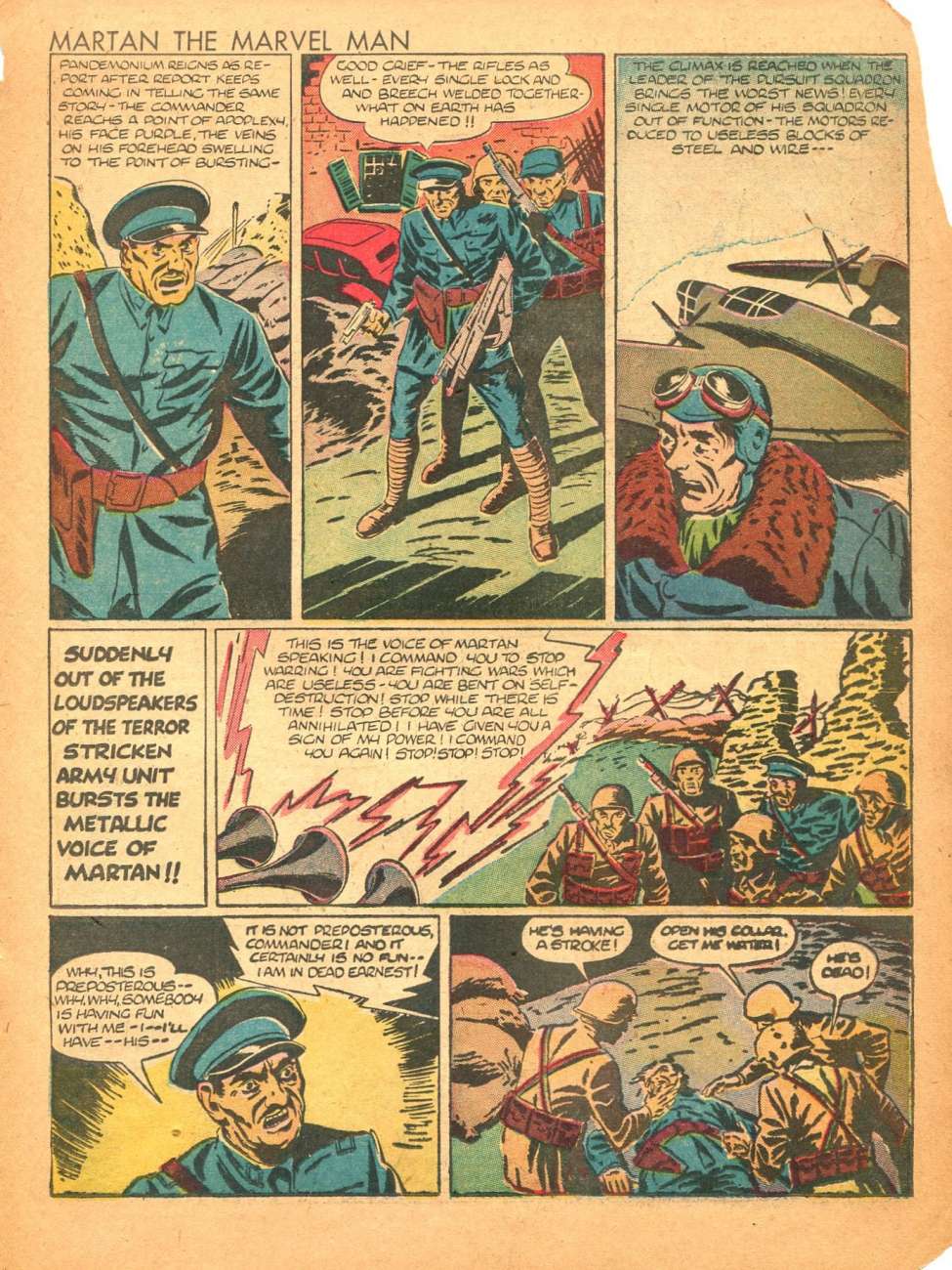
Interesting -- Martan is obviously attacking them with a raygun, but it's so rare for a ray to be invisible in comic books. The effect of the ray is specifically to lock up all mechanisms -- but this is effectively the same as temporarily wrecking things.
What we don't get a good idea of is what the area of effect is for this ray; we can tell it's wide, but it does have its limits (as Martan discusses shortly after this page).

Another feature of Martan's ship is that it can broadcast his voice through any electronic device, like these loudspeakers, with a range as great as the raygun.

The story takes as a dark turn, as the commander is so shocked that he has a stroke and dies on the spot. That is one failed morale save (on my chart, the worst result is fainting!)!
"Fata Morgana" is the Italian name for Megan le Fay. Martan's power seems to be the first instance of postcognition in comics (new super power!). Martan is able to create an image of what the building used to look like that both he and Vana can see (but not for long). It's unclear how long ago the church was ruined; perhaps postcognition can only reach back a few days in time.
Martan has no compulsion against killing humans (humans are still beneath him; an easy position for an alien to take).

Weird that the shadowy figures are armed with only swords and daggers. I actually did stat shadowy figures as a mobstertype back in Supplement V (and will likely include them in the Mobster Manual).
Radios being broken seems a not uncommon complication of airplane crash landings.

Being marooned on a deserted island is a great H&H scenario, as it tests the Heroes' ability to problem solve without the use of most of their special abilities.

The Masked Pilot should be very suspicious of the captain's lack of suspicion, particularly in regards to the Masked Pilot's mask.
Treasure placement can include weapon placement and always needs lots of thought, as two fully loaded automatics is not what I would expect to have found in a radio room.
It's interesting how the Masked Pilot is not worried until the sub-machine gun turns up. Now, that's interesting because, in H&H 2nd ed., a sub-machine gun isn't all that dangerous in the hands of a low HD mobster. Could it do more damage vs. a vehicle, though?

Things continue to escalate once the grenades come out! This kind of escalation of threat level happens all the time in game play, with the same risk of weapons falling into the Heroes' hands.
In Gang Busters, we see how a skill check for even driving can be critical in a scenario, as a failed check would send them over the cliff, or stopped before the parked car.

(Scans courtesy of Comic Book Plus.)