Mr. Satan returns and, expectations aside, he's still a good guy! Ed Ashe's artwork here is growing on me. I love the cryptic letter-plot hook and the use of shadows on this page. There's a real sense of menace here, despite the fact it looks suspiciously like the monster has a periscope. Can this story live up to the art...?
Actually, things are going great halfway through page 2. They start to go weird when Mr. Satan, wondering why Mrs. Heaslip locked Blake's door, decides he'll get the answer by investigating at the pond, rather than following her, or just saying, "Hey, Mrs. Heaslip! Why did you lock Blake's door?"
Satan is lured out onto the lake by a scream. First his canoe is capsized (I skipped showing you that page) and then the Monster tries to grapple him and misses. Rather than surface right away, Satan dives deeper to escape the Monster...in its natural element. That's a creepy third panel, with the three corpses floating in the whirlpool. Satan either makes a save vs science or a Strength check to pull free from the whirlpool (I would accept either mechanic).
It seems curious to me that he can see the three scientists clearly underwater, at night, but he can't see the Monster, but I suppose this is bound to happen sometimes from random search rolls.
The "bomb" looked like a grenade (I skipped that page too) and while it isn't explained to us why it went off too soon, the implication is that his wife rigged it to happen to kill him.
I think this is the first mention of the radium ray, unless I missed it in there somewhere. It's hard to believe that monster costume would fool anyone; Scooby Doo villains get more convincing monster costumes than that.
The motive of the affair is surprisingly adult.
It may seem ridiculous to suggest there can be a newly discovered planet, but remember that Pluto was not discovered until 1930, and for many years afterwards people wondered if there might not be more planets further out. The Mount Wilson Observatory in California was the largest telescope in the world in 1940, unless this is a fictional rival.
It's pretty hard to take "Stargaze" seriously as a surname; it must be a nickname?
Every time someone calls out for help anywhere, Zambini's "radioscopic" mind picks it up? Is he hearing voices constantly, then? Although, it actually says "any" distress calls, not "all." So maybe it's random or, more likely, happens whenever the Editor wants to drop him a plot hook.
His first cast spell must be a reverse of Word of Recall, where the spell teleports you from home to where ever you sense danger.
Some sort of low-level Untying spell, or simply Unseen Servant?
Oh boy...now, magic-user comic books tend to always err on the side of the ridiculous...but the magic tree that grows over 3 billion miles tall overnight is waaaaay crazy. And as if that wasn't bad enough, the tree is made of glass? That's not even flexible! How did this make sense to the people who made this?
The best part of this story is the glass men, living robots made of glass, hard to surprise because of their telescopic eyes, and immune to heat and fire.
Maybe the second best part is the name Zambini's Shower Ring, which seems like a great name for a spell. It may be a unique spell too, as I can't think of any Resist Fire 5' Radius spells out there -- which this seems to be, with some flavor text added.
It almost goes without saying that Zambini casts a Polymorph any Object spell in this story. H&H really needs a low-level version.
The glass men are called Inferians here, which does seem like a better name.
It's ...interesting how Zambini chooses to polymorph the Inferian into a hunky guy in short shorts. Is this for his benefit or the girl's? We never do learn the girl's name. Apparently the radius of Zambini's Shower Ring is so narrow that there was no room for their prisoner, and Zambini had no problem with handing out a death sentence, even though the Inferian cooperated.
Is that a fern in the king's chamber? How would any vegetation grow on this planet?
Will Zambini survive the lava flow? Of course he will. He's a golden age magic-user; he'll probably turn all the lava into butterflies or something.
(Scans courtesy of Comic Book Plus.)
An exploration of the Golden Age of Comics, through the lens of Hideouts & Hoodlums, the comic book roleplaying game.
Showing posts with label costumes. Show all posts
Thursday, June 25, 2020
Monday, April 27, 2020
Marvel Mystery Comics #5 - pt. 2
We're still in Prince Namor, the Sub-Mariner's story in this issue. Namor is heading home! Golden Age Comic book readers know that Namor's home wasn't an Atlantis off the North American Atlantic Coast, but an icy realm under Antarctica. Namor is in the North Seas and says it is 9,000 miles from the North Sea to Antarctica. Bill
Everett was either a good guesser or he spent some time with a map
working that out. He is actually only a little off; it's 9,500 miles. He says the submarine can make it there in two days; assuming 24-hour travel, that means a speed of roughly 200 MPH; that's almost four times the fastest real submarine speed.
Namor refers to his uncle, the king, as "Holy one," suggesting that royalty is divinity in their culture.
Namor travels via his own power from Antarctica back to New York, a journey of roughly 9,100 miles that he makes in three days, and meaning Namor can travel an average of 126 MPH (though he is said to make this journey by air and water, so it's impossible to say how much of this reflects his swimming and how much his flying speed).
Namor does not yet spend all his time in just swim trunks; he returns to New York in a shirt, pants, gloves, and cloak. Anticipating Edna Mode and her "no capes!" advice, Namor's cloak is caught in the landing gear of a passing plane while he's flying away from police and this knocks him out -- either from the cloak collar strangling him or being buffeted by wings against the side of the plane, though I favor the first explanation. This makes no game mechanic sense, though, as he should have easily been able to use his wrecking things ability to tear the cloak before it choked him or led him to being buffeted unconscious. Unless, Namor was considered surprised by the situation, giving the cloak's strangulation a free surprise turn in which he could not react. It is still harsh, if not unlikely, to say Namor would run out of air in just 30 seconds (the time of a surprise turn in 2nd edition Hideouts & Hoodlums).
Actually, Namor is only stunned and when he recovers, he uses "jiu-jitsu" to throw a fireman trying to grapple him. It's unlikely Namor has any direct knowledge of Japanese wrestling moves, but it's not like the Japanese invented the idea of flipping someone over their shoulder.
Namor fails his saving throw vs. chloroform and is knocked out by a really brave ambulance driver and taken into police custody.
Based only on a sergeant's permission, Betty Dean gets Namor released into her custody. Namor is uncharacteristically forgiving of his treatment by the police, pledging to work with them if he is deputized.
At that same time, a subway "accident" floods the tunnel at "5th street." In Midtown, this is likely the 5th Avenue-59th Street Subway Station. There, he uses "the strength of 100 whales" to tip the subway cars upright. I don't know how to measure the strength of 100 whales, but we could talk about the weight of 100 whales, with 100 of the smallest whales (dwarf sperm whales) weighing 25 tons total. This would be a 4th-level Raise power. By watching for air bubbles, he can find submerged passengers to rescue without having to make a search skill check (or does so at a bonus, since the bubbles should be easier to see).
Finding the hole that is the source of the flood, Namor flies into it with "his usual impulsiveness," showing Everett had a strong idea of Namor's character that has stayed with him for 80 years. The hole was made by three robbers trying to drill into the "Treasury," which we would know today as Federal Hall National Memorial. When Namor comes across a vault door, he thinks it will be hard for him to open, but he rips it open easily. Inside he finds the men and beats them up, breaking their bones in the process. The gold vault under Federal Hall was protected by a reservoir of water that they drilled and drained into the subway tunnel.
Next up is The Masked Raider. MR comes to talk to a troubled sheriff, but the sheriff mistakes him for an outlaw and draws on MR. MR is able to close the distance and punch him, despite the gun being pulled on him at range. So, in H&H, random initiative has to take priority over a more reasonable order of attack (not all missiles first, then melee).
MR uses an interesting tactic to lure out the bad guys in town, hanging a threatening sign from an arrow in town as the bad guys have been doing, and then following whoever sees it and looks suspicious. The bad guys plan to off the sheriff with poisoned arrows (the plan is to make gullible locals think Indians did it), but the Masked Raider shoots the head off the first arrow before it's fired and the bad guys all fail a morale save. That was one lucky roll, particularly since MR had to have been at long range to be out of sight; I would have said only a natural 20 would have made that shot.
Next up is Electro, the Marvel of the Age. In it, Professor Zog summons two of his twelve agents (he must have an 18 Charisma to have such a large supporting cast -- unless Zog is a non-Hero character and only his operatives are being played) and assigns them an international mission. He must be using code, though, because he describes a country called "Molivia" being attacked by a country called "Torpis." Molivia is easy -- that has to be a poorly disguised Bolivia. Torpis is going to be trickier. If we go by number of syllables, it has to be Brazil, Chile, or Peru. And yet...if we go by history, this whole story was likely inspired by the Chaco War of 1932-1935, suggesting a renewal of fighting between Bolivia and Paraguay. And yet again...when they finally get to "Molivia" it looks very European, and has a king instead of a president, so...who knows!
The brutality of war is illustrated by dead women and children in the street -- though the figures lack any gory details.
The radio controls for Electro have fantastic range -- 4,336 miles, in fact, if the operatives are summoning Electro from Sucre, capital city of Bolivia (called "Braka" in this story). It is unclear how long it takes Electro to fly the distance; it is possible there is some story compression before and during the siege of the city. Regardless, Electro does make it the entire way without needing to refuel, or that, if statted as a superhero, his Fly power has a remarkably long duration.
At the scene of the siege, machine gun bullets bounce off Electro, suggesting he has the Imperviousness power activated. When cannonballs and bombs dropped from planes fail to harm Electro, we know he has the Invulnerability power activated. Electro's wrecking things ability makes short work of the army, allowing him to even wreck "huge" tanks. If the tanks are truly of abnormal size, I would shift them up one category to battleships. Tanks were not used during the real Chaco War.
In the end, Torpis' dictator, Kalph Belgri commits suicide when his invasion fails, perhaps anticipating Hitler's famous suicide. No one committed suicide after the Chaco War.
(Read at readcomicsonline.to)
Namor refers to his uncle, the king, as "Holy one," suggesting that royalty is divinity in their culture.
Namor travels via his own power from Antarctica back to New York, a journey of roughly 9,100 miles that he makes in three days, and meaning Namor can travel an average of 126 MPH (though he is said to make this journey by air and water, so it's impossible to say how much of this reflects his swimming and how much his flying speed).
Namor does not yet spend all his time in just swim trunks; he returns to New York in a shirt, pants, gloves, and cloak. Anticipating Edna Mode and her "no capes!" advice, Namor's cloak is caught in the landing gear of a passing plane while he's flying away from police and this knocks him out -- either from the cloak collar strangling him or being buffeted by wings against the side of the plane, though I favor the first explanation. This makes no game mechanic sense, though, as he should have easily been able to use his wrecking things ability to tear the cloak before it choked him or led him to being buffeted unconscious. Unless, Namor was considered surprised by the situation, giving the cloak's strangulation a free surprise turn in which he could not react. It is still harsh, if not unlikely, to say Namor would run out of air in just 30 seconds (the time of a surprise turn in 2nd edition Hideouts & Hoodlums).
Actually, Namor is only stunned and when he recovers, he uses "jiu-jitsu" to throw a fireman trying to grapple him. It's unlikely Namor has any direct knowledge of Japanese wrestling moves, but it's not like the Japanese invented the idea of flipping someone over their shoulder.
Namor fails his saving throw vs. chloroform and is knocked out by a really brave ambulance driver and taken into police custody.
Based only on a sergeant's permission, Betty Dean gets Namor released into her custody. Namor is uncharacteristically forgiving of his treatment by the police, pledging to work with them if he is deputized.
At that same time, a subway "accident" floods the tunnel at "5th street." In Midtown, this is likely the 5th Avenue-59th Street Subway Station. There, he uses "the strength of 100 whales" to tip the subway cars upright. I don't know how to measure the strength of 100 whales, but we could talk about the weight of 100 whales, with 100 of the smallest whales (dwarf sperm whales) weighing 25 tons total. This would be a 4th-level Raise power. By watching for air bubbles, he can find submerged passengers to rescue without having to make a search skill check (or does so at a bonus, since the bubbles should be easier to see).
Finding the hole that is the source of the flood, Namor flies into it with "his usual impulsiveness," showing Everett had a strong idea of Namor's character that has stayed with him for 80 years. The hole was made by three robbers trying to drill into the "Treasury," which we would know today as Federal Hall National Memorial. When Namor comes across a vault door, he thinks it will be hard for him to open, but he rips it open easily. Inside he finds the men and beats them up, breaking their bones in the process. The gold vault under Federal Hall was protected by a reservoir of water that they drilled and drained into the subway tunnel.
Next up is The Masked Raider. MR comes to talk to a troubled sheriff, but the sheriff mistakes him for an outlaw and draws on MR. MR is able to close the distance and punch him, despite the gun being pulled on him at range. So, in H&H, random initiative has to take priority over a more reasonable order of attack (not all missiles first, then melee).
MR uses an interesting tactic to lure out the bad guys in town, hanging a threatening sign from an arrow in town as the bad guys have been doing, and then following whoever sees it and looks suspicious. The bad guys plan to off the sheriff with poisoned arrows (the plan is to make gullible locals think Indians did it), but the Masked Raider shoots the head off the first arrow before it's fired and the bad guys all fail a morale save. That was one lucky roll, particularly since MR had to have been at long range to be out of sight; I would have said only a natural 20 would have made that shot.
Next up is Electro, the Marvel of the Age. In it, Professor Zog summons two of his twelve agents (he must have an 18 Charisma to have such a large supporting cast -- unless Zog is a non-Hero character and only his operatives are being played) and assigns them an international mission. He must be using code, though, because he describes a country called "Molivia" being attacked by a country called "Torpis." Molivia is easy -- that has to be a poorly disguised Bolivia. Torpis is going to be trickier. If we go by number of syllables, it has to be Brazil, Chile, or Peru. And yet...if we go by history, this whole story was likely inspired by the Chaco War of 1932-1935, suggesting a renewal of fighting between Bolivia and Paraguay. And yet again...when they finally get to "Molivia" it looks very European, and has a king instead of a president, so...who knows!
The brutality of war is illustrated by dead women and children in the street -- though the figures lack any gory details.
The radio controls for Electro have fantastic range -- 4,336 miles, in fact, if the operatives are summoning Electro from Sucre, capital city of Bolivia (called "Braka" in this story). It is unclear how long it takes Electro to fly the distance; it is possible there is some story compression before and during the siege of the city. Regardless, Electro does make it the entire way without needing to refuel, or that, if statted as a superhero, his Fly power has a remarkably long duration.
At the scene of the siege, machine gun bullets bounce off Electro, suggesting he has the Imperviousness power activated. When cannonballs and bombs dropped from planes fail to harm Electro, we know he has the Invulnerability power activated. Electro's wrecking things ability makes short work of the army, allowing him to even wreck "huge" tanks. If the tanks are truly of abnormal size, I would shift them up one category to battleships. Tanks were not used during the real Chaco War.
In the end, Torpis' dictator, Kalph Belgri commits suicide when his invasion fails, perhaps anticipating Hitler's famous suicide. No one committed suicide after the Chaco War.
(Read at readcomicsonline.to)
Labels:
Armor Class,
costumes,
distances,
Electro,
grappling,
history lesson,
initiative,
locations,
Masked Raider,
missile attacks,
powers,
saving throws,
Sub-Mariner,
Superhero,
surprise,
transportation,
wrecking things
Saturday, November 23, 2019
Thrilling Comics #2 - pt. 4
We're still looking at The Woman in Red as she investigates at a hospital, and talking Hideouts & Hoodlums game mechanics.
The one benefit I've seen so far to WiR dressing as a vigilante is, when she comes out of the costume, she's unrecognizable and doesn't have to make a disguise skill check.
Grabbing the canopy is a normal attack roll. The Editor has to wing the Armor Class based on how fast WiR was falling past it. Since it looks like she fell no more than 30', I'd say AC 7. Of course, the Editor does not have to put a canopy there, but a player can request one and, if the Editor is feeling half-generous, allow a save vs. plot for there to be a canopy between the window and the ground.
It's hard to make out that figure in panel 3, but it looks like the killer is wrapped up like a mummy. So...stat as fake undead?
Note the wisps of smoke around the police officers in panel 5, suggesting that they have been shooting at her, in the hallway of a hospital! This is so typical of the mysteryman genre, that police are ineffectual against crooks, but super-dangerous when they turn on the Hero.
The basement of the hospital is now more like a traditional hideout, with long, dark corridors and cell-like doors. A morgue contains lots of good, atmospheric dressing for a hideout.
A maniac might be a workable mobstertype. He seems at least as tough as a thug, but also has the ability to rip costumes off.
It's rare for radiation to be treated realistically in a comic book at any decade, so it's nice to see radium having an effect on someone. It must have also affected the morgue attendant's brain, since he doesn't apparently recognize a Geiger counter.
Geiger counters should be a mundane trophy item Heroes can collect.
Here's a question to ponder: is the rattlesnake a wandering encounter, the woman in trouble, or both together? Setting up wandering encounters as a rescue situation is a good way to let your players net additional XP!
"You spoke your piece" is just the kind of phrase you'd expect in a western.
There's some interesting slang on this page. A "waddy" was a cowboy, in this context, and not an Aboriginal war club.
This page makes me nuts. The top tier is all about confronting the killer, and then the store veers off into this sub-plot about capturing wild horses. The timing of it is terrible, but the idea of having sub-plots ready that your players can go do during less busy times in the game is a great idea.
Speaking of great ideas...setting off dynamite in the vicinity of the wild horses you want to capture alive? Probably not one of those great ideas...
This is from Tommy Dolan, Ace Detective. It's a confusing story that seems to be about an undercover detective pretending to have shot a cop in order to get in with a vamp who knows where treasure is buried, but not all of that is very clear up to this point; confusing things is that even the captions keep referring to Tommy as his alias, Terry.
Under dashboards is a good place to look for hidden weapons.
The "Lambeth Walk" is "an exaggerated rhythmic swagger, with plenty of arm swinging, copious hat-play, and elements of slapstick," according to the Londonist.com.
There's some interesting chemistry between detective and vamp here, and lots of good pulpish dialogue, like "You hold all the cards," "I'm nothing but a stooge for a blonde," and "grab yourself a chunk of ceiling!" Perfect for an urban campaign with lots of noir to it.
(Scans courtesy of Comic Book Plus.)
The one benefit I've seen so far to WiR dressing as a vigilante is, when she comes out of the costume, she's unrecognizable and doesn't have to make a disguise skill check.
Grabbing the canopy is a normal attack roll. The Editor has to wing the Armor Class based on how fast WiR was falling past it. Since it looks like she fell no more than 30', I'd say AC 7. Of course, the Editor does not have to put a canopy there, but a player can request one and, if the Editor is feeling half-generous, allow a save vs. plot for there to be a canopy between the window and the ground.
It's hard to make out that figure in panel 3, but it looks like the killer is wrapped up like a mummy. So...stat as fake undead?
Note the wisps of smoke around the police officers in panel 5, suggesting that they have been shooting at her, in the hallway of a hospital! This is so typical of the mysteryman genre, that police are ineffectual against crooks, but super-dangerous when they turn on the Hero.
The basement of the hospital is now more like a traditional hideout, with long, dark corridors and cell-like doors. A morgue contains lots of good, atmospheric dressing for a hideout.
A maniac might be a workable mobstertype. He seems at least as tough as a thug, but also has the ability to rip costumes off.
It's rare for radiation to be treated realistically in a comic book at any decade, so it's nice to see radium having an effect on someone. It must have also affected the morgue attendant's brain, since he doesn't apparently recognize a Geiger counter.
Geiger counters should be a mundane trophy item Heroes can collect.
Here's a question to ponder: is the rattlesnake a wandering encounter, the woman in trouble, or both together? Setting up wandering encounters as a rescue situation is a good way to let your players net additional XP!
"You spoke your piece" is just the kind of phrase you'd expect in a western.
There's some interesting slang on this page. A "waddy" was a cowboy, in this context, and not an Aboriginal war club.
This page makes me nuts. The top tier is all about confronting the killer, and then the store veers off into this sub-plot about capturing wild horses. The timing of it is terrible, but the idea of having sub-plots ready that your players can go do during less busy times in the game is a great idea.
Speaking of great ideas...setting off dynamite in the vicinity of the wild horses you want to capture alive? Probably not one of those great ideas...
Under dashboards is a good place to look for hidden weapons.
The "Lambeth Walk" is "an exaggerated rhythmic swagger, with plenty of arm swinging, copious hat-play, and elements of slapstick," according to the Londonist.com.
There's some interesting chemistry between detective and vamp here, and lots of good pulpish dialogue, like "You hold all the cards," "I'm nothing but a stooge for a blonde," and "grab yourself a chunk of ceiling!" Perfect for an urban campaign with lots of noir to it.
(Scans courtesy of Comic Book Plus.)
Saturday, November 9, 2019
Thrilling Comics #2 - pt. 1
Mike's Amazing World of Comics tells me that the next comic book I should be reviewing, in order, is War Comics #1. But I accidentally reviewed that early, a year ago. Oops! So let's skip another ahead to Better's Thrilling Comics and the original Dr. Strange.
Our adventure begins with a mysterious death and the easy plot hook of Strange being asked to investigate it by the police. Strange looks for clues and, in an unusual move that I want to call your attention to, appears to be using scissors to cut into the dead man's clothing (unless, of course, he's also planning on performing an autopsy...). This is how he finds a secretive pin sewn into the seam of the clothing.
Note how Strange now has dark hair. Does he, instead of wearing a costume or uniform, just darken his hair before going into action?
Really, Fleming? The only place in the world you would find a three-headed serpent is an ancient lost city? I decided to do a quick Internet search on three-headed serpents to see if he was right. Besides an awful lot of hits for the video game Hitman 2, there was an article about a pillar depicting a three-headed serpent that came from Delphi. Good thing Strange didn't go there instead!
I wouldn't put much stock in what that assistant's telling you either, Strange. And you, Richard Hughes, writer of this story, if you knew you were going to base this story in Tibet, how hard would it have been in 1940 to do a little research and learn the real name of the desert there (which is the Gobi)?
One of the nice things about that last page is the fallibility of the assassin, who allows the assistant to get one vital word out before offing him. This makes it pretty easy to follow from one plot character right to the next -- and then risk killing him by punching him through a wall.
The game mechanics of Hideouts & Hoodlums (remember, this blog is also about a game!) don't currently support punching villains through walls, and would either need a modification to the pushing rules, or a new power that combines damage with wrecking things. I would definitely need to consider this as we move ahead, as I can think of quite a few later comic books that combine violence with such a flagrant disregard for property.
This third page, to the right, makes no sense to me...
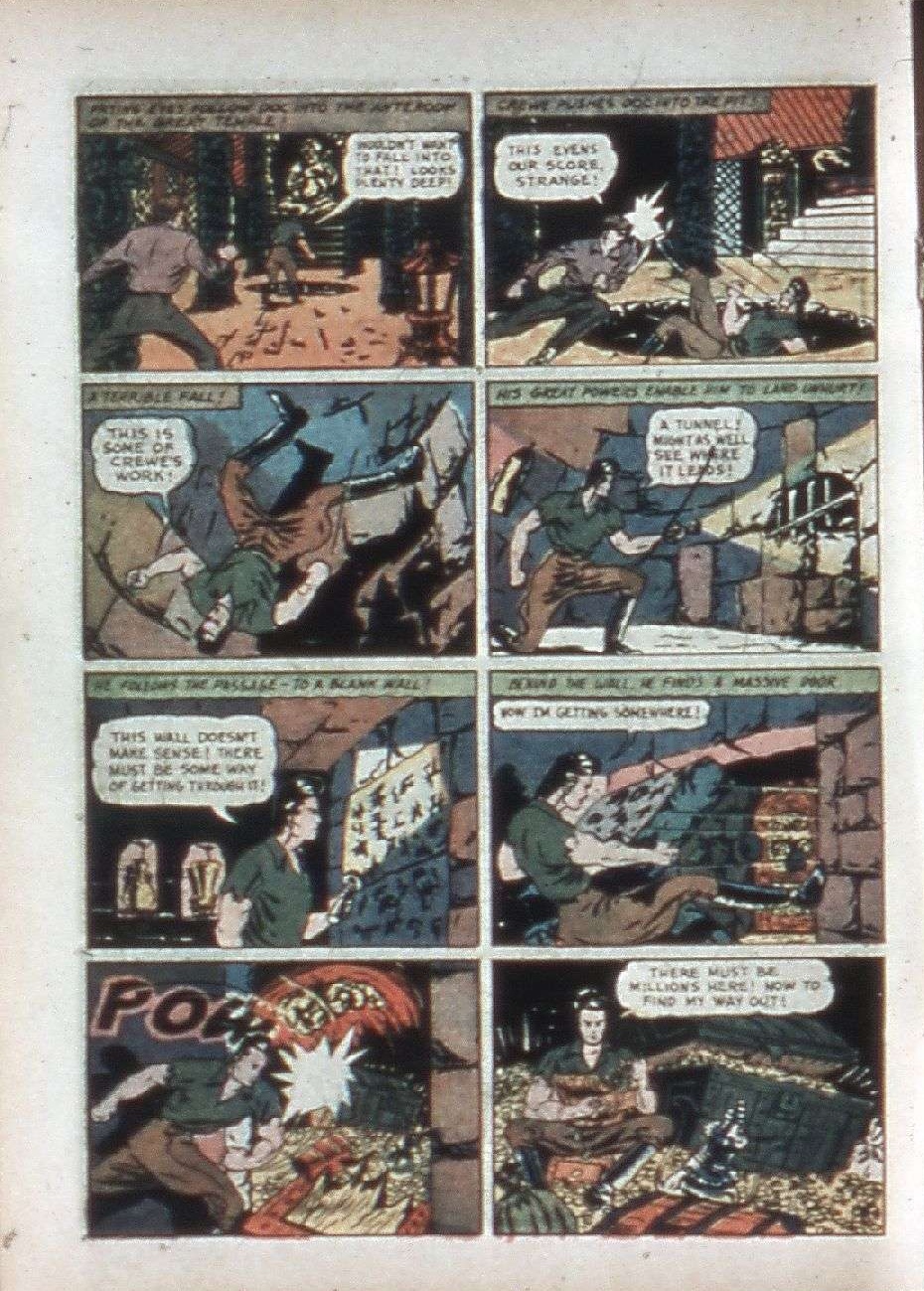
Strange seems to have Crewe dead to rights already, yet after beating up his henchmen and showing off his Nigh-Invulnerable Skin, he just leaves so he can tail Crewe instead. You would think Crewe would be extra-cautious now about Strange and not act so brazenly criminal.
As stupid as Crewe is, his henchmen must be even stupider to nab a girl and bring her to their boss, just for loitering around a giant skyscraper. Strange isn't happy with them either, as he's perfectly willing to toss one of them out the window, knowing it's a lethal fall from that height.
Now this page has some tricky geometry to it. I'm not sure how Strange twists his body to land on the roof across the street, but it definitely appears that he is still leaping instead of flying. And, the fact that he needs to land on the roof instead suggests there is an upper limit to how far he feels he can fall safely.
In game mechanics-terms, maybe an upper limit needs to be put on the Feather Landing power.
A herb that cures diseases like the spell would be a very valuable item in any campaign, and probably one best to keep out of the Heroes' grasp so it doesn't change the campaign world too dramatically.
Mongols are just wandering around Tibet? Mongolia is about 1,400 miles from Tibet. Seems like more writing done without research to me. Though the artist, Alexander Kostuk, at least looked at some old references for how Mongolians once dressed.
Strange uses his wrecking things ability on a stone wall, a door, and a cage here, demonstrating that a superhero needs the ability to use that game mechanic in quick succession.
What's going on with the guards being drawn like primitive African natives, hurling spears? How does that make sense in Tibet?
Rescuing prisoners is always a good idea, for the "good deed" XP award, the useful information they may have about the hideout, and their Supporting Cast recruitment potential.
Animals never fare well against Golden Age comic book Heroes and the fights are usually over in a single panel. This one, with Strange fighting two lions, occurs largely off-panel!
Once again, Hughes gets his geography wrong. The "Mountains of the Moon" are a legendary mountain range in east Africa, once thought to be the source of the Nile River.
More evidence that ordinary people can make push attacks on superheroes.
Strange wisely carries a flashlight.
Finding a secret door usually includes finding the means of opening it. But, if you just suspect a secret door is there, but you're getting impatient waiting for that successful "find secret doors" check, you can always wreck the wall. If you're right, you will only be wrecking against the door category, even if you can't actually see the door.
Millions of dollars' worth of treasure is usually a campaign-busting find and should be avoided doling out in actual play.
(Scans courtesy of Comic Book Plus.)
Our adventure begins with a mysterious death and the easy plot hook of Strange being asked to investigate it by the police. Strange looks for clues and, in an unusual move that I want to call your attention to, appears to be using scissors to cut into the dead man's clothing (unless, of course, he's also planning on performing an autopsy...). This is how he finds a secretive pin sewn into the seam of the clothing.
Note how Strange now has dark hair. Does he, instead of wearing a costume or uniform, just darken his hair before going into action?
Really, Fleming? The only place in the world you would find a three-headed serpent is an ancient lost city? I decided to do a quick Internet search on three-headed serpents to see if he was right. Besides an awful lot of hits for the video game Hitman 2, there was an article about a pillar depicting a three-headed serpent that came from Delphi. Good thing Strange didn't go there instead!
I wouldn't put much stock in what that assistant's telling you either, Strange. And you, Richard Hughes, writer of this story, if you knew you were going to base this story in Tibet, how hard would it have been in 1940 to do a little research and learn the real name of the desert there (which is the Gobi)?
One of the nice things about that last page is the fallibility of the assassin, who allows the assistant to get one vital word out before offing him. This makes it pretty easy to follow from one plot character right to the next -- and then risk killing him by punching him through a wall.
The game mechanics of Hideouts & Hoodlums (remember, this blog is also about a game!) don't currently support punching villains through walls, and would either need a modification to the pushing rules, or a new power that combines damage with wrecking things. I would definitely need to consider this as we move ahead, as I can think of quite a few later comic books that combine violence with such a flagrant disregard for property.
This third page, to the right, makes no sense to me...
Strange seems to have Crewe dead to rights already, yet after beating up his henchmen and showing off his Nigh-Invulnerable Skin, he just leaves so he can tail Crewe instead. You would think Crewe would be extra-cautious now about Strange and not act so brazenly criminal.
As stupid as Crewe is, his henchmen must be even stupider to nab a girl and bring her to their boss, just for loitering around a giant skyscraper. Strange isn't happy with them either, as he's perfectly willing to toss one of them out the window, knowing it's a lethal fall from that height.
Now this page has some tricky geometry to it. I'm not sure how Strange twists his body to land on the roof across the street, but it definitely appears that he is still leaping instead of flying. And, the fact that he needs to land on the roof instead suggests there is an upper limit to how far he feels he can fall safely.
In game mechanics-terms, maybe an upper limit needs to be put on the Feather Landing power.
A herb that cures diseases like the spell would be a very valuable item in any campaign, and probably one best to keep out of the Heroes' grasp so it doesn't change the campaign world too dramatically.
Mongols are just wandering around Tibet? Mongolia is about 1,400 miles from Tibet. Seems like more writing done without research to me. Though the artist, Alexander Kostuk, at least looked at some old references for how Mongolians once dressed.
Strange uses his wrecking things ability on a stone wall, a door, and a cage here, demonstrating that a superhero needs the ability to use that game mechanic in quick succession.
What's going on with the guards being drawn like primitive African natives, hurling spears? How does that make sense in Tibet?
Rescuing prisoners is always a good idea, for the "good deed" XP award, the useful information they may have about the hideout, and their Supporting Cast recruitment potential.
Animals never fare well against Golden Age comic book Heroes and the fights are usually over in a single panel. This one, with Strange fighting two lions, occurs largely off-panel!
Once again, Hughes gets his geography wrong. The "Mountains of the Moon" are a legendary mountain range in east Africa, once thought to be the source of the Nile River.
More evidence that ordinary people can make push attacks on superheroes.
Strange wisely carries a flashlight.
Finding a secret door usually includes finding the means of opening it. But, if you just suspect a secret door is there, but you're getting impatient waiting for that successful "find secret doors" check, you can always wreck the wall. If you're right, you will only be wrecking against the door category, even if you can't actually see the door.
Millions of dollars' worth of treasure is usually a campaign-busting find and should be avoided doling out in actual play.
(Scans courtesy of Comic Book Plus.)
Monday, October 21, 2019
Fantastic Comics #4- pt. 1
Alex Blum's first work in comics were these early Samson stories, and they are pretty good stuff. It is believed that Will Eisner, Alex's boss, wrote these stories, but I suspect he had a hand in the layout of this story as well, as ingenious as some of it is. Follow along and decide for yourself!
First of all, check out the amazing detail work on that smashed robot! This is, perhaps, our best glimpse ever at how an artist in 1940 imagined the mechanical insides of a robot would look like.
Samson never actually wielded a flail in combat -- but wouldn't that have been cool too?
That's right -- Samson doesn't just wear a furry loincloth into combat, he wears only that while casually strolling around town too. I have a theory, though, that Samson's look is only meant to be symbolic; that he doesn't really appear like this in public, but is shown to us this way because this is how we see him, as the Hero.
Note the imaginative panel layout at the bottom, with the island superimposed over the map showing where it is. That is genius, and has Eisner's handiwork written all over it.
---
Game mechanics-wise, Samson is buffed both with Raise Car and Different Physical Structure (to help him save vs. the deadly gas) on this page.
Narrators are usually prone to hyperbole, but this one was modest on page 1 when it said the robots were twice human size. On this page, the robot appears to be more like three times human size. That makes them giant robots, and normally 15 Hit Dice. Even one is a tough encounter; bear that in mind as this story progresses.
---
It's really hard to pin down a nationality for Rigo based on just the name, but we'll see shortly who "Rigo" really is...
"No man made weapon can harm my creation" could well be hyperbole, but we do see the robot is nigh-invulnerable, which means at least an Armor Class as low as 3.
---
Dragor is who now? Oh wow, yeah, Dragor was the Hitler stand-in in Fantastic Comics #2! That's a cool little bit of continuity I almost missed!
I love this ingenious top panel!
Maximillian looks very Germanic to me, but Rigo is nearly a dead ringer for Stalin in that second panel. Since Samson has already bested Germany two issues ago, it makes sense he would tackle Russia this time around.
Don't miss the implications here -- Eisner and Blum just killed off Stalin.
We also see that giant robots can be voice-activated, and that they can be encountered in groups of up to -- 5,000?? 5,000 15 HD robots? That's one messed up challenge level. I mean, maybe 3+ Heroes, all level 21+, could handle this, but I would never throw this against a single Hero of any level.
The first panel here needs to be seen as symbolic only; clearly that robot at the bottom is not so huge that it can literally reach over and crush a skyscraper in its hand as it walks past. The 2nd and 3rd panels, though, are probably meant to be literal, and are pretty grim and violent. These giant robots main attack forms are squeezing and stomping. I would not treat squeezing as a grappling attack, as there's clearly no way those women (or the natives we saw this happen to earlier) can reverse the hold and throw those robots on the ground.
If Rigo is Stalin and the robots come from Russia, then this gorge must be somewhere in the Ural Mountains? Samson is lucky to have found a place where he can strategically bottleneck the robots. I guess traffic was too heavy on the roads for the robot army?
Now, what is poison gas supposed to do to robots? Is Samson leaving this incredibly gullible old man in front of the robot army to get killed off, so he can't make any more deadly inventions?
Players should be rewarded for coming up with ways to use their wrecking things ability to do secondary damage. Here, it stops three robots. Only 4,997 more to go! The story doesn't tell us how Samson stops the rest, though I suspect they are programmed to try and go around rubble and simply keep falling off the cliff, one after the other.
(Scans courtesy of Digital Comic Museum.)
First of all, check out the amazing detail work on that smashed robot! This is, perhaps, our best glimpse ever at how an artist in 1940 imagined the mechanical insides of a robot would look like.
Samson never actually wielded a flail in combat -- but wouldn't that have been cool too?
That's right -- Samson doesn't just wear a furry loincloth into combat, he wears only that while casually strolling around town too. I have a theory, though, that Samson's look is only meant to be symbolic; that he doesn't really appear like this in public, but is shown to us this way because this is how we see him, as the Hero.
Note the imaginative panel layout at the bottom, with the island superimposed over the map showing where it is. That is genius, and has Eisner's handiwork written all over it.
---
Game mechanics-wise, Samson is buffed both with Raise Car and Different Physical Structure (to help him save vs. the deadly gas) on this page.
Narrators are usually prone to hyperbole, but this one was modest on page 1 when it said the robots were twice human size. On this page, the robot appears to be more like three times human size. That makes them giant robots, and normally 15 Hit Dice. Even one is a tough encounter; bear that in mind as this story progresses.
---
It's really hard to pin down a nationality for Rigo based on just the name, but we'll see shortly who "Rigo" really is...
"No man made weapon can harm my creation" could well be hyperbole, but we do see the robot is nigh-invulnerable, which means at least an Armor Class as low as 3.
---
Dragor is who now? Oh wow, yeah, Dragor was the Hitler stand-in in Fantastic Comics #2! That's a cool little bit of continuity I almost missed!
I love this ingenious top panel!
Maximillian looks very Germanic to me, but Rigo is nearly a dead ringer for Stalin in that second panel. Since Samson has already bested Germany two issues ago, it makes sense he would tackle Russia this time around.
Don't miss the implications here -- Eisner and Blum just killed off Stalin.
We also see that giant robots can be voice-activated, and that they can be encountered in groups of up to -- 5,000?? 5,000 15 HD robots? That's one messed up challenge level. I mean, maybe 3+ Heroes, all level 21+, could handle this, but I would never throw this against a single Hero of any level.
The first panel here needs to be seen as symbolic only; clearly that robot at the bottom is not so huge that it can literally reach over and crush a skyscraper in its hand as it walks past. The 2nd and 3rd panels, though, are probably meant to be literal, and are pretty grim and violent. These giant robots main attack forms are squeezing and stomping. I would not treat squeezing as a grappling attack, as there's clearly no way those women (or the natives we saw this happen to earlier) can reverse the hold and throw those robots on the ground.
If Rigo is Stalin and the robots come from Russia, then this gorge must be somewhere in the Ural Mountains? Samson is lucky to have found a place where he can strategically bottleneck the robots. I guess traffic was too heavy on the roads for the robot army?Now, what is poison gas supposed to do to robots? Is Samson leaving this incredibly gullible old man in front of the robot army to get killed off, so he can't make any more deadly inventions?
Players should be rewarded for coming up with ways to use their wrecking things ability to do secondary damage. Here, it stops three robots. Only 4,997 more to go! The story doesn't tell us how Samson stops the rest, though I suspect they are programmed to try and go around rubble and simply keep falling off the cliff, one after the other.
(Scans courtesy of Digital Comic Museum.)
Saturday, May 18, 2019
Pep Comics #2 - pt. 1
We're back to MLJ and my second favorite MLJ superhero, The Shield!
As you can see here, today's adventure is going to take place in (and en route to) "Porto Rico." Now, this may seem on the face of it to be one of those times where the comic book writers fictionalized a country name by changing it slightly, but it actually was called Porto Rico from 1898 to 1931! (Our author here, Harry Shorten, may have been just nine years behind the times...)
I understand the cabin doors on a boat are pretty thick, so maybe it makes sense that the Shield needs a special device to listen at one. It might make even more sense when you consider that the Shield is wearing a mask with extra ear covering on it. Yet, I am hesitant to introduce too many negative modifiers to skill checks. I would especially hate to penalize someone for coming up with an inventive, but impractical, superhero costume.
Instead of referring to the villains outright as Germans, they are just called "Nordics" here.
We've been seeing superheroes jumping out of planes in movies a lot lately, but the Shield might have been the first. He lands safely, partly because he's landing in water and water landings are almost always safe in comic books...but, just in case, it might help to have a Feather Landing power activated.
I'm sharing this page, not so much because it informs us, so much as because it confuses me. In panel 5, a man yells, "A hit!" but we don't actually see the shell connect. Does the man just think it was a hit, but is mistaken? What does it mean that the Shield "escaped?" Did he dodge, or did the shell bounce off him?
I'm going to have to toss out here now that I'm not really a fan of the earliest Shield stories, and I can't wait for Irv Novick's art to improve (it does, later).
The Shield has the Super-Tough Skin power activated, or his armor grants him the Super-Tough Skin power. We also have examples of Wrecking Things being used (door category, mainly), and possibly a stacking of Extend Missile Range I and Multi-Attack to get that throw that knocks over multiple crew members (should be no more than three, though).
"Done Went McGinty" is a 1889 song written by Joseph Flynn; this is its comic book debut, and possibly only appearance of the song.
Shield is likely protected by one of the higher level defensive buffing powers, at least Imperviousness, to shrug off grenades like that.
I'm not really sure what the Shield's plan is here...but I suspect he buffed himself with Resist Fire, and then figured if he had flaming kerosene all over his body...he would set the enemy ship ablaze and sink it? It seems like it would be a lot easier just to land on the other ship and start wrecking it, but I have to admit this is pretty visually interesting.
That paralysis raygun sure came out of nowhere -- but that's very appropriate for Hideouts & Hoodlums, a game where you might not even know what trophy items are going to come into play until you roll up the encounter. Or, to look at it from the other direction, golden age comic books like this are perfectly emulated through randomness.
The sharks are encountered in a group of at least four.
Being moist protects you from rays? I'd have an easier time believing that he just made his saving throw this time.
Panel 4 shows off the awkwardness of the Shield's thong-back costume.
Speaking of his costume, where do you suppose the pocket is located where he kept that shield-shaped calling card?
(Scans courtesy of Digital Comic Museum.)
As you can see here, today's adventure is going to take place in (and en route to) "Porto Rico." Now, this may seem on the face of it to be one of those times where the comic book writers fictionalized a country name by changing it slightly, but it actually was called Porto Rico from 1898 to 1931! (Our author here, Harry Shorten, may have been just nine years behind the times...)
I understand the cabin doors on a boat are pretty thick, so maybe it makes sense that the Shield needs a special device to listen at one. It might make even more sense when you consider that the Shield is wearing a mask with extra ear covering on it. Yet, I am hesitant to introduce too many negative modifiers to skill checks. I would especially hate to penalize someone for coming up with an inventive, but impractical, superhero costume.
Instead of referring to the villains outright as Germans, they are just called "Nordics" here.
We've been seeing superheroes jumping out of planes in movies a lot lately, but the Shield might have been the first. He lands safely, partly because he's landing in water and water landings are almost always safe in comic books...but, just in case, it might help to have a Feather Landing power activated.
I'm sharing this page, not so much because it informs us, so much as because it confuses me. In panel 5, a man yells, "A hit!" but we don't actually see the shell connect. Does the man just think it was a hit, but is mistaken? What does it mean that the Shield "escaped?" Did he dodge, or did the shell bounce off him?
I'm going to have to toss out here now that I'm not really a fan of the earliest Shield stories, and I can't wait for Irv Novick's art to improve (it does, later).
The Shield has the Super-Tough Skin power activated, or his armor grants him the Super-Tough Skin power. We also have examples of Wrecking Things being used (door category, mainly), and possibly a stacking of Extend Missile Range I and Multi-Attack to get that throw that knocks over multiple crew members (should be no more than three, though).
"Done Went McGinty" is a 1889 song written by Joseph Flynn; this is its comic book debut, and possibly only appearance of the song.
Shield is likely protected by one of the higher level defensive buffing powers, at least Imperviousness, to shrug off grenades like that.
I'm not really sure what the Shield's plan is here...but I suspect he buffed himself with Resist Fire, and then figured if he had flaming kerosene all over his body...he would set the enemy ship ablaze and sink it? It seems like it would be a lot easier just to land on the other ship and start wrecking it, but I have to admit this is pretty visually interesting.
That paralysis raygun sure came out of nowhere -- but that's very appropriate for Hideouts & Hoodlums, a game where you might not even know what trophy items are going to come into play until you roll up the encounter. Or, to look at it from the other direction, golden age comic books like this are perfectly emulated through randomness.
The sharks are encountered in a group of at least four.
Being moist protects you from rays? I'd have an easier time believing that he just made his saving throw this time.
Panel 4 shows off the awkwardness of the Shield's thong-back costume.
Speaking of his costume, where do you suppose the pocket is located where he kept that shield-shaped calling card?
(Scans courtesy of Digital Comic Museum.)
Friday, November 9, 2018
Famous Funnies #66 - pt. 2
A bubble genies is... an unusual, modern spin on a classic. The Bubble Pipe of Genie Summoning is not something your players would be expecting, that's for sure!
Sifting through the racism, we get to the bottom and the image of a man swinging a bull around by its horns -- gruesome, if it wasn't so cartoony. At issue here is, did Wahoo have to activate the Raise Car power to do this, and would he have to? What is going on is clearly combat, so whether the bull is airborne or not seems irrelevant and is merely flavor text. Two exceptions I can think of would require Wahoo to activate the power for this: 1) he plans on throwing the bull next, which does require him to be able to lift it into the air, and 2) he is doing this to intimidate the bull and force a morale save, without hurting it any further. Flavor text cannot activate morale saves, so a power would have to be used for that.
Scorchy is doing everything right to find the kidnapper -- using aerial reconnaissance, checking maps, watching escape routes, and contacting the authorities.
Krag, on the other hand, doesn't seem to be as smart at setting up traps as Scorchy is. Why would he step on the starter if he thinks the motor is busted? And wouldn't his chief priority still be finding the girl?
The Lone Rider's true identity is revealed in this story -- and soon thereafter he is easily subdued in combat once the mystique of his mask was removed. 1st edition Hideouts & Hoodlums had a rule for superheroes that they could only use their powers in costume...but I'm wondering if that rule was not misplaced and a better fit for the mysteryman class all along. Perhaps the mysteryman should be denied his signature move when not wearing some kind of mask.
It seems a small point, but I thought I would explain that saving a dog from a burning building is still a good deed, and worth just as much XP as saving a person.
(Scans courtesy of Comic Book Plus.)
Labels:
Big Chief Wahoo,
costumes,
flavor text,
good deeds,
grappling,
Lightning and the Lone Rider,
magic items,
Mescal Ike,
morale,
Mysteryman,
player tips,
powers,
racism,
Scorchy Smith,
Seaweed Sam,
signature moves
Subscribe to:
Posts (Atom)