Showing posts with label mood. Show all posts

Wednesday, March 22, 2023

Fight Comics #4 - pt. 2

We return to Kinks Mason to find he's...well, improvising a club to bet a pirate captain with, I have no problem with that, but using a cape, underwater, to distract swordfish like a bullfighter...that seems problematic to me...


...especially since Kinks does it to pull off this trick, which I find flat-out impossible. I know, as a good Editor, I should be encouraging my players to come up with clever solutions and give them a chance to work, but sometimes you need to consider the mood, or tone, you want for your campign and if the idea is compatible. 


We're jumping ahead now into the futuristic adventures of Saber. How can you tell it's the future? Well...there's that weird machine next to his desk, and that weird machine hanging from the ceiling. And no clutter!

Saber unlikely has active powers buffing him in panel 3. The spies failed to gain surprise, which allowed Saber to "size up the situation." Saber appears to be using Leap I, but the distance crossed is no different than what he could have reached running, so the leap is flavor text.

Saber is rolling great for damge to knock out one person per punch, but it is possible without buffing. It is also possible he is buffed with the Get Tough power. 

Saber fails his saving throw vs paralysis.  

It's nice that, in the future, spies will all wear uniforms so you can tell they are spies.

It's unclear if Saber is saying he "must get out of here" from within his jail cell because he is frustrated with the speed of the judicial system or because his cell is somehow Saber-proofed. He doesn't look like he's trying very hard to escape, but maybe we missed all his wrecking things checks.

It's also unclear why that exchange with the guard had to happen through telepathy; I would be comfortable with handwaving that as flavor text, since it doesn't really impact the story whether they spoke out loud or not.


An electo-mort seems to be short for electric mortar, though I can think of several better names for the weapon than that, like an electro-mortar, e-mortar, or - heck - why not just call it a raygun?

500-foot leaps are covered by the Leap I power...but the rules as written are intentionally vague as to what the lifting capacity is while leaping. If my explanation for the leap power is my super-strong leg muscles, then maybe I should be able to carry more than someone who can leap because their magic belt lets them float. The important thing is to reach a decision between player and Editor and remain consistent.

"That just about finishes everyone in this stronghold! Oh, that's the wrong building? I just murdered dozens of sunbathers? Oops!" It never ceases to amaze me when I find someone arguing that heroes didn't kill in the golden age, because people like Saber had absolutely no compunctions stopping them from casual slaughter. There is absolutely zero consideration of bringing these traitors in for trial going on here; it's more like -- ooo, this is easy!

It's very gracious of Saber to give credit to Lt. Chandler, but I think we can trace a lot of his success to the absurdly deadly weapons Saber keeps finding, and that the spies have nothing compatible. The spies/sunbathers on the rooftop apparently had no weapons to fire back. While Saber is zipping around with an atomic disintegrator, the enemy ships are just trying to ram his - the equivalent of letting your 1940-era Heroes arm themselves with sub-machine guns, while the mobsters are armed with sticks and broken bottles. 


This is the second half of a two-page strip called Slug-Nutty Sam. The end gag isn't particularly good, but neither would the fall be lethal in Hideouts & Hoodlums; falling damage always leads to unconsciousness, except for falls resulting from deathtraps. And that is assuming an average or higher damage roll for the fall; a three-story fall could still be as little as 3 points of damage if the rolls are lucky enough.


Wang Chi and Chin Lo are surprisingly realistic Chinese names...so it's all the more disappointing that this story takes place in Mongolia. Although most Westerners, even at the time, thought of Mongolia as a province of China, Mongolia was more closely aligned with the Soviet Union than to China at this time.

The twist plot - that the Heroes are recruited by the bad guy under false pretenses - is worth pointing out, and an exciting scenario alternative when used sparingly.

Shanghai is probably a thousand miles from where "Wang Chi" lives; that's a long distance to travel to recruit the Americans. Geopolitically, the story makes little sense; Wang would be better off and have a shorter route to go heading north/northwest to recruit some Soviet pilots. 

Again, when you ignore these particulars, the plot itself is clever, using your own gunmen to convince Chip an innocent man is the enemy.

(Scans courtesy of Digital Comic Museum.)


Monday, January 16, 2023

Amazing Man Comic #11 - pt. 4

Wrapping up this comic, we return to The Shark. We find the Shark has buffed himself with the Super-Tough Skin power, almost correctly identified by name by the narrator. 

Spoiler: The Shark wins.


Now we'll jump right into Mighty Man.  Here is what finding a secret door in the game looks like. 

Comic book fans are expected to be familiar with Hollow World settings, so the reader is meant to be no more shocked by sunlight in an underground setting than Mighty Man is.

Okay now, if you can look past the implied racism of these black men, the idea of coal giants itself is pretty good and not that different from stone giants in D&D. 

I appreciate that, even know after taking his blows, Mighty Man still doesn't think of them as the enemy and wants to make peace.

Again, if you look past the "White Savior" cliche...and the suggestion of black cannibals, you'll find that this is a surprisingly dark scenario (especially given the Filchock cartoony art), with the 12 missing people having already been eaten and beyond rescue.

The origin of coal giants - that they have to eat chemically altered coal - is ridiculous, but it's not that out of line with golden age comic book origins; we're about a year away from a speedster getting his powers from a transfusion of mongoose blood. 


"Making every blow count" sounds to me like Mighty is buffing his damage rolls. 

This is maybe the first time a trap has been triggered to aid a Hero. It looks like that pit trap really hurt him too, though he could have already taken a lot of damage in the fight. 

So far we don't really learn much about the coal giants, physically, other than they are tough and they are not faster than Mighty Man.


We are told, but do not see the dozen coal giants here. It's interesting that this is the same number as the missing people and it would have been a nice twist if the coal giants were actually the 12 missing people.

The last thing we learn about the coal giants is that seeing fire triggers morale saves for them, and we can presume that they take additional damage from fire (+1 point per die?). 

Didn't the old man tell us that he found the hidden kingdom by a different method? So they're not hidden forever.
 

Jumping ahead into Magician from Mars, we have a rare instance of authority figures not doing whatever it is the Hero asks them to do. Could it be because she's a woman? 

Jane uses pyschic paper!  Or is it a Phantasmal Image spell, cast on the paper...?

500,000 MPH seems fast, except in space travel, where it would still take almost six days to reach Mars from Earth.

Jane casts Wall of Force.


Martian tanks look pretty much like normal Earth tanks, except they have windows? And better shielding around the treads. 

The king's city has a force field, but the generator must be enormous and costly; they don't have the technology for smaller forcefields until Jane teaches them how to make them. Or she just gives them the idea, because they never thought of it...?

Yet another bad guy with a television.


Gravity shoes allow them to fly. They must be wearing some other device that creates the personal force field. 

Jane uses the ...well, there's no Raise Tank power, but the Raise Bridge power should be more than strong enough to let her toss tanks around.  If we didn't know she was a Magic-User/Superhero, we do now!

There's an interesting little subplot building with Taal - you'll have to read the comic to see what happens!

(Scans courtesy of Comic Book Plus.)


Thursday, September 1, 2022

Thrilling Comics #3 - pt. 4

We're back (after a LONG time away!), still with the Three Comrades, though you'll only see two of them on this page. 

Max should be statted as a guard, or maybe a beat cop. 

Note that our two Heroes intentionally surrender to Von Sneer, no doubt to learn what he's up to. If they'd wanted to, they could have rushed him, even from across the room, and still gone before him if they'd won initiative (which I see happen in comics a lot!).

It's worth noting that Heroes shouldn't have to worry about what languages they know, but you're encouraged to take this benefit away from non-Hero characters. This is a good way to give Heroes another advantage over normal people (and here, greatly assists the plot!).

This page brings up an interesting point, because a lot of the time Heroes are tied up for deathtraps, but are almost never gagged. And they almost never yell for help either. Now, we don't expect them to because it doesn't come off as very heroic, but it is certainly the most natural reaction to being tied up. 

I am skeptical about allowing a filing cabinet tipping over on someone to knock them out - though it will famously be super-effective against Iron Man years later - and would probably allow this to do no more than 1 point of damage. Of course, it's possible for mobsters to only have 1 hit point!

That's a really good guess as to what the oil drums are for. I probably would have guessed they were smugglers myself, but this makes for a better story with higher stakes.

It's weird how physics work in comic books to feed the narrative. A filing cabinet tipping over knocks out a guard, but Lucky bounces down a flight of stairs, caught halfway in a barrel, and seems virtually unharmed. Two thoughts: 1) this proves that damage ranges are a thing, and 2) it makes me wonder if objects should be able to soak damage. I have ruled before if you fall on a person, you can half your damage and transfer the other half to the person you're landing on. But if we applied that to inanimate objects...then armor has to work much differently game mechanics-wise. I think we'll skip this for now.


"Attaboy, Lucky, keep 'em busy killing you!" Seriously, how is Lucky not dead, as the mobsters shoot down at him at short range and he's only moving as fast as a motorboat attempting to match to their vessel? Luckily, in the hands of a 1 HD mobster, even sub-machine guns only get 1 attack per turn. 

I am as unconvinced by that wooden beam being able to do that as I was by the filing cabinet. This is a very generous Editor these boys' players have.

Using the oil seemed an ingenious move at first, but wouldn't starting a fire with it have been more effective?


We're done with those crazy kids and moving onto the next feature, The Woman in Red. The violence level is pretty extreme in this feature, with a man being shown (granted, in silhouette) hanging from the rope that you see on this page on the previous page, and on this page you get a knife thrown into someone's neck (again, granted, not the first time I've seen that in a golden age comic book; it even features into Amazing Man's origin story). 

I mainly include this page for two points. One, American mansions have a tendency to be castles or have many castle-like features in golden age comic books -- and that is a good thing, because you can freely borrow castle maps from That Other Game and use them here and they fit this game. And secondly, telling the handedness of someone from how they tied a knot sounds like a basic skill check to me.

Okay, one more observation - other than having very pronounced cheekbones, there doesn't seem to be anything too terrifying about The Terror.
 
Since The Woman in Red and The Terror are both unencumbered and, hence, moving at the same movement rate, it's only natural that WiR fails to catch up. 
 
Here, we learn that you can open a secret door and still get a surprise turn after. 
 
A 200' drop is a very tall castle, unless this also accounts for a dry moat at the base of the castle wall too? 
 
It's not clear where the mysteriously handy rope is hanging from. Depending on how far down she is when she passes it would help me determine how fast she's falling and, from that, the AC to reach out and "hit" the rope -- AC 9 in the first second, AC 7 in the second second, AC 4 in the third second - by then she's fallen more than halfway. I might also require a Strength or a Dexterity check (whichever is better on the 1st second; whichever is worse on the 3rd second) to determine if she can keep a hold on the rope after catching it, or if her downward momentum pulls her past it. 
 
I'm puzzled by what that shape is in front of the window, as I'm not aware of that being a castle feature. I mean, it makes sense, as it makes it harder for anyone to smash through the window and fit inside, but I just don't know what that pole would be called.  
 
I wish I had enough detail to map this castle, because we keep getting tantalizing glimpses of how elaborate it is. So far we have a rooftop access door from a tower, multiple staircases, rooms that are only accessible by secret doors and outside windows (or by digging your way into them), and a literal dungeon with cell doors (double-barred no less) on the same floor with a library.


More interesting points - the Woman in Red gives away her real name in order to gain someone's trust, a rare instance of a gun being used to disarm a knife, and in the Scooby Doo-esque climax we learn that the butler - that is, someone named Butler - did it.


Here's a quick look at the next feature, which gives us two novel twists - one, a new location to rescue a damsel in distress from, and two, a new "Macguffin" - a military code book (thank goodness it's not yet another new invention!).

(Scans courtesy of Digital Comic Museum.)


Tuesday, December 14, 2021

Zip Comics #3 - pt. 5

More Captain Valor today, with Mort Meskin showing off his skill with crowd scenes, though hampered by some really racist depictions and sometimes sketchy details. I bring this to your attention, though, for panel 1, so we can talk about the two ways to set up a fight scene. Version 1 is that it occurs in "real time," with the crew arriving onto the deck in waves as they can reach it. Version 2 is that you set the scene with all the fighters already in the scene and then start the clock again. 


And we're jumping out of Captain Valor already into the next story, Mr. Satan. Holy cow, this scene is gory. There's actual blood everywhere! These bad guys are brutal...but the point of sharing here is the second to last panel, where Mr. Satan runs out, grabs the girl, and escapes unseen. But unseen by how many? We only see that one guy, but there must be a lot of other killers around. Is it fair to say this can be explained away as a surprise turn, a moving silently skill check, or maybe both to reflect the difficulty of no one happening to see him?  
 

The panels seem to be in the wrong order here...Mr. Satan should probably try to get that woman to safety first, instead of leaving her alone in a tunnel and going out to look for clues. 

What else can we gather from this page? Superhero costumes, despite appearing to have no pockets, must have room for matches or a lighter on them somewhere, or Mr. S would never have got that giant fire lit so fast. 

Also, we learn that rocks used as improvised weapons don't have to be very big.
That seems, at first, to be a clever twist about the sheriff, and having them both wind up on the tracks makes it seem extra surprising when the big reveal happens, but...why did it happen? Is he showing off his confidence in his men, that they would not betray him by tying him up for real? Is the deception part of trying to get Mr. Satan to reveal when the payrolls are "going to ride," and if so, why not try to trick him into telling while still on the tracks? Or he could have revealed himself as leader sooner, never been tied down, and still used the threat of the train to coerce Mr S into giving up the info? But on the other hand, if the robbers don't know when the payroll is coming, why are they so sure a train is coming soon? 

And if Mr. Satan knew the national guard was coming, why go back early to scout with the sheriff without them?

If it wasn't already obvious, Mr. Satan would be statted as a mysteryman. His "spectacular leap" and snatching Doris out of the car and jumping out in time both qualify as mysteryman stunts.


Now we're going to jump into the next story with Zambini the Miracle Man, and this is a prime example of everything wrong with the magician genre: if your magic-user is so powerful that Satan himself has to plot against him while he's on vacation so his guard is down -- then your magic-user is too powerful.

As if to illustrate this, Satan causes a tidal wave to threaten Zambini's ship and, instead of simply calming the waters, Zambini freezes "the oceans." Way to alter Earth's climate there, Zam! 

More interesting are these devil men...let's see if I need to stat them! Hmm...I guess not -- they get mass polymorphed into penguins on the very next page before they can do anything!

Mass Polymorph is, of course, going to be a Hideouts & Hoodlums spell. I think I've determined before it would have to be a ninth level spell, even though it gets cast an awful lot in comic books.

Sure, Zambini could have just cast Resist Fire on himself instead of conjuring asbestos...although, perhaps he did cast Resist Fire and this is how it manifested? Previously, we've seen Zatara cast a healing spell that made a first aid kit appear. The conceit here is that magic takes whatever form is most familiar to the caster. 

Really, Zambini? You're traveling into Dante's Inferno and your only concern is how long the trip is taking you?

And is he really trapped in a net, or just relaxing on a hammock?  
 
Whoa, whoa, whoa - take a close look at that Cage of Flesh. The bars are made up of human forearms, each grasping the next one in the row. That is crazy grizzly -- but also just the thing to impress veteran D&D players, accustomed to dungeons full of grizzly things. That it seems to contain an anti-magic field is just icing on the cake.


Who's the fool, Satan? You just told them to push the flammable cage into fire. 

The "docile" rabbits tracks with how polymorph works (or at least the spells of 4th level and above; H&H has lower level polymorph spells this won't apply to), as there should be a chance of losing your mind/personality to the new form. Otherwise, these would be satanic rabbits!

I'm not going to show you the rest of this crazy story, but here's two spoilers: one, Zambini meets a dinosaur down there, either brought down there in prehistoric times as a pet, or the story is suggesting that's where dinosaurs all went when they died?

Lastly, Satan is killed, which is a pretty crazy ending for just your third issue. 

(Scans courtesy of Comic Book Plus.)


Friday, January 29, 2021

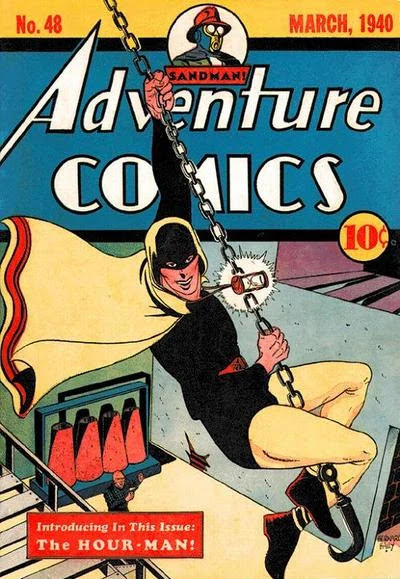
Adventure Comics #48 - pt. 2

And we're back with what I promised, a look at this issue's installment of Federal Men. In it, the FBI gets a hot tip that counterfeiters are working in Northville, and in an unusual way -- a fake $1,000 bill is mailed to them anonymously, but came from Northville. Of course, we're given no indication as to where Northville is but, since so many comic book stories have a New York City orientation by now, it stands to reason that "Northville" means somewhere North of NYC, so...maybe it's actually Albany? Or even Poughkeepsie? Ah well, it's all speculation...

The plot is one we've seen before and will see again -- the hero stumbles across a crime school where a professor (or professors) teach classes on forgery, safe cracking, and killing in exchange for a cut of future profits. This one is pretty expensive -- a complete course costs $5,000, plus 25% of your take for the first year. I would be really leery of allowing a real game mechanic benefit to this.

Steve Carson (our hero) disguises himself as a "tough" by smoking a cigarette, going without shaving, and possibly darkening his eyebrows. He's caught -- not because he looks just like Steve Carson, but because he gets fingerprinted and the Professor somehow has all federal men's fingerprints on file.

Fitting in with the dark themes at DC Comics this month, the deathtrap is a suicide machine -- you're strapped in, with a gun in your hand, and the machine makes you squeeze the trigger and shoot yourself in the head. Without wrecking things, it's a pretty foolproof deathtrap -- so the only way out for Steve is to have one of the hoodlums turn on the Professor and free him. The twist is that the hoodlum did it -- and sent the fake $1,000 bill to tip off the feds -- not out of any altruism, but revenge because he was about to be expelled.

By now, the Sandman has been downgraded from billionaire Wesley Dodds to millionaire Wesley Dodds. Wesley is shown smoking a pipe, and the Sandman carries binoculars for the first, if not only time, in this issue.

Dian Belmont is in love with Wesley already, if her letter to him is written honestly. Her father, the D.A., learns Wesley is the Sandman in this story and seems cool with it, even though the Sandman was wanted by the police in the past.

The Sandman is shown jumping safely from a second floor window. Should stunts be able to lessen falling damage? Maybe. Maybe...half damage per 10', per stunt?

The Belmonts own a Chris-Craft -- Chris-Craft Boats was an American manufacturer of boats that was founded by Christopher Columbus Smith. This page is a good commercial for them -- it's fleet, and can easily catch up to a yacht. 

When Sandman searches Judge Quick he finds a letter in a secret pocket. I'm not sure how you conceal a "secret pocket" on your person. A pocket inside your jacket certainly wouldn't qualify as "secret." Maybe it's sewn to the inside of his pant leg...? The letter is a major clue without even reading it, because it smells of one of the suspects' perfume. 

Sandman climbs a wine-covered trellis (it's called a ladder, but it's pretty clearly a trellis) to an upstairs window, which should be a basic skill check, maybe even with a bonus if the trellis is sturdy. Dian, the Woman in Evening Clothes (and that's including high heels, no doubt) climbs it right after him, and that's got to be an expert skill check.

In one panel, the gas from his gas gun is referred to as "deadly."   

In Socko Strong, Socko is trapped in a deathtrap underwater, but he finds a trapdoor that serves as the drain for this pool. It feeds to an underground stream and Socko is swept into it. He emerges, "finally," on the bank of a river. But how long was he underwater? Were there pockets of air for him, or did he hold his breath the whole time? We're not told, but those details can mean life or death in a realistic campaign. 

The next day, while shooting a film, the guide wire snaps on a heavy arc lamp, and the lamp is about to fall on a small girl. "The entire group all stands motionless in frozen horror -- except for Socko..." Now, there's two possible explanations for that. One is that, as the only Hero present on the scene, the Editor is making sure none of the other characters on the scene can upstage him. Or, the Editor used surprise rolls to determine if anyone was surprised by the falling arc lamp, or perhaps Socko surprises the falling arc lamp, giving him even more time to act.

In an interesting twist, the father of the girl was paid to kill off Socko by sabotaging his parachute for the next scene to film. Doing the good deed pays off and saves Socko.  

(Read at readcomiconline.to)


Saturday, January 23, 2021

Detective Comics #37 - pt. 3

Speed Saunders starts out in odd territory; Speed has been busted down to a beat cop in the suburbs since we last saw him, after being framed as a drunk. This is extra odd because Speed was never a police officer before! He also has a new friend, Patsy Ross. Speed has sunk so low that he doesn't see a way out of this without Patsy's encouragement, becoming his partner as he takes down enough mobsters to get his old job back. It's a really big departure for the feature, practically a reboot. 

You can do that with your Hideouts & Hoodlums heroes too, if everyone agrees. You also have to agree if you want to restart from zero experience points or from some point higher. 

Steve Malone, District Attorney gets involved when a woman is kidnapped for $50,000 ransom. The kidnappers aren't very experienced at this; they write out the random letter by hand. One of the kidnappers uses the phrase "No dope" to mean, "no kidding." 

There is a huge plot hole in the story where Steve plans to find the kidnappers by searching the woods he thinks they might be hiding by plane at night, and parachutes down by the first light he sees in that area. It turns out to be the kidnappers' hideout on the first try, but there is no reason why that should be the case; there could be any number of people with cabins in the woods, and they would naturally have their lights on if it's night.

This story turns really dark; not only do the kidnappers plan to kill the woman once they get the money, but it seems like one of them plans to rape her first before Steve shows up. I've never seen that in a golden age story before, and I don't like it.

Steve conveniently lost his gun when he landed (Oh, I haven't even brought up how low his chances of landing safely in the woods at night should have been!), but that's okay because these are low-hit die hoodlums and guns aren't that effective in their hands. Oops, Steve almost loses anyway, and the kidnapped young lady has to save him by setting the building on fire (it distracts the hoodlums, naturally!). 

Cliff Crosby is a reporter who gets a scoop over the phone - a moll/vamp wants to rat out her partner for the kidnapping of a judge (lots of these anthologies would have theme issues where the stories are all similar). The moll jabs paper into the phone to keep the connection open -- because phones used to work like that. Cliff, instead of being worried for her safety when he hears her partner confront her, brags about what a scoop this is going to be for him. Smooth, Cliff...

Cliff hears the mobsters threaten his moll on the phone, and he's still just threatening her when he shows up after...driving across town? Finding a parking space in the city? 

The mobsters are slavers! Cliff tricks them by saying he needs to call his friend at the office and tell him there was no story here (makes sense), but then they don't notice him tapping out Morse code (harder to believe). 

We know the slave ship is off the Florida coast, but never get a clue where the story started. On board the slave ship, a slaver tries to whip Cliff, and he grabs the whip. I would allow that with a successful attack roll, but the weapon automatically does damage to the grabber. After escaping Cliff throws a knife at a slaver hard enough that his hand is pinned to a metal wall. Had it been a wooden wall, I could see this happening after rolling to attack both the slaver and the wall, or rolling a certain number over what he needs to hit the slaver, but to pierce a metal wall is going to require a wrecking things roll as well.

Amongst the slavers are thugs. The thugs are better armed, with handguns and rifles. One man on the ship has a machine gun, but it's not clear if he's a slaver or a thug.

This issue continues to be really dark. When the Coast Guard shows up, most of the slaves on the ship are dumped overboard, while still chained, and apparently drown. The gangster heading the slavers captured the Coast Guard when he recovers the machine gun, Cliff is taken prisoner, and thrown overboard to a waiting "giant" octopus (maybe a large octopus?). Because Cliff still has a knife on him, he's able to kill the octopus. In a really weird moment, Cliff puts the dead octopus on his head as a disguise so he can sneak on board the ship (warning: this is a racist moment; he scares the "colored lad" with his disguise). 

In the Slam Bradley story, Slam inherits a racehorse, and every cliche about horse racing stories ensues. I'm not going to take the time to cataloging them. The Slam stories have been so lame since Joe Shuster left that I can barely stand to read them.

(Read at readcomiconline.to)


Friday, February 22, 2019

Crackajack Funnies #20 - pt. 1

It's been a while since we visited the comic strip reprints Dell was running with. This post is mostly about tactics.

Here, Don and company show us the best way to get through a minefield.
I didn't really need to share this page; I just think "Doctor Thor" is such a cool name. Don Winslow had a good rogues gallery.
In this age of automatics, we forget how easy it once was to stall your motor. There should maybe be a small chance (1 in 10?) per turn of a car chase of stalling your motor, or it could be just added to the list of halting obstacles listed in the chase rules in 2nd edition.

The scale seems to be  off on the Dwarf in that last panel -- he looks huge in that front seat.
"Espionage, eh? Sounds like a good name for a feature!"

Trying to pass yourself off as an inspector is one of the great RPG ruses and works perfectly here. You might have to forge some credentials, as not everyone will take you at your word like Mr. Rello seems to.
Note that Ed Tracer did not have to actively feel around on that wall to spot it was fake; secret door checks can be done on sight only.

Hideouts on piers with motorboats docked underneath them is practically a cliche by now on this blog.

This is the same year Dell will begin publishing squeaky-clean Disney comics, so I'm amused that they're still publishing stories about dope smugglers in February.
I like how, in 1940, the U.S. government is never a suspect. Conspiracy-based scenarios need not apply in the golden age!
Clipping the spark plugs is one of those complications I'll have to add to my vehicular combat rules.

The fighter aircraft pictured here is most likely a P-35. It's an interesting choice to compare the stratosphere plane to, as Wikipedia claims the "P-35's performance was poor even by contemporary standard" and "it was already obsolete by the time deliveries were finished..."
Wash gives us some more pricing information, with $830 being the cost of all new windows for a building and $300 being the cost of repainting a building.

Extortionists can be statted as bandits, at least according to Wash.
Rather than stat bodyguards, I think we need to recognize that Easy's pals are probably mid-level fighters, like he is.

Another example of non-Heroes needing longer to heal, in this case the hoodlums need three weeks to recover from being reduced to zero hit points.

Wire-tapping your own phone seems a sound strategy, especially if you suspect you have a spy in your midst.

(Scans courtesy of Comic Book Plus.)

Thursday, October 4, 2018

More Fun Comics #49 - pt. 3 - More Fun Comics #50 - pt. 1

Sergeant O'Malley of the Red Coat Patrol demonstrates balance by walking on top of logs floating in the river -- a basic skill check. As O'Malley and Pierre grapple on the bridge, O'Malley flips Pierre over the side, but Pierre still has a hold on O'Malley and pulls him over with him. This sounds like an Editor's interpretation of the grappling results (O'Malley's success on the turn following Pierre's established hold), as opposed to needing to become a consideration when one opponent pushes another.

In the water, the story shows how swimming with logs is dangerous; the logs bob up and down in the water like swinging clubs, so anyone in that environment is subjected to 1-4 head blow attacks per turn, depending on how densely packed the logs are.

Bulldog Martin is in Egypt, where the Phantom of the Pyramids has been raiding tombs. The Phantom wears a metal helmet that serves as armor (precedent for helmets helping Armor Class?), and carries a gun with a silencer and a crowbar.

Moving on to #50...

Wing Brady is riding to the rescue of a French Foreign Legion regiment who have fallen victim to vicious tactics -- nomads have snuck into their camp and killed the sentries so no alarm can be raised when the main force rides in.

Biff Bronson and Dan Druff encounter perhaps the first mad wax sculptor in comics. This is a dark story; the sculptor not only kills people and coats them in wax, but they stumble across a bust that is a cut-off head. They sneak back into the museum by climbing a tree and finding an open skylight. During their scuffle, a can of ether falls into a hot vat of wax and fills the whole room with poisonous fumes. Only Biff and Dan make their saving throws and leave conscious.

King Carter follows up on a hit-and-run in India and the trail leads to an "evil" prince, Ali Ghazi (groan), who is plotting an uprising against the British.  Ali has a guard who is armed with a scimitar, but is easily defeated with a punch. Ali is tough; he can throw a dagger so hard that it can crash through a window and stab someone (windows don't count as cover?). Ali doesn't use jail cells for prisoners; he seals them up inside brick walls, Cask of Amontillado-style. Brick walls are easily broken if the cement is not dry yet, apparently, making for a pretty weak prison. The palace (consistently called a castle) has at least one tiger wandering its halls.

(Read in fullcomic.pro)


Tuesday, August 14, 2018

Champion Comics #3 - pt. 3

This is still Blazing Scarab. The Curtain of Ammon is a magic item that functions like a...well, it's a television set with color and sound. Karnak is a real place.


 Memthet seems to be a fictional location.


Revenge of the Zombies is a serial probably based on the 1932 classic White Zombie.  Here, for the first time, we see undead zombies instead of space zombies or green hairy zombies. We also see Voodoo Charms, which act like a Charm Person spell on anyone wearing them.

The story is surprisingly dark, what with the dead goat left on the doorstep here, and later a dead pig is thrown as a distraction.

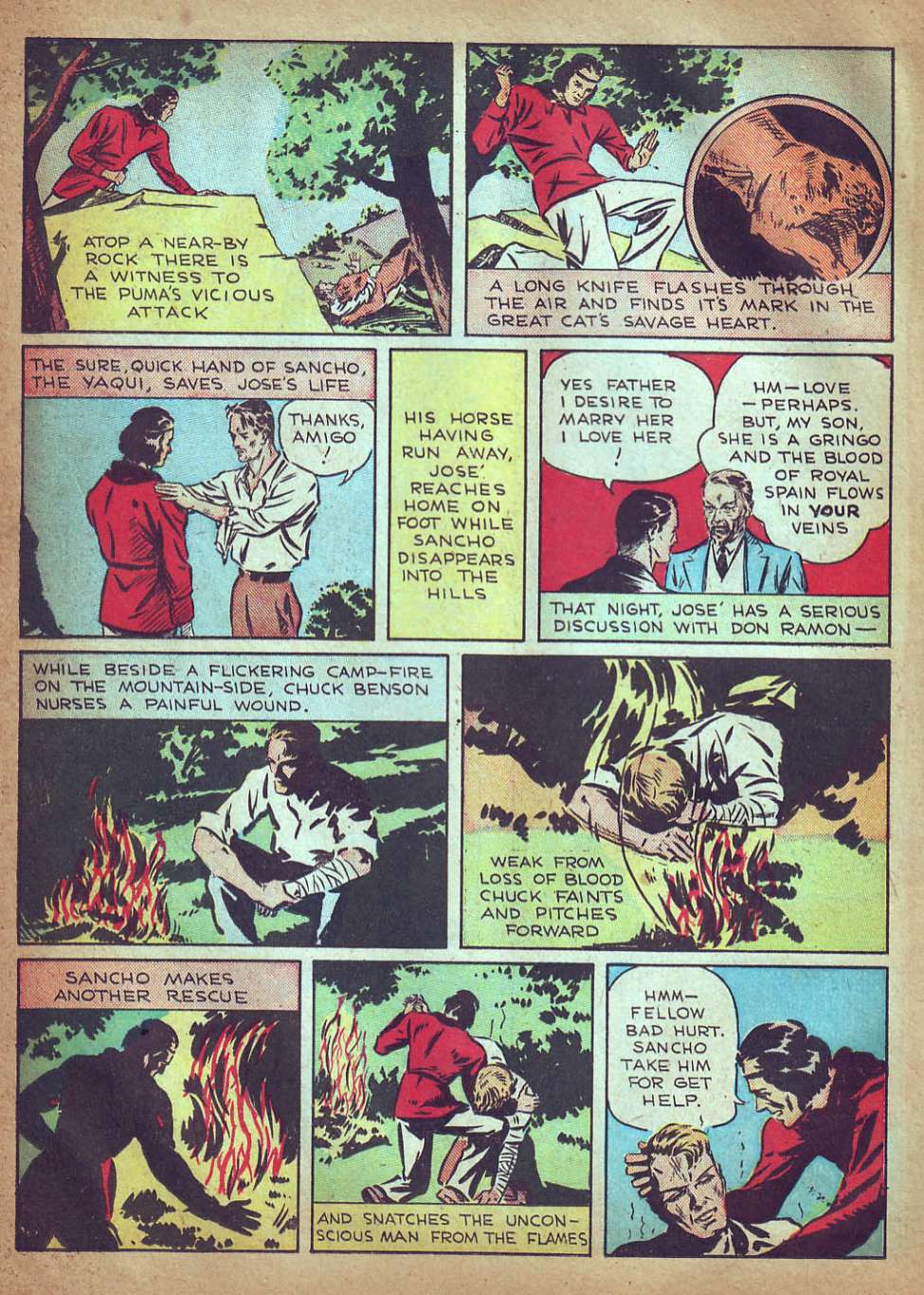
This serial is called Yacqui Gold. Yacqui is an Indian people indigenous to the southern Sonora state, on the west coast of Mexico. The art is by an obscure artist, Roland (or Romana?) Patenaude. Most of the art looks rushed, but the inking on that fifth panel is gorgeous.

Here is an encounter with a cougar (puma), and another example of a mobstertype being killed in one hit. 

Weakness from loss of blood is not a game mechanic in Hideouts & Hoodlums, though needing to sleep is an implied mechanic and perhaps he was also just really tired.

(Scans courtesy of Comic Book Plus.)