Showing posts with label Cal n' Alec. Show all posts

Saturday, January 30, 2016

New Adventure Comics #31 - part 1

Barry O'Neill takes it slow while moving through hideouts. He tests the walls, pulls on anything suspicious, like rings set in walls -- and finds secret doors that way!

In the first room behind the secret door, Barry finds two cobras. Luckily, even though Barry came disguised, he still has a concealed flashlight and weapon.

In the room is a note for Barry from his nemesis, Fang Gow. An Editor can always do this too, retroactively placing notes wherever the Heroes are, as if the nemesis anticipated them. Just be careful not to go too far with this, if the Heroes went somewhere really unexpected.

The tunnel after the cobra room is trapped -- it swiftly fills with water. I assume the secret door Barry used to get in can't be opened from this side. I'll have to wait until next month to find out how he gets out!

Tom Brent, in his adventure, is captured, but his captors forget to search him and leave a weapon on him. This same situation happened in one of my Hideouts & Hoodlums campaigns; in that case, the player asked for a chance of having a weapon left unfound on his person, so I gave him a save vs. plot to make that happen.

Tom makes the smart move of capturing the leader and making all his henchmen stand down, rather than fight his way through everyone. It's the safer move, anyway. I'm not sure I'd allow full experience awards for the henchmen for it, even though he's technically defeated them this way.

Players often want to get to where they need to go as early as possible. Tell them that they have a midnight rendezvous and they'll show up at 6 pm and start staking out the place. The same holds true for Steve Carson of Federal Men, who thinks the 4-hour car ride from Washington, D.C. to New York City is too long and flies there instead.  Knowing this, the Editor can plan more scenarios that require a time crunch.

On the other hand, if the scenario has high stakes, like a kidnapped child who will be killed if the Heroes do not find him in time, it's best to keep from setting a definite deadline, so the Heroes can always show up at the last minute and save him.

In Dale Daring, the Heroes shockingly take a moment to check their guns to see if they still have any ammo left. One is empty, but the other is okay.

I have suggested several "fixes" over the years for good ways to more easily keep track of remaining ammo during combat. One of them was to roll randomly, 1d6, to see how many turns you can shoot before running out of bullets. That seems to be what happened here, in Dale Daring, given the disparity between their ammo situations.

In Cal n' Alec, Cal wants Alec to go ahead because Cal thinks he sees quicksand and Alec doesn't. Sounds like spotting dangerous terrain needs to be a random chance, just like finding secret doors.

Cal n' Alec is a gag strip, so I don't know how seriously to take this, but it takes Cal five hours to dig a 25' deep pit.

As Captain Desmo's India adventure continues, a bounty is set for him at 20 gold pieces. Which is odd because, by 1938, India already was using the silver Rupee as its unit of currency.

Desmo wins two battles against the thieves by failed morale saves -- once after mowing down enough of them with a machine gun, and then later by mowing down their leader with a machine gun.

(This issue can be read at Comic Book Archives)


Monday, January 11, 2016

New Adventure Comics #30

We rejoin Don in Anchors Aweigh as he's lowering himself into the dark hold of a ship and praying "he wouldn't land on anything sharp cornered."  It's true that, while the base damage for falling is 1-6 points per 10' fallen, the Editor is free to lower this for falling on soft terrain, or raise it for falling on sharp, or otherwise more dangerous, terrain.

In the hold of the ship, Don takes a quick look around and manages to appraise the value of the cartridges being smuggled in the hold at a quarter of a million dollars. The first edition Hideouts & Hoodlums rules say nothing about appraisal (the implication being that everyone could do it automatically), but the second edition will treat it as a basic skill everyone has a chance to perform.

The first sailor who comes down into the hold is said to have "the agility of a monkey" and "runs down the rope ladder".  I'm tempted to add sailor as a mobster type, with the ability to climb up and down ropes and ladders faster than an ordinary person (or just give that ability to pirates).

In Tom Brent's adventure, Tom practices that most important of player tips -- when you have important papers to deliver, meet your contact first without the papers on you, in case something goes wrong.

When Tom tries to escape from the clutches of the fake consul, a guard has his rifle trained on Tom. Tom is somehow able to pick up the other guard and throw him at the rifleman before he can fire a shot. Now, it's possible that Tom won surprise, got a free action (the grapple), and then won initiative on the first regular turn of combat. Or, Tom picked up the first guard during his first turn, but the rifleman refused to fire because firing into a melee has a chance of hitting your ally if you miss.

Tom is captured again and tortured for information -- specifically, he is hung from his thumbs and whipped while shirtless. I would not expect an Editor to have to go into that much detail; torture can be glossed over and summarized by a save vs. science to resist. I would, ironically, require this save once per 4-hour "rest" turn.

In the adventure of Steve Carson of Federal Men, our story opens on the trial of three men accused of treason, with the judge saying "I regret that the sentence for treason carries only a twenty year penalty!"  Actually, according to the U.S. Constitution, treason can be punished with death. It is, however, appropriate for the courts to be more lenient in a comic book universe, as this allows a lot more repeat appearances by the same villains (something that will become more of an issue starting with the Silver Age).

A wanted poster shown to Steve shows a $500 reward for a wanted criminal.

When Steve is about to lose a fight, he is saved by a boy who throws a baseball and beans the mobster in the back of the head. I would normally allow a full grown man to do 1-3 points of damage with an improvised missile like a baseball; for a half-pint, I would probably restrict damage to 1 point of damage. Of course, the mobster could be on his last hit point from the unarmed combat with Steve before the baseball hits him.

Later, another half-pint Junior Federal Man thwarts an attempt on his own life by having rigged an alarm system for his bedroom -- anyone climbing the drain pipe outside his window pulls a string that causes a ball to drop and land on the boy's sleeping head to wake him -- after which the boy can bash the intruder with a baseball bat while the intruder is prone and hanging from the window ledge. If this comic strip -- and the movie Home Alone -- has taught us anything, it's that half-pints should be good at setting traps and alarms.

Nadir, Master of Magic, deals with river pirates in his adventure. They are well-equipped pirates, piloting speedboats and armed with sub-machine guns; they might be better statted as robbers than as pirates, since robbers tend to be more hi-tech. Nadir defeats them with a Charm Person spell on their leader, who Nadir gets to sound a retreat.

Later, Nadir is ambushed by peculiar attackers using a noose. I would say that a noose could do normal 1-6 points of damage on a hit, but only if the hit occurs during a surprise attack. If the victim is somehow unable to free himself, he will continue to take damage each combat turn.

Cal n' Alec is a joke strip about two old prospectors, but they remind me of played characters in this installment. Frustrated that their mine was buried in a dynamite explosion, they briefly decide to swear off prospecting. This can happen to players too, who can feel disgruntled by too much failure in a game scenario. In the end, though, Cal and Alec bite on their next plot hook when a stranger runs up and hands them a map -- and stalwart players will often bite on that next plot hook too.

Incidentally, I'm not keen on preparing any game mechanics to determine the extent of a cave-in when a mine is hit by dynamite. There just needs to be things for the Editor to wing as he goes along.

Another example is The Adventures of Desmo and Gabby.  Gabby loses his wallet during a fight. There does not need to be a game mechanic to check for seeing if you lose something from your pockets during fights. Sometimes, players just need to accept that their Editor has a story-based reason to make something happen.

Tod Hunter, Jungle Master, finds rubies worth $5,000 each, which is 10 times what I guessed rubies were valued at in Book III: Underworld and Metropolis Adventures (in the gem table previously found in Book II: Mobsters and Trophies).  Guess I may have to revisit that!

(This issue can be read at Comic Book Archives)


Tuesday, August 25, 2015

New Adventure Comics #21

I'm still playing catch-up on this title, so this is actually the issue of New Adventure Comics from November 1937 and, hopefully, I'll be able to review December 1937 next.

Captain Jim of the Texas Rangers shares a little history lesson for you on how common it used to be for men to write their names in their hats. A good clue if your Heroes happen to find a hat at a crime scene!


Note that the cowboy here is surprised, but his horse isn't. Normally, the Editor only rolls surprise once for each side, but if a Supporting Cast Member (particularly an animal SCM) has extra-keen senses, then that could be reflected in a second surprise roll for that side.


In the Golden Dragon serial, Reilly is frustrated that he can't find a secret door. Actually, he knows the secret door is there -- he just saw some mobsters open and shut it on the previous page. What he can't find is the way to open the secret door. Of course, if there is no opening mechanism on this side, no number of search rolls will find it.

Instead, Reilly could choose to try non-Superhero wrecking, but a stone door would have a very good saving throw and he is probably wary of attracting wandering mobsters for however long that could take.


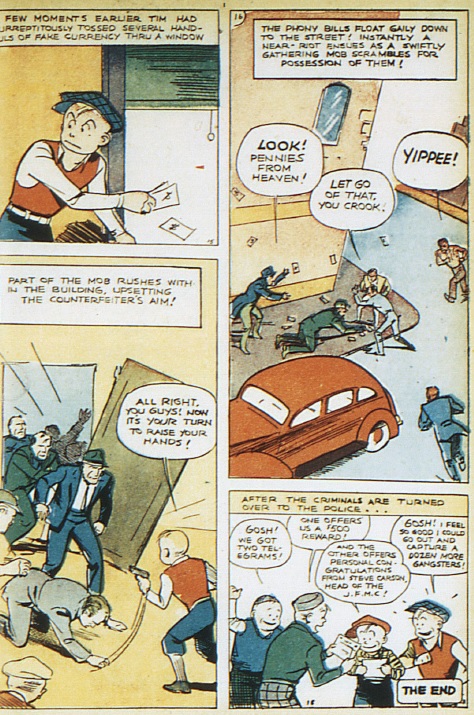
This month's Federal Men is again devoted to the Junior Federal Men Club (J.F.M.C.). This installment makes crime-fighting look like easy employment; no sooner have the police taken their prisoners then Steve Carson of Federal Men telegrams them congratulations, and another telegram promises them a $500 reward. This system could level up Heroes fast!


There are arguments for and against keeping track of ammo in a H&H gunfight.  A quick argument against: mundane "bean counting" runs counter to the fantasy elements of comic book action; a quick argument for: Cal n' Alec, counting bullets to know when their opponent's gun is empty.


Nadir has a magic crystal ball with an interesting limitation -- it can only be used between 3 am and dawn!  Time restrictions, race restrictions (like, only a merman can operate it), and items that can only be activated by destroying other items (like draining the magic out of lesser magic items) are all more inventive ways to keep a powerful trophy item from being too powerful, without saying it can only be used once per day, or it only has x number of charges.


What's this?  Nadir, Master of Magic, using guns! That's a big no-no for Magic-Users. But he's not really using them, is he? He's just holding them and, perhaps, planned to bluff his way through an encounter holding them, but wouldn't be able to hit the broad side of a barn with them.

I had a similar situation in an earlier H&H campaign, where a player wanted his Magic-User to carry a bow and arrows. He accepted that he would have no chance to hit with them in combat; he just wanted them for how he envisioned his character.


Another magic item, and this one's a new one -- Nadir apparently has a Ring of Alertness, that keeps him from being surprised.


Sandor encounters a lion here who treats him as if he already knew him. It's possible, actually, that Sandor had encountered this lion before and recruited it as a SCM, either behind the scenes or during some earlier installment I've forgotten or never got to read. An Editor can also, at his discretion, allow a player to make up SCMs from his backstory. The Editor must be careful, though, to consider the implications and how the Hero might benefit. Having a lion for a friend could be an unfair advantage over the other Heroes.

(Scans courtesy of Comic Book Archives)