Showing posts with label Mysteryman. Show all posts

Thursday, January 27, 2022

Mystic Comics #2 - pt. 5

We're back with The Invisible Man Known As Dr. Gade, which is admittedly a really unwieldy title and perhaps one reason why Gade literally disappeared from comics after this. 

While visible, Gade is no better at fighting than an ordinary person, which makes me wonder if he isn't a Magic-User with some brevet ranks at all, but should be statted as a 1st-level Mysteryman given a powerful mad science trophy item by his Editor. 

Gade also has a disintegrator - and not just any disintegrator, but an "old disintegrator" - like he'd invented it ages ago and then lost interest in it. Maybe it didn't work proper, because Gade has to throw his enemy into it and make it explode to kill the man.

I think I'm more turned off by heroes who kill now than I was a few years back, as I'm only giving that story a B+ now.

The next story is Zara of the Jungle, a Sheena clone (but with dark hair). It starts with Captain Jeff Graves, heading out into the jungle to try and stop the local tribes from fighting. He has a wandering encounter with a lion that he ... *sigh* kills with a single bullet. 

The native tribes are drawn...really weird. I've seen a lot of racist depictions of black people in these early comic books, but these guys look almost like aliens. 

Jeff is captured after falling into a concealed pit (even though it doesn't look even 5' deep). Zara rescues him, first by shooting the natives who are about to execute Jeff with her bow, and then by shooting the ropes off of Jeff -- which would be a near-impossible trick shot for anyone but maybe a Mysteryman using a stunt. So Zara is a Mysteryman instead of a jungle Explorer? 

Again more racism -- it is implied that Zara is able to stop the tribes from fighting just by the "white goddess" showing up on the battlefield. But I wonder, would they have stopped fighting if a pretty woman of any color had shown up? And if so, this speaks to the power of a having a high Charisma score.

The last story is Dakor the Magician. Dakor is unusual in that he has a personal secretary. He also needs to cross the Pacific by plane instead of magic. To rescue a British consul from Chinese bandits in Singapore (quite the international adventure!), Dakor disguises himself as Chinese, apparently using makeup instead of magic, and pretends to be a pistol peddler to win the bandits over (instead of just charming them). When a guard catches Dakor at the consul's cell, Dakor punches him out instead of using a spell. 

The spells don't start until page 4, at which point Dakor Polymorph Weapons (3 spears into cornstalks; I think I've talked about needing this spell before). He then creates magic scissors that cut the ropes binding him, which could be flavor text for a Knock spell? Then he casts Knock again for sure on the cell door, with the added wrinkle being that he can make the door swing open so hard that it hits a bandit enough to hurt him (a freebie from the Editor? An extra-strong Knock spell?). 

The biggest takeaway from here should be that Dakor can cast spells with his arms bound, proving that Hideouts & Hoodlums magic-users need to be flexible in what disrupts their spellcasting. The second biggest is that Dakor casts the same spells twice. I have long toyed with the notion of a mechanic that would give magic-users a chance to retain a cast spell...and it seems that Dakor has that, unless he just happened to memorize the same two spells twice. Actually, three times with Polymorph Weapons, as soon he's changing a thrown knife into a bird. 

I have serious issues with Dakor being able to cast a spell, while falling into a pit trap, to polymorph the spikes at the bottom into springs. Casting a spell in melee is one thing -- he could have started casting that Polymorph Weapons spell before the knife was thrown -- but he doesn't know about the pit until he's already falling, and it should only take 1 second to hit bottom in a pit that shallow, which is way too little time to cast a spell. The only other suggestion I have is that maybe one of these polymorph spells has a duration and he can change anything at will during the spell duration.

The last spell he casts makes a giant net, but ...man, that sure looks like a Web spell to me!


Tuesday, December 14, 2021

Zip Comics #3 - pt. 5

More Captain Valor today, with Mort Meskin showing off his skill with crowd scenes, though hampered by some really racist depictions and sometimes sketchy details. I bring this to your attention, though, for panel 1, so we can talk about the two ways to set up a fight scene. Version 1 is that it occurs in "real time," with the crew arriving onto the deck in waves as they can reach it. Version 2 is that you set the scene with all the fighters already in the scene and then start the clock again. 


And we're jumping out of Captain Valor already into the next story, Mr. Satan. Holy cow, this scene is gory. There's actual blood everywhere! These bad guys are brutal...but the point of sharing here is the second to last panel, where Mr. Satan runs out, grabs the girl, and escapes unseen. But unseen by how many? We only see that one guy, but there must be a lot of other killers around. Is it fair to say this can be explained away as a surprise turn, a moving silently skill check, or maybe both to reflect the difficulty of no one happening to see him?  
 

The panels seem to be in the wrong order here...Mr. Satan should probably try to get that woman to safety first, instead of leaving her alone in a tunnel and going out to look for clues. 

What else can we gather from this page? Superhero costumes, despite appearing to have no pockets, must have room for matches or a lighter on them somewhere, or Mr. S would never have got that giant fire lit so fast. 

Also, we learn that rocks used as improvised weapons don't have to be very big.
That seems, at first, to be a clever twist about the sheriff, and having them both wind up on the tracks makes it seem extra surprising when the big reveal happens, but...why did it happen? Is he showing off his confidence in his men, that they would not betray him by tying him up for real? Is the deception part of trying to get Mr. Satan to reveal when the payrolls are "going to ride," and if so, why not try to trick him into telling while still on the tracks? Or he could have revealed himself as leader sooner, never been tied down, and still used the threat of the train to coerce Mr S into giving up the info? But on the other hand, if the robbers don't know when the payroll is coming, why are they so sure a train is coming soon? 

And if Mr. Satan knew the national guard was coming, why go back early to scout with the sheriff without them?

If it wasn't already obvious, Mr. Satan would be statted as a mysteryman. His "spectacular leap" and snatching Doris out of the car and jumping out in time both qualify as mysteryman stunts.


Now we're going to jump into the next story with Zambini the Miracle Man, and this is a prime example of everything wrong with the magician genre: if your magic-user is so powerful that Satan himself has to plot against him while he's on vacation so his guard is down -- then your magic-user is too powerful.

As if to illustrate this, Satan causes a tidal wave to threaten Zambini's ship and, instead of simply calming the waters, Zambini freezes "the oceans." Way to alter Earth's climate there, Zam! 

More interesting are these devil men...let's see if I need to stat them! Hmm...I guess not -- they get mass polymorphed into penguins on the very next page before they can do anything!

Mass Polymorph is, of course, going to be a Hideouts & Hoodlums spell. I think I've determined before it would have to be a ninth level spell, even though it gets cast an awful lot in comic books.

Sure, Zambini could have just cast Resist Fire on himself instead of conjuring asbestos...although, perhaps he did cast Resist Fire and this is how it manifested? Previously, we've seen Zatara cast a healing spell that made a first aid kit appear. The conceit here is that magic takes whatever form is most familiar to the caster. 

Really, Zambini? You're traveling into Dante's Inferno and your only concern is how long the trip is taking you?

And is he really trapped in a net, or just relaxing on a hammock?  
 
Whoa, whoa, whoa - take a close look at that Cage of Flesh. The bars are made up of human forearms, each grasping the next one in the row. That is crazy grizzly -- but also just the thing to impress veteran D&D players, accustomed to dungeons full of grizzly things. That it seems to contain an anti-magic field is just icing on the cake.


Who's the fool, Satan? You just told them to push the flammable cage into fire. 

The "docile" rabbits tracks with how polymorph works (or at least the spells of 4th level and above; H&H has lower level polymorph spells this won't apply to), as there should be a chance of losing your mind/personality to the new form. Otherwise, these would be satanic rabbits!

I'm not going to show you the rest of this crazy story, but here's two spoilers: one, Zambini meets a dinosaur down there, either brought down there in prehistoric times as a pet, or the story is suggesting that's where dinosaurs all went when they died?

Lastly, Satan is killed, which is a pretty crazy ending for just your third issue. 

(Scans courtesy of Comic Book Plus.)


Sunday, January 17, 2021

Detective Comics #37 - pt. 1

SPOILERS: This is the very last pre-Robin Batman story. 

One of the reasons I find the infallible Batman of today's comics so laughable is that he bears nothing but name and costume in common with this Batman, the Batman who gets lost and stops at a random house to ask for directions. 

In the house, a man is being tortured by three mobsters. Despite the fact that one of them gets the drop on the Batman with a pistol, the Batman is still able to go first and kicks him in the face hard enough to knock him into the mobster behind him. Two game mechanic things here: one is that there is no order of battle in Hideouts & Hoodlums, where missiles always go before melee. The Batman has won initiative, so the advantage of already pointing a gun at him disappears. The other point is the two attacks. This should only be possible if the Batman has levels in fighter and these mobsters have less than 1 Hit Die, or if he was a superhero using the Multi-Attack power. Neither should be the case here, since the Batman is obviously a mysteryman. There is one more area with some wiggle room, and if you recall the Batman's stats from Supplement IV you know I already used it; the Batman's signature move is hitting mobsters with other mobsters. This is actually borne out in the following panels; the Batman drops those first two with one kick, but it takes him two punches to drop the third one, possibly because that mobster had more hit points, but also possibly because the Batman no longer has as good an attack bonus against a single opponent. 

The first plot twist is that the tortured man, once freed, delivers a head blow that stuns the Batman (head blows are common enough that it is now a combat rule in 2nd edition). Because the Batman had already tied up the three mobsters, they are easy targets for the fourth man, Joey, when he uses a gun on them. If the tied-up men were Heroes, he would only get a +4 bonus to hit them (or at least the one who was only stunned and is awake already), but because these are just mobsters the Editor can handwave that and say they are each killed in one shot (as happens here).

The Batman's only clue as to where Joey went is that they all said they worked for a man named Turg. Later, Bruce Wayne remarks how uncommon that name is. No kidding, Bruce! Ancestry.com only lists six Turg families in Ontario, and none in the United States. But in this story, Bruce finds three in the New York City phone book and after visiting all three deduces the suspicious one is the one, Elias Turg, who opened a grocery store in a part of town without many houses in it. Most people would consider that a zoning issue, but to the Batman, it's a vital clue that turns out to be correct!

Later that night, the Batman barges into the upstairs office of the grocery store and finds Turg there with Joey and two more mobsters. He decides to intimidate them from the doorway first, spoiling any chance of a surprise attack. They are all 15-20' away, so the Batman can reach them easily for melee if he wants to, but this Batman doesn't feel infallible against four-to-one odds, so he turns off the lights and uses night-vision goggles. They aren't called night-vision goggles; the narrator calls it a "queer piece of glass," probably because the term "night-vision goggles" isn't in use yet. Night-vision devices are brand new on the battlefields of Europe, so new that I'm not sure the author (Comics.org credits Bill Finger) would even have heard of it yet and may have invented this idea independently.

After roughing them all up, the Batman does something I think is really clever; he pretends to leave and then hides before the lights come back on, so the mobsters will start to talk incriminatingly in front of him. It turns out, they aren't hoodlums but spies (or at least all of them but poor Joey, who they turn on and kill because the Batman called him out by name). 

En route to the piers to commit sabotage, Elias Turg splits off from the other spies and the Batman has to choose who to follow. He follows the other spies to the pier, where they are met by two more spies. Actually three more spies, because Carl (probably the lookout) is on the balcony of a building behind the Batman and gains a surprise attack (because he is standing separate from the others, he gets his own separate surprise roll). He drops a heavy sack full of ...something heavy on the Batman's head and it counts as a head blow attack, stunning the Batman again. Instead of just shooting him and killing him (which actually makes sense here, since they don't want to alert the ship they plan to attack), the spies put him in a sack and toss him in the water. Stunning has a very short duration and the Batman is able to cut his way out of the sack with a knife in his utility belt before drowning. 

When the Batman sneaks back up onto the pier, he switches to another favorite tactic of his, swinging on a rope to attack. It's very cinematic, but definitely would not improve his chance to hit. I think I talked about this before when he killed Jabbah this way and decided I might allow a +1 to damage for doing this, due to the additional momentum. 

Despite beating all five spies in melee combat, they still managed to start the moto launch rigged with TNT that will blow up the docked steamer that was their target. The Batman tells his feet to run like they've "never run before," perhaps burning his first stunt of the night to run faster so he can reach the end of the pier in time to jump on board. Once he's on board, the cutting of the ropes holding the steering wheel and turning the wheel in time takes four panels, but there are no game mechanics in play anymore to resolve this, only stated intentions.  

The story could have been over at this point, but there are two additional pages that seem rushed, as if tacked on. Joey had given the Batman the phone number for The Head (as in, the head of the operation) before dying, so the Batman finds out who's number that is and goes to his house. It's someone named Count Grutt and the Batman is either genuinely surprised or being sarcastic when he seems astonished that someone named Count Grutt is a foreign agent. Grutt is actually Turg without a disguise on (notice how the name is reversed; semi-clever, but if Grutt had gone by the name Smith, the Batman never would have found him). 

Grutt/Turg has super-strength, able to throw a sword across a room with enough force that it goes halfway through a door. Count Grutt must be a supervillain, buffed with ...Extend Missile Range? Then the Batman pummels Grutt until he's down to zero hit points. With his last punch, the Batman must have pulled his punch a little and transferred some points of damage into pushing Grutt back, because Grutt falls back into the sword, which kills him, since he just took more damage while at zero hp. The Batman doesn't seem concerned.

(Read in Batman Archives vol. 1.)


Wednesday, December 23, 2020

Target Comics #2 - pt. 1

We return to Carl Burgos' third android hero. I don't have much to say here, since this is largely recap from the first issue, but...Dr. Simms, the world is at peace? In 1940? How long has it been since you looked at a newspaper?


Carl Burgos seems to be on the side of isolationists here (spoilers: that's definitely not the direction the U.S. wound up going in). 

So far, we don't know what this chromelac can do, unless it can make blinding flashes. Maybe an alloy made with magnesium?


Here's the page where we first learn chromelac is an alloy. We also get a demonstration of how you made phone calls in 1940.

It's worth noting that Manowar has to climb the fence; he does not have the leaping power prepared and it's not his built-in android power. The white streaks from his eyes suggest Wreck at Range is his built-in power. However, a speeding bullet is an awful specific, hard-to-hit target to wreck.  It's tricky because wrecking doesn't specifically call for attack rolls normally, to some extent wrecking is an area-effecting ability, but the Editor can require them at his discretion. A stingy Editor could assign an Armor Class of 0 or lower to a speeding bullet.  

It's rare for us to learn that mobsters are using automatics, not that it does them any good. It seems that only one of them gets a chance to hit before Manowar gets to go, which defies how initiative normally works in H&H, with each side rolling against each other. Now, it won't break H&H if you, as Editor, decide to switch to individual initiative rolls, but it does slow combat down unnecessarily.  Of course, just because they're present doesn't mean mobsters need to attack.  They might have been overconfident enough to just have one attack first.

"High tension electrons," huh? Well, that's sort of a thing. He must mean high tension electron voltage, but tension is, as far as I can tell, what helps power your television or your electron microscopic; it's the voltage that can harm you. Here, Manowar is using the Blast power -- perhaps our first encounter with it in a comic book! -- to harm, although an alternate explanation is that he's using Wreck at Range to disarm (his goal is clearly to disarm, but both attack methods have a chance of disarming).
I'm not sure what the science is, if any, behind the electrons having to strike the steel bar first before hitting the water. Apparently being stunned by electricity makes you mispronounce words. 

Manowar is sort of correct, that electrocution typically means grave injury or death, but I think, technically, even being stunned should count as electrocution.

I don't plan on making "toughie" a mobstertype. Toughie sounds enough like thug that I would just use that one.

Note that, again, Manowar has to climb because he can't leap (I point it out because it's so unusual for a superhero circa 1940).

Ha, I would have been right to use thug stats for the toughie!

The narrator calls those guys guards in panel 4; I wonder if that makes them rented cops, as opposed to on-duty officers. There shouldn't be any difference in statting them; they would still be beat cops. 

There is no game mechanic that causes heart attacks; that must have been a freebie from the Editor because the game session needed to wrap up. 

I'm going to have a Message power in the Heroes Handbook, if I ever get that done.

Wait - we still don't know what chromelac is! Is it a magnesium alloy? If it is, why do you want to make bridges and houses out of it? Maybe you should have thought this through before killing Tomsen for just wanting to make a profit off of it, Manowar...
We're going to jump right into the middle of Bulls-Eye Bill and the good stuff. Everett does not write your typical hero stories, so here's the bad guy kicking the good guys' butts. The question I pose here is, should kicking with boots with spurs on them do more damage than kicking with boots alone? Except in deliberately rare situations (trophy weapons), all weapons do the same range of damage in H&H. Again, it's a deliberate choice to go with abstraction over accuracy. 

Now, an option for the Editor that isn't really spelled out in the rulebooks is that, in a situation like this, where the bad guy really kicks butt due to lucky die rolls, the Editor could make his weapon a trophy weapon with a higher damage die, even if the weapon had not been intended to be a trophy weapon, nor did higher damage during the battle. The fact that there's a fun anecdote tied to the item enhances its importance in the campaign.

Let's overlook the racist Chinese caricature for a moment. Can you guess the code? That's the kind of clue that can keep your players guessing for sessions...I love it!


*sigh* Now we have a racist "half-breed" caricature. Relax, I'm not going to create a half-breed mobstertype with fantastic leaping abilities. Rather, I think this is a good example of an enemy mysteryman using a stunt! He's probably higher than 1st level too, since he takes a bullet and is still ready for more fighting!


(Scans courtesy of Comic Book Plus.)


Saturday, April 4, 2020

Flash Comics #3 - pt. 3

King Standish debuts in this issue, a prettily drawn mysteryman feature by Gardner Fox and a William Smith, who I've not heard of before. King is one of those master-of-disguise types, and an excellent pick pocket, able to remove a wallet out of a woman's purse -- while facing her! That's definitely a mysteryman stunt, not possible with a simple skill check (though maybe one at a significant penalty, like making it a 1 in 10 chance).

King's interesting gimmick, at least initially, is his anonymity. He can just show up in evening dress and either admit he's the King or deny it; all he's known by is his calling card, an actual card with a crown on it.

Deliberately walking into a trap to prove to a pretty lady that she's fallen in with mobsters, King is attacked by two thugs in an ambush. Fox doesn't seem to ever get how bulletproof vests work, as King's makes him completely immune to the impact of bullets, and they just bounce off his clothing. King also has a "specially built, high powered car," though we never see what's so special about it. His license plate reads "410-W."

King cracks a combination safe, which would be an expert skill check.

Appropriate for a first level mysteryman, King is about to be overwhelmed by the two thugs along with their boss, and needs to be saved by the aforementioned lady (who's not adverse to killing with a gun, apparently).

In The Whip's adventure, he uses a tripwire to trip at least five running people. The first person reaching the tripwire I would have make a save vs. science to avoid tripping, and then each person after him a +1 bonus. The first person to make their save stops the others behind him from falling for the trap. This is a rather mild trap, only making the runners prone for one melee turn, but since he only uses it to get their attention it is quite effective.

Quite a bit of Spanish is being tossed around in this installment, including common words like "bueno" and "amigos," but also words less common in comic books, like "adelante" (for "go ahead!") and "enredeso" (for "complicated").

The Whip's whip tricks include using the whip like a grappling hook, and then supporting his weight while he climbs a wall, and grabbing and pulling an item with the whip. I hesitant to assign game mechanics to the former; with no time limit, he could just keep trying with the whip until it caught on the balcony (though the actual climbing might require a basic skill check). In the latter case, since it occurs in combat, the grab-and-pull needs to require an attack roll, vs. an Armor Class of the Editor's discretion (it's a complex move, grabbing the shade and pulling it down over someone's head, so I'd say AC 6 or 5).

One of the mobsters the Whip encounters uses the slang "horse-podder." I cannot figure out what that means. In the context of the sentence, it seems to mean BS, and the literal definition of "podder" is "a cup." So I don't get how these things go together.

(Stories read at readcomiconline.to)

Saturday, December 7, 2019

Jumbo Comics #13 - pt. 3

This is Stuart Taylor's lab now? Interesting, because in the beginning, Stuart was just lab assistant to Dr. Hayward. Has Hayward died and left everything to Stuart?

Laura raises a good question about how sexist Stuart is, though Stuart could have countered with the more logical response, "I need you to work the controls that get me home!"

So, in the future, giant mosquitoes will be mankind's worst problem, just like in Minnesota today.

The numbers encountered in this story seem way off. Somehow, the city's defenders are just three guys with one cannon?

And then there's the convenience of Stuart being the only person in the room to think of picking up a hand weapon when the insect arrives. Yes, it makes sense to always give the Hero an opportunity to shine before any non-Hero characters in the room, but this would have made more sense if the soldiers were outnumbered.
So, in the 93rd century, there are very few people left, they have atomic-powered hand weapons, but don't wear pants.

We never learn how the atomo-gun is better than what Stuart last used; he appeared to disintegrate the giant insect in one hit before, so this gun is an improvement how...?

What kind of time machine is this that, that Stuart doesn't know what year he was sent to? Does it just randomly fling him to some year?

Are we to believe the City of the Insects was built by insects, or just taken over by them?


I had to laugh out loud when I read this page. What a terrible plan this was...

"I'm going to take on the insects in their lair! Stay behind men, I'll take this stranger with me!"

"Oops -- I forgot, their lair is outside my jurisdiction! I'm not a soldier, just an ordinary policeman. Here, why don't you take care of the insects for me? Bye!"

So...can only the leader talk, or are they all intelligent insects? We never learn!
This page is pretty comical too. The insect king keeps Stuart prisoner, but without any restraints, without any guards -- in fact, the insect king is now all alone! Where are his followers? Apparently either all killed by the invading army ("Just kidding -- it was actually in my jurisdiction after all!"), or like an ant queen the other insects lack direction without their leader.

Speaking of if things make sense...Stuart is the one who bumps into the generator, but is the only one in the room not hurt? I guess the electricity has an area of effect, with a saving throw for half-damage, and Stuart was the only one who made his save.


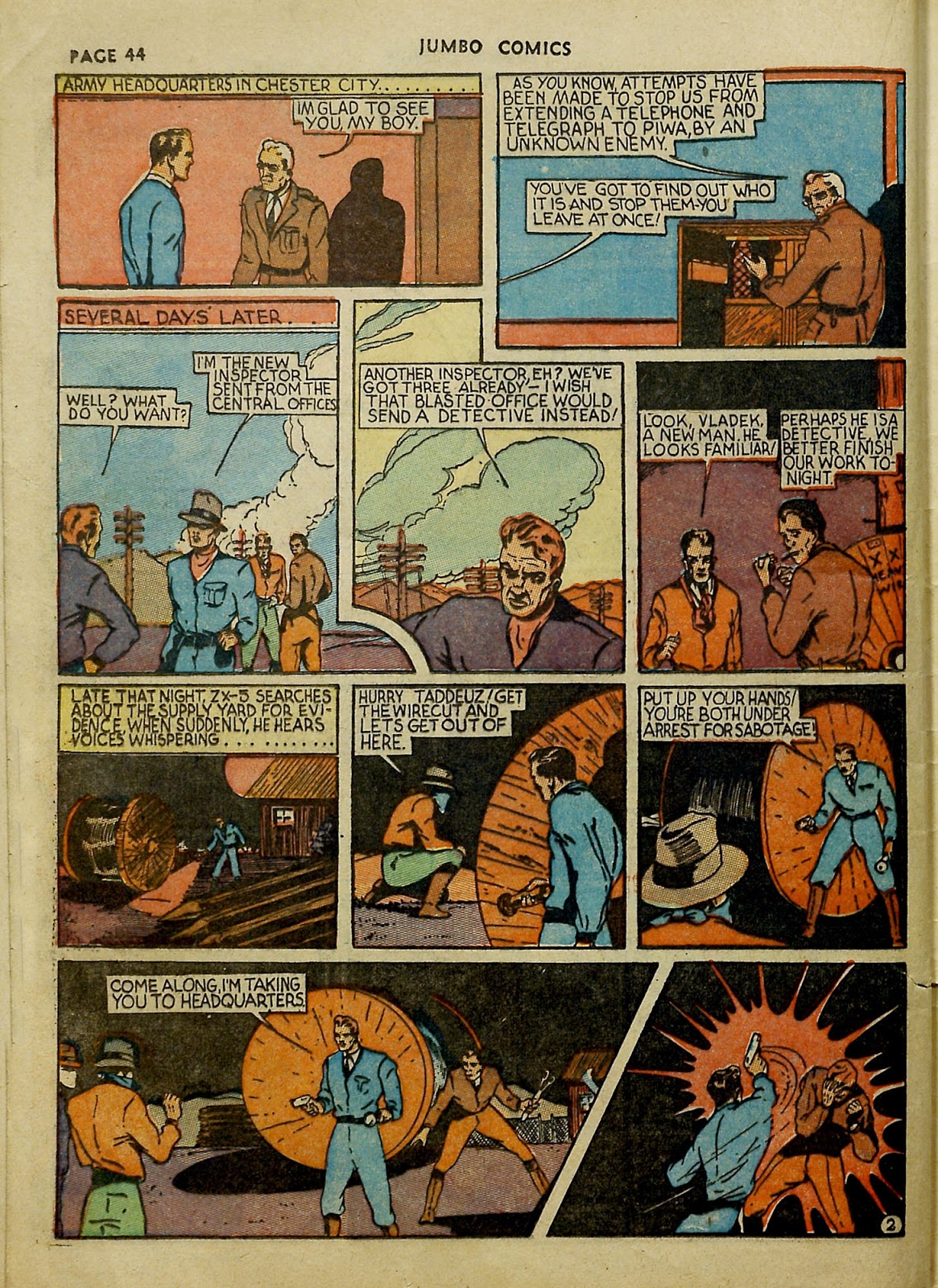
Moving on, this is ZX-5 Spies in Action. This story seems to take place in Ukraine or Russia, given the names, which makes it so weird when something like "Chester City" winds up in the mix. Is this supposed to be Chester, England?


I hadn't bothered including the first page of this story so you might not follow the twist here, but ZX-5's girlfriend was with him at the start of this story and, apparently didn't have the documents yet or this adventure would have been much, much shorter. This is a novel twist to pull on your players, having a supporting cast member turn out to be something other than she appeared to be, as long as you don't use this too often.

Completely ignored between panels 7 and 8 is how ZX-5 gets into enemy HQ and gets the general alone. That's probably not the sort of thing you would normally gloss over in a game scenario; in fact, that's likely more likely to be the main goal of the scenario, as there is exploration involved then.

ZX-5 has successfully grappled General Miaha, but does not need any kind of game mechanic to just point a gun at his head. Rather, the player stated the intention, the Editor adjudicated on the spot and determined that warranted a morale check, and the general failed. Or is that the general...?

...Because it seems really weird to capture the enemy's general, but then take Captain Vybral hostage instead. In fact, the whole scenario gets super-sidetracked at this point, with the mission becoming rescuing Manya from Vybral and nothing else really happening on the front. This is part of the charm of a roleplaying game that there is no winning or losing and goals can be highly flexible in a scenario...but as a story, it really doesn't make much sense.

In addition to guns, we see soldiers using knives and whips. These soldiers seem like they would need to be statted as something other than ordinary fighters, because they go into a berserk frenzy if their leader gets taken down first. I hesitate to stat Cossacks as a mobstertype because that's a little racist...maybe we should call them berserkers, or just add this special ability (+1 to hit if their leader is incapacitated) to bloodthirsty hoodlums.


Speaking of berserk, ZX-5 does the same, and I think we can safely say he would be statted as a Mysteryman now, because fighting after a woman has been struck seems like his signature move now.

Panel 6 sure makes it look like some passion is about to spark in the heat of the moment. And just how did his shirt get ripped off again...?

Lastly, why is ZX-5 being congratulated, when it seems like Manya did all the work? She delivered the papers herself and then summoned the English Army herself.

(Scans courtesy of Digital Comic Museum.)


Sunday, November 17, 2019

Thrilling Comics #2 - pt. 3

Saving the Wayne Girl is worth 100 XP for the good deed. Capturing the Mask is worth $25,000 and almost guarantees a level up.

And yet...letting the villain slip away once he's underwater is a staple of the genre, so he would have had to make a save vs. plot to dive for the Mask.
Now we'll jump into Tom Niles, Undersea Raider. This strip is even harder to read, with smaller font and gray captions. I could read enough for this part to jump out at me, about Berlin being a seaport. That can't be right, can it? I thought. Apparently, Berlin is linked to the Baltic Sea, the North Sea, and the Rhine River by a network of rivers, lakes, and canals.

There are a lot of ways this encounter at the bottom could have gone without violence. I mean, don't be so jumpy, Tom! They probably just wanted to check your papers. But in fairness, the soldiers seem to jump the gun too for no reason. It's a good idea to always come up with an idea for your encounter and a motive for the mobsters to work for.
The ol' impersonate-an-officer trick backfires because the commanding officer makes his save vs. plot. The guards at the door fail their saves and fall for such an obvious bluff.


I'm not sure how you would use a bayonet to bend iron bars, but apparently it was easy enough for Tom that it happened off-panel.

I honestly don't know how difficult a zip line is to ride, and if it should be treated as a skill or not.


I wonder if there is really a single lever on a submarine that would let water in. That doesn't seem like good design to me.

I really wanted to share this page because the U-boat is the U-46, and that was the name of my school district!

Tom's strategy seems sound, but I'm not sure how those tactics would play out mechanically in Hideouts & Hoodlums. I'm not liking the idea of fast-moving opponents being able to move into range, attack, and move out without counter-attack, as it seems grossly unfair the way the combat system is set up now. I may have to come back to thinking about that, particularly later when we start looking at more speedster superheroes.
Mobsters can punch women without a save vs. plot!

Despite only being halfway ready for second level, Tom is already given a captaincy at the end, as a special reward for his mission. Special rewards and titles can be worth XP as well.


There's trouble at the hospital and the police are called in. Naturally, a policewoman is put on the case and...immediately dresses up like a vigilante? Does she not think being a policewoman would give her enough pull with the hospital to let her talk to the staff? Or is this some subtle social commentary, that as a woman she feels unsupported by the establishment and has to go outside the boundaries to do what needs doing?

She lucks onto that mobster way too easily in the hospital, like a really lucky wandering encounter roll, or maybe a set encounter.


The assassin is a good one, offing the mobster before he can get out any clue.

The Woman in Red also loses the fight quickly, as a 1st-level Hero most likely would.

Typical of the mysteryman convention, everyone who sees her thinks she's one of the bad guys. You'd think she would just give up and show them her badge...
There's no such thing as an automatic hit in H&H, even when you're firing with a gun and your target is standing less than 10' away from you.

Implied in panel 3 is that the Woman in Red killed those mobsters, or else she could have questioned them when they woke up.

The caption in panel 5 tells us that the assassin we saw earlier is also classed as a mysteryman. Probably at least 2nd level, since he worked over WiR so quickly.

(Scans courtesy of Comic Book Plus.)


Friday, September 6, 2019

Speed Comics #6 pt. 3

We're still looking at this month's Crash, Cork, and the Baron adventure and, as always, talking about comic book stories and how to emulate them using the game Hideouts & Hoodlums.  If you don't play H&H, you're still welcome to stick around and look at the pretty pictures.

Under most circumstances, and as we've talked about many times on this blog, H&H makes no distinction between subdual damage and lethal damage; the only time injuries kill is when the character is already unconscious or in a deathtrap. So the question here is, is Crash in a deathtrap?

No, the natives' intentions are to torture Crash, not kill him, so this cannot be a deathtrap. Indeed, rather than full damage, it appears that the natives are being careful to do less than full damage.


I hesitate to allow either side, players or Editor, to have such control over their damage that they can specify an exact number of points of damage they want to inflict, but misusing or under-utilizing a weapon should make it work like an improvised weapon, which do half weapon damage.

I really hate how this story ends. They threaten the chief, feed him a baloney story about how oil pipes leaking into their drinking water isn't bad for them, and then apparently get him addicted to cigarettes to force compliance. I just...ugh.
So let's move along and look at Ted Parrish, Man of 1,000 Faces.

Right off the bat, I'm wondering about that fall. Is Ted -- disguised here as Pedro -- really knocked unconscious by that, or just pretending? Ted is a 2nd level mysteryman by now, so it seems awfully humiliating to have a 10' fall knock him out. On one hand, maybe he's feigning unconsciousness, so no one can ask him any probing questions about where Pedro had got off to, but on the other hand, maybe the Editor wanted him unconscious so he couldn't do anything that would derail the story before the sub reaches Central America.

So, the next question I have is -- where is this? What Central American country was producing oil circa 1940? With some effort, I was able to find that Mexico started drilling for oil back in 1916, but I can't verify any other countries were drilling that early.

Even this page, which talks about a jungle, does not invalidate Mexico as a likely suspect. Though one normally thinks of Brazil both in terms of jungle and oil, Mexico has the smaller Lacandon Jungle within it.

And look, the ol' stick in the mouth trick!
Moving on, this is Dick Briefer doing Biff Bannon. For humor, the superhero-soldier turns out to have a fear of public speaking. But what does that mean, in terms of game mechanics? Is this evidence that Biff has a low Charisma score? Perhaps Biff's player really wants Miss Lee for his supporting cast, and is afraid of messing up the recruitment roll?
This first tier is rather remarkable. Firstly, it's a stirring mini-speech about the value of integrated public education to combat racism. I think that was Dick's genuine intention, as the second remarkable thing about this tier is panel 2, and the black boy who is drawn completely normal (or as normal as Briefer's highly stylized art allows). Remember, this is a time when even artists as progressive as Will Eisner were drawing black people in minstrel show style.
I'll spare you from the strange subplot that gets Biff put in a dress and wig. The important thing here is the sheer mass of improvised weapons half-pints can use, including things I never thought of, like B-B guns, firecrackers, blowguns, and inkwells. The inkwells come with a little something extra, the chance of producing a blinding attack, but I would say that's pretty unlikely; maybe if the inkwell hits on a natural 20.
This page is noteworthy because the mobster in panel 2 acknowledges that they live in the same world with Shock Gibson. So many characters lived in their own isolated universes before this, even in the same anthology title.


This is Lt. Jim Cannon of the British Navy. By "15-inch guns" it probably means the BL 15-inch Mk I naval gun. "It was the first British 15-inch (381 mm) gun design and the most widely used and longest lasting of any British designs, and arguably the most efficient heavy gun ever developed by the Royal Navy. It was deployed on capital ships from 1915 until 1959, and was a key Royal Navy gun in both World Wars," according to Wikipedia.

Leaving your big, protective ship, and putting yourself in harm's way in a shot-range plane or a torpedo launch seems like a terribly unsound tactic, and yet what else can a Hero do? Share XP with everyone on board the Hood? Not likely!

(Scans courtesy of Digital Comic Museum.)


Wednesday, August 28, 2019

Rocket Comics #1 - pt. 2

We're still looking at the first comic book of March 1940, from Hillman!

Hurricane Hart, High Seas Hellion, is noteworthy because of this note, or more specifically the riddle on it. My players have always hated riddles, and they wouldn't like this one any better.  Indeed, I doubt many of them would have figured this one out.
Spoilers abound on this page for the riddle.

---
Also note that, in Hideouts & Hoodlums terms, the monetary value in that treasure chest probably just bumped Hart up a level.
More riddle spoilers. The tide was so strong, it pulled his pants off between panels 1 and 3!
Moving on to the next story, this is Red Robert, the Electro Man. This guy kind of resembles Spider-Man's future foe, Electro too, though Red completely foregoes any kind of costume, and the Marvel comics version was over-the-top gaudy (in a good way).

Red is more powerful than Marvel's future Electro too, as in addition to (in H&H terms) Get Tough and wrecking things, Red can turn into electricity and travel through power lines, via the high-level power Teleport through Focus (more like DC's future Atom). Electro Man must be buffed a lot of brevet ranks.


Although buffed to the gills with brevet rank-enabled powers, Red is still a starting-level Hero and has starting-level funds; hence, his needing to borrow a car from his sister. And why would someone who can effectively teleport through power lines need to borrow a car? Because his H&H player wants to conserve his high-but-still-limited number of powers he can use per day for the big fights ahead.

Panel 4 is very confusing, as if panels are missing Where did that paper come from and what does it have to do with being too afraid to fight?

The villains' hideout just happens to be stocked with a vacuum-bell-drops-from-the-ceiling trap. Very dangerous, as long as one of the Heroes happens to step in just the right 5' x 5' square and -- oops, hasn't already demonstrated the ability to wreck things.

I need an invisibility power for superheroes besides Invisibly Fast...

Jumping ahead, this is The Steel Shark, which is the name of the villain, while the Hero is Lt. Dick Jones. You know you're dealing with a villainous mysteryman when they have a signature move like leaving a submarine-shape cut where they hit you.

Comics.org lists "?" for artist on this story, but I'll be darned if this doesn't look like our old friend John Paterson, so prolific at Centaur back in '38.

Bear in mind this was a coded message that's already been decoded; the decoders bothered leaving the "stop" words used in telegrams, instead of just writing periods.

I wonder if we should have a mobstertype called a suicide jockey -- a mobster who's not particularly tough, but never needs to check morale and will kill himself in the most spectacular way possible at the first sign of trouble.

(Scans courtesy of Comic Book Plus.)