Showing posts with label falling. Show all posts

Thursday, April 16, 2020

Amazing-Man Comics #10 - pt. 1

For my 800th post (!), we're back to Centaur Comics and this issue of Amazing-Man Comics has a theme of getting places. Particularly since Bill Everett's lead feature is all about getting Amazing Man to his next adventure.

Two things about this page -- one is that John Aman, the Amazing Man, is "unaffected by intense heat," suggesting he's activated the 2nd-level Fire Resistance power.

The other is that "the pilot is unaware that flames have seared and damaged his parachute." Does that mean John is aware of it? And he still threw the man out of the plane?
There's some reallly curious physics going on here. Now, if John had assumed a proper diving position and reduced his wind resistance, there was a chance of him falling faster and catching up to the pilot. But if he's transformed into green mist, there's no way he should be falling faster than a solid object.

In the final panel, John is using the Feather Landing power. The expanded explanation for that power in 2nd edition Hideouts & Hoodlums even accounts for this use (it's the 2nd function under the power).
Smothering Cloud might need to be a new power, as I can't think of any game mechanic I currently have in H&H that would handle this, other than Control Fire, a 3rd-level power.

I'm not sure if we need a power that handles protection from rare air/high altitude...but I'll consider it.
Usually it's the villains who unerringly find the Heroes' weaknesses, but here John just stumbles onto the fact that his mist form can be frozen!
 ...but he isn't totally vulnerable in this state, as he can still control his movement completely, just as he could when his mist form was gaseous. What we can gather from this, though, is that he can't change back to human form from a different solid state.
Now, I'm wondering here if we can pin down anymore closely where this super-isolated village is. It's not a very big plateau if it only has the one village on it. Otherwise, it really sounds like Tibet, with how it's encircled by seemingly impassable mountains. Perhaps this is just one corner of Tibet.
If John already is in Tibet, that would explain how this secret passage gets him back to the Tibetan monastery so quickly.

I'm not sure how strong 100 elephants are, but if this means he could lift 100 elephants, that would be 600 tons, making him by far the strongest superhero yet (Superman and Captain Marvel are still years away from being able to lift 600 tons). In fact, that would currently be like an 8th-level Raise power. But I suspect an unreliable narrator again, as those boulders don't look nearly that heavy.
I wasn't impressed with this western story, hastily drawn and supposedly by Joe Simon (though he had to have really hacked this out fast!), and will only share this one page from "Ranch Dude." I share this because counting to 2 or 3 in a gunfight makes no difference by H&H rules; both sides still roll randomly, with highest roll going first.
We'll probably come back and look at The Magician from Mars more next time, but two things about this page -- yes, it really does say she got her powers from being exposed to a cathode ray, and cathode rays really are just the beam of electrons you'd find in a (now) old-fashioned television set.

The other thing is the Moderni Airport. There is no real Moderni Airport that I can find evidence of, but this is likely a Mars location anyway.

(Scans courtesy of Digital Comic Museum.)

Saturday, November 9, 2019

Thrilling Comics #2 - pt. 1

Mike's Amazing World of Comics tells me that the next comic book I should be reviewing, in order, is War Comics #1. But I accidentally reviewed that early, a year ago. Oops! So let's skip another ahead to Better's Thrilling Comics and the original Dr. Strange.

Our adventure begins with a mysterious death and the easy plot hook of Strange being asked to investigate it by the police. Strange looks for clues and, in an unusual move that I want to call your attention to, appears to be using scissors to cut into the dead man's clothing (unless, of course, he's also planning on performing an autopsy...). This is how he finds a secretive pin sewn into the seam of the clothing.
Note how Strange now has dark hair. Does he, instead of wearing a costume or uniform, just darken his hair before going into action?

Really, Fleming? The only place in the world you would find a three-headed serpent is an ancient lost city? I decided to do a quick Internet search on three-headed serpents to see if he was right. Besides an awful lot of hits for the video game Hitman 2, there was an article about a pillar depicting a three-headed serpent that came from Delphi. Good thing Strange didn't go there instead!

I wouldn't put much stock in what that assistant's telling you either, Strange. And you, Richard Hughes, writer of this story, if you knew you were going to base this story in Tibet, how hard would it have been in 1940 to do a little research and learn the real name of the desert there (which is the Gobi)?
One of the nice things about that last page is the fallibility of the assassin, who allows the assistant to get one vital word out before offing him. This makes it pretty easy to follow from one plot character right to the next -- and then risk killing him by punching him through a wall.

The game mechanics of Hideouts & Hoodlums (remember, this blog is also about a game!) don't currently support punching villains through walls, and would either need a modification to the pushing rules, or a new power that combines damage with wrecking things. I would definitely need to consider this as we move ahead, as I can think of quite a few later comic books that combine violence with such a flagrant disregard for property.

This third page, to the right, makes no sense to me...

Strange seems to have Crewe dead to rights already, yet after beating up his henchmen and showing off his Nigh-Invulnerable Skin, he just leaves so he can tail Crewe instead. You would think Crewe would be extra-cautious now about Strange and not act so brazenly criminal.

As stupid as Crewe is, his henchmen must be even stupider to nab a girl and bring her to their boss, just for loitering around a giant skyscraper. Strange isn't happy with them either, as he's perfectly willing to toss one of them out the window, knowing it's a lethal fall from that height.


Now this page has some tricky geometry to it. I'm not sure how Strange twists his body to land on the roof across the street, but it definitely appears that he is still leaping instead of flying. And, the fact that he needs to land on the roof instead suggests there is an upper limit to how far he feels he can fall safely.

In game mechanics-terms, maybe an upper limit needs to be put on the Feather Landing power. 

A herb that cures diseases like the spell would be a very valuable item in any campaign, and probably one best to keep out of the Heroes' grasp so it doesn't change the campaign world too dramatically.

Mongols are just wandering around Tibet? Mongolia is about 1,400 miles from Tibet. Seems like more writing done without research to me. Though the artist, Alexander Kostuk, at least looked at some old references for how Mongolians once dressed.
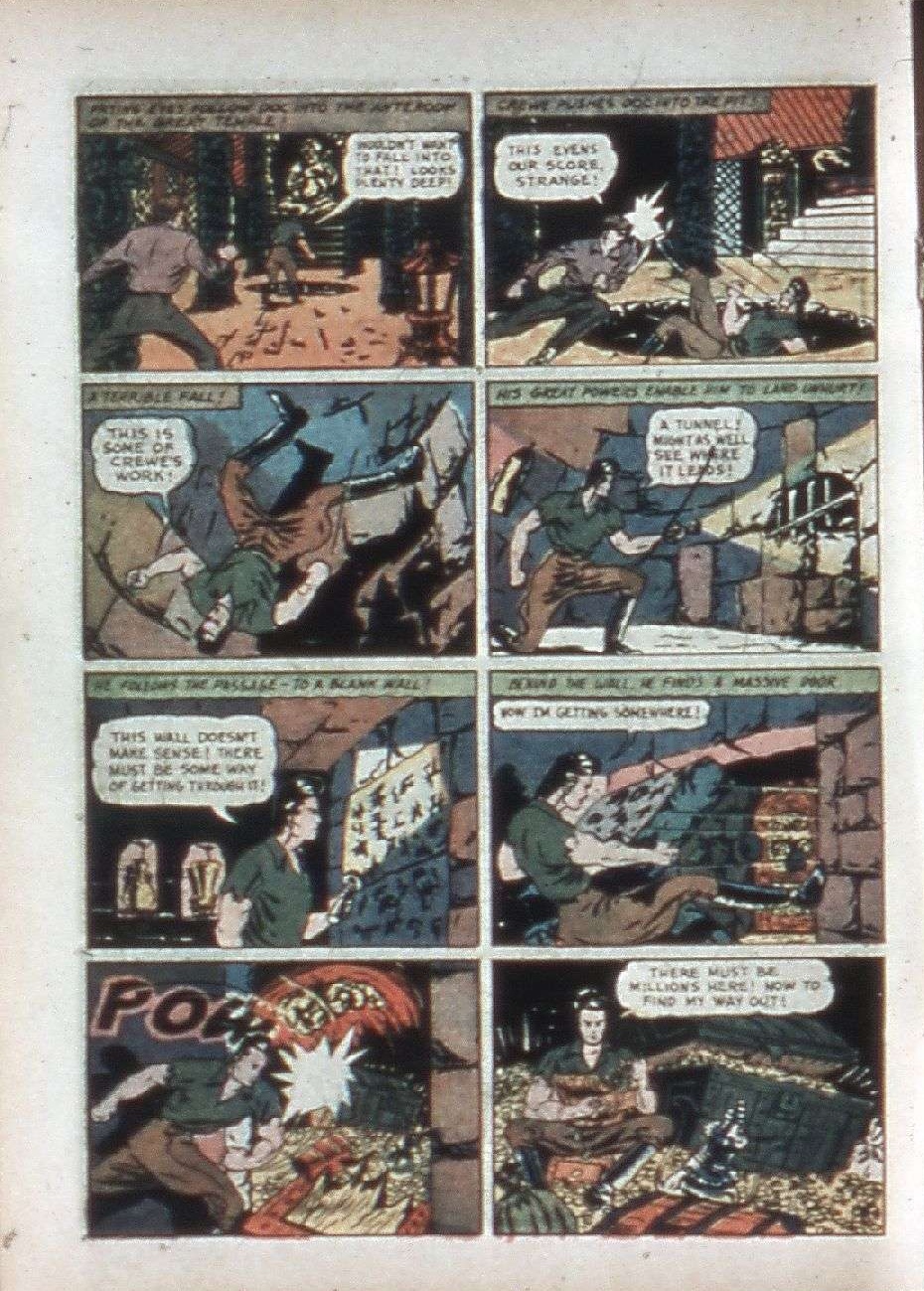
Strange uses his wrecking things ability on a stone wall, a door, and a cage here, demonstrating that a superhero needs the ability to use that game mechanic in quick succession.

What's going on with the guards being drawn like primitive African natives, hurling spears? How does that make sense in Tibet?

Rescuing prisoners is always a good idea, for the "good deed" XP award, the useful information they may have about the hideout, and their Supporting Cast recruitment potential.

Animals never fare well against Golden Age comic book Heroes and the fights are usually over in a single panel. This one, with Strange fighting two lions, occurs largely off-panel!

Once again, Hughes gets his geography wrong. The "Mountains of the Moon" are a legendary mountain range in east Africa, once thought to be the source of the Nile River.
More evidence that ordinary people can make push attacks on superheroes.

Strange wisely carries a flashlight.

Finding a secret door usually includes finding the means of opening it. But, if you just suspect a secret door is there, but you're getting impatient waiting for that successful "find secret doors" check, you can always wreck the wall. If you're right, you will only be wrecking against the door category, even if you can't actually see the door.

Millions of dollars' worth of treasure is usually a campaign-busting find and should be avoided doling out in actual play.

(Scans courtesy of Comic Book Plus.)

Friday, September 6, 2019

Speed Comics #6 pt. 3

We're still looking at this month's Crash, Cork, and the Baron adventure and, as always, talking about comic book stories and how to emulate them using the game Hideouts & Hoodlums.  If you don't play H&H, you're still welcome to stick around and look at the pretty pictures.

Under most circumstances, and as we've talked about many times on this blog, H&H makes no distinction between subdual damage and lethal damage; the only time injuries kill is when the character is already unconscious or in a deathtrap. So the question here is, is Crash in a deathtrap?

No, the natives' intentions are to torture Crash, not kill him, so this cannot be a deathtrap. Indeed, rather than full damage, it appears that the natives are being careful to do less than full damage.


I hesitate to allow either side, players or Editor, to have such control over their damage that they can specify an exact number of points of damage they want to inflict, but misusing or under-utilizing a weapon should make it work like an improvised weapon, which do half weapon damage.

I really hate how this story ends. They threaten the chief, feed him a baloney story about how oil pipes leaking into their drinking water isn't bad for them, and then apparently get him addicted to cigarettes to force compliance. I just...ugh.
So let's move along and look at Ted Parrish, Man of 1,000 Faces.

Right off the bat, I'm wondering about that fall. Is Ted -- disguised here as Pedro -- really knocked unconscious by that, or just pretending? Ted is a 2nd level mysteryman by now, so it seems awfully humiliating to have a 10' fall knock him out. On one hand, maybe he's feigning unconsciousness, so no one can ask him any probing questions about where Pedro had got off to, but on the other hand, maybe the Editor wanted him unconscious so he couldn't do anything that would derail the story before the sub reaches Central America.

So, the next question I have is -- where is this? What Central American country was producing oil circa 1940? With some effort, I was able to find that Mexico started drilling for oil back in 1916, but I can't verify any other countries were drilling that early.

Even this page, which talks about a jungle, does not invalidate Mexico as a likely suspect. Though one normally thinks of Brazil both in terms of jungle and oil, Mexico has the smaller Lacandon Jungle within it.

And look, the ol' stick in the mouth trick!
Moving on, this is Dick Briefer doing Biff Bannon. For humor, the superhero-soldier turns out to have a fear of public speaking. But what does that mean, in terms of game mechanics? Is this evidence that Biff has a low Charisma score? Perhaps Biff's player really wants Miss Lee for his supporting cast, and is afraid of messing up the recruitment roll?
This first tier is rather remarkable. Firstly, it's a stirring mini-speech about the value of integrated public education to combat racism. I think that was Dick's genuine intention, as the second remarkable thing about this tier is panel 2, and the black boy who is drawn completely normal (or as normal as Briefer's highly stylized art allows). Remember, this is a time when even artists as progressive as Will Eisner were drawing black people in minstrel show style.
I'll spare you from the strange subplot that gets Biff put in a dress and wig. The important thing here is the sheer mass of improvised weapons half-pints can use, including things I never thought of, like B-B guns, firecrackers, blowguns, and inkwells. The inkwells come with a little something extra, the chance of producing a blinding attack, but I would say that's pretty unlikely; maybe if the inkwell hits on a natural 20.
This page is noteworthy because the mobster in panel 2 acknowledges that they live in the same world with Shock Gibson. So many characters lived in their own isolated universes before this, even in the same anthology title.


This is Lt. Jim Cannon of the British Navy. By "15-inch guns" it probably means the BL 15-inch Mk I naval gun. "It was the first British 15-inch (381 mm) gun design and the most widely used and longest lasting of any British designs, and arguably the most efficient heavy gun ever developed by the Royal Navy. It was deployed on capital ships from 1915 until 1959, and was a key Royal Navy gun in both World Wars," according to Wikipedia.

Leaving your big, protective ship, and putting yourself in harm's way in a shot-range plane or a torpedo launch seems like a terribly unsound tactic, and yet what else can a Hero do? Share XP with everyone on board the Hood? Not likely!

(Scans courtesy of Digital Comic Museum.)


Saturday, May 4, 2019

Tip Top Comics #29, 30

Moving on to vol. 3, no. 5 (Sept. 1938), we rejoin Broncho Bill as he's doing some trick shooting. But how we do make this work in game mechanics? How do we transfer the shooting attack to a deflect-hot-poker-into-face attack? A push attack against a non-living object? Yes, that's possible. A stunt? I've written at length about using the Mysteryman class to emulate cowboys (en lieu of needing a separate Cowboy class), but stunts are supposed to be separate from combat (so as not to eclipse the  
need for the Fighter class). But what if that was made different for Cowboys? What if Cowboys could use stunts in combat for trick shots, as long as the shots did not directly hit a living target? That might work, as long as the Cowboys gave up some other benefit of the Mysteryman class, for balance.

Now, on this strip, we learn that falling 175' means "certain death," which may seem strange to our eyes because we're used to thinking of 175' feet as 17d6 damage and, under normal  
circumstances, that only causes unconsciousness in Hideouts & Hoodlums. But this is a case that almost screams out for realism; perhaps a house rule that 60 points of damage all at once always causes death would not be unreasonable.

I don't get the joke in Benny (not unusual, I never find this one funny), but it does give us the prices for men's hats ($3-5), gum (1 cent), and haircuts (20 cents). It's also worth mentioning that this looks much closer to a gumball machine than the gum vending machine we saw in Chris Crusty just days ago.
Wow, this is one mean-spirited fun house. Is that clown zapping Phil with a cattle prod? There is some great fodder here that I wish I'd seen soon enough to send to Jo Kreil before module RT2 Adventures in Fun World got written!
 The amethyst story is somewhat interesting, but the true "gem" here is "The Enchanted Cave of Richmond Hill." Now, I don't believe that was really King Arthur in the cave, because why would Arthur have a diamond-encrusted sword with him when Excaliber was returned to the Lady of the Lake? But the idea of a spooky cave that looks trapped, but actually rewards you if you're brave enough to go up and touch stuff -- that idea I'm stealing.
Now we're moving on to vol. 3, no. 6 (Oct. 1938).

You've never seen Divot Diggers on this blog before, as it's a super-specific subject for a comic strip and doesn't lend itself to adventure. But, it does give us some pricing hints this issue,
starting with $20 for what I'm guessing is some kind of medicinal liniment, and then in the next one the remarkable sum of $500 for a rug (though we've talked before here about how, while many things were cheap in the 1930s, there was still plenty of high-priced stuff for the rich to blow their money on). The lesson here is, when
looting a hideout, check those rugs to see if they're valuable (and try not to get any blood on them!).

We haven't seen much of Joe Jinks on this blog, and certainly not since he started teaming up with Dynamite Dunn. I still don't care for either character, but I do like the snooty rich boxer they encounter here (stealing that character!). I also share this because this is the first I've ever heard of a boxer's license badge.
And lastly, while I get that this is just a stage magician and likely not a true Magic-User, I'm intrigued by some of the tricks he does and wonder if we need to discuss how they would work in H&H. Many of these stunts -- the rabbit out of the hat, the box sawed in half, the disappearing juggling balls, are just sleight of hand tricks and, hence, require expert skill checks. But, I can't say I've ever heard of a stage magician appearing to impale his assistant with a sword before. Could that be an actual spell -- and what spell would it be? Phantasmal Image of a sword, perhaps?

...I also don't get the "Rubber!" joke at the end.

(Scans courtesy of Comic Book Plus.)

Tuesday, February 5, 2019

Marvel Mystery Comics #4 - pt. 1

The Human Torch has apparently stayed in Texas since last issue, as he's just coming back to New York now. New York is under martial law because of the attack of the green flames. The green flames are said to be goblin-like creatures with ice-cold green flame all around them. Their cold flame paralyzes and kills, but real heat kills them quickly. It's almost a shame that the "green flames" are actually just hoodlums in chemically treated asbestos suits that become surrounded by the green flame.

The Torch makes up the alias Jim Hamond (initially spelled with one m) in this story.  He also uses some now-familiar powers -- Wreck at Range, Leap II (he clears at least 60' vertically), and -- of course -- wrecking things (by melting).

The Torch is aided by Johnson -- an undercover cop who has helped the Torch before -- and a lady undercover cop named Mazie. Mazie worked undercover with Dr. Manyac, the creator of the green flame. Dr. Manyac only seems to have a gang of six, none tougher than gangsters, which hardly seems like it would be threatening enough to force the temporary evacuation of New York City -- yet somehow hysteria spread to the point where it did.

The Torch gets doused in water and doesn't get his flame extinguished in this story.  Evidence that he should get to save vs. plot for all possible vulnerabilities?

The Torch demonstrates a power again where he can hit someone with a fireball from far away. This time, though, he's shown to have so much control over the fireball that it can go around one target to hit another. That seems a lot like Magic Missile to me...

The Angel's story opens in a kitchen...well, not that kitchen, exactly, but a slummy area of Manhattan here called "The Devil's Playground." Avoiding real life place names allows the writer some latitude for swapping out the poverty that really defined the Clinton neighborhood and replacing it with mob corruption.

The mob has a new enforcer named Butch, a giant (from panel to panel his height seems to vary between 8'-12') that appears to be bulletproof. Now, my first thought was to stat Butch as an ogre and bullets just can't get past his decent Armor Class; but later, when armed militias start patrolling the streets searching for him and meet Butch, they throw "machines guns, revolvers, rifles, and grenades" at him with no effect. That means Butch has to be an evil superhero with some major defensive-buffing powers, possibly as good as Invulnerability. For some reason, though, the Angel's punches make Butch fail a morale save and flee. Is Butch confused, as the narrator says, or is he aware that the duration is about to end on his buffing power?

Somehow, Butch's mob is raking in $5 million a day, though we're given no explanation as to how that's possible.

Butch dies when he plows through an exterior wall on an upper floor and falls, perhaps no more than 40'.

In the Sub-Mariner's story, Namor draws a line -- he's fine with war and killing, but won't abide any nation preventing the delivery of food or medicine to other nations. To show the world how much that bothers him, he's going back to Antarctica to summon an army of sub-mariners and wipe out all the warring countries.

So Namor swims back -- that's over 8,300 miles from New York City, or over 9,000 miles from the English Channel, depending on where he actually was last issue. That's a lot of stamina, or another example of the Teleport through Focus power.

In Antarctica, we see more of the Sub-Mariner's kindgom, The palace is carved out from an anchored iceberg. The realm is ruled -- not by a king, but by an emperor. The emperor has a "court of three," who could themselves be king-vassals of the emperor, and perhaps one of them is brother to Namor's mother. The emperor is held to be a holy figure.

The mermen who are not half-human like Namor and Dorma have large saucer eyes and catfish mustaches, They appear to be blue-skinned, but Namor is colored blue when underwater too.

What power does Namor have over the Emperor? Intervening in the wars of the surface world is apparently against the rules of the empire, yet the Emperor breaks the law and gives Namor carte blanche to do just that. In a week, he has a fleet of "hundreds" of submarines that can also fly via steam jets, and fire steam weapons (instead of direct hits, the weapons create hot clouds of steam and the victims are driven into the clouds).  The metal of their hulls has a "repellent quality", whatever that means. Magnetic repulsion? Probably means a low AC for the planes.

Namor, normally happy to parade around in trunks, wears a full-dress uniform while commander-in-chief of his naval air force.

The narrator makes some rather hard-to-believe assertions, like the aerial-subs move at the "speed of light" and Namor can telepathically communicate with the other ships (is it that hard to use a radio?).

"Great sharks!" is Namor's next colorful exclamation.

(Read at Marvel Unlimited.)


Friday, November 30, 2018

Target Comics #1 - pt. 2

Now, let's jump ahead to the next feature, Lucky Byrd, Flying Cadet. Although it looks like someone different inked over him, this is our old friend Harry Francis Campbell, from Dean Denton and John Law. Like his predecessors, Lucky wins the day with his scientific know-how, and here he explains to us how he figured out how a bomb set off by altitude could work.


Next up in this all-star line-up of artists is Joe Simon (minus Jack Kirby), drawing T-Men. T-Men, as the first page (not seen here) explained to us, are like G-Men, but they work for the Treasury Department. 

Here, a disguised T-Man is captured and is put into a deathtrap -- or rather, a deathtrap is sat in his lap. A black soldier spider isn't a real thing -- thank goodness, because that thing is huge! Well, using large/huge/giant terminology, this could be our first example of a large spider. Its bite is implied to be quite lethal.

It's unclear if the hoodlum falls because he's dead or just because he's been shot. Under normal circumstances, you don't have to worry about falling down after taking damage in Hideouts & Hoodlums, but common sense can overrule that for situations like this, when you happen to be leaning over a trapdoor at the time.

A rare example of a bullet wrecking things. I've never been happy with how to handle this, but perhaps the bullet can just be treated as flavor text, now that non-superheroes can all wreck things.

And we get an example of a secret door and a hideout connected to sewers.
This true crime genre feature is called City Editor, with the hook being that journalists are investigating instead of the police. Though, really, this kid winds up doing most of the detective work. And just for a plate of beans and some coffee too! Half-pints are easily bribed. They also can have surprising skills, like photographic memories and the ability to draw photo-realistic.


This feature is really different. Calling 2R is a twisted boys town with super science weapons doled out to the kids.

This first weapon is a raygun that can make you blind and stunned for 24 hours (though I would allow saving throws for both effects and have the duration be a range of hours, like 3-24). 

A vest that projects force blasts, or the Blast I power, seems awfully potent to turn on another half-pint with 1-3 hit points.
Three of the bad guys here are gangsters, accompanied by the spy in the green coat.

The electrical force wall seems to act as more than a Wall of Force spell; it does some damage (1-3 or a full die?) against anyone touching it, but apparently does more damage if you're touching metal and not grounded, and stalls electronics that touch the wall.

The airbug is an interesting design. I doubt it would fly, yet it almost seems feasible.
The Captain tries to sneak up on the spy, but the surprise check the Editor rolled said he failed. He might still have gotten lucky and gone first by winning the initiative on turn 1 of combat, but was not so lucky and apparently only had 6 or less hit points.

Speck was only stunned on a previous page, and that's not applesauce on his head. This strip is really violent, by the way.
At the end of this page is a very rare indication in a comic book that skills have to be learned, as most of the time anyone seems to have a chance to try anything.

(Scans courtesy of Comic Book Plus.)


Friday, October 12, 2018

More Fun Comics #51 - pt. 3


Betty, who helps Flying Fox search for her father, uses field glasses (a starting equipment item).

Rather than shoot down her "father" in a dogfight, FF uses a stunt to force his opponent to land. Landing on the island, FF has to fight his way out of a jam. He punches a gunman and, in a rare instance, the punch neither disarms nor knocks out his opponent. FF has to grapple and throw him on the next turn. Betty, meanwhile, trips the mobster disguised as her father and that does succeed at disarming him.

The disguise, when it's knocked off, is a mask that doesn't look like it would have fooled anyone. Worse, the villain's name turns out to be Bayou Borg, one of the worst villain names I've ever seen.

Detective Sergeant Carey is asked by an auto racer to investigate a death threat against him, then watches from the sidelines (with the binoculars from his starting equipment) when the racer's car crashes and the man dies. Remember, in the Golden Age, it's okay to fail and let innocent people die! The killer conveniently leaves two clues behind where he'd sniped the racer's tire -- his rifle and a wrench. Carey's sidekick Sleepy makes an expert skill check and appraises the wrench, realizing it is of foreign make (or an automatic skill check if it has foreign writing on it). When the killer tries to drive away in his race car, Carey has no compunction against shooting out the tire, the same way the first racer was killed (though the killer survives -- must have made a save vs. science!).

Sergeant O'Malley of the Red Coat Patrol has an unusual problem -- he encounters a group of bandits -- seven in number -- that he determines is too large for him and his sidekick Black Hawk to handle. Forced to resort to tactics, he uses the old "roll boulders down on them" trick -- but not to hit them (which is what most players would have done). Instead, the boulders are to knock out the ledge in front of and behind the bandits. If I had to referee that scene, I might use wrecking things for the boulders (maybe at O'Malley's level, or with a slight bonus), or I might just allow it outright because it's such a clever and nonviolent solution.

Black Hawk shows us that you can lasso a person falling past you from a higher ledge, that the rope does not swing the falling person into the cliff with enough force to do any serious damage, and that the momentum of the faller does not pull the lassoer over the ledge.

Bulldog Martin is asked to investigate a supposedly haunted house that a cute lady friend has inherited. It's a perfect low-level haunted house adventure, as most of it is just spooky noises that can be explained away (an open bottle left "under the eaves" so wind will blow into it, and a loud speaker hidden in the fireplace that plays "oooooo" noises). Bulldog finds the amplifier only by searching the walls and finding a concealed wire leading towards the fireplace.

It's obvious that the fake undead is digging for buried treasure in the yard because of all the upturned earth. Bulldog pretends to find the treasure, putting $2,000 of his own money at risk, and then gets robbed when the fake undead uses a secret door to take him by surprise. Bulldog has to spend time searching for the method of opening the secret door, even though he knows where it is. When he fails his roll, he decides to bash the secret door in with a sledge hammer instead. He wrecks through the secret door with such a good roll that the Editor rules that he can hit the fake undead guy hiding on the other side.

(Read at fullcomic.pro)


Friday, September 21, 2018

Popular Comics #47 - pt. 3

This is The Hurricane Kids, though you're only seeing one of the kids here with his new caveman supporting cast member. And we also see some weirdly drawn giant bats -- giant bats being surprisingly rare in early comics (though ordinary bats, not so much).

This is also a good depiction of what the "underworld" would look like in a Hideouts & Hoodlums world -- like it was part of a natural cave system. They got lost -- guess no one was mapping!
Partially flooding hideouts make for an added level of challenge in them.

1,000' tall waterfalls look dangerous and should be dangerous, despite the cliche of heroes always surviving them. The first time I talked about waterfalls, I suggested a save vs. science at +1 for half damage -- but that would still be 50d6 damage. We need something even safer, like save for no damage, and 1 point per 10' if you fail the save (so, 100 points of damage, almost surely automatic unconsciousness).

Should there be a chance of dropping items while climbing? It particularly makes sense if you're trying to hold something in your hands while climbing.
A rare sighting of a cave bear in comics.

How much falling damage gets added to the big rock? I would not add more than 1d6 for that. If you allowed full falling damage to be added, Heroes would be chomping at the bit to fly over every combat (the fallacy of the lethal falling coin long ago infected a D&D campaign I played in).
Here we see cavemen encountered in groups as large as nine.


A rare adventure in the North Sea, this begins a new serial.

I had to look up what the elevation record was by 1940 and these planes are nowhere near it; a record of 56,000' was set in 1939.
 Here we see two old aviator stunts, Power Dive and Hide in Clouds. When I get to the Advanced Hideouts & Hoodlums Heroes Handbook, I'll include many more examples of specific stunts Heroes can try.
This is Penguin Pete and His Pal Pudgie, and this is an unusual wrinkle on the "help, I'm sick" ruse for getting out of jail.

(Scans courtesy of Digital Comic Museum.)