Showing posts with label trophies. Show all posts

Wednesday, January 30, 2019

Mystery Men Comics #7 - pt. 1

And we return to Fox's second title and a feature that had started out as a small back-up strip and now is lead feature in Mystery Men Comics.

We start with a rare example of a bad guy (the Blue Beetle impersonator) using tear gas as a weapon.

Mike Mannigan is the perfect example of the copper -- a police officer so incompetent that he stumbles when there is nothing to trip on -- he's not even close to a crack in the sidewalk.

The Blue Beetle imposter could count as a doppelganger, as they are now defined in 2nd edition rules.

Although we've seen million-dollar crimes so far in the comics, $50,000 is still a large amount in 1940 and one mobsters are willing to kill over.

This is one of the earliest instances -- if not the earliest -- of cussing in a superhero story.
 I'm not sure if the Blue Beetle qualifies for the new Avenger class that is going in the AH&H Heroes Handbook, but I'm giving this ability to that class. The ability is to trigger morale saves without even being present, but via the presence of the avenger's "calling card."

Letting a bad guy get away so you can follow him back to his lair is already a cliche by this point.
I've never considered Blue Beetle to be much of a source for inspiration, but now I want a tall chest disguised as a bookcase just like that.

This may be the first and last time Blue Beetle ever carries "trick make-up" with him.
BB is teetering right on the edge of switching from the mysteryman class to the superhero class, but we're not quite there yet. BB can get two punch attacks if his opponents are unarmed, so he's not necessarily buffed with any superpowers here.


 An avenger can trigger so much fear as to cause damage.
Wing Turner takes on a "costumed" foe, though one just wearing short shorts and fake horns. The Devil goes for a bigger pay-off than BB's villains had. 
I've written plenty before about how vehicular combat needs to be based on complications rather than hit points. Hitting the fuel tank is a particularly good complication, one that cuts down how much longer the vehicle can move, while giving it a chance each turn of exploding.
Lava pit? How did he get a lava pit under his castle, when there's no sign of an active volcano anywhere in the vicinity of that castle? You just never know where lava will turn up in a comic book story.

(Scans courtesy of Comic Book Plus.)

Friday, March 30, 2018

Fight Comics #1 - pt. 1

The first issue from the third title by Fiction House starts with George Tuska's Shark Brodie. Here we see some nautical transportation we don't see every comic -- a sloop and an outrigger. That the sloop is described as a "swift" sloop may suggest that it is a special trophy item and not just an ordinary sloop one might be able to buy.

This looks pretty good for early Tuska and makes me wonder if he didn't have help from a better inker...
Here we see a schooner.


There's some interesting details here that I'm going to guess are accurate about pearl diving, like the circle of weighted netting.

I think I've talked before about underwater clams -- traps or mobster-types? -- and am still leaning towards trap, rather than something that needs statting for combat.

But, come on, Nanka's been down there for 20 minutes already, and now you're wondering what happened to him? Ten minutes is good for a pearl diver. In fact, I'm thinking of extending how long Heroes can hold their breath underwater, from 1 turn to 1 turn per 2 points of Constitution (rounded down).

That actually is a pretty good idea -- if your main hideout is a less maneuverable boat like an old schooner, it would make sense to have more maneuverable motorboats patrolling around it.

I'm not crazy about the idea of letting Heroes make homemade grenades with gunpowder and pineapples; I think I would make them half as effective as real grenades.

I would also be inclined to say that, if you're using explosive weaponry like grenades, you should not be able to take your opponents by surprise afterwards -- though that is exactly what Shark manages to do on the next page (before getting captured).

If you're confused how Shark got captured, but still has a flare gun on him that wasn't confiscated, don't worry -- so I am, and I read the page I skipped sharing. I've talked before about letting players request a save vs. plot to keep a weapon unconfiscated on them when captured, but I was thinking of small things, like a knife in the boot. Here, they not only let him keep his flare gun, but his ammo belt as well. That would require some major penalties (-5?) to that plot save!

Now, I would be okay with allowing forcing a locked door as an expert skill check, but this door gets absolutely shattered, and Shark definitely doesn't seem like he's got superhero-level strength. So it's a good thing that I have non-superhero wrecking things rules (different in both editions; I prefer the newer, more streamlined mechanic) that account for this.


Hmm. Shark seems to be an amazingly good fighter for a guy who seems like he's been around only long enough to be level 1 still. Those are two lucky disarming hits in a row (disarming of a non-gun being tricky because your target has to be hit and miss a save vs. science). And what's this talk about "limitless strength?" Hyperbole? Is this the Editor telling us he's not using fatigue rules? Or is Shark a superhero after all...?

If Shark is a superhero, then he's a fighter/superhero, as demonstrated here by how he has no compunctions against using firearms (like all fighters in 2nd edition).


Alternate histories that have Germany winning WWII are a dime a dozen, but this unusual set-up from The Spy Fighter takes place in a 1997 where the smaller nations of the world have all been gobbled up into three competing superpowers representing Russia, the U.S., and China/Mongolia. I wonder if the board game Risk was based on this...

(Scans courtesy of Comic Book Plus.)

Saturday, December 30, 2017

Action Comics #19

In the Superman feature, Superman demonstrates a "super-resistance to disease", but could have just been a successful saving throw vs. the "purple plague."

Professor Henry Travers is so worried about the plague killing people in... is this still Cleveland? The headline of The Daily Star says "Purple Plague Grips Metropolis," but that was probably not a proper name yet at this point. Anyway, Travers is so flustered that he accidentally says the plague that ravaged Europe in the Middle Ages was the purple plague, when of course it was the bubonic plague.

The "De Fauvier's study of the Purple Plague" sounded so specific that I wondered if De Fauvier was an actual scientist who had once studied diseases. It seems to be purely fictitious, though.

I don't think I ever made a trophy item out of this, but Ultra-Humanite fools Superman wearing a "false-face mask", despite the fact that rubber masks never would fool anyone in real life.

Superman does not always have the Quick Change power prepared. In this story, he knows Travers has been attacked after hearing it over a phone call, yet curiously takes the time to untie his shoes before removing them so he can go leap off to Travers' apartment.

Thugs are also called "muscle men" in this story, proving to me I was right to give thugs better than average Hit Dice.

Superman halting his fall by catching a ledge is cliche -- and can be supported by game mechanics in several different ways. The Editor could have conveniently put the ledge there and offered the chance to roll "to hit" the ledge (an attack roll). Or, Superman's player could have suggested there might be a ledge nearby to grab, and the Editor gave him a save vs. plot for there to be a ledge to grab. Or, the ledge is actually flavor text for the Feather Landing power being activated.

I'm curious about who Travers' "scientific society" was. The story is three years too early for it to be the Cleveland Technical Societies Council.

Superman is still not a Lawful hero at this point; he steals chemicals for Travers that Travers needs for his research into the plague cure. He does so by uprooting a massive skylight to break in and then walking through a wall to break out -- both examples of wrecking things.

For the second time, the Ultra-Humanite knocks Superman unconscious with electricity. It may be important that Superman is taken by surprise each time, so he is not able to activate any defensive powers first.

In addition to the electric raygun, Ultra uses a mind control helmet on Superman, but it comes with a saving throw vs. science that Superman easily makes. Ultra's "fantastic airship" is propeller-less, and almost surely an early jet plane.

The power 4th level power (in first edition Hideouts & Hoodlums) Turn Gun on Bad Guy comes from the final scene of this story, where Ultra shoots his electric gun at Superman, yet Superman is improbably able to pull Ultra in front of the blast first.

In the Pep Morgan feature, stopping to perform a good deed -- moving a loose rail off the railroad tracks -- leads to an encounter with gangster/robbers (perhaps a mixed group of both mobster types), and demonstrates how good deeds can become plot hooks or be tied to plot hooks.

Pep foils the efforts of the mobsters to jump off the train by reaching the engine and telling the crew to speed up too fast for them to risk jumping off. So how fast is too fast? If we assume 30 MPH = 1-6 points of falling sideways damage, and the train made it up to 90 MPH, that would equate to a brutal 3-18 points of damage -- more than most gangsters and robbers would be able to endure.

It also appears that Pep might have a brother in this story, though there is no text that corroborates this when he is seen with his family.

In the Chuck Dawson feature, Chuck is attacked by roughnecks.  I don't have a mobster type for "roughnecks", but outlaws are the evil version of cowboys and it sounds like these are just some of those, or maybe bandits. Chuck is defeated with lassos -- and in fact 2nd edition H&H now has entangling rules for just this situation. Luckily, he had trained his horse, Blacky, to untie knots, freeing Chuck, and showing just how complex the actions of animal Supporting Cast Members can be.

Later, catching up to the outlaw/bandits, Chuck jumps down off a ledge behind them to attack them. Now, there is little tactical advantage to taking falling damage, losing surprise, and then attacking your opponents. We have already seen lots of comic book characters fall on mobsters from a height, as an attack, which I suspect Chuck was trying to do here -- Chuck was just the first hero to miss!

In the Clip Carson feature, Clip is in "Kenye," which is surely an intentional misspelling of Kenya. In 1939, this would be the British colony of Kenya. The first thing Clip does is go to a bar and get in a fight with a drunken hoodlum...which reminds me of about half the D&D campaigns I've ever played in. The drunken hoodlum holds a grudge and hides a cobra in Clip's room. Later, Clip runs into cannibals -- which I've said before I plan to leave statted as "natives" and not stat them separately -- but chooses not to fight them and bribes them for safe passage instead.

In the Tex Thompson feature, Tex and his sidekick, Bob Daley, meet actor "John Barryless" -- har har -- obviously meant to be John Barrymore. Tex and his associates head to Egypt to find John's missing son, Bart (John Barrymore's son was also named John). One doesn't normally associate the savage native trope with Egypt, nor zombies, but Tex encounters both while there. We also learn that salt can counter the potion that turns living people into zombies.

Gargantua T. Potts, by the way, is a minstrel show-level racist caricature of a sidekick for Tex.

In the Three Aces feature, I learned (or maybe I knew this before and forgot) that the Three Aces ("Fog" Fortune, "Gunner" Bill, and "Whistler" Will) are members of the U.S. Naval Reserves -- which seems an odd choice, as I would have thought the Army had more fliers than the Navy at that time. They have to "solve" a murder mystery, and I use the term loosely because they overhear practically everything and then just have to prove who did it. It can be a useful reminder to Editors not to make mysteries too difficult to solve during game sessions.

In the Zatara feature, Zatara -- who usually throws around high level spells like they were nothing -- solves this scenario where a mad scientist in Mexico is creating an army of gorillas with transplanted human brains (and apparently is shipping the gorillas all the way into Mexico, since they are clearly not indigenous) using only two second-level spells, Invisibility and Hold Person. Of course, you could call the scenario only a partial success because Zatara only frees the scientist's prisoners who still have their brains, leaving all the transplant victims to be blown up along with the scientist after Zatara escapes.
 
(Superman story read in Action Comics Archives v. 1; select pages from the rest were read at the Babbling about DC ,o;Comics blog and the rest was read in summary at DC Wikia.)


Tuesday, September 19, 2017

Top-Notch Comics #1 - pt. 1

We're now up to the third of the MLJ titles and still about two years away from their superhero zenith.

Here we get the first of their superheroes, The Wizard. He's not a magic-user wizard, but a hi-tech wizard. We'll observe him carefully and see what class he best fits shortly.

First a historical note -- there was no historical General Steven Whitney in the Revolutionary War. The actual Chief of the Naval Intelligence Service in late 1939 was Vice-Admiral John Godfrey, not Grover Whitney.

Telephone scrambling was already in development in 1939, but was not practical until 1943.

Somewhat famously, Pearl Harbor would be later attacked almost exactly as it's laid out in this issue.

The Wizard is one of the earliest characters we can pin down to an exact age, having been born in 1904. It was certainly not uncommon for comic book heroes to be grown men in their 30s.

The phone scrambling computer must be a trophy item, but we can't be as sure about this steel-burning chemical. Hi-tech potion -- or wrecking things power?

Woodrow Wilson is the first historically real character in this story, as well as this being the first time President Wilson had ever appeared in a comic book.

That's some mystery chemical -- even in 2017 we don't have a chemical that will burn 1,000 times hotter than acetylene.


In 1939, the land speed record was 369 MPH; it would not exceed 500 MPH until 1964.


The Wizard's invisible car, occurring in flashback, makes it chronologically older than the Ultra-Humanite's invisible car in Action Comics #13. An invisibility field generator that can fit in a car was a trophy item since first edition.


That The Wizard's prop plane can go from New York to Los Angeles in 2 hours and 45 minutes is suspicious -- even today the flight takes almost twice that long. Despite appearing to be a prop plane, it must be a jet.


Now here's where we start to get into guessing what class The Wizard is. First, he appears to be using magic -- maybe some powerful divination spell -- to figure out both what his objective is and where to find it. Then he dresses like a Mysteryman. Then he tears fish nets apart with his bare hands -- strong, but not quite wrecking things strong; a Mysteryman could accomplish this with a stunt.

"Jatsonian" must mean Japanese.


But, here, we see The Wizard using Leap, he leaps unharmed through gunfire as if buffed with Nigh-Invulnerable Skin, and it sure looks like he's using wrecking things on that submarine portal. Further, his high velocity propulsion pistol could be another hi-tech trophy item, or it could be flavor text for one of the Blast powers.

It's also curious just what a high velocity propulsion pistol is. Just about any gun works by propelling ammunition at high velocity. If there is no ammunition, it sounds like an air gun.

Here, again, is the Wizard wrecking his way through that door or using an actual vial of some sort of super-acid?

So, in just his first story, we've already seen what appears to be three different classes represented -- basically, all the core classes other than Fighter (unless the 3rd panel of that previous page counts as that too!).

I'm wondering if I should develop a sort of "bard" class for H&H...a jack of all trades class that can switch back and forth between classes, possibly from turn to turn...

(Scans courtesy of Digital Comic Museum.)


Tuesday, May 16, 2017

Marvel Mystery Comics #2 - pt. 4

Namor kills one of the policemen who survived his vehicular weapon attack later by drowning him, racking up a kill total of five over two adventures so far.

The Masked Raider's story begins with intriguing narration -- it describes a hideout in a hidden valley protected by "rocky mountains" -- perhaps meaning the Rocky Mountains?  This could be the only clue we ever get for where the Masked Raider's adventures take place.

The entrance to the hidden valley is protected by a lone sentry, later referred to as a dead shot. I would stat him as an assassin, a mobster type left out of the 2nd ed. basic rules, but will be in the more comprehensive AH&H Mobster Manual.

Rifles are called "smoke poles" in this story, because cowboys always have strange names for things.

Dressing in the hidden valley includes a U.S. Marshal's skeleton, still wearing his white hat and badge. I have white hats and badges statted as Mythic West trophies (badges appeared in Supplement III: Better Quality) and will both appear in the AH&H Editor's Guide.

Late in the scenario, we learn that the Masked Raider is infiltrating the group of outlaws to find out where they have their loot stashed. This is almost the opposite of how most players would play this scenario, preferring to fight the outlaws first and then search the valley for the loot themselves. The secret storage vault is concealed down at the bottom of a dry well, where, admittedly, not every player would think to look. A ladder leads down inside the well, while a tunnel also leads into the vault from another direction.

The American Ace story is an alternate history where World War I was perpetrated, not by the Austrians, but by the French, following a young French queen named Ursula -- only France is here called Castile D'or. Like Napoleon, Ursula is in exile, only Ursula is rescued by her old allies and put back in power. The focus of her revenge is Attainia -- likely standing in for Britannia. Ursula has her own minister assassinated in Britannia as a pretext to declare war, similar to the assassination of Archduke Ferdinand in WWI. Attania has a king instead of a queen. But all this is simply backstory before Perry Wade, the American Ace, shows up.

In Attainia, Perry encounters a steady string of random encounters: trucks and artillery heading for the front (Attainia is not an island in this world), old, weeping peasant women, children begging in the streets, and an air raid as a random event.

This scenario does not shy away from violence, as the aforementioned beggar children are blown to bits by a bomb. Perry is temporarily knocked out by the bomb, but recovers quickly. And that's all we see of him in this installment!

I don't normally mention text stories, but this issue contains a one-page Angel story that treats (mistreats?) him as if he had Superman's powers.

In Ka-Zar's installment, a jungle explorer only needs low-tech trophy items, as Ka-Zar fights Bardak the Ape for an old mirror.  As they fight over the mirror, Bardak uses a grappling move to disarm Ka-Zar of his knife. Now, normally I would not let dumb animals make disarming moves, but in the jungle explorer genre, all animals seem to have human or near-human intelligence.

African elephants are shown to be able to uproot trees, which should be as difficult as wrecking cars for a superhero.

Ka-Zar avoids falling damage when shaken out of a tree by grabbing onto a branch. Only at the Editor's discretion should there be saves vs. plot to see if some projection can be grabbed onto and protect the Hero from falling.

Elephants are explained to suffer a madness that makes them go rogue. It also makes them a really dangerous encounter in a H&H scenario.

In Ka-Zar's rematch with Bardak, Bardak doesn't seem to have to make morale checks because all of his tribe is watching them fight, and fear of dishonor checks his fear of Ka-Zar.

Ka-Zar kills Bardak with a single thrust of his dagger -- which seems like Bardak must have awful low hit points. Because Ka-Zar falls on Bardak while stabbing him, perhaps it is the transfer of falling damage, coupled with the dagger wound, that delivers enough damage to knock out Bardak. Then it's Bardak's fall from the tree that actually kills him (because he's now at zero hp).

(Read at Marvel Unlimited.)


Wednesday, March 8, 2017

Mystery Men Comics #5 -pt. 1

This is a deceptively simple-looking page of The Green Mask, that takes some explanation for Hideouts & Hoodlums.

Where is The Green Mask going? He's just walking down the street from the house where a murder has occurred, in broad daylight, in full costume. I presume he has a vehicle parked somewhere in the vicinity and did not leave it too close to the scene of the crime to draw attention.

Until now, I'd never seen the term "prowl car" for squad car. It seems the prowl car is just a random encounter, especially since the police don't know about the murder yet.

If Green Mask is a mysteryman, then I can't explain how he manages to trip two opponents in the same turn, especially since one of them is armed (so GM shouldn't get the "two attacks vs. unarmed opponent" bonus). Unless, he's burning a stunt slot (this is 2nd ed. talk) to give himself a chance to attack twice, which is a precedent I'll need to consider for my upcoming campaign.  Of course, if he was a superhero instead, he could easily be using Multi-Attack.

Green Mask has no qualms with stealing cars from the police.

I get that Green Mask confronts, but doesn't stop, Janette because he doesn't have enough evidence yet -- even after searching her room (which I assume he did while waiting for her).

But, bear in mind, a cruise ship to Africa is going to take about a week -- that's at least two weeks Green Mask plans to be away from home and crimefighting, all because he has such respect for due process that he won't keep a suspect from leaving the country. Don't expect this from your players.

The consequences of Green Mask's inaction -- and blatant racism -- can be seen here, when native assassins are mowed down with sub-machine gun fire because Green Mask let things escalate to this point, but he only intervenes when white lives are at imminent risk.

The shot in the back cliche is given two twists here -- one, it's a poison arrow instead of a bullet, and two, Green Mask didn't need information from Janette before she was killed from behind.

The entry for natives should maybe mention something about a chance of using poisoned weapons...


Here is a nice bit of continuity that is very much Hideouts & Hoodlums -- Green Mask kept a villain's weapon for himself and uses it, despite the fact that it doesn't fit the theme or motif of his character. He hasn't changed his name to The Paralyzer; he's just the Green Mask, with an extra weapon.

It is implied that the paralyzing raygun can hit multiple targets and lasts for hours (which would be true even if in turns, if the time switches to rest turns).

This installment of Rex Dexter talks about 5,000 miles as if it was a big distance -- but if this ship was traveling at light speed, it would cross 5,000 miles in 1/37 of a second. Interstellar ships must travel in a solar system at something more like Mach 10.

Cosmic storms sound pretty bad...

Other planets don't have to follow natural laws -- hence, you can have worlds where time flows differently, like this one.

The machine apparently protects people from unnatural aging, with a permanent duration.


The alien mad scientist (who looks suspiciously like Marvel's Loki in the future) seems to be a superhero buffed with Super-Tough Skin, but is actual a robot (perhaps buffed by the same power, though).


While it would be a fun project to try and stat these monsters from just one panel, given the context of the story it seems these are just imaginatively designed large robots.

The sliding panel is a secret door. The Hero's roll to discover a secret door can be to find a mechanism to open one, or it can be to find the secret door at all; the Hero should not have to roll twice for both.


There's no reason for a robot to need to drink oil this often. It could be something about the unnatural flow of time on this world, or it could be a glitch in the robot's programming that makes it think it needs oil this much. Either way, it's good to give a villain a weakness clever players can exploit.

(Scans courtesy of Digital Comic Museum)


Monday, March 6, 2017

Fantastic Comics #1 - pt. 4

Yank Wilson is an odd duck; there's no indication that this is some future scenario, so this is a present in some alternate timeline where the U.S.'s greatest enemy is a tiny kingdom at the North Pole and both sides have ridiculously large military forces backed with super-science.  For a clue as to how super-sciency this feature is, the airspeed record in 1939 was 469 MPH, almost half what these strat-bombers can do.

More evidence of not only super-science, but impossible super-science, as "2,000 degrees below zero" can't happen.  A freezing gas would be useful for hideout traps, though.


We're given no explanation for how 5,000 tanks managed to cross the Arctic Sea, but judging from the rest of this feature, I wouldn't be surprised if they grew wings and flew.

A long distance atom separator sounds an awful lot like an atomic bomb. It would take something like that to destroy 5,000 tanks at once too.  For such a goofy feature, it's scarily prescient here.

Interestingly, the writer had to come up with electro-vibrographs because, as discussed before, the term RADAR was not in common parlance yet in 1939.  Note how super-sciency Radar seems to be at the time.

The freezing gas, in sufficient quantities, can be used to affect entire cities.

This is, I believe, the first instance of a heat ray being used to counter a cold effect.

Other than the feature being named after him, I really can't see how Yank Wilson was granted a hero's reward and not, you know, the scientists who came up with the heat ray and the other super-science.


This is Captain Kidd, Explorer.  When you meet a mad scientist, don't attack right away, and get a good encounter reaction roll, they want to show you all their trophy items and explain how they work to you.


When I put a mechanical hand on the trophy list for 1st edition, I didn't actually have a good example of one in mind. Here's one, though it is better for attacking and giving a human a claw attack than for wrecking.


He doesn't look like one, but Von Haupt was a supervillain, buffed with Nigh-Invulnerable Skin. Kept him safe from bullets, but not from falling damage or heat damage.


As if this issue hadn't already hit its weird quota, this is from Flick Falcon in the Fourth Dimension.  Flick is a scientist who's 4th dimension machine flings him onto Mars. The slave giant appears to be at least 30' tall, which would stat him as a titan (from Supplement I: National).

Not sure what to make of this other guy. He must be some kind of mutant Green Martian, missing his fourth arm, and apparently having tiny hooves for feet. Only, the next page shows dozens of them...

Having escaped the mutant Green Martians through their own time machine, Flick discovers -- as so many others have on Mars -- that *humans* are the aliens on Mars and gain the same leaping, speed, and (presumedly) bulletproof skin that aliens have on Earth.

The fourth dimensional ray takes Flick back and forth, much like a "future" Adam Strange.

(Scans courtesy of Comic Book Plus)


Wednesday, February 1, 2017

Amazing Mystery Funnies v. 2 #11 - pt. 1

Well, this story jumps right into the action, doesn't it?  The "electro-robot" (introduced months before Timely's robot Electro) looks to be about 10' tall, making it a huge robot. The narrator claims it has electrified hands, but that makes it odd that it needs the dynamo to attack The Fantom with, then.

That the spear crumbles on contact suggests that the robot is so electrified that ordinary (non-trophy) weapons touching it will shatter.

That the "million volts of electricity crackle above The Fantom" suggests that it missed. Normally, an attack like a lightning bolt would get a saving throw for half damage, not a save to be missed.

When The Fantom says he "won't be able to hold this robot back forever," he means that he's grappling the robot and the robot may, with a lucky dice roll, the robot might eventually escape or even reverse the hold.

Which brings up the question, why doesn't The Fantom just wreck it? He's surely strong enough to. But, in this scenario, this robot doesn't belong to hoodlums; it's someone's legal property and he's trying to stop it without harming it. It certainly makes the scenario more challenging.

Now, why there's a chandelier in a science exhibit hall, is even more questionable...


This is how big the remote control device for a huge robot is.


Narrative voices can often be forgiven for exaggeration, but I wonder if there's more to this one about The Fantom striking with the force of a meteor. It's not likely because he fell 20' or so before hitting the robot, though that would have added to his damage, as indicated in previous posts. Now, he could also have buffed himself with Get Even Tougher, or a similar power, and that would be cumulative with his falling damage bonus. That would be enough to put some serious hurt in a robot!

The robot is using a bear hug, a maneuver possible in 2nd edition's grappling system.

Finally, when all else fails, The Fantom wrecks the robot --- though he seems to have a hard time of it! Unlucky dice rolls? Maybe this robot was hardier than usual?

This is Daredevil Barry Finn, and this is a very combustible car!  Usually, when a crash happens, the Heroes inside only have a small chance of being killed. If there's a chance of complications after a crash, full immolation must be a small percentage chance.


The boys of The Inner Circle have a sound tactic here -- arrange a meeting with the enemy, then have someone else follow the enemy back to their hideout to find out where it is. Just be wary of successful evasion checks!


Here's more good tactics. If you can't find a secret or concealed door, but you know there must be one about -- keep searching! Even come back the next day.

If you don't want to go through the trapdoor at the end of an underground passage to find out where it goes, mark how long it is and then go try to find on a map where that passage would come out at. Warning: in higher level hideouts, expect magical teleport traps and the like!

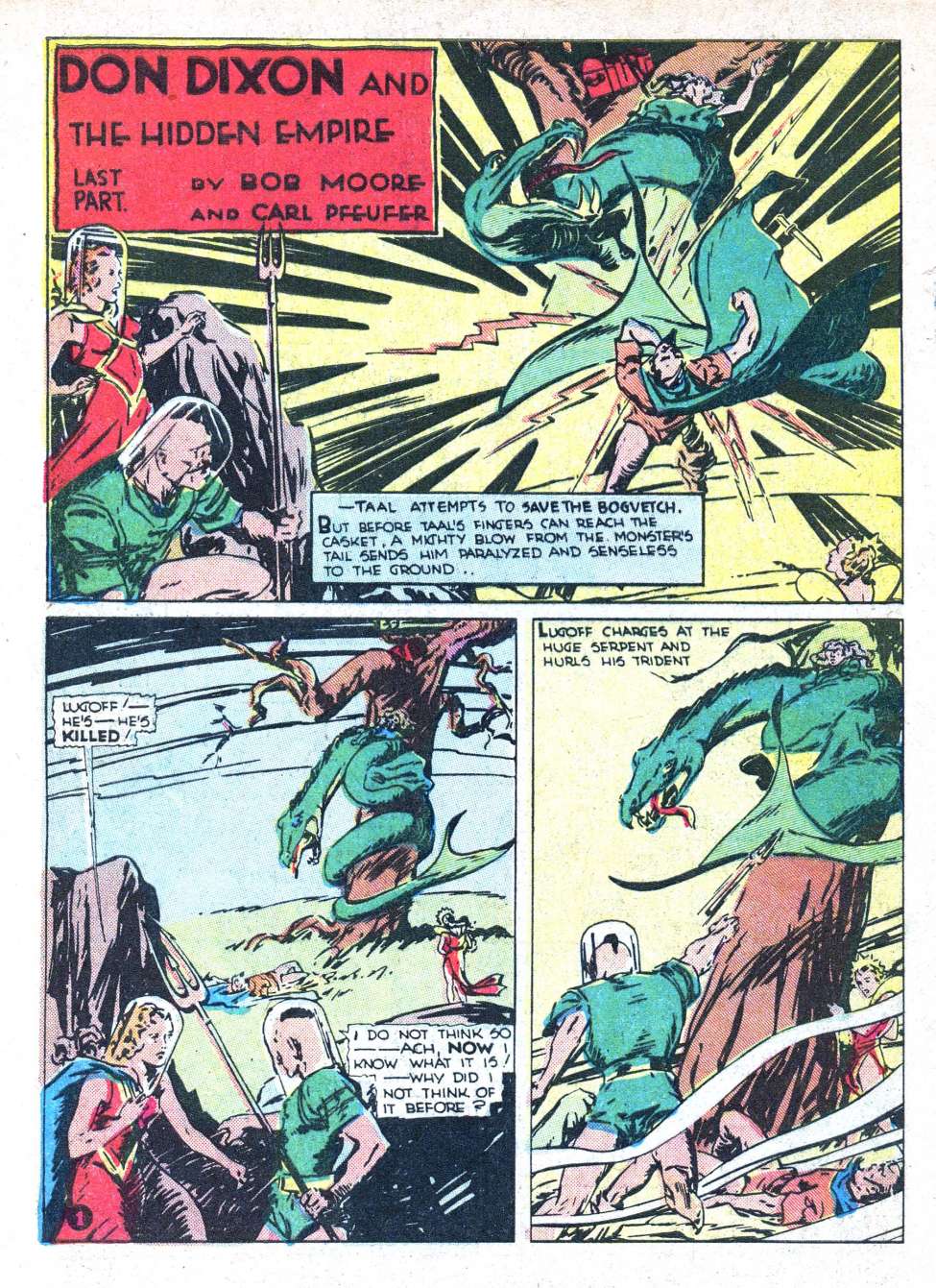
The giant snake with the whale tail is not the bogvetch in this picture, which is a shame because that seems like an appropriately cool name for this creature. It likes to coil around trees and can use its tail smack to paralyze foes.


(Scans courtesy of Comic Book Plus)