Showing posts with label Explorer. Show all posts

Tuesday, May 18, 2021

Daring Mystery Comics #3 - pt. 2

The Phantom Reporter story, for Timely Comics, was a strong one, with an interesting character, and well-told, in the sense that there are no glaring plot holes I saw. I'm no longer surprised that David Liss, when given an opportunity to write a forgotten character for Marvel's 70th anniversary issues, chose the Phantom Reporter.

Trojak the Tiger Man is up next. I'm not a fan of these stories, being almost uniformly cheap Tarzan rip-offs and just overflowing with racism. In this story, we learn Trojak has trained himself to go days at a time without sleep, the special thing about this being that Trojak doesn't have access to coffee. I'm not sure how to handle this in game mechanics terms, but I think I need to because Trojak is staying up for days staking out a dangerous area and wandering encounters could kill him easily if he falls asleep. Constitution checks seem like they would work here, though there needs to be either diminishing returns from those successful checks (the first one lasts for 24 hours, the next lasts for 20 hours, and so on), or a penalty to each successive check, to reflect that it gets harder the longer he stays up.

Okay, a few pages in this story gets cool. How often have Tarzan or Sheena gone up against prehistoric animals? Well...we're told that it's a prehistoric animal, but it really just looks like a poorly drawn Indian rhinoceros. Still, a very tough fight for a low-level explorer and his tiger companion! The rhino has Super-Tough Skin that can break knives (as the power does), and while I don't normally plan on giving rhinos superpowers, I suppose it couldn't hurt in individual cases. And...I'm going to say the way Trojak and his underlings defeat the animal is legit, pulling a tree over on top of it. A tree that size could weigh a ton. Let's say that's...6d6 damage? 

Not content to stop there, the story then goes on to have Trojak fight Nazis who abducted Edith (his Jane analog). This is one of those early stories that doesn't shy away from calling Nazis Nazis, instead of some concealing pseudonym. We get treated to an interesting overhead shot of the Nazi camp, which is very neatly arranged with everything in perfect rows! There are 14 tanks (possibly of 2-3 distinct types), 8 canons, 1 anti-aircraft gun, 4 planes (presumedly fighter planes), 6 things I can only presume are meant to be cars, 39 small tents, 6 large tents, 2 buildings, and 3 trees! We even get a map showing us where this camp falls on the Belgian Congo River. 

Basically, there is no chance Trojak should be able to get with 1,000 feet of this place without being dead. So, naturally, Trojak manages to sneak into the camp after only defeating two sentries. We also get our first indication that Trojak is actually a superhero, or might be an explorer/superhero, as he is able to wreck a barred window with "the strength of ten men." Even after an alarm is raised, only four more guards show up right away to attack Trojak with bayonets. Amazingly, Trojak thinks he can take them and everyone else who shows up (admittedly, the way the Editor is rolling randomly for reinforcements, maybe he's not wrong), but stops because Edith begs him to surrender, emasculating our hero. Actually, once he's captured, he figures he can watch the Nazis work their guns until he understands how to do it himself. And he does, throttling a guard who comes to feed him (which is weird, because we already know he can just bust out the barred window) and then escaping into the camp. Before he leaves with Edith, he mans an anti air-craft gun and aims it over the river so it drops shells onto the submarines docked there. We're informed that Trojak can work a cannon that "requires many normal men to operate," presumedly because he's buffing himself with a power, maybe Raise Car to make himself stronger. Again, only four Nazi guards converge on them before they escape the camp because of their "dulled Nazi minds" -- so, they're basically Trump voters.

Next up is Marvex the Super-Robot. It's interesting how common the concept of robots was back then, but no one really understood how one would work. Marvex is able to think because of the "delicate mechanism" in his brain, without specifying that as a computer. Marvex is created by two fifth-dimensional men who do it because they're bored and they want it to capture some Earth humans. Marvex is "born" with a conscience and won't do it, so he mops up (by then) six fifth dimensional men around him - with a seventh 5D guy. Which is weird because comic books tell us that people from higher dimensions are more powerful than us, sometimes vastly more powerful. And yet, maybe in their own dimension, they are just normal people?

Blowing up their lab tears an interdimensional hole that blows Marvex to Earth, where he immediately...tows an old man's car. Raise Car power? The man must be pretty wealthy because he tips Marvex $20 for it, which in 1940 lets him buy an entire suit in town to help conceal his appearance. When he hears a woman nearby scream for help he leaps up at least five stories, which can just be the Leap I power. The Feather Landing power lets him drop from that window to the ground without harming him or the two people he carries with him out of the burning room.

When a car full of spies speeds past and shoot at them, Marvex uses Nigh-Invulnerable Skin to block the others from harm and then Race the Train to catch up to the car. After learning where the spies took the secret plans (that is what the woman was hollering about), Marvex flies up to a 13th floor instead of leaping (Fly I, most likely). There is also an instance of wrecking things where Marvex wrecks a car, though since it's just the top of the car, maybe we can downgrade that one rank to robots. From the evidence, it seems like Marvex has used five 1st-level powers, but higher level powers could have duplicated some of them. As an android, he always get a free power anyway. And since we've only seen him use one 2nd-level power for sure, it's possible he's only 4th level, with only three brevet ranks.    

Last up is Captain Strong of the Foreign Legion. In Algeria, Strong is up against ...pirates? That's weird because these guys would normally be called nomads or bandits in anyone else's stories. While trying to set up an outpost to guard against the "pirates," the legionnaires are attacked by a "horde" of them, but we don't see more than ten of them. I really don't like how these stories act like it's okay to mow down Arabs with machine guns, but after that the tactics are sound. Strong knocks out one Arab, dresses as him, and then rides his horse back with the others as soon as they flee, and in this way he finds out where they were heading. In the Arab camp, Strong uses a combatant as a body shield, something we haven't seen in a comic in awhile. 

After escaping back to the legion's fort, Strong sets a trap for the "pirates" straight out of The Fellowship of the Ring; when the "pirates" show up and find the legionnaires all asleep, it's actually just empty clothes (though there must be some stuffing in them), ala The Prancing Pony. 

(Read at readcomiconline.to)   


Thursday, February 11, 2021

Master Comics #1 - pt. 1

Another new title! The disturbingly named Master Comics is home to the disturbingly named Master Man! In addition to having mastered being a man, he can also do all the things shown on this page. Maybe! Comic book narrators are notorious for exaggeration. This particular origin story goes surprisingly well, considering that most people don't get superpowers when a stranger gives them pills. 

Master Man builds his castle on the highest peak...where? The highest peak on Earth would be Mount Everest, but the rest of this story sure doesn't look like it takes place in Tibet. The highest peak in the United States is Mount Whitney -- making Master Man the first confirmed Californian superhero. 


He can see all evil in the world...from 14,500 feet? Okaayyy, crazy narrator person!

Does that say Ecaldon or Ecalpon? Ecalpon is from Discworld! Unsurprisingly, this is a made-up name either way. 

Master Man's ability to run 100 MPH is the Race the Train power. He also uses Leap II at rivers and, it looks like, Imperviousness when he reaches town. Obviously, he is the superhero class.

It's interesting that he bares his chest. Is his shirt not bulletproof? The power description intentionally doesn't specify if items worn are protected by this power; this is something the player and Editor should work out between themselves and aim to be consistent thereafter.

The bad guys are a mixed group of four gangsters and thugs, probably half of each. 

I like the phrase "he scatters them like raindrops in a gale." Speaking of that, I like that Master Man can fail; he tries to catch that thrown torch and just misses, and the consequence is the building burns.

However, there is a lot to dislike here too. Why are the bad guys dropping a bomb on an orphanage? Are they terrorists? Why is Master Man smiling when he catches the bomb, when he knows he could have missed? How are the thugs strong enough to hurl a lit torch through an upper-story window that looks like it's 30' high? How on Earth does one lit torch immediately catch the entire building on fire? 

About that one question, "when he knows he could have missed?"
....it occurs to me that if Master Man is high enough in level to get a stunt -- and I have thought about letting all classes have stunts at some eventual level -- then one should be able to use a stunt for an attack roll in non-combat situations, like when you're trying to grab something out of the air. 

Master Man uses the powers Resist Fire and Raise Car here. There's a wrinkle here that the car is barreling down on Master Man at the same time, so both sides would roll for initiative. If Master Man wins, then he can raise the car before he takes ramming damage. He uses wrecking things on the car and the bomber. He's still using Leap II from earlier, as the duration hasn't ended.


It seems odd, from a Hideouts & Hoodlums perspective of mobstertypes, but the leader of gangsters and thugs is a bandit. There was originally going to be hierarchical trees of mobstertypes in the 1.5 edition books that I wound up eliminating. On those trees, bandits would be low on the pecking order. 

You can tell the scenario was too easy and the players still have more time to play, so the Editor has to create a new threat to overcome and the mayor turns up to reveal the kidnapping. 

Dragging a car to a stop is another use for the Raise Car power. 

We never did get any clue as to what the bad guys' motives were.

We're going to jump ahead to The Jeweled Crown of Ramistan, a starring a Tarzan/Mowgli mash-up called White Rajah (just not yet, as this is his origin story).   
 
I can't find any evidence that there are or were headhunters in India. 

Not even Sikhs wear their head wraps in their sleep like this.

This animal summoning power is why I keep leaning towards keeping the explorer class, since this seems beyond what a fighter should be able to do.
 

So, a "black jungle" is right next to India? Riiight. This page is pretty unbearable, not just for that, but for Sin-Gee falling into a trap and David just leaves her there! 

I'm only sharing this page because I want to spend a little time on this death trap. The theory behind it is, by binding one of David's hands, he can't dodge during the knife fight. I wouldn't necessarily call him prone, because he still has some range of movement, so maybe he's +2 to be hit, plus this can kill him because it still qualifies as a deathtrap. 
 
Wrecking things is the obvious way out of this trap, and I would let him wreck his way out of the rope knots as if it was a door.
 
I don't have game mechanics to discuss from this page. I just want to vent. Despite being left behind to die, Sin-Gee gets himself out of the pit without any help, sprints to David's rescue, saves the day and the crown, and then David not only gets all the rewards, but Sin-Gee still has to carry him around! Poor Sin-Gee. As far as I'm concerned, this feature should be called White Elephant!


There is a Carterville in Illinois, but it's only a city in the academic sense since there were less than 3,000 people there in 1940. No, this must represent a larger metropolis, though which city it's representing escapes me. The only clues here is the neighboring mountain, but that still leaves dozens of possibilities.
 
The rivalry with a Moriarty-like villain is appealing, but what made Moriarty so sinister is that only Sherlock Holmes knew he was a criminal. Jeff isn't much of a criminal mastermind if the local newspapermen are already onto him. 
 
I am half tempted to stat a street loafer, but I suspect a wimpy hoodlum would suffice. 
 
And we'll probably pick up with this feature next time! 
 
(Scans courtesy of Digital Comic Museum.)


Tuesday, December 1, 2020

Slam-Bang Comics #1 - pt. 3

Hello! We're back, still looking at the Lucky Lawton feature. We could talk about the oddly rectangular word balloons (the very next page goes back to rounded corners), or the terrible coloring job on this page, but I'm going to focus on the "no guns" law, which was actually quite common in the "Old West," and is something we badly need more of today. Personally, I would like to run a "no guns" H&H campaign, but I know that wouldn't emulate the comics well.


If you've followed this blog long enough, you've probably seen plenty of examples where the artist just seems to be guessing what an animal looks like without using a reference. The artist here is Hal Sharp, and I have a feeling Hal owned a dog; Pal is in real dog poses every time we see him.

Lucky does the smart thing, circling the perimeter instead of barging right into the bank. 

Also note how not going solo gives Lucky twice the chance to detect the activity in the bank that he would have had walking along alone.


There are two ways to achieve Lucky's noiselessness. One, he can make a skill check to move silently. The other is that he trust to his surprise roll and, if successful, means he must have been moving silently. Since chance of surprise is normally 2 in 6, it seems like that would be easier for most Heroes (unless Lucky is a mysteryman using a stunt, but I doubt it). 

Combat in the dark adds a greater level of challenge, what with the -4 penalties to hit. Just by not flipping the lights on, every unarmored combatant is now effectively at AC 5. Now, from the panel art it appears that there is plenty of light coming in through those front windows, making the scene only dimly lit, but this could just be artistic license so we can see more than five black panels with word balloons in them.

And yet, in this scene, the bandits are silhouetted in front of the windows, so it wasn't really that dark after all? And the remaining band sees Lucky in the darkness now? To emulate this scene, we need a new mechanic for eyes adjusting to darkness after a certain, or maybe random, number of combat turns. 

Although the rest of this story is seemingly set in the Old West, the remaining bandit's hat looks suspiciously modern.

The bad coloring job on the lower half of this page might be fooling me, but it appears that the rancher is wearing his bandana up over his mouth. I only mention it because I see so many people wearing their masks wrong like that these days...


There aren't game mechanics on display here, but I like how Lee is a scientist/explorer. Both were classes in Hideouts & Hoodlums 1st edition, and while both classes did get playtested in my campaigns, no one ever thought to combine those two.

My initial reaction was that having the slavers be Arabs was racist, but while there have been many white slavers through history, there was a strong tradition of slavery in the Middle East, with several countries not outlawing it until 1970. Also in the writer's favor, Ali and Hassan are real Arabic names, and not gibberish names meant to sound Arabic (I know, some golden age writers set the bar really low!).

Wow, we're in pure fantasy territory at this point. First, there's no way a plane explodes, and someone sitting in that plane falls from that wreckage completely unharmed. This should be a save for half damage situation at best. 

Then, there's no way someone's coat would be big enough to create enough wind drag necessary to cushion his fall, so there's more damage Lee should have taken by now. I think we're looking at the tune of 55d6 damage at this point - and that's assuming the plane was at a near dangerously low altitude for flying.

As unlikely it is that all the spear attacks Lee left himself open to while charging the pygmies missed, it is even more impossible for him, game mechanically, to push the leader onto a spear, unless the Editor was house ruling a fumble mechanic. More likely, this is just a freebie from the Editor.
Neutralizing poison is really easy in Lee's world. All you have to do is stick someone with a knife and the poison leaks right out of you! If I was willing to implement this as a new rule (and I'm not), for every point of damage you do to the wound, you would give the recipient a new saving throw. 


The pygmies are very patient in indulging Lee's rampant passive-aggressive racism. "Uh...ever heard of donkeys? The domestication of donkeys started in Africa. And we know what iron is, iron smelting and forging technologies were discovered in Nigeria as early as the 6th century BC. Bricks too, since about 7,000 BC. And just what are you whittling? A giant banjo?"


I am so torn on this page. On one hand, I think it's great that, for once, a lion shows up in a story and the Hero wants to capture it alive instead of stabbing it to death, or snapping its jaws, or shooting it. But that he wants it so he can perform experiments on its brain doesn't sit well with me, even though I get that the author is trying to offer a scientific explanation for how the jungle Hero is able to talk to animals. 

(Scans courtesy of Digital Comic Museum.)


Friday, June 21, 2019

Zip Comics #1 - pt. 3

This is still Kalthar, and we've rejoined him just in time to find out where he hides his magic potions. Is invisible panther hair whiskers? I wonder why the grains even need to be tied to his ears, as weaving them into his hair (if it was longer) would have been much more sensible.

===

Being normal size means Kalthar isn't buffed by any powers. In such a state, five guards are easily enough to take him down.

===
Unlike many other strips, it is clear that not everyone is speaking English; Kalthar just happens to know all their languages. I honestly don't see much difference between that and having them all speak the same language, although we'll talk about this more on the next page...

===

It's interesting that throwing spears at a Hero when he can move around is combat, but if he's tied up, it becomes a deathtrap, with the separate rules that apply to deathtraps (zero hit points means death instead of unconsciousness).

It seems like Kalthar is using some kind of power to summon apes, but if the apes are considered his SCMs, and he's just shouting for them, and they're near enough to hear it, isn't there a good chance they would just come anyway...?

Here's where requiring Heroes to know different languages might actually be useful in the game -- because knowing the language can form a connection with someone, and give you a bonus (+1?) to your encounter reaction roll.

Kalthar can clearly speak with animals as well. I do not want to give this ability all Heroes, and in fact brought up on this blog a long time ago that the Explorer class should get the speak with animals ability. Maybe Kalthar is multi-classed?

And last on this page is a rare example of an elephant being able to wreck through a stone wall. Elephants sure are strong!
Here, for the first time, we learn that Kalthar grows 15' tall when he's activating his powers, which seems to include Nigh-Invulnerable Skin and Multi-Attack.
This feature is War Eagles. Six am seems awful early to start playing Dawn Patrol (TSR joke there).

One of the nice things about this strip is that it includes the name of each plane at the bottom. I don't have to compare the drawings to photos and guess anymore!

===

If I ever manage to write my own aerial combat rules, trying to gain control of the facing of your opponents will be a critical function in combat.

===
Always make sure there is some downtime in your campaign for role-playing. Friendly rivalries are a good role-playing opportunity. Romances are a little more challenging for most roleplayers.

It seems almost too good to be coincidence that the twins like a Helen Carter, like Captain America would later like a Sharon Carter.

Again, we get the name of a plane to help with research, though that is awfully hard to read...

===
A lot of the H&H rules still can apply to aerial combat, including using skills to move silently and gaining surprise before combat -- just occurring at much faster movement rates.
...and yet there still seems to be a need for specific aerial stunts that work more like they used to for the 1st edition Aviator class. Here we see the stunt Power Dive in use.

===

This is also a prime example of the amount of carnage that can go on in a war-themed campaign. The goal seems to be accruing the highest possible death toll -- which is perfect for racking up XP in a campaign where finding treasure and trophies is not the goal.
Here we have a villain turn up. You can identify villains by their ability to make return appearances; so, basically, anyone who survives going up against the Heroes could be a villain. The problem here is, the twins haven't actually met or interacted with Anton Schultz, so there's no fun in making him a villain.

(Scans courtesy of Comic Book Plus.)

Wednesday, April 17, 2019

Jungle Comics #2 - pt. 3

We're still looking at Captain Terry Thunder of the Congo Lancers ("Terry" has been added to the title since last issue). I like that fifth panel; in a RPG scenario, each man's secret could be shared with the player only and, although the published scenario here was all combat, in game everyone could have the secondary goal of trying to figure out everyone else's secret past through roleplaying.
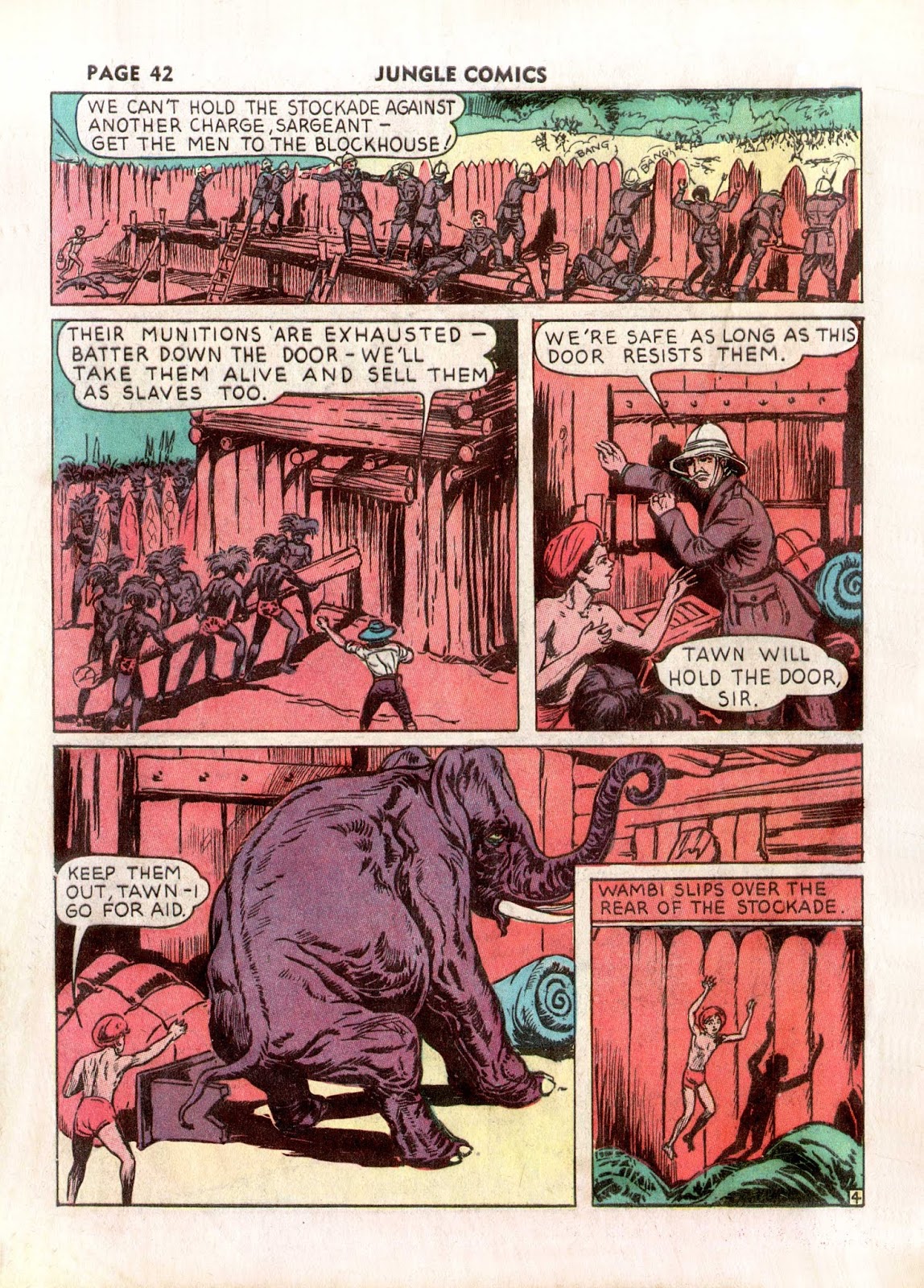
This is Wambi, the Jungle Boy. Wambi has the ability, like most jungle explorers seem to do, of summoning animals. Here, we see nine monkeys encountered at once.

Wambi, forced to choose between the people who raised him and some white guys he just met last issue, chooses to betray his own people. Okay, sure, they turn out to be slavers -- but those slavers wiped your bottom when you are a baby, kid!
Speaking of number appearing, here we see at least 40 natives, and is probably meant to represent much more than that.
"What the devil? How did the elephant get in my blockhouse? And how is there room for him in here? Is he sitting on all my men?"

Of course, in the early days of D&D, you could put 20 orcs in a 10' x 10' room and no one batted an eye, but nowadays you should put a little more sense into spaces than that...
This is from Roy Lance, a feature best remembered for its good sense of geography and ethnography. The Riffians are indeed a real people, also known as Riyafa or Rwafa, and a Berber-speaking people of Northwestern Africa. Everyone has heard of Ethiopia today, but that might have been an obscure country in 1940. The Zulu are a Bantu ethnic group of Southern Africa and the largest ethnic group in South Africa. Not surprisingly, the author cannot name a real cannibal or pygmy people from Africa.
This page is all kinds of wrong -- Joan is being spanked, with a native gleefully watching, for being a free thinker and feeling like she shouldn't have to obey a man. 1940 was a tough time to be a woman.

The map is serviceable, though, with a mix of real locales, like the Congo River and Stanley Falls, with names that I can't verify are real. Twice, upon seeing Wakuna in this story, I thought "Wakanda...?" Probably not intentionally similar.
Now, seeing all the "primitives" running in fear from a film projection might seem racist to you, but bear in mind this trick also works on Scooby Doo. It just seems to be a given of the comic genre that visual and audio trickery is much more compellingly realistic than it would be in real life. So, as the Editor, keep an open mind when your players try nonsense like this.
This is from Simba, King of Beasts. It takes a lot of imagination to picture a water buffalo being the deadly nemesis of a lion, but now I'm just going to have to make sure to stat water buffalo -- and make them nasty!
I included this page because I realized there were actually few examples I had found so far in comics of outdoor tracking. This was the primary ability of the 1st edition explorer class, but maybe that can't be justified by direct emulation after all...

(Scans courtesy of Digital Comic Museum.)

Thursday, February 7, 2019

Marvel Mystery Comics #4 - pt. 3

Ferret is an odd name for a Hero, and a seemingly unnecessary one since everyone seems to know who Ferret is. I suspect what's going on there is that "Ferret" is meant to be protecting the famous author's identity from his the readers, so you don't know who he's meant to be.

Ferret is investigating a murder and the police are focused on a stereotypical clue -- the matchbook in the dead man's pocket. Ferret, however, does his legwork and interviews people from the nightclub. Now, it turns out the first clue was right, but being thorough can help the Heroes from following up false leads, and then blaming the Editor later for letting them spend the whole session on a dead end.

Ferret wears a bulletproof vest. It doesn't protect Ferret from taking the bullet, but he gets pushed back and has the wind knocked out of him instead of being killed. It is more realistic sounding, but it's not how bulletproof vests work in most comic books, and won't work this way in Hideouts & Hoodlums.

Ferret is staked out, watching an apartment, for two hours before he falls asleep. There's no game mechanic that covers that sort of thing. I guess Ferret's player announced he was falling asleep, or the Editor punished the player for yawning at the game table.

When a life is in danger, Ferret has to ditch his plans of being methodical and play on a hunch as to who the killer is. He barges into the nightclub and searches the office for secret doors before anyone can stop him. It's not behind the bookcase, but it looks like it's behind some paneling that slides open, revealing a door. Behind the doors is a short flight of steps that leads down into a lower room with barrels of cement in it.

In Ka-Zar's fourth installment, white men have come back to the Congo where Ka-Zar calls home, with a small army of native porters with them. Ka-Zar goes to their camp to harass them with his bow and arrows, but when a native shoots at him, that's provocation enough for Ka-Zar to shoot him with an arrow and kill him (which isn't possible under normal H&H rules).

Leopards really have it out for Ka-Zar -- again a leopard challenges Ka-Zar and only backs down when other animals come to Ka-Zar's aid.  Maybe Ka-Zar is just unlucky with encounter reaction checks when leopards are around -- or maybe the Explorer class needs an animal with a special enmity for the Hero.

Ka-Zar roars like a lion and it chases some of the natives away; mixed in with the natives might be some superstitious hoodlums.

(Read at Marvel Unlimited.)


Sunday, January 13, 2019

Daring Mystery Comics #2 - pt. 2

We resume with discussing Trojak the Tiger Man, though the page I'm reading now is about the unnamed woman who has turned good from Trojak's presence and has decided to leave her companions to make her way back through the jungle alone. En route, she encounters a random encounter, a lion. Trojak rescues her by grappling the lion to death. I've commented before on how murderous the early golden age heroes were, but it's also worth pointing out that morale checks never seem to come into play; fights are always to the death with animals.

Trojak learns English from the woman in about a week.

There is no game mechanic for Trojak's "strange premonition that something is wrong." Rather, in game play it is more likely a case of the Editor doing a little unsubtle prodding. "So, what do you now? Maybe head back to the village and check up on it...?"

Trojak's tactic of grappling the chieftain and holding him hostage is a sound one.

Instead of summoning animals himself, like by some special cry, Trojak tells his pet tiger to go get help. How the tiger communicated with the lions and elephants who show up with him is unclear.

K-4 and His Sky Devils is the aviation feature in this issue. It is a step above many other aviation features in naming the planes it depicts; we see British Hawkers and American Grummans. Not only that, but we even get K-4's number of kills in war -- 11 in WWI (where he rose to the rank of lieutenant), 33 in the Spanish Civil War, and "dozens" in the "China-Japan conflict." If we award him 100 XP per battle, and assume dozens = 36, that's 8,000 XP, which happens to be exactly enough to make K-4 a lieutenant by the XP chart for fighters.

In an unusual twist, K-4 is only using his plane for transportation for most of this story; as the bulk of it involves him going undercover, masquerading as a German SS officer. K-4 has to get to Kurtzburg, Germany, which is not a real place but probably represents Kutzberg, which is. When K-4 is ID'ed as a spy, he snatches up as many grenades as he can carry from an armory and blows up his way out of an enemy base. Interestingly, of all the strips, this is the one that most seems to have been prepared for serial publication in a newspaper and was reformatted to the comic book page (with frequent recap narrations intact).

Mr. E is a mysteryman. When a rich man with a threatening note tosses it in his fireplace, Mr. E has to win initiative to get to the note before it's consumed by the fire. Of course, being a mysteryman, and not in combat yet, Mr. E can burn a stunt to win initiative. The stakes are high; this is a rare adventure where the bad guys want $1 million.

Mr. E is run off the road on his way back from the old man's mansion and -- here's the really interesting part -- it's an arch-enemy, The Vampire. Apparently, his nemesis has just been trailing him in his own car, waiting for a chance to get even. They have enough of a history that Mr. E recognizes him by voice. The notion of starting your hero with a nemesis baked into your backstory is an intriguing one. Hypothetically, a human Hero could make his nemesis his free supporting cast member, so every time the Editor uses him, the Hero automatically gets an extra 100 XP.


(Comic read at fullcomic.pro)


Wednesday, January 9, 2019

Daring Mystery Comics #2 - pt. 1

It's been some time since we last checked in on the fledgling company of Timely Comics.

It starts with Zephyr Jones and His Rocket Ship, firmly in the science fiction genre. Zephyr and his friend Corky are heading to Mars in a privately built rocket ship. Zephyr is right about how far it is to Mars, but either his calculations for travel time are off or mine are, because at the 300,000 MPH speed he claims he's going I think it would take five days to reach Mars instead of one. That speed is, incidentally, eight times faster than the fastest spacecraft ever launched from Earth up to the present day.

When the ship veers off course, it lands on a "lost planet" -- as if there could be an unnoticed planet between Earth and Mars. Actually, since the theory is floated later that this "planet" broke off of Earth ages ago, it's more factually a moon -- just one much smaller and in a far wider orbit. The moon is called Sunev (yes, Venus backwards, har har), and it not only has normal gravity and a breathable atmosphere, but it is inhabited by human-like aliens with feathery wings who call themselves the Birdmen and speak English. The birdmen live in a 19th century-like monarchy, but gunpowder was never discovered and the only science they are advanced in is chemistry. They have discovered an elixir that expands lifespan, so that the birdmen can live 300-400 years (there is no explanation given for how they have solved the overpopulation problem that would cause). There is a separate race/culture on the Sunev called (I'm not kidding either) the Parrotmen.  The Parrotmen are more muscular and brutish-looking, preferring to go shirtless in combat and fight with maces.

Zephyr and Corky, perhaps having not expected a safe journey into space, came armed with two automatic pistols and a Tommy gun, make short work of the parrotmen with their maces. After stopping the Parrotman uprising, Zephyr and Corky return to Earth before heading to Mars, which makes sense -- they would need all new calculations to change their trajectory from Senuv, and likely the Birdmen are not advanced enough mathematically to help them.

The Phantom Bullet, Scourge of the Underworld, is next.  Nearly washed-up and cynical newspaper reporter Allen Lewis works for the Daily Bulletin, a name just too generic to be able to trace to a particular real city.

Despite the fact that at least five people have examined a crime scene before him, Allen is the first person to find a bird feather clutched in the dead man's hand -- proof that it always pays to examine the scene of the crime for clues, no matter how much later. A police officer at the scene also gives him a freebie, telling him what might have been a randomly rolled rumor, that hand prints have been found at the scene of three crimes that seemed to belong to a seven-fingered person. 

Players often pay little or no attention to the private lives of their characters when not adventuring; seldom is that more on display than when Allen's player calls his boss an idiot and tells him to write the story himself, before running off to do hero work.

The first indication that Allen may be a mysteryman comes pages later, when Allen makes a spectacular -- though still far from superhuman -- leap between rooftops. But Allen is still 1st level -- indeed, still in his origin story -- and is handily beaten in his first turn of combat when ambushed by "birdmen" (see a theme developing between stories...?).

Amazingly, Allen still has his job the next day and gets assigned to talk to an inventor, who just randomly decides to hand off his "invention" to Allen -- a gun that shoots ice bullets. This is what Allen needs to complete his origin story; armed with the gun, wearing make-up on his face instead of a mask, and wearing a bright-colored shirt and red cape -- because, you know, he'll need to sneak around and stuff -- he sets out to stop more murders. Off-panel, the Phantom Bullet uses his skills to move silently and climb walls to get around the police cordoning off a threatened man's home.

This time Allen shoots and kills one of the bad guys when they show up again, but there is no sign that the man has feathers; he just seems to be an ordinary black man. We also learn the plot finally -- the bad guys are killing rich men who refuse to hand over $500,000 to help fund a new government. The other two make off with the money and Allen has to move on to the next would-be victim.

This time, the man doesn't refuse and the money is picked up by a bum Allen recognizes. Cornering the bum, Allen recovers the undelivered money and finds out where it was supposed to go, the address being a local cemetery. Now, it would be great if this was the bad guys' hideout -- a nice, atmospheric location. But the cemetery is empty. Allen goes back to the bum and re-examines the envelope with the address on it; the correct address is in invisible ink and the first address was a phony clue.

The real hideout is an African explorer's house, or more precisely the caverns under the house (the Phantom Bullet finds the caverns off-panel). *sigh* ... in a decidedly racist twist, the "bird men" turn out to be half-black men/half-ape mutants wearing feathered headdresses as if they were American Indians. This resembles the beast men race we talked about adding to Hideouts & Hoodlums a long time ago, but I think I would just stat them as ape men. There are not two more of them, but five more of them, and they're dumb enough that PB can trick them into following him back upstairs to a window and then all jumping out after him like lemmings. PB had swung himself up to the top of the window ledge, and then comes down to shoot the evil explorer, ending the story (and saving a kidnapped young woman who just happened to be in the caverns).
 
Next up is Trojak the Tiger Man, a Tarzan clone. Normally, Tarzan clones have to be raised by animals to speak to animals, but Trojak was raised by an African tribe of humans and just happens to know how to talk to animals anyway. He also gets a tiger for a starting companion. His tiger, Balu (showing this feature steals from The Jungle Book as well as Tarzan), is shot, but is only lightly injured by it.

Trojak himself is shown to be able to bend a gun barrel, which is either a really lucky roll for a non-superhero at wrecking things, or maybe Trojak is a multi-class fighter/superhero. Further, subtle evidence of Trojak being a superhero might be the strange case of the unnamed woman in the white hunting party Trojak encounters and follows. At first, the woman is fine with her companions and their quest for gold, but over the course of days of observing Trojak following them, she starts to show disgust with her fellow travelers and an admiration for Trojak that can only be explained as sexual attraction -- or maybe use of the power, Turn Good.

(read at fullcomic.pro)

Monday, August 13, 2018

Champion Comics #3 - pt. 2

Picking up where I left off, Penny Wright is tied to a tree by Santos and just left there (I guess he has to go somewhere to get his favorite whip).

While Penny's not that bright, Gus seems to be a quite capable assistant -- so much so that I hope he represents a played Hero and not supporting cast. Making a rope out of a blanket is clever, and I don't think I've ever seen a snare trap used like this.

There's a couple freebies from the Editor here, though. One, I'm not crazy about allowing a snare to do knockout damage. At best, I would treat it as an improvised weapon and have it do 1-3 points of damage (of course, it could also just be a very weak guard). Second, the keys in easy reach is either a freebie or the result of a save vs. plot.

Government Man seems to be a wandering encounter, though he could also be a third freebie. Or a third played Hero who's player showed up late to the session!

Liberty Lads had me fooled with Wonocco for a bit there, as it sounds just convincing enough that I thought it might be an actual Indian name. I can't find any evidence of that being true, though. If this is Richmond, Virginia, then Wonocco is likely Algonquin or Sioux.


The mother bear, apparently, attacks just to defend her cub, but Wonocco ruthlessly guts her and then, also apparently, they just leave a motherless cub to defend for himself. Way to live with nature there, Wonocco!


Now I have to decide if I need to stat militiamen as a mobstertype. I could just leave them as fighters, but they are also characterized here as "yellow backed" (low morale), and we know their number appearing goes up to 400. They are shown to be racist -- but then, when even the good guys call you Possum, you know you're a black man in a racist society.


Quinine is a a medication used to treat malaria and babesiosis -- an odd remedy for a fever, but what do colonial-era kids know?

And maybe it's my modern sensibilities at play here, but that wood-cutter's intentions seem more perverted than "wily" to me. Maybe, if read from a 1940 perspective, it would seem more obvious that the wood-cutter is in league with the redcoats.

This is Jungleman. Evidence that the white (-ish) tiger is a supporting cast member and not directly under Jungleman's control is seen in how Jungleman leaves it behind to guard his prisoner.

That Jungleman's ability to speak with animals is not limited to one animal at a time is demonstrated by this communion with a small army of apes and monkeys (all living together, as if they were interchangeable).

Angkor is incorrectly described as a living city here, when it was actual already in ruins well before 1940.

Kalu is an actual name, but more often an African name than an Asian name.

The Blazing Scarab picked up where it left off.

More proof that languages spoken is unimportant in comic books.

Evidence of an unusual magic-user "wand" -- in this case, the scarab -- and evidence of a visual manifestation of the spell being cast.

It seems that the spell was Hold Person, but Walt can still follow commands. Hold Person II?

Interestingly, these men-at-arms that can step through walls are very similar to the hieroglyph guardian mobstertype that I introduced in the 2nd edition Basic book, only full-sized and not monstrous-looking.

(Scans courtesy of Comic Book Plus.)


Monday, July 9, 2018

Marvel Mystery Comics #3 - pt. 3

In American Ace, Wade Perry rescues a girl and gets a new mission from this plot hook character -- deliver her to her sister, 60 miles away, so she can tell her sister their parents are dead. It turns out to be a super-easy trip, as his plane is fast and they make the trip too quickly for the Editor to roll up any wandering encounters along the way.

Instead of speeding off on another scenario, though, Wade spends a whole week of down time just hanging out with the girls and their grandparents on their farm. Now, maybe Wade's player is just playing it smart...figures a war scenario is too dicey, so he's safer just hanging out here, earning some XP for including supporting cast members in the story, and hoping for more chances to rescue them for more XP. Or maybe his player just really enjoys role-playing.

But eventually, regardless of which it is, he tires of his character having no action here and decides to leave. Now the Editor gets that wandering encounter check he'd been waiting for!  He rolls up three enemy fighter planes.  Three-to-one odds are tough for low-level Heroes and are too much for Perry. Luckily, he survives, and revenge is a good motive to get players into more dangerous scenarios.

The third "episode" of the Adventures of Ka-Zar the Great provides a map showing us that Ka-Zar's adventures are firmly planted in the Belgian Congo. Again, Ka-Zar demonstrates an ability to speak with animals, which either must become a special ability of an explorer class, or just written off as part of the jungle/Tarzan genre.

This is a different adventure for Ka-Zar, as there is no "villainous" person or animal in it. Steve Hardy is a rival explorer, collecting animals for zoos. Ka-Zar is at cross-purposes and wants to free the animals, but without harming Steve. By waiting until nightfall, Ka-Zar only has to gain surprise against one guard and simply open all the cages. Of course, had the dice rolls gone against him, the guard would have woke the whole camp and Ka-Zar would have been quickly outnumbered. Sometimes, the result of just a few dice rolls can determine if a whole scenario is going to be easy or hard.

The wild animals released include a hog, a stork, a leopard, and an elephant. Boars, leopards, and elephants have all been statted for H&H, and storks...probably don't need to be. Curiously, Steve never just follows the tracks of the missing animals. Ka-Zar must have swept all evidence of tracks away?  When Steve goes hunting a rhino (also statted already), Ka-Zar attacks Steve's native porters and makes them all fail a morale save.

Ka-Zar is using a bow and arrow in this scene and manages a wounding shot, being careful not to kill the porter. I've not considered doing this before, but maybe H&H could allow Heroes to set a maximum damage they want to do. Or maybe that would just work with non-firearm damage. It bears more thought.

On his way home from that adventure (presumedly because the artist had another page to fill), Ka-Zar has a wandering encounter with a hostile leopard (apparently not the same one he'd saved earlier).

(Read at Marvel Unlimited.)