Showing posts with label trophy placement. Show all posts

Thursday, January 6, 2022

Mystic Comics #2 - pt. 2

Next up is Flexo the Rubber Man. This is like old home week for me, as both of these heroes (Mastermind Excello and Flexo) were played in my 1962 Marvel Super Heroes campaign I ran two years back. 

Flexo's inventors, Joel and Joshua, aren't ones to rest on their laurels; they're already hard at work reinventing those common comic book staples, the torpedo repeller and the new, more deadly explosive. And our enemies are up to the same tricks, because they have one of those dime-a-dozen rayguns that turn off electric motors. The 2nd edition basic book has no tables for specific trophies, but if it did, they would be weighted by frequency and these items would have some of the widest ranges on the table. 

Joel, captured by spies, is placed in a pretty lame deathtrap; he is tied to a tree with rope and left for wolves to eat. Wolves? Do these spies think they're in Siberia? The spies also don't think to check Joel's pockets, or they would have found the portable transmitter. Portable transmitters are also pretty common among comic book characters, but what makes Joel's different is that he taps on a button on his jacket, Morse code-style, and that transmits the message. 

When Josh gets the message, he takes the hi-tech approach of using Flexo to get him there and the low-tech approach of tying himself to Flexo's back with rope. I hope you're really good at knots, Josh! The comic book doesn't really explain how Flexo flies, but in the RPG campaign I ran that Flexo was played in, we came up with the idea that he shoots gas out his butt for propulsion. 

Josh reaches Joel just as 4 or 5 wolves arrive and, even though the wolves have shown nothing but curiosity about Joel so far, Flexo is made to viciously attack the wolves.

Flexo lifts their plane over his head (its head?). I think a 4-seat, single prop plane weighs about 1.5 tons, which is almost to the point where the power Raise Car tops out. Then they follow the repeller because it's magnetic and their compass in the plane points towards it because...you know, magnetism has no range to it.

As they charge into the spies' hideout, the marching order is unusual in that Josh and Joel go in first, with Flexo trailing behind. You'd think the human beings would want to use him for cover. Unless Flexo just moves really slowly on foot? 

The entrance is trapped with dynamite and all three of them are buried beneath "a mass of rock and heavy timbers" (without specifying how much a mass weighs). The entrance is trapped with dynamite and all three of them are buried beneath "a mass of rock and heavy timbers" (without specifying how much a mass weighs). The panel is pretty dramatic, with it looking like the timbers are exploding towards them instead of just falling. I would rate that as at least 3-18 points of damage. It makes sense that Flexo is not harmed by it if he buffed himself with a strong defensive power, but what's really surprising is that Josh and Joel only have scratches. I had considered them noncombatant supporting cast members - but are they actually mid-level scientists with a fair amount of hit points?

Although Josh and Joel normally control Flexo with a remote, it seems it can respond to voice commands too. The really interesting thing about Flexo is that bullets don't just bounce off of him like you'd expect from a rubber robot; instead, Flexo reseals after being punctured, like self-sealing tires. Only, as far as I can tell, self-sealing tires weren't a thing until 2006, so this seems to have anticipated the technology.

Flexo's "machine gun blows" must be the Flurry of Blows power. What's harder to describe with game mechanics is when the spies' car bounces off of Flexo, as there's not really a good power for that. Bounce Back Blows, maybe, if you let it work on vehicles and not just living attackers. Bounce Back Blows is powerful, so Flexo has a lot of brevet ranks. At this point, Flexo should still be just a first-level superhero. 

Moving on, the next adventure features Dynamic Man, and it starts with a curious mystery. Saboteurs are planning to blow up a bridge to crash a train. Dynamic Man is riding, in costume, on the top of the train. Is that because he knows the train is in danger, or is it just coincidence? Like Mastermind Excello, Dynamic Man has Clairvoyance and can see the bomb being placed, but Clairvoyance only has so much range, so he shouldn't have known about this until the train was close. 

Dynamic Man can fly fast enough to catch up to a speeding car, which is difficult to do with Fly II, and might require Fly III if the car had enough of a head start. He is buffed, possibly with Imperviousness, or relying on Nigh-Invulnerable Skin and a little luck, before going in so he doesn't have to worry about the bullets bouncing off of him. He picks up the men with ease, suggesting he has Raise Car activated, and appears to be beating the men against the ground like clubs, doing clubbing damage to them (which would be 1-6 points only -- unless he is also buffed with one of the Get Tough powers). The one surprise is that Dynamic Man seems to have a power that works just like rayguns that shut off engines, though you might be able to duplicate that effect with Wreck at Range, if the Editor allowed you to use it on just the engine and not the whole car. 

The bad guys' car has a special add-on; a radio transmitter in the back seat so their boss can listen in on everything...

(Read in Marvel Masterworks: Mystic Comics vol. 1.)


Wednesday, October 13, 2021

Top-Notch Comics #4 - pt. 4

We're back and looking at the next page of Wings Johnson. Panel 4 looks very dramatic, but playing chicken that close with two airplanes seems like a terrible idea to me. It also gives the impression that facing really doesn't matter in aerial combat -- and in Hideouts & Hoodlums, maybe it shouldn't. In hand-to-hand combat, you don't get a bonus to hit for being right in front of someone; your odds are still about 50/50.

Finding a grenade in your plane seems like a dangerous idea, but in a campaign where trophy items are randomly dropped this makes more sense.


We're going to jump out of that story (nothing is every really resolved in a Wings Johnson story, he just hops from one dire situation straight into the next - as if anticipating how Marvel Comics will work someday!). 

...And we're going to jump ahead to yet another disastrously named comic book character, the laughable Bob Phantom. This particular story isn't too laughable, though, because you're going to be choking on the racism here instead. But if we look past that, we'll see an instance of game mechanics poking through here at the end, where the mobster gets a bonus to his morale save as soon as he knows his boss is listening.

This page gets really dark, as Bob completely fails to save an entire plane-full of people. Are there consequences? Only for the bad guy, as Bob now has an excuse to really cut loose on him.

And here we see something unusual; a superhero using an opponent as his instrument of wrecking things. The H&H rules are really set up to avoid this, mainly for game balance; the superhero is supposed to be good at breaking stuff and the fighter is supposed to be good at hurting people. Now, the superhero can knock a bad guy into a wall, essentially treating the wall as a club, and doing 1-6 points of damage (possibly modified by the superhero's Wisdom bonus). Wrecking things should be a separate action the player would have to wait a turn to do...but suppose the hero was buffed with a power, like Race the Train, that granted him an extra action per turn? Then he could legit wreck the wall at the same time as knocking the mobster into it, though it would confer no additional damage to the mobster. 

And check out the text around that newspaper article! It's the text from a story, but not from a made-up newspaper story. It seems to be cribbed from some piece of fiction. Maybe a text story from another MLJ comic book? I don't read the text stories, so I'm not sure.

I am really hoping that the writer of this story just didn't think it through. All the bad guys want to do is smuggle Chinese citizens into the U.S. Five times Bob has forced the planes to dump their human cargo into the ocean and kill them all. Never once has he teleported into the plane before it takes off, or waits for it to land and then catch the smugglers red-handed. It's really bizarre how Bob's player keeps making the situation worse every time he intervenes, and he just keeps right on doing the same thing each time.


You'd guess that pit was, what? Sixty feet deep based on the drawings? It seems unlikely that the boss could survive that fall, but Bob could just teleport down there and check. But this is a comic book story, so Bob would have to save vs. plot to interfere with a villain plunging to her death. 

Walt (it's hard to believe that his real name isn't Bob) goes to great pains here to hide Bob Phantom's involvement in the case, and this seems like it would be up to the personal preference of the player. Maybe it's just as well that there's no Popularity or Reputation mechanic in H&H, because it would hurt the players wanting their characters to act more anonymously.


I'm going to jump into the middle of Stacey Knight, M.D. If you do a good deed, but someone's forcing you to do it, even though you would have done it anyway - do you still get the 100 xp for doing a good deed? It's a question almost as tough as, why did these mobsters leave a kerosene can within reach of their prisoner? 

As dumb as the mobsters are, Stacey's plan is pretty bright. Not only does the fire distract his guards and puts their mobile hideout in jeopardy, but it draws the attention of much-needed help.


It's unclear if Stacey can boss the Coast Guard around because of his occupation or because of his level. 

Is that guy on the radio saying "Roosevelt" really slowly or spelling it out? 

The Roosevelt Field?  According to Wikipedia, "Roosevelt Field is a former airport, located 2.3 miles (3.7 km) east-southeast of Mineola, Long Island, New York. Originally called the Hempstead Plains Aerodrome, or sometimes Hempstead Plains field or the Garden City Aerodrome, it was a training field (Hazelhurst Field) for the Air Service, United States Army during World War I.

In 1919, it was renamed in honor of President Theodore Roosevelt's son, Quentin, who was killed in air combat during World War I.

Roosevelt Field was the takeoff point for many historic flights in the early history of aviation, including Charles Lindbergh's 1927 solo transatlantic flight."

Apparently, "auto-giro" is still a legitimate spelling, even though you never see it anymore. 

Good guys can pretty much go around punching bad guys with complete immunity, whereas in real life that cop could also arrest Stacey for assault, and Moriarty could still sue him for the assault even if Moriarty was found guilty of a crime.

And is this the biggest waste of the name Moriarty ever? You're going to use the name of Sherlock Holmes' nemesis on a guy who rigs boxing matches?


Before we wrap up this post we're going to take a sneak peek at Kardak, the Mystic Magician. Here we see an unusual type of mermen, for two reasons -- one, they have legs and fishtails, and two, despite obviously being mermen they are never once called mermen. They are referred to as underseas men, fishtails, and Anderrans (after the name of their city, Anderras). 

Oh, and Kardak casts Part Water, so, as commonly happens in comic book magic-user stories, we can expect the high-level spells to come fast and furious...

(Scans courtesy of Digital Comic Museum.)   


Wednesday, December 23, 2020

Target Comics #2 - pt. 1

We return to Carl Burgos' third android hero. I don't have much to say here, since this is largely recap from the first issue, but...Dr. Simms, the world is at peace? In 1940? How long has it been since you looked at a newspaper?


Carl Burgos seems to be on the side of isolationists here (spoilers: that's definitely not the direction the U.S. wound up going in). 

So far, we don't know what this chromelac can do, unless it can make blinding flashes. Maybe an alloy made with magnesium?


Here's the page where we first learn chromelac is an alloy. We also get a demonstration of how you made phone calls in 1940.

It's worth noting that Manowar has to climb the fence; he does not have the leaping power prepared and it's not his built-in android power. The white streaks from his eyes suggest Wreck at Range is his built-in power. However, a speeding bullet is an awful specific, hard-to-hit target to wreck.  It's tricky because wrecking doesn't specifically call for attack rolls normally, to some extent wrecking is an area-effecting ability, but the Editor can require them at his discretion. A stingy Editor could assign an Armor Class of 0 or lower to a speeding bullet.  

It's rare for us to learn that mobsters are using automatics, not that it does them any good. It seems that only one of them gets a chance to hit before Manowar gets to go, which defies how initiative normally works in H&H, with each side rolling against each other. Now, it won't break H&H if you, as Editor, decide to switch to individual initiative rolls, but it does slow combat down unnecessarily.  Of course, just because they're present doesn't mean mobsters need to attack.  They might have been overconfident enough to just have one attack first.

"High tension electrons," huh? Well, that's sort of a thing. He must mean high tension electron voltage, but tension is, as far as I can tell, what helps power your television or your electron microscopic; it's the voltage that can harm you. Here, Manowar is using the Blast power -- perhaps our first encounter with it in a comic book! -- to harm, although an alternate explanation is that he's using Wreck at Range to disarm (his goal is clearly to disarm, but both attack methods have a chance of disarming).
I'm not sure what the science is, if any, behind the electrons having to strike the steel bar first before hitting the water. Apparently being stunned by electricity makes you mispronounce words. 

Manowar is sort of correct, that electrocution typically means grave injury or death, but I think, technically, even being stunned should count as electrocution.

I don't plan on making "toughie" a mobstertype. Toughie sounds enough like thug that I would just use that one.

Note that, again, Manowar has to climb because he can't leap (I point it out because it's so unusual for a superhero circa 1940).

Ha, I would have been right to use thug stats for the toughie!

The narrator calls those guys guards in panel 4; I wonder if that makes them rented cops, as opposed to on-duty officers. There shouldn't be any difference in statting them; they would still be beat cops. 

There is no game mechanic that causes heart attacks; that must have been a freebie from the Editor because the game session needed to wrap up. 

I'm going to have a Message power in the Heroes Handbook, if I ever get that done.

Wait - we still don't know what chromelac is! Is it a magnesium alloy? If it is, why do you want to make bridges and houses out of it? Maybe you should have thought this through before killing Tomsen for just wanting to make a profit off of it, Manowar...
We're going to jump right into the middle of Bulls-Eye Bill and the good stuff. Everett does not write your typical hero stories, so here's the bad guy kicking the good guys' butts. The question I pose here is, should kicking with boots with spurs on them do more damage than kicking with boots alone? Except in deliberately rare situations (trophy weapons), all weapons do the same range of damage in H&H. Again, it's a deliberate choice to go with abstraction over accuracy. 

Now, an option for the Editor that isn't really spelled out in the rulebooks is that, in a situation like this, where the bad guy really kicks butt due to lucky die rolls, the Editor could make his weapon a trophy weapon with a higher damage die, even if the weapon had not been intended to be a trophy weapon, nor did higher damage during the battle. The fact that there's a fun anecdote tied to the item enhances its importance in the campaign.

Let's overlook the racist Chinese caricature for a moment. Can you guess the code? That's the kind of clue that can keep your players guessing for sessions...I love it!


*sigh* Now we have a racist "half-breed" caricature. Relax, I'm not going to create a half-breed mobstertype with fantastic leaping abilities. Rather, I think this is a good example of an enemy mysteryman using a stunt! He's probably higher than 1st level too, since he takes a bullet and is still ready for more fighting!


(Scans courtesy of Comic Book Plus.)


Saturday, June 29, 2019

Zip Comics #1 - pt. 4

Moving on, this is Captain Valor. If the art looks above average to you, it's because this is by Mort Meskin, the Jack Kirby before Jack Kirby was Jack Kirby.

Does the writing hold up to the art? Let's consider the stool. A stool is a perfectly good clubbing weapon. Valor could have just handed the stool to Ronnie. Instead he breaks one leg off. He doesn't even break three legs off and pass the weapons around; he tosses the rest of the stool aside. And then he leads with the stool leg, when he's actually holding a gun? He could have taken the first guard prisoner and used him as a hostage.


===

Finding grenades in the saddle bags is a huge lucky break. Too lucky? He blows up at least 15 pursuers with that last grenade (definitely possible, since I had lowered damage and extended blast radius on grenades in 2nd edition), slowing down Ho Tsin's army enough that our Heroes can ride out well ahead of their pursuers.

We don't see much of the chase scene, but losing line-of-sight is an example of an obstacle to overcome during a chase.

I suspect Valor is exaggerating about a million, though in a wilderness setting, numbers encountered could be in the hundreds.

===

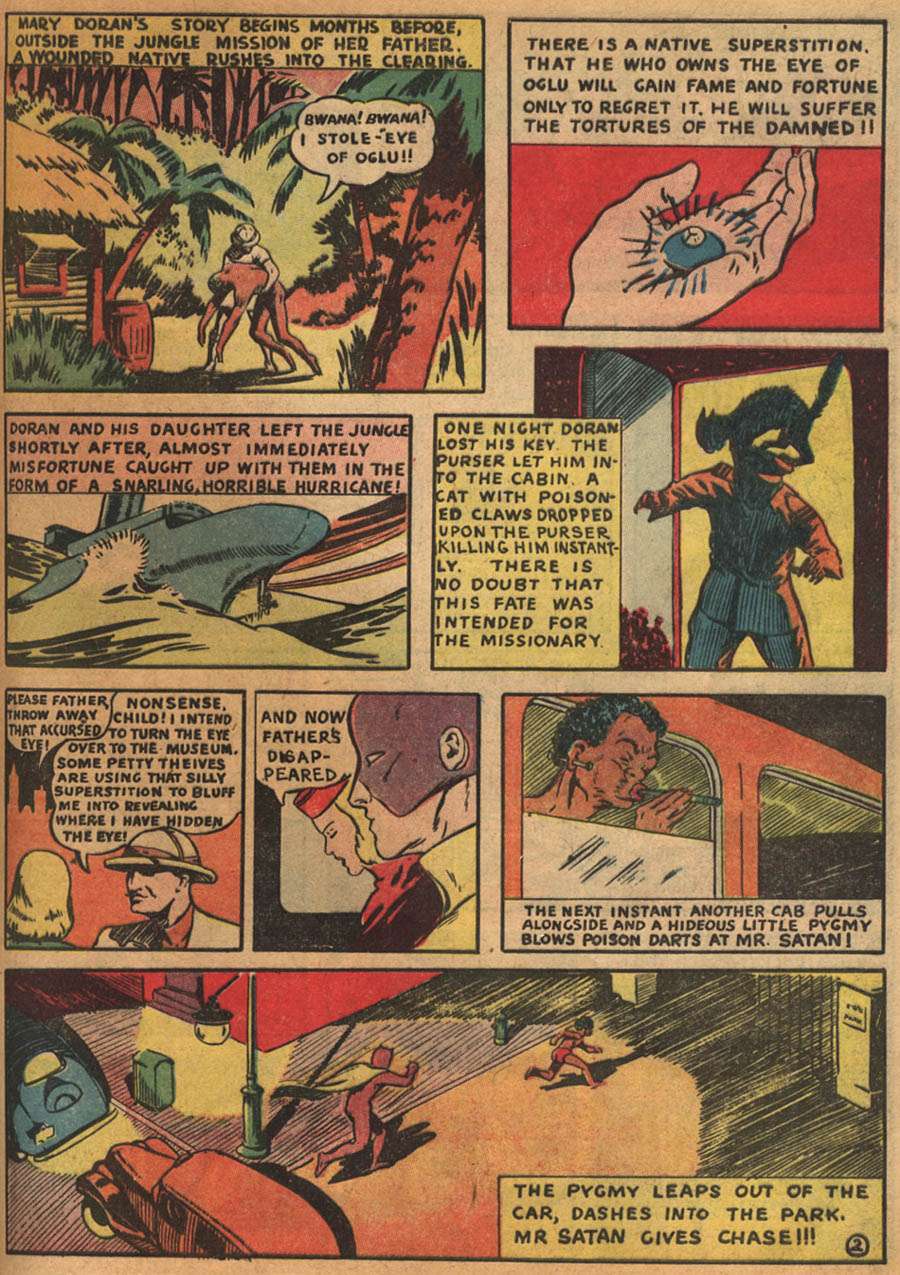
This is Mr. Satan, what would be a pretty standard pulp feature, except that it reaches deep for its inspirations. This page alone evokes both The Moonstone and The Sign of Four.
Now this page strikes me as odd. You'll note that Mr. Satan chokes the guard unconscious, but when more mobsters show up ...they find blood? I'm having trouble even figuring out how that happened, unless the guard hit his head when he went down...?
Mr. Satan appears to be hitting two bad guys at once, but I think we have to account for some time compression in that panel and he's hitting them on separate turns.

Is it relevant that Dudley Bradshaw likes to go to the gym? It is, because it speaks to what Heroes do in their downtime. Should it have some game mechanic benefit if you go to the gym? Probably not...but if enough game time passed and a fighter or mysteryman had not been to the gym, I might be willing to assign a temporary penalty to attack rolls...


Lastly, this is Zatara -- oops, no it's not, but a clumsy imitation Zatara named Zambini the Magician. Here we see Zambini can cast Snake Charm and, I'm guessing, Hypnotic Pattern (though we never see a pattern, just its effects).

We also see him using his "wand" -- a boomerang amulet -- to cast spells. The boomerang aspect is a bit forced.

Thank goodness he doesn't say "I'll rub my boomerang amulet and find out who sent the snake!" from in bed.
Here Zambini seems to be casting the spell Fumble.

Some of his spells -- but not all of them -- require command words. They look like they say something backwards, like Zatara's spellcasting, but they don't.

And then he casts Reduce Person...
...and, presumedly, Charm Person, so the spy chief will serve him.

Mass Polymorph is going to be a tough spell on this game; it seems fairly common, but it should be a high-level spell for what it can do. Normally I would say, okay, let's make a weaker version with just a very short duration, but these guys stay pigeons long enough to coat a statue. This would be an 8th level spell, meaning Zambini has a whopping 15 brevet ranks.

Or, he used his already cast Hypnotic Pattern to make them think they were pigeons, then used Charm Animal to make two real pigeons do what he made the two men think they were doing. Convoluted, yes, but more feasible in a balanced campaign world.
The Basic book made it clearer than 1st edition Hideouts & Hoodlums did that magic-users needed to be limited by something -- either verbal, somatic, or material components. Zambini has a unique weakness -- human contact. That may seem pretty rough, but essentially, someone's touch could do the same for the first three examples -- covering the mouth during verbal components, swatting the fingers out of alignment on somatic components, or batting the material components to the floor. And grappling always halts spellcasting, though I did not clarify this enough in the rules.
The last spell is actually a power, Turn Gun on Bad Guy. I think this is the second time I've seen this, so there does need to be a spell.

Incidentally, the countries here are "Ritania" and "Hundanian," clearly meant to be European countries. Hundanian must be a stand-in for Germany, though Ritania is less clear -- Germany had so many enemies by 1940!

Saving a king and getting knighted are high honors for a rookie Hero. I would personally have waited longer and built up to this.

(Scans courtesy of Comic Book Plus.)

Saturday, May 18, 2019

Pep Comics #2 - pt. 1

We're back to MLJ and my second favorite MLJ superhero, The Shield!

As you can see here, today's adventure is going to take place in (and en route to) "Porto Rico."  Now, this may seem on the face of it to be one of those times where the comic book writers fictionalized a country name by changing it slightly, but it actually was called Porto Rico from 1898 to 1931! (Our author here, Harry Shorten, may have been just nine years behind the times...)
I understand the cabin doors on a boat are pretty thick, so maybe it makes sense that the Shield needs a special device to listen at one. It might make even more sense when you consider that the Shield is wearing a mask with extra ear covering on it. Yet, I am hesitant to introduce too many negative modifiers to skill checks. I would especially hate to penalize someone for coming up with an inventive, but impractical, superhero costume.

Instead of referring to the villains outright as Germans, they are just called "Nordics" here.
We've been seeing superheroes jumping out of planes in movies a lot lately, but the Shield might have been the first. He lands safely, partly because he's landing in water and water landings are almost always safe in comic books...but, just in case, it might help to have a Feather Landing power activated.
I'm sharing this page, not so much because it informs us, so much as because it confuses me. In panel 5, a man yells, "A hit!" but we don't actually see the shell connect. Does the man just think it was a hit, but is mistaken? What does it mean that the Shield "escaped?" Did he dodge, or did the shell bounce off him?

I'm going to have to toss out here now that I'm not really a fan of the earliest Shield stories, and I can't wait for Irv Novick's art to improve (it does, later).
The Shield has the Super-Tough Skin power activated, or his armor grants him the Super-Tough Skin power. We also have examples of Wrecking Things being used (door category, mainly), and possibly a stacking of Extend Missile Range I and Multi-Attack to get that throw that knocks over multiple crew members (should be no more than three, though).
"Done Went McGinty" is a 1889 song written by Joseph Flynn; this is its comic book debut, and possibly only appearance of the song.

Shield is likely protected by one of the higher level defensive buffing powers, at least Imperviousness, to shrug off grenades like that.
I'm not really sure what the Shield's plan is here...but I suspect he buffed himself with Resist Fire, and then figured if he had flaming kerosene all over his body...he would set the enemy ship ablaze and sink it? It seems like it would be a lot easier just to land on the other ship and start wrecking it, but I have to admit this is pretty visually interesting.
That paralysis raygun sure came out of nowhere -- but that's very appropriate for Hideouts & Hoodlums, a game where you might not even know what trophy items are going to come into play until you roll up the encounter. Or, to look at it from the other direction, golden age comic books like this are perfectly emulated through randomness. 

The sharks are encountered in a group of at least four.
Being moist protects you from rays? I'd have an easier time believing that he just made his saving throw this time.

Panel 4 shows off the awkwardness of the Shield's thong-back costume.

Speaking of his costume, where do you suppose the pocket is located where he kept that shield-shaped calling card?

(Scans courtesy of Digital Comic Museum.)

Monday, December 10, 2018

Thrilling Comics #1 - pt. 3

And we're back with more of Dr. Strange! If this feature seems unusually long, it's because it is! It runs on for a record-breaking 37 pages and was probably intended for the first three issues, but I'm guessing the new publisher, Better Publications, didn't have enough other material to get a full anthology out.

We get an example of wrecking things in panel 2, unarmed combat (2 attacks vs. unarmed foes) in panel 3, but now we have to decide what to do about panel 4. Is the Faceless Phantom using Invisibility (as I first thought, but now seems increasingly unlikely), the spell Poof! (disappearing in a swirling purple mist is very Poof!-like), or is this a new power of Intangibility? Or, is intangibility just flavor text for Imperviousness?

What's more important is that, without Super-Senses, a superhero is practically powerless in the dark. Had the lights stayed on, there was no way anyone would have been able to spirit Victoria away from him again.

I don't know about you, but I'm getting kind of annoyed with these early superheroes killing every animal they encounter. What is with that?

The hidden aeroplane is dropped trophy loot, meant for the Hero to find.


It would be nice if I could tell from this blurry picture how many natives it takes to "hopelessly outnumber" Strange. Very likely, they just keep coming at him in waves until the durations end on all his buffing powers.

What doesn't emulate well in Hideouts & Hoodlums is not being able to wreck things, and getting back his defensive powers. I have considered putting a cap on how often per day a superhero can wreck things, and maybe he wasted them all on wrecking spears and shields in the big fight.

As for getting his powers back, maybe he was a prisoner for 8 hours, giving him time to get his power slots refilled, but it doesn't make sense to waste 1 turn of a high-level power protecting himself from the fire when he could just bust the ropes by flexing his muscles instead. Even ignoring game mechanics and looking at this from a story perspective, it doesn't make much sense.
Poisonous snakes can be encountered in groups up to 7, when found in their dens, which are apparently sometimes at the bottom of 20' deep pits.

Pushing attacks must always work on superheroes, no matter how defensively they are buffed up.

Wha?? The delta ray gun is only a rifle? That's the weapon that had a range of about a mile?
Amazingly, after killing a tiger in one hit, Strange is unable to save himself from seven poisonous snakes without help. Perhaps he burnt through all his powers fighting the natives.

The Faceless Phantom had a pen and paper on him in the jungle, and took the time to write Strange a note? Or was he so cocky he wrote the note in advance?
Again, Strange failed a save vs. poison and was kept asleep.

Watch this plot hole about the stolen Alosun. Despite not having his Alosun, he will be displaying superpowers repeatedly for the rest of the story (and don't forget how he recovered his powers while tied to a stake without taking more Alosun). The Alosun is clearly flavor text and does not affect him game mechanics-wise in any way.

Tropical hurricanes need to be on outdoor wandering encounter lists when out at sea. As must giant octopi (naturally).
Almost as bad as all this animal killing is how they never even stand a chance against the Hero. If anything killed the superhero genre, it's probably the lack of suspense that engendered.

Without any fatigue rules tied to movement, there is no game mechanic stopping Strange from swimming a few miles without even needing to buff with a power.

If I was Strange's player, I would call shenanigans on my Editor for this agent of the Faceless Phantom, who just happens to be near the beach where Strange just happens to wash up on shore. How the Faceless Phantom could possibly anticipate that Strange's plane was downed by a hurricane and had to swim to Florida, instead of arriving at an airport, is beyond suspicious.

And speaking of that hurricane, what happened to the hurricane that was just miles away from mainland Florida a little while ago? Now there's not even a tropical storm on the coast.
I skipped a page where the Phantom's men tried to off Strange by crashing another train into his (they were two well-drawn trains at that). The crash gave him amnesia - a comic book staple so common that I finally included it in 2nd edition (p. 90) of the Basic book, but only under head blows.


The amnesia was only temporary and the hobos all got beat up on the pages I skipped over.

By now, you've probably figured out that I'm not a fan of this story, over all. One of the things I do like about it occurs here -- Strange's failure to stop the Faceless Phantom earlier has campaign-changing consequences. Now, weeks later, New York City is in a state of terror, besieged by FP's mobster henchmen.

Oh, and Strange picks up a kid sidekick. This is kind of a big deal because this is two months before Robin debuts in Detective Comics, making Jerry one of the first kid sidekicks, and the first one for a superhero.

(Scans courtesy of Digital Comic Museum.)

Sunday, November 25, 2018

Speed Comics #5 - pt. 4

I have just a few leftovers to discuss from this issue, starting with this page of Texas Tyler. Two things: one, kicking over the table is good strategy because, if it hits it could be a disarming attack, and even if it misses it will still serve as soft cover. Two, until the henchmen reveal themselves, Tyler doesn't have to worry about anyone else and can beat on Croker with a chair to his heart's content. After the henchmen reveal themselves, then Tyler has to save vs. plot to keep dealing with Croker, and otherwise has to deal with the henchmen first.
These filler pages are handy for statting air transportation in the game, particularly the cruising speeds listed here.
And lastly, this is Spike Marlin, holed up in the armory of a bunch of gunrunners. The "high-powered" rifle is likely a Gun +1 or a rifle doing trophy weapon damage (1-8 or better). The way he's picking them off like rabbits makes me think the gun is +1, for the attack bonus.

Trophy weapons are supposed to be rare, so that Spike picked the one Gun +1 in the entire armory just by chance seems unlikely. However, the Editor could have given him a 1 in 6 chance of grabbing the right one by random, like finding a secret door, or could have allowed him a skill check to evaluated each rifle until he got to a better-than-average one.

Throwing oil into an enclosed room with Heroes is sound strategy; Spike would take 1-8 points of damage per turn spent in the room until leaving.

(Scans courtesy of Digital Comic Museum.)