Showing posts with label tracking. Show all posts

Thursday, March 18, 2021

Colossus Comics #1 - pt. 2

This is still Lucky Lucifer (that's a good guy's name, in case you couldn't tell). Game mechanically, I wanted to point out a rare instance of an aviator not using the wing walk stunt and just holding on for dear life. Should the fact that he's injured lower his number of available stunts? 

Storywise, I just want to point out that Lucky takes a huge gamble ditching his plane to hop onto another plane because he believes -- correctly it seems -- that the anti-aircraft gunners would ignore the still active pilot and concentrate on the plane that was going to crash soon anyway.


"Lt Lucifer, your reconnaissance -- I'm sorry, I just have to ask, why am I calling you Lt. Lucifer? Lucifer is just your nickname, right? Your father's surname isn't really Lucifer. Your mother didn't really go, 'O, I love this man, I can't wait to change my last name to Lucifer"?

That said, I like both how complex and how simple this next scenario is. It's complex in that there's going to be a lot of moving parts moving around, but simple in that most of that is going to be background detail, as the focus of our Hero is going to be on this spy retrieval side-mission. 

Given the speeds involved, the target AC for "hitting" the spy's outreached arms must be pretty low, though she can also roll "to hit" Lucifer back. 

Now, I know I have no skin in this game, but if I was the one flying into enemy territory to pick up a spy, I wouldn't go in alone; I would want at least one more plane with me to run interference.


As I said, the scenario is simple because Lucifer's orders are basically to stay out of it. If he ignored orders (and you'd sort of expect that from someone named Lucifer), he could fly into the battle and then you'd have to play it out, but if it's just going on around him, you can treat it as flavor text and describe a pre-decided outcome. 

When one plane separates to attack Lucifer's plane, that isn't necessarily bringing him into the big battle and can be treated as a separate battle/one-on-one dog fight.

Ugh...I can tell this one's going to hurt to read. It looks like some 4th grader's attempt to draw a L'il Abner clone. Although it might be hard to imagine drawing inspiration from this...I wonder if hillbillies, as a mobstertype, should have a bonus to "rasslin'."


Normally I would not apply the wrecking things rules to missile weapons used against you, but sometimes it could be fun flavor text. It could also be of practice use, like if arrows were being fired at you, to find out if the arrows broke or are retrievable (because arrows are a lot more likely to break than boulders).

Aside from that, I think I'll just mention that it's pretty weak storytelling, that the only spooky thing these guys pretending to be ghosts do is talk through a bush. I can't even count them as fake undead!

Jumping in here to the next story, Mory Marine.  Thumbscrews are a real thing, and could be as small as what is sorta drawn here, but they are archaic by 1940, being more of a 17th-18th century device. 

It is more likely that Mory (what kind of name is Mory?) blew his escape artist skill check than the mobsters have past experience as sailors. Mobsters don't generally have individualized skills. 

Finding a blood trail could be a searching check, and following a trail could be a tracking skill check, but an Editor should not require both unless the blood trail is very faint.

The bottom keeps dropping out on this artwork! Ugh...it looks like someone is dropping crumpled up balls of paper at our Heroes, here in "The Gold of Gartok." 

But behind that atrocious art is a pretty good idea to explain superheroes. Tulpas are real things too, or I should say real world theory. "Tulpa" is a concept in mysticism and the paranormal of a being or object which is created through spiritual or mental powers. It was adapted by 20th-century theosophists from Tibetan sprul-pa which means "emanation" or "manifestation." It can do anything the person who wills the tulpa into being is able to believe the tulpa can do, but only while concentrating and, as we learn here, if that concentration is disrupted, it takes an hour to create a new one.

A ledge saved our "white hero," but he's quickly captured and dropped into this snake pit. Interestingly, the snake pit only has four snakes in it, as if to give Rob a really sporting chance. 

Chanti and Charmi are Indian names -- but girls' names -- Genghis is a Mongolian title and not a name (but maybe a nickname?), and Bhutra is an Indian surname. Maybe Chanti and Charmi are nicknames too, like calling someone a Nancy or a Karen. 

It's interesting that the tulpa's explanation for what happened to him is patently untrue. Does a tulpa have to believe in itself to exist? Or it simply doesn't want Rob to know it can disappear on him again if the lama smells something else good? 

I may be having a deja vu moment, but, amazingly, I don't think this is the first time we've seen someone picking up snakes and throwing them as missile weapons in a comic book story.

(Scans courtesy of Comic Book Plus.)


Sunday, February 7, 2021

Comics on Parade #24

Happy February! We're back and revisiting Comics on Parade and, for the first time in a long time, Tailspin Tommy.  Boy, it feels like Tommy and company have been stuck in that valley forever! 

Here we have a remarkably rare occurrence of an animal not being dropped by a single bullet. Cougars need to be really tough in Hideouts & Hoodlums; I'll have to review the stats and see if I should raise them.

It appears our Hero plans to act as a living shield for the damsel in distress, but since he is the only threat present it makes sense that all attacks would go towards him anyway.


We have an unusual use of "cookie" as slang here, but the real reason I shared this page is the tip about following tracks back to the lair. I have mixed feelings about this. There have been times when I had a lair all prepared and was frustrated that the players didn't want to follow the tracks back to it, and other times when it was a completely random encounter, and I was frustrated when they did follow the tracks!

The concern about an animal having a mate nearby is a sound one too. When rolling for number encountered, bear in mind that the total number doesn't have to be encountered all at the same time.


Detailed plane information for your next transportation trophy.


Oops, don't have a lot to say about this page. Keep scrolling down...


Hi again! So Abbie an' Slats is obviously not an adventure strip, but there is a strong moral dilemma here that I think would be delicious to explore in a game session at some point. A rich girl will save the town for you if you're willing to get rid of your most important supporting cast member. Is that 100 XP for a good deed worth it to you?


There are three things that stand out from this page for me. One is the uncommon term "soup strainer" for mustache. Two is the amount of money would could expect to find on someone of, let's assume middle class. Three, and perhaps the most unusual thing here is the exact height of her husband. Cartoony men are often drawn short, but in this case it is not exaggeration for comic effect. Yeah, and there's some racist depictions here too.


Yes, I'm obsessed enough on little details that I checked to see if the Bowery Lifter Upper Society was a real thing. This is almost surely a reference to the Salvation Army. 

A $150 purse seems really good for a boxing match in the 1930s, or even the 1920s (this story was first published in 1936, and the scene within it is a flashback to some years earlier). 


I'm not sure what the crime was here. Prizefighting without a license? Or was it illegal to be a female boxer? I can't figure this one out. I know it was legal for women to box in the 1950s, but I can't find anything about the earlier half of the century.

I had to look up "demi-tasse;" it's a small coffee cup, so this is an insult about his short height.

Lochinvar is a very obscure reference today, and I can't help but wonder how often this went over the readers' heads in the 1930s. Lochinvar was the fictional, romantic hero of the ballad "Marmion" by Sir Walter Scott (1808).
 
Even Fish Cake Fannie maybe isn't a throwaway line - "Fish Cake Fanny" was a 1923 play. 

This feature continues to educate! "A Bird in a Gilded Cage" was one of the most popular songs of 1900, reportedly selling more than 2 million copies in sheet music at the time.

Drinking champagne from a lady's slipper became a symbol of decadence in the early 20th century, possibly before 1910. 

"Skiddoo" meant "go quickly," later shorted to "shoo!"


And I'm tossing this gag filler in because I thought it was funny!

(Scans courtesy of Comic Book Plus.)


Wednesday, April 17, 2019

Jungle Comics #2 - pt. 3

We're still looking at Captain Terry Thunder of the Congo Lancers ("Terry" has been added to the title since last issue). I like that fifth panel; in a RPG scenario, each man's secret could be shared with the player only and, although the published scenario here was all combat, in game everyone could have the secondary goal of trying to figure out everyone else's secret past through roleplaying.
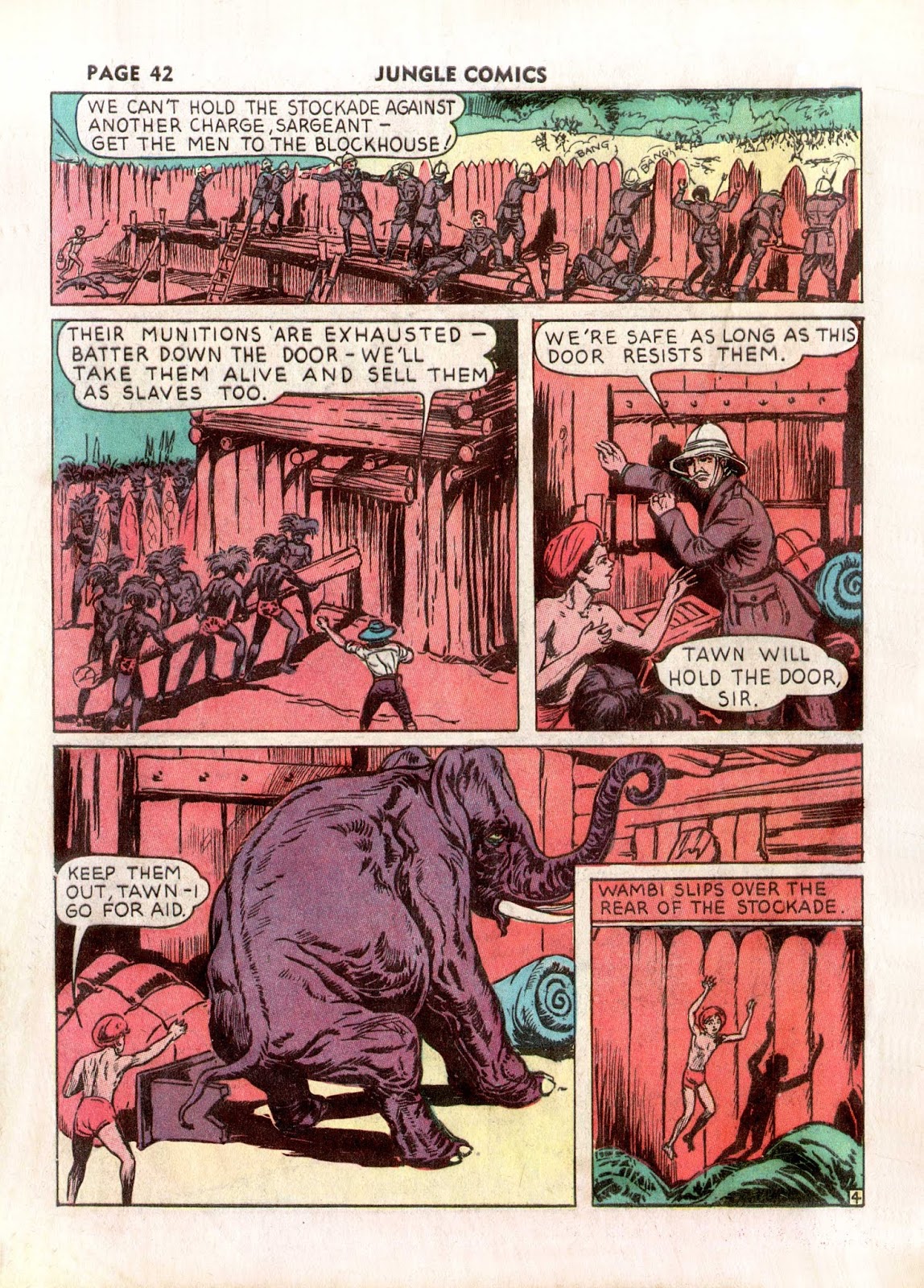
This is Wambi, the Jungle Boy. Wambi has the ability, like most jungle explorers seem to do, of summoning animals. Here, we see nine monkeys encountered at once.

Wambi, forced to choose between the people who raised him and some white guys he just met last issue, chooses to betray his own people. Okay, sure, they turn out to be slavers -- but those slavers wiped your bottom when you are a baby, kid!
Speaking of number appearing, here we see at least 40 natives, and is probably meant to represent much more than that.
"What the devil? How did the elephant get in my blockhouse? And how is there room for him in here? Is he sitting on all my men?"

Of course, in the early days of D&D, you could put 20 orcs in a 10' x 10' room and no one batted an eye, but nowadays you should put a little more sense into spaces than that...
This is from Roy Lance, a feature best remembered for its good sense of geography and ethnography. The Riffians are indeed a real people, also known as Riyafa or Rwafa, and a Berber-speaking people of Northwestern Africa. Everyone has heard of Ethiopia today, but that might have been an obscure country in 1940. The Zulu are a Bantu ethnic group of Southern Africa and the largest ethnic group in South Africa. Not surprisingly, the author cannot name a real cannibal or pygmy people from Africa.
This page is all kinds of wrong -- Joan is being spanked, with a native gleefully watching, for being a free thinker and feeling like she shouldn't have to obey a man. 1940 was a tough time to be a woman.

The map is serviceable, though, with a mix of real locales, like the Congo River and Stanley Falls, with names that I can't verify are real. Twice, upon seeing Wakuna in this story, I thought "Wakanda...?" Probably not intentionally similar.
Now, seeing all the "primitives" running in fear from a film projection might seem racist to you, but bear in mind this trick also works on Scooby Doo. It just seems to be a given of the comic genre that visual and audio trickery is much more compellingly realistic than it would be in real life. So, as the Editor, keep an open mind when your players try nonsense like this.
This is from Simba, King of Beasts. It takes a lot of imagination to picture a water buffalo being the deadly nemesis of a lion, but now I'm just going to have to make sure to stat water buffalo -- and make them nasty!
I included this page because I realized there were actually few examples I had found so far in comics of outdoor tracking. This was the primary ability of the 1st edition explorer class, but maybe that can't be justified by direct emulation after all...

(Scans courtesy of Digital Comic Museum.)

Thursday, March 21, 2019

Wonderworld Comics #10 - pt. 2

This is only Yarko the Great's eighth story, but already his second trip to the land of the dead -- and surprisingly his way there is entirely different this time. Instead of transitioning through a Dante-lite version of the afterlife, Yarko is able to transport himself (Plane Shift spell?) directly to the Valley of Shadows, or an area of it that is more desolate and uninhabited than when we last saw it. Interestingly, Yarko needs an item belonging to the Baron in order to track him across the planes; one could interpret from this that Yarko would wind up in some random space on the same plane without the sword to attract him to the Baron.
Shining Knight, no! (Just kidding; the old knight just has the same coloration as the Shining Knight will have a year or two from now).

Here we see Yarko fighting with a sword, and fighting well, invalidating the "magic-users can only fight with daggers" conceit.

We also get a good example of why we want to put powerful Heroes in environments where they can't use their full range of spells or powers. We know Yarko can still cast spells in the Afterlife, but there must be anti-magic zones throughout and Yarko had temporarily stepped into one.
Yarko's spell -- conjuring the ghosts of his past victims to attack him -- reminds me of the Phantasmal Killer spell.
This is Shorty Shortcake, and those are some really big germs flying out of that watch case! Rigging something to release tear gas -- or "crying germs", as it's called here -- is not a bad trap.
Hideouts & Hoodlums has rules for pushing opponents, but pulling them? That's trickier, I think. It would probably be a grappling attack and then, if successful, I would allow the grappler to make half-moves and pull the victim along, so long as the grappler had the higher Strength score.

While grappling your opponent, if you have a strong enough hold on them (that means at the Editor's discretion), you could roll to make another attack and put a hat on your opponent's head, if that was really something you wanted to do. I'm definitely not opposed to giving free attacks if they're used to do something in-character, but not actually harm anyone.
I'm glad I've never statted giant bats as having very many hit points, as these giant vampire bats (simply called vampire bats here, but the scale is always way off in a Shorty Shortcake adventure -- oh, I wonder if that is a feature I should talk about?) fall easily after just being hit with a rubber-band ball (an improvised weapon, doing no more than 1-3 points of damage, if ever there was one).
I'm kind of surprised that I've never seen a Hero track a bad guy by his cigar ash until this point.

This is also the first time I can recall seeing one trophy item specifically able to counteract another trophy item.
This is Patty O'Day, so naturally I'm going to focus on her partner Ham being awesome instead. Here it takes not one, but two head blows to knock him out, demonstrating that head blows are not automatic knockouts.

We also get a glimpse of a secret door concealed as a wall panel.
How long, in game time, should it take for eyes to become accustomed to the dimness? It probably doesn't matter for this scene, but if combat was about to begin it could be relevant. Or maybe not; I'd probably ignore the issue, unless Patty lost initiative, and then I could use the "eyes adjusting" thing as an excuse to explain why.

It's a smart tactic to keep the rope you were tied up in. Awesome Ham has figured out a use for it already!

(Scans courtesy of Comic Book Plus.)

Tuesday, September 4, 2018

Blue Ribbon Comics #3 - pt. 1

Back now to early MLJ and, remarkably, another reason to visit with Rang a Tang the Wonder Dog. And it's not for anything that Rang has done yet, but for this interesting transition of the term bandit. Long-time readers here (if there is such a thing) will recall that bandit was long used as a racist term for non-white or Latino criminals. But lately I've been seeing "bandit" used much more as it's used here, as synonymous with bank robbers. I wonder what changed in 1939 to make that happen?

A dropped hat is a good clue circa 1940, as hats could still be purchased then at specialty stores and might be more easily traced back to their owners.

Instead, Speed must be hungry because he decides to go have lunch first. This is the first use of the terms "lunchroom" and "luncheonette" in comics, terms that have been cast aside in favor of "diners" today.

Bandits are now also synonymous with gangsters. Cut it out, guys, or you're going to take away all my mobstertypes!

Still unresolved is, is Rang a playable Hero, or Speed's supporting cast?

You wouldn't think this page would present such a game mechanics problem, but what causes Speed's crash, game mechanics-wise? Is his inability to see where he's going a randomly generated complication or obstacle to overcome during the car chase? Or is the complication triggered by the car taking damage during the chase? Could Speed's hit points apply to both himself and his car during a chase scene (the answer is a weak yes -- yes, hit points are highly abstract, but on the other hand there is no precedent for treating them so broadly)?

We also see that bodies of water do not necessarily stop tracking (at least not for dogs).

This first issue is older than RPGs and goes back to war games -- do you let the players know exact measurements, so they know where missile ranges end, or make them guess? There is no definitive way to rule on this and Hideouts & Hoodlums Editors could go either way.

Very unusual for a RPG scenario, Hy (our hero "Speed") finds the boss villain outside the hideout, rather than after exploring much of it. The gang's chief and at least one other are thugs, making them tougher than bandit/robber/gangsters. Because Hy is low level, two thugs are more than a match for him.

Now this is a little crazy, and why I find it hard to believe Rang is an ordinary dog. This is the second time he's leapt through an upstairs window, making me think Rang should be statted as an alien instead of a real dog.


Hy, now I know you don't really care about this dog at all anymore. We know those mobsters have at least two guns between them. And you're making your dog run towards them, with dynamite in his mouth? How about dropping the dynamite out a window on the other side of the house, where he won't get shot at?


Okay, as crazy random as this page seems to be, it actually could play out this way in Hideouts & Hoodlums. Even though Rang cannot get to the boat without running past the three men on the dock, there's still a chance of the dog getting surprise. Maybe all their backs were turned for three seconds.

The mobsters are not "paralyzed," but stunned by the explosion (because they made their saves to avoid being unconscious longer when reduced to zero hp). They are all stunned for a random amount of time, but it is possible to roll the same recovery time for all three of them. Since they recover hp after recovering from a stun, it's possible for them to be winning this fight.

And...yeah, I'm not really sure what to make of this page. The local police force has planes, and elite squad of parachutists, and extra parachutes for rescue dogs? What do they even need low-level Heroes for around here?


This page is from the next feature, Stuart Logan. The artist is unknown, and Stuart Logan never appeared again, which is doubly tragic because this looks really good.  I've also never considered searching a scabbard for dust before to find out when the blade was drawn.

(Scans courtesy of Digital Comic Museum.)


Friday, January 13, 2017

Smash Comics #4 - pt. 1

And we're back to Will Eisner's Espionage, still featuring Black Ace instead of Black X.  This installment is the debut of Madame Doom, one of the best femme fatales invented for comic books and the precursor to, well, every femme fatale in The Spirit later.

From this page, we learn that a map of the California Coast's military defenses would be worth about $10,000.


200 MPH was certainly doable for a plane circa 1939. Pursuit planes, transport planes, and bombers all moved at about that speed.

In Chicago, in 1939, they would have likely landed at Midway Airport. But the city looks too far away in the background for this to be Midway. They might have landed at a smaller airport out in the near suburbs to evade notice; this could conceivably be the Pal-Waukee Municipal Airport (in Wheeling).


In Supplement IV, I spent a little while discussing Bantu and if he was a magic-user or psionic. Here, he seems to be casting the spell Phantasmal Image. There is no equivalent psionic power in Supplement III, where the psionics rules are.

When I cataloged various aviator stunts for Hideouts & Hoodlums (for The Trophy Case no. 6), I neglected the Immelmann Turn. Putting it in simplest game mechanic terms, the Immelmann stunt would be used immediately after attacking, and it gets you into position to go first in the following turn (you cannot lose the initiative for that turn).

The Immelmann is a popular maneuver from my limited experience playing Dawn Patrol; I may have to investigate that game more deeply.


This is likely Salt Lake City Municipal Airport.

Black Ace makes his save vs. plot to see through Madame Doom's disguise.


I am not a fan of Clip Chance at Cliffside, and you'll probably never see it here again. But it's worth pointing out that Ray Snort has got to be one of the worst names in all of comicdom. If you meet a character in a comic book story with a name like that, it should send up all kinds of red flags that you're dealing with a bad guy. Names like that, they scar a young man...


Two things here: one, The Green Lizard is not a fearsome name for a master criminal; and two, hiding a radio in a globe is a great detail for hideout dressing.


Invisible Justice calls this a giant crocodile, but it really doesn't look as big as some other crocodiles we've seen in the comics -- this is a large one at best.

It seems IJ only has to shoot it twice to either kill it or chase it off. Indeed, there are a lot of examples in comics of really big, fearsome monsters going down in one or two hits. I'll continue to ignore that for H&H, to keep big battles longer and more exciting.


Invisible Justice looks for tracks, which is now an option for all classes in H&H 2nd ed.

Despite being an underground hideout in a swamp, it seems the hideout is nice and dry. For convenience, and RPG tradition, underground hideouts will seldom have to worry about the local water table.

Concealing the door inside a tree is a nice hideout feature, as is the alarm on the door.

(Scans courtesy of Digital Comic Museum.)