Showing posts with label Golden Dragon. Show all posts

Thursday, May 12, 2016

Adventure Comics #36 - pt. 2

Tom Brent runs into two bad guys in China who are interesting because of their titles. One is the Russian Count Roloff.  Counts turn up all the time in comic books as bad guys (as do barons). Maybe nobles need to be statted as a mobster-type?  The other is a bandit leader, specifically called General Chang. "General" is a level title for fighters of at least 8th level!  I was more conservative with my entry on bandits in Book II, topping off their leaders at 4th level.

The Golden Dragon serial concludes in this issue. The gold dragon is killed after it shows off some wrecking things skills. The gold dragon does not appear to be Lawful either, nor particularly intelligent. The dragon is dropped by a hail of bullets (JUST like what happened the first time I used a dragon in one of my H&H games).  The dragon guards a treasure room with enough treasure for ten camels (I often take shortcuts like that too, instead of giving the heroes a careful inventory of what all their treasure entails). The one trophy item they acquire is the Seal of Genghis Khan, that assures them safe passage anywhere in Mongolia.

And lastly, in Anchors Aweigh, Don Kerry uses the old trick of throwing sand in someone's face to blind them. This dirty fighting trick should require a successful attack roll, followed by a failed save vs. science, and then the victim is blinded and fights at a -2 penalty for the next 1-6 turns of combat.

(Summaries read at DC Wikia)

Sunday, January 31, 2016

New Adventure Comics #31 - part 2

Don Coyote is another gag strip, and another one of those "I thought I'd never use this strip as an example" situations.  When Don is challenged to a duel, he is given a knife, while his opponent plans to use a spiked mace, or morning star.  There's also a peculiar encounter with a skunk that Don refers to as a "wood pussy" ...which possibly only makes sense in the context that this is a pseudo-medieval setting and skunks, non-indigenous to Europe, would have gone unrecognized there.

This installment of Tod Hunter, Jungle Master, starts with Tod and company, very sensibly, planning shifts of watch duty for the night while they camp outdoors. Have to watch out for those wandering encounter checks!  They don't encounter anything all night, but they do meet two men on an elephant the next day. Isn't it often like that with random encounter rolls?

In The Golden Dragon, Ken Cockerill, comes to in a prison cell and gets led through an interesting-looking hideout. Outside the cell is a "vast shadowy hall, with towering sculptured forms on the walls. At the far end was something that looked like a huge altar, extending the entire width of the building." The altar has a writing desk by it. On the side of the hall is a "sculpted doorway" that "led into a sort of grotto, lighted by a small low altar covered with candles."  The Golden Age habit of including descriptive narrative captions was unnecessary in illustrated stories, but is gold for using as boxed text to read during adventure scenarios!

In the grotto, Ken sees an illusion, but it's unclear if his captors are casting Phantasmal Force, or if this is some feature specific to the grotto.

In Rusty and His Pals, at the center of the island is a high stone wall, probably meant to be the remnants of a dead volcano. Inside its circumference are trees, a pond, and a two-story house. The house is one big prison cell; all the outside doors lock from the outside, and apparently the windows can't be opened (or easily shattered, though Rusty and his pals don't seem to have thought to try that yet).

Despite the care Fred Guardineer has put into Anchors Aweigh, this strip has been relegated to the back of the issue. Red is captured in this issue and is brought before a hooded man who is apparently the "Diablo" he's been looking for. Interesting, Diablo will not speak directly to Red, to keep Red from having the chance of recognizing his voice.

Diablo's bad guys have a sneaky idea -- they tell Red at knife point that he has to read something aloud because they have members who might recognize his voice, but it's a trick to record his voice so they can use it to lure Don into a trap.

(This issue can be read at Comic Book Archives)

Wednesday, September 23, 2015

New Adventure Comics #24

We're going to start off today staring into the face of 1930s racism again. Here, in this page from The Golden Dragon, we see that "yellow peril" can cover multiple ethnicities.


Hideouts & Hoodlums has always danced on that dangerous edge of recognizing, but not embracing, the racism of the early comic books. Hence, Book II: Mobsters and Trophies having an entry for savages. Now, if I really wanted to dance perilously over that edge, I could include giving savages an "unholy shriek" that prompts morale saves, as seen here in Captain Quick.


Although it may look like I'm sharing this page to talk about racial stereotyping again, I'm off that subject -- and much more interested in the ladder in the shaft, concealed inside a fake vase, that leads into hidden catacombs. A great hideout entrance!


How do you know when a leopard should only miss by an inch, like in this page of Sandor and the Lost Civilization?  It's not a H&H rule, but what I've long done is treat the number I missed by "to hit" on my d20, -1, to be the number of inches the attack missed by. So, if I rolled I needed a 10 to hit, but rolled a 7 or 8, my leopard only missed by 1 inch. If I'd rolled a 9, then the leopard did connect, but did no damage (maybe it tore his pants?).


(Scans courtesy of Comic Book Archives)

Friday, September 11, 2015

New Adventure Comics #23

The Adventures of Steve Conrad includes, if not the first, at least one of the first dives off a balcony to swing on a chandelier in comic books. As much as a staple as this is of the action genre in general, I almost hate to attach any game mechanics to it. A roll, perhaps a save vs. science, could tell you if the jump-and-swing was carried off with aplomb or not.


Nothing says "Run for your lives!" quite like having turtles chasing you. Granted, these "army-turtles" are large in size (and look more like tortoises, really). I might be generous and assign these 2+1 HD, a 9 Move, an AC 4, and have those beaks do 1-8 damage.


Bob (from Captain Jim of the Texas Rangers) here gives us a demonstration of what constitutes a concealed door vs. a secret door.  A trap door that is covered by something that can easily be moved is a concealed door. A door in the ceiling, made to look like a riveted metal plate, is a secret door. The fact that Bob has to search for a means of opening it clinches that it is a secret door.  Concealed doors should be easier to find than secret doors.


Here, from the serial Monastery of the Blue God, is a textbook example of Heroes beating up mobsters and then searching them for loot to keep as trophies. They are so clearly excited about a star sapphire on a gold chain because it is probably worth considerably more XP than the mobsters themselves were worth.


This is from Robin Hood.  Literary adaptations will rarely be the focus of this blog, but this page brings up the interesting question: can a single arrow that does 1d6 damage kill a stag? By combat rules, unlikely. A stag, as a combatant, would have about 3 HD, 10-11 hit points on average, and do about 2-8 points of damage in a charge -- stats that should give any archer pause. However, if the archer was firing from far enough away that the stag could not possibly reach the archer soon, or the stag immediately missed a morale save and would not be fighting, the Editor could rule the stag is a noncombatant, and so the killing can be described with flavor text.


Illumination can be tricky to referee as the Editor; when you're imagining the scene, you're trying to picture everything. Dim or no illumination at the scene then requires you to filter out detail from the scene as you're describing it to the players, creating an extra step for you to keep track of.

Another thing to keep track of is the number of things that shed light that can be seen at great distances away. Here, we're reminded that even cigarettes may give your opponents away at a half-mile range.


Sandor's player asks us, "Can I have Sandor pick up a guy, toss him into a group of other guys, and knock them all down?"

As a general rule of thumb, you should not allow Fighters to make any kind of special attacks that they would gripe about you using on them. Would they complain if one mobster could knock over all the Heroes with one well-placed attack?

Note that Superheroes could buff themselves with Multi-Attack or Flurry of Blows and pull off this stunt.

As common as leopards are becoming (this is the third time I've discussed them here), they really need an entry in the mobsters section of the next edition.


Lastly, we have Detective Sergeant Carey of the Chinatown Squad, who encounters an unusual trap. It's a tripwire trap that sets off explosives -- but it's not meant to harm the intruders; the explosives are set off further down the tunnel, destroying any evidence there before it can be found.

(Scans courtesy of Comic Book Archives)


Tuesday, August 25, 2015

New Adventure Comics #21

I'm still playing catch-up on this title, so this is actually the issue of New Adventure Comics from November 1937 and, hopefully, I'll be able to review December 1937 next.

Captain Jim of the Texas Rangers shares a little history lesson for you on how common it used to be for men to write their names in their hats. A good clue if your Heroes happen to find a hat at a crime scene!


Note that the cowboy here is surprised, but his horse isn't. Normally, the Editor only rolls surprise once for each side, but if a Supporting Cast Member (particularly an animal SCM) has extra-keen senses, then that could be reflected in a second surprise roll for that side.


In the Golden Dragon serial, Reilly is frustrated that he can't find a secret door. Actually, he knows the secret door is there -- he just saw some mobsters open and shut it on the previous page. What he can't find is the way to open the secret door. Of course, if there is no opening mechanism on this side, no number of search rolls will find it.

Instead, Reilly could choose to try non-Superhero wrecking, but a stone door would have a very good saving throw and he is probably wary of attracting wandering mobsters for however long that could take.


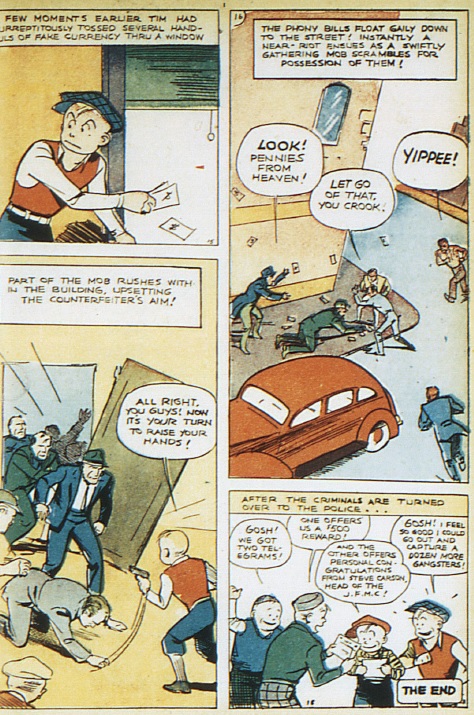
This month's Federal Men is again devoted to the Junior Federal Men Club (J.F.M.C.). This installment makes crime-fighting look like easy employment; no sooner have the police taken their prisoners then Steve Carson of Federal Men telegrams them congratulations, and another telegram promises them a $500 reward. This system could level up Heroes fast!


There are arguments for and against keeping track of ammo in a H&H gunfight.  A quick argument against: mundane "bean counting" runs counter to the fantasy elements of comic book action; a quick argument for: Cal n' Alec, counting bullets to know when their opponent's gun is empty.


Nadir has a magic crystal ball with an interesting limitation -- it can only be used between 3 am and dawn!  Time restrictions, race restrictions (like, only a merman can operate it), and items that can only be activated by destroying other items (like draining the magic out of lesser magic items) are all more inventive ways to keep a powerful trophy item from being too powerful, without saying it can only be used once per day, or it only has x number of charges.


What's this?  Nadir, Master of Magic, using guns! That's a big no-no for Magic-Users. But he's not really using them, is he? He's just holding them and, perhaps, planned to bluff his way through an encounter holding them, but wouldn't be able to hit the broad side of a barn with them.

I had a similar situation in an earlier H&H campaign, where a player wanted his Magic-User to carry a bow and arrows. He accepted that he would have no chance to hit with them in combat; he just wanted them for how he envisioned his character.


Another magic item, and this one's a new one -- Nadir apparently has a Ring of Alertness, that keeps him from being surprised.


Sandor encounters a lion here who treats him as if he already knew him. It's possible, actually, that Sandor had encountered this lion before and recruited it as a SCM, either behind the scenes or during some earlier installment I've forgotten or never got to read. An Editor can also, at his discretion, allow a player to make up SCMs from his backstory. The Editor must be careful, though, to consider the implications and how the Hero might benefit. Having a lion for a friend could be an unfair advantage over the other Heroes.

(Scans courtesy of Comic Book Archives)

Wednesday, August 12, 2015

New Adventure Comics #20

I didn't realize when I covered the October 1937 stories that I had access to New Adventure Comics #20, so I'm covering it just a tad out of order...

This page of Captain Jim of the Texas Rangers doesn't give us much of a sense of scale for that "gigantic" rattlesnake, but this could be the first giant poisonous snake in comics that isn't from a "tall tale"-like story.


This probably won't ever become an official Hideouts & Hoodlums rule, but if you ever miss a cowboy with an attack roll that's only 1 number off -- it should shoot off his hat.


There's a lot of grappling attacks going on here on this page. In some game systems, the player of Ian Murray would have to pick a different, specific grappling move each turn, each with different game mechanics attached to it. In H&H, the Editor has more latitude and is expected to describe the fight based on the dice rolls.  This seems to be a particularly vicious fight, so both sides must be rolling very well to hit and for damage...


There might be some exceptions I would make to my above statement, like in the case of a flip/throw attack, since this attack is unusual in that it leaves the opponent prone instead of held.


It's difficult to have a realistic rate of fire for missile weapons -- even for comic book realism -- and have any kind of game balance that would make Heroes reasonably choose melee over missile weapons. Here Ian cracks off 2-3 shots per combat turn with a single-shot rifle. Two shots would be possible if he was 4th level or higher in H&H.


This issue's installment of Federal Men is dedicated to the demonstrating the value of having half-pints as your Supporting Cast Members. Heroes like Steve Carson can recruit half-pints via ham radio! Half-pints loyal to Heroes are ever-vigilant for signs of crimes, and may be willing to put themselves in danger flattening tires and tripping robbers.


A history/technology lesson here from Monastery of the Blue God for anyone who had trouble picturing what a wireless radio looked like in the 1930s. This is not as portable as an iphone...


A patient Hero is just two lucky rolls away from finding the average secret door -- one roll to find the door and the second roll to find the way to open it. The impatient Hero, though (like Nadir, Master of Magic) finds the door, and then wrecks his way through it with a pick axe (using the non-Superhero wrecking rules, unless a Superhero obviously).


If there was a contest for best feature in this issue, The Adventures of Steve Conrad just won it. Behold the glory of natives riding trained alligators.

(Scans courtesy of Comic Book Archives)


Monday, April 20, 2015

New Adventure Comics #12

Nomads are an obscure mobster-type in Hideouts & Hoodlums Book II: Mobsters and Trophies and one I always debated over including; there just didn't seem to be much I had that set them apart from brigands. Now I can see that nomads should, instead, stand out as the only mobster type that specializes in horseback combat.


As the Gold Dragon serial shows, "gold pieces" can still turn up as a form of treasure in a modern-day adventure -- at least ones taking place outside the U.S.


Sometimes I just ignore silly creatures in the funny strips, but the tree cobra seems like an interesting idea, so -- why not? -- I'll talk about the elephog as well.  The elephog, an evolutionary dead-end that includes characteristics of elephants and giant hogs, would be a 9 HD monster.  A tree cobra, on the other hand, would likely be no more than 2 HD, with its poisonous bite being more dangerous than its combat abilities.

The Spy character class debuted in The Trophy Case v. 2 no. 5 and remains unplaytested, to my knowledge.  Spies, as Sandor demonstrates, make useful allies, even if just Supporting Cast Members.  Spies should also have a higher than normal chance to hear noises, as demonstrated here.


I normally ignore imaginary tales/dream sequences...but it seems this imaginary glimpse into the year 3000 was meant to be taken seriously.  Some standard equipment items we can expect our police to have by then include "thought vibrators" (not as dirty as it sounds) that detect evil thoughts over a long range, one-man space flyers, and ingestible transmitters that allow their superiors to hear everything around them (not unlike dashboard cams).

Also standard issue are invisibility bills and a hypodermic needle that injects some sort of sleeping poison.  Invisibility pills are the one thing already found in H&H (Book II, of course!).


(Scans courtesy of Comic Book Plus)