Showing posts with label initiative. Show all posts

Wednesday, January 11, 2023

Amazing Man Comics #11 - pt. 3


We're still on Minimidget, so today we're going to talk about the trouble with shrinking and game mechanics. I have proposed before on this blog the radical idea of using no new game mechanics at all -- that shrinking is entirely flavor text. The benefit is that you are -4 to be hit, the same as if your opponent couldn't see you (in this case, because you're so small).  But that ignored one critical issue with being small, and that's getting from point A to point B when any common sense ruling at normal size would say you could not pass through that opening.  You could hand wave the common sense ruling, but that could be granting more power through handwaving then I am generally comfortable with, particularly in a scenario like this where escaping from a locked room is critical. 
Where that leaves us is that the shrinking Hero must be a Magic-User with the Poof! spell. The flavor text of the spell has been replaced with shrinking, but the spell effect - of getting from point A to point B over a short distance - is still there.

Ugh, Google isn't letting me wrap text around the images today. Thanks so much, Google!

I shared this second page for more evidence of the importance of random initiative rolls for each combat turn. Even as I've turned away from random initiative rolls when running D&D and back towards Old School common sense order, it's clear that common sense has nothing to do with who gets to attack first in a comic book panel. Here, the hoodlum has three guns trained on him, yet he's still able to rush up and punch Minimidget before anyone can make a move to stop him.

What you just looked at was Zardi the Eternal Man, a brand new character, and an interesting spin on the Mandrake clone. You'll notice in the following pages that Zardi sometimes appears to be using real magic, like when he makes himself young again, and other times his wand seems to be more like a scientific tool akin to the Doctor's sonic screwdriver. The last panel even seems to allude to this when it refers to what Zardi does as "tricks," instead of spells.

Now the question is, do I need a spell that de-ages someone? I would say probably not, since there are no game mechanics attached to age in H&H (except between minors and adults, and even then just for mobsters). More on this shortly.

"Conquering gravity" is a Levitate spell. 

And, of course, it's ridiculousy racist to make your ethnic manservant dress in period clothing and not let him even wear a shirt.

For a magic cane, it sure looks like it's just a trick cane with a retractable silk line reeled up inside it. The only magic I'm seeing here is that Zardi is strong enough to lift Jeffry aloft with one hand - but then, we can chalk this up to flavor text, since Zardi isn't using his other hand for anything important.


Here we can see that Zardi's age actually does figure into the scenario, as a disguise. Since that is the only purpose it is serving, this could simply be a Change Self spell. 

He also casts Invisibility on Jeffrey.


There is no explanation for how Silky faked that photo, but Silky is a great nickname for a Slick Hoodlum. 

Zardi is either casting Knock, or his cane has some electronic door-opening feature -- which it looks more like. 

The magic cane "works" because he's using it as a whip and actively whipping them. No magic here.


Chaldean illusions are the Phantasmal Image spell. 

I think it's refreshing that Zardi seems to be no more than a 5th level magic-user. 

I'm jumping into the Shark story in progress. 

There's not really a good in-game rational for how Shark just happens to find this going on with his "magic" television just in the nick of time...except....the Shark's TV probably has a certain chance of finding bad guys per turn, which were measured in rest turns, until the moment a combat happened, and then his turns became melee turns. This explanation is a little dodgy because the Shark is not in her combat until after he already benefits from being slowed down to her turn speed.

Another example of a gun being disarmed with a thrown knife.


I don't recall if any other Shark stories feature this weakness, but it's a good idea and makes the last two panels of the previous page all the more heroic. 

I don't get how Fritz is able to tell just by looking at him that he's helpless, or manages so quickly to tie it to the thrown knife. 

I'm also surprised that belt buckles can do that kind of damage. Were belt buckles made sharper in 1940? I would think they would each do 1-3 points of damage, at best. 

Pretty good art, though! 

(Scans courtesy of Comic Book Plus.)


Wednesday, April 13, 2022

Thrilling Comics #3 - pt. 2

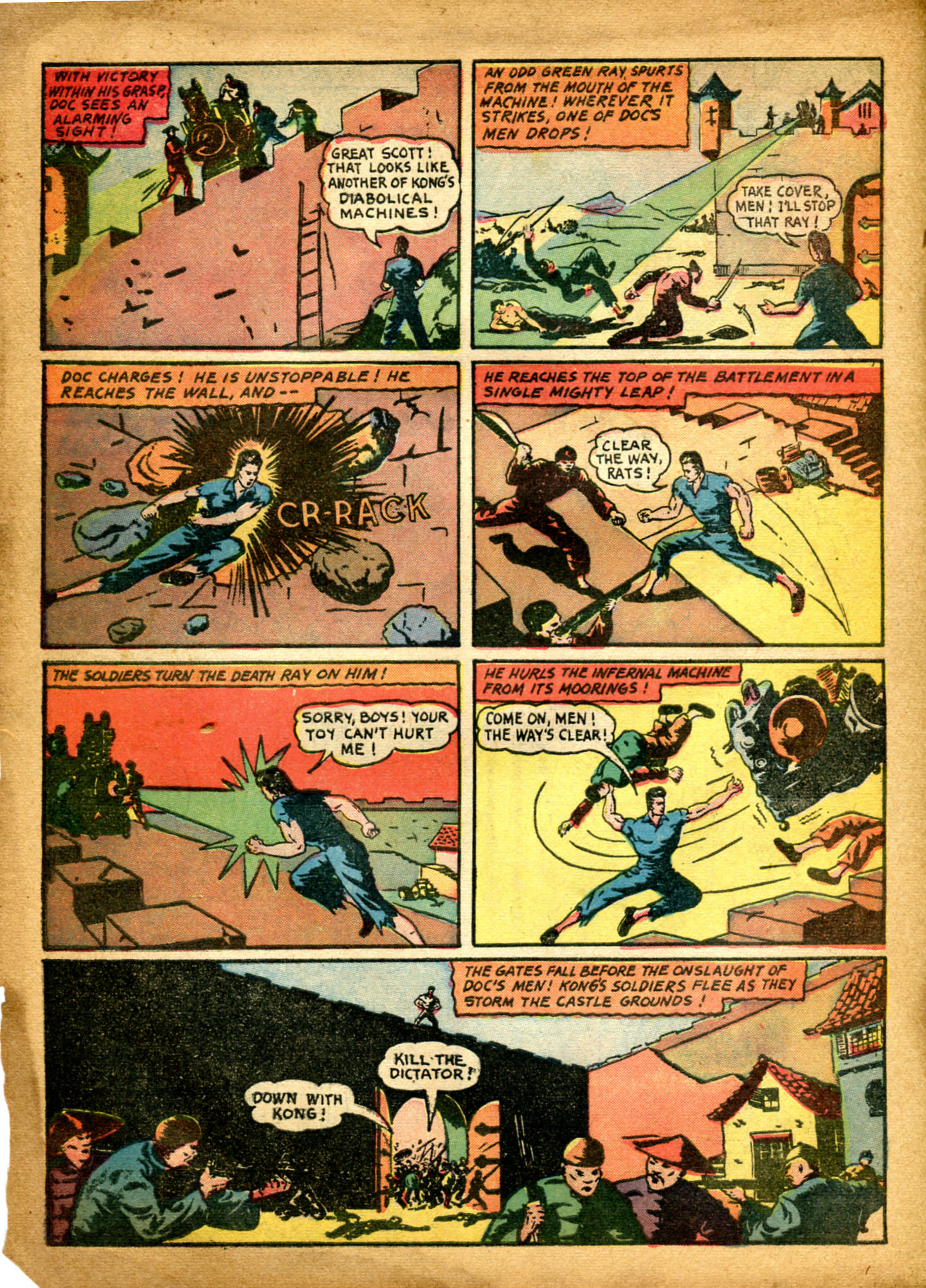
Here we have Dr. Strange using wrecking things, only to find his great strength "sapped." This actually happens just like that in Hideouts & Hoodlums, when activated powers run out and you're out of powers to activate. By waiting until the next day for his deathtrap, the villains have actually given him time to regain all his powers from the previous day.

I'm tempted to stat wild hill warriors as berserkers. I could also make them 2nd level fighters, using the level title of warrior from That Other Game.  I could also just use natives, since that's the broad stereotype being used here. 

I've never seen elephants in an arena before! Too bad Doc has Raise Elephant prepared. And a Leap power (looks like II or better) that makes escaping from an arena super-easy. 

As unstoppable as Dr. Strange seems to be, you have to wonder why he doesn't stay at the arena and take out Kong then, and sneaks back in disguise later. Maybe because there's more pages to fill...?


"You're fighting for freedom, men! Don't waste your shots! Keep dropping like flies - even though I could have wrecked my way through that wall for you at any time!"

Or could he? Dr. Strange has to be at least level 3, the bare minimum for wrecking stone walls, but he could also just be rolling poorly and failing to wreck the walls the whole fight so far. 

Or..maybe he really did not try wrecking through the wall until now. This is an early precedent for a trope of the superhero genre to come, that says superheroes try to stay neutral in the course of events until something occurs that ordinary people can't deal with on their own, like a deathray. Of course, not every superhero respects this trope - like Superman himself, who almost exclusively dealt with mundane crime despite being able to do so much more. 

Is this our first evidence that Doc is Neutral in Alignment? Hmm...

Interestingly, the deathray can only affect a single target at a time. So, even though it is killing them like a deathray, it is also, game mechanics-wise, perhaps no different than a Magic Missile spell (with cool flavor text). 

And here we've got a line-up of standard cliches - the big cat (a panther, this time) in the cage, the damsel in distress...and somehow Doc gets to the panther before it gets to the damsel? Now, I've covered many times before in this blog that random initiative needs to trump common sense when it comes to who goes first in a comic book story, but, Doc is wrecking things in the same turn that the panther is first attacking. So, we can only assume, then, that the panther missed with every attack on Virginia, even though it didn't even need to roll very high (reminds me of my rolls when I'm playing!). 

So, we also get the cliches of a big cat being killed (SIGH), and the villain threatening to blow himself up to take out the Hero. I bet it doesn't work...

Hmm...now, if I was running this scenario, I would have let Kong drop the potion as a free action; that is too easily done, and not a direct attack, for it to be trumped by initiative. 

Also, why not use Kong's raygun to revive the men, instead of experimenting with Alosun in a totally untested way (though, I suppose, Doc could argue that they're already dead, what worse could happen to them?)?


Here's a new character and an interesting twist on Tarzan and the Jungle Book. Instead of the infant being raised by animals, he's raised by yogis in India. They teach him potent spells like Rope Trick and ...Wall of Force, to stop mad dogs with? That seems a bit like overkill.

*SIGH* ...what I wouldn't give to read a magic-user story that doesn't throw around ridiculously overpowered spells all the time. Causing a submarine to rise into space ...well, that's got to be a Wish spell. So we've already given The Ghost 17 brevet ranks! Just to get him through a wandering encounter!


Here we get a dose of more insanely powerful magic being tossed about haphazardly -- a Telekinesis spell as powerful as the Raise Trolley Car power, and a Teleport Sandwich spell able to reach around the world. 

Chance's only interest in fighting crime is when the man who just hired him to entertain at parties was murdered. Had the man not been murdered, would Chance have been content to be a party magician instead?

(Scans courtesy of Digital Comic Museum.)


Sunday, May 30, 2021

Prize Comics #2 - pt. 2

We're still visiting with Ted O'Neil in Mexico. He's dealing with diamond smugglers, but pretty poor smugglers. Are they really about to brag about having $1,000 in diamonds? That should be easy, even in 1940. 

Here we have an uncommon instance of a whip being used as an entangling weapon. 

Just as rare, we have a missile weapon -- a rock -- being thrown into a melee to great effect.

Here we're told these are poor smugglers again, willing to kill over only thousands of dollars. 

They're slow smugglers too, though that is because of Hideouts & Hoodlums' initiative system. Even though Bates should be able to pull a trigger before Ted can reach up and grab that beam, he can't if Ted out-rolls him.

The smugglers are also poor shots, missing despite the +2 bonus they should have for attacking from behind, and while Ted can't move too much.

Tossing a lasso over someone while flying by in a fast-moving plane strains cred -- oh, who am I kidding? This whole story is straining me. This lasso trick would need a natural 20, over a result over 20, to pull off. 

And how dark is this ending? It's implied that Ted landed so rough that Bates' face is smashed in by the fall. 


You know, this issue really isn't winning me over, and Jupiter, Master Magician isn't helping. Let's ignore for the moment that Jupiter's antennae look like pencils sticking out of his hair. Let's pretend that monster is drawn less goofy-looking and more like the D&D gargoyle it superficially resembles. Let's even try to ignore the fact that, if the city is shielded by rays so he can't locate it, then how does Jupiter know it's far away? Instead, let's talk about how dumb your supporting cast member has to be to volunteer to be a decoy, while you watch a monster carry him away, even though you have no idea if the monster is going to eat him the minute it leaves town with him. And even if they're convinced from the crystal ball that the monsters are taking their abductees to this far away city, maybe the abductees don't need to show up alive, or with their heads still on. 

Okay, I lied -- let's go back and talk about the crystal ball shielding too. We need a Protection from Scrying spell for H&H

to simulate that.

On this next page, we learn how gargoyles are made. Ouch! And made by mad scientists...or is the old man a magic-user? It seems he is if he knows about white magic and shielding his location from scrying.

Jupiter here casts Hold Person, Knock, and ...Clean Room? Or just a use of Telekinesis maybe? Oh, and previously he used a Fly spell I forgot to note! It's worth noting that the Fly spell for magic-users is slower than gargoyles fly (12 vs. 15), so it would be hard for Jupiter to keep up, unless he has a faster Fly spell.

It's not a very successful ambush if the other side is able to attack first, is it? 

Jupiter's next spell is a new one and I'm inclined to call it Jupiter's Disarming Hand. It creates one invisible hand per level of the caster that can all make attack rolls vs. visible targets within a, oh, let's say 20' diameter area of each other and if the roll succeeds the target is disarmed of a weapon. The range is, let's say, 60' + 10' per level. It's a pretty weak spell, weaker than Sleep, so I think I'd put it at 1st level.

I'm not clear about how to describe the next panel. Is Jupiter using Hold Person, and then loading the paralyzed gargoyles onto Floating Disc spells? Or is there a new spell in play here (actually, Floating Disc would also be new, to H&H)? Maybe something called Jupiter's Delivery, where 1 inanimate, or paralyzed animate, object per level will float to any location you name for them to go, as long as the caster knows the location,
and it is within, oh, let's say 200' + 25' per level? This is maybe a 3rd level spell.

Then Jupiter scrys the bad guy's location with his crystal ball. "Wow! I still don't know how you do it!" "Really? Really? I'm holding a crystal ball right in front of you. How was this not a big clue for you?"

Up to this point, I could still pretend Jupiter is 3rd or 4th level with a Crystal Ball trophy item, but then he casts Earthquake and I'm just rolling my eyes at how many brevet ranks I have to throw at comic book magic-users. 

Now this turn of events starts out pretty cool; we get a nice visual of a paralysis raygun. And then...whaaaat? Instead of Jupiter thinking his way out of this trap, they luck into a stupid gargoyle tripping over the cord and unplugging it? They're miles underground -- why are there even wall plugs down here? 
It's unclear how Jupiter wrecks the raygun (and a lot of wooden rafters around it). Some spell version of Wreck at Range? Or a Fireball spell? 

It's worth pointing out here that Jupiter has either cast Fly twice, or has a Mass Fly spell that let's them both fly separately. He also has a higher level version of the Strength spell that boosts multiple (at least 2, let's say 2-5) targets' STR scores. This spell is going to be level 3. 

"Hey, watch where you're grabbing with that hand, mister!" You know which panel I'm talking about.

That is one funky ramp onto the plane. And for that matter, why are subterranean monsters using a plane?

Uh...H&H already has an Enlarge spell, but the size of Jupiter's hand is pretty ridiculous there. More so because we're lead to believe it's only his hand that gigantic and the rest of his body, off-panel, is normal size. 

Jupiter demonstrates a Mass Teleport spell that, gosh, that would have to be a 7th-level spell, especially since Johnson isn't anywhere near them when Jupiter and the mad scientist teleport. Johnson is, of course, only there to either witness Jupiter's victory (because Jupiter needs it for his ego) or -- as happens -- to give the mad scientist one last chance to threaten them. Polymorph is already a 4th-level spell. Based on the 7th-level spell alone, we know Jupiter is at least 15th level, and that's with 13 brevet ranks, just for what we see in this story. And I don't even remember how many brevet ranks we had to assign him last time!

(Scans courtesy of Digital Comic Museum.)


Monday, March 1, 2021

Famous Funnies #68 - pt. 2

Just a few pages left I want to share from this issue. This shooting contest demonstrates that, if you get more than one attack per turn, and you win initiative, you still get all your attacks before the other side goes. 


These gags are from "Life's Like That," which I often enjoy. The one on the left I found particularly funny, while the right reinforces my own distrust of the stock market, all these decades later.


This page, apparently from way back in 1935 (according to comics.org), demonstrates that monkeys are naturally skilled pick pockets no matter what size the monkey (maybe a 2 in 6 chance?). 

What kind of monkey is this? As cartoonishly as it's drawn it is hard to say. It is clearly not a mandrill or a proboscis monkey. Since howler monkeys can grow to 4' tall, I'm thinking that's what this is meant to be, though a langur or a macaque are also not outside the realm of possibility.

(Scans courtesy of Comic Book Plus.)


Thursday, February 11, 2021

Master Comics #1 - pt. 1

Another new title! The disturbingly named Master Comics is home to the disturbingly named Master Man! In addition to having mastered being a man, he can also do all the things shown on this page. Maybe! Comic book narrators are notorious for exaggeration. This particular origin story goes surprisingly well, considering that most people don't get superpowers when a stranger gives them pills. 

Master Man builds his castle on the highest peak...where? The highest peak on Earth would be Mount Everest, but the rest of this story sure doesn't look like it takes place in Tibet. The highest peak in the United States is Mount Whitney -- making Master Man the first confirmed Californian superhero. 


He can see all evil in the world...from 14,500 feet? Okaayyy, crazy narrator person!

Does that say Ecaldon or Ecalpon? Ecalpon is from Discworld! Unsurprisingly, this is a made-up name either way. 

Master Man's ability to run 100 MPH is the Race the Train power. He also uses Leap II at rivers and, it looks like, Imperviousness when he reaches town. Obviously, he is the superhero class.

It's interesting that he bares his chest. Is his shirt not bulletproof? The power description intentionally doesn't specify if items worn are protected by this power; this is something the player and Editor should work out between themselves and aim to be consistent thereafter.

The bad guys are a mixed group of four gangsters and thugs, probably half of each. 

I like the phrase "he scatters them like raindrops in a gale." Speaking of that, I like that Master Man can fail; he tries to catch that thrown torch and just misses, and the consequence is the building burns.

However, there is a lot to dislike here too. Why are the bad guys dropping a bomb on an orphanage? Are they terrorists? Why is Master Man smiling when he catches the bomb, when he knows he could have missed? How are the thugs strong enough to hurl a lit torch through an upper-story window that looks like it's 30' high? How on Earth does one lit torch immediately catch the entire building on fire? 

About that one question, "when he knows he could have missed?"
....it occurs to me that if Master Man is high enough in level to get a stunt -- and I have thought about letting all classes have stunts at some eventual level -- then one should be able to use a stunt for an attack roll in non-combat situations, like when you're trying to grab something out of the air. 

Master Man uses the powers Resist Fire and Raise Car here. There's a wrinkle here that the car is barreling down on Master Man at the same time, so both sides would roll for initiative. If Master Man wins, then he can raise the car before he takes ramming damage. He uses wrecking things on the car and the bomber. He's still using Leap II from earlier, as the duration hasn't ended.


It seems odd, from a Hideouts & Hoodlums perspective of mobstertypes, but the leader of gangsters and thugs is a bandit. There was originally going to be hierarchical trees of mobstertypes in the 1.5 edition books that I wound up eliminating. On those trees, bandits would be low on the pecking order. 

You can tell the scenario was too easy and the players still have more time to play, so the Editor has to create a new threat to overcome and the mayor turns up to reveal the kidnapping. 

Dragging a car to a stop is another use for the Raise Car power. 

We never did get any clue as to what the bad guys' motives were.

We're going to jump ahead to The Jeweled Crown of Ramistan, a starring a Tarzan/Mowgli mash-up called White Rajah (just not yet, as this is his origin story).   
 
I can't find any evidence that there are or were headhunters in India. 

Not even Sikhs wear their head wraps in their sleep like this.

This animal summoning power is why I keep leaning towards keeping the explorer class, since this seems beyond what a fighter should be able to do.
 

So, a "black jungle" is right next to India? Riiight. This page is pretty unbearable, not just for that, but for Sin-Gee falling into a trap and David just leaves her there! 

I'm only sharing this page because I want to spend a little time on this death trap. The theory behind it is, by binding one of David's hands, he can't dodge during the knife fight. I wouldn't necessarily call him prone, because he still has some range of movement, so maybe he's +2 to be hit, plus this can kill him because it still qualifies as a deathtrap. 
 
Wrecking things is the obvious way out of this trap, and I would let him wreck his way out of the rope knots as if it was a door.
 
I don't have game mechanics to discuss from this page. I just want to vent. Despite being left behind to die, Sin-Gee gets himself out of the pit without any help, sprints to David's rescue, saves the day and the crown, and then David not only gets all the rewards, but Sin-Gee still has to carry him around! Poor Sin-Gee. As far as I'm concerned, this feature should be called White Elephant!


There is a Carterville in Illinois, but it's only a city in the academic sense since there were less than 3,000 people there in 1940. No, this must represent a larger metropolis, though which city it's representing escapes me. The only clues here is the neighboring mountain, but that still leaves dozens of possibilities.
 
The rivalry with a Moriarty-like villain is appealing, but what made Moriarty so sinister is that only Sherlock Holmes knew he was a criminal. Jeff isn't much of a criminal mastermind if the local newspapermen are already onto him. 
 
I am half tempted to stat a street loafer, but I suspect a wimpy hoodlum would suffice. 
 
And we'll probably pick up with this feature next time! 
 
(Scans courtesy of Digital Comic Museum.)


Monday, January 18, 2021

Detective Comics #37 - pt. 2

*sigh* "Spy" used to be so good when it was Jerry Siegel and Joe Shuster working on it. Ever since Maurice Kashuba started drawing it it's been so boring, I wonder if Siegel's name is only contractually on it and he's not actually writing it anymore.  

The plot here is that a bomb blows up a "conference of government officials," with no specifics as to the nature of the conference or the level of the officials present. Forensic evidence points to a suspect, which our hero Bart Regan collects from the scene, which seems odd because you would think a forensic specialist instead of a spy would be collecting evidence. 

An assassin tries to shoot Bart in the back, but facing doesn't matter in Hideouts & Hoodlums; if you win the initiative roll, you can turn around and deck someone behind you, just like Bart does. 

Undercover, Bart tries to join Ligoni's mob, what we would call a terrorist organization today. Ligoni is a skilled knife thrower and tests his new recruits by throwing knives at them until they flinch. Bart stands still for 16 knives before Ligoni gives up. I would use two mechanics for this: one is rolling to attack Bart with each throw. Since he's trying to miss, a successful "hit" becomes a miss. The other is requiring a save vs. plot from Bart to see if he flinches. If I was really mean, I'd make him make 16 different saves, but the odds would really be against him then. I would have him roll once and, if he missed, the number he rolled is the number of knives he can withstand without flinching. Then, to be fair, I would roll randomly (on a 20-sided die) to see how many knives Ligoni throws.

During the initiation, a mobster walks in who knows Bart and recognizes him immediately. Bart was "disguised" only with a change of clothes to look like a criminal, which is not enough to warrant a mobster having to make a saving throw to see through it.

Whimsically, the newspaper headline saying the bombers were captured is from The Daily Star, the newspaper Superman then worked for. This could be seen as the first cross-title continuity between Action Comics and Detective Comics.

In Cosmo, the Phantom of Disguise, Cosmo's friend is a ship captain tasked with delivering unspecified "chemicals" to England. I immediately thought this was suspicious and did some digging and saw that we did send chemicals to England -- illegal mustard gas -- in 1943. We never do learn if it's that type of chemical being delivered.

It normally took a steamship 15 days to reach England from New York then, but the captain seems to suggest it will take 1 whole month with the circuitous route they planned around the "war-infested areas," which actually does sound like quite a reasonable precaution.

Cosmo, in disguise, hears talk of mutiny on board the ship (after a skill check for listening?). In a clever bit, Cosmo pretends to shoot the captain with a blank cartridge, then dumps a dummy overboard, so the mutineers will trust him and the captain can still move about the ship. Less clear is how Cosmo further distracts the mutineers with an explosion timed to when he drops the dummy in the water. Are the explosives inside the dummy? And if so, wouldn't dumping them in the ocean stop them from detonating? The story should have ended with the captain rallying the loyal crew for a big fight, but the story is running out of pages, so the mutineers all flee to the life boats, but Cosmo punches out the ringleaders before they can board the boats (why the ring leaders wait so long, until all the other mutineers are at sea, before leaving the ship is not clear).

The Crimson Avenger returns! A rich man's daughter has been kidnapped, so the Crimson Avenger goes to work -- as reporter, Lee Travis. He apparently finds no useful clues, so he comes back that night as the Crimson Avenger and, at gunpoint, forces the dad to tell him where the drop point for the ransom money is. His only plan now is to follow the kidnappers' car from the drop point (are police not doing the same?). 

The twist is that the kidnappers' hideout is a mansion in the suburbs. The Avenger even gives us the address for the mansion, 704 West Highway, "Scarchester." That sounds like Dorchester, Massachusetts to me. When he gets there, though, all the Avenger does is point a gun at the five kidnappers and wait for the police to arrive. Boring, and the art is terrible. What a bad comeback!


Sunday, January 17, 2021

Detective Comics #37 - pt. 1

SPOILERS: This is the very last pre-Robin Batman story. 

One of the reasons I find the infallible Batman of today's comics so laughable is that he bears nothing but name and costume in common with this Batman, the Batman who gets lost and stops at a random house to ask for directions. 

In the house, a man is being tortured by three mobsters. Despite the fact that one of them gets the drop on the Batman with a pistol, the Batman is still able to go first and kicks him in the face hard enough to knock him into the mobster behind him. Two game mechanic things here: one is that there is no order of battle in Hideouts & Hoodlums, where missiles always go before melee. The Batman has won initiative, so the advantage of already pointing a gun at him disappears. The other point is the two attacks. This should only be possible if the Batman has levels in fighter and these mobsters have less than 1 Hit Die, or if he was a superhero using the Multi-Attack power. Neither should be the case here, since the Batman is obviously a mysteryman. There is one more area with some wiggle room, and if you recall the Batman's stats from Supplement IV you know I already used it; the Batman's signature move is hitting mobsters with other mobsters. This is actually borne out in the following panels; the Batman drops those first two with one kick, but it takes him two punches to drop the third one, possibly because that mobster had more hit points, but also possibly because the Batman no longer has as good an attack bonus against a single opponent. 

The first plot twist is that the tortured man, once freed, delivers a head blow that stuns the Batman (head blows are common enough that it is now a combat rule in 2nd edition). Because the Batman had already tied up the three mobsters, they are easy targets for the fourth man, Joey, when he uses a gun on them. If the tied-up men were Heroes, he would only get a +4 bonus to hit them (or at least the one who was only stunned and is awake already), but because these are just mobsters the Editor can handwave that and say they are each killed in one shot (as happens here).

The Batman's only clue as to where Joey went is that they all said they worked for a man named Turg. Later, Bruce Wayne remarks how uncommon that name is. No kidding, Bruce! Ancestry.com only lists six Turg families in Ontario, and none in the United States. But in this story, Bruce finds three in the New York City phone book and after visiting all three deduces the suspicious one is the one, Elias Turg, who opened a grocery store in a part of town without many houses in it. Most people would consider that a zoning issue, but to the Batman, it's a vital clue that turns out to be correct!

Later that night, the Batman barges into the upstairs office of the grocery store and finds Turg there with Joey and two more mobsters. He decides to intimidate them from the doorway first, spoiling any chance of a surprise attack. They are all 15-20' away, so the Batman can reach them easily for melee if he wants to, but this Batman doesn't feel infallible against four-to-one odds, so he turns off the lights and uses night-vision goggles. They aren't called night-vision goggles; the narrator calls it a "queer piece of glass," probably because the term "night-vision goggles" isn't in use yet. Night-vision devices are brand new on the battlefields of Europe, so new that I'm not sure the author (Comics.org credits Bill Finger) would even have heard of it yet and may have invented this idea independently.

After roughing them all up, the Batman does something I think is really clever; he pretends to leave and then hides before the lights come back on, so the mobsters will start to talk incriminatingly in front of him. It turns out, they aren't hoodlums but spies (or at least all of them but poor Joey, who they turn on and kill because the Batman called him out by name). 

En route to the piers to commit sabotage, Elias Turg splits off from the other spies and the Batman has to choose who to follow. He follows the other spies to the pier, where they are met by two more spies. Actually three more spies, because Carl (probably the lookout) is on the balcony of a building behind the Batman and gains a surprise attack (because he is standing separate from the others, he gets his own separate surprise roll). He drops a heavy sack full of ...something heavy on the Batman's head and it counts as a head blow attack, stunning the Batman again. Instead of just shooting him and killing him (which actually makes sense here, since they don't want to alert the ship they plan to attack), the spies put him in a sack and toss him in the water. Stunning has a very short duration and the Batman is able to cut his way out of the sack with a knife in his utility belt before drowning. 

When the Batman sneaks back up onto the pier, he switches to another favorite tactic of his, swinging on a rope to attack. It's very cinematic, but definitely would not improve his chance to hit. I think I talked about this before when he killed Jabbah this way and decided I might allow a +1 to damage for doing this, due to the additional momentum. 

Despite beating all five spies in melee combat, they still managed to start the moto launch rigged with TNT that will blow up the docked steamer that was their target. The Batman tells his feet to run like they've "never run before," perhaps burning his first stunt of the night to run faster so he can reach the end of the pier in time to jump on board. Once he's on board, the cutting of the ropes holding the steering wheel and turning the wheel in time takes four panels, but there are no game mechanics in play anymore to resolve this, only stated intentions.  

The story could have been over at this point, but there are two additional pages that seem rushed, as if tacked on. Joey had given the Batman the phone number for The Head (as in, the head of the operation) before dying, so the Batman finds out who's number that is and goes to his house. It's someone named Count Grutt and the Batman is either genuinely surprised or being sarcastic when he seems astonished that someone named Count Grutt is a foreign agent. Grutt is actually Turg without a disguise on (notice how the name is reversed; semi-clever, but if Grutt had gone by the name Smith, the Batman never would have found him). 

Grutt/Turg has super-strength, able to throw a sword across a room with enough force that it goes halfway through a door. Count Grutt must be a supervillain, buffed with ...Extend Missile Range? Then the Batman pummels Grutt until he's down to zero hit points. With his last punch, the Batman must have pulled his punch a little and transferred some points of damage into pushing Grutt back, because Grutt falls back into the sword, which kills him, since he just took more damage while at zero hp. The Batman doesn't seem concerned.

(Read in Batman Archives vol. 1.)


Wednesday, December 23, 2020

Target Comics #2 - pt. 1

We return to Carl Burgos' third android hero. I don't have much to say here, since this is largely recap from the first issue, but...Dr. Simms, the world is at peace? In 1940? How long has it been since you looked at a newspaper?


Carl Burgos seems to be on the side of isolationists here (spoilers: that's definitely not the direction the U.S. wound up going in). 

So far, we don't know what this chromelac can do, unless it can make blinding flashes. Maybe an alloy made with magnesium?


Here's the page where we first learn chromelac is an alloy. We also get a demonstration of how you made phone calls in 1940.

It's worth noting that Manowar has to climb the fence; he does not have the leaping power prepared and it's not his built-in android power. The white streaks from his eyes suggest Wreck at Range is his built-in power. However, a speeding bullet is an awful specific, hard-to-hit target to wreck.  It's tricky because wrecking doesn't specifically call for attack rolls normally, to some extent wrecking is an area-effecting ability, but the Editor can require them at his discretion. A stingy Editor could assign an Armor Class of 0 or lower to a speeding bullet.  

It's rare for us to learn that mobsters are using automatics, not that it does them any good. It seems that only one of them gets a chance to hit before Manowar gets to go, which defies how initiative normally works in H&H, with each side rolling against each other. Now, it won't break H&H if you, as Editor, decide to switch to individual initiative rolls, but it does slow combat down unnecessarily.  Of course, just because they're present doesn't mean mobsters need to attack.  They might have been overconfident enough to just have one attack first.

"High tension electrons," huh? Well, that's sort of a thing. He must mean high tension electron voltage, but tension is, as far as I can tell, what helps power your television or your electron microscopic; it's the voltage that can harm you. Here, Manowar is using the Blast power -- perhaps our first encounter with it in a comic book! -- to harm, although an alternate explanation is that he's using Wreck at Range to disarm (his goal is clearly to disarm, but both attack methods have a chance of disarming).
I'm not sure what the science is, if any, behind the electrons having to strike the steel bar first before hitting the water. Apparently being stunned by electricity makes you mispronounce words. 

Manowar is sort of correct, that electrocution typically means grave injury or death, but I think, technically, even being stunned should count as electrocution.

I don't plan on making "toughie" a mobstertype. Toughie sounds enough like thug that I would just use that one.

Note that, again, Manowar has to climb because he can't leap (I point it out because it's so unusual for a superhero circa 1940).

Ha, I would have been right to use thug stats for the toughie!

The narrator calls those guys guards in panel 4; I wonder if that makes them rented cops, as opposed to on-duty officers. There shouldn't be any difference in statting them; they would still be beat cops. 

There is no game mechanic that causes heart attacks; that must have been a freebie from the Editor because the game session needed to wrap up. 

I'm going to have a Message power in the Heroes Handbook, if I ever get that done.

Wait - we still don't know what chromelac is! Is it a magnesium alloy? If it is, why do you want to make bridges and houses out of it? Maybe you should have thought this through before killing Tomsen for just wanting to make a profit off of it, Manowar...
We're going to jump right into the middle of Bulls-Eye Bill and the good stuff. Everett does not write your typical hero stories, so here's the bad guy kicking the good guys' butts. The question I pose here is, should kicking with boots with spurs on them do more damage than kicking with boots alone? Except in deliberately rare situations (trophy weapons), all weapons do the same range of damage in H&H. Again, it's a deliberate choice to go with abstraction over accuracy. 

Now, an option for the Editor that isn't really spelled out in the rulebooks is that, in a situation like this, where the bad guy really kicks butt due to lucky die rolls, the Editor could make his weapon a trophy weapon with a higher damage die, even if the weapon had not been intended to be a trophy weapon, nor did higher damage during the battle. The fact that there's a fun anecdote tied to the item enhances its importance in the campaign.

Let's overlook the racist Chinese caricature for a moment. Can you guess the code? That's the kind of clue that can keep your players guessing for sessions...I love it!


*sigh* Now we have a racist "half-breed" caricature. Relax, I'm not going to create a half-breed mobstertype with fantastic leaping abilities. Rather, I think this is a good example of an enemy mysteryman using a stunt! He's probably higher than 1st level too, since he takes a bullet and is still ready for more fighting!


(Scans courtesy of Comic Book Plus.)