Showing posts with label Slam Bradley. Show all posts

Tuesday, July 9, 2019

Detective Comics #36 - pt. 3

It's a little hard to believe that, three years into Detective Comics, Cosmo, the Phantom of Disguise still has a berth here. This month, Cosmo, who undoubtedly got that nickname because he's so cosmopolitan, has to visit a cowboy ranch. Interestingly, Cosmo admits that acting like a cowboy is outside his wheelhouse and has to visit under other pretense. This is more realistic, but actually contradicts the Hideouts & Hoodlums skill system, where everyone has the same chance of performing any skill, based just on class and level (and possibly modified by race).

The ranch has mortgage payments of $7,000 (monthly? Annually?) and someone makes an offer of $60,000 for the entire ranch, which is apparently low but not entirely unreasonable.

A neat trick Cosmo uses (though I'm not sure this would actually work) to fool some rustlers into thinking he's still hiding behind a boulder is to tie strips of his shirt around bullet cartridges and lit them like fuses. The bullets go off, convincing them that he's still shooting from behind there.

Do I need to stat rustlers? I think I'll just treat them as outlaws.

The disappearing cattle are being herded through a secret door made of stone (or made to look like stone).

Bruce Nelson is skiing in the White Mountains. I was sure this was a generic fictional name, but there really is a White Mountains in New Hampshire and Maine. Bruce is staying at a ski lodge with a bunch of "famous celebrities," but they don't seem to be based on real ones in either name or appearance.

Bruce shows expert-level tracking skills when he looks at all the tracks in the snow outside the lodge -- by moonlight! -- and manages to spot finger-tracks, where someone's hand was dragged through the snow. I'd say that would normally be a 1 in 10 chance of success at best.

Slam Bradley and Shorty are surprised when an intruder enters their bedroom and leaves a small box with $10,000 in it -- though I was more surprised to see Slam and Shorty sleep in the same bed. The money is a retainer from someone who wishes to hire them anonymous, which wouldn't have lasted long had they caught the intruder. To collect, they have to go to Shanghai, which takes them out of the country on a very long sea voyage (the only thing we know about the trip is that Shorty learns how Chop Suey is not a traditional Chinese dish).

The scenario is fairly interesting; Slam has been hired because of his reputation. He's supposed to procure something, but they refuse to tell him upfront. Instead, a female guide is to be sent with him who will reveal what it is at the "proper time." I think this would scream "trap" to my players and they would never touch this plot hook.

Slam was always a tough scrapper, but in this adventure he needs to be rescued from five yellow peril hoodlums, and then gets knocked out by a head blow later. Slam is tortured for information (that he doesn't have) on a strange rack that pulls sideways instead of up and down. Shorty is hung off the floor by his wrists (at least it wasn't his thumbs).

There's a curious plot hole in the story where Slam and Shorty's caravan through China is attacked, the men who tortured them save them (because they are following Slam to the Macguffin) by mowing down the new attackers (and I'm not sure who they are, other than a random encounter) with machine guns. Slam acts like he didn't even notice and is surprised later that they're being followed, even though there's no way he didn't witness the machine gun fire.

The Macguffin is an idol that will give whoever owns it the ability to command people (not a magical ability, I don't think). It is poorly guarded by a single sword-wielding guard and a pit, though the real protection, I suppose, is the trap on the idol -- mess with it and a dagger springs out of the base of it and stabs you (killing the main villain, Chong, incidentally. Poisoned, perhaps?).

Although Slam gets paid in the end, he didn't actually do much, except he scares off Chong's men with a machine gun he steals from them in the end.

(Read at readcomiconline.to)


Monday, October 29, 2018

Detective Comics #35 - pt. 2

Speed Saunders, Ace Investigator is next. Speed calls himself a detective in this story, but by now he should have enough accumulated XP to be a 5th-level captain. He goes against a villain called the Snake Master in this Cuban-/voodoo-themed story. According to this story, Cuba is inhabited by natives who attack with darts. Speed is able to identify hemp rope as coming from Haiti just by looking at it (expert skill check?). Despite darts not having a great range, Speed has darts thrown at him three times before he is finally able to spot the thrower. By using a guide, Speed is able to avoid concealed snake pits on his way to the Snake Master. Not one of the Snake Master's followers has better than darts for weapons, so Speed just waltzes in with a gun and takes out the cult leader.

This month Cosmo, the Phantom of Disguise seems to be all over the place. He starts out looking into the case of a man who escapes jail by appearing to be dead, then he's investigating the murder of a police captain who was looking into the case (weird, that a captain wouldn't have delegated that responsibility), then he's following a Hindu because the captain had mentioned a dragon before he died (even though India isn't known for its dragons), then he's in disguise as a bum, trying to get invited into the home the Hindu went into (why he thought a bum would be invited in, I don't get, but somehow it worked). The best part of the adventure is that the bad guys trap him in a room and talk to him through a bronze dragon statue, as the room slowly fills with poison gas. Cosmo survives by making his saving throw (with some likely modifiers for laying on the floor and covering his mouth with a wet handkerchief  -- wetting the handkerchief in a fish tank was particularly ingenious).

There's a second trap that's not as good -- he drops through a pit trap into a room the floods with water -- but the plot twist is rather clever that Cosmo is saved by city water works employees, investigating that the house was leaking water into the street. It turns out that the owner of the house is the man who escaped jail by using the "Oriental trick" of suspended animation. That doesn't sound like an Oriental trick -- that sounds like a psionic discipline.

Bruce Nelson is continuing an adventure in ...Africa? I forget. He and his native guide Mambu are canoeing along rapids, dodging whirlpools, probably requiring expert skill checks to avoid being in situations where they have to save vs. science to avoid drowning (I would be okay with affording them that double layer of protection because the penalty for failure is so steep). The "white goddess" they rescued last time wakes up after being splashed in the face, something I don't recommend for H&H play, so maybe it just coincidentally coincided with a duration ending.

Bruce learns the name of the "white goddess" and immediately recognizes who her father is. Should recognition be a skill check? The girl, Toni Hutton, was drugged by the natives with something that would knock her out for two days at a time (long duration!).

In Slam Bradley, Slam and Shorty are paid to bodyguard a group of swells on a "slumming tour" of dangerous dives. This should be an example of a situational modifier that increases chance of wandering encounters. Someone is murdered and Slam beats people up until a barkeep gives up the name of the murderers. Slam and Shorty deliver the suspects' names to the police and Shorty is ready to end the scenario, but Slam wants to pursue it further. This is one of the ways that traditional RPGs are so flexible, that the players can decide -- not just the referee -- when the scenario has been successfully completed. Luckily, Slam must have some supporting cast in the FBI, because he is able to just waltz into their HQ and request to see the files on the suspects.

On a crazy whim, Slam decides to sign them both up for the French Foreign Legion just because the suspects used to be Legionnaires (apparently it was for strictly enforced five-year stints too). Now, I'm not a very flexible Editor. When I'm running games, I have a story in mind and when Heroes go too far off the rails, I'm comfortable with just saying there are no leads in that direction. But Slam and Shorty have a very flexible Editor, because he rules that the killers are exactly where they get shipped off to, and even tosses in the wrinkle that one of the suspects is their sergeant!

To get rid of Slam, Sergeant Jensen sends them out into the desert and they are attacked by nomads. Slam, who can usually handle any fight, is overwhelmed by six-to-one odds. In fact, the scenario gets way out of hand and Slam is about to be executed by firing squad, so the Commandant of the Foreign Legion has to ride in at the last moment and save the day for him.

(Read at fullcomic.pro)  


Wednesday, December 28, 2016

Detective Comics #32 - pt. 2

Skull-Face is also the first mad scientist to wear a bulletproof vest.

Speed Saunders is placed in a locked cell with a fairly ingenious way to escape -- the floor is clay instead of stone and a resourceful Hero can dig through it to water.

Speed comes back with just two supporting cast -- unnamed police officers -- for back-up. They swim into the lair, and Speed thinks to bring waterproof bags for their guns. The hideout entrance tunnel has water up to their knees. There are at least three levels to the place and on the second level is a dry office with a balcony overlooking the water.

It's Speed's best story yet -- marred only by the fact that Speed stumbles across everything by accident and doesn't actually learn anything through investigation.

In Cosmo, Phantom of Disguise, a state governor is murdered. But which one? It seemed like Cosmo's adventures took place in New York before, but this guy doesn't look like Herbert Lehman, A prominent newspaper in the story is the "Evening Record." New Jersey had a prominent newspaper called the Evening Record. Hmm...

Cosmo disguises himself as a judge targeted for death to lure out the killer. The killer plans to use the cliche of the gun-in-a-camera, with the extra twist that it fires ice bullets -- though the story isn't clear about how Cosmo recognizes the weapon as a fake camera.

Interestingly, Cosmo uses the phrase "tag after that wagon!" instead of the more familiar "follow that car!"

In Cosmo's fistfight, he takes advantage of the "semidarkness and confusion." Could this be evidence that I was right to give humans a penalty to be hit in dim light -- or maybe a morale modifier for fighting in the dark?

Bruce Nelson describes purse snatchers as "never dangerous. They're the sniveling rat type. Weak kneed and lame brained." Sounds like cowardly hoodlums!

To find a woman Bruce Nelson is looking for he simply looks in the phone book -- one of the first times a Hero takes such a simple action in the comics.

To find out about a murder, Bruce goes straight to the police captain, who promptly tells Bruce everything he knows. Bruce is either exploiting a supporting cast member we haven't seen before, or he's benefiting from a really good encounter reaction roll.

Slam Bradley starts his story with an interesting conundrum. He finds two men in an alley; one is accosting the other.  But which is the bad guy? Slam takes a guess and gets it wrong. How could he have gotten it right? I have toyed with the notion of allowing Heroes to identify mobsters with a skill check, but that could invalidate the Detect Evil power or spell. I guess he could have asked questions first and punched later.

Slam makes it up to the guy he punched by coming to work in his haunted hotel (he was a disguised plot hook character!). The hotel is sprinkled liberally with secret doors that "ghosts" use to pull pranks like stealing suitcases (when they have surprise, they can open the secret door, grab something nearby, and exit without being seen). Of course, it's not really the supernatural (even though Slam did have that one adventure when he could cast spells!). The creepy voice in the elevator is coming from a concealed speaker.

The "ghosts" appear to be a mad scientist and his lovely assistant (definitely not an Igor-like assistant!). Shorty is overcome by the assistant when she chloroforms him. Slam is gassed by the scientist, using a gas gun, that first blinds him, then knocks him unconscious. But then, in another twist, the mad scientist and his assistant turn out to be something else and -- ah, ah -- spoilers!

(Read at Readcomics.net.)

Wednesday, August 10, 2016

Detective Comics #29

Bruce Wayne begins this month's adventure doing what every good Hero should do at the start of each day -- read the newspaper for plot hooks. You just never know when your next arch-nemesis is going to leave you a message in the classified section, inviting you to ask for a letter at the post office, that will defy you to stop him from murdering someone, which will actually be a trap.

Before going, Bruce checks over some of his gear. He's equipped himself well with trophy items already, including "gas pellets of choking gas" and suction gloves and knee pads to aid climbing.

And even on arriving at the scene of the trap, The Bat-Man takes further good precautions, leaving a hanging rope outside the penthouse for a quick getaway in case the encounter goes sour.

When The Batman is attacked, he hits two hoodlums at once with a pedestal. Now, that can't be the Fighter class' "combat machine" ability, unless we give The Batman some levels in Fighter. And it can't be the Multi-Attack power unless we give him some levels in Superhero. Right now, the Mysteryman class has no avenue for making multiple attacks in the same turn. So...bit of a mystery there right now.

We do know that The Batman isn't too high in level yet because when he's shot by Jabah, he's apparently low enough on hit points that he decides to retreat (maybe the Editor rolled a 6 for damage)! Or is this no ordinary wound? The Batman is still bleeding from his gun shot wound about two turns later. Now, so far, we have no game mechanic in place for bleeding wounds causing additional damage over turns. Do we need one for gunshot wounds? Or could Jabah have a special trophy item, a Gun of Wounding?

The next day, Bruce Wayne just plain gets lucky, spotting Jabbah on the street as he drives by. You would think that would be a one in a million chance, but it's not really that bad. More likely, the Editor added Jabah to a wandering encounter table with no more than 20 entries on it, giving Bruce a 1 in 20 chance of encountering Jabah there.

Bruce saves Jabbah's intended victim from poison gas by putting a handkerchief over both their faces (good thing Bruce carries two!). Any sensible precaution like that should give a situational modifier of +1 to a saving throw.

The Batman is shown to have more equipment: a glass-cutter for breaking and entering. He uses a lasso in his next fight with Jabah.

Dr. Death's lab is equipped with a pit trap with a mat underneath it, for Dr. Death's quick escape.

What is in the vial Dr. Death accidentally smashes on the floor? He seems to refer to it as "the fiery death", but he may be referring to what he has planned for The Batman. Whatever it is, it seems to work a lot like Greek fire, combusting on impact, spreading quickly, and burning hot.

And that's all just from the Batman story!

In Spy, Bart Regan seems to still be separated from his wife and partner Sally and is saddled with boring partner Jack Steele. Jack is still a 1st-level Fighter, wet behind the ears, and easily captured when he follows the bad guys solo. Now, the bad guys know Jack knows too much; there's really no good reason for them not to kill him. But a good Editor knows to keep the story going as long as possible, and give the Heroes every possible break. So a previously unknown even bigger boss calls in and asks to see Jack.

At least the spies Bart and Jack have to deal with are pretty smart. They have a back-up plan; if their robot plane full of bombs is stopped, they have another pilot in the air who will swoop down and machine gun all the government officials the spies want to murder. Bad guys should always have a back-up plan, because Heroes tend to wreck plans so often.

Interestingly, Bart doesn't seem remotely interested in capturing the spy leader, but mows him down with bullets at long range. I hate it when my players are like that...

The Crimson Avenger, in his story, is hunting down kidnappers, based on the testimony of the kidnap victim they freed. These kinds of clues -- "we were on a farm about fifty miles from here....the front gate was locked with a chain, the second porch step was loose, and a water pump out in back squeaked" -- would be a different kind of investigation than an urban adventure.

The Crimson is not opposed to doing his hero work while out of costume. When he finds the kidnappers, he immediately launches into attacking them, even though he has none of his crime-fighting gear with him. Luckily, his sidekick Wing saves him and brings his gear to him.

During a car chase, The Crimson jumps from car to car. I don't have that on my skill list, but it seems like it would be a hard skill, so there should only be a 1 in 6 chance of that working. Maybe if the cars were going slower it would be easier, but this seems to be a high-speed car chase.

Okay -- what the heck? Speed Saunders is investigating a murder scene, sees a tobacco stain on the ceiling, and correctly deduces from that the tobacco was used to blind the murder victim before he died? That's got to be a case of an Editor feeding clues to the players when they can't solve the scenario on their own.

In Bruce Nelson's adventure, he's chasing a hoodlum (he's literally in a hood -- I wonder if hoodlums should get bonuses if they're wearing hoods) and shoots into the air to try and force a morale save (one of my players just recently tried that).  When that fails, it becomes a chase. Editor and player each make skill checks for their characters. On a 2, they run slightly faster than normal. On a 1, they run much faster than normal. On a 3-6, they just run normal. That's basically how skills will work in 2nd edition.

Cosmo, in his adventure, is on the trail of a mad scientist. He's following a car that he thinks the mad scientist is in -- but rather than trail him back to his lair, Cosmo detours to the local license bureau and inquires who the car belongs to. Interesting technique there, Cosmo -- lucky you the car wasn't stolen!

But Cosmo's luck doesn't end there. He bluffs his way into the mad scientist's home posing as an electric meter inspector. Then the mad scientist simply invites him in and begins showing off his disintegrater raygun. It has a range of six miles and wrecks things as at least a 6th level superhero. When the mad scientist succeeds at disarming Cosmo, it looks like it's all over for that character. But the Editor allows the dropped gun to go off and shoot the raygun, blowing it up somehow. Really...lazy storytelling at its worst here. I can scarcely recommend anything from this as game tips.

And while Cosmo's audacity just seems lazy, Slam Bradley's is perfectly in-character for him. When he receives a threatening letter warning him to stay away from Hawaii, he not only goes there at once, but puts an ad in the newspaper right away saying "I'm here! So what?" (I laughed out loud at that).

But Slam is being suckered -- every note he receives warning him to stay away from somewhere is being used to lure him around (I wonder how many of my players that would work on...?).

Slam is stopped from catching the bad guys in a car chase by the simplest method -- a fork in the road. Unsure of which route to take, Slam gives up and tries something else.

And Slam's next plan is really interesting. Hoping to endear himself to his next suspect, Slam and Shorty endanger the man's life so Slam can rescue him.

The villains' hideout is a house on a leper colony island -- which, you've got to admit, is a pretty good way of keeping intruders away.

Sadly, the story is marred by horrible racism towards native Hawaiians, who are shown to be human-sacrificing primitives, easily tricked by Slam's ventriloquism into thinking Slam and Shorty are gods. Also, there's some bizarre politics, where the Japanese and Chinese seem to be working together to foment revolution in Hawaii.

(The Batman story was read in Batman Archives v. 1, the rest was read at ReadComics.net)


Thursday, July 14, 2016

New York World's Fair #1

It's June 1939 and the New York World's Fair is making the rounds in a lot of comic books, but none made especially for the fair like this issue was.

Superman visits the World's Fair. Being mid-1939, Clark Kent is still a Cleveland, Ohio reporter writing for the Daily Star, but he's a veteran correspondent on three continents already.

Superman demonstrates his leaping ability in this story, uses the powers Hold Train, Raise Building, Raise Car (to uproot a tree), Race the Bullet, and Outrun Train in that order.

"Chuck Warner Goes to the New York World's Fair" is interesting in where it focuses, not on famous landmarks from the fair, but the less known presence of track and field events at the fair. Unless I hear a lot more interest soon in the sports genre of early comic books, though, I don't plan on including any new game mechanics for racing or high jumping. These can all be lumped into a static skill roll, where you have a 1 or 2 in 6 chance of doing slightly better than the person you're competing against.

"Hanko Goes to the World's Fair" is a tall tale story that has Hanko's horse tightrope walking from the ground to the top of the Trylon and then he and his horse falling safely from the top of it. This reminds me of Dell's Pecos Bill strip, another tall tale hero I ignored when I went through those issues -- though maybe I shouldn't have? There's nothing in the description I just gave that couldn't be explained away by superhero powers. And a cowboy costume could be a distinctive superhero uniform in modern times. So maybe tall tale cowboys are actually early examples of the superhero class, if not the genre?

I've not been keeping track of how many times I've seen a hoodlum slip out of a hold by slipping out of his coat, like one does in the Scoop Scanlon adventure here. As common as it is, maybe it should be a special move for slick hoodlums?

Slam Bradley and Shorty Morgan visit the World's Fair and get a poison dart thrown at them for their trouble. Heroes will not be allowed to use poison, but there needs to be clear rules for villains' use of poison. Poison will often be potentially lethal -- like the save or die variety -- though death does not need to occur right away. And there will be ways of countering poison (magic, antivenom, sucking out the poison,...).

Someone tries to pick Shorty's pocket too. Picking pockets is a static skill (those skills will not be totally static in 2nd edition, they will just improve slowly). If it fails, roll surprise normally. If the would-be thief failed but still has surprise, the attempt was not noticed. Otherwise, the attempt is noticed.

Slam finds a secret compartment in a fireplace. Even though he knows where to search, he doesn't know what he's looking for, so he has to roll to find the secret compartment (like searching for a secret door). Though, since the fireplace is such a small area, I would also be okay with giving him a +1 or even a +2 situational modifier on his roll.

The Sandman's debut adventure I wrote about previously here.  I'll add some notes here, though.

It doesn't really matter if you want to say your brand new hero is a millionaire or a billionaire -- you'll still have the same starting money and all the rest of your money will be tied up in investments, long-term bonds, or somewhere else where you can't touch it during game play.

The Sandman is said to be an inventor in this story, but his raygun is only a plot hook, not something he ever uses. I'm comfortable with skipping giving him levels in Scientist.

There's no game mechanic right now for Sandman's "queer intuition of danger". I would treat that as a failed surprise roll by the other side, had anyone been actually trying to attack him. Instead, he just seems to sense something amiss is about to happen.

Sandman uses his gas gun several times, but we never see it affect more than two at a time.

The Zatara adventure presents some interesting posers. When Zatara and Tong are falling and Zatara catches them with a "magic stair-case" -- what the heck is that? A Mass Fly spell? Or am I literally to take this as a Create Stairs spell? No, maybe it is Mass Fly, because he uses that spell for sure a few pages later.

Zatara uses some sort of illusion spell to make it appear that he drinks a punch bowl full of liquor. He casts a Mass Reduce Persons spell that shrinks three people at a time down to six inches tall.

Zatara casts a spell on himself that renders him heavier than lead so he can't be knocked off his feet. Instead of doing the same thing for Tong, he turns Tong to stone. I bet Tong said "Gee, thanks a lot, boss!" all sarcastic after that one.

Zatara appears to conjure a private train, but maybe that's just a coincidence that it shows up when it does.

Zatara casts a spell that makes a soldier go "up in smoke". Disintegrate? He also casts Bestow Curse, so that anything a man puts on becomes rags.

He uses his now-familiar spell that polymorphs weapons.

He casts a Mass Telekinesis spell to move two people into the air.

He casts Enlarge on himself, supposedly until he's a mile tall, but I'm not buying that, Zatana! I bet you're 25' tall and just exaggerating a whole lot.

(Read in DC Rarities Archives)


Friday, June 24, 2016

Detective Comics #25

This one is woefully out of order. I had skipped over it because the summary I'd read seemed so uninteresting. Now that I've read it myself, though, I found plenty worthy of comment.

Nailing down where the early Heroes are from isn't easy most of the time, but here Speed Saunders tells us he's from New York. He also tells us some useful tips for checking corpses: check the wrists to see if they had show signs of having been tied up, and -- of course -- check the ground to see if there's enough blood, or if the body was moved. And, of course, play every hunch. Even though the body seems to have been killed by a hammer blow to the head, Speed still asks for the stomach to be pumped -- just for, you know, whatev's -- and then by amazing coincidence finds the true source of death. It makes me curious about how a skill in Hideouts & Hoodlums shouldn't be "get sudden hunch" -- which would let the Editor feed clues to his players...

In Spy, Bart and Sally are the first Heroes to be given a plot hook by FDR himself! Speaking of amazing coincidences, Sally reaches into a spy's desk drawer, pulls out random papers, and they just happen to be detailed invasion plans. Now, maybe the Editor assigned something like a 1 in 6 (or even a 1 in 8!) chance of stumbling on just the right papers and Sally's player got lucky, or the Editor fudged events to ratchet up the stakes in the scenario.

In The Mysterious Doctor Fu Manchu, slime-covered walls prevent climbing from a trap. It's your standard flooding room trap with one extra twist -- there are beams just high enough for the Heroes to grab and try to pull themselves up, but concealed on the top of the beams are sword-blades. Although the characters believe they could sever fingers, we deal with more abstract injury in H&H; they probably do only 1-6 damage.

The Crimson Avenger carries two trophy items: a lineman's phone that he can plug into someone's else's phone jack and use, and the first gas gun used by a Hero in comics!

Bruce Nelson is said to have a curious ability: he can shoot "accurately while on the dead run".  Now, normally, one can make two moves in combat in H&H, or one move and an attack. This seems to be implying that Bruce can make a full move and still get an attack. So what's going on there? Should this be a skill everyone has, like a 1 in 6 chance to shoot while on a dead run? But skills don't affect combat, class and level (and to a limited extent, ability scores) affect combat. For running combats consistently, I'm inclined to ignore what Bruce just did, but I'll watch for more evidence...

Crooks often do dumb things in comic books that make them easy to find. Bruce homes in on a gang of robbers because all of their robberies are roughly equidistant from the same town the bad guys use as their base. Heroes should always remember to check maps and look for patterns -- though it should not fall to the Editor to spell out what the patterns are.

Slam Bradley & Shorty Morgan (really, Shorty) are attacked by a rattlesnake when they try attending college to better themselves. That Slam can't spell, but in another issue is revealed to be a self-taught magic-user, either shows that the strip had no sense of continuity, or that an education-related stat would be unnecessary in H&H.

Slam is good at division of labor; when a rock is thrown through their dorm window with a note tied to it, Slam leaves Shorty to read the notes, while Slam crashes through the window to chase the thrower. Smart players will make quick decisions like this, so that all the Heroes aren't trying to accomplish the same thing.

(Read at ReadComics.net)


Thursday, May 26, 2016

Detective Comics #26

Slam Bradley and Shorty are lured into a scenario by lack of dough. It's hard to believe that any (by now) mid-level heroes could be poor, but I suppose it depends on how decadent a lifestyle Slam and Shorty live (or they give a lot to charity, to keep the good deed XP rolling in?).

They are captured by Pierre D'Orsay and his macabre group of death cult artists -- they paint pictures of you dying and let you pick the one you like best, then try to make it happen. If that one doesn't work, they go through all the rest (a nifty idea for a scenario!). First they try to hit Slam and Short with a car (save vs. science to dodge?), then bring them back to the studio at gunpoint and force them through a trapdoor. Next the room they are in is partially flooded (the solution is to ruin their paintings with silly poses). The room is then heated with powerful heat lamps to cook the heroes (the solution is to break the bulbs). The room is then refrigerated to freeze the heroes, filled with gas to choke them, the air is sucked out of the room to suffocate them, the walls move closer to squeeze them, and then they are finally allowed through a secret door -- into a room with a leopard!

That's a lot of traps. Now, what those traps are doing to the boys, game mechanics-wise, isn't as clear. Each trap might be doing 1-6 points of damage to the boys (with the cold trap doing the most damage), or maybe they are saving vs. science each time to avoid damage.

Bruce Nelson has a great idea for getting into someone's house, pretending to be from the electric company and needing to read the meter (which used to be indoors). Bruce is locked in a closet, but manages to break out after shouldering the door twice. To end a stalemate, Bruce shoots into the air to bring a police car so he can borrow the tear gas bombs out of their car (was/is it really standard issue for every police car to carry them?).

The Crimson Avenger is starting to slowly take a turn in a different direction. While never displaying unusual abilities before, The Crimson can now take a "superhuman leap" through a glass window -- even though it's not that uncommon for any Heroes to be able to leap through glass windows -- and the police don't bother to chase him because of how fast he is. Should it be a skill, or a stunt, for people to run faster?  Then, out of costume, Lee Travis is knocked out and tied up, but as soon as he comes too he just heaves and snaps his bonds. How strong is this guy supposed to be? Does he need a level in Superhero so he can wreck things?

Bart Regan, Spy, is menaced by a mad scientist with radio-controlled rockets. It sounds like it might have been cutting edge hi-tech in 1939, but it wasn't -- radio-controlled rockets had been around since WWI.  That's one of the nice things about tech in the Golden Age; a lot of military grade stuff never made it into civilian use after the Great War (except for planes; it seems everyone figured out uses for the planes), so a lot could be re-purposed and made to seem new.

And when I say Bart Regan was menaced, technically, what I mean is that landmark buildings in Washington, D.C. were menaced and Bart just had to deal with it. In my home campaign, set in 1941, I ran a scenario not too long ago based on a 1941 comic book story that had the Capitol Building bombed by a mad scientist, but Siegel and Shuster did it here first. This stuff has great shock value in a one-off story, but in actual campaign play -- how often do you really want landmark buildings getting destroyed? Will there be strong consequences (capital punishment for the saboteur)? Repercussions (government registration of all mad scientists)? These are things for the Editor to consider.

Bart and Sally try the windows to see if they find one unlocked (I think I've already talked about how I use a save vs. plot in my home campaigns when Heroes do this; if they save, they find an unlocked window).

Professor Barton is a sneaky guy. He slips Bart and Sally a note, pretending to be held prisoner, but he's really the bad guy and just wants to lure them into a trap (though it's unfortunately not an elaborate trap; they just get a gun pulled on them).

(Read at ReadComics.net.)


Monday, April 18, 2016

Detective Comics #24

In Spy, preserving the U.S. neutrality is crucial to the mission.   Bart and Sally get caught and wind up treading water in the middle of the ocean. How long they can tread water is not clear by the Hideouts & Hoodlums rules. Luckily it didn't come up, because a U.S. submarine just happens by and picks them up. But how? Is the submarine just a wandering encounter, a planned encounter, or did the Editor fudge and make it happen to save them?

Crime Never Pays is filler material. It talks about how dental work is nearly as reliable at identifying bodies as fingerprints by 1939.  There's a good tip about how hoodlums often keep the same nicknames even when they're using aliases. There's also a claim that the FBI convicts 98% of everyone they bring to trial.

In The Mysterious Doctor Fu Manchu, I learn that Fu Manchu-types have a paralyzing gaze!

Bruce Nelson gets in a shootout with a thug.

The only installment I plan to talk about from this issue is Slam Bradley, which still takes place in 2 billion AD. Jerry Siegel makes some remarkable predictions here. One is uplifted animals that can walk and talk like humans, a common science fiction staple today, and two is communicators sewn into shirts that you just press to activate, such as seen decades later in Star Trek: the Next Generation. Jerry also wisely predicts that our modern languages would be unintelligible that far into the future, but luckily people wear thought translators (I guess so they don't have to wear out their lips with talking?).

Another curious feature in the future, which could be a good trick to feature in a mad scientist's hideout, is a room that has to be entered from above. If you fall through the room, you fall slowly, as if through a "jelly-like substance". It isn't clear if there's really a column of jelly there, or if the anti-gravity effect just feels like moving through jelly, but it's an interesting detail regardless.

Slam fights a monster that seems to be ogre-sized, with metal claws. His opponent also seems to have the Super-Tough Skin power activated!

In the far distant future, death is reversible and Shorty is brought back to life as a routine matter. Heroes with access to a time machine could essentially be immortal, going into the far future whenever they need to be resurrected.

One of Siegel's misfires on future tech is motorized propeller shoes that let people walk on air. But - ow! -- what if one of your legs brushed against the other? Sounds like 1-6 points of damage to me, followed by falling damage.

(Issue read here)

Wednesday, March 30, 2016

Detective Comics #23

Speed Saunders investigates a murder committed with a sharpened ski-stick that can be thrown like a javelin. Speed reveals that it has a range of 50', so a javelin would too.

Larry Steele, Private Detective, is hit with a blackjack and knocked out for 20 minutes, after which he wakes up.

The Crimson Avenger runs afoul of zombies in this issue; zombies made by science instead of magic. The science zombies are called "mechanical men" and "zombis", and are driven around by two hoodlums who work for a mad scientist. The scientist has a "giant" king cobra that the zombis are worship (though why they would worship the snake if they were mindless eludes me), but it's not really that giant -- large, maybe. It's also worth noting that they can be fooled by disguises, as The Crimson disguises himself as a zombie and successfully moves among them (definitely calls for a save vs. plot, that trick).

The Crimson also hides in shadows and the zombis are unable to spot him.

Bruce Nelson goes back to his alma mater of Princely University, clearly a stand-in for Princeton. He stops a murder from happening with a blowgun.

Speaking of stand-ins, Jerry Siegel likes to kill off stand-ins for famous people. In Spy, a senator is murdered (no indication as to which, but there's only 100 of them), and then a famous aviator who sure seems to be Charles Lindbergh is killed. The murderer is a mad scientist who has his hunchbacked assistant swap out buttons on the victims' clothes with buttons containing a radio receiver. The receiver buttons trigger heart attacks in the victims, apparently over long distances. the whole set-up is a pretty dangerous trophy item to put into the Heroes' hands.

The assistant, Rutsky, is quite capable. He climbs a tree with cat-like grace, sneaks up on a trained spy like Bart Regan, and almost throttles Bart to death with his bare hands. Maybe assistant should be a mobster type!

To find out where Dr. LaForge is, Bart just has to call the local newspaper office and talk to someone in the research department. The paper has on file what country Dr. LaForge is visiting from and where he's staying. Newspapers sure used to have generous budgets for research departments!

Cosmo, the Phantom of Disguise, has to shoot the head off a cobra to save someone. I'm as yet unsure if I need to distinguish between varieties of poisonous snakes, stat-wise, in 2nd edition, other than perhaps the large/huge/giant distinctions.

Slam Bradley and Shorty explore the distant future of 2 billion AD with the help of a scientist with a time machine (specifically a "time-flier" -- it looks like a plane, but it moves through time instead of space).  The time machine seems to work an awful lot like Wells' The Time Machine, down to history playing out at super-fast speed through a view screen.  Something else to point out is that time machines must be remarkably easy to make; in comic books, a single professor working alone is often responsible for creating them.

It's perhaps easier to send your time-traveling Heroes to the ridiculously distant future so it doesn't have to even resemble the present world anymore. But there's a danger of too powerful hi-tech trophies winding up in the Heroes' hands in any future scenario, as well as the temptation to find out knowledge of the future the Heroes can exploit to their advantage.

The future is sure different in some ways, with a metal sun in the sky shedding green light, and a mysterious body orbiting the artificial sun. Cities surrounded by a screen of death rays. There's still jungles in the future, and wild leopards in them, but if the time-flier hasn't moved through space, then the jungle is at the same latitude as New York City. Anticipating global warming...?

Shades of Gamma World, the future is ruled by humans, living with uplifted/mutant bird-men and uplifted/mutant plant-men!  They live on a monarchical society once again, answering to a prince. The weapons of the future consist of odder fare than Laser guns. They use pipes that can paralyze others with sound, or living missiles -- plants that can dodge in mid-air and spray poison gas.

(Issue read at Read Comics)


Sunday, March 13, 2016

Detective Comics #22

The Crimson Avenger makes a very rare cover appearance here.

So far, in my experience running Hideouts & Hoodlums, not too many players put any effort into concealing their other identities. And while it's true that maintaining a secret identity can be a liability during an adventure, it at least seems like it could be a fun thing to roleplay about during downtime.

Since Slam Bradley's adventure is "The Return of Fui Onyui", this might be a good time to talk about racism in Golden Age comic books again. I like to think that I'm pretty good at understanding historical racism in context and not be offended by it -- but even I can't stand the insult names many Chinese characters got. Maybe if you think of them as codenames, intentionally chosen by Chinese agents out of a sense of irony, it could be palatable.

The other way to combat the racist elements, while not leaving them entirely out of your game, is to make sure there is equal representation of good guys to bad from each minority group. This Slam Bradley story does that, teaming Slam up with good guy Yat Sin to battle Fui Onyui.

One more point to consider here is that Fui Onyui is a returning villain -- the first ever in a non-serialized comic book adventure. When Jerry Siegel referenced a story from 21 issues earlier, it was a huge leap of faith that his readership extended back that far -- but in doing so he invented comic book continuity.

I have almost never used returning villains, so far, in H&H (and my one exception only occurred in a sub-plot). For one thing, H&H players I've gamed with tend to be brutal dispensers of justice and leave little room for returning villains. But further than that... while familiar characters are fun to see in comic books, I fear there is a lessening of dramatic impact every time you see a villain return, when the Heroes already know they can beat him because they have before. I'll be testing this theory in my Justice Society campaign later, when they start running into recurring villains, like Brain Wave...

Slam buys a three-cent newspaper and drives a red convertible 100 MPH to try to find out if Shorty is okay. He has a make-up kit in his apartment, which is in an eight-story building.

Slam busts a locked door in with just his shoulder. Do fighters need a chance to wreck things, limited to doors only?

Slam is attacked by assassins, which may become a mobster type. Assassins seem to prefer attacking from the rear and have a chance to sneak up on people stealthily from behind.

Fui Onyui uses a chemical that induces suspended animation ("the living death") in Shorty.

Incidentally, the dentist office behind Slam at the beginning of this story is a Dr. Siegel.

Larry Steele is on one of those adventures where he has to seek shelter in a spooky old house from a storm -- but with the further incentive that the road ahead of him is washed out, so he can't reach his destination. The house has no electricity and the owner sees by candlelight. There are bats living upstairs and this one dark staircase ends at a pit trap. There is a laboratory with two entrances and volatile chemicals inside that can blow up the whole room (but not the whole house). A mad scientist and three madmen (new mobster type?) lurk in the house, though after an hour the madmen turn on the scientist and kill him. In the cellar is a locked cell with the scientist's pretty niece locked in it.

In The Crimson Avenger, Lee Travis deals with the issue of protecting secret identities and hits on what seems like a pretty good idea: offer a $5,000 reward for information on your own secret identity so that, if anyone is getting close to learning who you are, they might come forward. Of course, you're also incentivizing people to try to figure it out, so there's trade-offs there. When everyone thinks the D.A. has information on The Crimson, the mob shows up to lay claim to it.

Bruce Nelson solves a murder mystery where the murder weapon is poisoned throat spray. Instead of a random onset time, this poison always takes effect during the same time during a play.

(Read at ReadComics.net)

Thursday, February 18, 2016

Detective Comics #21

Speed Saunders can walk onto a crime scene, observe the body, and tell from the visual symptoms alone what poisons might have been administered to kill the person. He also just happens to know where to find a mobster's hideout, even though there were no clues in the story about where to find it. Detect Poison and/or Detect Hideout might need to be an abilities added to the Detective class -- if the Detective class ever makes it officially into Hideouts & Hoodlums (it's currently an optional class from The Trophy Case).

Cigarettes tainted with prussic acid is both a murder weapon and a death trap in this story.

The Crime Never Pays filler page talks about the Royal Canadian Mounted Police. "Today, motor cars, fast patrol boats, airplanes, and motorcycles are used by the Mounties to aid the apprehending of criminals. There are more mounted police in automobiles than on horses." Funny, then, that whenever Mounties appear in the comic books, they usually are not using cars to get around...

Buck Marshall spends two days unconscious from going down to zero hit points.

In Spy, spies are shown to be better than average at picking locks.

In Crimson Avenger, grave robbing only warrants a $100 reward for information.

The Crimson's gas gun is shown affecting three beat cops at once.

In this story, Slam and Shorty burn quickly through $10,000 and find themselves needing to find fresh work. But that begs the question -- what did they spend it on? A dollar went a lot further in 1938, and 10,000 of them could buy quite a lot. If Slam was being played by a sensible player, he would be stocking up on healing pills with that money, but Slam seldom seems like he's being played by a smart player.

It reminds me of this one section of Dave Arneson's First Fantasy Campaign, "Special Interests".  It broke expenditures into seven categories: wine, women, song, wealth, fame, religion, and hobbies. In this system, experience points for treasure were only awarded after being spent on one or more of these categories.  Hideouts & Hoodlums doesn't have that rule, and maybe doesn't need that rule, but the categories themselves are worth thinking about.

Wine:  Likely only the recourse of hard-knuckle Fighters, making your Hero a raging alcoholic not only gives him some pathos, but an excuse to do nothing useful during downtime.

Women: This doesn't have to be anything sordid. It could be a Hero bribing people to keep tabs on a femme fatale adversary, or a Superhero who has to hire people to serve as his alibis to fool his girlfriend, who doesn't know about his dual identities yet.

Song: Or partying, is the best way to rub shoulders with other members of your social class. It can be a great way to bring plot hooks to you, instead of going out and pursuing plot hooks.

Wealth: Or the generation of wealth, by investing. If players were interested in tracking this, it could be an annual rate of return equal to the Hero's Wisdom score.

Fame: Heroes generally don't, but could pursue licensing deals, court the press, or even stage events to increase their popularity. Maybe for every $1,000 spent, the Hero gets one +1 bonus to use on a future encounter reaction roll?

Religion: I'm not sure how to put a game mechanic bonus to donating to one's own church, or if that would even be appropriate. Most comic book Heroes are a pretty irreligious bunch.

Hobbies: Again, maybe not so useful for game mechanics purposes, but could be handy for role-playing purposes.

I'm not sure which, if any of these ideas, merit adding into 2nd edition.

Also, there's a trap, where Slam is supposed to fall into a pit lined with spikes. I'd like to keep additional damage for falling simple. If there are not too many spikes, maybe an additional d6 of damage. For a moderate amount of spikes, it could be an additional 2d6, and for a large amount of spikes, it could be 3d6.

(Read at Read Comics)

Sunday, January 10, 2016

Detective Comics #19 - part 2

In the adventure of Cosmo, the Phantom of Disguise, the bad guys have a seaplane (called an amphibious plane in Supplement III: Better Quality) at their island base. Who knows what else they have for Cosmo to loot; Cosmo does the one thing guaranteed to ruin any game session -- he turns the problem over to the authorities (in this case, the U.S. Air Corps) and then sits back and watches non-Hero characters solve the scenario for him. How boring!

In the adventure of Steve Malone, District Attorney, Steve's opponents have a smokescreen ejector in their car (as found in Book II: Mobsters & Trophies).

Steve offers a bribe for tips to help him gather information faster, feeling $100 is a good deal for valuable information.

When Steve and his supporting cast member, Jim, are about to raid a hideout and split up, Steve says he has a whistle he can use to summon Jim if he needs help. This seems like a good idea for any Heroes to have.

When the boss mobster flees to his private airplane, Steve jumps up, grabs the underside of the plane, and then clambers up into the plane.  I'm not even sure how to handle that game mechanic-wise. Sure, I suppose you could break it down into smaller components -- roll to hit the plane, save vs. plot to reach the top of the plane -- or just assign what seems like a good random chance, like a 1 in 10 chance of success.

Jerry Siegel liked to start his Slam Bradley stories with a bang and this one has Shorty walking into their shared apartment to find an ape!  An Editor can keep things moving in the campaign with random encounters, even when the Heroes are being relatively stationary. This is especially good for when the Editor doesn't know what to do next; just toss a wandering encounter at them and, hopefully, by the time the encounter is resolved you may have thought of a good reason for it to have happened (or your players will come up with something even better while they're guessing!).

Disguise works both ways; not only does a little domino mask or a pair of glasses keep people from learning the good guy's true identity, but a bad guy can disguise himself with just a fake mustache and avoid detection by Slam and Shorty.

In Africa (man, this story sure went a long way from an ape in his living room!), Slam and Shorty find a hidden city behind a waterfall, and across a chasm spanned by (of course) a rickety bridge. The city is called the City of the Ape-Men, but it seems to be a city of apes and men instead of ape-men. The tribesmen keep and control the apes and have Slam fight them with whips. How the Man in the Tall Hat controls the tribesmen, how he found them, and what he was doing in the U.S. is never explained. That the Man in the Tall Hat resembles the Man in the Yellow Hat from Curious George is purely coincidental; Curious George came out in 1941!

(This issue can be read at Comic Book Archives)

Tuesday, December 22, 2015

Detective Comics #18 - part 2

This installment of Bruce Nelson continues his adventure in aviation. His attackers use the stunt Find Blind Spot.

When Bruce's plane crashes, "his ankle was badly sprained and one arm wrenched painfully", but this is all just flavor text -- in reality, Bruce would only took x amount of hit points of damage from the crash.

Bruce utters the racist statement about his black companion, "There's plenty of white man in that big black."  To be fair, Bruce is burning up with fever at the time and likely delirious. Disease is not flavor text.  It can be resisted with a saving throw vs. poison, but if one succumbs, disease should have game mechanic penalties (in the case of jungle fever, Bruce is apparently incapacitated to the point where he can barely move (but is still able to attack on the next page).

A large python attacks Bruce and Ungi. Curiously, in addition to constricting, the python is able to headbutt anyone it is constricting for additional damage. I've never heard of a python doing that, though I suppose it's possible.  Ungi is only stunned for one turn by the headbutt -- further proving to me that H&H needs a rule where any melee attack has a chance to stun for 1 turn.

We meet Steve Malone, District Attorney, in this issue. His adventures are clearly set in New York City (with his first scenario taking him specifically to Brooklyn).  Steve's starting equipment includes a book of matches, a revolver, a flashlight, and a car with a short wave radio.

At his first hideout, Steve runs into seven hoodlums at once. Since Steve is probably a level 1 Fighter, his Editor clearly never meant for him to win that fight. Luckily, his Editor planned a deathtrap for him to be placed in, instead of killed outright. The deathtrap is: Steve is tied to a chair and a bomb with a lit fuse is sitting next to him. This isn't too hard to get out of. Steve could a) tip over the chair and see if it loosens his bonds, b) tip over his chair and headbutt the round bomb so it rolls away from him, c) try to snuff out the fuse between his shoes, d) try to tiptoe away from the bomb while balancing the chair on his butt. But Steve has a rookie player and his Editor, seeing that he's presented too much of a challenge, gives him a break and has two beat cops show up in time to save him.

Seeing that Steve's player is going to need more help, the Editor has those beat cops tag along and go into the killer's hideout first.

Really, the smartest person in this scenario is the dead diplomat's wife, who hid her husband's treaty by sewing it into her dress.

By now, stratosphere planes were becoming almost a common trophy item in the comic strips. Even though jet aircraft would not be reliably tested, for real, until 1940, two years from now, the idea or using rockets to make planes fly had been around since 1928. In this installment of Slam Bradly, Slam helps the inventor of a stratosphere plane. In this story at least, stratosphere planes look like futuristic jets and not ordinary planes. Furthermore, the stratosphere plane is said to be able to reach Europe in a "few hours", making it as fast as the supersonic jets of the 21st century.

Unlike the average comic book plot, this one has unexpected switch after unexpected switch, The person we believe to be the scientist's daughter turns out to be working for the crooks who want the plane, and the scientist, who believes Slam and Shorty are working with the crooks, becomes their adversary for part of the scenario. He captures them in his lab with trick chairs that extend straps around wrists and torsos, and then tries to torture them with a heat ray. When the crooks show up to steal the ship, the scientists frees Slam to fight them. But when the girl helps Slam, and the scientist escapes, we find out we'd been misinformed again -- this scientist was actually a thief who stole the ship previously. The girl really is a scientist's daughter, but of a previously unseen and captured scientist (in the story's one disappointing note, the missing scientist is found, uncreatively, locked in a closet).

At the end, Shorty asks for a reward by handing over a blank check and saying "figure it out".  While not the most Lawful solution possible, this could be a helpful reminder for an Editor who doesn't always remember to offer a big reward at the end of his adventures.

(This issue can be read at Comic Book Archives)

Sunday, November 29, 2015

Detective Comics #17 - part 2

Bruce Nelson seems to be an aviator in this month's installment. In fact, he seems to be demonstrating the Increase Speed stunt while flying (a more colorful name for this stunt would have been "Yank the Throttle Wide Open").  He also demonstrates Wing Walking.  I now wonder if my aviator rules shouldn't be a separate class, but stunts anyone can use, based on their level, when they hop in a plane...

The smuggler's plane is trapped, literally -- there's a trapdoor underneath the passenger seats.

From the telephone style in Buck Marshall, Range Detective, it appears this strip is meant to take place in the early 1900s.

Slam Bradley is revealed to have a great singing voice in this story; not surprising, since Golden Age Heroes often happen to have whatever skill they need for the scenario. Maybe this should be handled by a save vs. plot each time. Any inconsistency in skill is only more appropriate for the continuity-lite Golden Age.

For some reason, the radio station that hires Slam buys a $1,500 clock. It's unclear why the clock costs so much. A valuable antique? Slam and Shorty are also hired for a $5,000 reward, so this radio station really likes to toss its money around. The scenario is ridiculously easy to solve too. If microphones are exploding and killing performers, all they have to do is have an engineer take each microphone apart and check it before each program.

(This issue can be read at Comic Book Archives)

Thursday, November 12, 2015

Detective Comics #16

We're just six months away from the debut of the Bat-Man at this point, so instead of him -- let's talk about Larry Steele, Private Detective!

This installment of Larry's adventures features a pretty exciting gunfight in a burning warehouse. Caught on a four-story roof ledge with fire behind him, Larry jumps and catches a fire escape on another section of the building to save himself. This is a big warehouse -- four stories tall, with what appears to be an alley running up the middle of it, nearly dividing the warehouse in two (and hence providing the gap that Larry has to jump over). Heroes could spend a whole game session just exploring this warehouse!

It does bring up the question, though -- how far can a Hero leap (without being an alien, or buffed by powers)? The world record for a running broad jump (and we'll assume in this case that the fire was not so close behind Larry that he couldn't back up and get a running start) is over 29 feet -- but I'm not suggesting that every Hero should be able to jump that distance. Indeed, I would say that any Hero trying to clear over 15 feet should have to save vs. science to clear the rest -- up to 29 feet maximum.

There's even an idea here for a nifty trap, when the floor gives way under the bad guy called "Snow", and then the ceiling collapses on top of him and pins him to the floor. Now, in an ordinary building, with 8-foot high ceilings, falling damage between floors would be negligible, because it's less than 10 feet. In a high-ceilinged warehouse, though, falls might be 1d6 or even 2d6 damage (per 10' fallen, of course), with the weight falling on top of them doing an extra 1d6 of damage, and necessitating a save vs. science to avoid being pinned and immobile.

Cosmo, the Phantom of Disguise, investigates a case of jewel theft from a museum perpetrated by (spoilers!) fake undead. Night watchmen are being temporarily driven mad or dying from fright when they see a mummy costume, painted in phosphorous, hanging from a pole so it appears to be floating. I'm interested, now, in introducing a new mobster type called undead imposter, who can Scare Good Guys (like the power, reversed) -- but Editors have to be careful with using this. If fake undead can do this, then what would happen in your game if people saw real undead?

Bruce Nelson encounters the world's worst secret door -- it's opened by turning the light switch in the room.

Bart Regan, Spy, demonstrates how easy it is to unlock a door with a hairpin. Very likely, picking locks will become a basic skill for all Heroes -- with the prerequisite of asking a woman for a hairpin.

Buck Marshall overhears the slang term ranny, which I've found out means "cowboy" or "ranch hand".

This month's Slam Bradley confirms that Slam is from Cleveland, same as Superman. Slam not only takes tap dancing lessons for $3 a lesson, but learns to tap dance in only five hours.  Hideouts & Hoodlums has no skill system, nor any game mechanic you could tie directly to tap dancing. You could use a save vs. plot to decide if the Hero tap dances well enough, offering a +1 bonus for every four hours (length of a downtime turn) spent practicing beforehand.

Despite taking place in New York, Chief Gage from Cleveland, Slam's nonviolent foil, returns. This police chief turns up just to laugh at Slam and Shorty and impede their investigation. These characters should not be treated as Supporting Cast, since they have no loyalty to the Hero. Likewise is a new rival character, PI Joan Carter. A rival is looking to complete the same scenario faster (though by the end of the story it appears that Slam has recruited Joan into his SCM roster).

(Available to read online via Comic Book Archives)


Sunday, October 18, 2015

Detective Comics #14

200th post!

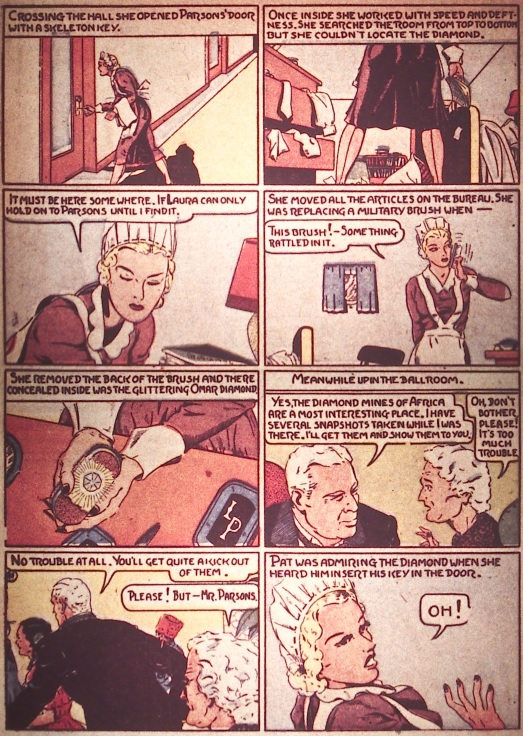
There's no Bruce Nelson on this page of Bruce Nelson, but there are some interesting items here. Skeleton keys always seem to work in comic books, so they must make for great trophy items.

Hollow brushes also make for useful items. Note that our burglar wasn't intentionally searching the brush, but just got lucky on her "notice things" roll.


Bart Regan and Sally are up against spies who have stolen a molecular friction raygun -- which sounds a lot like a fancy name for a heat ray to me. On the bright side, it seems to take a full turn for the friction to build up enough to wreck things or harm anyone, plenty of time for people to, oh, hop out of a car that's been struck. A good threat for 1st level Heroes, maybe.


There's not a lot of Hideouts & Hoodlums content on this page of Cosmo, but I'm really amused that these guys are poultry racketeers. "You're gonna buy your chickens from us, see?" "You buy our poultry at our price, or you'll get your head cracked open like an egg." I can't see statting them anyway special, unless I made a new entry called laughable hoodlum.


There's also a nice Slam Bradley story I'm not going to share here, that starts with a plane crash, includes surviving a blizzard in an igloo, and lots of punching people. Worth noting is that Slam beats up a drunken hoodlum, and that his plane cost $13,000 (Heroes have really been enjoying revealing how much their planes cost/are worth lately).

There's also a short, but pivotal fight where Slam and the unnamed master criminal grapple underwater, trying to drown each other. This would be difficult to play out in H&H, with its 1-minute combat turns. Likely, the combat would be resolved by a single pair of attack rolls before it would be over -- which is actually pretty close to how quickly the fight is resolved in the comic book.

(Scans courtesy of Comic Book Archives)

Friday, October 2, 2015

Detective Comics #13

Crashing never seems to be very dangerous in comic books. Here, fighting Speed Saunders, we see two men plow through a windshield after a crash, and one of them is still up and fighting afterwards. I would probably only roll 1d6 damage for each occupant in a car crash, regardless of how fast the car was going (under most circumstances; perhaps doubled if it was two cars crashing into each other).


Bars are handy places to listen for rumors, or be spotted by hostile wandering encounters.

Speed will reveal on the next page that he's fine because he was wearing a bulletproof vest. Armor keeps you from being "hit" in Hideouts & Hoodlums (as opposed to damage reduction), but that doesn't mean that people might not think you were hit if you time it right and fall forward, like Speed does here.


Remember not to play your cowardly hoodlums too smart. Speed Saunders had nothing on this judge, not even a suspicion he was involved, until this hoodlum blurted it out. Had the hoodlum played it smart, he would have kept his trap shut, got a message to the judge, and asked if the judge could arrange to preside over his case and let him off, in exchange for his silence. In fact, bad guys in comic books are usually pretty dumb!


Stan Asch will go on to do a lot of superhero art in the "future", of which I've never particularly been a fan, but here we see that his true strength was always in gag filler.


Not long after my last observation about car crashes, here we find Larry Steele also walking away from a car crash without a scratch!  It seems that Heroes should get a save vs. missiles to avoid car crash damage, just like dodging bullets.


Book III: Underworld & Metropolis Adventures includes (ends with, really) a short section on vehicular combat rules that makes it very difficult to hit someone else in a speeding vehicle. One could, perhaps, make an argument that it should not be as hard to hit the speeding car itself, or its tires, as common as that type of hit is in car chases.


I'm just going to summarize the Slam Bradley adventure. Slam is having a slow day, so he decides to visit a seedy waterfront saloon dressed to the nines, just to provoke a fight (or maybe he needed just a little more XP to level up!).  The improvised weapons in the fight are a chair and a bottle. Slam and Shorty find a plot hook on a sheet of paper in a wallet that they take after the fight. Winding up on board a ship, Slam is repeatedly clubbed unconscious and winds up in the brig, only to escape and do something else that winds him back up in the brig. This is the kind of stubborn determination that low-level H&H Heroes need -- low hit points means being beat up and imprisoned by bad guys often!

Uh-oh. Slam also demonstrates the ability to pick pockets. Another stunt that has to be available to Fighters!

(Scans courtesy of Comic Book Archives)


Saturday, September 19, 2015

Detective Comics #12

Speed Saunders is in a cross-genre tale here in the Mythic West. But aside from the pretty scenery and racism, the real lesson here is how long a fight can last in a comic book story -- 60 one-minute combat turns.

I thought Hideouts & Hoodlums needed fatigue rules for realism, and to keep combats from going on too long, but I didn't want to overdue it so there's only some minor penalties after too many consecutive turns. Past that, I did nothing with exhaustion, or setting a maximum number of turns you can fight. It looks like I made a good call.


Larry Steele finds out the danger of hanging out with people who have 100' deep pits ending in pools of lime behind their closet doors.  It's the fall that kills, doing 10d6 damage. Lime is dangerous, but not that dangerous; immersion would do maybe 1 point of damage per hour. The lime is clearly there just to remove evidence.


Here, Larry loses control of his car and crashes. Though Book III: Underworld & Metropolis Adventures has some guidelines for vehicular combat, I never wrote anything for car chases, or a mechanic for losing control of a car. My article on plane mishaps (The Trophy Case no. 8) comes closest and some of it might be applicable here, with some creative fudging.


The Slam Bradley story has an interesting twist -- there's a waterfall and no one falls down it!  The trope, of course, is that waterfalls never hurt anyone in stories, but it should.  There's also an interesting chase scene, with running across floating logs. I should think that's a lot tougher to do than it looks in the scene, maybe requiring a save vs. science at a -2 penalty?

(Scans courtesy of Comic Book Archives)

Tuesday, September 8, 2015

Detective Comics #10

Oops!  I had started to review this issue one day, got distracted from the project, and picked up on the next comic book in order. Now I'll have to go back and look again at #10 before doing #11...

How's this for starting with a bang?  Larry Steele is in a shootout, with some interesting things going on here. First, Larry manages to shoot a gun out of someone's hand, which is not supported by the game mechanics for "ordinary" Fighters. So what's going on there? The Editor might be:

A. Using stunts (Disarming Shot), but allowing Fighters to use them.
B. realizing that the gangster is at zero hp, but is using flavor text to shake things up; instead of saying the gangster drops, or something like that, the gangster has been removed from the fight by the loss of his gun (and, perhaps, will drop on the following turn).
C. remembering that The Trophy Case v. 1 no. 5 included optional rules for disarming during unarmed melee combat; the Editor is simply allowing those rules to stand in missile combat as well.
D. implementing a house rule of his own -- perhaps on a natural 20, the player can choose a special result from a hit in combat.

There are some other game mechanics possibly at play here. The obvious one is "misses his mark in the darkness", which could well be because of the hide in shadows ability for humans (the "-2 to be hit in dim light" rule), though it could also be just a situational modifier (since I am 95% sure I'm ditching the hide in shadows bonus in 2nd edition, for reasons shared elsewhere on this blog).

The other possible mechanic here is "driving Larry back," and this could be another example of covering fire, a new rule I just brought up yesterday. Only, then I was talking about covering fire making it too dangerous to move through an area, and this page suggests it would actually drive you back out of an area, which may be too powerful.

Also worth mentioning are the words associated with the bad guys. I've always treated "gangsters" as hoodlums, not knowing how I would stat gangsters differently. Any thoughts out there? "Thug", though, is an extra-tough hoodlum that was statted in Book II: Mobsters & Trophies.

Now, this page of Larry Steele brings up a good point about cars. Cars of the 1930s were things of beauty, and some of my favorite cars of all time, but one thing they were not was aerodynamic. That's why, when the mobsters' car is described as "streamlined", you know it's going to win this chase scene. So, "streamlined car" should be its own type of trophy item, which will always win in a race or chase (all other things being equal) against a regular 1930s/1940s-style car.


Cosmo is in India this issue, acting more like an explorer than a mystery man with a penchant for disguise. This is why Heroes need to travel -- because they aren't likely to find temples carved out of the tops of mountains in their home towns. The temple is a great idea for a hideout, but disappoints here, as the interior seems to be only two rooms big.

Note the wild dogs; I would use either the stats for watchdogs or wolves (both in Book II).


There's that disarming shot again! It's so cliche, maybe everyone should be able to do it?

This was probably Cosmo's most exciting adventure ever, so it's too bad it was wrapped up in just six rushed pages. It's hard to say what happens at the end that lets the villains all conveniently escape. Was that a flare bomb of some kind that blinded everyone long enough for the bad guys to pick up the mummy and flee to a secret door with it? Or maybe some sort of Dimension Door Grenade?

Bruce Nelson serials tend to be really talky, but here's an action page where Bruce grabs a knife thrown at him and throws it back. This should be possible in H&H, probably as a new stunt called Catch Missile Weapons, if Fighters are allowed to use stunts.


Bruce Nelson gives us evidence of two shots per turn, as allowed with automatic weapons in the core rules (and slower missile weapons at higher levels).


This month's installment of Spy shows us that anarchists are good at picking locks, and should get a really good bonus to morale saves, if they have to roll at all.


Buck Marshall, Range Detective, has some good advice on searching for secret things. Rolling a d6 and hoping for luck is one thing, but looking for specific things, like checking to see if the embers in a fire are still warm, will tell you information that requires no roll.

Now, Buck's advice about bolting the door behind you, so you're not disturbed while you're searching, may or may not appeal to players. Some players welcome the chance of wandering encounters while exploring as a ready source for more XP.


Slam Bradley, this month, teaches us that hi-tech weapons don't need to be found just with mad scientists. Here, a crooked boxing manager has an electric raygun, perfect for making murders look like accidental deaths (though taken from a murdered mad scientist, behind the scenes).

(Scans courtesy of Comic Book Archives)