Showing posts with label crashing. Show all posts

Thursday, April 13, 2017

Jumbo Comics #11 - pt. 2

Well, that was a two week, unscheduled vacation from blogging!  Let's see where we left off...

Oh, that's right, in Jumbo Comics!  This is a page from Spencer Steel and, here, we see a car chase going on. I'm still in the early stages of formulating some car chase mechanics in my head which may or may not make it into the 2nd edition basic book, so it's worth saving this example of evasion during a chase. How do the hoodlums turn the corner so fast that Nora misses it? Is evasion a skill, or a chase-based mechanic that would have to be rolled for each turn?

It's also worth pointing out that Spencer and Nora marry before this story, making them the second married couple in comic books after Bart and Sally in Spy.

The driver has hard cover from the car. Because the car has not had time to get up to speed since turning around, there would be no penalty to hit for moving too fast. In a chase, there should always be a chance of a complication, like a crash. Though this is not a chase, as soon as the driver of a vehicle is incapacitated, the vehicle should move straight to crash complication.


The episodic nature of this installment leads me to think it was originally a UK comic strip, or was planned to be released that way.

The idea of placing a deadly gas inside glass vials, and then concealing the vials were they would be easily broken by accident, is a good trap.


Is Nora still a Supporting Cast Member? With her upgrade to married partner, I wonder if a player took over the SCM rather than roll up a new Hero. If Nora is still a SCM, then the Editor should not be using her to give away vital clues; that should fall to the players to find them.


For those not keeping track, Stuart Taylor was just the SCM in The Diary of Dr. Hayward, before being cast back in time and becoming a sort of "Yankee in King Arthur's Court"-type character, only in a generic fantasy version of medieval Europe. That's all the explanation you need to understand how Stuart has mini-grenades, or why he's the only character with a modern name.


Stuart doesn't feel so bold when it comes to five-to-one odds, but he also is Lawful enough not to murder them with a grenade just for doing their job.

The pit trap has the additional wrinkle of a stone slab sliding shut over the opening. Though it might be worse, depending on how thick the cover is, I would have that wreck as if a generator for superheroes trapped beneath it.

The pit trap is further complicated by apparently dropping them into an arena where a lion can be released to attack them. More portcullises block other exits from the arena, including one portcullis blocking a curiously small door.


100 xp for whoever can figure out the real life geographical analogues to this map. Chesterland sounds decidedly English, which would make the Island of Dono a substitute for Ireland. But none of that explains how Mongolia is right next to them.


That's actually not bad strategy -- enter the villains' hideout in disguise, slip them a fake map and plans, and watch them follow it into a trap.  Not bad, ZX-5!

(Scans courtesy of Comic Book Plus.)


Monday, February 20, 2017

Silver Streak Comics #1 - pt. 2

This is Mister Midnite and he's a strange duck. He looks like a Mysteryman, acts like a Mysteryman, but has a ridiculously powerful magic spell -- every night, during the final strokes of midnight, he can choose to stop time. In That Other Game, this would be the 9th level spell Time Stop, but with a very specific limitation. I, frankly, don't know how you would build this Hero with Hideouts & Hoodlums.  You would need a very flexible and accommodating Editor to let your Hero have such a potentially campaign-breaking ability, especially right away in the campaign.

Also note that, despite telling us through the story to this point that Chief Birey has it in for Mister Midnite, he's easily persuaded to cooperate with Mister Midnite on this case. Past encounter reaction failures do not weigh against you in present encounter reaction rolls.

Speaking of Heroes with campaign-unbalancing powers when just at first level -- Red Reeves is just a half-pint, an ordinary boy, until he finds a magic marble that releases a genie, or djinni, to serve him. That's a potent magic item -- unless the marble and the genie are all just flavor text, to explain Red's magic-user abilities.


As if having a genie serving you wasn't enough, the genie gives Red a "wand of power."  There's no wand of power in That Other Game, but there's a Staff of Power, and that's yet another potent magic item. Or, the wand is Red's normal magic wand for casting spells with, as a magic-user, and the genie is then more of a supporting cast member.

Red's first spell is Create Food & Water.

It seems that Red is casting Wish spells, but they can be explained other ways. He casts Enlarge on his dog and then Fly.


This is an odd one -- no spell really matches this one, but it does match the power Raise Building.


Plant Growth.


Teleport.  And then Fly again (unless the duration hadn't ended from the first casting).

Red has to be at least a 9th level magic-user, if he is the one casting all these spells.

A sloop is present in the transportation section of the 2nd ed. H&H rules. It's an expensive item, at $8,000, well beyond what most Heroes have for starting money. So, what is it? The exploding dice option for rolling starting money that I'm introducing makes it hypothetically possible for even a 1st level Hero to start with that much. Or, it could be a house rule where every Hero gets to start with a trophy item of some sort.


Captain Fearless has three sharks advancing on him when a seaplane comes down to save him. Is Lieutenant Dugan a Hero or a Supporting Cast Member? Is this a wandering encounter? And did Dugan roll to hit the shark with his plane? How much damage does hitting a shark with a plane do? I can come up with an easy mechanic for basing damage on speed, but it would get complex if it had to take the mass of the vehicle into account too.

(Scans courtesy of Digital Comic Museum)

Wednesday, February 1, 2017

Amazing Mystery Funnies v. 2 #11 - pt. 1

Well, this story jumps right into the action, doesn't it?  The "electro-robot" (introduced months before Timely's robot Electro) looks to be about 10' tall, making it a huge robot. The narrator claims it has electrified hands, but that makes it odd that it needs the dynamo to attack The Fantom with, then.

That the spear crumbles on contact suggests that the robot is so electrified that ordinary (non-trophy) weapons touching it will shatter.

That the "million volts of electricity crackle above The Fantom" suggests that it missed. Normally, an attack like a lightning bolt would get a saving throw for half damage, not a save to be missed.

When The Fantom says he "won't be able to hold this robot back forever," he means that he's grappling the robot and the robot may, with a lucky dice roll, the robot might eventually escape or even reverse the hold.

Which brings up the question, why doesn't The Fantom just wreck it? He's surely strong enough to. But, in this scenario, this robot doesn't belong to hoodlums; it's someone's legal property and he's trying to stop it without harming it. It certainly makes the scenario more challenging.

Now, why there's a chandelier in a science exhibit hall, is even more questionable...


This is how big the remote control device for a huge robot is.


Narrative voices can often be forgiven for exaggeration, but I wonder if there's more to this one about The Fantom striking with the force of a meteor. It's not likely because he fell 20' or so before hitting the robot, though that would have added to his damage, as indicated in previous posts. Now, he could also have buffed himself with Get Even Tougher, or a similar power, and that would be cumulative with his falling damage bonus. That would be enough to put some serious hurt in a robot!

The robot is using a bear hug, a maneuver possible in 2nd edition's grappling system.

Finally, when all else fails, The Fantom wrecks the robot --- though he seems to have a hard time of it! Unlucky dice rolls? Maybe this robot was hardier than usual?

This is Daredevil Barry Finn, and this is a very combustible car!  Usually, when a crash happens, the Heroes inside only have a small chance of being killed. If there's a chance of complications after a crash, full immolation must be a small percentage chance.


The boys of The Inner Circle have a sound tactic here -- arrange a meeting with the enemy, then have someone else follow the enemy back to their hideout to find out where it is. Just be wary of successful evasion checks!


Here's more good tactics. If you can't find a secret or concealed door, but you know there must be one about -- keep searching! Even come back the next day.

If you don't want to go through the trapdoor at the end of an underground passage to find out where it goes, mark how long it is and then go try to find on a map where that passage would come out at. Warning: in higher level hideouts, expect magical teleport traps and the like!

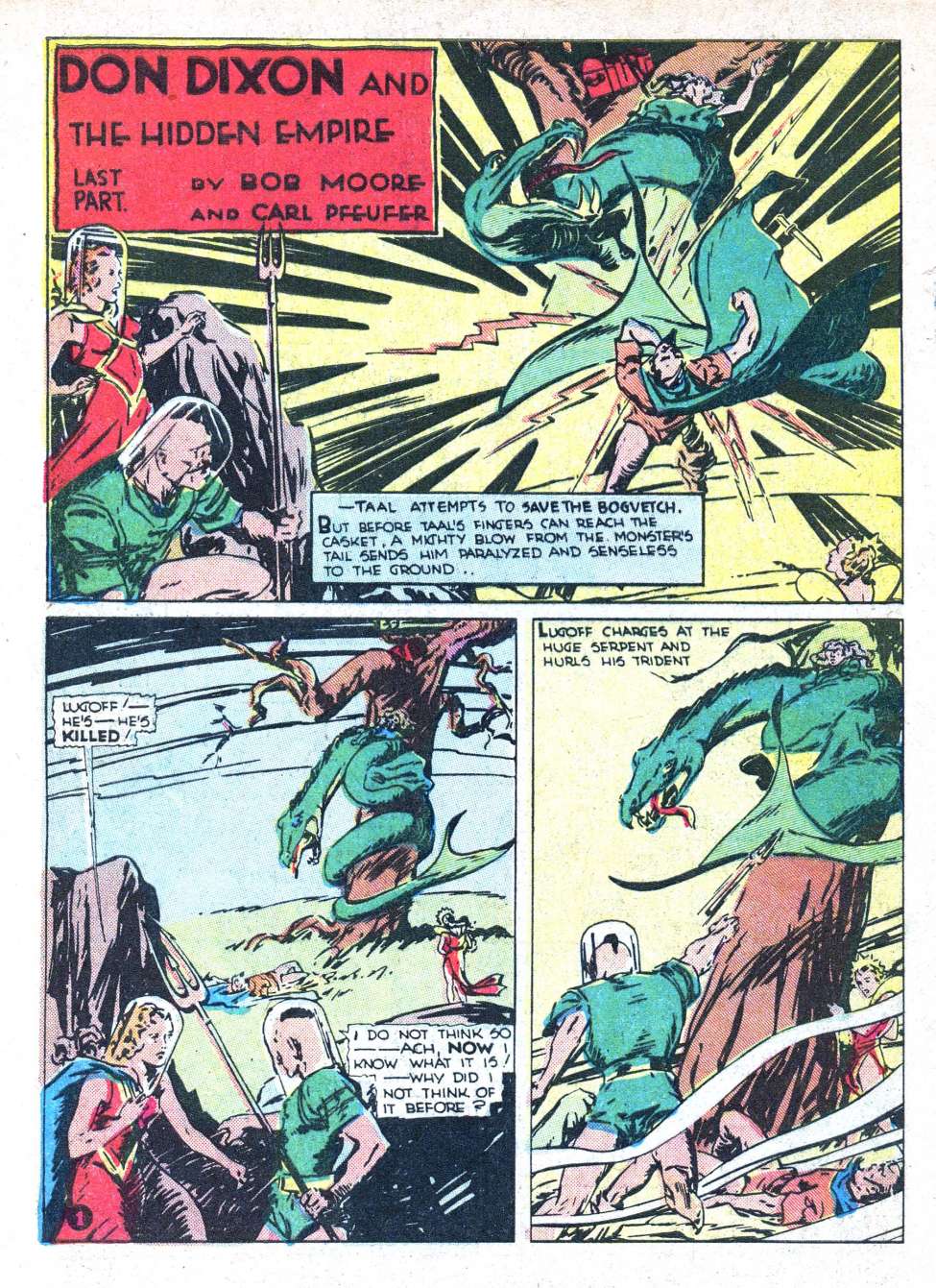
The giant snake with the whale tail is not the bogvetch in this picture, which is a shame because that seems like an appropriately cool name for this creature. It likes to coil around trees and can use its tail smack to paralyze foes.


(Scans courtesy of Comic Book Plus)


Friday, October 2, 2015

Detective Comics #13

Crashing never seems to be very dangerous in comic books. Here, fighting Speed Saunders, we see two men plow through a windshield after a crash, and one of them is still up and fighting afterwards. I would probably only roll 1d6 damage for each occupant in a car crash, regardless of how fast the car was going (under most circumstances; perhaps doubled if it was two cars crashing into each other).


Bars are handy places to listen for rumors, or be spotted by hostile wandering encounters.

Speed will reveal on the next page that he's fine because he was wearing a bulletproof vest. Armor keeps you from being "hit" in Hideouts & Hoodlums (as opposed to damage reduction), but that doesn't mean that people might not think you were hit if you time it right and fall forward, like Speed does here.


Remember not to play your cowardly hoodlums too smart. Speed Saunders had nothing on this judge, not even a suspicion he was involved, until this hoodlum blurted it out. Had the hoodlum played it smart, he would have kept his trap shut, got a message to the judge, and asked if the judge could arrange to preside over his case and let him off, in exchange for his silence. In fact, bad guys in comic books are usually pretty dumb!


Stan Asch will go on to do a lot of superhero art in the "future", of which I've never particularly been a fan, but here we see that his true strength was always in gag filler.


Not long after my last observation about car crashes, here we find Larry Steele also walking away from a car crash without a scratch!  It seems that Heroes should get a save vs. missiles to avoid car crash damage, just like dodging bullets.


Book III: Underworld & Metropolis Adventures includes (ends with, really) a short section on vehicular combat rules that makes it very difficult to hit someone else in a speeding vehicle. One could, perhaps, make an argument that it should not be as hard to hit the speeding car itself, or its tires, as common as that type of hit is in car chases.


I'm just going to summarize the Slam Bradley adventure. Slam is having a slow day, so he decides to visit a seedy waterfront saloon dressed to the nines, just to provoke a fight (or maybe he needed just a little more XP to level up!).  The improvised weapons in the fight are a chair and a bottle. Slam and Shorty find a plot hook on a sheet of paper in a wallet that they take after the fight. Winding up on board a ship, Slam is repeatedly clubbed unconscious and winds up in the brig, only to escape and do something else that winds him back up in the brig. This is the kind of stubborn determination that low-level H&H Heroes need -- low hit points means being beat up and imprisoned by bad guys often!

Uh-oh. Slam also demonstrates the ability to pick pockets. Another stunt that has to be available to Fighters!

(Scans courtesy of Comic Book Archives)