Showing posts with label downtime. Show all posts

Saturday, June 29, 2019

Zip Comics #1 - pt. 4

Moving on, this is Captain Valor. If the art looks above average to you, it's because this is by Mort Meskin, the Jack Kirby before Jack Kirby was Jack Kirby.

Does the writing hold up to the art? Let's consider the stool. A stool is a perfectly good clubbing weapon. Valor could have just handed the stool to Ronnie. Instead he breaks one leg off. He doesn't even break three legs off and pass the weapons around; he tosses the rest of the stool aside. And then he leads with the stool leg, when he's actually holding a gun? He could have taken the first guard prisoner and used him as a hostage.


===

Finding grenades in the saddle bags is a huge lucky break. Too lucky? He blows up at least 15 pursuers with that last grenade (definitely possible, since I had lowered damage and extended blast radius on grenades in 2nd edition), slowing down Ho Tsin's army enough that our Heroes can ride out well ahead of their pursuers.

We don't see much of the chase scene, but losing line-of-sight is an example of an obstacle to overcome during a chase.

I suspect Valor is exaggerating about a million, though in a wilderness setting, numbers encountered could be in the hundreds.

===
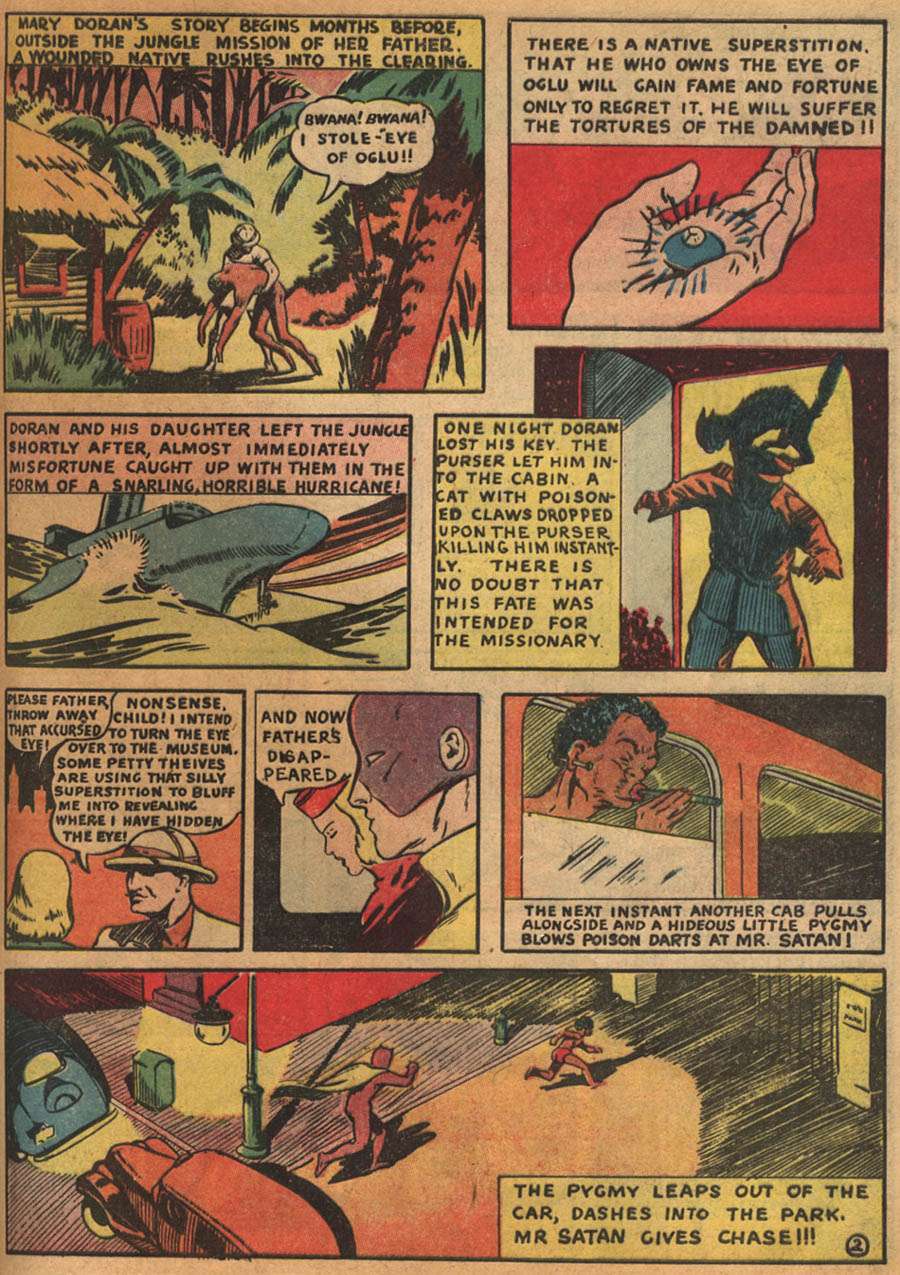
This is Mr. Satan, what would be a pretty standard pulp feature, except that it reaches deep for its inspirations. This page alone evokes both The Moonstone and The Sign of Four.
Now this page strikes me as odd. You'll note that Mr. Satan chokes the guard unconscious, but when more mobsters show up ...they find blood? I'm having trouble even figuring out how that happened, unless the guard hit his head when he went down...?
Mr. Satan appears to be hitting two bad guys at once, but I think we have to account for some time compression in that panel and he's hitting them on separate turns.

Is it relevant that Dudley Bradshaw likes to go to the gym? It is, because it speaks to what Heroes do in their downtime. Should it have some game mechanic benefit if you go to the gym? Probably not...but if enough game time passed and a fighter or mysteryman had not been to the gym, I might be willing to assign a temporary penalty to attack rolls...


Lastly, this is Zatara -- oops, no it's not, but a clumsy imitation Zatara named Zambini the Magician. Here we see Zambini can cast Snake Charm and, I'm guessing, Hypnotic Pattern (though we never see a pattern, just its effects).

We also see him using his "wand" -- a boomerang amulet -- to cast spells. The boomerang aspect is a bit forced.

Thank goodness he doesn't say "I'll rub my boomerang amulet and find out who sent the snake!" from in bed.
Here Zambini seems to be casting the spell Fumble.

Some of his spells -- but not all of them -- require command words. They look like they say something backwards, like Zatara's spellcasting, but they don't.

And then he casts Reduce Person...
...and, presumedly, Charm Person, so the spy chief will serve him.

Mass Polymorph is going to be a tough spell on this game; it seems fairly common, but it should be a high-level spell for what it can do. Normally I would say, okay, let's make a weaker version with just a very short duration, but these guys stay pigeons long enough to coat a statue. This would be an 8th level spell, meaning Zambini has a whopping 15 brevet ranks.

Or, he used his already cast Hypnotic Pattern to make them think they were pigeons, then used Charm Animal to make two real pigeons do what he made the two men think they were doing. Convoluted, yes, but more feasible in a balanced campaign world.
The Basic book made it clearer than 1st edition Hideouts & Hoodlums did that magic-users needed to be limited by something -- either verbal, somatic, or material components. Zambini has a unique weakness -- human contact. That may seem pretty rough, but essentially, someone's touch could do the same for the first three examples -- covering the mouth during verbal components, swatting the fingers out of alignment on somatic components, or batting the material components to the floor. And grappling always halts spellcasting, though I did not clarify this enough in the rules.
The last spell is actually a power, Turn Gun on Bad Guy. I think this is the second time I've seen this, so there does need to be a spell.

Incidentally, the countries here are "Ritania" and "Hundanian," clearly meant to be European countries. Hundanian must be a stand-in for Germany, though Ritania is less clear -- Germany had so many enemies by 1940!

Saving a king and getting knighted are high honors for a rookie Hero. I would personally have waited longer and built up to this.

(Scans courtesy of Comic Book Plus.)

Wednesday, August 15, 2018

Wonderworld Comics #9 - pt. 1

Our return to Fox begins with The Flame and something that I would never let players do at the beginning of a scenario -- locking themselves in a laboratory and trying to invent the most powerful explosive ever. Come on, this is game night! Try the scenario and leave this for downtime. You've got cool superpowers at your disposal (I even let you have all those brevet ranks; see previous posts about the Flame); try using those.

Not a map, per se, but an interesting cut-away of the interior of a submarine. Submarine design is very linear, making for a pretty boring hideout to explore.


Teleport through Focus is a great, high-level power for getting the Hero straight to the trouble, without having to do any slow investigation first. Maybe I'm not an expert on torpedo strikes, but I don't think they set fires in most cases -- seeing as how they punch holes into ships that quickly fill up with water. I wonder if there should be something like a 1 in 6 chance of vehicles sustaining damage catching on fire.

Now this is interesting...apparently the Flame isn't just immune to fire, but can interact with fire like it was a solid object. This is flavor text for the spell Water Walking.

Sometimes I wonder if I should just put all powers and spells in the same pool and let players pick from both...but then, some powers are very un-spell-like (the Get Tough, Raise, and "Race the" powers, for examples). Maybe there needs to be a rule for researching ways to transfer a spell into a power, and vice versa.

This can happen in Hideouts & Hoodlums. Superheroes are deliberately not good at fighting without buffing themselves with offensive and/or defensive powers, so if you want your power slots for other things, nine low-level fighters could conceivably take out a mid-level superhero just by doing enough damage.

Interestingly, steam is harmful to the Flame, even though fire and, presumedly, heat is not as well.

The Flame uses his explosive to blow up the hideout, which is also odd because usually hideouts blow up on their own just as the Hero is escaping.

Our villain, Doyoff (not a real name), reminds us that it pays to have more than one escape route.


And we're on to Yarko the Great, here reading a lot like that early Superman story of the con man posing as Superman. Like that story, these con men have no special abilities and are so generic as to be practically mobstertype-less. We do learn, however, that $300 watches were a thing in 1940.

This is a really curious Yarko story. After fighting vampires, the Devil, and Death itself, Yarko seems content to use his ventriloquism spells to play pranks on the con men -- even though they may have shot and killed a woman (though that scene seems out of place and really out of character for them). So far, Yarko hasn't cast a single spell.


Now we get into the spell-casting! First there's Hold Person, and then Yarko...well, he casts some kind of spell that summons stolen items and makes them float in the air in front of him. Maybe something called Thief's Bane? But it would have to be a 5th or 6th level spell, being a combination of Locate Object (for multiple objects) and Telekinesis.

Also note that, because fire extinguishers were not common yet, the theater has a fire bucket on the wall by Yarko.

(Scans courtesy of Digital Comic Museum.)


Sunday, March 13, 2016

Detective Comics #22

The Crimson Avenger makes a very rare cover appearance here.

So far, in my experience running Hideouts & Hoodlums, not too many players put any effort into concealing their other identities. And while it's true that maintaining a secret identity can be a liability during an adventure, it at least seems like it could be a fun thing to roleplay about during downtime.

Since Slam Bradley's adventure is "The Return of Fui Onyui", this might be a good time to talk about racism in Golden Age comic books again. I like to think that I'm pretty good at understanding historical racism in context and not be offended by it -- but even I can't stand the insult names many Chinese characters got. Maybe if you think of them as codenames, intentionally chosen by Chinese agents out of a sense of irony, it could be palatable.

The other way to combat the racist elements, while not leaving them entirely out of your game, is to make sure there is equal representation of good guys to bad from each minority group. This Slam Bradley story does that, teaming Slam up with good guy Yat Sin to battle Fui Onyui.

One more point to consider here is that Fui Onyui is a returning villain -- the first ever in a non-serialized comic book adventure. When Jerry Siegel referenced a story from 21 issues earlier, it was a huge leap of faith that his readership extended back that far -- but in doing so he invented comic book continuity.

I have almost never used returning villains, so far, in H&H (and my one exception only occurred in a sub-plot). For one thing, H&H players I've gamed with tend to be brutal dispensers of justice and leave little room for returning villains. But further than that... while familiar characters are fun to see in comic books, I fear there is a lessening of dramatic impact every time you see a villain return, when the Heroes already know they can beat him because they have before. I'll be testing this theory in my Justice Society campaign later, when they start running into recurring villains, like Brain Wave...

Slam buys a three-cent newspaper and drives a red convertible 100 MPH to try to find out if Shorty is okay. He has a make-up kit in his apartment, which is in an eight-story building.

Slam busts a locked door in with just his shoulder. Do fighters need a chance to wreck things, limited to doors only?

Slam is attacked by assassins, which may become a mobster type. Assassins seem to prefer attacking from the rear and have a chance to sneak up on people stealthily from behind.

Fui Onyui uses a chemical that induces suspended animation ("the living death") in Shorty.

Incidentally, the dentist office behind Slam at the beginning of this story is a Dr. Siegel.

Larry Steele is on one of those adventures where he has to seek shelter in a spooky old house from a storm -- but with the further incentive that the road ahead of him is washed out, so he can't reach his destination. The house has no electricity and the owner sees by candlelight. There are bats living upstairs and this one dark staircase ends at a pit trap. There is a laboratory with two entrances and volatile chemicals inside that can blow up the whole room (but not the whole house). A mad scientist and three madmen (new mobster type?) lurk in the house, though after an hour the madmen turn on the scientist and kill him. In the cellar is a locked cell with the scientist's pretty niece locked in it.

In The Crimson Avenger, Lee Travis deals with the issue of protecting secret identities and hits on what seems like a pretty good idea: offer a $5,000 reward for information on your own secret identity so that, if anyone is getting close to learning who you are, they might come forward. Of course, you're also incentivizing people to try to figure it out, so there's trade-offs there. When everyone thinks the D.A. has information on The Crimson, the mob shows up to lay claim to it.

Bruce Nelson solves a murder mystery where the murder weapon is poisoned throat spray. Instead of a random onset time, this poison always takes effect during the same time during a play.

(Read at ReadComics.net)

Friday, September 25, 2015

Feature Funnies #6

Quality's Feature Funnies didn't tend to have much in the way of adventure-themed strips, so I don't always have things to share from this title.  Likewise, I often don't have a reason to share Joe Palooka, even though I'm a big fan.  At least I had the excuse of reminding players that hot dogs only used to cost 5 cents this time.


While, on the far side of prices, Lala Palooza tells us that a sable fur coat could be worth as much as $20,000. That's a LOT of XP to the Hero who finds that stolen coat -- better institute xp caps -- never part of the official 1st ed. rules, but suggested in TTC -- to prevent multi-leveling.


The last gag falls flat, but the rest of this page could be the best gag filler I've read so far in this project!


Note that the Clock's records archives goes back at least nine years. What's in those archives? Probably copies of every record he had access to while a practicing district attorney, or maybe even a newspaper clipping archive of noteworthy stories, or both. Should Heroes in Hideouts & Hoodlums be allowed to start with a research archive?

I would be inclined to say no. This could be a findable item, perhaps, or something the Heroes could build in their downtime. Or, they could just go to the public library, or their city clerk's office, as these give them more opportunities to interact with potential Supporting Cast Members.

Speaking of findable items, a trick cane like this one should be a trophy item. It got mentioned in the Clock entry for Supplement IV: Captains, Magicians, and Incredible Men, but probably needs more description, like a range (20'?). It's clearly a one-shot item, with a chance to reload.


Dixie Dugan tells us that you can buy a dress for as cheap as $4.95 in 1937, but if you spend less than $20, you're going to have problems with the fabric...


(Scans courtesy of Digital Comic Museum)