Showing posts with label poison. Show all posts

Monday, March 28, 2022

Rocket Comics #2 - pt. 4

I probably shouldn't be as impressed as I am with the adventures of Buzzard Barnes, and maybe I'm reading too much into things here, but as Barnes and Andy argue over who has the most kills, it reminds me of Legolas and Gimli. In addition, we get to see some of the things you can do during aerial combat, including setting each other's planes on fire, and shooting copilots.


Now this also intrigues me, probably being the first instance of a record being played backwards in a comic book.


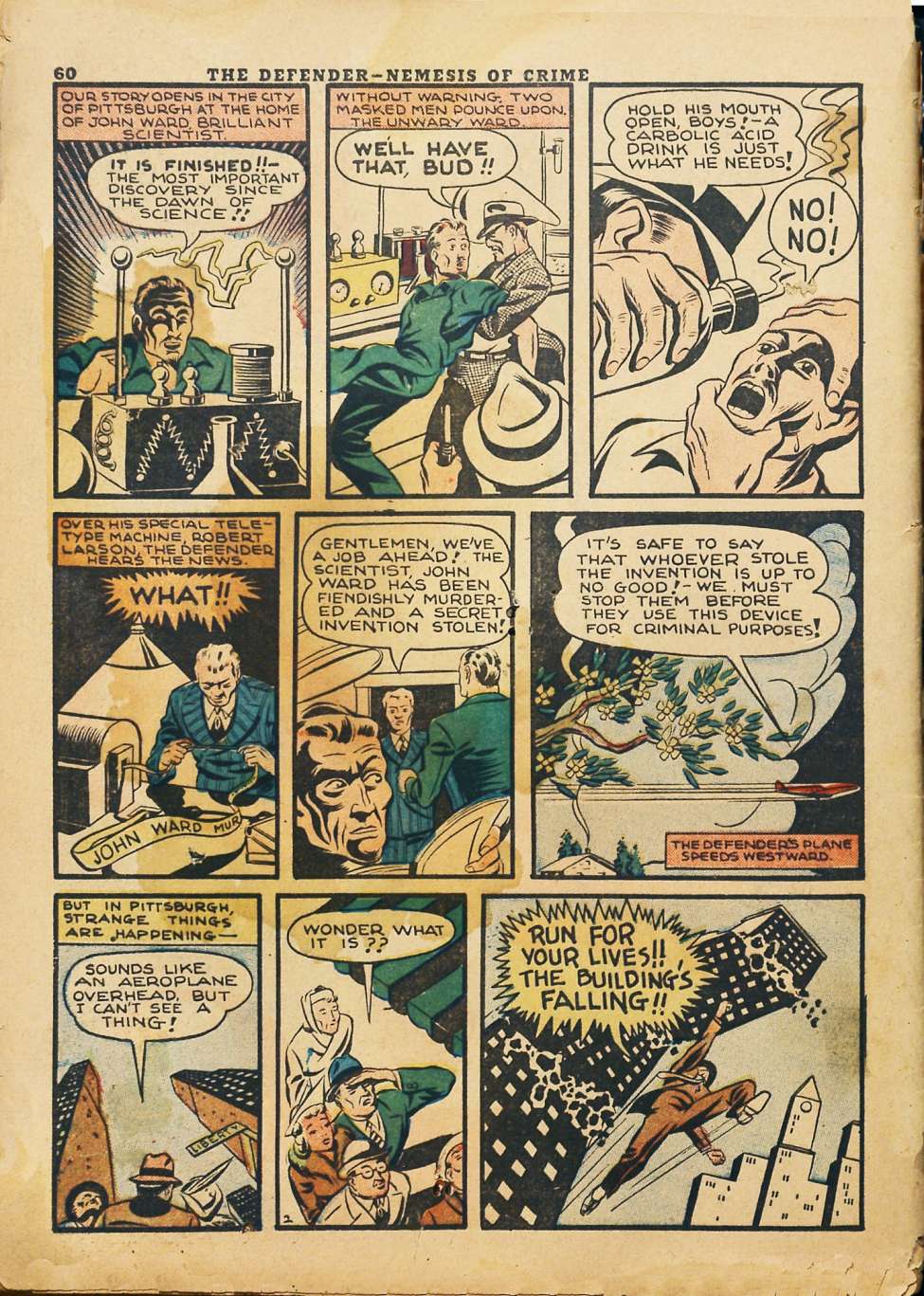
I could tell Jack Cole's The Defender is a blatant ripoff of the pulp novel hero, The Avenger, but an even more knowledgeable fan on Comic Book Plus tells us that this story specifically plagiarizes the third Avenger pulp novel, "The Sky Walker." 

Pittsburgh is an unusual setting for a comic book story and might actually be its first appearance in one. 

Drinking carbolic acid is more of a save or die situation rather than doing points of damage - though I could see it still doing damage even if the saving throw vs. poison is made.

The first invisible plane in comics? I'm not sure about that...might have to go back through the blog to check.

It seems like the Defender is kinda' reaching here...wouldn't it be more likely that Peerless Steel just makes inferior product, than the conspiracy theory that Supex Steel is using a stolen ray from an invisible plane to damage any steel that's not theirs? Well, this is comic books, so...


Here's another mad science invention for your Hideouts & Hoodlums campaigns: a sound detector that can follow specific vibrations over a distance of miles, hours later (as unlikely as that seems). 

You'd think inventing a bulletproof airplane might have been a better use of his time...


I get why it was done this way, for story, so it would look like the villains were getting away, but I hope not too many H&H players will plant time bombs in enemy planes, rather than capturing the villains and turning them over to the police with evidence. Although, on second thought, this strategy keeps me from having to give out trophy planes to my players...

(Scans courtesy of Comic Book Plus.)


Tuesday, December 1, 2020

Slam-Bang Comics #1 - pt. 3

Hello! We're back, still looking at the Lucky Lawton feature. We could talk about the oddly rectangular word balloons (the very next page goes back to rounded corners), or the terrible coloring job on this page, but I'm going to focus on the "no guns" law, which was actually quite common in the "Old West," and is something we badly need more of today. Personally, I would like to run a "no guns" H&H campaign, but I know that wouldn't emulate the comics well.


If you've followed this blog long enough, you've probably seen plenty of examples where the artist just seems to be guessing what an animal looks like without using a reference. The artist here is Hal Sharp, and I have a feeling Hal owned a dog; Pal is in real dog poses every time we see him.

Lucky does the smart thing, circling the perimeter instead of barging right into the bank. 

Also note how not going solo gives Lucky twice the chance to detect the activity in the bank that he would have had walking along alone.


There are two ways to achieve Lucky's noiselessness. One, he can make a skill check to move silently. The other is that he trust to his surprise roll and, if successful, means he must have been moving silently. Since chance of surprise is normally 2 in 6, it seems like that would be easier for most Heroes (unless Lucky is a mysteryman using a stunt, but I doubt it). 

Combat in the dark adds a greater level of challenge, what with the -4 penalties to hit. Just by not flipping the lights on, every unarmored combatant is now effectively at AC 5. Now, from the panel art it appears that there is plenty of light coming in through those front windows, making the scene only dimly lit, but this could just be artistic license so we can see more than five black panels with word balloons in them.

And yet, in this scene, the bandits are silhouetted in front of the windows, so it wasn't really that dark after all? And the remaining band sees Lucky in the darkness now? To emulate this scene, we need a new mechanic for eyes adjusting to darkness after a certain, or maybe random, number of combat turns. 

Although the rest of this story is seemingly set in the Old West, the remaining bandit's hat looks suspiciously modern.

The bad coloring job on the lower half of this page might be fooling me, but it appears that the rancher is wearing his bandana up over his mouth. I only mention it because I see so many people wearing their masks wrong like that these days...


There aren't game mechanics on display here, but I like how Lee is a scientist/explorer. Both were classes in Hideouts & Hoodlums 1st edition, and while both classes did get playtested in my campaigns, no one ever thought to combine those two.

My initial reaction was that having the slavers be Arabs was racist, but while there have been many white slavers through history, there was a strong tradition of slavery in the Middle East, with several countries not outlawing it until 1970. Also in the writer's favor, Ali and Hassan are real Arabic names, and not gibberish names meant to sound Arabic (I know, some golden age writers set the bar really low!).

Wow, we're in pure fantasy territory at this point. First, there's no way a plane explodes, and someone sitting in that plane falls from that wreckage completely unharmed. This should be a save for half damage situation at best. 

Then, there's no way someone's coat would be big enough to create enough wind drag necessary to cushion his fall, so there's more damage Lee should have taken by now. I think we're looking at the tune of 55d6 damage at this point - and that's assuming the plane was at a near dangerously low altitude for flying.

As unlikely it is that all the spear attacks Lee left himself open to while charging the pygmies missed, it is even more impossible for him, game mechanically, to push the leader onto a spear, unless the Editor was house ruling a fumble mechanic. More likely, this is just a freebie from the Editor.
Neutralizing poison is really easy in Lee's world. All you have to do is stick someone with a knife and the poison leaks right out of you! If I was willing to implement this as a new rule (and I'm not), for every point of damage you do to the wound, you would give the recipient a new saving throw. 


The pygmies are very patient in indulging Lee's rampant passive-aggressive racism. "Uh...ever heard of donkeys? The domestication of donkeys started in Africa. And we know what iron is, iron smelting and forging technologies were discovered in Nigeria as early as the 6th century BC. Bricks too, since about 7,000 BC. And just what are you whittling? A giant banjo?"


I am so torn on this page. On one hand, I think it's great that, for once, a lion shows up in a story and the Hero wants to capture it alive instead of stabbing it to death, or snapping its jaws, or shooting it. But that he wants it so he can perform experiments on its brain doesn't sit well with me, even though I get that the author is trying to offer a scientific explanation for how the jungle Hero is able to talk to animals. 

(Scans courtesy of Digital Comic Museum.)


Friday, January 24, 2020

Flash Comics #3 - pt. 2

Continuing where I left off...

Hawkman's (or Hawk-Man's) friend is "killed" by Una Cathay, a female mad scientist/magic-user, a very unusual combination in the Golden Age, when most women aren't shown as being scientific-minded. The story is (get ready for spoilers later): she has come up with an interesting spin on raising the dead; her chemical potions can resurrect dead people, but to stay alive they have to remain mostly immersed in the chemical bath. She has a collection of revivified men floating in water tanks, a spin on the "brains in jars" trope. Oh, and she can work "Voodoo" spells. If she ties her hair to someone, she can make him take burning damage even at long range (not sure what to call this spell...Voodoo Fire?).

Hawk-Man does not yet have much of a reputation as a good guy; he is able to easily fool the scientist and a Russian spy working with her (actually identified as Russian and not given a fake country) into thinking he wants to throw in with them. But she decides to kill him anyway, with the aforementioned voodoo spell. Typical of the genre, the spy is an aristocrat (or at least calls himself a count).

Somehow, when Hawk-Man goes home to pick up some throwing daggers, Shiera is there, immediately spots a long woman's hair wrapped around his wrist from across the room, and instead of jumping to the conclusion that Carter is seeing another woman, she jumps to the weirder conclusion that someone cast Voodoo Fire on him. Could that be an expert skill check in arcane lore?

The twist to the story -- as too often happens -- is that there's less supernatural or super-sciency going on than it appeared; Una was poisoning people with something that put them into comas and pretended they were dead.

Hawk-Man confronts the villains after freeing the prisoners and pins the spy's hand to the wall with a dagger, but the dagger really just disarms the spy (it was his gun hand) and the pinning is quickly forgotten flavor text.

Una escapes from Hawk-Man by using a secret door that he appears to be unable to bust through. Does that suggest that secret doors should be harder to wreck than normal doors, or is Hawk-Man only concerned that wrecking the door will take too long and Una will get away?

When the spy falls out a window, Hawk-Man makes no effort to save him.

For the first time in any medium, I've now seen a thrown dagger puncture a tire and make a car crash. Also unusual for the car crash trope, the villain actually dies in the crash, Una suffering a broken neck (and Hawk-Man even checks the body to make sure she's really dead!).

Next up is Johnny Thunderbolt, or Johnny Thunder as we know him! Training to be a boxer, Johnny has gotten ripped since last issue.

"Pile of jack" is slang for "lot of money" in this story. Johnny also uses the term "slop up" to mean "go out for a drink" (though this is Johnny, so he means a chocolate malt, not booze). There is a topical reference to Glenn Cunningham. According to Wikipedia, Glenn Vernice Cunningham was an American middle-distance runner, who was considered as the greatest American miler of all time. He received the James E. Sullivan Award as the top amateur athlete in the United States in 1933.

When Johnny tells bullets to go back where they came from, he activates what appears to be the Turn Gun on Bad Guy power. Since Johnny is a magic-user, that means we need a Missile Reflection spell too.

Johnny is, at least briefly, heavyweight champion of the world. We still haven't seen a physical manifestation of his thunderbolt-genie yet.

Next we're treated to a reprint of Rod Rian of the Sky Police. The Mephisians use a giant raygun (one of those that looks a lot like the dome of a planetarium) to pull Rod out of the sky using a combination of magnetism and gravity, or what we now call in science fiction a tractor beam. In a convenient moment of charity, the Mephisian leader (who's name also happens to be Mephistos) not only spares Rod from being shot and decides to strand him and the other prisoners on The Island of the Living Dead, but also is sporting enough to arm them first. I guess Mephistos isn't such a bad guy after all! On the island we haven't seen the living dead yet, but we get to see the chasm beast! We haven't seen this guy since Dell's The Comics #10!

(Read at readcomiconline.to)


Thursday, July 11, 2019

Fight Comics #2 - pt. 1

Ah, George Tuska...how much better I like his 1970s work. With Young George, you can almost see the Eisner influence there, but the figures are so stiff in almost every panel...

There is no Lolaii Island, but from the spelling it seems clearly a stand-in for a Hawaiian island.
Popeye's love for spinach, clearly the reference here, goes all the way back to 1932.
A rare use of "birds," sometimes used for crackpots and oddballs, but here sarcastically used for obviously bad people.

Manoa is not an island, but a valley on the island of Oahu, near Honolulu. Now, it would make more sense for this story to start near a major city like Honolulu, and move away from there to a more isolated island, but apparently these were lazy pirates.

Oahu does have coves, like the map does, which makes it even likelier to be the location.


I'm a bit surprised that both Shark and the girl are so eager to shoot the whipper while Daddy is right on the other side of him. I mean, it almost makes sense for Shark because he has no personal stake in this, in case he misses and hits Daddy, but the daughter too? She must be really confident...
Since Shark would still be a 1st-level fighter (beat cop), being beaten by four-to-one odds seems, statistically, extremely likely.
Now, Shark could have rushed Skinny at any time, except that he clearly missed his save vs. plot and had to fight his way through the underlings first.

Koa is the Hawaiian word for warrior.
Pre-modern Hawaiian hunters used bows, but Hawaiian soldiers used slings. Of course, this is 1940, so they'd actually be wearing modern clothes and carrying guns in real life.
I can find no evidence that Hawaiian soldiers ever used poison.
Shared for the prize purse after five months of professional fighting, which is good news for Heroes who want some side money between adventures.

(Scans courtesy of Digital Comic Museum.)

Friday, May 10, 2019

Tip Top Comics #42, 46

We'll start again with Hawkshaw the Detective, not because I believe that you could really use a magnet to detect a concealed sword cane (or at least no ordinary-sized magnet), but because this is the first time I've ever seen "corporation" used as a slang term for a fat stomach (apparently that's a real thing).
 Is $15 reasonable for a watchdog in 1940, or is it a bargain?
I think I can relate to Phil Fumble. Maybe not literally, but I've had days that felt like this.

Anyway, it's interesting to see the number of threats you can encounter in a farm setting, from runaway pigs, biting geese, charging bulls, terrorizing hawks, swarming bees, racing dogs, and butting goats. Of them, pigs, bulls, dogs, and goats are statted for the game. I really don't think a goose, a hawk, or a bunch of bees is enough of a threat for Heroes.
This is the first new feature in Tip Top Comics since I started reading these! We know Hal Forrest from Tailspin Tommy, another aviator strip that wasn't very good. I suspect he got so much work in comics because his name was so close to Hal Foster, the legend behind the Prince Valiant comic strip.

Anyway, here we learn that the license number for planes (like VINs on cars) are hidden on the underside of wings and you can check with the Dept. of Commerce to find out who owns them (actually, I think we learned at least most of this from another strip before; I just don't remember the numbers being on the wings).
Two points here: one, if I'm really serious about making half-pints an official H&H Hero race, I need to think about setting more strict encumbrance restrictions on them than for full-grown adults. What's a good weight limit for a 10 year old? 50 lbs.?

And the other issue is the very real issue of child labor that I keep seeing in these strips (I almost brought this up earlier this week, with evidence from another strip). It seems like any unsavory character could get away with charging a kid just $1-2 a week.
I'm even more concerned about this short strip, and the cheap availability of poison in 1940. It might tempt players to go out and buy 50 cents worth of rat poison if it can make hoodlums sick, but this seems very un-Heroic behavior to me and should trigger a save vs. plot to carry out.
And, lastly, Ella Cinders teaches us that balcony seats are just 40 cents. And the robber shows us an uncommon stick-up method (I feel like I've seen that in a movie before, but I can't remember which!).

And that's it! I am done with Tip Top Comics for quite some time!  Woo! Next time, we go back to More Fun Comics and the debut of the Spectre!

(Scans courtesy of Comic Book Plus.)

Saturday, April 6, 2019

Popular Comics #48 - pt. 3

The sports genre doesn't get a lot of attention on this blog, and Wally Williams gets even less (in fact, debuting here on the blog), but this story deserves special attention. Instead of the college kids fending for themselves, they unrealistically approach Wally's grandpa and ask him for help.

How old is Gramps? Gramps claims to have worked with Mark Twain, which may sound off, but Samuel Clemens died in 1910. Someone who was 18 in 1910 would be only 48 now in 1940. This bears in keeping in mind, when considering who your Heroes might have known in their backstories...
And Gramps actually has some good ideas. This underground newspaper is a sort of pre-Internet crowdsourcing for crime prevention.
I'm not sure if $10 is a reasonable rental price for a wagon and two horses in 1940, but it is for at least this old geezer.

This page raises other questions. Can a pea shooter/slingshot launch a dart? How great an effect would a small dose of carbolic acid have on an elephant?  If a person drank carbolic acid, it would cause acute gastroenteritis (inflammation of the stomach and intestines), leading to vomiting, collapse and death -- but only on a failed saving throw.

This is where game mechanics surrounding poison kind of break down in the game. The effects described always assume human mass; not only should increased Hit Dice allow mobsters to shake off the effects of poison, but should lessen the effect of poison when it does take effect. But how to adjudicate that?

I share this page so we could talk about movement rates. Can a charging elephant really overtake horses pulling a wagon? There are a lot of unknowns here, like how much weight the wagon is loaded down with, but generally speaking - an elephant runs up to 16-25 MPH. How this translates into movement rate is that an elephant would have a Move of 21, but with a skill check can manage a burst of speed that raises it to 24 (both for convenience and because of precedent, movement rates are rounded off to the nearest divisible of 3).

A horse can run up to 30 MPH; if we assume that the wagon halves their movement, that brings us down to 15. So, yes, even if the horses make their skill checks and the elephant fails its check, the elephant would still win. Of course, if the wagon was very light, this might not be the case.

(Scans courtesy of Digital Comic Museum.)


Thursday, March 14, 2019

Champion Comics #4 - pt. 3

This is from Blazing Scarab and...what's this? An immortal league of assassins? How can this not be where the idea for Batman nemesis Ra's al-Ghul came from?

The immortal city of Baracs, full of immortal assassins, is just begging for a Hideouts & Hoodlums adventure module. Who's going to volunteer to write it for me?

I'm also curious about this condition where, if they lose their heart or their brain, they live on, but lost their "identity" (all levels in their class/es lost?), and become only half-visible.
Here's an interesting description of how the magic portal to Baracs works, and why humans (and human-like races, I suppose) are the only ones who can cross through the portal.
This is Jungleman, who has a ridiculously large army of animals working for him, but what really gets me is that crazy spelling of orangutan. Orang-outang? Did someone not have a dictionary handy, or was the spelling that non-standardized by 1940?
A rare instance of a Hero using a blowgun as a weapon. The implication seems to be that the dart is poisoned, but we're never actually told that. Maybe he's just trying to distract the chief?
I'm amused that Louise immediately thanks Jungleman, but look how hard those monkeys have to work to take down the pygmies! And without knives, no less!

The death toll of animals in this feature is pretty staggering. Tigers, snakes -- they all bite it trying to protect Jungleman.

"Monkey-like people" seems to stink of racism a bit. I hope the gibbon men in H&H don't have the same odor...
This is Revenge of the Zombies. We're treated to a pretty standard pit trap (nice that there's a ladder at the bottom!), and an adventuring party that wisely puts their best fighters in the lead, the light source in the second rank, and keep to their marching order.
Giant death head moths are now definitely going into the AH&H Mobster Manual. I guess under D? They'll probably have only 1 hit point, and can only drain 1 hp, but when encountered by dozens or a hundred at a time, would be quite deadly.

(Scans courtesy of Digital Comic Museum.)

Tuesday, January 29, 2019

Jumbo Comics #12 - pt. 4

We're still on Spencer Steel. That firefight in panels 6-7 is pretty crazy; does no one think about using cover?

Where was the secret door? Was it really necessary for Brudd to go out a secret door rather than a regular door?

Here's another example of throwing yourself into the way of a bullet.  I'm still leery about making this a game mechanic, as there's so much opportunity for meta-gamers to abuse. At most, I would give the original target a -2 AC bonus (as if having hard cover), and if within only 4 numbers of missing, it hits the new target.


That has to be the easiest trap ever. They're left alone in the basement where they can easily get to each other's tied hands? And there's a door out, but it's boarded up on this side with them?
There is no stat difference between a dog and a vicious dog, though one could say a vicious dog will never give you a positive or friendly encounter reaction result.

Yikes. More animals dying? I find it very unlikely that throwing it against a wall would kill a dog, though maybe it would knock him unconscious.

Where was the secret door? The bright yellow, boarded-up door?
It's a little surprising how seldom sewers are used as hideouts in these early stories. They're underground, maze-like in nature, and accessible from many manhole covers.
This is Inspector Dayton. We learn how poison can be administered on a knitting instrument that most non-knitters would not recognize as a sharp object.
Patch is a bottomless font of information. Just look at those sentences spill out of his mouth! Sure, Editor, you could tease out clues in small doses through the mouths of many non-Hero characters over the course of an entire play session, or you could just have Patch stroll in and provide a big info dump in their laps.

(Scans courtesy of Digital Comic Museum.)