Showing posts with label new stunts. Show all posts

Thursday, December 20, 2018

Whiz Comics #2 - pt. 2

Ibis the Invincible is not acting like a 1st-level magic-user here. Create Underpass doesn't seem like a spell that needs to exist, but perhaps a 4th-level Dig spell would explain that.

We learn how much sailing from Manhattan to Cairo cost back then.

Again, I'm skeptical about the need for a Create Money spell (though maybe Fool's Gold could be modified for this). Also, since Ibis would not yet have encountered American money, it seems unlikely he would have known how to make the right kind of money, and makes for a pretty convincing case that this is another illusion that makes you see what you want to see (I had suggested last time that Ibis used an Improved Disguise spell that makes him appear to be wearing what others want to see him wearing).
Create Cottage does have some precedent, lying somewhere between Leomund's Tiny Hut and Mordenkainen's Magnificent Mansion, making this likely a 5th level spell -- but only if temporary. If permanent, this has to be a Wish, and a 9th level spell!

Create Bridge could actually be a spell with a lot of uses, and if it had a short enough duration I could see that maybe being only a 2nd level spell.
Here is a spell version of the power Turn Gun on Bad Guy - maybe called Missile Turning?

Excellent commentary on world affairs, circa 1940.
Wow, okay, this is Protection from Normal Missiles...but instead of 15' Radius, it's extended to 1 mile Radius. And then there's Restore City, a spell that has got to be Wish-level power.

I did have a conversation here in the comments section (an actual conversation with a reader!) recently about the issue of if Hideouts & Hoodlums emulated the power-level of golden age comic book characters well enough. I would use this page as a prime example for my answer: yes it does, as far as I would wish it to emulate those comic books. Because, really, stopping an enemy bombardment in one turn and then reversing all its damage in the next turn -- how do you build a challenging and entertaining scenario when they can all be resolved this quickly and easily?
Moving right along, this is the origin story of Golden Arrow. You only get part of it on this page, and it's interesting how often his story seems to go in a Mowgli-in-the-Wild-West direction and then surprise detours.

This page is still early in the origin story, so I'm not sure what to make of these last two panels, or if I should make anything out of them. Being able to wrestle a bear cub at the age of 5 or catch an antelope at age 7 seem relatively superhuman. It also suggests to me that half-pints be able to have classes like mysteryman or even superhero. I have toyed with the notion in the past of treating half-pints as a separate race.

I'm not entirely sure yet how I would make them a separate race (I mean, obviously they aren't ever going to literally be a separate race, but to separate them out from normal humans game mechanics-wise). It would make sense to take away the free Supporting Cast Member (unless the SCM was a parent). It seems like half-pints would do half damage, but others would have to save vs. plot to harm them. Anyway, it all needs more thought.

This would be a world record for a horse jump (it currently stands at 8'). So, if I did bring back the cowboy class (and I'm not saying I am yet), one thing that would distinguish them is that they could not only push themselves past normal limits with stunts, but they can push their mounts too.


That is one beautifully aimed arrow, but it does create a problem for me. When I revised the mysteryman class, I limited stunts to applying to out-of-combat situations, so as not to take away what makes fighters special. So this can't be a mysteryman-cowboy using an arrow for a stunt, if the result is a trip attack.

So then I have to decide if a trip attack should normally be allowable at range. I guess the answer to that should be yes, though it would make more sense when throwing something heavy at someone else's feet, or launching a lot of marbles across the floor.

And that brings us back to the perennial question: should Heroes get to attack more than one opponent per turn? There is ample evidence of this in comic books, yet I've shied away from this in terms of game mechanics because it's not fair in a group setting to have one Hero get to attack everyone before the others have had a turn. But...what if this was an optional rule for solo play only? I will consider putting that in the Heroes Handbook.

And, lastly, if I do bring back the cowboy class, it will have the ability to fall from any height, without damage, as long as there is a horse and saddle within 10' of where he would have landed.

And now on to Spy Smasher! I'm including this page because it gives my players a goal for how much money they have to save up to buy their own aircraft carrier.
Spy Smasher is a mysteryman, and the surest sign of that is a dramatic window entrance. In fact, my biggest regret with the class redesign is that it included no mechanic for dramatic entrances. I suppose they could use a stunt to ensure they have surprise, but that's not quite what is happening here; this is more like what mysterymen could do in 1st edition, with their intimidate ability, forcing a morale save before they've even done anything. Ah well...

(Scans courtesy of Comic Book Plus.)

Sunday, December 11, 2016

Popular Comics #44

Today's lead feature is Gangbusters!  Here, we're reminded that electric drills might make a good mundane trophy item, slot machines are worth $80, and might have $60-$80 in them on a good night (that's pretty impressive, considering these were apparently nickel slots). We also know police cars can hit 70 MPH...


This is a reminder to myself that I haven't statted look-outs yet. This mobster type would have a better chance of surprise and a lower chance of being surprised.


I have no intention of getting rid of the hit point mechanic. But, if I was, I might consider damage categories, as evidenced here in this first panel. The police officer is shot and receives a "bad wound". A bad wound apparently leaves him able to attack, but not move. But then he bleeds out some more and the bad wound becomes a "critical wound", leaving him unconscious and dying.

The dearth of specific makes and models of guns in early comics made me rethink how specific the 1st ed. Hideouts & Hoodlums equipment list was, but the true crime genre might prove I was right the first time. Here we get a .38 Colt revolver, a 7.65 German Mauser, and a 12 gauge shotgun.

The Masked Pilot is in another dogfight. Second edition is going to allow Heroes to wing their own stunts, which gives them greater flexibility, but it doesn't allow for a list of stunts with set game mechanics. Aviator dogfights need mechanics. Here we have the popular Power Dive stunt and, although it goes unnamed, the Masked Pilot countered with Find Blind Spot.


Here we see two more aviator stunts -- Improved Take-Off/Landing and Repair Plane Damage. There's probably another one here I hadn't thought of before -- Blind Flying.


Plane crashes have, pretty obviously, a high chance of death involved (save vs. plot or die?). Because of that, Heroes' planes don't run out of hit points and crash -- they accumulate complications instead, like the blinding oil spray on the previous page.

Note how the enemy pilot rolled so low to hit that the Masked Pilot's gunner didn't even need to duck or anything to get missed...


There seems to be a "Big Two" kinds of gems that are highly sought in the early comic books, diamonds and -- as here and on another recent post -- star sapphires. Making a gem "priceless" -- as happens here in Mr. Wong -- may be useful for a plot hook, but it's not good news for if your Heroes ever manage to lay claim to it (unless you rule that priceless, technically, means no XP or $ values).


Ha -- "As senior officer of this ship and a government mail pilot, I am, by virtue, an officer of the law!" I wonder if there's any truth to that or if Tommy is totally bluffing with these folks...


Tex Thorne's hunch about the "trick" could be explained by the result of opposed surprise rolls coming up in Tex's favor, but it also could have been a smart player asking for a head count of the outlaws in front, realizing there must have been more, and guessing correctly where they might have gone. Players making the right calls should be able to trump game mechanics sometimes (as I've talked about in the past about searching in the right places).

(Scans courtesy of Digital Comic Museum.)


Tuesday, January 26, 2016

Crackajack Funnies #5

The difference between role-playing and roll-playing is exemplified, to me, by this page of Dan Dunn.  Note how Dan's plan doesn't involve sneaking or fighting -- just talking. He's going to talk his way into the villain's hideout. The Editor could still add an element of randomness with encounter reaction rolls, but the players can just keep talking, come at it from a different angle, and try to change the dynamics.


This is Captain Frank Hawks, Air Ace.  Flying Blind should probably be a 1st or 2nd level Aviator stunt, allowing the Aviator to fly safely with zero visibility.


Still in the same adventure, Frank has locked himself into a ship's cabin and the mobsters after him try to break through with an axe. It seems a logical choice in real life, but there is currently no game mechanic bonus to wreck through a door. Maybe axes should have some kind of bonus, like a -1 penalty for the door to save vs. non-Superhero wrecking?


This is Myra North, Special Nurse, and she has a playing tip -- if you think someone has done something and you want to prove it, bribe them to stop and see how they react.


Canisters of anesthetic gas should be a trophy item. It only works in tandem with a grappling attack.


Clyde Beatty, Daredevil Lion Tamer reminds us that you should always keep poison antidotes handy. A lot of my players have all learned to stock up on anti-venom.


In Wash Tubbs, the circus manager (I don't think he was revealed to be an inventor until the story needed him to be) has a spray that makes claws too rubbery to do damage. I think a lot of players would want their Heroes to have this stuff.

(Scans courtesy of Comic Book Plus)


Monday, January 25, 2016

The Funnies #25

Okay...I'm a little skeptical about Captain Easy being able to throw a lit torch over a castle wall, but besides that, it's a brilliant plan to get into a castle. And this is just a Fighter -- no powers or spells, no wrecking things. This is the kind of plan that makes you proud when your players come up with it, and you're only too glad to let them succeed.


I'm not a Ben Webster fan, so I hesitate to even share these pages...but the idea of installing an invisibility ray in your foyer, so no one can see who's entering your house, seems like just the sort of over-the-top thing a mad scientist might do. This could be a great deterrent for burglars working in teams, or groups of Heroes looking to raid his house.  "You see your teammate walk in first and -- completely vanish, as if disintegrated!" Of course, you risk your players getting their hands on an invisibility ray...

I don't know what to make of this page. Should "missing link" be a mobster type? Should it really be an intelligent, well-spoken monkey man? I'm open to the possibility, but really want a different model for it than this...


"Delirious from his wounds" sounds like an interesting complication from injuries. Again, I'm skeptical about inflicting complications on Heroes, even though I was at one time planning to have a table of these in 2nd edition. Maybe I still will, but for non-Heroes to suffer...?


Bob Baker's got a bold, but good plan to draw the killer out of hiding. Interestingly, I used this same strategy myself once, when playing the classic D&D module, The Assassin's Knot.


Now, this -- roping two people with the same lasso? This makes me think that maybe I do need to keep the game mechanic of stunts as-is. Mass Roping is not something that should be normally possible in combat, but as a once-a-day occurrence, I could allow this.

(Scans courtesy of Digital Comic Museum)


Saturday, November 28, 2015

Detective Comics #17 - part 1

What am I thankful for, on the day after Thanksgiving? More comic book reading!

Speed Saunders has always been a peculiar duck, both in terms of how irrelevant his river patrol job is to his adventures (but, really, how often does a hero's civilian profession come up in a scenario?) and how fluid his adventures have been so far in terms of genre. This month, we find out that Speed's abilities are also pretty fluid in terms of skills. Here, Speed steps off a low roof onto the top of a parked car and lays down on it -- and no one inside the car hears him doing this! This is a level of stealth more appropriate to the Mysteryman class than the Fighter class. Or...the Editor has simply fudged how the surprise rules work. Even if Speed has complete surprise, his free turn of action should only be 1 combat turn long before being discovered.

Now, the hideout Speed finds in this issue is rather interesting. The kidnapper is in a remote cabin, located on a mountain terrace inside a giant gorge. The only way to get down to the cabin is by climbing down, which seems to come with a high risk of falling. The kidnapper does have a rope tied to a tree overlooking the gorge that is used to lower supplies down to the cabin, and Speed uses that to descend safer (though a nastier game Editor would have made this a trap -- rigging the tree branch or the rope to snap).

Speed is saved from a deathtrap by the "fact" that snakes won't cross a rope made from hair. Now, call me overly suspicious, but if one of my players tried this, I would think he was trying to hoodwink me. It does seem like the sort of phony science you see in comic books, though, so if one of my players did come up with this "fact", I might feel charitable enough to give him a save vs. plot to determine if this turns out to be true -- particularly if every other attempt to thwart the deathtrap has failed.

Larry Steele isn't a very good detective sometimes. He's exploring an old castle in Maine this month and notes how dusty the floors are, but completely fails to notice any footprints from the three kidnappers in the castle in the dust. Now, this could be the result of bad dice rolls; Larry's Editor has been asking for keen senses/notice things checks periodically, but Larry's player just keeps rolling too high. Note that the players can ask for checks as often as they want to, but it is the Editor who decides how often they are eligible for new checks.

Larry later makes up for it by rappelling down the sheer side of a rain-soaked castle wall, which you would think would come with some serious penalizing modifiers. Since it's not clear yet in the Hideouts & Hoodlums rules what the chance for a Fighter to climb should be, I can't comment yet on what those modifiers should look like.

One of the kidnappers is a drunken hoodlum!

Sometimes you might want to tone things down from the comic books, for the sake of game balance. This month's installment of Cosmo, the Phantom of Disguise introduces an explosive gun, handheld, with a 125 mile range, that wrecks as if an 8th level Superhero. If this weapon isn't destroyed forever by the end of the scenario, I know it's bound to wind up in the hands of the Heroes and there goes any challenge ever for the rest of my campaign.

The Russian embassy serves as a sort-of hideout-in-plain-sight in this story. It would be interesting to run a scenario where the Heroes can't get in without wearing tuxedos, surrounded by foreign dignitaries and spies. On the other hand, the possibility for mass deaths that lead to war...maybe there are safer places to put your Heroes...

Cosmo also demonstrates lip reading in this scenario, a skill not covered by the H&H rules.  It should, I would think, be more difficult than hearing noises, and possibly relegated to a stunt.

This issue begins a serialized adaptation of Dr. Fu Manchu.  Fu Manchu's henchmen make use of poisoned arrows. There isn't much discussion of poisoned weapons in H&H, but it's definitely a practice best left in the hands of villains. I would either outright forbid Heroes to use poisoned weapons, or force a save vs. plot with a -1 or -2 penalty each time to use poison.

Well before Superman tackled the KKK on the radio, Bart Regan, Spy, tackles the "hooded horde".  Jerry Siegel directly labels them a "terrorist organization", which, sadly, remains quite prescient about today's politics.  However, the KKK isn't up to lynching blacks here, but inciting general unrest and wrecking businesses.

Bart Regan demonstrates ventriloquism in this story, even throwing his voice about 10' away!  I've talked about ventriloquism before and feel the same now; that, for Golden Age stories at least, ventriloquism needs to be a basic skill.

(This issue can be read at Comic Book Archives)

Tuesday, September 29, 2015

More Fun Comics #30 - pt. 1

Just when I was convinced that "hide in shadows" should be a class-based instead of a race-based special ability, a page like this comes along, where Sandra of the Service is shown to be hiding in shadows.  So what's going on here? Can all humans hide in shadows after all? Should this be a special ability for the Spy class, or is Sandra a Mysterman? Is hiding in shadows going to become a stunt accessible to many classes?

The only thing I can say with any certainty is that the Spy class (an unofficial class from The Trophy Case) will not make the cut into 2nd edition Hideouts & Hoodlums.  It may be too specific an archetype, while Hero classes should be broad enough to be used for more than one. Also I've just received no feedback from players interested in playing one.


Good call, Sandra. If your player had been careless enough to have you shoot into a dark room, crowded with combatants, I would have rolled randomly to hit any target, friend or foe, regardless of how well you rolled on your attack roll.


I'm still unsure if Doctor Occult is public domain or not, so I'm going to continue to err on the side of not sharing these next pages -- which is a shame, because we see a lot of H&H-relevant material in them.

An old soothsayer performs a seance, not unlike the seance ability of the Trickster class (from The Trophy Case v. 1 no. 4). The trickster is more likely to end up as a mobster-type in 2nd edition than a Hero class.

The seance goes wrong and summons an elemental. Elementals, in Dr. Occult's world, are supernatural and composed of ectoplasm instead of an alchemical element.  Elementals can possess people.

We also observe Dr. Occult and the elemental-possessed soothsayer in a contest of wills -- an optional rule for Magic-Users that debuted in The Trophy Case. A slightly altered version just appeared in Supplement V: Big Bang.

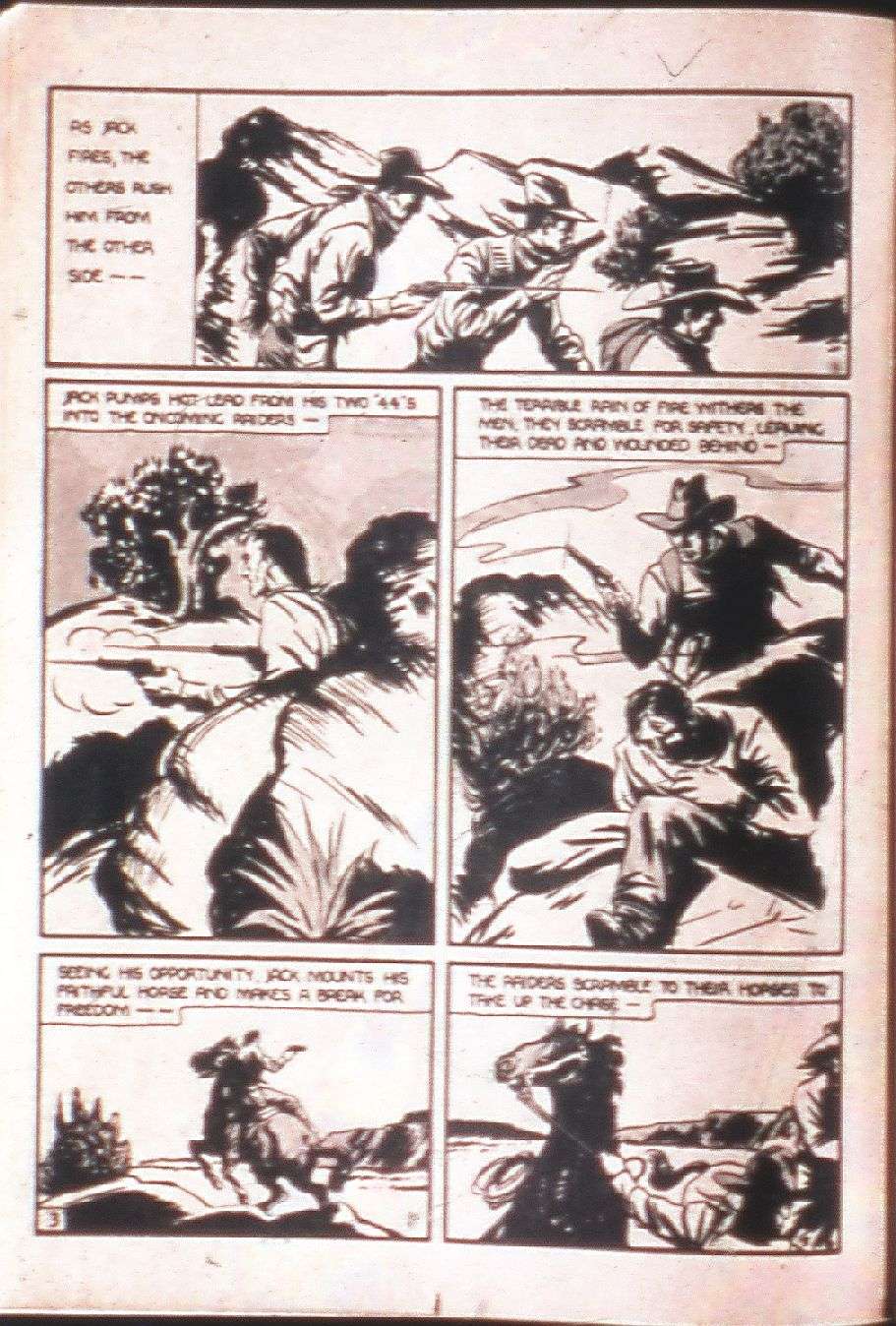
Meanwhile, Jack Woods reminds me that I should have made a Cowboy Stunt called Make Shoot at Hat. For 1 turn, all opponents must save vs. plot or shoot at the exposed hat instead of the concealed Hero.


Comic books seldom specify what type of gun is being used, and I now see it as an error that I specified so many types of historical guns on the starting equipment list. That said, this page clearly refers to Jack's weapons as being .44's, and are probably Winchester .44 revolvers.


Some amounts of climbing, like up a steep, rugged slope, or maybe even the side of a building, should be accessible to all Heroes. This, though...climbing a sheer wall, straight out of water? This has to be a special skill -- either performed by a Mysteryman (which Brad Hardy doesn't seem to be) or a stunt usable by Fighters (as Brad Hardy definitely seems to be).


It really seems like Wing Brady's player rolled a fumble in this combat. Criticals and fumbles are house rules in some games, and official rules in others. I have decided to avoid both for H&H -- I would rather the Editor control the flavor text of what happens in combat, bearing in mind the mood of the campaign he is aiming for.


(Scans courtesy of Comic Book Plus)


Tuesday, September 8, 2015

Detective Comics #10

Oops!  I had started to review this issue one day, got distracted from the project, and picked up on the next comic book in order. Now I'll have to go back and look again at #10 before doing #11...

How's this for starting with a bang?  Larry Steele is in a shootout, with some interesting things going on here. First, Larry manages to shoot a gun out of someone's hand, which is not supported by the game mechanics for "ordinary" Fighters. So what's going on there? The Editor might be:

A. Using stunts (Disarming Shot), but allowing Fighters to use them.
B. realizing that the gangster is at zero hp, but is using flavor text to shake things up; instead of saying the gangster drops, or something like that, the gangster has been removed from the fight by the loss of his gun (and, perhaps, will drop on the following turn).
C. remembering that The Trophy Case v. 1 no. 5 included optional rules for disarming during unarmed melee combat; the Editor is simply allowing those rules to stand in missile combat as well.
D. implementing a house rule of his own -- perhaps on a natural 20, the player can choose a special result from a hit in combat.

There are some other game mechanics possibly at play here. The obvious one is "misses his mark in the darkness", which could well be because of the hide in shadows ability for humans (the "-2 to be hit in dim light" rule), though it could also be just a situational modifier (since I am 95% sure I'm ditching the hide in shadows bonus in 2nd edition, for reasons shared elsewhere on this blog).

The other possible mechanic here is "driving Larry back," and this could be another example of covering fire, a new rule I just brought up yesterday. Only, then I was talking about covering fire making it too dangerous to move through an area, and this page suggests it would actually drive you back out of an area, which may be too powerful.

Also worth mentioning are the words associated with the bad guys. I've always treated "gangsters" as hoodlums, not knowing how I would stat gangsters differently. Any thoughts out there? "Thug", though, is an extra-tough hoodlum that was statted in Book II: Mobsters & Trophies.

Now, this page of Larry Steele brings up a good point about cars. Cars of the 1930s were things of beauty, and some of my favorite cars of all time, but one thing they were not was aerodynamic. That's why, when the mobsters' car is described as "streamlined", you know it's going to win this chase scene. So, "streamlined car" should be its own type of trophy item, which will always win in a race or chase (all other things being equal) against a regular 1930s/1940s-style car.


Cosmo is in India this issue, acting more like an explorer than a mystery man with a penchant for disguise. This is why Heroes need to travel -- because they aren't likely to find temples carved out of the tops of mountains in their home towns. The temple is a great idea for a hideout, but disappoints here, as the interior seems to be only two rooms big.

Note the wild dogs; I would use either the stats for watchdogs or wolves (both in Book II).


There's that disarming shot again! It's so cliche, maybe everyone should be able to do it?

This was probably Cosmo's most exciting adventure ever, so it's too bad it was wrapped up in just six rushed pages. It's hard to say what happens at the end that lets the villains all conveniently escape. Was that a flare bomb of some kind that blinded everyone long enough for the bad guys to pick up the mummy and flee to a secret door with it? Or maybe some sort of Dimension Door Grenade?

Bruce Nelson serials tend to be really talky, but here's an action page where Bruce grabs a knife thrown at him and throws it back. This should be possible in H&H, probably as a new stunt called Catch Missile Weapons, if Fighters are allowed to use stunts.


Bruce Nelson gives us evidence of two shots per turn, as allowed with automatic weapons in the core rules (and slower missile weapons at higher levels).


This month's installment of Spy shows us that anarchists are good at picking locks, and should get a really good bonus to morale saves, if they have to roll at all.


Buck Marshall, Range Detective, has some good advice on searching for secret things. Rolling a d6 and hoping for luck is one thing, but looking for specific things, like checking to see if the embers in a fire are still warm, will tell you information that requires no roll.

Now, Buck's advice about bolting the door behind you, so you're not disturbed while you're searching, may or may not appeal to players. Some players welcome the chance of wandering encounters while exploring as a ready source for more XP.


Slam Bradley, this month, teaches us that hi-tech weapons don't need to be found just with mad scientists. Here, a crooked boxing manager has an electric raygun, perfect for making murders look like accidental deaths (though taken from a murdered mad scientist, behind the scenes).

(Scans courtesy of Comic Book Archives)


Wednesday, July 22, 2015

The Funnies #13

If TV shows aren't lying to me, then Dan Dunn is using a legitimate police "trick" here, ignoring the obvious smuggling charges because it's not his department.

Having a law enforcement officer present can be a handy incentive for getting mobsters to talk. How much they reveal is always up to the Editor, and it doesn't always have to be as specific as this ship captain is here, about the secret door.

But here...Dan seems to be on some pretty shaky legal ground here. I'm not an expert on what the rights were of police captives in the 1930s, but I'm pretty sure you weren't supposed to beat them up and drug them.  That's not to say that your Neutral and Chaotic Heroes couldn't possibly do this to prisoners...


Captain Easy always offers a wealth of playing tips. Here, we learn the value of prearranging a simple code between Heroes, so you can safely write messages to each other, even when captured!


Even though we get a great overhead shot on this page, it doesn't reveal too much about the hideout. We do learn that the clever mobsters have concealed doors leading to adjoining buildings, so that they can escape more easily.

These mobsters also have a pretty fancy car, that has a smokescreen ejector and is bulletproof as well (that's revealed on the next page). Bulletproof cars and smokescreen ejectors can be found in Book II: Mobsters & Trophies.


Another player tip is to remember how old-time doors used to have transoms above them. They're a good way to peek into the next room, or drop gas bombs into the next room. But bear in mind that the bad guys can use them against you too!


Somehow I missed this stunt when I was designing the Aviator class for The Trophy Case v. 1 #6-7, but there should be a barrel roll stunt that allows you to force someone to fall off the surface of your plane, or out of the passenger seat, if not strapped in.


Five cents for a root beer seems like useful information, but really I'm just interested in this Daisybelle strip because, if I was ever tempted to open my own hot dog stand, it would like just like this.


A fortune telling booth is actually a trophy item listed in Book II -- though it's not much of a trophy item if it works this poorly.


(Scans courtesy of Digital Comic Museum)