Slam Bradley and Shorty are lured into a scenario by lack of dough. It's hard to believe that any (by now) mid-level heroes could be poor, but I suppose it depends on how decadent a lifestyle Slam and Shorty live (or they give a lot to charity, to keep the good deed XP rolling in?).
They are captured by Pierre D'Orsay and his macabre group of death cult artists -- they paint pictures of you dying and let you pick the one you like best, then try to make it happen. If that one doesn't work, they go through all the rest (a nifty idea for a scenario!). First they try to hit Slam and Short with a car (save vs. science to dodge?), then bring them back to the studio at gunpoint and force them through a trapdoor. Next the room they are in is partially flooded (the solution is to ruin their paintings with silly poses). The room is then heated with powerful heat lamps to cook the heroes (the solution is to break the bulbs). The room is then refrigerated to freeze the heroes, filled with gas to choke them, the air is sucked out of the room to suffocate them, the walls move closer to squeeze them, and then they are finally allowed through a secret door -- into a room with a leopard!
That's a lot of traps. Now, what those traps are doing to the boys, game mechanics-wise, isn't as clear. Each trap might be doing 1-6 points of damage to the boys (with the cold trap doing the most damage), or maybe they are saving vs. science each time to avoid damage.
Bruce Nelson has a great idea for getting into someone's house, pretending to be from the electric company and needing to read the meter (which used to be indoors). Bruce is locked in a closet, but manages to break out after shouldering the door twice. To end a stalemate, Bruce shoots into the air to bring a police car so he can borrow the tear gas bombs out of their car (was/is it really standard issue for every police car to carry them?).
The Crimson Avenger is starting to slowly take a turn in a different direction. While never displaying unusual abilities before, The Crimson can now take a "superhuman leap" through a glass window -- even though it's not that uncommon for any Heroes to be able to leap through glass windows -- and the police don't bother to chase him because of how fast he is. Should it be a skill, or a stunt, for people to run faster? Then, out of costume, Lee Travis is knocked out and tied up, but as soon as he comes too he just heaves and snaps his bonds. How strong is this guy supposed to be? Does he need a level in Superhero so he can wreck things?
Bart Regan, Spy, is menaced by a mad scientist with radio-controlled rockets. It sounds like it might have been cutting edge hi-tech in 1939, but it wasn't -- radio-controlled rockets had been around since WWI. That's one of the nice things about tech in the Golden Age; a lot of military grade stuff never made it into civilian use after the Great War (except for planes; it seems everyone figured out uses for the planes), so a lot could be re-purposed and made to seem new.
And when I say Bart Regan was menaced, technically, what I mean is that landmark buildings in Washington, D.C. were menaced and Bart just had to deal with it. In my home campaign, set in 1941, I ran a scenario not too long ago based on a 1941 comic book story that had the Capitol Building bombed by a mad scientist, but Siegel and Shuster did it here first. This stuff has great shock value in a one-off story, but in actual campaign play -- how often do you really want landmark buildings getting destroyed? Will there be strong consequences (capital punishment for the saboteur)? Repercussions (government registration of all mad scientists)? These are things for the Editor to consider.
Bart and Sally try the windows to see if they find one unlocked (I think I've already talked about how I use a save vs. plot in my home campaigns when Heroes do this; if they save, they find an unlocked window).
Professor Barton is a sneaky guy. He slips Bart and Sally a note, pretending to be held prisoner, but he's really the bad guy and just wants to lure them into a trap (though it's unfortunately not an elaborate trap; they just get a gun pulled on them).
(Read at ReadComics.net.)
An exploration of the Golden Age of Comics, through the lens of Hideouts & Hoodlums, the comic book roleplaying game.
Showing posts with label Bart Regan Federal Agent. Show all posts
Thursday, May 26, 2016
Saturday, January 9, 2016
Detective Comics #19 - part 1
This issue starts with another Speed Saunders investigation, and this investigation starts off well with Speed getting a good lead to follow. Speed finds the guy who's been passing around the counterfeit money, but when he needs to find the guy printing the money Speed does what many a player of mine in the past would have done -- just wander around aimlessly and wait for me to throw them bigger clues. Here, Speed just happens to walk past a random building where he hears a printing press inside.
Inspector Kent of Scotland Yard is after a missing invisibility formula -- my first thought was that this would be a potion, but the formula seems to be instructions for working an invisibility machine that works for just 30 minutes. This deviates from the Invisibility spell, but that's okay for mad science devices.
Kent notices that a car is trailing him (keen senses/notice things check?). He is rescued by a mysterious woman who seems suspiciously eager to help Kent. Supporting cast members are meant to be actively recruited by the player, but Kent just shrugs and says stuff like "Sure, why not?" when she wants to go everywhere with him. This type of freebie character should not be considered supporting cast for purposes of awarding xp (which Heroes get when their players actively involve their SCMs in the scenario).
Larry Steele's new adventure starts at on an uncharted island "2000 miles due East off the coast of Brazil", which is odd because by the time you're 2,000 miles East of Brazil you're practically to Africa.
Another peculiarity -- Larry sprains his ankle in a plane crash! I'm not being facetious; specific injuries, or complications after being unconscious, are fairly rare in comic book stories. I really wanted a table of complications linked to being reduced to zero hit points in 2nd ed. Hideouts & Hoodlums, but now I'm not so sure.
There's also a really creepy backstory here about the mobsters on the island who kill a 14-year old girl's parents and keep per prisoner for the next 4 years, hoping Stockholm syndrome kicks in so she'll marry the boss mobster. More proof that you can go really dark and still be Golden Age-like.
Bart Regan and Sally of Spy are about to have the first wedding in comic book history when the service is interrupted by a new mission, and this one is...pretty silly. The all-important mission is that a woman is in town who is suspected of being a spy and Bart and Sally are the only ones who can prove she is. But...where is the time crunch here? Is the Chief secretly jealous and doesn't want Bart to have Sally?
Anyway, the lady spy has a mirrored compact she uses to powder her nose that can project invisible beams of wrecking things force, capable of smashing a brick wall (or equal to a Superhero able to wreck up to cars). This is the kind of compact super-science I expect to see Iron Man carrying in 2016 and seems oddly out of place in a Golden Age story. Of course, the item does have a drawback -- if you accidentally aim it towards your face, your face explodes (so, at least 3-18 damage as a weapon).
The Bruce Nelson story starts with a combat turn that does not go the way I normally handle combat. If one side has the drop on the other -- like the bad guy with a gun at Bruce's back -- or some other distinct advantage, I may ignore rolling for initiative. Here, Bruce somehow wins initiative despite his opponent having every advantage.
Bruce would have been killed if that coconut had not fallen on his attacker's head and knocked him out. Now, the skeptical reader might interpret this as an overly lenient Editor, but perhaps not. Perhaps the Editor had merely planned the environment in advance, considered there might be, oh, a 1 in 10 chance of a coconut falling and hitting someone on the head for, oh, 1-3 points of damage if anyone stood underneath those trees -- a sort of natural trap. Bruce's player was lucky enough that his opponent wound up under the trees first.
Once Bruce is in his plane again, we see the stunts Evasive Maneuvers, Increase Speed, and Wing Walking, and possibly a new stunt. Bruce draws attacks to himself to keep his friend descending by parachute from being attacked. Maybe it would be called Draw Fire?
We also see another complication from an injury, as Bruce loses the use of his arm that he was shot in.
(This issue can be read at Comic Book Archives)
Inspector Kent of Scotland Yard is after a missing invisibility formula -- my first thought was that this would be a potion, but the formula seems to be instructions for working an invisibility machine that works for just 30 minutes. This deviates from the Invisibility spell, but that's okay for mad science devices.
Kent notices that a car is trailing him (keen senses/notice things check?). He is rescued by a mysterious woman who seems suspiciously eager to help Kent. Supporting cast members are meant to be actively recruited by the player, but Kent just shrugs and says stuff like "Sure, why not?" when she wants to go everywhere with him. This type of freebie character should not be considered supporting cast for purposes of awarding xp (which Heroes get when their players actively involve their SCMs in the scenario).
Larry Steele's new adventure starts at on an uncharted island "2000 miles due East off the coast of Brazil", which is odd because by the time you're 2,000 miles East of Brazil you're practically to Africa.
Another peculiarity -- Larry sprains his ankle in a plane crash! I'm not being facetious; specific injuries, or complications after being unconscious, are fairly rare in comic book stories. I really wanted a table of complications linked to being reduced to zero hit points in 2nd ed. Hideouts & Hoodlums, but now I'm not so sure.
There's also a really creepy backstory here about the mobsters on the island who kill a 14-year old girl's parents and keep per prisoner for the next 4 years, hoping Stockholm syndrome kicks in so she'll marry the boss mobster. More proof that you can go really dark and still be Golden Age-like.
Bart Regan and Sally of Spy are about to have the first wedding in comic book history when the service is interrupted by a new mission, and this one is...pretty silly. The all-important mission is that a woman is in town who is suspected of being a spy and Bart and Sally are the only ones who can prove she is. But...where is the time crunch here? Is the Chief secretly jealous and doesn't want Bart to have Sally?
Anyway, the lady spy has a mirrored compact she uses to powder her nose that can project invisible beams of wrecking things force, capable of smashing a brick wall (or equal to a Superhero able to wreck up to cars). This is the kind of compact super-science I expect to see Iron Man carrying in 2016 and seems oddly out of place in a Golden Age story. Of course, the item does have a drawback -- if you accidentally aim it towards your face, your face explodes (so, at least 3-18 damage as a weapon).
The Bruce Nelson story starts with a combat turn that does not go the way I normally handle combat. If one side has the drop on the other -- like the bad guy with a gun at Bruce's back -- or some other distinct advantage, I may ignore rolling for initiative. Here, Bruce somehow wins initiative despite his opponent having every advantage.
Bruce would have been killed if that coconut had not fallen on his attacker's head and knocked him out. Now, the skeptical reader might interpret this as an overly lenient Editor, but perhaps not. Perhaps the Editor had merely planned the environment in advance, considered there might be, oh, a 1 in 10 chance of a coconut falling and hitting someone on the head for, oh, 1-3 points of damage if anyone stood underneath those trees -- a sort of natural trap. Bruce's player was lucky enough that his opponent wound up under the trees first.
Once Bruce is in his plane again, we see the stunts Evasive Maneuvers, Increase Speed, and Wing Walking, and possibly a new stunt. Bruce draws attacks to himself to keep his friend descending by parachute from being attacked. Maybe it would be called Draw Fire?
We also see another complication from an injury, as Bruce loses the use of his arm that he was shot in.
(This issue can be read at Comic Book Archives)
Labels:
Bart Regan Federal Agent,
Bruce Nelson,
Editor's tips,
environments,
experience points,
initiative,
injuries,
Inspector Kent,
keen senses,
Larry Steele,
locations,
new trophies,
SCMs,
Speed Saunders,
trophies
Monday, December 21, 2015
Detective Comics #18 - part 1
As always (so far), this issue begins with Speed Saunders, this time investigating a murder -- and that's all we know. We don't know how Speed knows the dead man's son helping with the investigation, and we're given very little to go on why Speed suspects it's murder and not suicide.
If you only have time for a short scenario of Hideouts & Hoodlums, it might be best to jump into a story, in media res, like this -- cutting out the plot hooks and setting up the scene and just lay out what the challenge is in the scenario right at the start. And place any supporting cast your players will need nearby.
As evidence of how combat needs to stay abstract in a comic book RPG, Speed is shot at point blank range, but recovers when a doctor performs first aid on him, and doesn't even have blood on his clothes.
Later, "Speed learns the truth from the glint of fear in the fence's eyes." There's not a game mechanic tied directly to lie detection or eye reading, but if the Editor really wants to give the Hero a chance to pick up on a clue, then a "notice things" roll should be allowed, just as if the Hero were searching for secret doors.
Later still, Speed wants to go back to the murder scene "to make a more thorough search." What his player means is he wants more "notice things" rolls because he doesn't think he has enough clues yet.
This installment of Cosmo, The Phantom of Disguise, is suggestive that Cosmo might be based out of Chicago, since he leaves from Chicago to start a vacation. Cosmo's vacation takes place in the Mythic West, where everyone gets around on horseback, the only way to not draw suspicion to yourself is to dress like a cowpoke, and the town is remote enough that its only tavern is the only place to eat in 20 miles.
It is unclear how Cosmo solves his mystery. It seems he overhears the Mexican in the tavern say something incriminating, but all we're told is that Cosmo overhears the Mexican "babble" to himself. The implication seems to be that the Mexican's "babble" is him talking in Spanish, and indeed the only reason Cosmo seems to find the Mexican suspicious-looking is because he's a Mexican (or, to be fair, the only Mexican in the tavern). Further racism is found in the sheriff's "Negress" servant.
In the Larry Steele installment, Larry and his pal are in a deathtrap -- a dark pit that is being filled with a lethal gas. The way out is to search the floor and find the floor boards are loose enough to be pried up. Below the pit trap is an underground stream with a strong current, leading to a waterfall outside, near the house they were in. Although waterfalls are never lethal in comic books, there are still overhanging branches to grab in case the Heroes don't want to chance it.
Larry's big fight scene breaks down like this: Larry gets a surprise turn and, because everyone is unarmed, he gets two attacks. He uses them both to swing from the chandelier and kick the two hoodlums, doing enough damage to one of them to knock him unconscious. In the first turn of regular combat, the boss bad guy wins initiative, but the Editor rolls so poorly on his attack roll that he says the boss is still drawing his gun. Larry makes a disarming attack on the boss and wins possession of the gun. Because a weapon is now in play, we switch to one melee attack per turn. On turn 2, Larry wins initiative and clocks the bad guy, doing enough damage to only lightly injure him. The hoodlum who wasn't knocked out, though, fires into the melee. Because firing into a melee is dangerous, there is a chance to hit either combatant, and the Editor rolls that the bullet hits the boss instead of Larry. The remaining hoodlum gets shot on turn 3 by Larry. It's not clear if the second hoodlum and the boss are unconscious yet, or if they've failed morale saves and stopped fighting.
Bosses should maybe be a new mobster type, between hoodlums and master criminals.
If the Fu Manchu adaptation here was a H&H scenario, the Editor would be in for a tricky situation. There is a scene where one of the Heroes is approached by a mystery lady (a female practitioner of the Mysteryman class, no doubt). She gives him an important clue, and then needs to disappear (or she won't be mysterious). Now, the Editor could just make her high enough in level to give her a great roll at becoming effectively invisible through stealth, but that may later beg the question why she doesn't just tackle Fu Manchu herself if she's so high in level. Or, the Editor could fudge the die roll so she gets away, but fudging dice rolls just to railroad through a plot doesn't feel fair to most players.
Now, the trick used in the story to keep our Hero from following her is to have Wayland Smith show up with even more vital information our Hero needs. The problem with this is, Wayland is probably also a Hero in play in this scenario, so the two players will likely be confident they can share information at any other time. For a RPG scenario, Wayland would have to be swapped out for a character not under a player's control.
In Spy, Bart Regan is assigned to recover the Kahoon Ruby, not to keep, but to give back to the Maharaja who owned it. Still, because the ruby would clearly have a monetary value, it is easy to assign an XP award for finishing this scenario. Had the mission been to recover the Maharaja's missing child, the award would not be so clearly quantifiable. A further wrinkle is that the Maharaja will sign a peace treaty with whatever country recovers the ruby, so there will be lots of rival factions vying to compete this scenario first.
This is also the issue that Bart proposes to his partner Sally. If these were both played Heroes, this is role-playing above and beyond the call of duty.
(You can read this issue at Comic Book Archives)
If you only have time for a short scenario of Hideouts & Hoodlums, it might be best to jump into a story, in media res, like this -- cutting out the plot hooks and setting up the scene and just lay out what the challenge is in the scenario right at the start. And place any supporting cast your players will need nearby.
As evidence of how combat needs to stay abstract in a comic book RPG, Speed is shot at point blank range, but recovers when a doctor performs first aid on him, and doesn't even have blood on his clothes.
Later, "Speed learns the truth from the glint of fear in the fence's eyes." There's not a game mechanic tied directly to lie detection or eye reading, but if the Editor really wants to give the Hero a chance to pick up on a clue, then a "notice things" roll should be allowed, just as if the Hero were searching for secret doors.
Later still, Speed wants to go back to the murder scene "to make a more thorough search." What his player means is he wants more "notice things" rolls because he doesn't think he has enough clues yet.
This installment of Cosmo, The Phantom of Disguise, is suggestive that Cosmo might be based out of Chicago, since he leaves from Chicago to start a vacation. Cosmo's vacation takes place in the Mythic West, where everyone gets around on horseback, the only way to not draw suspicion to yourself is to dress like a cowpoke, and the town is remote enough that its only tavern is the only place to eat in 20 miles.
It is unclear how Cosmo solves his mystery. It seems he overhears the Mexican in the tavern say something incriminating, but all we're told is that Cosmo overhears the Mexican "babble" to himself. The implication seems to be that the Mexican's "babble" is him talking in Spanish, and indeed the only reason Cosmo seems to find the Mexican suspicious-looking is because he's a Mexican (or, to be fair, the only Mexican in the tavern). Further racism is found in the sheriff's "Negress" servant.
In the Larry Steele installment, Larry and his pal are in a deathtrap -- a dark pit that is being filled with a lethal gas. The way out is to search the floor and find the floor boards are loose enough to be pried up. Below the pit trap is an underground stream with a strong current, leading to a waterfall outside, near the house they were in. Although waterfalls are never lethal in comic books, there are still overhanging branches to grab in case the Heroes don't want to chance it.
Larry's big fight scene breaks down like this: Larry gets a surprise turn and, because everyone is unarmed, he gets two attacks. He uses them both to swing from the chandelier and kick the two hoodlums, doing enough damage to one of them to knock him unconscious. In the first turn of regular combat, the boss bad guy wins initiative, but the Editor rolls so poorly on his attack roll that he says the boss is still drawing his gun. Larry makes a disarming attack on the boss and wins possession of the gun. Because a weapon is now in play, we switch to one melee attack per turn. On turn 2, Larry wins initiative and clocks the bad guy, doing enough damage to only lightly injure him. The hoodlum who wasn't knocked out, though, fires into the melee. Because firing into a melee is dangerous, there is a chance to hit either combatant, and the Editor rolls that the bullet hits the boss instead of Larry. The remaining hoodlum gets shot on turn 3 by Larry. It's not clear if the second hoodlum and the boss are unconscious yet, or if they've failed morale saves and stopped fighting.
Bosses should maybe be a new mobster type, between hoodlums and master criminals.
If the Fu Manchu adaptation here was a H&H scenario, the Editor would be in for a tricky situation. There is a scene where one of the Heroes is approached by a mystery lady (a female practitioner of the Mysteryman class, no doubt). She gives him an important clue, and then needs to disappear (or she won't be mysterious). Now, the Editor could just make her high enough in level to give her a great roll at becoming effectively invisible through stealth, but that may later beg the question why she doesn't just tackle Fu Manchu herself if she's so high in level. Or, the Editor could fudge the die roll so she gets away, but fudging dice rolls just to railroad through a plot doesn't feel fair to most players.
Now, the trick used in the story to keep our Hero from following her is to have Wayland Smith show up with even more vital information our Hero needs. The problem with this is, Wayland is probably also a Hero in play in this scenario, so the two players will likely be confident they can share information at any other time. For a RPG scenario, Wayland would have to be swapped out for a character not under a player's control.
In Spy, Bart Regan is assigned to recover the Kahoon Ruby, not to keep, but to give back to the Maharaja who owned it. Still, because the ruby would clearly have a monetary value, it is easy to assign an XP award for finishing this scenario. Had the mission been to recover the Maharaja's missing child, the award would not be so clearly quantifiable. A further wrinkle is that the Maharaja will sign a peace treaty with whatever country recovers the ruby, so there will be lots of rival factions vying to compete this scenario first.
This is also the issue that Bart proposes to his partner Sally. If these were both played Heroes, this is role-playing above and beyond the call of duty.
(You can read this issue at Comic Book Archives)
Labels:
Bart Regan Federal Agent,
combat,
Cosmo,
deathtraps,
Dr. Fu Manchu,
Editor's tips,
Larry Steele,
Mythic West,
new mobsters,
notice things,
places,
racism,
rewards,
role-playing,
scenarios,
skills,
Speed Saunders
Saturday, November 28, 2015
Detective Comics #17 - part 1
What am I thankful for, on the day after Thanksgiving? More comic book reading!
Speed Saunders has always been a peculiar duck, both in terms of how irrelevant his river patrol job is to his adventures (but, really, how often does a hero's civilian profession come up in a scenario?) and how fluid his adventures have been so far in terms of genre. This month, we find out that Speed's abilities are also pretty fluid in terms of skills. Here, Speed steps off a low roof onto the top of a parked car and lays down on it -- and no one inside the car hears him doing this! This is a level of stealth more appropriate to the Mysteryman class than the Fighter class. Or...the Editor has simply fudged how the surprise rules work. Even if Speed has complete surprise, his free turn of action should only be 1 combat turn long before being discovered.
Now, the hideout Speed finds in this issue is rather interesting. The kidnapper is in a remote cabin, located on a mountain terrace inside a giant gorge. The only way to get down to the cabin is by climbing down, which seems to come with a high risk of falling. The kidnapper does have a rope tied to a tree overlooking the gorge that is used to lower supplies down to the cabin, and Speed uses that to descend safer (though a nastier game Editor would have made this a trap -- rigging the tree branch or the rope to snap).
Speed is saved from a deathtrap by the "fact" that snakes won't cross a rope made from hair. Now, call me overly suspicious, but if one of my players tried this, I would think he was trying to hoodwink me. It does seem like the sort of phony science you see in comic books, though, so if one of my players did come up with this "fact", I might feel charitable enough to give him a save vs. plot to determine if this turns out to be true -- particularly if every other attempt to thwart the deathtrap has failed.
Larry Steele isn't a very good detective sometimes. He's exploring an old castle in Maine this month and notes how dusty the floors are, but completely fails to notice any footprints from the three kidnappers in the castle in the dust. Now, this could be the result of bad dice rolls; Larry's Editor has been asking for keen senses/notice things checks periodically, but Larry's player just keeps rolling too high. Note that the players can ask for checks as often as they want to, but it is the Editor who decides how often they are eligible for new checks.
Larry later makes up for it by rappelling down the sheer side of a rain-soaked castle wall, which you would think would come with some serious penalizing modifiers. Since it's not clear yet in the Hideouts & Hoodlums rules what the chance for a Fighter to climb should be, I can't comment yet on what those modifiers should look like.
One of the kidnappers is a drunken hoodlum!
Sometimes you might want to tone things down from the comic books, for the sake of game balance. This month's installment of Cosmo, the Phantom of Disguise introduces an explosive gun, handheld, with a 125 mile range, that wrecks as if an 8th level Superhero. If this weapon isn't destroyed forever by the end of the scenario, I know it's bound to wind up in the hands of the Heroes and there goes any challenge ever for the rest of my campaign.
The Russian embassy serves as a sort-of hideout-in-plain-sight in this story. It would be interesting to run a scenario where the Heroes can't get in without wearing tuxedos, surrounded by foreign dignitaries and spies. On the other hand, the possibility for mass deaths that lead to war...maybe there are safer places to put your Heroes...
Cosmo also demonstrates lip reading in this scenario, a skill not covered by the H&H rules. It should, I would think, be more difficult than hearing noises, and possibly relegated to a stunt.
This issue begins a serialized adaptation of Dr. Fu Manchu. Fu Manchu's henchmen make use of poisoned arrows. There isn't much discussion of poisoned weapons in H&H, but it's definitely a practice best left in the hands of villains. I would either outright forbid Heroes to use poisoned weapons, or force a save vs. plot with a -1 or -2 penalty each time to use poison.
Well before Superman tackled the KKK on the radio, Bart Regan, Spy, tackles the "hooded horde". Jerry Siegel directly labels them a "terrorist organization", which, sadly, remains quite prescient about today's politics. However, the KKK isn't up to lynching blacks here, but inciting general unrest and wrecking businesses.
Bart Regan demonstrates ventriloquism in this story, even throwing his voice about 10' away! I've talked about ventriloquism before and feel the same now; that, for Golden Age stories at least, ventriloquism needs to be a basic skill.
(This issue can be read at Comic Book Archives)
Speed Saunders has always been a peculiar duck, both in terms of how irrelevant his river patrol job is to his adventures (but, really, how often does a hero's civilian profession come up in a scenario?) and how fluid his adventures have been so far in terms of genre. This month, we find out that Speed's abilities are also pretty fluid in terms of skills. Here, Speed steps off a low roof onto the top of a parked car and lays down on it -- and no one inside the car hears him doing this! This is a level of stealth more appropriate to the Mysteryman class than the Fighter class. Or...the Editor has simply fudged how the surprise rules work. Even if Speed has complete surprise, his free turn of action should only be 1 combat turn long before being discovered.
Now, the hideout Speed finds in this issue is rather interesting. The kidnapper is in a remote cabin, located on a mountain terrace inside a giant gorge. The only way to get down to the cabin is by climbing down, which seems to come with a high risk of falling. The kidnapper does have a rope tied to a tree overlooking the gorge that is used to lower supplies down to the cabin, and Speed uses that to descend safer (though a nastier game Editor would have made this a trap -- rigging the tree branch or the rope to snap).
Speed is saved from a deathtrap by the "fact" that snakes won't cross a rope made from hair. Now, call me overly suspicious, but if one of my players tried this, I would think he was trying to hoodwink me. It does seem like the sort of phony science you see in comic books, though, so if one of my players did come up with this "fact", I might feel charitable enough to give him a save vs. plot to determine if this turns out to be true -- particularly if every other attempt to thwart the deathtrap has failed.
Larry Steele isn't a very good detective sometimes. He's exploring an old castle in Maine this month and notes how dusty the floors are, but completely fails to notice any footprints from the three kidnappers in the castle in the dust. Now, this could be the result of bad dice rolls; Larry's Editor has been asking for keen senses/notice things checks periodically, but Larry's player just keeps rolling too high. Note that the players can ask for checks as often as they want to, but it is the Editor who decides how often they are eligible for new checks.
Larry later makes up for it by rappelling down the sheer side of a rain-soaked castle wall, which you would think would come with some serious penalizing modifiers. Since it's not clear yet in the Hideouts & Hoodlums rules what the chance for a Fighter to climb should be, I can't comment yet on what those modifiers should look like.
One of the kidnappers is a drunken hoodlum!
Sometimes you might want to tone things down from the comic books, for the sake of game balance. This month's installment of Cosmo, the Phantom of Disguise introduces an explosive gun, handheld, with a 125 mile range, that wrecks as if an 8th level Superhero. If this weapon isn't destroyed forever by the end of the scenario, I know it's bound to wind up in the hands of the Heroes and there goes any challenge ever for the rest of my campaign.
The Russian embassy serves as a sort-of hideout-in-plain-sight in this story. It would be interesting to run a scenario where the Heroes can't get in without wearing tuxedos, surrounded by foreign dignitaries and spies. On the other hand, the possibility for mass deaths that lead to war...maybe there are safer places to put your Heroes...
Cosmo also demonstrates lip reading in this scenario, a skill not covered by the H&H rules. It should, I would think, be more difficult than hearing noises, and possibly relegated to a stunt.
This issue begins a serialized adaptation of Dr. Fu Manchu. Fu Manchu's henchmen make use of poisoned arrows. There isn't much discussion of poisoned weapons in H&H, but it's definitely a practice best left in the hands of villains. I would either outright forbid Heroes to use poisoned weapons, or force a save vs. plot with a -1 or -2 penalty each time to use poison.
Well before Superman tackled the KKK on the radio, Bart Regan, Spy, tackles the "hooded horde". Jerry Siegel directly labels them a "terrorist organization", which, sadly, remains quite prescient about today's politics. However, the KKK isn't up to lynching blacks here, but inciting general unrest and wrecking businesses.
Bart Regan demonstrates ventriloquism in this story, even throwing his voice about 10' away! I've talked about ventriloquism before and feel the same now; that, for Golden Age stories at least, ventriloquism needs to be a basic skill.
(This issue can be read at Comic Book Archives)
Labels:
Bart Regan Federal Agent,
climbing,
clues,
Cosmo,
deathtraps,
Dr. Fu Manchu,
hideouts,
Larry Steele,
mobsters,
new stunts,
new trophies,
poison,
saving throws,
skills,
Speed Saunders,
surprise,
traps
Thursday, November 12, 2015
Detective Comics #16
We're just six months away from the debut of the Bat-Man at this point, so instead of him -- let's talk about Larry Steele, Private Detective!
This installment of Larry's adventures features a pretty exciting gunfight in a burning warehouse. Caught on a four-story roof ledge with fire behind him, Larry jumps and catches a fire escape on another section of the building to save himself. This is a big warehouse -- four stories tall, with what appears to be an alley running up the middle of it, nearly dividing the warehouse in two (and hence providing the gap that Larry has to jump over). Heroes could spend a whole game session just exploring this warehouse!
It does bring up the question, though -- how far can a Hero leap (without being an alien, or buffed by powers)? The world record for a running broad jump (and we'll assume in this case that the fire was not so close behind Larry that he couldn't back up and get a running start) is over 29 feet -- but I'm not suggesting that every Hero should be able to jump that distance. Indeed, I would say that any Hero trying to clear over 15 feet should have to save vs. science to clear the rest -- up to 29 feet maximum.
There's even an idea here for a nifty trap, when the floor gives way under the bad guy called "Snow", and then the ceiling collapses on top of him and pins him to the floor. Now, in an ordinary building, with 8-foot high ceilings, falling damage between floors would be negligible, because it's less than 10 feet. In a high-ceilinged warehouse, though, falls might be 1d6 or even 2d6 damage (per 10' fallen, of course), with the weight falling on top of them doing an extra 1d6 of damage, and necessitating a save vs. science to avoid being pinned and immobile.
Cosmo, the Phantom of Disguise, investigates a case of jewel theft from a museum perpetrated by (spoilers!) fake undead. Night watchmen are being temporarily driven mad or dying from fright when they see a mummy costume, painted in phosphorous, hanging from a pole so it appears to be floating. I'm interested, now, in introducing a new mobster type called undead imposter, who can Scare Good Guys (like the power, reversed) -- but Editors have to be careful with using this. If fake undead can do this, then what would happen in your game if people saw real undead?
Bruce Nelson encounters the world's worst secret door -- it's opened by turning the light switch in the room.
Bart Regan, Spy, demonstrates how easy it is to unlock a door with a hairpin. Very likely, picking locks will become a basic skill for all Heroes -- with the prerequisite of asking a woman for a hairpin.
Buck Marshall overhears the slang term ranny, which I've found out means "cowboy" or "ranch hand".
This month's Slam Bradley confirms that Slam is from Cleveland, same as Superman. Slam not only takes tap dancing lessons for $3 a lesson, but learns to tap dance in only five hours. Hideouts & Hoodlums has no skill system, nor any game mechanic you could tie directly to tap dancing. You could use a save vs. plot to decide if the Hero tap dances well enough, offering a +1 bonus for every four hours (length of a downtime turn) spent practicing beforehand.
Despite taking place in New York, Chief Gage from Cleveland, Slam's nonviolent foil, returns. This police chief turns up just to laugh at Slam and Shorty and impede their investigation. These characters should not be treated as Supporting Cast, since they have no loyalty to the Hero. Likewise is a new rival character, PI Joan Carter. A rival is looking to complete the same scenario faster (though by the end of the story it appears that Slam has recruited Joan into his SCM roster).
(Available to read online via Comic Book Archives)
This installment of Larry's adventures features a pretty exciting gunfight in a burning warehouse. Caught on a four-story roof ledge with fire behind him, Larry jumps and catches a fire escape on another section of the building to save himself. This is a big warehouse -- four stories tall, with what appears to be an alley running up the middle of it, nearly dividing the warehouse in two (and hence providing the gap that Larry has to jump over). Heroes could spend a whole game session just exploring this warehouse!
It does bring up the question, though -- how far can a Hero leap (without being an alien, or buffed by powers)? The world record for a running broad jump (and we'll assume in this case that the fire was not so close behind Larry that he couldn't back up and get a running start) is over 29 feet -- but I'm not suggesting that every Hero should be able to jump that distance. Indeed, I would say that any Hero trying to clear over 15 feet should have to save vs. science to clear the rest -- up to 29 feet maximum.
There's even an idea here for a nifty trap, when the floor gives way under the bad guy called "Snow", and then the ceiling collapses on top of him and pins him to the floor. Now, in an ordinary building, with 8-foot high ceilings, falling damage between floors would be negligible, because it's less than 10 feet. In a high-ceilinged warehouse, though, falls might be 1d6 or even 2d6 damage (per 10' fallen, of course), with the weight falling on top of them doing an extra 1d6 of damage, and necessitating a save vs. science to avoid being pinned and immobile.
Cosmo, the Phantom of Disguise, investigates a case of jewel theft from a museum perpetrated by (spoilers!) fake undead. Night watchmen are being temporarily driven mad or dying from fright when they see a mummy costume, painted in phosphorous, hanging from a pole so it appears to be floating. I'm interested, now, in introducing a new mobster type called undead imposter, who can Scare Good Guys (like the power, reversed) -- but Editors have to be careful with using this. If fake undead can do this, then what would happen in your game if people saw real undead?
Bruce Nelson encounters the world's worst secret door -- it's opened by turning the light switch in the room.
Bart Regan, Spy, demonstrates how easy it is to unlock a door with a hairpin. Very likely, picking locks will become a basic skill for all Heroes -- with the prerequisite of asking a woman for a hairpin.
Buck Marshall overhears the slang term ranny, which I've found out means "cowboy" or "ranch hand".
This month's Slam Bradley confirms that Slam is from Cleveland, same as Superman. Slam not only takes tap dancing lessons for $3 a lesson, but learns to tap dance in only five hours. Hideouts & Hoodlums has no skill system, nor any game mechanic you could tie directly to tap dancing. You could use a save vs. plot to decide if the Hero tap dances well enough, offering a +1 bonus for every four hours (length of a downtime turn) spent practicing beforehand.
Despite taking place in New York, Chief Gage from Cleveland, Slam's nonviolent foil, returns. This police chief turns up just to laugh at Slam and Shorty and impede their investigation. These characters should not be treated as Supporting Cast, since they have no loyalty to the Hero. Likewise is a new rival character, PI Joan Carter. A rival is looking to complete the same scenario faster (though by the end of the story it appears that Slam has recruited Joan into his SCM roster).
(Available to read online via Comic Book Archives)
Labels:
Bart Regan Federal Agent,
Bruce Nelson,
Buck Marshall,
Cosmo,
jumping,
Larry Steele,
new mobsters,
other characters,
picking locks,
saving throws,
SCMs,
skills,
Slam Bradley,
slang,
traps,
undead
Sunday, October 18, 2015
Detective Comics #14
200th post!
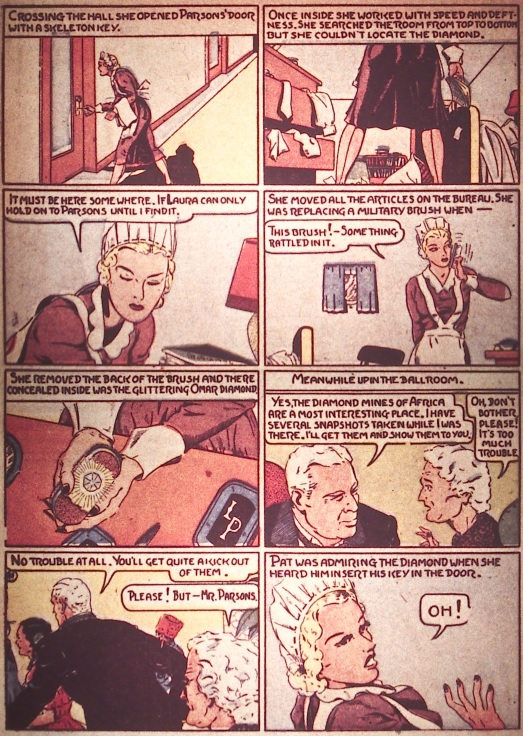
There's no Bruce Nelson on this page of Bruce Nelson, but there are some interesting items here. Skeleton keys always seem to work in comic books, so they must make for great trophy items.
Hollow brushes also make for useful items. Note that our burglar wasn't intentionally searching the brush, but just got lucky on her "notice things" roll.
Bart Regan and Sally are up against spies who have stolen a molecular friction raygun -- which sounds a lot like a fancy name for a heat ray to me. On the bright side, it seems to take a full turn for the friction to build up enough to wreck things or harm anyone, plenty of time for people to, oh, hop out of a car that's been struck. A good threat for 1st level Heroes, maybe.
There's not a lot of Hideouts & Hoodlums content on this page of Cosmo, but I'm really amused that these guys are poultry racketeers. "You're gonna buy your chickens from us, see?" "You buy our poultry at our price, or you'll get your head cracked open like an egg." I can't see statting them anyway special, unless I made a new entry called laughable hoodlum.
There's also a nice Slam Bradley story I'm not going to share here, that starts with a plane crash, includes surviving a blizzard in an igloo, and lots of punching people. Worth noting is that Slam beats up a drunken hoodlum, and that his plane cost $13,000 (Heroes have really been enjoying revealing how much their planes cost/are worth lately).
There's also a short, but pivotal fight where Slam and the unnamed master criminal grapple underwater, trying to drown each other. This would be difficult to play out in H&H, with its 1-minute combat turns. Likely, the combat would be resolved by a single pair of attack rolls before it would be over -- which is actually pretty close to how quickly the fight is resolved in the comic book.
(Scans courtesy of Comic Book Archives)
There's no Bruce Nelson on this page of Bruce Nelson, but there are some interesting items here. Skeleton keys always seem to work in comic books, so they must make for great trophy items.
Hollow brushes also make for useful items. Note that our burglar wasn't intentionally searching the brush, but just got lucky on her "notice things" roll.
Bart Regan and Sally are up against spies who have stolen a molecular friction raygun -- which sounds a lot like a fancy name for a heat ray to me. On the bright side, it seems to take a full turn for the friction to build up enough to wreck things or harm anyone, plenty of time for people to, oh, hop out of a car that's been struck. A good threat for 1st level Heroes, maybe.
There's not a lot of Hideouts & Hoodlums content on this page of Cosmo, but I'm really amused that these guys are poultry racketeers. "You're gonna buy your chickens from us, see?" "You buy our poultry at our price, or you'll get your head cracked open like an egg." I can't see statting them anyway special, unless I made a new entry called laughable hoodlum.
There's also a nice Slam Bradley story I'm not going to share here, that starts with a plane crash, includes surviving a blizzard in an igloo, and lots of punching people. Worth noting is that Slam beats up a drunken hoodlum, and that his plane cost $13,000 (Heroes have really been enjoying revealing how much their planes cost/are worth lately).
There's also a short, but pivotal fight where Slam and the unnamed master criminal grapple underwater, trying to drown each other. This would be difficult to play out in H&H, with its 1-minute combat turns. Likely, the combat would be resolved by a single pair of attack rolls before it would be over -- which is actually pretty close to how quickly the fight is resolved in the comic book.
(Scans courtesy of Comic Book Archives)
Monday, August 10, 2015
Detective Comics #8 - pt. 2
Bart Regan is reminded that it pays to have a day job as a spy, as routine assignments are often plot hooks for adventure!
The key to tracking, as I've discussed here before, is often just asking the right questions. Here, Buck Marshall's player asks his Editor, "What shape are the boot prints?" to ascertain there were two assailants. But if tracking is being used as a Cowboy stunt or Mysteryman special skill, then some information should always be withhold from "ordinary" Heroes searching for tracks. "You simply can't tell," is a fair answer, no matter how long the Heroes spent searching.
Not really germane to game mechanics, but...I wonder where Slam Bradley is from? I would have assumed Slam was from Cleveland, Ohio, just like Siegel and Shuster's next creation, Superman, will be from originally. And yet, a road trip from Cleveland to the Kentucky mountains should only take 6-7 hours, not exactly a "long night". New York to Kentucky would be 13-14 hours, more idea of a long night's drive.
Shorty often plays the fool, but in this story he wisely uses Supporting Cast Member recruitment in order to change the encounter reaction of the hillbilly girl holding a shotgun on him.
(Scans courtesy of Comic Book Archives)
The key to tracking, as I've discussed here before, is often just asking the right questions. Here, Buck Marshall's player asks his Editor, "What shape are the boot prints?" to ascertain there were two assailants. But if tracking is being used as a Cowboy stunt or Mysteryman special skill, then some information should always be withhold from "ordinary" Heroes searching for tracks. "You simply can't tell," is a fair answer, no matter how long the Heroes spent searching.
Shorty often plays the fool, but in this story he wisely uses Supporting Cast Member recruitment in order to change the encounter reaction of the hillbilly girl holding a shotgun on him.
(Scans courtesy of Comic Book Archives)
Tuesday, February 17, 2015
Comics Magazine #2
We're up to June 1936 now, two years before Superman and what is normally considered the beginning of the Golden Age of Comics. We'd get there faster, but there's just so much good stuff to look at first!
Of course, by "good", we're looking for material useful for applying to the Hideouts & Hoodlums roleplaying game. Good, in terms of quality, is sparse in this next issue, the second one to come out of what will become known as Centaur, but is at this time only the Comics Magazine Company.
First of all, what is it with goats? This is at least the fourth comic book in just the first six weeks of this blog project where I've seen a goat. People must have thought goats were hilarious in the '30s.
Even half-pints can go hideout delving! Something for novice Editors to keep in mind is illumination in the hideout, and remembering to treat it as a limited resource. A lantern only sheds light in a small (30' radius) and even flashlights are only good for so far, and in only one direction at a time.
Bart Regan, Federal Agent, is another character that was somehow borrowed from National. Here, Bart demonstrates how to use Supporting Cast Members to help solve a case. An engraver was a new one on me, not even included in Book III: Underworld & Metropolis Adventures. The other SCM works for a newspaper, a vital source for information.
Like Dan Dunn yesterday, Bart Regan doesn't like to show up at a hideout empty-handed. He and his men will be showing up with riot guns (shot guns, absent from the starting equipment list in earlier versions), machine guns (not immediately available to Heroes for game balance issues), and tear gas (also treated as a trophy item that must be acquired in-game).
I include this page as a dual history lesson/lesson in not always trusting Wikipedia. According to the Wikipedia page, the Mexican Expeditionary (Air) Force was not formed until 1944 -- but here it is in a 1936 story!
When your Hero needs access to a skill set his class and/or race would not normally have, the best resource is Supporting Cast Members (SCMs). Here, we see the value of the assayer for appraising things.
Here are the now familiar tropes of the antique diving suit and a giant octopus. But, attacking it with a knife? Hoo-hum, after seeing Captain Easy fight one with a saw, how is this going to impress?
A knife in both hands! That's how!
Skipper Ham Shanks may be the star of this Popeye rip-off, but Corky (the Bluto stand-in) is the half-beast Superhero, wrecking things with his bare hands/claws, in their midst. Note how Patterson takes a familiar cast, shakes up relationships, and renders it into something that can pass for new.
And lastly, Spunk Hazard talks about iron nerves. What is that? Could it be a stunt non-Heroes could use to temporarily suppress their morale saves? I think it sure could!
(Scans courtesy of Digital Comic Museum at http://www.digitalcomicmuseum.com/index.php?dlid=13445)
Of course, by "good", we're looking for material useful for applying to the Hideouts & Hoodlums roleplaying game. Good, in terms of quality, is sparse in this next issue, the second one to come out of what will become known as Centaur, but is at this time only the Comics Magazine Company.
First of all, what is it with goats? This is at least the fourth comic book in just the first six weeks of this blog project where I've seen a goat. People must have thought goats were hilarious in the '30s.
Even half-pints can go hideout delving! Something for novice Editors to keep in mind is illumination in the hideout, and remembering to treat it as a limited resource. A lantern only sheds light in a small (30' radius) and even flashlights are only good for so far, and in only one direction at a time.
Bart Regan, Federal Agent, is another character that was somehow borrowed from National. Here, Bart demonstrates how to use Supporting Cast Members to help solve a case. An engraver was a new one on me, not even included in Book III: Underworld & Metropolis Adventures. The other SCM works for a newspaper, a vital source for information.
Like Dan Dunn yesterday, Bart Regan doesn't like to show up at a hideout empty-handed. He and his men will be showing up with riot guns (shot guns, absent from the starting equipment list in earlier versions), machine guns (not immediately available to Heroes for game balance issues), and tear gas (also treated as a trophy item that must be acquired in-game).
I include this page as a dual history lesson/lesson in not always trusting Wikipedia. According to the Wikipedia page, the Mexican Expeditionary (Air) Force was not formed until 1944 -- but here it is in a 1936 story!
When your Hero needs access to a skill set his class and/or race would not normally have, the best resource is Supporting Cast Members (SCMs). Here, we see the value of the assayer for appraising things.
Here are the now familiar tropes of the antique diving suit and a giant octopus. But, attacking it with a knife? Hoo-hum, after seeing Captain Easy fight one with a saw, how is this going to impress?
A knife in both hands! That's how!
Skipper Ham Shanks may be the star of this Popeye rip-off, but Corky (the Bluto stand-in) is the half-beast Superhero, wrecking things with his bare hands/claws, in their midst. Note how Patterson takes a familiar cast, shakes up relationships, and renders it into something that can pass for new.
And lastly, Spunk Hazard talks about iron nerves. What is that? Could it be a stunt non-Heroes could use to temporarily suppress their morale saves? I think it sure could!
(Scans courtesy of Digital Comic Museum at http://www.digitalcomicmuseum.com/index.php?dlid=13445)
Subscribe to:
Posts (Atom)