Showing posts with label new trophy items. Show all posts

Sunday, January 17, 2021

Detective Comics #37 - pt. 1

SPOILERS: This is the very last pre-Robin Batman story. 

One of the reasons I find the infallible Batman of today's comics so laughable is that he bears nothing but name and costume in common with this Batman, the Batman who gets lost and stops at a random house to ask for directions. 

In the house, a man is being tortured by three mobsters. Despite the fact that one of them gets the drop on the Batman with a pistol, the Batman is still able to go first and kicks him in the face hard enough to knock him into the mobster behind him. Two game mechanic things here: one is that there is no order of battle in Hideouts & Hoodlums, where missiles always go before melee. The Batman has won initiative, so the advantage of already pointing a gun at him disappears. The other point is the two attacks. This should only be possible if the Batman has levels in fighter and these mobsters have less than 1 Hit Die, or if he was a superhero using the Multi-Attack power. Neither should be the case here, since the Batman is obviously a mysteryman. There is one more area with some wiggle room, and if you recall the Batman's stats from Supplement IV you know I already used it; the Batman's signature move is hitting mobsters with other mobsters. This is actually borne out in the following panels; the Batman drops those first two with one kick, but it takes him two punches to drop the third one, possibly because that mobster had more hit points, but also possibly because the Batman no longer has as good an attack bonus against a single opponent. 

The first plot twist is that the tortured man, once freed, delivers a head blow that stuns the Batman (head blows are common enough that it is now a combat rule in 2nd edition). Because the Batman had already tied up the three mobsters, they are easy targets for the fourth man, Joey, when he uses a gun on them. If the tied-up men were Heroes, he would only get a +4 bonus to hit them (or at least the one who was only stunned and is awake already), but because these are just mobsters the Editor can handwave that and say they are each killed in one shot (as happens here).

The Batman's only clue as to where Joey went is that they all said they worked for a man named Turg. Later, Bruce Wayne remarks how uncommon that name is. No kidding, Bruce! Ancestry.com only lists six Turg families in Ontario, and none in the United States. But in this story, Bruce finds three in the New York City phone book and after visiting all three deduces the suspicious one is the one, Elias Turg, who opened a grocery store in a part of town without many houses in it. Most people would consider that a zoning issue, but to the Batman, it's a vital clue that turns out to be correct!

Later that night, the Batman barges into the upstairs office of the grocery store and finds Turg there with Joey and two more mobsters. He decides to intimidate them from the doorway first, spoiling any chance of a surprise attack. They are all 15-20' away, so the Batman can reach them easily for melee if he wants to, but this Batman doesn't feel infallible against four-to-one odds, so he turns off the lights and uses night-vision goggles. They aren't called night-vision goggles; the narrator calls it a "queer piece of glass," probably because the term "night-vision goggles" isn't in use yet. Night-vision devices are brand new on the battlefields of Europe, so new that I'm not sure the author (Comics.org credits Bill Finger) would even have heard of it yet and may have invented this idea independently.

After roughing them all up, the Batman does something I think is really clever; he pretends to leave and then hides before the lights come back on, so the mobsters will start to talk incriminatingly in front of him. It turns out, they aren't hoodlums but spies (or at least all of them but poor Joey, who they turn on and kill because the Batman called him out by name). 

En route to the piers to commit sabotage, Elias Turg splits off from the other spies and the Batman has to choose who to follow. He follows the other spies to the pier, where they are met by two more spies. Actually three more spies, because Carl (probably the lookout) is on the balcony of a building behind the Batman and gains a surprise attack (because he is standing separate from the others, he gets his own separate surprise roll). He drops a heavy sack full of ...something heavy on the Batman's head and it counts as a head blow attack, stunning the Batman again. Instead of just shooting him and killing him (which actually makes sense here, since they don't want to alert the ship they plan to attack), the spies put him in a sack and toss him in the water. Stunning has a very short duration and the Batman is able to cut his way out of the sack with a knife in his utility belt before drowning. 

When the Batman sneaks back up onto the pier, he switches to another favorite tactic of his, swinging on a rope to attack. It's very cinematic, but definitely would not improve his chance to hit. I think I talked about this before when he killed Jabbah this way and decided I might allow a +1 to damage for doing this, due to the additional momentum. 

Despite beating all five spies in melee combat, they still managed to start the moto launch rigged with TNT that will blow up the docked steamer that was their target. The Batman tells his feet to run like they've "never run before," perhaps burning his first stunt of the night to run faster so he can reach the end of the pier in time to jump on board. Once he's on board, the cutting of the ropes holding the steering wheel and turning the wheel in time takes four panels, but there are no game mechanics in play anymore to resolve this, only stated intentions.  

The story could have been over at this point, but there are two additional pages that seem rushed, as if tacked on. Joey had given the Batman the phone number for The Head (as in, the head of the operation) before dying, so the Batman finds out who's number that is and goes to his house. It's someone named Count Grutt and the Batman is either genuinely surprised or being sarcastic when he seems astonished that someone named Count Grutt is a foreign agent. Grutt is actually Turg without a disguise on (notice how the name is reversed; semi-clever, but if Grutt had gone by the name Smith, the Batman never would have found him). 

Grutt/Turg has super-strength, able to throw a sword across a room with enough force that it goes halfway through a door. Count Grutt must be a supervillain, buffed with ...Extend Missile Range? Then the Batman pummels Grutt until he's down to zero hit points. With his last punch, the Batman must have pulled his punch a little and transferred some points of damage into pushing Grutt back, because Grutt falls back into the sword, which kills him, since he just took more damage while at zero hp. The Batman doesn't seem concerned.

(Read in Batman Archives vol. 1.)


Monday, January 4, 2021

Target Comics #2 - pt. 4

 I just can't seem to let go of Calling 2R, being such a bold, ambitious utopian story -- the sort of thing I wish I could write, if I were to get really confessional. And that attention to detail in the background work! I don't think I would have the patience to draw that first panel alone.

I'm hoping the old man's not literally talking about fining those two for wrong thinking, as that sounds too 1984 for my taste. Owing a debt to society for wrong doing is nothing new, of course.


This page is full of glorious period detail, from the realistically drawn slums, to the sign for a "ice and coal" store, to slang you don't see in most stories, like "nerts" (= an exclamation like "nuts," and a fairly new exclamation, according to Mirriam-Webster online first used in 1929), "bulls" (= city police? But that's an unusual use of it, as Wikipedia tells me this was used for railroad police specifically), and the even more unusual term "white lights." This one's so obscure it almost has me baffled, except...if the punk likes to ride the rails like a hobo and has run afoul of the bulls before, then maybe "white lights" refers to the head lamps of trains?


Here's the protective vests of the rangers in action, and it looks like they work just like the force screen around the city, in terms of hurting and knocking back anyone who tries to melee with them, while also stopping bullets as if the wearer had the Imperviousness power. That's a pretty powerful vest; I'd try to balance that out by saying it can only operate for 3 turns in a row before needing 4 turns to recharge. 

It's unclear if the force gun actually harms/does damage to the opponent to render him unconscious or if it stuns (with a save to resist?). 

And this last page I'll share is from the last story in this issue; a stand-alone story about a pilot who befriends an ugly hermit. The hermit is so grateful that he shares a secret; he's guarding a cave full of dust (magic dust?) that disintegrates all metal it touches. A nice touch is that the dust is so fine that you can't see that it's in the air all around you while you're walking through the cave tunnels (as seen on a previous page). I'm sharing this page to show how incredibly potent this Dust of Disintegration is, effectively wrecking as if a 7th level superhero (I'm guessing, by how easily it destroys that tank). It's used here to stop the War in Europe, but it's a good challenging trap for high-level Heroes too.

(Scans courtesy of Comic Book Plus.) 


Wednesday, May 20, 2020

Fight Comics #3 - pt. 3

Oran of the Jungle is strong! He doesn't just break the ropes binding him to the wooden stake, he breaks the wooden stake. Oran is still a 1st-level fighter at this point, unless we're assigning him brevet ranks (maybe we do need to give him at least one, as he seemed so sure he had the "combat machine" ability of fighters over 1st level -- see the previous post). Let's assume he has 1 brevet rank and is actually 2nd level. Breaking the ropes would be a wrecking things roll vs. doors. Going for the stake is going to make it harder; let's say the machines category. Being a fighter, he only gets two dice for wrecking things, so he has to roll a 10 or higher to wreck the stake. Like I mentioned last time, Oran is very lucky with the dice!

Last thing I want to say about Oran of the Jungle - as much as I have problems with the story, I really like the art. Comics.org's experts think the artist might be August Froehlich, but they're not sure.
Now we're going to jump into the debut of a new feature, Rip Regan the Power-Man. This is very much an origin story, with Rip just being a class-less nobody at this point. For reasons we don't know -- we'll just have to trust his judgement -- Dr. Austin has chosen Rip out of all the people he knows to wear this power suit he invented. Unless...say, could Dr. Austin have invented more than one and doled them out to other do-gooders, without telling each of them about the others? Sort of hedging his bets?

Dr. Austin just might be prankster enough to do something like that. I am not convinced that it was more discrete to tell them through a loudspeaker to lay on a trapdoor than it would have been to just send them a note that tells them where the door to the stairs was. It's unclear who is laughing in panel 3, but my guess is that it's Austin laughing at them.

As for the suit itself, we're dealing with comic book science
 here, so we have to accept that chemically treated metal can make someone weightless. Or maybe Austin is pranking him again, because we don't see him weightless once in this feature once he's wearing it. Maybe what Austin means is that the suit is weightless; adds nothing to his encumbrance.

As hard as it is to take the power suit seriously, the explanation for how the electric eye sounds an alarm is quite reasonable. The prank chute appeals to my sense of hideout design too.

I'm less interested in the scenario that follows than in Rip's unusual motive for fighting crime -- essentially, the anti-crime fund is paying Rip to work for them the moment he accepts the power suit they funded.
The suit gives Rip the Super-Tough Skin power. That gives us two choices for statting Rip; he is either a fighter wearing a trophy item that gives him the Super-Tough Skin power once per day, or he is a superhero with two brevet ranks, making him high enough to take the Super-Tough Skin power on his own.
Moving on, this is Strut Warren. I thought the slang being thrown around might need some explanation. A leatherneck is a military slang term for a member of the United States Marine Corps, or of the Corps of Royal Marines. A rubberneck is a tourist. "Sloppysocks" is a little trickier. I asked the Golden Age Facebook group about this yesterday and the consensus was this either refers to their loose-fitting trousers, or the actions a lonely sailor might take alone in his hammock.
I really had this guy pegged as one of those brain transplant-type mad scientists, so that he wants to bleed Strut dry to make explosives from his blood is both novel and creepy, if not good science.

It's rare for a Hero to get robbed, but Strut's money here goes to the mobsters who attacked him (even if he was just holding it for someone else).
That's a really awkward third panel. Leglock may need to be added to an extended grappling results table, especially if you can get in extra kick attacks while leglocked.

Flasks in mad science labs make great grenade-like missiles!
Whoa, whoa, whoa -- yes, both the Germans and the Japanese made overtures to the Tibetans from 1938-'39, but that doesn't mean the Tibetans actually planned to help them. This feature is unusual because, while Mongolians were usually treated as savages and the Chinese as fools, Tibetans were always treated like wise mystics in the comics. These warlike Tibetans are still racist, but at least it goes against the cliches.
Just when I think I'm sure aerial combat should be determined by complications, here is more evidence it needs to be settled by hit points. Having your wing riddled shouldn't force a landing, unless hits are just abstractions and hp loss is the real indicator of when you need to land.

"Their hospitality enhanced by rifles" is a good, sarcastic turn of phrase.

We also see a rare instance of a Hero hung by his thumbs. I wonder how many points of damage that would do over time...?

(Scans courtesy of Comic Book Plus.)

Saturday, January 4, 2020

Silver Streak Comics #3 - pt. 4

I have just a few pages left of this issue that I want to share, all from the final feature, Planet Patrol. It's the future of 2000. Remember when we had a colony on Mercury in 2000?

Long before space travel was real, if you didn't understand the mathematics behind figuring out where planets are at any given moment, you might believe that compasses would need to be reset so that the sun is north.  
It's not true that Mercury's axis is locked so one side always faces the Sun. I wonder if people believed that was true in 1940?

The real temperature on Mercury varies from -279 Fahrenheit at night to 801 Fahrenheit during the day. Those who remember Hideouts & Hoodlums Supplement III: Better Quality may recall that I suggested balancing real world physics with comic book physics, smoothing out these inhospitable elements so they are only mostly inhospitable. So, without Ken's heat-resisting outfit (itself a trophy item), he would take 1-4 points of damage per turn spent on the surface in the daytime. 

It's odd to call something that is so clearly a plane a "land cruiser."
The blast-ray gun fires a true ray, making it an area-effecting weapon.

It's really tacky to insult them for their speed while killing them.

Even in the future we have dungeons!

Most importantly, consider Aavon's pocket transmitter. This alone is the only accurate prediction about the year 2000 -- Aavon is using a cellphone!

(Scans courtesy of Comic Book Plus.)

Saturday, November 9, 2019

Thrilling Comics #2 - pt. 1

Mike's Amazing World of Comics tells me that the next comic book I should be reviewing, in order, is War Comics #1. But I accidentally reviewed that early, a year ago. Oops! So let's skip another ahead to Better's Thrilling Comics and the original Dr. Strange.

Our adventure begins with a mysterious death and the easy plot hook of Strange being asked to investigate it by the police. Strange looks for clues and, in an unusual move that I want to call your attention to, appears to be using scissors to cut into the dead man's clothing (unless, of course, he's also planning on performing an autopsy...). This is how he finds a secretive pin sewn into the seam of the clothing.
Note how Strange now has dark hair. Does he, instead of wearing a costume or uniform, just darken his hair before going into action?

Really, Fleming? The only place in the world you would find a three-headed serpent is an ancient lost city? I decided to do a quick Internet search on three-headed serpents to see if he was right. Besides an awful lot of hits for the video game Hitman 2, there was an article about a pillar depicting a three-headed serpent that came from Delphi. Good thing Strange didn't go there instead!

I wouldn't put much stock in what that assistant's telling you either, Strange. And you, Richard Hughes, writer of this story, if you knew you were going to base this story in Tibet, how hard would it have been in 1940 to do a little research and learn the real name of the desert there (which is the Gobi)?
One of the nice things about that last page is the fallibility of the assassin, who allows the assistant to get one vital word out before offing him. This makes it pretty easy to follow from one plot character right to the next -- and then risk killing him by punching him through a wall.

The game mechanics of Hideouts & Hoodlums (remember, this blog is also about a game!) don't currently support punching villains through walls, and would either need a modification to the pushing rules, or a new power that combines damage with wrecking things. I would definitely need to consider this as we move ahead, as I can think of quite a few later comic books that combine violence with such a flagrant disregard for property.

This third page, to the right, makes no sense to me...

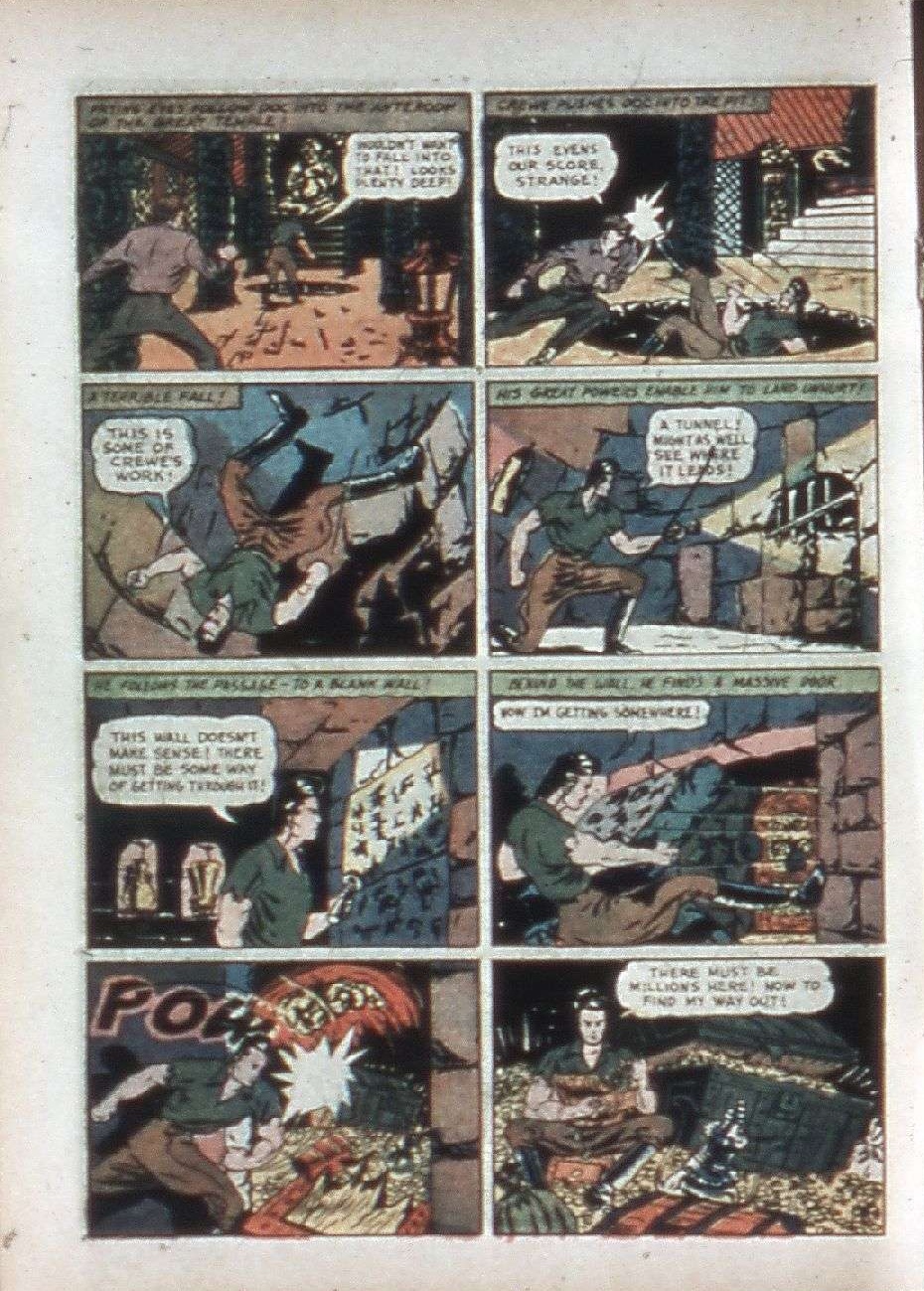
Strange seems to have Crewe dead to rights already, yet after beating up his henchmen and showing off his Nigh-Invulnerable Skin, he just leaves so he can tail Crewe instead. You would think Crewe would be extra-cautious now about Strange and not act so brazenly criminal.

As stupid as Crewe is, his henchmen must be even stupider to nab a girl and bring her to their boss, just for loitering around a giant skyscraper. Strange isn't happy with them either, as he's perfectly willing to toss one of them out the window, knowing it's a lethal fall from that height.


Now this page has some tricky geometry to it. I'm not sure how Strange twists his body to land on the roof across the street, but it definitely appears that he is still leaping instead of flying. And, the fact that he needs to land on the roof instead suggests there is an upper limit to how far he feels he can fall safely.

In game mechanics-terms, maybe an upper limit needs to be put on the Feather Landing power. 

A herb that cures diseases like the spell would be a very valuable item in any campaign, and probably one best to keep out of the Heroes' grasp so it doesn't change the campaign world too dramatically.

Mongols are just wandering around Tibet? Mongolia is about 1,400 miles from Tibet. Seems like more writing done without research to me. Though the artist, Alexander Kostuk, at least looked at some old references for how Mongolians once dressed.
Strange uses his wrecking things ability on a stone wall, a door, and a cage here, demonstrating that a superhero needs the ability to use that game mechanic in quick succession.

What's going on with the guards being drawn like primitive African natives, hurling spears? How does that make sense in Tibet?

Rescuing prisoners is always a good idea, for the "good deed" XP award, the useful information they may have about the hideout, and their Supporting Cast recruitment potential.

Animals never fare well against Golden Age comic book Heroes and the fights are usually over in a single panel. This one, with Strange fighting two lions, occurs largely off-panel!

Once again, Hughes gets his geography wrong. The "Mountains of the Moon" are a legendary mountain range in east Africa, once thought to be the source of the Nile River.
More evidence that ordinary people can make push attacks on superheroes.

Strange wisely carries a flashlight.

Finding a secret door usually includes finding the means of opening it. But, if you just suspect a secret door is there, but you're getting impatient waiting for that successful "find secret doors" check, you can always wreck the wall. If you're right, you will only be wrecking against the door category, even if you can't actually see the door.

Millions of dollars' worth of treasure is usually a campaign-busting find and should be avoided doling out in actual play.

(Scans courtesy of Comic Book Plus.)

Wednesday, August 22, 2018

Funny Pages v. 4 #1 - pt. 2

We return to Mad Ming. No, that's not Mad Ming at the bottom, though it is pretty crazy to think that Chinese people think in broken English.

No, I included this page because the first panel gives us a great image of a single, multi-level encounter area, plus a reminder to use olfactory clues in describing hideouts to players.

Jinny was revealed on the previous (not shown here) page to be a "safe expert, burglar, and all-round confidence woman" -- in other words, a mysteryman. I had been surprised to learn a while back that the Sandman's companion, Dian Belmont, had an identical criminal background, but apparently this was a pulp fiction trope that both stories drew on.

Jinny uses sleight of hand (a basic skill check) to slip him the mickey while his back is turned, and then lock picking (an expert skill check) on the safe.

I love how this story starts in a library! The big book being carried around in the last three panels is how newspapers used to be bound together for libraries. The [something] Pelican is the name of the newspaper; with an unusual title like that, you might think it was a clue as to where this story takes place. Unfortunately, I can't find a single newspaper called The Pelican before 1949.

Never mind that the cottage is "concealed" behind a gaudy gold-colored boulder and a striped blue and gray boulder -- we can excuse that as careless coloring. But pay attention to the fact that The Owl brought dirt samples back to his geologist father to examine for no particular reason. Your players are really hard up for plot hooks when they start doing things like this.


Here we learn that The Owl's father is completely legless. Cooped up in a remote cabin with nothing else to do, and certainly incapable of going outside for a stroll, Dad fends off cabin fever by endlessly checking his son's soil samples and inventing for him.

The owl costume is able to fly at a Move of 200, which is equal to the Fly IV power. Since that puts the Owl in possession of a very high-level power, I'd like to think this is just a trophy item rather than a class ability.

The big dial-like thing on his chest is a touch-activated radio.

The New York Blade was fictional at the time. Interestingly, a paper would eventually bear that name as of 1997, as a LGBT-oriented newspaper. 

This is when we learn The Owl's real name is Jack.

Jack soothes the irate library patroness with a friendly result on the encounter reaction table.

Covering the windshield just as they take that turn too fast...it's another situation that is just about impossible in most game systems to emulate with specific mechanics. Luckily we have the catch-all save vs. plot mechanic here in Hideouts & Hoodlums.  The Editor has to decide if the situation warrants it (I would agree that it does here) and then roll a save vs. plot for the driver, as opposed to the player rolling for his Hero.

Shoily Dimple is almost surely meant to be Shirley Temple.

It's really hard to put a class on The Owl after just one appearance, as he doesn't really do much. I'm inclined to say he's a fighter so far.

(Scans courtesy of Comic Book Plus.)


Thursday, May 31, 2018

Fantastic Comics #2 - pt. 4

Welcome back! We're still on January 1940 and this is still Space Smith. Unlike many features, "Space" doesn't seem to be his nickname -- it's his actual first name!

The science is wacky here -- especially weird, being a Fletcher Hanks story. The effect of "long range power lights" is not altogether clear, but they seem to be holding Space's ship in place.

The same applies to "radio-phonic detectors." It's not just a radio, but some sort of eavesdropping device for listening across the vacuum of space. And how did the ogres hear Space's radio call? Do they have some sort of "radio-phonic detector" too?

And then there's "anti-Earth demolishing rays." How exactly are they anti-Earth? Would they not work against other planets?

Ray-resistant shielding is new. If your campaign has too many rayguns floating around in it, your players will want ray-resistors too.

Ramming with spaceships seems fraught with peril, but ogre's must be very confident in their own shielding. Vehicular ramming damage is something that can be found in the 2nd edition basic book's trophy-transportation section, and even for airborne flying objects the ramming damage can be extremely high. I can't imagine how much damage to assign to ramming with a spaceship.

Are the ogres flying without any aid? The demolisher guns can be fired by ogre-sized opponents as if handguns, and superheroes should be able to do the same regardless of size.


Quick-shrinker bombs can take a 10' tall ogre and reduce them to...not sure, but probably under 3' tall, or at least 70% shrinkage, with a corresponding loss in strength (and, I would presume, carrying capacity, and damage). Of course, I'm assuming Martian ogres are 10' tall; given how stocky they look, perhaps they are shorter.


This is the next story, Captain Kidd, and the real mystery here is, where is Morgia Island? This page says it is in the tropics, and the legend of bamboo torture comes from Asia. But where would you find an island in that area? The South China Sea? Well, maybe; there are over 250 islands there, but none of them are known for having gold...

What interests me far more is the design of that temple. Windowless, accessible only by a front door that is only accessible by going underwater, and vaguely shaped like a cubist elephant -- brilliant stuff!

I'm not sure how the hat keeps the gun dry, but maybe we do need a mechanic to see if guns still work once they're wet. 2 in 6 chance of not firing? Anything to discourage players from overly relying on firearms!

I like the idea of a large statue that works like a slot machine; tug the arm and out pops a whiskey bottle from where his kidney should be!


I like the detail of the grenades mounted on the wall -- thank goodness the natives never mistook them for torches!  It would also be a nice encounter for Heroes to walk into an occupied room, see grenades on the wall, and then whoever wins initiative has a chance to grab the grenades first.

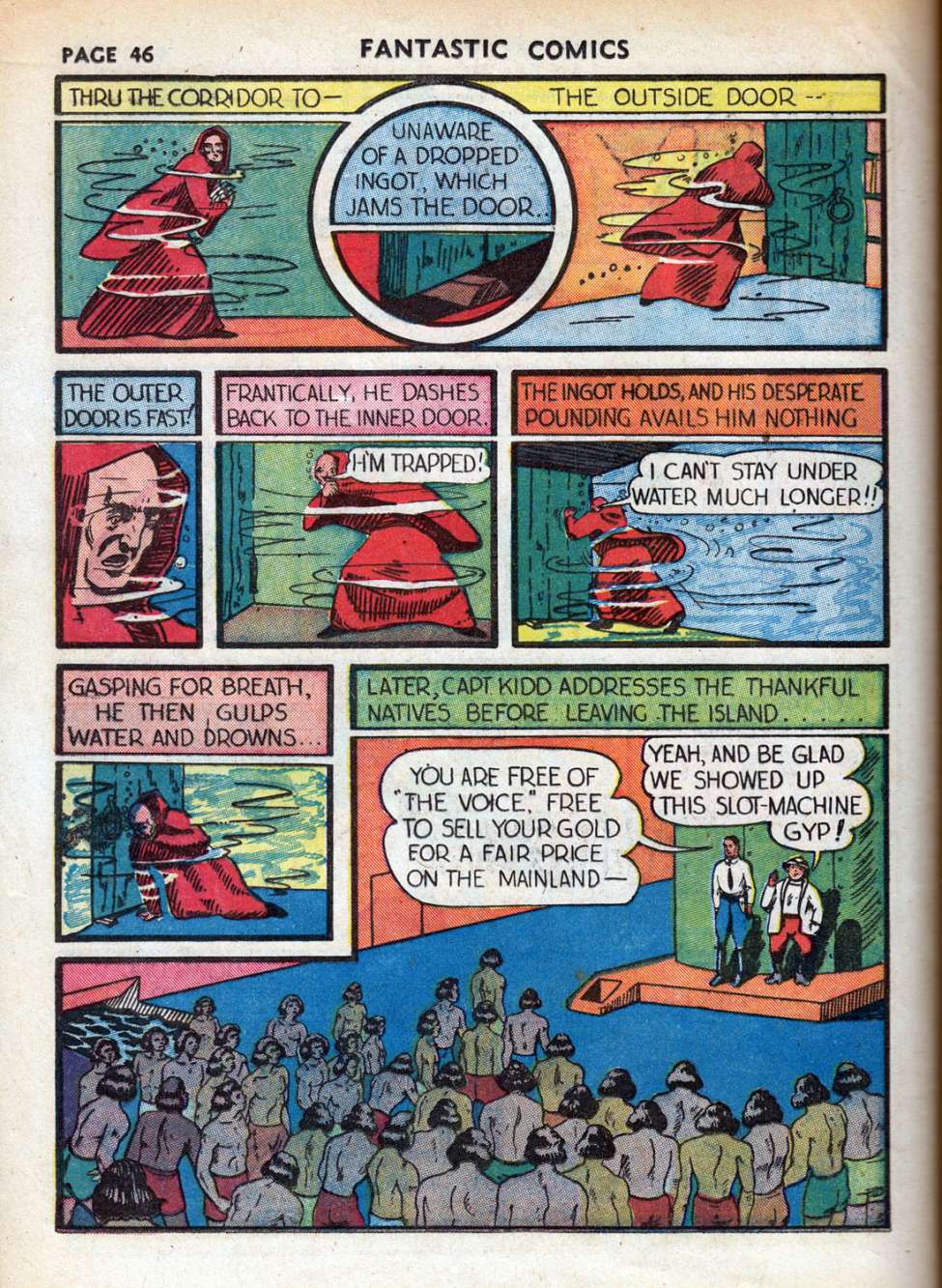
Those gold ingots look pretty heavy, and gold was worth $34.50 an ounce back then.

Oh...so that's why you don't want your front door underwater. Actually, I think the real lesson here is to always have a secret escape route from your temple.

Not sure how Kidd knows the bad guy was called "The Voice," since only the narrator called him that up to this point. Maybe one of the natives told him.


This is from a short humor strip called Professor Fiend. People are out to get the Professor for inventing a raygun that fires (*ahem*) permanent waves and curls people's hair.

Shrinking in order to hide is actually a good tactic, if you have the magic or the science for it. A "normal" potion of shrinking (as found in the H&H basic book's trophy section) stops at shrinking you down to about 6" tall. Here, the Professor shrinks to one-quarter of an inch tall, pauses, and keeps shrinking to the size of an atom (not unlike some future superheroes!).

(Scans courtesy of Comic Book Plus.)


Tuesday, December 19, 2017

Keen Detective Funnies v. 2 #12 - pt. 1

How sad if I wind up having to end out the year on such mediocre fare from Centaur!


Here we have the return of "The Masked Marvel." If some of this art looks familiar, it is because it was featured prominently in Books II and III of 1st edition Hideouts & Hoodlums. We see a master criminal at work with a high number of thugs working for him; I may have to up the "number appearing" range to 1-12 for thugs.


Note how most of them have Tommy guns, except for that one guy who only brought a pistol. Don't bring a pistol to a Tommy gun fight, Muggsy! In hoodlum descriptions, I tend to present a random range of likely weapons. If the Editor has time, he should determine weapons individually instead of having every mobster fight with the same thing.


Or are they all thugs? One or two of them may be gangsters instead, including the lone guy armed with a revolver. Gangsters are a new mobster type in 2nd edition H&H who have a skill for coercing people to get into cars, not unlike what we're seeing in that last panel.


Master criminals are 3+1 HD hoodlums, but I'm wondering if public enemy number one's need to be an even more powerful type of hoodlum. Maybe 4+1?


Here we see how high the bounty can get on a public enemy number one, at least in the comic books. The sum of $100,000 is rather incredible, considering that the bounty on John Dillinger was only $10,000.


I'm also amused by the phrase "that's a lot of sugar," instead of the more familiar to our ears phrase "that's a lot of dough." I wonder how interchangeable these terms were in common parlance of the time.


That Zr, Zy, and Zl can be put in charge of a squad of policemen each, despite having really goofy code names, tells me they must be at least third-level fighters, which makes them the equivalent of sergeants.

It's almost worth mentioning that this story is the first time a sidekick character dies in a comic book. But then, it's just Zl, so no one was ever shaken up over this.

This is Spark O'Leary, Radio Newshawk. The scenario is that he has to prove the Countess is a phony. Now, some players might just choose to beat her up and then frighten a confession out of her, but Spark goes out of his way to collect lots of evidence.

I point out the fingerprint collecting in particular because this is a go-to for my players, despite the limitations on it at the time. They have to remember that there is no national database of fingerprints they can scan for a match in; the local police station can try to match them against the ones they have on file. They can then try contacting other agencies, but it will be a slow process. At best, I would let you have a save vs. plot to try and get results back as fast as Spark gets them here.


What, I wonder, is the origin of the "organ that can create destructive sound"? It's not quite common enough to be a cliche, but it surely didn't originate in this obscure comic book and this Dan Dennis, FBI story. It's worth pointing out that the villain here is called The Fiend.


The organ sure seems versatile; it can not only wreck, but it can "paralize." My first thought that The Fiend was a mad scientist is giving way to a new theory that he is a magic-user and the organ serves as his wand (since he seems to be casting Hold Person here). Too bad The Fiend is such a poor speller...


Players finding trophies may often wish that they were all properly labeled with instructions, like potion bottles clearly (and honestly!) marked with their contents. At least the Editor, in this case, only gave the player a clue as to which button to press on the organ.

Of course, there goes my magic-user theory, as Dan would not be able to use a wand unless he was also a magic-user. It seems the organ is, instead, a powerful trophy item with a range of, at first, random effects Heroes could trigger -- sort of like a Wand of Wonder, until they figure out how to play it.

(Scans courtesy of Comic Book Plus.)