Showing posts with label complications. Show all posts

Monday, March 28, 2022

Rocket Comics #2 - pt. 4

I probably shouldn't be as impressed as I am with the adventures of Buzzard Barnes, and maybe I'm reading too much into things here, but as Barnes and Andy argue over who has the most kills, it reminds me of Legolas and Gimli. In addition, we get to see some of the things you can do during aerial combat, including setting each other's planes on fire, and shooting copilots.


Now this also intrigues me, probably being the first instance of a record being played backwards in a comic book.


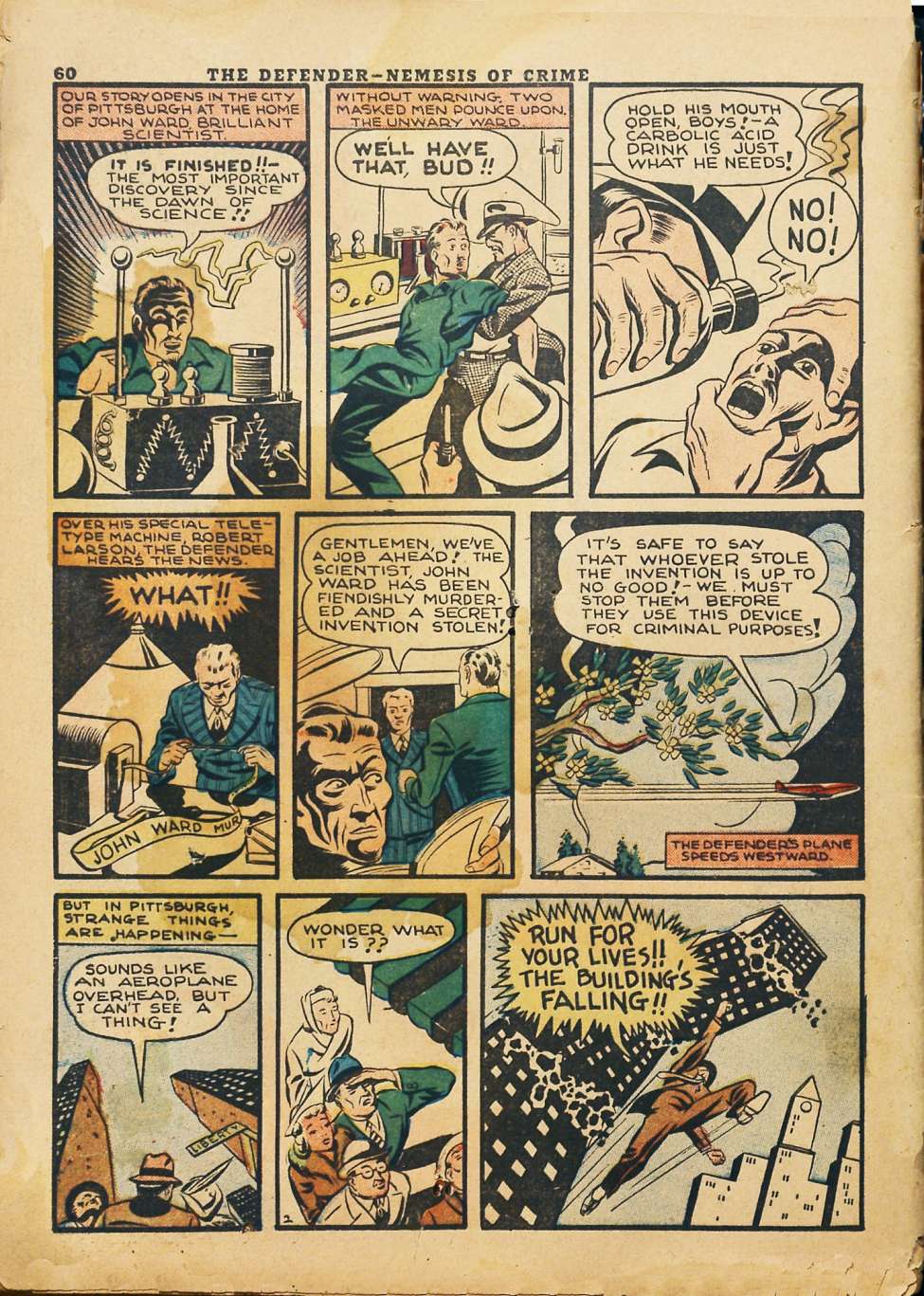
I could tell Jack Cole's The Defender is a blatant ripoff of the pulp novel hero, The Avenger, but an even more knowledgeable fan on Comic Book Plus tells us that this story specifically plagiarizes the third Avenger pulp novel, "The Sky Walker." 

Pittsburgh is an unusual setting for a comic book story and might actually be its first appearance in one. 

Drinking carbolic acid is more of a save or die situation rather than doing points of damage - though I could see it still doing damage even if the saving throw vs. poison is made.

The first invisible plane in comics? I'm not sure about that...might have to go back through the blog to check.

It seems like the Defender is kinda' reaching here...wouldn't it be more likely that Peerless Steel just makes inferior product, than the conspiracy theory that Supex Steel is using a stolen ray from an invisible plane to damage any steel that's not theirs? Well, this is comic books, so...


Here's another mad science invention for your Hideouts & Hoodlums campaigns: a sound detector that can follow specific vibrations over a distance of miles, hours later (as unlikely as that seems). 

You'd think inventing a bulletproof airplane might have been a better use of his time...


I get why it was done this way, for story, so it would look like the villains were getting away, but I hope not too many H&H players will plant time bombs in enemy planes, rather than capturing the villains and turning them over to the police with evidence. Although, on second thought, this strategy keeps me from having to give out trophy planes to my players...

(Scans courtesy of Comic Book Plus.)


Thursday, September 30, 2021

Top-Notch Comics #4 - pt. 2

We're back and, if you've been waiting on me to finish the Wizard's story, here it is -- the Wizard defeats the "Bundonian" sub by lifting it out of the water. That's right, he can lift at least 750 tons over his head, without even firm ground underneath him. As unlikely as that is, I have to wonder if he's not actually using some form of levitation -- contra-gravity discs attached to the hull -- and then is pretending to hold it up just for the showmanship of it? Or, hey, I'd even be willing to accept some combination of the two. 

This ending brings up the issue of what to do in your Hideouts & Hoodlums campaigns when it's well before 1945, but your heroes have already forced Germany, or your German-analog country, to surrender. One possibility is to just keep replacing them with German-analog countries ("Bundonia surrenders...but the next day their neighbors Caledonia declares war on Europe!"). Or the country reneges on their surrender, finding some excuse to invalidate it and then continues the war effort. Or, you and your players agree to a campaign where nothing the Heroes do has an impact on continuity between sessions, as if the world resets each session (very much like many golden age comic books, though I don't recommend this so much for fun campaign play). 

But you didn't come back to hear more about the Wizard, you came back for Dick Storm. Because who can resist Dick Storm? 

Here we find an unimaginatively named Chile analog called Chilan, with an unusual history. It's not too surprising that, 22 years after the 1918 pandemic, people were still worried about plagues, but Chile had not had its own plague during the intervening years. 

I wonder what the president thinks Dick Storm is going to be able to do about a plague. Shouldn't he talking to a doctor instead?


Here is a great example of Hideouts & Hoodlums' abstract combat system, and at the same time an argument against specific hit locations. At point blank range, the assassin could probably hit Dick Storm anywhere, but panel 2 seems to make it appear the bullet is going to land in his right arm or stomach. In panel 3, the bullet lands in his left arm. 

That is the worst outfit for an assassin ever. Maybe not; I suppose pink pajamas would make him stand out even more.

Rana is surprised to see how quickly Dick Storm stands erect.

Pruvians is almost certainly an analogue for Peruvians. In reality, Chile and Peru had been at peace since 1883.

"I have a plan but you need to turn your army over to me for a few days."

"Sure, what could go wrong?"

"I'll also need access to all your bank accounts. And -- heeyyy...if you're Chileans, why is your daughter blonde?"
"Rana! Despite parading around in a cocktail dress, you've managed to sneak past my entire air force and reached that plane!"

Dick swings into action! Honestly, I can't even make fun of this stuff anymore because now I think the author is in on all the jokes.


To their credit, these soldiers have had about five minutes of uninterrupted stare-up-a-dress-time as the parachutists descend, but their thoughts are entirely on Dick Storm when they reach the ground. 

The fact that the general is still standing there unarmed in panel 7 as Dick Storm is attacking him seems to suggest Dick is enjoying a surprise round, but I don't think the circumstances here would have warranted a surprise roll. Rather, I think Dick won initiative and the Editor had made no statement yet of the general's intentions. It's also possible that the general is holding his gun in the shadows of his uniform; his whole right hand seems malformed, as if hastily drawn.

In a chase sequence, the desk in the way would be considered a complication to overcome, but in a combat sequence, this panel is correct; in H&H, you can ignore obstacles in your way during melee, unless you choose to incorporate them into your flavor text (or, obviously, if you plan to pick it up and use it as a weapon!).

I remember this scene from the first Indiana Jones movie. Plane propellers are nasty weapons; I'd put this at least in the range of 3-12 damage, so no wonder the soldiers are running. 


You might have guessed that Dick Storm's plan turns out perfectly and Chile surrenders after Dick arranges for a lot of them to die. So we're going to jump way ahead towards the end of the next story featuring Moore of the Mounted. Here we see an example of a trap as a wandering encounter. This page also shows us a good example of Lawful and Chaotic Alignments and how they differ in this scenario.

Technically Sgt. Moore is right; an Olympic skier can achieve downhill speeds of ten times someone running on foot, but the average speed of the average skier is more like 2 1/2 times faster (Movement rate 30 as opposed to 12).


And now we're going to make one last jump into the next story, Streak Chandler of Mars. I think from just this one page you can tell the backstory borrows heavily from Flash Gordon, with the wrinkle of the gangsters forcing them all to leave. Streak's problems are a frequent staple of the sports genre. The art isn't very good, but doesn't Streak look awful old to be a college football player?

(Scans courtesy of Digital Comic Museum.)


Wednesday, March 31, 2021

Keen Detective Funnies #19 - pt. 1

WOOOOOO! Finally! Finally, made it to April 1940, after being stuck on March 1940 for the longest time. But will the stories get any better? Uh-oh -- we're back to Centaur Comics...

We're going to start with Spark O'Leary, and the upteenth time someone in comics has invented a method of invisibility! Kudos, at least, to getting the optics of it kind of right, that it would have to bend light around an object instead of reflecting it, though how it makes hands invisible when they're left uncovered is unclear. And is it dangerous to wear the suit? Is that why it needs a built-in gas mask?


There is a lot of plot convenience on this page. One, Spark just happens to leave the press conference early, which seems to be a terrible thing for a "newshawk" to be doing, but otherwise he wouldn't already be on the road to see the kidnappers, who just happen to drive past him. 

The story completely glosses over how Spark manages to sneak into the building unseen, and then how the two men manage to sneak out unseen. But then, these are some pretty nearsighted mobsters, because they completely miss the car just sitting off to the side of the road. Perhaps we can at least give Spark credit for having Prof. Doran lay down in the backseat, rather than visibly sitting shotgun, but it seems a risky move when more careful mobsters might have stopped and checked out the suspicious vehicle.


An old flivver conveniently blocking the road is just the sort of examples of chase complications I need to expand my table, and the owner of the flivver also being an ornery sheriff is just a bonus complication. But how they resolve the problem leaves me very suspicious of who's side this professor is really on. And how impressionable is Spark that he immediately goes along with this plan to run a sheriff off the road into a pond, where he might drown?


It's very rare for early trophy items in comics to have this kind of built-in weakness, like having water short-circuit them. 

In anyone else's hands, having an invisibility suit would be the origin story for a new superhero (indeed, that's precisely the Invisible Hood's origin story!), but Spark simply gives the suit back when he's done with it. 

Spark is, again, unconcerned when he is out-scooped by another reporter, on the same story he should have been on top of, and instead of being concerned about this mysterious-sounding fire, he just shrugs it off like it's no skin off his nose. Way to avoid your next plot hook, player! 

We're going to jump to the end of the next story, Dean Masters, D.A. Dean has apparently gone out and bought this trophy item, a magnetic cane. It allows him to control rigged roulette wheels and, I presume, pick up his dropped keys without bending over. How it cut wires isn't clear; it would be cool if it had a concealed pop-out blade in the foot of it, but such was never shown.


Now we'll jump into Spy Hunters, for a very early, very rare example of breaking the fourth wall in a serious adventure story. Eat your heart out, Deadpool!

Brest is a real city, a port city in the Finistère département in Brittany.

The Maginot Line of defenses had been installed along the German border throughout the 1930s and would be familiar to most American readers. This comic book, though cover dated April 1940, would have come out in January, four months before the Maginot Line became irrelevant. 


I usually share any maps I see in old stories, in case they could be useful later in planning game sessions or published scenarios...but I'm not even sure what I'm looking at in this map. I wouldn't have much confidence in a military campaign relying on such a map. 

Salzwedel is a town in Saxony-Anhalt, Germany, so it's optimistic, if not poor forecasting, to assume France would be taking the offensive into Germany soon.


I wouldn't be bragging if I won a fight with 30:4 odds, but this is always possible when you rely on random wandering encounters instead of planned encounters. The dice give you breaks sometimes!

A subaltern is an officer in the British army below the rank of captain, especially a second lieutenant, so this wouldn't be a term you'd be using to describe German soldiers.


This is from Dan Dennis, FBI. Polly spotted Dan and Tick shadowing her because he failed a skill check or a surprise roll (the Editor could handle that either way), and then she tries to throw them off by handing the package to someone else and splitting up, so Dan and Tick have to split up to follow them both. This could work particularly well against H&H players, as not splitting up is so ingrained in their training.

St. James Place may seem familiar to most of us from the Monopoly board, but it's also a fairly common place name. We can't know for sure if this is the St. James Place in Brooklyn, or Chicago, or somewhere else.

(Scans courtesy of Digital Comic Museum.) 


Friday, March 5, 2021

Colossus Comics #1 - pt. 1

Wow! I have been reviewing comic books from only the cover date of March 1940 since August 2019. It's hard to believe it's taken this long, and makes me a little fearful of how long it's going to take to get through April! But now we are on the final issue available to me from this month, the one and only issue of Colossus Comics from Sun Publications (one of only two comic books they ever produced). It reads like a cheaper knock-off of Planet Comics...but I'm getting ahead of myself!

First we get a glimpse of the 27th century. We know from this page that mankind has colonized the solar system at least as far as Jupiter's moons by then, and that we've gone back to manned, moon-bound telescopes instead of automated satellite telescopes. Because this is the second attack of the Plantaliens -- vicious-looking Mr. Potato Heads with spaghetti-like green tentacles -- we get a "oh no, not again!" reaction and not a "we've finally encountered other life in the universe!" reaction. So we don't know from this story if this is the only other intelligent species out there. 

Getting permission from a patient before injecting an untested drug into them is apparently not a thing anymore in the future. Darn you, lax medical malpractice laws!   

Oh, girls are so ditzy! How can you expect them to notice the difference between 2/100th of a part of a catalyst and a portion 10,000 times larger?

 2,000' tall may or may not be a record for largest giant in a comic book to this point; the moon giants in Flip Falcon would definitely give him a run for his money. Thank goodness his clothes (somehow) grow with him!


That's right, technology has still not replaced the zipper by the 27th century -- unless Zenith just likes to wear super-retro clothes. Incidentally, if 20th century clothes were the retro-fashion of the 27th century, that would be akin to people dressing in 13th century garb in the 20th century to look retro.

I'm curious about that threat that he could crush them with his breath. I don't know how even the Mythbusters team would test that one. If we accepted this at face value, we'd have to assign damage to his breath, since Hideouts & Hoodlums currently has no wind-based powers that do damage.


Urbania is either a renamed city or a city that doesn't exist in our time. 

In the future they still have televisions with poor color quality, and use telegrams instead of, oh, an electronic version that transmits over some electronic device.


Here we see the Colossus using his breath to Wreck at Range, though at a distance of 2,000' it's more of an inconvenience than a threat.


You know, it's really annoying that we never get any frame of reference for the size of the Plantaliens. I'm tempted to stat them like a D&D roper, but what if they are only 2' tall?

So, these are fleets? I'm seeing 5 vs. 6. 

The range on those ground ray batteries/electric rayguns is fantastic; they can reach from ground level to the upper atmosphere.


It's not clear from this story if the Martians and Venusians are Earth colonists or aliens.


As odd a futuristic story as Colossus AD 2640 was, the Educational Adventures of Panda-Lin is much weirder. Why does the panda have a P on his chest? Who knows.

I'm showing you this page because of the unusual flying carpet that's a split bamboo mat. Magic items can be shaped to fit the culture they came from.


We're going to end today with just this one page from Lucky Lucifer, Flyer of Fortune. The artwork is so terrible I'm almost embarrassed to have it on my blog; I could find 5th graders who can draw better than this. I share it for two things. One is the concept of Heroes having an emblem on their vehicles that identifies them -- this is long before Batman gets his Batmobile. 

The other is the concept of a direct hit. Critical hits are a house rule almost as old as D&D itself, and in any d20-based game using criticals, it is usually treated as a natural (unmodified) roll of 20 on the die. But what if a direct hit was rolling the exact target number for the Armor Class? Against a live opponent, your direct hit might do +1 damage, or against a vehicle automatically cause a complication (like here, where the engine catches on fire).

(Scans courtesy of Comic Book Plus.)


Sunday, January 31, 2021

Adventure Comics #48 - pt. 3

When we left off with Socko Strong, he was confronting Monte on the wing of a flying plane about Monte's attempts to kill him. In a clever trick, even though both parachutes are actually fine, Socko pretends he switched parachutes on Monte to give him the "sabotaged" one. You would think Socko would use this trick to make Monte confess, but instead Socko pushes him off the wing to panic him, just to pay him back.

Moving on to Steve Conrad, Adventurer, we find Steve on a cruise where he spots and recognizes 'Singapore Sal,' a notorious jewel thief (perhaps after making an INT ability score check?). When she leaves the deck, Steve is surprised she didn't notice him, suggesting they've met before (and letting us know that Steve had surprise in that encounter?). Sal's partner is called Slick -- he's almost surely a slick hoodlum. Steve comes up with a pretty clever trick where he has his comic sidekick slip a handwritten, signed note by Steve under the door, then listen to the two of them talk about their plans through the door after they read it. 

The next wrinkle in the story is that Steve tries to stop the valuable jewels on the ship from being stolen. The would-be thief appears to be Slick, but he's wearing a mask and, surprisingly, he manages to get away from Steve easily after just hitting him once with a sap (and not even a head blow at that). When Steve confronts Slick he discovers it wasn't him -- Slick is not wearing the same jacket and hasn't had time to change it. Although the wrinkle requires a bit of railroading to let the thief escape, it winds up being a pretty interesting wrinkle. The clue turns out to be the cord Steve tore off the thief; he doesn't know where he's seen it before until he remembers it was holding another passenger's monocle in place (if the player had trouble thinking of this, maybe he was allowed to "remember" after an INT check). 

The only other thing I'm going to say about the Steve Conrad story is that it is extremely verbose with big word balloons in almost every panel.

Am I just going to have to accept that it's a lot easier to throw a missile weapon hard enough to pin it into a wall in comics than real life? In Rusty and His Pals, Rusty manages to throw a spear -- and it's not really a spear, it's just called a spear in the story but it's clearly a lance -- across a room, knocks a man's gun out of his hand, sails right past him, and still hits the wall hard enough to become embedded into it. Did I mention Rusty looks like he's 11 years old? You know...sure, why not. Embedding in the wall is just flavor text at the end of the combat turn that doesn't affect the disarming attack or anything in the following turn. 

Having cleared the bad guys out of the house, they consider the clue they have, that they're supposed to look "behind Stevenson," and then they figure out that there's something in the library behind a copy of Treasure Island -- a clever clue, so long as no one felt like reading it and took it back to their room, of course. Behind the book is a button that opens a secret door. The boys realize they need to consider illumination issues behind the secret door so they all fetch candles. They mysterious passage looks straight out of D&D, leading to a small room with a chair, desk, and a small chest on the desk. The desk contains both a clue, a journal, and a secret clue concealed in a false top -- a single sheet of paper, the contents of which we'll find out next issue.

In Anchors Aweigh, we hear about the trick of putting cotton in your nose to make it look broader, when disguising yourself as someone with a broader nose. There is an interesting wrinkle to the story where Kerry finds out the man he's impersonating has a wife who he has to push away without making her suspicious. The last page, though, is terribly confusing. When the Naval officers burst in on the smugglers' headquarters, they leave the driver tied up in the elevator. The driver, trying to escape, makes the elevator go down with his feet. Somehow, the elevator doors do not close on their own (did elevators not have automatic doors at this time?), so the boss smuggler backs up to the elevator and falls. But...somehow he falls onto the driver at the bottom of the shaft and not onto the roof of the elevator car. Were there ever roofless elevators?

Lastly, Cotton Carver and Deela crash-land in a petrified valley where the challenge of this scenario is finding food! On day 2, they find a tree with edible berries (skill check to identify they are not poisonous?). Hunting for meat, Cotton knows he will run out of bullets soon, so he builds a bow. The terrain gets progressively worse for them; they come across a chasm thousands of feet deep filled with hot geysers, and at their backs they encounter three ape men armed with warclubs weighted for throwing. The ape men seem unusually intelligent and manage to defeat Cotton, then carry them away down to the bottom of the chasm by leaping from branch to branch growing out of the rock wall. Cotton was only stunned and cowardly shoots the ape men in the back (I guess with his last bullets?). Too bad he didn't try to talk to the ape men, because it seems like they could talk. They probably also were responsible for making the stairs they find, and the tall ladders that lead to the top of a volcanic cone. The volcanic cone is dangerous because of poisonous fumes in the air. Both of them make saving throws vs. poison and Deela fails, faints, and falls off the ladder. Cotton grabs her with an attack roll, then makes a Strength check, probably with a significant penalty (-5? More?) to continue climbing the ladder one-handed, while holding Deela with the other.

(Read at readcomiconline.to)


Tuesday, October 6, 2020

Popular Comics #49 - pt. 3

UGHH...the new Blogger is so terrible, I hate to even work with it. We'll see if I can plow through and at least finish this issue.

Captain Tornado finally earns some points -- despite how Jane is dressed, he keeps his eyes facing nice and high -- and then promptly tosses them away with senseless violence. "Giant eyes! I can't even see what it is, if it's dangerous or not, or what it's intentions are -- but I'm a'gonna shoot it anyway!"  
That's a pretty dynamic first panel for a strip this otherwise...well, I still don't know what to make of this strip. Let's try to work it out together, shall we? 

Pro: Moon Mountain Manor sounds like a great name for an adventure module.

Pro: Although the Village of Rose Hollow seems to be fictional, there is a Rose Hollow Valley in Baxter County, Arkansas that is near the Ozarks.

Con: A minor quibble, but newspapers don't print their headlines in color.

Pro? Con?: The story turns conventions on their head by having the unattractive scientist in the lonely laboratory overlooking the village be the hero instead of the villain.

Con: The laughably named Mancho Phyroe. Mancho makes me think our hero is Spanish, but what to make of Phyroe...?

Using field glasses to read cablegrams at a distance is a sound tactic.

"Yugrarvia" surely refers to the then-Kingdom of Yugoslavia.
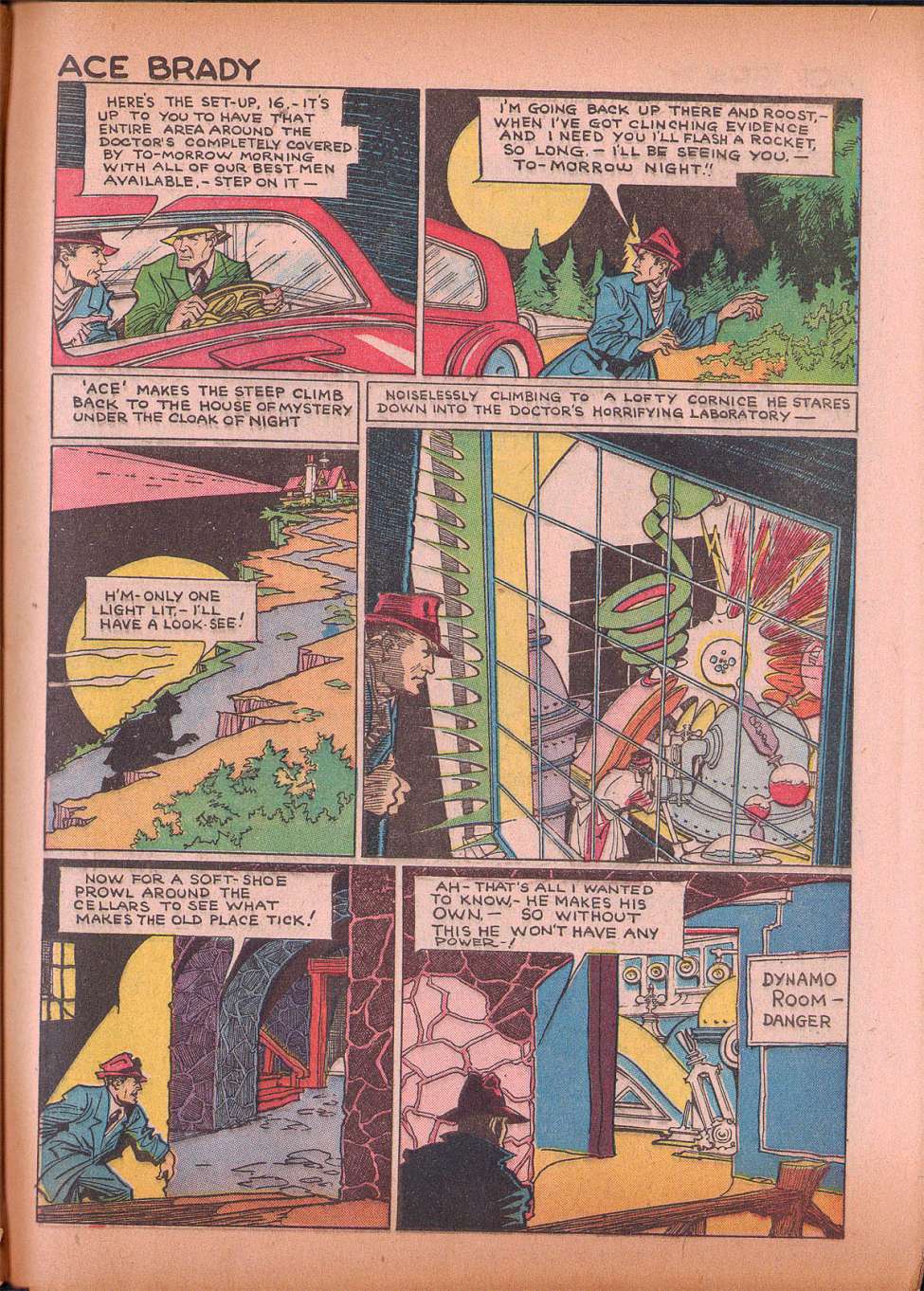
This page brings up a good point about the importance of thinking about where your hideouts are getting their electricity. If from the local power grid, it is too easy for the Heroes to turn that power off, but if the hideout has its own dynamo, you must place it somewhere. 

I am wondering what is supposed to be so "horrifying" about that laboratory. It looks more "intriguing" than anything.

"Soft-shoe prowl" is a cool term.
This is a rare occurrence of a Hero using a chimney to navigate vertically through a hideout, but it is a good idea to be prepared for this in-game.

I'm amused by, not only how the death ray says "death ray" on it, but that he's advertising it took nine tries to perfect it. 

There are no unexplored frequency bands in the vicinity of the X-ray; those are ultraviolet rays and gamma rays.

1,000 miles is a crazy long range for trophy weapons, but not that unusual in the comics. Consider carefully its effect on game balance, since players can get their hands on these. 
Wing-walking was a stunt for Aviators in 1st edition Hideouts & Hoodlums.

Gas tanks exploding is a fairly critical complication for aerial combat.
Shark is smart to rescue his opponents, as it does give him people to question for information.

In 1940, the "medical magic of the hypodermic" likely refers to morphine.

Here is a rare occasion of Asians speaking an actual foreign language instead of broken English.
The Syndicate sounds like a criminal organization, but here seems to be refer to a national alliance (the Axis, perhaps?). It does not seem to be a coincidence that the bad guys here seem to be Japanese.

Being able to throw destroyers against the Heroes does make it a seriously high-level challenge.
 
(Scans courtesy of Comic Book Plus.)

Sunday, September 6, 2020

Popular Comics #49 - pt. 1

The radio drama allegedly always used true cold cases from the FBI files, and the Gang Busters comic strip at least started out the same, but how true is that by 1940? I can't find any evidence of an actual FBI agent John Winston, though Winston being the middle name of John Lennon is, admittedly, clogging my search results, and there's no reason why the name couldn't have been changed to protect a still-active agent's identity.

Richmond, Virginia is of course a real place. I can't find a Calvert Bank in Richmond, but there is a Calvert Drive in Richmond, and perhaps there was once a bank there? 

The Tri-State Gang was real. According to the Sword and Scale website, their crime spree ran "through Pennsylvania, Maryland, and Virginia during the early to mid-1930’s."

By this page, the scene has shifted to Baltimore, Maryland. The names of the streets seem to have been changed to ...protect the innocent streets. Although there is a Harvey Street in Baltimore, it is commercial instead of residential, and doesn't intersect with an Elm Street. 

The map hardly seems necessary, since the maneuver of blocking the intersection with cars is really not elaborate. 

The story of the Tri-State Gang is actually pretty interesting, but you wouldn't know it by this rushed retelling. Indeed, the Gang Busters comic strip often has a bland sameness to its stories.


So we'll skip ahead into Martan the Marvel Man. I'm pleased with what this installment is trying to do, showing us Martan and Vana getting to know Earth, but I'm skeptical that they would immediately understand our comedy as quickly as they do here. Even more interesting is that this is an alien invasion story, but with the twist that Martan and Vana are on the ground with regular people and get to see how they react and deal with it.

The locations are worth mentioning here. It's unusual that the aliens land somewhere in New Jersey and San Francisco and not more obvious targets, like Chicago, New York City, or Washington, D.C. Likewise in Germany, the aliens skip Berlin and are landing in less important areas of northern Germany.  

On a page I'm not bothering to share we also learn that the invaders are Martians, but the story ends with us still not even having seen the invaders yet. Maybe next time!


I am leery of this page because of the gruesomeness of that final panel, but two points here: one -- and we've seen this elsewhere before (and done better) -- is the idea of mistaking dinosaurs for dragons, or having dinosaurs and dragons be one and the same thing. It's a fanciful idea today, but much less was known of dinosaurs in 1940, so it would be easier to equate them with fantasy creatures. 

Second, and going along with how less was known about dinosaurs, pterodactyls are here displayed acting like carrion-eating vultures, when they were actually fish eaters, more like seagulls and albatrosses.  

Again, pretty gruesome, but I appreciate that the author knew the poisonous fumes are at least as dangerous as coming into contact with the lava (oops, Jurassic World 2 seemed to have forgotten that!). I would say anyone within 10' would need to save vs. poison or take ...let's say 2-8 points of damage from it, per combat turn within that distance.


Rekra is a weird name, but it actually is a name! I'm not entirely sure from where, but Google searching seems to be pointing to it being Slovakian. So this Slovakian spy has a gas gun and gas mask. Well-outfitted! This is a variant gas gun too, one that sprays paralyzing gas instead of sleep gas (both are chemically fanciful so, why not?). 

Oil line to motor broken is a good random complication in aerial combat (though this time it's being faked by plane thieves!). 


Out of the Sun was an aviator stunt in 1st edition Hideouts & Hoodlums, and here is used to give the Masked Pilot a surprise bonus while tailing the hijackers. 

This could be the earliest mention of Nicaragua in comic books. It's interesting that Nicaragua, being a neutral county in this story, gets to keep its name, but the villainous country is called "Vulcania." It's pretty easy to figure out which country that is, as El Salvador is known as the Land of Volcanoes. Although ruled by a dictator, Nicaragua was at least officially on the side of the allies during WWII. Although Nicaragua's dictator, Somoza, was corrupt, he wasn't as bad as El Salvador's dictator at this time, Matanza, who had more than 30,000 of his people killed.

(Scans courtesy of Comic Book Plus.)