Showing posts with label Sandra of the Secret Service. Show all posts

Tuesday, September 29, 2015

More Fun Comics #30 - pt. 1

Just when I was convinced that "hide in shadows" should be a class-based instead of a race-based special ability, a page like this comes along, where Sandra of the Service is shown to be hiding in shadows.  So what's going on here? Can all humans hide in shadows after all? Should this be a special ability for the Spy class, or is Sandra a Mysterman? Is hiding in shadows going to become a stunt accessible to many classes?

The only thing I can say with any certainty is that the Spy class (an unofficial class from The Trophy Case) will not make the cut into 2nd edition Hideouts & Hoodlums.  It may be too specific an archetype, while Hero classes should be broad enough to be used for more than one. Also I've just received no feedback from players interested in playing one.


Good call, Sandra. If your player had been careless enough to have you shoot into a dark room, crowded with combatants, I would have rolled randomly to hit any target, friend or foe, regardless of how well you rolled on your attack roll.


I'm still unsure if Doctor Occult is public domain or not, so I'm going to continue to err on the side of not sharing these next pages -- which is a shame, because we see a lot of H&H-relevant material in them.

An old soothsayer performs a seance, not unlike the seance ability of the Trickster class (from The Trophy Case v. 1 no. 4). The trickster is more likely to end up as a mobster-type in 2nd edition than a Hero class.

The seance goes wrong and summons an elemental. Elementals, in Dr. Occult's world, are supernatural and composed of ectoplasm instead of an alchemical element.  Elementals can possess people.

We also observe Dr. Occult and the elemental-possessed soothsayer in a contest of wills -- an optional rule for Magic-Users that debuted in The Trophy Case. A slightly altered version just appeared in Supplement V: Big Bang.

Meanwhile, Jack Woods reminds me that I should have made a Cowboy Stunt called Make Shoot at Hat. For 1 turn, all opponents must save vs. plot or shoot at the exposed hat instead of the concealed Hero.
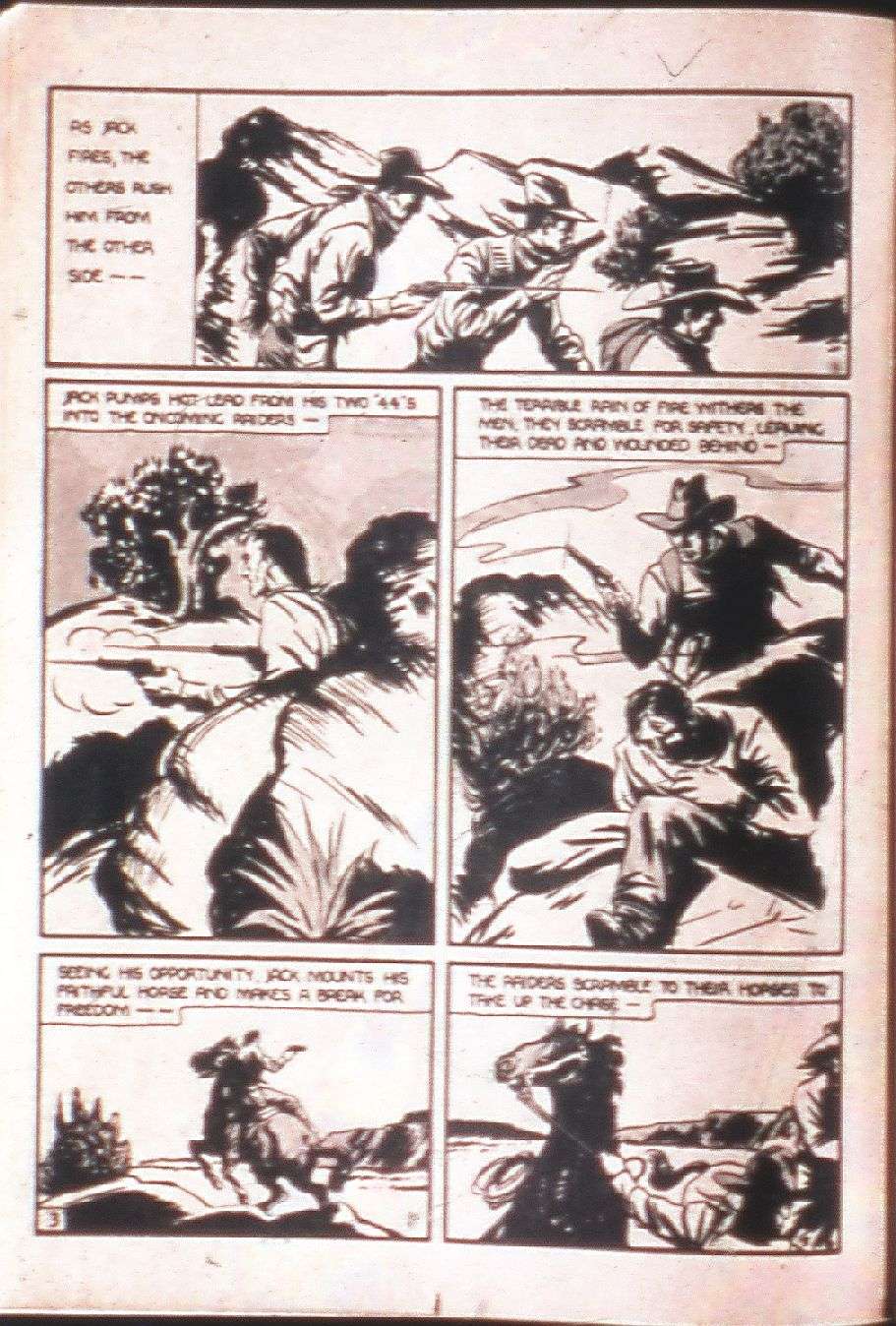


Comic books seldom specify what type of gun is being used, and I now see it as an error that I specified so many types of historical guns on the starting equipment list. That said, this page clearly refers to Jack's weapons as being .44's, and are probably Winchester .44 revolvers.


Some amounts of climbing, like up a steep, rugged slope, or maybe even the side of a building, should be accessible to all Heroes. This, though...climbing a sheer wall, straight out of water? This has to be a special skill -- either performed by a Mysteryman (which Brad Hardy doesn't seem to be) or a stunt usable by Fighters (as Brad Hardy definitely seems to be).


It really seems like Wing Brady's player rolled a fumble in this combat. Criticals and fumbles are house rules in some games, and official rules in others. I have decided to avoid both for H&H -- I would rather the Editor control the flavor text of what happens in combat, bearing in mind the mood of the campaign he is aiming for.


(Scans courtesy of Comic Book Plus)


Monday, August 24, 2015

More Fun Comics #27

Sandra of the Secret Service encounters one of the first gas guns in comics, well before the debut of the Sandman. Gas guns are a trophy item statted in Book II: Mobsters & Trophies.


This issue's Dr. Occult story is a tricky one. We have seen Dr. Occult (although he was called Dr. Mystic at the time) travel through other planes before, but here the implication seems to be that Dr. Occult can follow "trails" through the spirit world to places he doesn't know. This would seem to combine ethereal travel with a spell like Find the Path, which sounds like it would be powerful enough to at least be an 8th level Magic-User spell. Since I doubt even Dr. Occult should be high enough in level at this time to be casting spells of that level, there must be something else going on here.

I propose, then, a new spell called Improved Locate Object, or something like that, which not only tells you where something is, but allows you to get there twice as fast you can normally travel. The story doesn't actually support that Dr. Occult knows an object from the crime scene, but perhaps there is more going on there that is behind-the-panels. Also, travel through the spirit world could be a flavor text description of how you travel at x2 speed to your destination.  The range would have to be pretty good for this as well, at least twice the range of a normal Locate Object spell.

Dr. Occult battles a new mobster called the snake-god.  It appears to be a giant constrictor snake, but is intelligent and able to hypnotize with its gaze. I'd give it at least 5 HD, and possibly as high as 7 Hit Dice.  The death convulsions of a snake-god are particularly vicious, so that anyone in 10' would have to save vs. plot or take 1d6 damage from being smacked by a dying snake.

 Dr. Occult also casts Enlarge (or Enlargement) on himself, which definitely should increase strength and give a damage bonus in some way.


Moving on, we have this page from the Fang Gow serial, showing Barry O'Neill lassoing a rooftop and crossing that rope hand-over-hand. Lassoing has been talked about before here; what I wanted to bring up was when and when not to require saving throws.  At first, Barry is not threatened or under any pressure to hurry while crossing the rope. He has no encumbrance weighing him down. I would not make him roll any dice to determine if he makes it across safely.  Only once he is threatened -- in this case by the rope being cut -- would I consider requiring a saving throw vs. science to keep a hold on the rope.


This page of Pirate Gold, with its whipping scene and improvised weaponry, strikes me as a solid case against all weapons doing the same 1d6 damage.  If a whip could do 1d6 damage per lash, not many people would get past the first lash!  I also have trouble accepting that a thrown rock and an auto pistol do the same range of damage -- but maybe that is an example of comic book logic that I should not think about so much!


Brad Hardy has been facing a lot of weird underwater threats for awhile now, but this one is a giant barracuda! Curiously, the barracuda looks like a swordfish in the last panel. I would make a giant barracuda 12' long, weigh 800 lbs., and have 4+1 HD.


In The Yucca Terror, we see the Cowboy stunt Summon Posse at work.


(Scans courtesy of Comic Book Plus)

Monday, July 27, 2015

More Fun Comics #25

We'll start this revisit of More Fun with Sandra of the Service and this question -- in Hideouts & Hoodlums, do non-Heroes have to roll to notice things, like the men on the larger boat spotting Sandra's rowboat? It does make the game more fair if everyone rolls and plays by the results of the dice rolls. If, however, a specific result would make for a better story, the Editor should hand-wave the dice roll, or fudge the results to a better one. The most important thing is that the players should never feel cheated by hand-waving of dice fudging.


A seemingly simple, 2-page story of Doctor Occult, the Ghost Detective, actually requires a lot of unpacking. One point is that, in the climactic scene, the scientist seems to be casting a spell, one that can transmute, or polymorph, a human being into a small statuette. It's worth pointing out again that the narrator specifically refers to the villain as a scientist.  

Another point is that we see Dr. Occult's magic symbol reflecting the spell back on the scientist. Now, this seems very much like the Superhero power Turn Gun on Bad Guy, but the scientist has no visible weapon. A less literal interpretation of the power might allow it to reflect any form of attack. Or perhaps we need a new spell for spell reflection. 

The difficulty we're seeing here in Doctor Occult we've seen before -- it's the trope of magic and advanced science being indistinguishable and it tends to play havoc with a set of game mechanics that tries very hard to keep magic and science separate. Ultimately, I'll have to look at whether this is really the exception, or is it the rule, when dealing with magic in comic books. The latter situation could require a drastic overhaul of H&H.

Less dramatically, Johnnie Law deals with the threat of -- marijuana!  Reefer madness will occur frequently in comics until all mention is squashed by the comics book code in the 1950s, and it will be interesting to trace all the permutations of how the effects of marijuana were perceived by the average comic book artist, who was almost always too square to know anything about the drug other than its name. Here, we learn that marijuana causes hallucinations and fits of violence. 

(Scans courtesy of Comic Book Plus)

Tuesday, July 21, 2015

More Fun Comics #24

Sometimes things don't go as planned in a Hideouts & Hoodlums scenario. Sandra of the Secret Service can attest to that. Here, she and her guy-friend have gotten themselves captured again and can't figure a way out of this. What is an Editor to do?  In unsubtle fashion, you let the Heroes find a sheet of paper with instructions on how to find a secret escape route. There's no official game term for this, but you can call it a freebie.


There are freebies, and there are things the Heroes are willing to pay for. Here, Wing Brady's player could have trusted to the luck of the dice on his encounter reaction roll, but he's decided to sweeten the deal and improve his chances with a $5 bribe. As the Editor of this scenario, I'd be willing to give him a +1 bonus to the roll for the bribe.

Roleplaying should matter, though, so I'd also be willing to give him a -1 penalty to the roll for being kind of a dick. "I gave you five bucks to drive the cat, not to ask questions" indeed!


This month, Brad Hardy learns that there is arm wrestling and there's ultimate arm wrestling. The first one to lose a save vs. science and fall off-balance from the bridge lands on the...well, what is that creature supposed to be, anyway?  Some sort of giant catfish with tentacles? It sort of reminds me of the AD&D monster called the aboleth...


One of the best things about reading these old comic books is when you see a cool idea for an encounter area that you've never seen in a game scenario before. Bat infested caverns might be pretty common place, but ones with "sentinel-like stalagmites" taller than the Heroes? Navigating a maze of stalagmites? Sounds intriguing!


We're still months away from the debut of Superman. We've already seen one prototype, in Dr. Occult. Is Bob Merritt another? Here, he topples boulders and collapses tunnels with just a sword (yes, a ridiculously huge sword!). These feats of strength seem more appropriate for the Superhero's wrecking things game mechanic than anything a Fighter should be able to do...

And, lastly, there's Jack Woods, modern-day cowboy. Low XP-value trophies should be items that are only slightly better than ordinary. So, taking a bad guy's car would not net you any Experience Points, but a high-powered car, that might be worth 100 XP?


(Scans courtesy of Comic Book Plus)

Thursday, July 9, 2015

More Fun Comics #23

You know you're dealing with 1st-level Heroes when the main villain, instead of putting you in a deathtrap, makes you cook in his kitchen -- and then the chef beats you up.


Remote-controlled armored cars. You know you want one. Ram it through the entrance to the well-defended hideout. Run down bank robbers in the street from the corner deli.


The trouble with the abstract nature of combat in H&H -- the arrows are clearly sticking out of the Black Knight's armor, so was he "hit" by the arrows or wasn't he? One could use a panel like this as evidence of armor absorbing damage, but on the other hand, it also shows that the Black Knight has taken no physical damage, so being "hit" is more about the ability to inflict damage than contact.

But, if that is true, then are to-hit rolls the best game mechanic for resolving grappling attacks, which are about contact more than inflicting damage? Food for thought...

(Scans courtesy of Comic Book Plus)

Friday, July 3, 2015

More Fun Comics #22

This isn't so much a playing tip, but this page of Sandra of the Secret Service amused me, reminding me of my new players in a game of Hideouts & Hoodlums, and how tying people up and hiding them in closets was their go-to plan for a significant portion of our first session...


Hey, look! It's another villain, pushed backwards off a cliff and dies!  As often as I'm seeing this, I'm thinking that a "push back" or "bull rush" combat mechanic isn't the solution here. What this needs is an -

Official for H&H: The Falls off a Cliff and Dies Rule

Any time a Hero is about to get killed because of unlucky dice rolls, and you don't want it to happen (because it will spoil the narrative of the story, send a player home unhappy, etc.), you are free to have the Hero's opponent fall off a cliff and die. It is preferable, but not essential, that a cliff actually be present in the scene. 


The bad guy has the drop on our Hero, Wing Brady, his gun pointing right at him. The Hero's intention is to spin around, pick up a stool, and throw it at the gunman before he can pull the trigger. Our Hero is toast, right? Then you haven't read enough comic books. This is precisely why, instead of a realistic initiative system, we need the abstraction of 2 dice rolls, higher roll goes first.

I have no idea what giant vats of boiling oil were used for in 1930s laboratories, let alone futuristic ones. Regardless, they apparently make for good hideout decor.

Now, immersion in boiling oil could be handled in one of two ways by the Editor. One is random damage (1-6, or higher, depending on how hot the oil is) per turn until the immersed is rescued, and the other is a straight save vs. poison or death. The choice might say a lot about what kind of campaign mood the Editor is going for.

The ease with which a panther is killed by one of the Bradley Boys with just a knife is a good argument for going with same damage for everything, and not scaling to an expanded weapon damage system that penalizes the "lowly" knife.

As common as cannibals are in Golden Age comics, I've shied away from using them as a distinct mobster type. Instead, I've lumped them together with other racist portrayals under "Natives" in Book II: Mobsters & Trophies.

Here Brad Hardy encounters some kind of underwater dragon. The real lesson here is, as long as you can count on your players never to turn around and fight, you can throw encounters as big and spectacle-worthy as you like at them. Of course, then it's beholden on you, the Editor, to provide someone else to do the fighting for them.

Hence, mermen with underwater lightning guns.


In a page of Doctor Occult, not shown here, Jerry Siegel shows off his talent for cleverly playing with science fiction motifs again (as we have already seen him do in Federal Men). In the last issue, Dr. Occult was killed. In this issue, a scientist brings him back to life, ala Frankenstein's Monster, only here the mad scientist is more obviously the villain and the "monster" is more obviously the Hero.

The trophy item used to bring the Doctor back must be a mad science raise dead machine.

Proof that cowboys can climb walls. It's not just a Mysteryman skill anymore!


And lastly, a page of Johnnie Law, included here because it's actually an example of good detective work -- using a clue to narrow down a smaller list of suspects, and then meticulously tail each of them.

(Scans courtesy of Comic Book Plus)

Wednesday, June 24, 2015

More Fun Comics #21 - pt. 1

I wish we had more of an overhead visual of the layout of this island, because it sounds like an interesting locale for a remote hideout on, not just one, but spread out over a chain of small, uncharted islands. The building that looks like a covered bridge apparently conceals the entrance to the administrative building, which must be mostly underground.

And the hideout is extensively deep, with an elevator needing to go down to where The Brain keeps his lair.


Should punches stun temporarily? There are slim precedents in That Other Game, particularly an old Dragon magazine article I can recall, for setting a small percentage chance of punches stunning, in addition to causing damage.

For this particular instance we don't need it. In this combat, the captain goes first in turn 1, throwing his knife, and then Wing Brady punches at the end of the turn.

At the beginning of turn 2, Wing wins the initiative and attacks first. The captain misses -- but, the results of that miss can be explained away as anything by the Editor using flavor text. "Stunned temporarily" would be a good excuse for the Editor rolling a 1 to hit.


It does seem that H&H needs to have fatigue/exhaustion rules for scenes like this.


Barry O'Neill is going to learn his lesson from this scene -- always disable your enemy's transportation if you find it outside the hideout (or, if you have time, steal it first!).


I might give Mark Marson and his pal a +1 bonus to their saves vs. poison for having smashed the window first.


It seems very unlikely to me that kicking a bear would knock it off-balance. This seems like more flavor text to explain how the bear managed to miss a prone opponent (which the bear has a +2 bonus to hit!).


(Scans courtesy of Comic Book Plus)

Monday, April 13, 2015

More Fun Comics #17 - pt. 1

Am I starting with Sandra of the Secret Service because "Sandra and Lorenz have escaped from the Resbian prison" reads like "lesbian prison"?  No, it's because of the peculiar instance of Lorenz's flesh wound.  Can someone fall forward while running in Hideouts & Hoodlums and take damage?  Most likely not.  It's conceivable that Lorenz fell on something sharp, which could have impaled him like a weapon, but just landing on the ground from any distance less than 10' is not going to cause damage to a full-grown Hero. What is more likely is that Lorenz took a bullet wound, but is just being macho and doesn't want to tell Sandra.
Note Lorenz' regret over shooting the soldiers; this is perfectly in keeping with the save vs. plot rule for Heroes to shoot a person, which in earlier versions of the rules even Fighters had to make.


Thugs were statted in Book II: Mobsters & Trophies.


You know, the artwork in Don Drake has been pretty hit or miss so far, but the poses are really good in panel 1 and, in panel 2, you can really tell by looking at him that the whip-snapper with the boulder dropped on him is in a world of hurt.

The rules, as written, are a little harsh when it comes to requiring Lawful or Neutral Heroes to save vs. plot to go around picking up enemy trophies, but that's meant to prevent do-gooders from stockpiling all of those hi-tech whips that, we've already seen, do enough damage to even give Don Drake pause. Betty picking up smoked glasses, though, is really solving the puzzle of how to get through the Room of Blinding Light and not being greedy, so I would definitely not impose the save vs. plot there.


In this installment of Dr. Occult, the good Doctor and The Seven stand in final battle with Koth and his thousands of horsemen.  Again, I have to suspect that Siegel and Shuster are not as concerned with game balance as I am.  Especially when it comes to how easily Dr. Occult turns the tide, simply by activating the final power of his magic belt and summoning -- a Phantasmal Army.

Phantasmal Force is an H&H spell, but one meant to conjure maybe 1-10 illusionary soldiers, not thousands. Phantasmal Army would be a spell of at least the 8th spell level.  Will I include such a spell?  Like robots hundreds of feet tall in Federal Men, I'm inclined to accept that what we're seeing is an exaggerated version of what we can adapt to H&H.

This is from a loose adaptation of Ivanhoe, which you would think would work better with D&D or Pendragon...but this Black Knight sure seems a lot like a superhero here.  It would be interesting to see someone try running a medieval campaign using just H&H!


For a campaign aiming for a darker mood, you could take lessons from Barry O'Neill and Fang Gow.  Players may not appreciate having their SCMs kidnapped and murdered like this, so an Editor should consider it carefully, but killing their butler just to leave a message on his shirt, now that says evil.


(Scans courtesy of Comic Book Plus)


Thursday, April 2, 2015

More Fun Comics #16

It's the last More Fun of 1936 and Sandra of the Secret Service is dodging machine gun fire!  This is why Hideouts & Hoodlums needs the save vs. missiles mechanic -- because Sandra would be toast without it.

Sandra and Lorenz dive into the moat to escape. The rules cover falling damage, but are less specific about falling into water. Editors are free to hand-wave all damage away, reduce, or minimize damage in any way that makes sense in such an instance. Note that reduced damage is a privilege, not a right!  Heroes need to do all they can to minimize their damage; belly-flopping into the moat just to test the Editor should not be given any reduction.


Look out, Spike Spalding, they're searching for you!  Thank goodness you didn't have to bother with putting points into a skill like Hide just so you could have a chance of remaining a fugitive. In H&H, you just tell the Editor that you're hiding and the burden of finding you is entirely on the mobsters. Most everyone has either a 1 or 2 in 6 chance of finding concealed doors, which applies to concealed people too. Of course, some exceptions to this are the Mysteryman, a class with a higher chance of hiding, and the Magic-User, who has even better spells of concealment like Invisibility.


In this month's installment of Dr. Occult, we learn more about the magic belt that he picked up during his Egyptian quest. The belt is controlled by buttons that are pressed on the belt; one button activates a Fly function (as per the spell) and another button activates a petrification function (as per the gaze of a basilisk).  There is no indication of how many times he can use these functions. It is interesting to note that how the magic belt seems to resemble advanced technology, especially since the villainous Koth's origin on the next page is tied to outer space and a downed spacecraft on Earth in eons past. The implications of combining magic with technology were discussed in Supplement IV: Captains, Magicians, and Incredible Men, in the Dr. Fate entry.

It is even more interesting to note that Koth's origin is almost exactly like Superman's; the difference being that Koth didn't land alone, and his spaceship landed on Earth in the primitive, superstitious past. Had a nurturing society taken in Koth instead of slaughtering his shipmates, he wouldn't have wanted to wipe out mankind for eons!

Midshipman Dewey's Editor has created a bit of a poser for himself. Dewey is tied to a mast; he has cover, but not mobility.  Is he still entitled to a save vs. missiles?  I would be inclined to rule 'yes', but at a penalty.


Jack Woods is sort of dealing with a problem I often have when running H&H -- keeping track of ammunition. I am always grateful to the players who do a good job of tracking it for me. For those less fortunate, I have written some tips for "cheating" on ammo tracking in various sources, like allowing a weapon to fire for a random number of turns (determined by a die roll at the beginning of combat). 

Note that Villa isn't trying anything trickier than trying to get a surprise attack when he reaches the top of the stairs. He won't have any better a chance of surprising than anyone else would, though he won't have less because he is acting with caution.


Jack demonstrates the Cowboy stunt, Disarming Shot.  In theory, anyone could try this as a special maneuver, but would have to roll 5 or more higher than needed to hit, and Villa would have to miss a save vs. science.


After all the creatures Don Drake has defeated, these guys with whips must be awful good for Don to surrender!  Interestingly, Don, Betty, and Zira are kept prisoner in a room filled with blinding light, so they cannot see to escape.


The rules don't specifically cover shooting through doors, as happens to Sandy Kean here in Calling All Cars, but it could be assumed that Sandy has hard cover and is effectively invisible (so -2 to hit and -4 to hit).


(Scans courtesy of Comic Book Plus)

Friday, March 6, 2015

More Fun Comics #13

September 1936 brings us more of Sandra of the Secret Service, just now starting her second adventure after 12 2-3 page installments. To say Sandra is a master of disguise may seem a bit of a misnomer, and yet people in comic books seem to be frighteningly easy to fool by the simplest of disguises. But, only for Heroes; not just anyone is so good at disguise.

Sandra is likely a member of the Spy character class, introduced in The Trophy Case v. 2 no . 5, which has disguise as a class function right from the start. This will become tricky in the next edition, which I had not intended to include the Spy class in. Will that make Sandra a Mysteryman, then, using a Disguise Stunt?  Time will tell.

Medieval period pieces are not going to receive much coverage on this blog; there are LOTS of other RPGs that deal specifically with medieval re-enactment (or swords & sorcery-fantasy equivalents). This page of Ivanhoe does, however, address the mystery of the crossbow.

The mystery is -- where are they? Crossbows are not that rare in real life; they're still used in hunting to this day. But you'll be hard-pressed to find one in the comics. Why is that? Are they just somehow hard to draw? Note how the text describes the archers on the battlements as using crossbows, but those are obviously regular short bows in use in the artwork. Is it just because the act of pulling back a bow string looks more active than holding a stationary crossbow close to the shoulder? Until this mystery is resolved, I plan on taking the crossbow off the starting equipment list for Hideouts & Hoodlums.


The Crazy Meter still runs high on Don Drake on the Planet Saro, and that's good news for informing a campy sci-fi H&H campaign.  Here, we sort of learn about the contents of the Zetrurian queen's gold flagon. It doesn't spell out for us just how this potion "vanquishes" the monster, but it's clearly dead on the next page. Perhaps it's a powerful contact poison.

Poison, in H&H, does a lot of different things depending on the type, with most poisonous animals each having their own set of mechanics (and what goes wrong if a save vs. poison is missed).  Some poisons only weaken, some render a person comatose for a random length of time, while others are of the save or die variety (with onset time varying).

Now this is curious -- is the poisonous cloud an after-effect of the contact poison, or of killing the land monster? It seems like the queen would be crazy to intentionally give Don a weapon that would endanger her own people, so I have to say this is what happens to land monsters after they die. The poison vapor does not seem to be of the save or die variety, since everyone is just walking to shelter instead of running.


This issue's installment of Dr. Occult introduces the idea of a lycanthropy potion that can be injected into someone via a syringe.
This page of Pirate Gold shows a) pirates (statted in Book II: Mobsters & Trophies) and b) situational modifiers to hit, such as while backstabbing (which would be a +2 bonus to hit).  If the pirate was also a Mysteryman, this could be a Signature Move and do additional damage.


This page of Sandy Kean and the Radio-Squad features a gangster (treat as a bloodthirsty hoodlum, first introduced in The Trophy Case v. 2 no. 6, but then retroactively added to the next edition of Book II: Mobsters & Trophies), a sub-machine gun (treated as a trophy weapon), and a car and motorcycle (motorcycles were originally treated as transport trophies, but were retroactively added to the starting equipment list in Book I: Men & Supermen).

The death in the last panel is awfully hard to figure out, probably because of some slipshod artwork from future Superman creator, Joe Shuster. If the momentum of the car threw the hoodlum into the pole, then the hoodlum's body should be on the other side of the pole.

Regardless, this is an awfully tricky situation to duplicate with game mechanics. How do you give someone a chance of throwing someone off of the running board of your car hard enough to injure or kill them?  The vehicular combat rules in Book III: Underworld and Metropolis Adventures are for assigning damage based on speed if you hit someone with a car. Perhaps this attack would do half that damage, if the passenger on the running board failed a save vs. science?

(Scans courtesy of Comic Book Plus)