Showing posts with label pushing. Show all posts

Saturday, April 9, 2022

Thrilling Comics #3 - pt. 1

It's no Multiverse of Madness, but on this Dr. Strange adventure we get a trip to the Orient. Or at least as far as Chinatown, so far. Is this page worth sharing? I thought it noteworthy for three things. One, "plans for canal fortifications" felt like such a welcome relief from the upteenth adventure to revolve around a stratoplane or a new type of torpedo. Two, there's the interesting distinction between Chinese and Manchurian. Although we think of Manchuria as part of China today, and it was pretty much assimilated by China long before 1940, throughout most of the 1930s Manchuria had been conquered and "liberated" by Japan. Three, most heroes' contacts in Chinatown are "respectable" businessmen who turn out to be criminals, but this story skips over all that and reveals this guy Fang as a gang leader from the start. This is better (and less racist), as it frees up the rest of Chinatown to be represented by real respectable businessmen. 


That's got to be pretty embarrassing, falling for the ol' go-in-first-while-I-lock-the-door-behind-you trick. Almost as embarrassing as the collection of racist cliches in panel 3! But even that may pale in comparison to how incredibly dorky Doc looks in panel 4, with his incredibly misshapen shoulder, Don King hairstyle, and his short pants that barely reach his socks.   

That is a lot of attackers coming at Doc, but he does have a tactical advantage of bottlenecking them on the same side of the railing. 

More interesting to me is the last panel, with all the hideout dressing in the corner. There's a box, a pail, a coffer, a barrel, a chest, a...couch? A drip pan for oil changes? It's harder to tell with the smaller objects.

Trap doors with slides to lower levels? How D&D-like! A room filled with coffins? Also D&D-like! We only differ when the action moves away from the hideout to a new locale -- though cargo ships can also be hideouts!


I'm pretty sure Doc just killed four men with his Raise Elephant power. 

He could have wrapped up the adventure right there by capturing the men on the ship and learning from them who they worked for, but instead he inexplicably leaves the scene to go talk to someone, so the ship can slip away in his absence, and then has to get lucky trying to find it again. He can't track over water, so this is just a question of a lucky wandering encounter, and/or the Editor just being nice. 

Doc is pretty rich, owning a yacht and a plane already. We've talked many times about brevet ranks for this game. Do we need to start talking about ...brevet starting money?

Doc is lucky that plane isn't a rental!

There isn't any mechanic that would determine if your foot catches in something, so that's simply Editor's Fiat.

Kicking a plane out of the water...hmm. I'm tempted to say that's Extend Missile Range with several Roman numerals after it...but since it isn't used for combat, this could just be flavor text. 

More important is the following panel. How far can a superhero swim? Non-superhumans have swam over 100 miles without stopping, so the fact that Doc swam 30 isn't that impressive. Maybe it's the speed that he swam it? But that could be measured easily with a Race the- power. Anyway, back to my original question...I'm going to say that H&H Heroes can swim 1-6 miles per point of Constitution they have.

Hoo-hum, the old cliche of the warship disguised as a tramp! 

Shielding himself from fire is easy, that's just the power Fire Resistance at work. But shielding or blocking someone else with his own body...that requires a different mechanic, one that is universal in application and not specific to a certain power -- since there are many circumstances in a H&H game when the Heroes might need to shield people.

I am reminded of a recent time I ran Monsters!Monsters!, the Tunnels & Trolls variant where you play the monsters. In it, the only game mechanic outside of combat was saving throws. Need to hide? Make a saving throw! Trying to duck behind cover? Make a saving throw! Shield someone with your body? Oh! Hmm...


There's some insidious history alteration going on here I should point out. Kachukuo isn't a real place, but it looks like it's based on Manchukuo. Yes, Manchukuo had a ruthless dictator, but that dictator was Japanese, not Manchurian, and he was Hirohito -- Manchukuo was a puppet state created in Manchuria by their Japanese "liberator"/conquerors, as I alluded to at the beginning of this post. Suggesting that the Manchurians themselves were the bad guys suggests Japanese sympathies which surely evaporated in December 1941.
 
Besides that, there's a rare (at this point) example of a superhero punching a villain upwards into the air. The H&H mechanics deal with converting damage into feet pushed at a 1:1' ratio, but if that should be modified to account for gravity, I haven't done so yet - nor will likely do, honestly; sometimes realism just robs us of chances to have fun.  

The old man being attacked feels like a wandering encounter, while the twist of the "main bad guy" being so civil is refreshing, even if he's just being civil in a Bond villain-way.
Doing random good deeds have a way of coming back to help Heroes later, like how the old man knows a secret entrance. It would have been nice to see how the secret door operated! We do get some nice hideout dressing, with the carved pillars, and the closing walls trap is a classic. 
 
I think it's interesting how there's guards stationed at the secret entrance. I guess Kong doesn't like to take any chances? Or perhaps they too were just wandering encounters, heading back to their guard station.
 
It's interesting that Kong is so sure this cage will work when he knows Doc just busted through a stone wall. I wonder what the bars are made out of/what they were treated with? 

I also like the prismatic raygun, each color having a different power. This one is quite powerful - not for the charm ray, but the raise dead ray.

(Scans courtesy of Digital Comic Museum.)


Sunday, January 23, 2022

Mystic Comics #2 - pt. 4

Back to Blue Blaze! A sudden cave-in forces Blue Blaze to break out his higher level Raise powers and we observe blue flashes radiating from his body, flavor text any player can choose, but then has to be consistent with.

There's an odd plot hole where Blue Blaze learns the man who just walked out of the room was the bomber, but instead of just walking through the door and capturing him, BB ignores the man and speeds off to the next mine the bomber had threatened.

Second plot hole: Even though Blue Blaze's speedster has unlimited speed, Barko (a terrible name for a villain, by the way) somehow gets ahead of him on the way to the mine. Does Barko have a speedster with even more unlimited speed?

Blue Blaze's Raise power might still be active from earlier, allowing him to catch a heavy boulder. If the boulder missed him then he didn't need to lift it, but if it hit, I'm hesitant to let the Raise power thwart it...and yet...I have to admit that the Raise powers are currently of limited utility except when you need to lift something heavy, and that's seldom going to be important during combat. This warrants more thought.

Next Barko shoots out one of BB's car's tires and makes him swerve, but a skill check helps BB regain control. So how does Barko follow that? He sics two dogs on BB. BB chokes the dogs to death. Not cool, BB! 

Barko has a pair of ice guns that put BB in a block of ice. Hold Person with flavor text? BB is only faking so he can get taken to Barko's hideout, which is sound strategy, or would be if he didn't let Barko leave, just so he can chase him to the next mine. If he really wanted to stop the mine attack, he could have just knocked Barko out sooner. At the mine, BB punches out two thugs working for Barko first before taking out Barko, following the Hideouts & Hoodlums rules about taking out underlings before you go after the main bad guy (just like in the H&H play-by-post game I'm running now!). 

The next story is Taxi Taylor and His Wonder Car. It's your typical story of a mechanic who invents a car that can do anything, tries to gift it to the U.S. government, he gets laughed at, out of spite, he keeps the car without even showing them what it does, he becomes a taxi driver with the car that can do anything, until he just happens to overhear spies in his backseat one day. So what is "anything"? It can intercept radio messages, like most radios can. It can transform into a plane, though it isn't the first car-plane in comics. It can also transform into a sub - also not the first car-sub in comics. It can fire "contra-magnetic electric rays" that can neutralize magnetic mines, and now we're finally in new mad science territory. 

The German spies are called Swastikans, by the way - perhaps the most obvious stand-in for the word Nazi ever in a comic book. 

Oh, the wonder car has 6" steel plates all around it, so acetylene torches can't cut through it. That's a difficult game mechanic to rationalize because armor normally only makes something harder to hit, not more resistant to energy attacks. Perhaps this is special steel plating that confers fire resistance.

Taylor isn't reluctant to cut air hoses and kill underwater Nazis. 

Back to mad science, the wonder car can emit gas bubbles underwater that cause enormous suction, enough to pull a ship underwater. That is also hard to rationalize with game mechanics. Maybe some kind of wrecking things? 

The wonder car has a collapsible ladder that can project out of the top of the car. There is a belt and rope attached to a winch that will automatically reel back in in two minutes. There is a trampoline-like net that pops out of a hatch in the top of the car, and I don't even know how Taylor activated that before falling towards the car. The car also has two revolving chemical water jets for putting out fires. Taylor even has a fireman's hat in his car, just in case he has to put out fires. 

There is a nice trap in the spies' HQ. When the wall safe is touched, electricity causes one's hand to be stuck to it. Raising the stakes of the trap is that the building is on fire and a temperature-sensitive bomb (controlled by a thermometer) is rigged to go off nearby. Taylor takes maybe 2-7 damage from being pulled away from the electrified safe, but is still only lightly injured. 

Next up is The Invisible Man Known As Dr. Gade. When I first read this story a few years ago I graded it with an A. Will it hold up as well this time?

In his origin story, Gade is working in front of an open furnace in his lab when an assassin comes up behind him and pushes him in. Now I'm interested in giving assassins a backstab ability so they can increase their damage from behind, but then transfer those points of damage into pushing. 

Soaked in chemicals he was pushed into, and then set on fire, the strange reactions transform him into a ...magic-user? Because what he demonstrates when he comes out is is Invisibility and Resist Fire. Well, not normal Invisibility, because Gade is still invisible after punching and grappling, so it must be Improved Invisibility. 

Gade is not a live and let live kind of guy. Just for trying to kill him, Gade knocks the thug/assassin from earlier out a 40th floor window. As the two guys who hired the assassin wait to shoot Gade once he becomes visible, he forces one of them to shoot the other by moving the man's hand. That's not something the game mechanics of H&H is really set up for, and I'd be inclined to say that the Editor rolled to hit Gade, but rolled so badly that he accepted the player's suggestion that the bullet hit an unintended target. 

Although Gade is angry for being initially given his powers, apparently they were only temporary and wouldn't have lasted, so Gade had, between scenes, invented a ray that bathes him with the same energy and renews his powers. For some reason that's not clear to me, he can't turn visible easily on his own, but he's wearing some kind of a belt or harness with a button on it and when he presses it, the device...maybe dampens the energy field that render Gade invisible? 


Saturday, June 13, 2020

Zip Comics #2 - pt. 1

I'm pleased today to return to another of my favorite golden age heroes, Charles Biro's Steel Sterling. We're probably not going to skip a page of this story -- mostly because there's good content for Hideouts & Hoodlums-related discussion here, but also because it's a good adventure yarn.

And it starts fast! After a one-panel summary of Steel's origin (and a chance to see him naked), we launch straight into a prison break! But which prison? Can we find a specific prison by a river with housing nearby? It would seem a near-impossible task if I was looking at the whole country. However, in #1 I grabbed onto a tiny clue that Steel is based out of Texas. There is only one river, the Trinity River, that I can find in Texas that had jails near it. Of those four jails, are any of them near housing? Of them, Ellis County Jail looks closest to Riverside, Texas. That Riverside is 270 miles from Beeville, Texas, where I think Steel's first adventure took place, would only be an issue if Steel could not fly fast -- and we'll see that
happen very soon in this story.

We've seen Heroes pushing instead of doing damage before, but Steel pushing nine men at once is probably a first. It's certainly possible by the rules, if Steel is using the Flurry of Blows power, and choosing to make each hit a pushing attack. Normally, you would only be able to hit people in melee range with you, but for pushing, it makes sense that you could push people behind the people you're pushing.

There is zero game mechanic difference in H&H between slapping and punching, and Steel's punch would not have killed that guy.

Steel has Imperviousness activated for crossing the courtyard. Or is is Invulnerability? He may be needing that shortly...


Maybe I don't know cars well enough, but I cannot figure out what those things are on the side of the car in panel 1. Giant segmented worms? They're gone by panel 4, so...

Panels 2-3 would be tricky to replicate in H&H. The grenades wrecking the wall is easy enough, but determining where the debris goes is trickier. To be fair, I would position Steel on a map of the courtyard first, and then roll randomly between compass points to see where the majority of the debris falls.

How much damage should tons of brick and debris do when it falls on you? One of the underlying mechanics of H&H is that 30 lbs = 1 hp. If I calculated damage by weight at this rate gradually, 2 tons of debris could do a total of 133 points of damage. If I calculated it exponentially, doubling weight per point, that would be no more than 9 damage for 2 tons, so perhaps a range of 2-9. Anywhere in between those two seems
fair to me, but it seems that Steel took a major beating here if he

was only buffed with Imperviousness.

I love the flavor text in panel 5, that Steel has to use static electricity in his hair to jump start his powers. Here he's clearly using Race the Train.

Falling 300' would have done 30d6 damage, which Steel would have survived while invulnerable, but the prisoner in the car wouldn't. Instead it seems he used Feather Landing.

One nice thing about prison breaks is, you don't have to bother leaving crooks with evidence at the police station, since they already want them back.
This is a real curious first panel. Zooming "across the continent" to Alaska makes me think my Texas guesses were all wrong and Steel was on the East Coast after all.

Did Steel really zoom there with "lightning speed?" He can't arrive too quickly, because the escaped cons got there ahead of him, traveling by conventional means.

Let's still assume Steel is coming from Texas; that means the distance involved is roughly 4,000 miles (if NYC, add 360 miles to that). If he was using the Race the Plane power (which seems to make the most sense, going along with flying), it would need to last for 16 rest turns, meaning Steel would need to be a minimum of 13th level, as the duration on that power currently stands.


Of course, another possibility is that he took conventional travel most of the way to Alaska, and then "zooms" in by his own power only towards the end.

The crew is a mix of pirates and thugs, with that guy holding the harpoon gun under one arm probably being a higher-level fighter/leader. The harpoon gun definitely looks like a trophy weapon, probably doing at least 2-8 damage -- if Steel wasn't buffed with a protective power. Too bad he decides to wreck it!

Wrecking a propeller is treated only as a machine, whereas wrecking the entire boat would have been a tougher category.

In the golden age, if you meet a villain twice, he becomes your arch enemy. Repeat engagements are that rare!


Fake iceberg hideouts is very ingenious by 1940 standards, when most villains were still using warehouses. And having five polar bears in room 1 really sets this as a high-level hideout!


In actual play, these polar bears would be a lot tougher, but because this is a golden age story, they go down quickly in one hit each. Of all the ways H&H purposely chooses not to emulate the actual practice of golden age comics, this one is probably the most dramatically different.

This page does illustrate, though, that grappling moves can be reversed between turns.


What material is that wall made out of, that it would break away like that? And the wall is so thin...

Most players would, if their Heroes saw that much gold, would immediately start thinking about how much XP all that gold is worth.

Apropos of current events, Steel is tear gassed. No doubt this was intended to show that Steel has weaknesses, but a H&H player knows this only shows he missed a saving throw vs poison.

On taking a look at that pile of chains, one could be forgiven for thinking that's overkill. I'm not sure how heavy a 7' tall pile of chains is, but I'm guessing it would be enough to pin down an ordinary man. A superhero probably doesn't need a Raise power buffing him to get that off, though; I'd either allow it instantly, or require a save vs. science, depending on the superhero concept and how strong we pictured him being. And, for non-superheroes, I would probably go with the saving throw.

(Scans courtesy of Comic Book Plus.)

Friday, November 29, 2019

Jumbo Comics #13 - pt. 2

We return to Hawk of the Seas and the treasure hunt already in progress. The treasure is concealed by a boulder that looks to be the size of two men, and that's going to be a really heavy boulder.

Since we imagine these stories as scenarios of Hideouts & Hoodlums on this blog, I'm guessing nobody present is a superhero with the Raise Car power. So let's consider our alternatives.

The easiest solution is that the boulder is fake and mostly hollow inside. The next best solution is for the Editor to assign a target number of combined Strength, say 40, and if the party has at least that high a combined Strength they can all make Strength checks. If all succeed, they move the boulder. This is any official use of the H&H rules, as written, but not a great departure either, with precedent in that Original Game.
Another example of healing, when the Hero isn't simply stunned, taking a long period of time. This one even suggests that healing would not take place without the first aid skill being used first, which seems a tad excessive to me.


This seems a clever strategy, both to make your opponents think they've killed you (stated here) and to make them use up their ammunition (implied?). Perhaps rumor of this strategy would later inspire Sherlock Holmes in "The Adventure of the Empty House."
Order of combat needs to be determined by random initiative roll, to account for how Hawk was able to close the distance to this musketeer before the shot goes off.

Snyde has reason to feel confident; all but Chaotic Heroes are going to need to save vs. plot or be held by the Editor to whatever agreement they make during this parlay. 
Hawk is sometimes too good a man, to the point of naivety, like accepting Snyde's surrender without searching him first for concealed weapons. 
You'll just have to trust me that everything works out for Hawk in the end, as we jump into the next feature Spencer Steel. Artist George Tuska's inking seems unusual crisp, but maybe that's from skimping on the background art so much.

The backstory of the "famous Rembrandt that was brought over from Italy" seemed so precise that I did some quick research to see if that was a thing, but couldn't turn up any news stories about Rembrandt paintings coming to the U.S. during the late '30s.

Noticing that a rug has recently been tacked down might require a basic skill check/find concealed doors check.
Sometimes I'm just baffled by what Golden Age Heroes will do in comics. Spencer has two really good suspects to question or follow as soon as he remembers they are ex-cons -- and instead he goes back to the empty room to look for more clues.

It's like the Editor tossed him a bone, having that missing key turn up there, but then got tired of Spencer's player's poor attempt at detective work and tossed a wandering encounter into the room to shake things up.
The last game mechanic issue we'll look at today is combining grappling with pushing. Can grappling damage be substituted for distance pushed? I don't see why not, after reading this page. But would Spencer really want to? The falling damage on the stairs must be affecting both of them. Perhaps Spencer's player hopes he has the higher hit point total and will come out on top (which he does)...or, maybe Spencer's player was hoping that crashing him into the door would do enough damage, but forgot to ask if the door was closed...

(Scans courtesy of Digital Comic Museum.)

Friday, August 23, 2019

Famous Funnies #67 - pt. 1

We rejoin Roy Powers, Eagle Scout today after a long time separated. Here, we see how easy traps are in the modern age of Hideouts & Hoodlums. A simple oil flask hanging from a string in D&D would be of little threat to anyone, but substitute it with nitroglycerine and suddenly you've got a trap that can be deadly for even mid-level Heroes.

We also see some nice tactics from Roy, using role-playing to his advantage against the mad scientist.
Just a couple pages later, Roy is already jumping into his next scenario.

Editors may be tempted to roll randomly for mobsters to see which target they choose; I've done this many times, and it does present an element of fairness that keeps players from feeling picked on. And yet, if there are common sense reasons to attack one target over another, the Editor should follow his common sense.
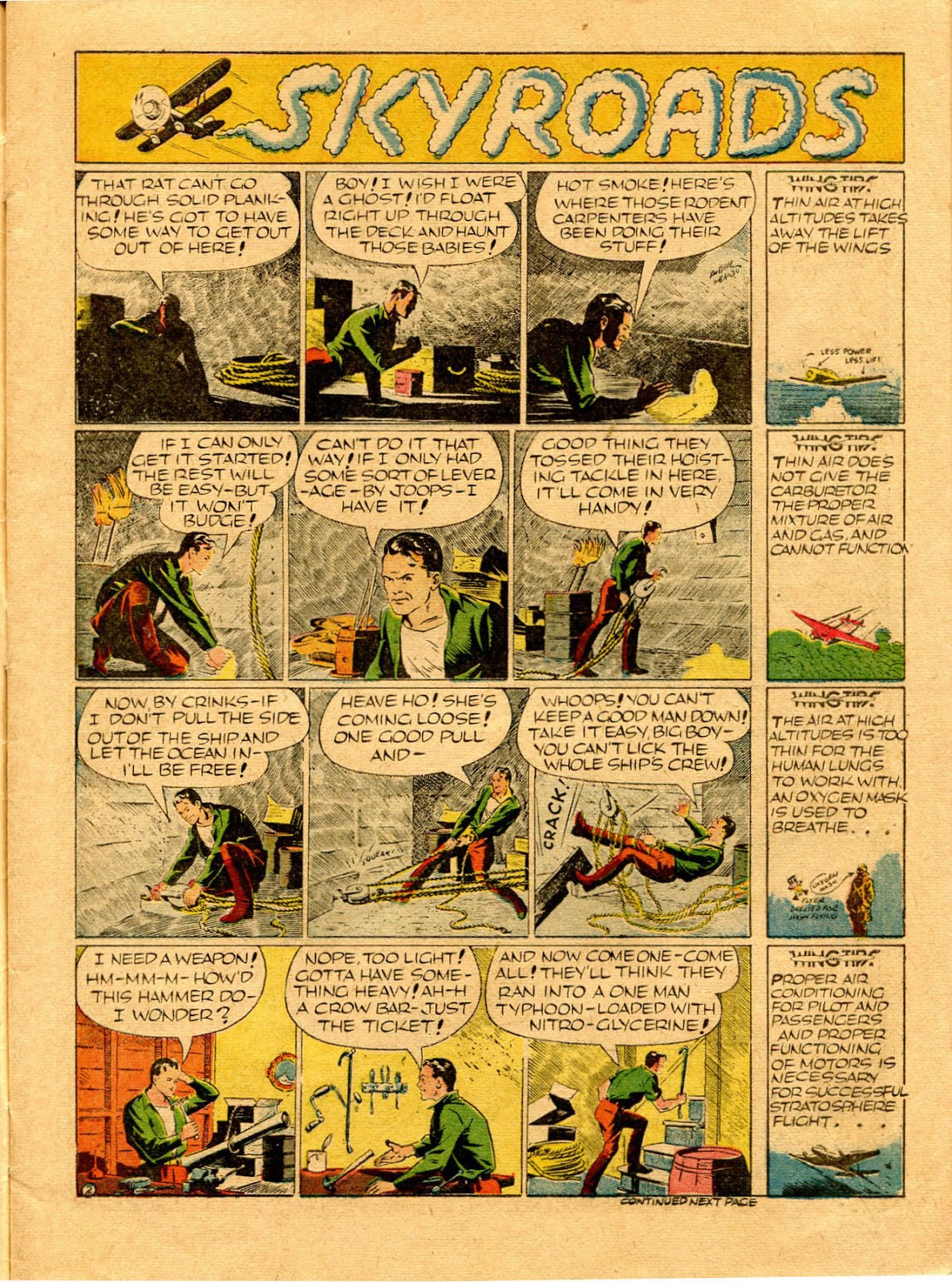
I'll be honest; Skyroads is such a generic aviator feature that I have no idea who this guy is!

Whoever he is, he comes up with a good rationale for getting a +1 modifier to his wrecking things roll. He probably asked if there was a hoisting tackle lying around and the Editor, unprepared for that tactic, had him make a save vs. plot to determine if there was or not.
Hairbreadth Harry leaps back and forth between being a credible source for H&H inspiration and outlandishness too zany to emulate with any seriousness game mechanics. Here, Harry swings towards the latter, as he claims to have used the pushing mechanic to push his melee combat with Rudolph 3,000 miles, or the equivalent of 15,840,000 points of damage, by H&H's current rules.

When I see panels of villains trying to bribe heroes, and I remember that taking money is a huge motivation in H&H, I wonder if we need to have different mechanics, even if only optional. Or would a saving throw vs. plot cover this? Yes, I think it might, at least for Lawful Heroes to take a bribe. But would that just deter players from playing Lawful Heroes...?
Sergeant Stoney Craig, even without his U.S. Marines, really (ahem) mops up with an improvised weapon in this combat. The spears are uncommonly short, and are maybe harpoons instead of spears. A harpoon would not count as an improvised weapon.

The knife is thrown by an assassin. There's a considerable amount of racism here, with the half-Asian man being called a "breed," but this actually plays well in the story, with the locals' racism explaining how quickly they accept this scapegoating.


Near Island is a real place, in Alaska. It seems strange that anyone in Alaska would hear "They had Jeremy Blade at near" and not think of Near Island...but this would make sense at a game session; players never get clues.
Dickie Dare is relegated to cheerleader in this month's installment, as these pages focus on the gorilla-lion battle. I'll have to add a note to the lion entry that, even when grappling, lions still get raking attacks.
I'm not even sure what's going on here, so it's even harder to figure out how this might apply to game mechanics. I guess...hearing Miss Karson's voice reminds Tiny that someone loves him, and gives him the will to keep fighting, even as his body tells him to quit...?

Yeah, that's really hard to quantify into crunchy rules. I suppose you could include a rule that supporting cast can rally you once per day to give you a +1 bonus to something -- and that would give players more impetus to bring supporting cast along besides the meager XP award.

Or, this is all flavor text and Miss Karson's rallying cries didn't influence Tiny's dice rolls at all.


(Scans courtesy of Digital Comic Museum.)


Friday, August 2, 2019

Planet Comics #2 - pt. 2

I'm picking up where I left off in this issue's Flint Baker adventure, as there's still a lot of interesting ground to cover here.

This page introduces a new alien, only referred to as "the creature" or the "tiny fiend." I'm tempted to call him a little green man, but I think he's being treated generically enough that he only needs to be statted as an alien. 
Last post I talked about this giant "white" ape, and now I found out that it's actually some sort of super-science golem, created from a combination of animate and inanimate parts. This transmogrification tube, or whatever you'd call it, is some huge mad science. It's essentially a mobster-maker.
Despite being so cartoony-looking and having no name or personality -- man, that's one tough adversary, unusually tough during a time in comic books when most adversaries go down after one hit or one shot. He's strong enough to do a lot of "pushing damage" to Parks. The ray unaffects him -- although, if it's a wrecking things ray, it wouldn't affect anyone anyway.
Our little unnamed alien even uses smart hostage-taking tactics.

Here, though, we have another example of how easy it is to disarm and grapple someone in comics. Even though we're told how fast and agile this alien is, the two unarmed women easily disarm him and knock him prone.
This caption is the only proof we have of the alien's agility, unless his twisting himself free is agility.

His ability to throw boulders (even small boulders) suggests the alien is statted as a superhero of at least 1st-level, with the Extend Missile Range I power activated.
Wrecking missile weapons before they can be used is actually a tactic that got used in my last Hideouts & Hoodlums campaign (and quite a lot, towards the end)!

Wait...what is Flint trying to do to the alien? I don't think he was trying to explode him into atoms, that was a random result of tinkering with the machine (I can just imagine the random mishap table to go along with the machine, with blowing up being the worst result)...but what result was he hoping for?
Time to finally move on to the next feature, which is Tiger Hart, the goofy Fletcher Hanks' one attempt at making a Prince Valiant-like strip. And there's certainly some goofiness here, like the name Tiger Hart, naming his horse Zip, the fact that Zip knows how to power dive, and that impossibly barrel-shaped chest on Tiger -- but I do like that trapped bridge. I'm not sure how the hanging rope triggers it, but the bridge folds up into a box, trapping anyone on it, which is a pretty cool trap.


Tiger is nice enough to give the men some privacy while they strip off their clothes, searches them (a very thorough tactic, by the way), and then lets them put their clothes back on -- before threatening to feed them to tigers. So Tiger isn't so much nice to his prisoners as he just didn't want to see them naked. And isn't he just like a Batman villain here, incorporating an animal in his name into his deathtrap?

But most bizarre of all -- how do you hide a glowing gem that big inside a horse's mane?? A saddle bag, maybe, but inside the mane? And how did it not just fall out?
Bending bars isn't that hard for comic book Heroes, but should maybe be slightly harder than doors - so, treat as machines.

Talon men would be a new mobster type. Its distinguishing features are, obviously, those over-sized claws that would let it do extra damage (maybe 2-8 with claw attack?).

(Scans courtesy of Comic Book Plus.)

Tuesday, April 30, 2019

Tip Top Comics #23, 24, 26

Jim Hardy is really taking over Tip Top Comics around this time, as other features like Peter Pat get wrapped up. Further down this page you'll see one page where Jim Hardy is intentionally dressed like Dick Tracy -- and suddenly the inspiration for this strip is crystal clear, even why he picks up a Junior-like sidekick in this storyline. And it turns out that Dick Moores was once Chester Gould's assistant on Dick Tracy, confirming my guess.

This is from vol. 2, no. 11 (Mar. 1938)...

===

Game notes: There are three ways that someone can be killed by hitting them with a vehicle in Hideouts & Hoodlums.  One, the Editor can simply change the mood
level of the campaign to be more lethal (this was discussed
more in 1st edition). Two, the Editor can rule that non-Heroes, or at least unnamed non-Hero characters, can be killed instantly. Three, the Editor could rule that hitting the victim knocks him unconscious, and then running him over is a separate attack that does additional, killing damage.

It seems unlikely that The Kid (I don't think he has a name yet) is tactically inclined enough to transfer damage into pushing attacks to try and knock the hoodlums off the train. There may be environmental factors in play, like the pitching and swaying of the train, that make the Editor declare that any damage necessitates a save vs. science or be thrown from the train, making combat as challenging for Jim as it is for the hoodlums.

In Little Mary Mixup, we see rabbits can be bought for $1 each. I'm not sure what good rabbits will do for the average Hero, though maybe a magic-user would like one for pulling out of his hat?
There are some tips here for keeping the challenge level not too high for solo play and low-level Heroes: keep hit points low on bad guys, even if they have more than 1 Hit Die. Be prepared to give away modifiers you would not normally give out, like maybe an Armor Class bonus for swinging on a rope while being attacked with missile weapons.

If running a game for half-pint Heroes, you could cut them some slack on skill checks like balancing on a beam, since that should be easy for them given their small size and low center of balance. But still reward them for coming up with grownup ideas, like juryrigging grappling hooks out of rocks.
How It Began proves useful filler again. I don't know where it got this idea about a charming dragon with emerald eyes from, but now I want to stat an emerald dragon for H&H really bad!
We come back around to Jim Hardy again in v. 2, no. 12 (Apr. 1938). The issue here is, would a steel door stop an explosion that can blow up an entire wooden building? It's almost an academic question, because it's not necessary that the steel door works; all we know is that the hoodlums think it will work. I don't think it would...
Now we're in vol. 3, no. 2 (June 1938) already, and this is that page I mentioned with the Dick Tracy outfit on Jim. We also learn here that a bouquet of roses cost $3.50.
Checking in on The Captain and the Kids again, I'm struck by the unusual situation of the mount turning around and biting its rider. I doubt that happens often, but it's worth bearing in mind that when trying out a new mount, the Editor should always make an encounter reaction roll for it to see how it reacts.
Curiously, the circus man says Blackie is going to get a two-bit (25-cent) ticket, but later he's sitting in the reserved seating where the seats cost $2.50. That's a really big range of pricing, like if I could go to the movies today and choose between $5 seating and $50 seating.

(Scans courtesy of Comic Book Plus.)