Showing posts with label ability checks. Show all posts

Friday, February 4, 2022

Fantastic Comics #5 - pt. 1

That's one big Samson! And this is one nice opening page, establishing our hero, our villain, and the setting, as the scenario gets quickly rolling along.  

Zanbar is just a lazy substitute for Zanzibar, which is also an island in the Indian Ocean.

There was a time when I would have statted Eelo as a merman...but now we have fish men in the Mobster Manual.


But already, on page 2, the fictional geopolitical landscape gets a little confusing. Zanzibar was a British protectorate, so Malajaca is either the name of the British colony there, or maybe it's the name of a neighboring island and Marie is just vacationing on Zanbar/Zanzibar. 

The amphibian henchmen are likely the same race as Eelo -- but not necessarily! I could see an underwater hierarchy where Eelo is a merman, but he can boss around fish men. 

That Eelo thinks he can interbreed with surface humans further suggests to me he is a merman, since we already have precedent for Namor (admittedly from another company) being half-merman.
 
You'd think Eelo would be able to grapple at least one of those girls before they all escape through the window, but he might be waiting for his wedding night to touch them, and his henchmen are all out of range. 

So, islands don't just float on the surface of the water like that. In all but the cartooniest of Hideouts & Hoodlums campaigns, I would refrain from messing with geology like that.

Here's my second clue that the three girls are vacationing on an island not their own. If her father was on the same island, and the islands is that small, you wouldn't need a telegraph to reach him.

The surface area of Zanzibar is 2,654 sq. km, so that island cannot be Zanzibar after all.  

Eelo seems to be an overreactor. Girls jilt him? He sinks their island. To punish the girls...he puts them in a trap that looks like it could kill them? 

That is an amazingly accurate teleporter, able to sit Samson down in a specific boat in an entire ocean. How does the Brun know where the boat is? It's probably best not to question things like that...though it's always possible that the seismograph is so sensitive that it can sense where boats are displacing water?


I find it very interesting that Samson has a blanket around him in panels 2, 3, and 5. What happened? Like the Teleport spell, is there a chance of failure and Samson appeared in the water next to the ship? Did he ask for the blanket so the crew would not get jealous of his amazing physique? 

Ceylon is what Sri Lanka used to be known as, so it's especially interesting that we've had fictional or half-fictional country names so far, and yet here we get a real one.

There's really no reason why the underwater pressure should be sapping Samon's strength, but not the amphibians, and no weakness to water pressure ever comes up again, but this is the beauty of game mechanics with unpredictable, random results -- that when the unexpected happens because of bad dice rolls, you have to explain/rationalize it in-game.

I really like Alex Blum as an artist, but I like him best for his layout work on inspired pages like this one. Panel 1 reveals so much about the characters from their stances. Eelo's dramatic posing in panels 1 and 2 remind me of 1960s Marvel Comics. Samson looks incredible powerful in panels 6 and 7 as he tears the torture apparatus apart and then stands over its wreckage, but the highlight of the page is being dropped down a chute into the deathtrap, as the deathtrap is slowly closing. 

Also note this implies a multi-level hideout.

I don't normally spend this long on admiring the artwork, but look at how panel 1 here zooms out from panel 7 of the previous page. Look at how practically Steranko-esque that 2nd panel is! Look at how panel 5 only exists to show a change of scene, in an age when many comic book panels were background-less. Admire the detail-planning that went into establishing that Eelo's machine has to be started with a key before the levers work. Admire the dynamics of Eelo leaning back, to show us he is about to pull the lever, instead of showing us a moment earlier when he was simply grasping the lever. Observe how the waves of pressure are illustrated in panel 8. 

Game mechanics-wise, I'm not sure how to handle thrusting one's way against pressure, except maybe by Strength checks.

I really don't get how the pressure creates a pathway to the sub, or what that even means. 

I have been grappling with where the "Maljacan fleet" comes from, but I think I've finally figured it out - Maljaca is Malacca, a small (at that time) British protectorate on the Malay Peninsula. I don't know why we're back to fictionalized names again. Now this makes sense, as the British Empire did have a formidable navy that would give even Eelo pause.

Samson sure gained on the sub quickly. He is likely boosted here by the Race the Train power. But how does movement translate underwater? I've never published specific rules on this, I don't think. 

Swimming speed should be 1/3 land speed...though I would be willing to consider it if a player argued that the Race the powers do not consider terrain. 

Turning the torpedo around sounds like the 4th-level Turn Gun on Bad Guy power. I've previously established that Samson started with five brevet ranks, so this should come as no surprise.

(Scans courtesy of Digital Comic Museum.)


Saturday, January 15, 2022

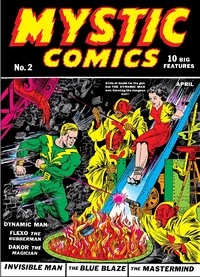
Mystic Comics #2 - pt. 3

Let's resume with Dynamic Man, just as DM is surprised by a headblow that knocks him out for 1 whole hour. When he comes to, he's in one of those cliche deathtraps where the spiked walls are closing in on him. Rather than fretting, he simply wrecks his way through the ceiling and escapes. This is a problem I have in Hideouts & Hoodlums, where it is hard to stick superheroes in deathtraps if they can just wreck their way out, but I'm glad that the earliest superhero writers seemed to be grappling with this problem too.

It's important for mobsters to leave clues behind in their desk drawers. I'm amused that the ship they plan to sabotage is called the Batavia, as there's a town near here called that. It's odd, though, that Dr. Vee goes along personally to sabotage the Batavia, but stayed in his hideout when the train was to be sabotaged. Maybe Vee just doesn't like trains?

One punch from Dynamic Man sends Vee flying off the ship and, it appears, Vee goes sailing pretty far through the air. We're told he survived, but it's hard to imagine an old man being able to take that kind of punishment. To have punched him so far, DM must have been using the power Super Punch power, which means Dynamic Man has access to a 4th level power. 

Lastly, I think it's interesting that DM loses interest once the master criminal is defeated and lets the police mop up the lesser spies.

Space Rangers is set in the year 2300 and it's a future where just about everyone has spacecraft that you can crisscross the solar system in and space rangers dress like 1940 police officers. New elements have been discovered, and "plinium" ore is the "only substitute for radium" -- which is a really unusual thing to say. Has all of the radium in the solar system been used up by 2300? This is a pretty forward thinking sci fi strip if it's thinking about the depletion of natural resources already in 1940. 

Space rangers' ships can travel from Earth to Mercury in two days, and they need to find the space bandit Black Hawk. It's hard to take Black Hawk seriously since he wears pointed shoes and what looks like a bathrobe. 

The rangers, Bob and Nibbs, are overwhelmed by at least 11 bandits, probably more. For some reason, they don't have a weapon more hi-tech than wooden clubs among them (even for missile weapons all they have is wooden clubs!), but that's okay because Bob and Nibbs have lost their guns, somehow, between panels -- but we're reminded twice that they lost them! We're left to imagine what their handguns could do, but the weapons on board the spaceships can paralyze and disintegrate. 

And it's not just weapons that are low tech on Mercury; once they captured Bob and Nibbs, the two rangers are tied up with simple hemp rope. And they don't even tie good knots!

Moving on to the next feature, that's Blue Blaze, the super hi-tech zombie. When I saw this scenario was about sabotage at an anthracite mine I was expecting something hi-tech, but that's just a fancy word for hard coal. The hi-tech comes in Blue Blaze's new car, a "supercharged speedster capable of unlimited speed." Infinite is awful fast for a Movement rate, though comic book captions are notorious for hyperbole.

Reaching the mine super fast, almost like he's teleported there (hmm...), Blue Blaze searches the wreckage and his "superior knowledge of science" helps him identify bomb parts, which sounds like a successful Intelligence check to me.

(Read in Marvel Masterworks: Mystic Comics Vol. 1)

Sunday, November 14, 2021

Zip Comics #3 - pt. 1

Yay, it's Charles Biro's Steel Sterling! Panel 2 is packed with detail. Steel looks so cool in that suit. The way Steel amuses himself when he's bored is a trait we seldom see from action heroes, and the third identity was super-original at the time (we can call this the "Mike Murdock" mistake now, in hindsight).


"Notorious" is an odd term to use here. Steel isn't wanted by the law that I recall from issues 1 and 2, so I think what she means here is "famous" or "most talked about."  

Brazonia is Brazil, that's an easy one. Orio is a little trickier, since Brasília is the capital of Brazil. It's certainly unusual, from a RPG campaign perspective, to send your Heroes to another continent already on their third adventure, but there's certainly strong precedent for it, going back to Superman's trip to South America in his second story. Biro's Steel Sterling is very much intended to be his answer to Superman, with the invention of the twin used to solve the question of how the maskless superhero goes without being discovered, and Steel conquering South America around the same time in his career. 
 

I can't figure out what city "Colosso" might represent; it doesn't match any of the big city names in Brazil I know. 

Winged tanks should not be a thing, but golden age comic book writers really seemed to love them.

That is a long range for that magnetism power. It's impossible to say how far exactly, but those planes could be anywhere from 100-1,000 feet away already.

Foreign nations always seem to be turning their defense over to Americans; at least Steel used some powers to impress them first. 


Okay, sometimes Biro is moving too fast for his own good. Steel has been given 12 hours to stop Dr. Yar, so instead of looking for Yar, or questioning that pilot he captured (unless the plane crashed and the pilot died...?), he decides to keep up his second secret identity on a long boat trip. So long that it takes him 12 hours to get back to Orio? Or did Yar break his word and attack early (that does seem very villainous)?  

Here's a surprisingly tough call -- if Steel is wrecking the hatch on a tank, is he wrecking a door or a tank? When it's too tough to make a call, go in the middle; Steel is wrecking the hatch as if it was a robot.

Taking over the winged tank instead of wrecking it seems sound strategy. And you get a trophy out of it afterwards!

I'm not sure what tactical advantage the protective circle would have...but tank pilots can make mistakes and this was clearly a mistake, grouping up like that.

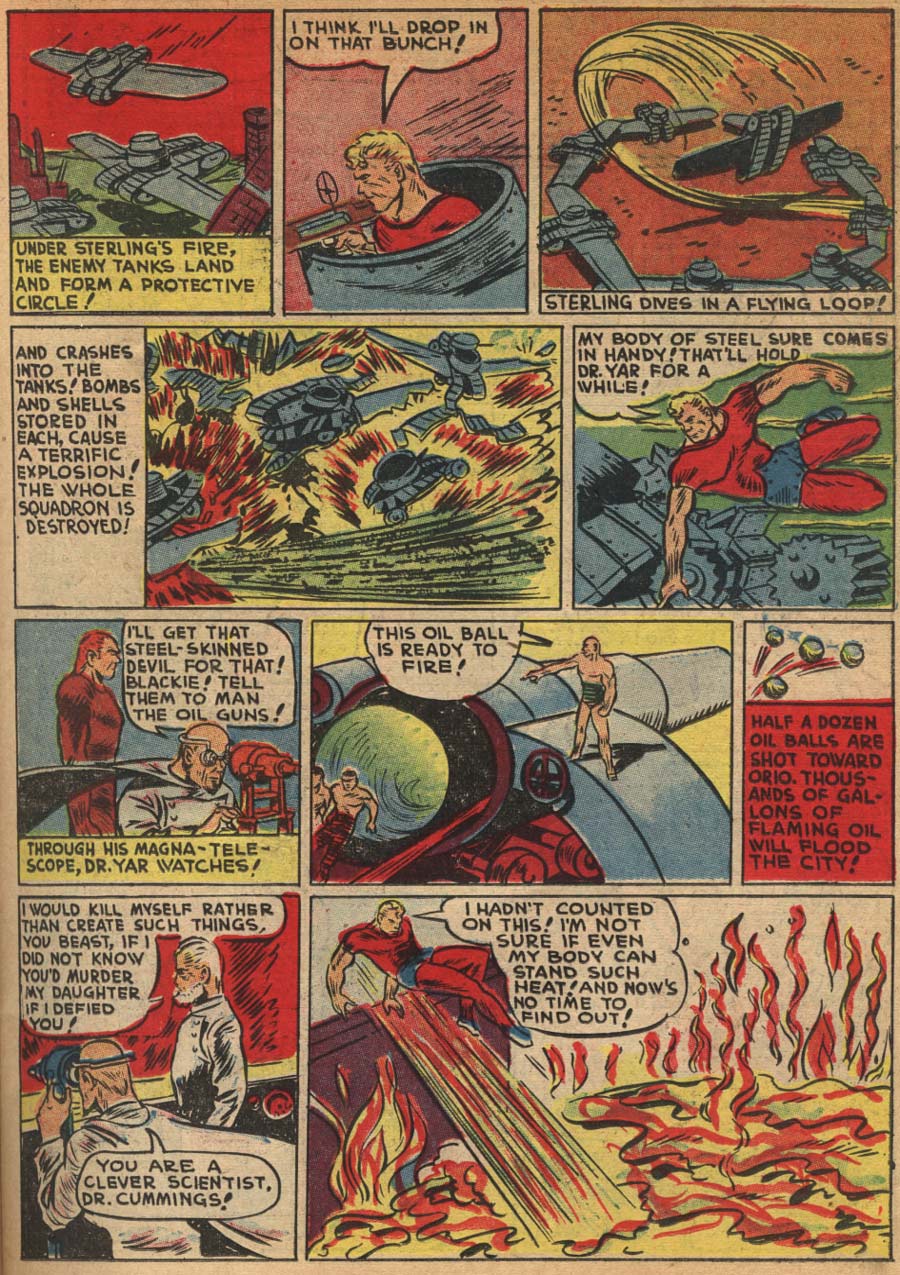
Steel survives the explosion thanks to the Invulnerability power. The fact that he's now worried about being hurt by fire proves that powers have limited durations, especially since Steel got his powers in the first place by diving into molten steel (we even saw a replay of it on page 1!).

Steel is going to regret wrapping himself in asbestos someday -- but nobody knew that in 1940. At the time, fashioning himself an asbestos suit out of the lining was quite ingenious. 

I'm a little apprehensive about allowing Heroes to catch missile weapons in mid-air, unless they are superheroes buffed with one of the Race the- powers, or perhaps some other related power -- I could see maybe Improvise Missile Weapon being rationalized, if Steel were catching it to then use as a missile weapon.

The range seems really impressive on those oil ball canons, but if Steel has seen the trajectory of enough of them, I could see letting him find the source with a successful Intelligence check.

Although the narration in the final panel says Steel is breaking into a building, it appears he is breaking through a fence outside the building. Steel walls wreck as tanks, but a steel fence, I might treat that as a truck instead.
Okay, I've had my fair share of quibbles with this story so far, but this page is gold. Henchmen with lightning guns! Steel showing a vulnerability to electricity (or at least thinking he is). Steel's smart tactics -- bringing down the roof to get at the villains out of range, and smashing through a wall to help surprise the main villain. Alligator men (anticipating the Monster Society of Evil?)! Although, between "Oogle gop!" and that suspicious looking seam between shirt and pants in panel 7, I have a sneaky suspicion these are just human hoodlums in costumes. 

Biro also anticipates something that at this time isn't yet true about Superman's stories: here the Black Knight is behind every plot, even in disguise, much like Luthor will later be in Superman stories.

Little details like how Steel recharges his powers from the static electric charge he gets from running his fingers through his hair help me really appreciate this feature. In H&H, you don't need to have a visual gimmick to activate your powers, but if you as a player decide to have one, it is up to you to play it consistent.

It looks like I was wrong about the alligator men being guys in costumes, unless those are amazingly good costumes. I would probably treat them as lizard men instead of statting alligator men separately. And yeah, I can definitely see 6 lizard men being able to take down one superhero with grappling attacks, particularly if the superhero has no good combat-related buffing powers left.

That the sound carrier looks like a giant megaphone is one of those comic touches that tells me Biro isn't taking this story too seriously, and neither should I.

The deathtrap is a good one, particularly for superheroes who can so easily wreck open doors...
 
But I'm skeptical about this solution. Does pushing a drill through a wall really not apply unusual pressure to the wall? In an instance like this, where I'm unsure if I should have a trap go off or not, I might allow the hero a save vs. science to answer the question for me.

Sterling's aim being perfect is worth noting because unbuffed superheroes don't get the bonuses to hit that fighters do. A lucky roll, or was he holding onto the Bulls-Eye power? 

I'm amused by how the colorist often doesn't know what to do with Biro's sometimes sketchy art style. When he doesn't draw lines on the sides of Steel's head in panel 1, suddenly he has no hair there anymore! And the colorist has no idea what to make of that guard. 

Things get really dark in panel 8 -- the Black Knight/Dr. Yar has apparently convinced Dora's father to concoct a chemical weapon, even after telling her father that he plans to use it on Dora. BK is either extremely convinced that he's broken the man's will, or isn't all that worried about whether whatever's in that cocktail will work or not. Perhaps it's just one last attempt to torture the old man before escaping.

(Scans courtesy of Comic Book Plus.)


Tuesday, May 18, 2021

Daring Mystery Comics #3 - pt. 2

The Phantom Reporter story, for Timely Comics, was a strong one, with an interesting character, and well-told, in the sense that there are no glaring plot holes I saw. I'm no longer surprised that David Liss, when given an opportunity to write a forgotten character for Marvel's 70th anniversary issues, chose the Phantom Reporter.

Trojak the Tiger Man is up next. I'm not a fan of these stories, being almost uniformly cheap Tarzan rip-offs and just overflowing with racism. In this story, we learn Trojak has trained himself to go days at a time without sleep, the special thing about this being that Trojak doesn't have access to coffee. I'm not sure how to handle this in game mechanics terms, but I think I need to because Trojak is staying up for days staking out a dangerous area and wandering encounters could kill him easily if he falls asleep. Constitution checks seem like they would work here, though there needs to be either diminishing returns from those successful checks (the first one lasts for 24 hours, the next lasts for 20 hours, and so on), or a penalty to each successive check, to reflect that it gets harder the longer he stays up.

Okay, a few pages in this story gets cool. How often have Tarzan or Sheena gone up against prehistoric animals? Well...we're told that it's a prehistoric animal, but it really just looks like a poorly drawn Indian rhinoceros. Still, a very tough fight for a low-level explorer and his tiger companion! The rhino has Super-Tough Skin that can break knives (as the power does), and while I don't normally plan on giving rhinos superpowers, I suppose it couldn't hurt in individual cases. And...I'm going to say the way Trojak and his underlings defeat the animal is legit, pulling a tree over on top of it. A tree that size could weigh a ton. Let's say that's...6d6 damage? 

Not content to stop there, the story then goes on to have Trojak fight Nazis who abducted Edith (his Jane analog). This is one of those early stories that doesn't shy away from calling Nazis Nazis, instead of some concealing pseudonym. We get treated to an interesting overhead shot of the Nazi camp, which is very neatly arranged with everything in perfect rows! There are 14 tanks (possibly of 2-3 distinct types), 8 canons, 1 anti-aircraft gun, 4 planes (presumedly fighter planes), 6 things I can only presume are meant to be cars, 39 small tents, 6 large tents, 2 buildings, and 3 trees! We even get a map showing us where this camp falls on the Belgian Congo River. 

Basically, there is no chance Trojak should be able to get with 1,000 feet of this place without being dead. So, naturally, Trojak manages to sneak into the camp after only defeating two sentries. We also get our first indication that Trojak is actually a superhero, or might be an explorer/superhero, as he is able to wreck a barred window with "the strength of ten men." Even after an alarm is raised, only four more guards show up right away to attack Trojak with bayonets. Amazingly, Trojak thinks he can take them and everyone else who shows up (admittedly, the way the Editor is rolling randomly for reinforcements, maybe he's not wrong), but stops because Edith begs him to surrender, emasculating our hero. Actually, once he's captured, he figures he can watch the Nazis work their guns until he understands how to do it himself. And he does, throttling a guard who comes to feed him (which is weird, because we already know he can just bust out the barred window) and then escaping into the camp. Before he leaves with Edith, he mans an anti air-craft gun and aims it over the river so it drops shells onto the submarines docked there. We're informed that Trojak can work a cannon that "requires many normal men to operate," presumedly because he's buffing himself with a power, maybe Raise Car to make himself stronger. Again, only four Nazi guards converge on them before they escape the camp because of their "dulled Nazi minds" -- so, they're basically Trump voters.

Next up is Marvex the Super-Robot. It's interesting how common the concept of robots was back then, but no one really understood how one would work. Marvex is able to think because of the "delicate mechanism" in his brain, without specifying that as a computer. Marvex is created by two fifth-dimensional men who do it because they're bored and they want it to capture some Earth humans. Marvex is "born" with a conscience and won't do it, so he mops up (by then) six fifth dimensional men around him - with a seventh 5D guy. Which is weird because comic books tell us that people from higher dimensions are more powerful than us, sometimes vastly more powerful. And yet, maybe in their own dimension, they are just normal people?

Blowing up their lab tears an interdimensional hole that blows Marvex to Earth, where he immediately...tows an old man's car. Raise Car power? The man must be pretty wealthy because he tips Marvex $20 for it, which in 1940 lets him buy an entire suit in town to help conceal his appearance. When he hears a woman nearby scream for help he leaps up at least five stories, which can just be the Leap I power. The Feather Landing power lets him drop from that window to the ground without harming him or the two people he carries with him out of the burning room.

When a car full of spies speeds past and shoot at them, Marvex uses Nigh-Invulnerable Skin to block the others from harm and then Race the Train to catch up to the car. After learning where the spies took the secret plans (that is what the woman was hollering about), Marvex flies up to a 13th floor instead of leaping (Fly I, most likely). There is also an instance of wrecking things where Marvex wrecks a car, though since it's just the top of the car, maybe we can downgrade that one rank to robots. From the evidence, it seems like Marvex has used five 1st-level powers, but higher level powers could have duplicated some of them. As an android, he always get a free power anyway. And since we've only seen him use one 2nd-level power for sure, it's possible he's only 4th level, with only three brevet ranks.    

Last up is Captain Strong of the Foreign Legion. In Algeria, Strong is up against ...pirates? That's weird because these guys would normally be called nomads or bandits in anyone else's stories. While trying to set up an outpost to guard against the "pirates," the legionnaires are attacked by a "horde" of them, but we don't see more than ten of them. I really don't like how these stories act like it's okay to mow down Arabs with machine guns, but after that the tactics are sound. Strong knocks out one Arab, dresses as him, and then rides his horse back with the others as soon as they flee, and in this way he finds out where they were heading. In the Arab camp, Strong uses a combatant as a body shield, something we haven't seen in a comic in awhile. 

After escaping back to the legion's fort, Strong sets a trap for the "pirates" straight out of The Fellowship of the Ring; when the "pirates" show up and find the legionnaires all asleep, it's actually just empty clothes (though there must be some stuffing in them), ala The Prancing Pony. 

(Read at readcomiconline.to)   


Friday, April 30, 2021

Daring Mystery Comics #3 - pt. 1

Dale of the FBI is our first feature and it takes place on an island in the San Francisco Bay called Dream Island. There are really 28 islands in the bay (and fewer in 1940, since some of them are artificial), none of them called Dream Island. The heavily forested appearance of the island makes me think it looks closest to Angel Island after perusing some photos. 

This story predates the founding of the real San Francisco National Bank by 22 years.

Dale likely arrives in California at the San Francisco International Airport, which in a year will become a Coast Guard base and Army Air Corps training and staging base. The story isn't clear if Red Corker's men just happen to be at the airport or if they on lookout duty watching for G-Men to arrive. It seems unlikely the gang can spare lookouts for every unlikely occurrence, since the gang doesn't appear to be very big.

Dale isn't very good at noticing his car is being followed; he must have failed his skill check to spot things. 

Other than having a keen eye, I would think research beforehand must explain how Dale immediately recognizes Red's lieutenant. This would either have occurred in-game, with the Editor giving the player specific information, or the player could, in the moment, ask for an Intelligence check or a save vs. plot (but not both!) to determine if he had any foreknowledge of what Red's lieutenants looked like.

Red's scheme is to kidnap the child of a San Francisco oil magnate. The most famous San Francisco oil magnate was J. Paul Getty. 

The rescue scene is peculiar, to say the least. Dale comes riding in on an airplane wing, scoops up the kidnapped girl between his legs while holding onto the wing with his hands, then climbed back onto the wing, held the girl with one arm, drew his gun with the other, and shot Red while holding the wing with his leg. There's a lot of unlikely things in there. A Dex check to cling to the wing (or a stunt), an attack roll "to hit" the girl (at a low AC, given the speed of the plane), and then another Dex check for all the balancing he does. And why does he shoot Red? It's his job to arrest Red and Red can't do anything at this point to harm the girl anymore. 

Next up is Breeze Barton in the Miracle City. It takes place in 1945 "and the world is at war" -- which was sadly accurate. Less accurate is the Japanese invasion of South Africa. When Breeze sees it, his first thought is to report this to London, which is weird because that's 5,600 miles away and there must be dozens of places he could check in closer. It's just an excuse to get him flying north over the Sahara Desert. That's how he finds a mirage of a city that turns out to not be a mirage, but an actual city - a super-scientific city where they already have anti-gravity transportation. People have lived there for over 30,000 years -- the same people in some cases, because the city exists in a pocket dimension where time doesn't pass like normal. Time does pass, even though we're told otherwise -- the sun rises and sets and events are not occurring simultaneously. It's aging that doesn't happen. 

More interestingly, the city can only be entered through a "spot" where the electrons flow just one way, so you can't leave. There is at least one neanderthal in the city and at least one dinosaur outside the city; the neanderthal makes some sense but the dinosaur doesn't on a lot of levels. It pushes the existence of this "one-way electron flow spot" way into the distant past, the dinosaur looks extremely unrealistic (even by how much they knew in 1940), more like a dragon, and if it is really that dangerous you'd think it would have been put down long before now. The weapon that puts it down is a tripod-mounted "heatwave" gun.   

Even the dinosaur is quickly eclipsed by my biggest problem with the story, that Breeze solves how to reverse the electrons with magnetism in less than a day, while the best scientist in the city hadn't thought of that in 12,000 years. It hadn't even occurred to the rival city in this pocket dimension, this one occupied by the demon people, an interesting-looking nonhuman race. They are furry, with spiky manes on their heads, pointy ears, hooved feet, they can fly, but with a single sail on their backs instead of wings. They have their own super-technology; they can make a cloud appear around someone's head that sucks thoughts out of your head through the astral plane. Both cities have heat-wave guns...but yeah, magnetism is beyond them. 

There's a further interesting detail about the culture of the demon people. They keep slaves, but the slaves are other demon people...on first inspection, but the slaves don't have sails on their backs.   

In the Purple Mask, Frederick Swabert refers to the Panic of 1907. I had to look this up, but the Panic of 1907 – also known as the 1907 Bankers' Panic or Knickerbocker Crisis – was a financial crisis that took place in the United States over a three-week period starting in mid-October, when the New York Stock Exchange fell almost 50% from its peak the previous year. Swabert is being threatened to reveal the location of a secret vault he doesn't know the location of, but Purple Mask (Dennis Burton) swipes a book with all of the floorplans to Fred's house in it, like starting a hideout crawl with the whole map in your hand. Since the house has secret doors, this is extra handy. 

The bad guys have a trap for Fred, his phone is rigged to spray poison gas in his face. Purple Mask somehow guesses this -- an impossible hunch -- and shoots the phone. The phone turns out to be a big clue that wouldn't exist today; because the bad guys have their own phone in the same house, so all PM has to do is follow the physical phone line and he locates the rooms they are hiding out in. 

Purple Mask has no compunction against shooting any mobsters holding guns, but if they attack him with fists he switches to the same. 

Somehow a stray bullet hits the secret button that opens a secret door, which is a freebie from the Editor because there's no way that should have happened. The secret room behind the door is where the treasure is and it's an interesting room; the money is in a big box on an island in the middle of a pool of acid with a narrow drawbridge leading to it. The drawbridge can be controlled with controls on the island.

Another discrepancy in the story: Purple Mask somehow knows there is a secret trapdoor under the island, but he didn't seem to know anything about this room from the maps earlier.  

The next adventure is the Phantom Reporter. Typical of these stories, they don't tell us where it takes place. We do get the name of his newspaper, though, and that's interesting because it's the Daily Express, and that is a well-known London newspaper. Is this a UK hero? Even the fact that the crimes occurred in the "East Side" fits, because the East End of London was infamous for poverty and crime. My theory only breaks down when the bad guys start talking in New York accents, and then the reference to Park Avenue clinches it; this is New York City. Oh well.

We're told the Phantom Reporter, in his regular identity, inherited $50 million from his father. Since Henry Ford had $200 billion in 1940, that doesn't even put him close to richest guy in town. 

I don't know what's going on with his mask. It seems to be glowing? Or maybe it's just artistic license to make him look more dramatic, as there's really no reason for it to be glowing.   

(Read at readcomiconline.to)


Sunday, February 28, 2021

Famous Funnies #68 - pt. 1

We haven't seen Roy Powers in a while! Here he's on a cruise to Africa (the previous page smartly talked about how much school he was going to miss because of this, but he has a tutor on the trip) where there's going to be some big game hunting (booo!). More interestingly, here's the beginning of some mystery on the ship. What do they want in Roy's room? When laying clues, remember to leave olfactory ones too.


Uashin? I think this is referring to Uasin Gishu County, and it is located on a plateau, in Kenya. Interestingly, "Jambo Bwana" is a Kenyan pop song that will come out 42 years later. 


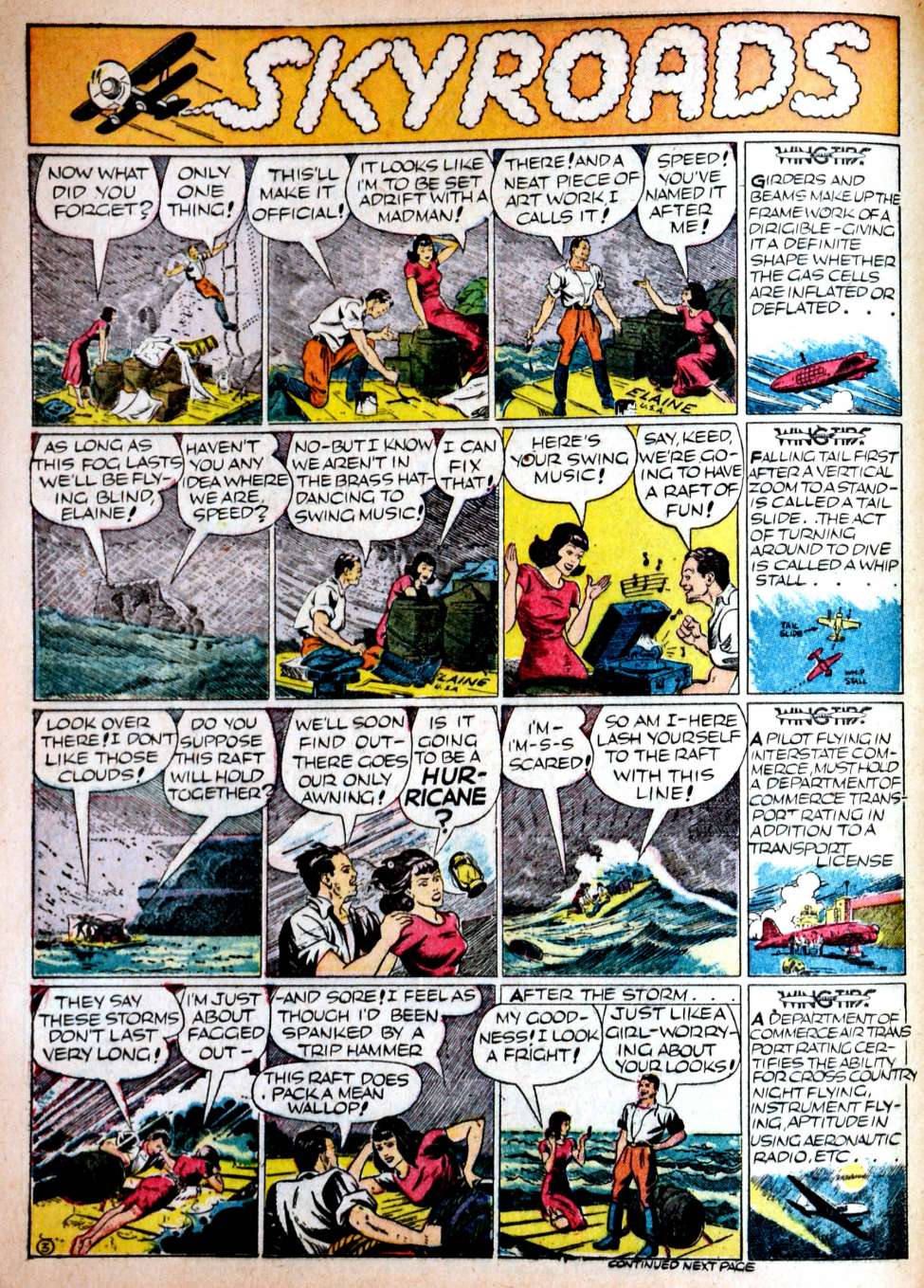
Skyroads surprises me occasionally; there is some interesting chemistry between these two characters, and I laughed out loud at "I was born quite young." Also, salt horse is slang for salted beef. 


Sure, we could talk here about how "fagged out" means exhausted, or how "I feel as though I'd been spanked by a trip hammer" reads like innuendo, but what really grabs me on this page is -- how is that record player working? Is it hand-cranked? Battery powered? I know they had the former back then, but I'm not sure about the latter.

Also note the "Wing Tip" about how 1st-level aviators would need to certify their transport rating, in addition to carrying a transport license.


Senor and senorita? That's interesting because, while Spain in its prime was one of the first countries to have U-boats in their navies, by 1940 Spain's military was in tatters from its civil war and did not have many submarines left. This is a good time to remind ourselves, though, that these are all reprints from earlier comic strips, these ones specifically from 1937 (according to comics.org), and -- according to this Wikipedia page -- Spain still had eight U-boats at that time. 


This page is a reminder, if mystery bad guys have been shooting at you, to search the ground for spent cartridges. With a skill check, you can identify which kinds of guns were being used to shoot at you, which could help you plan for your next encounter with them.


It might be easy to overlook this word through all that heavy dialect, but a yawl is that boat; a yawl is a two-masted fore-and-aft-rigged sailboat with the mizzenmast stepped far aft so that the mizzen boom overhangs the stern.


Oaky Doaks has stumbled across a wizard who lived in a cave for 20 years perfecting this flying carpet (giving us some indication for how long we can expect magic item creation to take?). The flying carpet has an incredible weight allowance, probably carrying 1,750 lbs. as it is here. Being able to reach cumulonimbus clouds suggests a ceiling height over 2,000 feet, and possibly much higher than that. There's no sense of how fast it is from this page.


How would you tell if someone is faking delirium? Perhaps a skill check at first aid. Or a Wisdom check. Or both, so characters with high WIS have a good chance of seeing through the deception, but mysterymen can also cash in a stunt for an automatic success on that skill check.

(Scans courtesy of Comic Book Plus.)


Sunday, January 31, 2021

Adventure Comics #48 - pt. 3

When we left off with Socko Strong, he was confronting Monte on the wing of a flying plane about Monte's attempts to kill him. In a clever trick, even though both parachutes are actually fine, Socko pretends he switched parachutes on Monte to give him the "sabotaged" one. You would think Socko would use this trick to make Monte confess, but instead Socko pushes him off the wing to panic him, just to pay him back.

Moving on to Steve Conrad, Adventurer, we find Steve on a cruise where he spots and recognizes 'Singapore Sal,' a notorious jewel thief (perhaps after making an INT ability score check?). When she leaves the deck, Steve is surprised she didn't notice him, suggesting they've met before (and letting us know that Steve had surprise in that encounter?). Sal's partner is called Slick -- he's almost surely a slick hoodlum. Steve comes up with a pretty clever trick where he has his comic sidekick slip a handwritten, signed note by Steve under the door, then listen to the two of them talk about their plans through the door after they read it. 

The next wrinkle in the story is that Steve tries to stop the valuable jewels on the ship from being stolen. The would-be thief appears to be Slick, but he's wearing a mask and, surprisingly, he manages to get away from Steve easily after just hitting him once with a sap (and not even a head blow at that). When Steve confronts Slick he discovers it wasn't him -- Slick is not wearing the same jacket and hasn't had time to change it. Although the wrinkle requires a bit of railroading to let the thief escape, it winds up being a pretty interesting wrinkle. The clue turns out to be the cord Steve tore off the thief; he doesn't know where he's seen it before until he remembers it was holding another passenger's monocle in place (if the player had trouble thinking of this, maybe he was allowed to "remember" after an INT check). 

The only other thing I'm going to say about the Steve Conrad story is that it is extremely verbose with big word balloons in almost every panel.

Am I just going to have to accept that it's a lot easier to throw a missile weapon hard enough to pin it into a wall in comics than real life? In Rusty and His Pals, Rusty manages to throw a spear -- and it's not really a spear, it's just called a spear in the story but it's clearly a lance -- across a room, knocks a man's gun out of his hand, sails right past him, and still hits the wall hard enough to become embedded into it. Did I mention Rusty looks like he's 11 years old? You know...sure, why not. Embedding in the wall is just flavor text at the end of the combat turn that doesn't affect the disarming attack or anything in the following turn. 

Having cleared the bad guys out of the house, they consider the clue they have, that they're supposed to look "behind Stevenson," and then they figure out that there's something in the library behind a copy of Treasure Island -- a clever clue, so long as no one felt like reading it and took it back to their room, of course. Behind the book is a button that opens a secret door. The boys realize they need to consider illumination issues behind the secret door so they all fetch candles. They mysterious passage looks straight out of D&D, leading to a small room with a chair, desk, and a small chest on the desk. The desk contains both a clue, a journal, and a secret clue concealed in a false top -- a single sheet of paper, the contents of which we'll find out next issue.

In Anchors Aweigh, we hear about the trick of putting cotton in your nose to make it look broader, when disguising yourself as someone with a broader nose. There is an interesting wrinkle to the story where Kerry finds out the man he's impersonating has a wife who he has to push away without making her suspicious. The last page, though, is terribly confusing. When the Naval officers burst in on the smugglers' headquarters, they leave the driver tied up in the elevator. The driver, trying to escape, makes the elevator go down with his feet. Somehow, the elevator doors do not close on their own (did elevators not have automatic doors at this time?), so the boss smuggler backs up to the elevator and falls. But...somehow he falls onto the driver at the bottom of the shaft and not onto the roof of the elevator car. Were there ever roofless elevators?

Lastly, Cotton Carver and Deela crash-land in a petrified valley where the challenge of this scenario is finding food! On day 2, they find a tree with edible berries (skill check to identify they are not poisonous?). Hunting for meat, Cotton knows he will run out of bullets soon, so he builds a bow. The terrain gets progressively worse for them; they come across a chasm thousands of feet deep filled with hot geysers, and at their backs they encounter three ape men armed with warclubs weighted for throwing. The ape men seem unusually intelligent and manage to defeat Cotton, then carry them away down to the bottom of the chasm by leaping from branch to branch growing out of the rock wall. Cotton was only stunned and cowardly shoots the ape men in the back (I guess with his last bullets?). Too bad he didn't try to talk to the ape men, because it seems like they could talk. They probably also were responsible for making the stairs they find, and the tall ladders that lead to the top of a volcanic cone. The volcanic cone is dangerous because of poisonous fumes in the air. Both of them make saving throws vs. poison and Deela fails, faints, and falls off the ladder. Cotton grabs her with an attack roll, then makes a Strength check, probably with a significant penalty (-5? More?) to continue climbing the ladder one-handed, while holding Deela with the other.

(Read at readcomiconline.to)


Monday, November 9, 2020

Slam-Bang Comics #1 - pt. 2

Okay, the planes going dead are explained (as if we needed it, as cliched as the rays are), but what we never get explained is how the machine guns have no effect. Bulletproof armor on the planes?

Also, take a look at the jowls on War Bird. In the Golden Age, a Hero could debut in his late 40s. 


It's nice that Von Kruhl was kind enough to write his note in English for us, despite being Serbian and writing this for Frenchmen to read.

Where is the searchlight that was on the front of the plane before? Perhaps more odd, what was holding it in place on that smooth surface?

I do like that, as hi-tech as Von Kruhl's forces are, it's an ordinary pair of binoculars that foils him.


We don't see enough of this tactic, where the hero sneaks into the enemy's hideout and, instead of engaging the enemy, wrecks their stuff. This makes especially good sense in the aviator genre.

"Look! A Frenchman!" Is the thinking there that only a Frenchman would be sabotaging their planes?

"Hammer-like blows" would normally be flavor text, except that it seems pretty clear War Bird is hitting them with a wrench, which would be heavy enough to do normal club damage.

You can probably guess that War Bird gets away and wins the day, so we'll jump into Jim Dolan. Jim is in the reporter hero genre, but with the twist that he's an editor.

The list of his past accomplishments seems like a set-up for starting him out with a brevet rank. It's also a pretty good list of scenario ideas you could add to a longer list, and the final panel illustrates the advantages of making the police chief your supporting cast (something I saw being put to good use in my last H&H campaign).


I'm not going to address everything on this page; we've talked about trip attacks and improvised weapons plenty of times. We could talk about movement and if rushing out the door should really be faster than standing up (hint: in H&H it's determined entirely by initiative rolls). But I'm mainly sharing this page because the mobsters are not only using hot irons as torture devices, but somehow have flaming hot irons. Did they soak those things in kerosene first? They look pretty fearsome; I might let them do 2-7 damage as melee weapons.


I've talked before about smoke and heat damage from trying to rescue in an arson scenario, but what's interesting here is that Jim spots a clue in the fire, when he clearly wouldn't have had time to do a search. This has to be a freebie from the Editor, as every skill check should take at least one melee turn, and in most cases should take one exploration turn. 


Does Jim have to roll to hit to land in the net? To truly be fearless, one would think he does, but it makes equal sense for the firemen to roll to hit him with the net, and as long as two of them succeed their rolls, they catch him. 

It's interesting that Jim doesn't know his Bible well enough to know the psalm without researching. His Editor could have spared him the trouble and let him have an Intelligence check to remember.

The clue seems like a bit of a stretch to me, though...


I'm not personally cool with Heroes holding guns on people's faces while interrogating them, but it does happen in games.

Swimming from the patrol board to the yacht is a smart tactic, giving him a chance at surprise he would have lost had the patrol board pulled up alongside the yacht.


We'll jump ahead to Lucky Lawton, this anthology's western feature. I could mention that the law was tougher in the Old West than many give it credit for; even in self-defense these two still have to make their case in court. Or I could mention that Pal can act without being ordered to, making me suspect that Pal the dog is actually being played as a Hero character. But what really catches my eye are the hashmarks on the wall of the jail outside the cells. What would the sheriff have been keeping track of like that, and couldn't do on a calendar...?

(Scans courtesy of Digital Comic Museum.)


Saturday, July 11, 2020

Champion Comics #5 - pt. 1

After a long time away we come back to the first Harvey Comic and the continuing adventures of The Champ. This is a nice first page, with just a little recap, and launches us right into some action where the last chapter left off -- but I'm not sharing this page for any of that. I'm sharing it share with you the unusual word "wetting." It means the act of making something wet, and usually applies to urination, but not always and clearly doesn't here.

The guy with the motorboat is just a handy wandering encounter.
This is the first and, as far as I know, the last mention of La Grange, Illinois in any comic book.Curiously, there was never an airport in La Grange, so why this relatively obscure town got name-dropped, when there were plenty of towns with airports near Chicago, like Evanston, Park Ridge, and Wheeling, that could have been named instead, is a mystery to me.


Hideouts & Hoodlums has no guidelines for learning skills; all Heroes are meant to be naturals in any subject the moment they make their first successful skill check.

I'm amused by this comic book logic. "It's okay that the Army is giving me a fighter plane to use over U.S. soil, because I'll have an Army Reserve pilot with me and I've been deputized by a local police chief." This is so crazy, and yet so perfectly encapsulates the "anything-can-happen" feel of the Golden Age of Comics.

I wish I could identify this fighter plane. It looks realistic enough that it probably based on a photo reference.

We never do get an explanation for why the Champ's hunch turns out to be right. I would have thought that, 24 hours later, the blimp would be miles away instead of sitting there, hoping for a rematch.
Rays that can stop motors are a dime a dozen in these early comics and should have the best chance of being encountered of any mad science invention. But the real icing on the cake here is being able to broadcast onto your enemy's radio to taunt them as you're killing their motor. And then have your men take potshots at them before they plummet to their deaths, just to rub it in!
I particularly like this page. Rescuing people off a mountain in a blizzard might seem like a subplot that takes The Champ in a totally different direction, but put the scientist he needs to talk to in that blizzard and suddenly it becomes an important complication in the main plot. The Editor, just like a good writer, needs to carefully plan the placement of his characters.
I don't know if I've mentioned this before, but The Champ is an interesting bridge between the sports genre and the superhero genre. The Champ seems to be able to do anything he sets his mind to, but within the confines of sports (and aviation also, apparently).

Game mechanically, though, the easiest way to explain super-skiing is with the stunts of the Mysteryman class. Another possibility is a Strength check to ski while holding someone, followed by Dexterity check for each crevasse and gully.
Searching for concealed things in the sky is more difficult than you'd think. It seems like they get a new roll to spot the blimp every 1,000 feet.

How does The Champ know the "infernal ray" will set off grenades? Wouldn't they more likely not function, like motors?


Climbing the dangling cable isn't anymore difficult because of how high they are, but it certainly would end the campaign for him if he fell. I do think there needs to be a common sense maximum possible damage limit, if you take this much damage you're dead even if it's not a deathtrap scenario, though rather than having a set amount in the rules I'd rather that be left to the Editor's discretion.
This first panel makes me wonder if it should be an optional rule to let the player decide if he wants to take physical damage or be moved back a number of feet from the combat. I would very rarely allow this, but I could see it being a good thing for keeping a solo game going.

Panel 2 has me confused, though. How exactly is The Champ trapped in the flaming gondola? It looks like the fire is mostly in front of him, licking a little bit at his flanks, but not keeping him from running out onto the catwalk at all.

Should explosives do more damage on a direct hit? Something to consider.

(Scans courtesy of Comic Book Plus.)

Monday, July 6, 2020

Crackajack Funnies #21 - pt. 3

I had a page of Boots I wanted to share, but for some reason I couldn't download it. Anyway, the joke at the end was that a cab fare was $25 and change, which was a surprisingly large amount to the character told that, but not out of the realm of the possible. I'll have to remember not to treat cab rides as freebies in my next campaign!

Here's a rare instance of Our Boarding House turning up here, and again it's to remind me of prices. $2 for moving men is reasonable, $5 seems a rip-off. Storage houses make house calls. You reading this, Public Storage? It's also worth remembering that, despite how cheap everything seems to us today in 1940 prices, they still expected quality from their merchandise.

 It should shock no one that the Iconi Indian tribe is made-up.

42' is really impressive for an anaconda, which usually top out at 30' long.

According to Wikipedia, "the large South American characins of the family Erythrinidae have also sometimes been called 'tigerfish'," but most tigerfish are found in Africa.

Poisonous reptiles has got to refer to snakes. There are pit vipers in the Amazon and...and...oh heck, there are plenty of sites you can look at yourself for this information, but I'm not looking at more pictures of real snakes to share them with you.

It's unclear if the crocodiles capsized the boat or simply took advantage of an accident.

One can't deny that swinging from vines, ropes, etc. into a battle is very cinematic. But is there any real advantage to it? He gains some momentum in the swing, but he also loses his ability to accurately target his kicks, while needing to maintain his balance and hold on the vine/rope/etc. at the same time.

If I had a precedent of using ability score checks in my campaign, I would ask for a STR and a DEX check, and only both are successful would I give a +1 to damage for the swing-kick.
From the outside of the fence, we can't tell if that is a professional hockey game, but 50 cents seems awful high for a non-professional game in 1940. The question then becomes, which hockey league is this? The Pro Hockey League was the earliest of its kind, started in Michigan in 1904. The National Hockey League, the one that's still around, began in Canada in 1917 but quickly spread to the United States. I suppose it depends on where Freckles takes place, but I don't think we've ever been given a clue. Heck, I don't even have a clue, after all these years, what that circle is in the middle of Freckle's face. A parrot beak?

But the real reason I shared this page is for the detector. I don't know if that's a real thing like the others, but it seems like it would be a really useful trophy item for mobsters to have, able to detect cars or planes approaching their hideout.
Dan Dunn gives us a detailed schematic of how to make your own buoy and use it to surreptitously drop off packages.
And here's a useful clue that you're dealing with a spy -- portable radios with inoperative tuning dials, so they can always pick up secret wave lengths.

(Scans courtesy of Digital Comic Museum.)