After a long time away we return to DC's very first series, just in time for the debut of its first superhero, the Spectre!
Jim Corrigan is a still-living police detective when we first meet him. Single-handedly, with just his fists, he defeats three thieves and a guard (which seems like it must have been some pretty lucky rolling). He's also a bully, mistreating his best friend and fiancee (though maybe not so much by 1940 standards), so it's hard to feel sorry for him when the master criminal "Gat" Benson and two hoodlums stick him in a barrel full of concrete and drop him in the river.
Jim dies, but his soul ascends to Heaven on a shaft of light. A voice speaks to him from the clouds -- it's all much less detailed than the versions of the Afterlife we've already seen from Will Eisner's Yarko the Great stories.
Returning as a ghost, Jim finds that he is now immune (or at least highly resistant?) to drowning, can fly, turn invisible (though he only knows he turned invisible because he had no shadow...?), and pass through walls.
===
Game mechanics: It's clear that Jim is now a Magic-User, as the four spells he just cast were Water Breathing, Fly, Invisibility, and Passwall. All of which are way beyond what a 1st-level Magic-User would be able to cast, but if there was ever a good candidate for brevet ranks, it's the Spectre.
Another possibility is that we just assign more special abilities to the ghost race that was introduced in Supplement V: Big Bang.
What remains unclear is, does Jim retain his level in the fighter class from when his campaign started? Or has the Editor allowed his player to start over with essentially a new character with the same name and supporting cast?
===
In a gag filler called Henrietta, we see a new bicycle selling for $25.
We pick up with Wing Brady where we left off, with him helping the colonists (the bad guys, from our modern perspective) against the natives/nomads (the good guys). Normally, it's the Westerners who are shown having air support in these adventures, but this time the tables are cleverly turned. While Wing and the British are holed up in a desert fort, the nomad besiegers call in an air strike by a light bomber.
The bomber is also a plot device, shaping the scenario by creating gaps in the walls where small-scale combats can take place, as the natives try to pour through.
(Spectre story read in The Golden Age Spectre Archives vol. 1; started to read the rest at readcomiconline, but then the site started trying some suspicious activity...)
An exploration of the Golden Age of Comics, through the lens of Hideouts & Hoodlums, the comic book roleplaying game.
Showing posts with label Wing Brady. Show all posts
Tuesday, May 14, 2019
Wednesday, October 10, 2018
More Fun Comics #50 - pt. 3 - More Fun Comics #51 - pt. 1
Sergeant O'Malley of the Red Coat Patrol tangles with arsonists. Since this is a rural adventure, the arsonists don't need any special skills; they just show up in the woods with lit torches. After they escape O'Malley in a scuffle, his faithful Indian companion Black Hawk finds evidence of blood at the scene and helps tracks them down (more of the "natives are excellent trackers" cliche).
Bulldog Martin and his racist caricature black friend Jonah are mountain climbing together in the Alps. To be fair, Jonah at least has a normal name and appears to be a friend instead of a servant. This is the first instance I can recall of climbers being shown tied together. Bulldog also claims that they cannot climb back down the mountain without their picks after they lose them; what he might mean is that climbing down will be an expert skill without tools instead of a basic skill, halving their chances, and he's not willing to risk it.
At the top of the mountain, they stumble across robbers planning to rob a hidden stronghold. Bulldog explains that "every foreign country has a hidden stronghold in which they store their gold." This was mostly true back when all countries relied on the gold standard, though I don't see how their locations would be secrets.
Unarmed against the robbers, Bulldog jury rigs bolos to attack them with. Normally, I consider improvised weaponry like that to do half-damage (1-3), but these bolos seem wicked effective.
Moving on to #51, which will catch us up!
Wing Brady has his first adventure in Paris, though it begins more like a sight-seeing tour (we are even treated to a surprising amount of untranslated dialog in French). He punches out a cutpurse and then socializes with two American tourists who have favorable encounter reaction rolls from him and could become supporting cast members for him later.
Biff Bronson deals with a Tong war in a caricatured version of Chinatown. I know I said recently I would do away with the yellow peril hoodlum...but maybe I need to keep them and revise them so they have a bonus to hit with hatchets? They sure use hatchets a lot in comic books.
Biff finds a vital clue hidden in a jade box that can only be opened after finding the concealed spring latch (find as a secret door). The murder list also serves as a directory for what 1940s whites thought of as typical Chinatown locations: curio shop, warehouse, silk shop, hotel, incense house, gaming place, restaurant, barber shop, laundry, joss house. "Joss house" is white slang for an Asian temple.
The "mayor" of Chinatown, a master criminal (as usual), wears a hollow signet ring containing poison powder for slipping into drinks. Biff foils him with a "spot check" (basic skill check) to notice that the signet ring is not sealed tight.
King Carter runs afoul of a shark while trying to reach an island, and a native on the island who (despite having as spear) hurls rocks down at him (maybe because weapon damage is essentially doubled when it's falling; see yesterday's post). King wisely dispatches both foes with his knife, rather than risk bringing more wandering encounters with the loud noise of his gun.
(read at fullcomic.pro)
Bulldog Martin and his racist caricature black friend Jonah are mountain climbing together in the Alps. To be fair, Jonah at least has a normal name and appears to be a friend instead of a servant. This is the first instance I can recall of climbers being shown tied together. Bulldog also claims that they cannot climb back down the mountain without their picks after they lose them; what he might mean is that climbing down will be an expert skill without tools instead of a basic skill, halving their chances, and he's not willing to risk it.
At the top of the mountain, they stumble across robbers planning to rob a hidden stronghold. Bulldog explains that "every foreign country has a hidden stronghold in which they store their gold." This was mostly true back when all countries relied on the gold standard, though I don't see how their locations would be secrets.
Unarmed against the robbers, Bulldog jury rigs bolos to attack them with. Normally, I consider improvised weaponry like that to do half-damage (1-3), but these bolos seem wicked effective.
Moving on to #51, which will catch us up!
Wing Brady has his first adventure in Paris, though it begins more like a sight-seeing tour (we are even treated to a surprising amount of untranslated dialog in French). He punches out a cutpurse and then socializes with two American tourists who have favorable encounter reaction rolls from him and could become supporting cast members for him later.
Biff Bronson deals with a Tong war in a caricatured version of Chinatown. I know I said recently I would do away with the yellow peril hoodlum...but maybe I need to keep them and revise them so they have a bonus to hit with hatchets? They sure use hatchets a lot in comic books.
Biff finds a vital clue hidden in a jade box that can only be opened after finding the concealed spring latch (find as a secret door). The murder list also serves as a directory for what 1940s whites thought of as typical Chinatown locations: curio shop, warehouse, silk shop, hotel, incense house, gaming place, restaurant, barber shop, laundry, joss house. "Joss house" is white slang for an Asian temple.
The "mayor" of Chinatown, a master criminal (as usual), wears a hollow signet ring containing poison powder for slipping into drinks. Biff foils him with a "spot check" (basic skill check) to notice that the signet ring is not sealed tight.
King Carter runs afoul of a shark while trying to reach an island, and a native on the island who (despite having as spear) hurls rocks down at him (maybe because weapon damage is essentially doubled when it's falling; see yesterday's post). King wisely dispatches both foes with his knife, rather than risk bringing more wandering encounters with the loud noise of his gun.
(read at fullcomic.pro)
Labels:
Biff Bronson,
Bulldog Martin,
cliches,
clues,
encounter reactions,
history lesson,
improvised weapons,
King Carter,
mobsters,
racism,
Red Coat Patrol,
skills,
trophy items,
wandering encounters,
weapons,
Wing Brady
Thursday, October 4, 2018
More Fun Comics #49 - pt. 3 - More Fun Comics #50 - pt. 1
Sergeant O'Malley of the Red Coat Patrol demonstrates balance
by walking on top of logs floating in the river -- a basic skill check.
As O'Malley and Pierre grapple on the bridge, O'Malley flips Pierre over
the side, but Pierre still has a hold on O'Malley and pulls him over
with him. This sounds like an Editor's interpretation of the grappling
results (O'Malley's success on the turn following Pierre's established
hold), as opposed to needing to become a consideration when one opponent
pushes another.
In the water, the story shows how swimming with logs is dangerous; the logs bob up and down in the water like swinging clubs, so anyone in that environment is subjected to 1-4 head blow attacks per turn, depending on how densely packed the logs are.
Bulldog Martin is in Egypt, where the Phantom of the Pyramids has been raiding tombs. The Phantom wears a metal helmet that serves as armor (precedent for helmets helping Armor Class?), and carries a gun with a silencer and a crowbar.
Moving on to #50...
Wing Brady is riding to the rescue of a French Foreign Legion regiment who have fallen victim to vicious tactics -- nomads have snuck into their camp and killed the sentries so no alarm can be raised when the main force rides in.
Biff Bronson and Dan Druff encounter perhaps the first mad wax sculptor in comics. This is a dark story; the sculptor not only kills people and coats them in wax, but they stumble across a bust that is a cut-off head. They sneak back into the museum by climbing a tree and finding an open skylight. During their scuffle, a can of ether falls into a hot vat of wax and fills the whole room with poisonous fumes. Only Biff and Dan make their saving throws and leave conscious.
King Carter follows up on a hit-and-run in India and the trail leads to an "evil" prince, Ali Ghazi (groan), who is plotting an uprising against the British. Ali has a guard who is armed with a scimitar, but is easily defeated with a punch. Ali is tough; he can throw a dagger so hard that it can crash through a window and stab someone (windows don't count as cover?). Ali doesn't use jail cells for prisoners; he seals them up inside brick walls, Cask of Amontillado-style. Brick walls are easily broken if the cement is not dry yet, apparently, making for a pretty weak prison. The palace (consistently called a castle) has at least one tiger wandering its halls.
(Read in fullcomic.pro)
In the water, the story shows how swimming with logs is dangerous; the logs bob up and down in the water like swinging clubs, so anyone in that environment is subjected to 1-4 head blow attacks per turn, depending on how densely packed the logs are.
Bulldog Martin is in Egypt, where the Phantom of the Pyramids has been raiding tombs. The Phantom wears a metal helmet that serves as armor (precedent for helmets helping Armor Class?), and carries a gun with a silencer and a crowbar.
Moving on to #50...
Wing Brady is riding to the rescue of a French Foreign Legion regiment who have fallen victim to vicious tactics -- nomads have snuck into their camp and killed the sentries so no alarm can be raised when the main force rides in.
Biff Bronson and Dan Druff encounter perhaps the first mad wax sculptor in comics. This is a dark story; the sculptor not only kills people and coats them in wax, but they stumble across a bust that is a cut-off head. They sneak back into the museum by climbing a tree and finding an open skylight. During their scuffle, a can of ether falls into a hot vat of wax and fills the whole room with poisonous fumes. Only Biff and Dan make their saving throws and leave conscious.
King Carter follows up on a hit-and-run in India and the trail leads to an "evil" prince, Ali Ghazi (groan), who is plotting an uprising against the British. Ali has a guard who is armed with a scimitar, but is easily defeated with a punch. Ali is tough; he can throw a dagger so hard that it can crash through a window and stab someone (windows don't count as cover?). Ali doesn't use jail cells for prisoners; he seals them up inside brick walls, Cask of Amontillado-style. Brick walls are easily broken if the cement is not dry yet, apparently, making for a pretty weak prison. The palace (consistently called a castle) has at least one tiger wandering its halls.
(Read in fullcomic.pro)
Labels:
Armor Class,
Biff Bronson,
Bulldog Martin,
cover,
environments,
grappling,
King Carter,
locations,
mobsters,
mood,
Red Coat Patrol,
skills,
starting equipment,
tactics,
traps,
wandering encounters,
Wing Brady
Tuesday, September 25, 2018
More Fun Comics #49 - pt. 1
I have a little catching up to do on on More Fun Comics!
I last left off on issue #48, so we pick up again in #49 with the first feature, Wing Brady. For one thing, if he thought he was on the Mediterranean island of Majorca, then he was wrong -- this is the fictional city of Majoca in the Middle East. Second, he quickly faces the indignity of being disarmed by a monkey. Wing is surprised that the bandit leader, Ali Pascha, takes more punches than his average foe and keeps fighting, since Ali is a higher-level fighter and has more hit points.
Wing is trying to escape when he runs into Ali's first lieutenant, and level titles tell us that lieutenants are 4th level fighters. Instead of punching him for damage, though, Wing converts his damage roll into feet pushed and sends the Lt. falling off a 15' tall wall.
Wing is not the vicious, murdering type of hero. He triggers a morale check for the bandits by shooting a machine gun over their heads instead of at them, then scoops up a grenade and uses it on the gates so his reinforcements can get in, rather than use it on the bandits. Grenade explosions can wreck things, just like Heroes.
Wing refers to himself as a lieutenant in the Foreign Legion, which may be the first time we've heard his rank. He has roughly 18,000 xp so far by my page count (I figure 100 xp per page), and that would actually make him a captain by Hideouts & Hoodlums levels.
Biff Bronson accidentally gets a sandwich and soda delivered to him, and the sandwich contains a cryptically written note about a rendezvous and password. More interestingly, we see that meal deliveries used to be in plain brown paper bags, with the soda arriving in a bottle. When they arrive they are told to put in white hoods -- no, not that kind of white hoods! It's a meeting of industrial spies, bent on stopping a new wonder fiber from upsetting the silk industry. Now that's a plot you don't see recycled often!
This story is also my first confirmation from a comic book that there were "open all night" drug stores around in the 1940s. Biff disguises someone as a corpse by splashing him with mercurochrome (misspelled without the first 'r') to look like blood. Mercurochrome was a topical antiseptic, no longer in use because -- obviously -- it contains mercury. Biff further uses sleeping pills more like a Potion of Feign Death.
The head spy is called The Master-Mind repeatedly in this story and even escapes to come back, making him one of the earliest recurring villains in comic books.
King Carter is a new Hero, one of those features that takes the cowboy out of the West and puts him in exotic locales, in this case China. And the story begins with shades of North by Northwest, with a plane chasing King while he runs on foot! But it's not a villain chasing him, it's a plot hook character. Red Rogers is one of those "old friends" we've never seen before, who invites King on a special mission to photograph a secret Japanese air-base (it is not specified as a Japanese base, but it was pretty clear who most of our war allies were, even as early as late 1939).
King does some wing walking, a surprisingly aviator-specific stunt for a cowboy, before the plane is shot down. Neither King nor Red have parachutes; when the Aviator class debuted, one of its stunts was Find Parachute. Now (in 2nd edition) that would translate into a skill check, which they both must have missed. Somehow they survive the crash unharmed, despite landing between boulders and a tree.
King and Red are overwhelmed by Japanese soldiers. The art isn't very good, but there appears to be no more than six soldiers present. The Japanese are not depicted well, being given names like Ah-Choo and Yee-Poo, and they are made to be stupid, taking King and Red to their leader without tying them up first, or doing anything but put them in a car with a single gunman watching them.
(Read at comiconline.me)
I last left off on issue #48, so we pick up again in #49 with the first feature, Wing Brady. For one thing, if he thought he was on the Mediterranean island of Majorca, then he was wrong -- this is the fictional city of Majoca in the Middle East. Second, he quickly faces the indignity of being disarmed by a monkey. Wing is surprised that the bandit leader, Ali Pascha, takes more punches than his average foe and keeps fighting, since Ali is a higher-level fighter and has more hit points.
Wing is trying to escape when he runs into Ali's first lieutenant, and level titles tell us that lieutenants are 4th level fighters. Instead of punching him for damage, though, Wing converts his damage roll into feet pushed and sends the Lt. falling off a 15' tall wall.
Wing is not the vicious, murdering type of hero. He triggers a morale check for the bandits by shooting a machine gun over their heads instead of at them, then scoops up a grenade and uses it on the gates so his reinforcements can get in, rather than use it on the bandits. Grenade explosions can wreck things, just like Heroes.
Wing refers to himself as a lieutenant in the Foreign Legion, which may be the first time we've heard his rank. He has roughly 18,000 xp so far by my page count (I figure 100 xp per page), and that would actually make him a captain by Hideouts & Hoodlums levels.
Biff Bronson accidentally gets a sandwich and soda delivered to him, and the sandwich contains a cryptically written note about a rendezvous and password. More interestingly, we see that meal deliveries used to be in plain brown paper bags, with the soda arriving in a bottle. When they arrive they are told to put in white hoods -- no, not that kind of white hoods! It's a meeting of industrial spies, bent on stopping a new wonder fiber from upsetting the silk industry. Now that's a plot you don't see recycled often!
This story is also my first confirmation from a comic book that there were "open all night" drug stores around in the 1940s. Biff disguises someone as a corpse by splashing him with mercurochrome (misspelled without the first 'r') to look like blood. Mercurochrome was a topical antiseptic, no longer in use because -- obviously -- it contains mercury. Biff further uses sleeping pills more like a Potion of Feign Death.
The head spy is called The Master-Mind repeatedly in this story and even escapes to come back, making him one of the earliest recurring villains in comic books.
King Carter is a new Hero, one of those features that takes the cowboy out of the West and puts him in exotic locales, in this case China. And the story begins with shades of North by Northwest, with a plane chasing King while he runs on foot! But it's not a villain chasing him, it's a plot hook character. Red Rogers is one of those "old friends" we've never seen before, who invites King on a special mission to photograph a secret Japanese air-base (it is not specified as a Japanese base, but it was pretty clear who most of our war allies were, even as early as late 1939).
King does some wing walking, a surprisingly aviator-specific stunt for a cowboy, before the plane is shot down. Neither King nor Red have parachutes; when the Aviator class debuted, one of its stunts was Find Parachute. Now (in 2nd edition) that would translate into a skill check, which they both must have missed. Somehow they survive the crash unharmed, despite landing between boulders and a tree.
King and Red are overwhelmed by Japanese soldiers. The art isn't very good, but there appears to be no more than six soldiers present. The Japanese are not depicted well, being given names like Ah-Choo and Yee-Poo, and they are made to be stupid, taking King and Red to their leader without tying them up first, or doing anything but put them in a car with a single gunman watching them.
(Read at comiconline.me)
Labels:
Biff Bronson,
consumables,
disarming,
history,
King Carter,
level titles,
levels,
locations,
morale,
number appearing,
plot hooks,
pushing,
racism,
scenarios,
stunts,
villains,
Wing Brady,
wrecking things
Tuesday, May 24, 2016
More Fun Comics #42
I'm working from summaries again, so I'm just going to assume these details are right...
Wing Brady takes to Algiers for a new scenario. I was at first doubtful about globe-trotting scenarios in Hideouts & Hoodlums, as my online campaign crashed and burned after a long trip to China, but more recent scenarios run in France, England, Norway, Cuba, and Trinidad have gone much better. And it's good to show players how big the "sandbox" can be in a H&H campaign.
Closer to home, Detective Sergeant Carey investigates an aquarium, which I suppose serves as a nice excuse to serve up some aquatic-themed encounters. The only one I know of that Carey has in this scenario is with a crocodile.
This scenario of Radio Squad deals with half-pints, how their alignment is initially Chaotic, and Heroes can do good deeds by converting them to a better alignment (a much bigger xp award than capturing half-pints!).
Gary Hawkes, meanwhile, is engaged in an exchange of heavy firepower with mobsters. He survives having multiple grenades lobbed at him -- which is possible. Even though grenades are area effecting weapons, there is always the chance of them bouncing or rolling out of range before going off. I would roll to hit for the mobsters and, if they missed by a lot (more than 5?), I would give Gary a save vs. science for no damage instead of just half damage.
Gary, in retaliation, takes to a plane and drops bombs on the mobsters. This is almost exactly like my last H&H session, where the Heroes discovered the "joys" of attacking mobsters safely from up above. To future Editors facing the same issue, I offer the following advice: 1) the higher up the Heroes are, the greater their chance of missing should be, 2) if there are opportunities for concealment around, mobsters will use it to hide, if not to try and help them escape, 3) let the mobsters give as good as they get -- instead of sitting on the ground and letting the bombs drop on their heads, let them move to a concealed plane and take to the air. Turn the encounter into an aerial dogfight! And 4) do not forget (like I did) to stock your hideouts with flying foes.
Summaries from the Comics Odyssey blog.
Wing Brady takes to Algiers for a new scenario. I was at first doubtful about globe-trotting scenarios in Hideouts & Hoodlums, as my online campaign crashed and burned after a long trip to China, but more recent scenarios run in France, England, Norway, Cuba, and Trinidad have gone much better. And it's good to show players how big the "sandbox" can be in a H&H campaign.
Closer to home, Detective Sergeant Carey investigates an aquarium, which I suppose serves as a nice excuse to serve up some aquatic-themed encounters. The only one I know of that Carey has in this scenario is with a crocodile.
This scenario of Radio Squad deals with half-pints, how their alignment is initially Chaotic, and Heroes can do good deeds by converting them to a better alignment (a much bigger xp award than capturing half-pints!).
Gary Hawkes, meanwhile, is engaged in an exchange of heavy firepower with mobsters. He survives having multiple grenades lobbed at him -- which is possible. Even though grenades are area effecting weapons, there is always the chance of them bouncing or rolling out of range before going off. I would roll to hit for the mobsters and, if they missed by a lot (more than 5?), I would give Gary a save vs. science for no damage instead of just half damage.
Gary, in retaliation, takes to a plane and drops bombs on the mobsters. This is almost exactly like my last H&H session, where the Heroes discovered the "joys" of attacking mobsters safely from up above. To future Editors facing the same issue, I offer the following advice: 1) the higher up the Heroes are, the greater their chance of missing should be, 2) if there are opportunities for concealment around, mobsters will use it to hide, if not to try and help them escape, 3) let the mobsters give as good as they get -- instead of sitting on the ground and letting the bombs drop on their heads, let them move to a concealed plane and take to the air. Turn the encounter into an aerial dogfight! And 4) do not forget (like I did) to stock your hideouts with flying foes.
Summaries from the Comics Odyssey blog.
Friday, October 30, 2015
More Fun Comics #31 - pt. 1
This month's Dr. Occult adventure has him investigating a mine being worked by zombies. The concept of zombies being "exploited" as unpaid labor is glossed over and the plot winds up being an invasion theme (the mine tunnels will come up under the city, eventually). Zombies are said to have "unbreakable" grappling holds, but turn inert when the Magic-User who raised them dies.
Dr. Occult also casts a spell that causes a cave-in. Stone Shape...?
Buzz Brown (yet another Terry and the Pirates rip-off) reminds us that you don't have to know Morse Code for it to be useful -- just hearing something that sounds like Morse Code tells you that someone intelligent is tapping on the other side of a wall.
I'm skeptical about using a blow torch to open a hole in a wall, but I don't know...maybe on board a ship the walls would be thin enough.
There is no game mechanic for determining when women faint, it has to be flavor text whenever it would not affect combat. Likewise, "restoratives" like smelling salts don't link to any game mechanic, and are certainly useless for rousing someone who is truly unconscious (zero hit points).
Similarly, there is no game mechanic to determine when you would accidentally sneeze and give yourself away while hiding. There are rules for determining surprise and, if you don't have surprise, the Editor might as well say a sneeze is what gave them away.
Russell "Alger" Cole did a lot of filler material like this in the early comics. I had once tried to develop a similar style of art, years before even encountering an Alger story. I haven't found an excuse to include him to date, as his pages tend to be stationary figures talking to each other, but this page is really different, as it shows men rock climbing.
The Hideouts & Hoodlums rules don't talk about climbing much, assigning it only to the Mysteryman class as something special they can do. And yet, with enough rope, tools, and a guide, surely anyone could try it? I might allow it with a saving throw vs. science if a Hero was using rope, with a +1 bonus for having help.
This page shows the consequences of missing said saving throw -- falling! Actually, it appears that a snapped rope is responsible for the falling, but since the wrecking things rule doesn't really apply here, then no game mechanic is directly tied to the rope; the failed saving throw is simply explained by the rope snapping.
I tended to be conservative with area of effect for weapons like grenades in Supplement I: National, but here we see a grenade thrown through a window into a room, and passerbys outside are still hurt by it. I'm not sure, though, if the area of effect needs to be revised upwards, or if the Editor needs to adjust on a case-by-case situation (clearly the big glass window plays a large part in the passerbys being hurt).
Incidentally, the convertible is called a touring car on the next page. It was a common term for a car in the times, but is a term that seemed rarely used in comic books.
Now this situation is different -- there's no way that a surprise roll should determine if someone wakes up from their sleep or not. I might allow a save vs. plot (for Heroes, maybe villains -- I'd be very hesitant to allow this ordinary characters) to wake up in time to get a surprise roll.
(Scans courtesy of Comic Book Plus)
Dr. Occult also casts a spell that causes a cave-in. Stone Shape...?
Buzz Brown (yet another Terry and the Pirates rip-off) reminds us that you don't have to know Morse Code for it to be useful -- just hearing something that sounds like Morse Code tells you that someone intelligent is tapping on the other side of a wall.
I'm skeptical about using a blow torch to open a hole in a wall, but I don't know...maybe on board a ship the walls would be thin enough.
There is no game mechanic for determining when women faint, it has to be flavor text whenever it would not affect combat. Likewise, "restoratives" like smelling salts don't link to any game mechanic, and are certainly useless for rousing someone who is truly unconscious (zero hit points).
Similarly, there is no game mechanic to determine when you would accidentally sneeze and give yourself away while hiding. There are rules for determining surprise and, if you don't have surprise, the Editor might as well say a sneeze is what gave them away.
Russell "Alger" Cole did a lot of filler material like this in the early comics. I had once tried to develop a similar style of art, years before even encountering an Alger story. I haven't found an excuse to include him to date, as his pages tend to be stationary figures talking to each other, but this page is really different, as it shows men rock climbing.
The Hideouts & Hoodlums rules don't talk about climbing much, assigning it only to the Mysteryman class as something special they can do. And yet, with enough rope, tools, and a guide, surely anyone could try it? I might allow it with a saving throw vs. science if a Hero was using rope, with a +1 bonus for having help.
This page shows the consequences of missing said saving throw -- falling! Actually, it appears that a snapped rope is responsible for the falling, but since the wrecking things rule doesn't really apply here, then no game mechanic is directly tied to the rope; the failed saving throw is simply explained by the rope snapping.
I tended to be conservative with area of effect for weapons like grenades in Supplement I: National, but here we see a grenade thrown through a window into a room, and passerbys outside are still hurt by it. I'm not sure, though, if the area of effect needs to be revised upwards, or if the Editor needs to adjust on a case-by-case situation (clearly the big glass window plays a large part in the passerbys being hurt).
Incidentally, the convertible is called a touring car on the next page. It was a common term for a car in the times, but is a term that seemed rarely used in comic books.
Now this situation is different -- there's no way that a surprise roll should determine if someone wakes up from their sleep or not. I might allow a save vs. plot (for Heroes, maybe villains -- I'd be very hesitant to allow this ordinary characters) to wake up in time to get a surprise roll.
(Scans courtesy of Comic Book Plus)
Labels:
areas of effect,
Brad Hardy,
Buzz Brown,
climbing,
Dr. Occult,
flavor text,
gag fillers,
Johnnie Law,
mobsters,
new spells,
playing tips,
saving throws,
surprise,
transportation,
trophy weapons,
Wing Brady
Tuesday, September 29, 2015
More Fun Comics #30 - pt. 1
Just when I was convinced that "hide in shadows" should be a class-based instead of a race-based special ability, a page like this comes along, where Sandra of the Service is shown to be hiding in shadows. So what's going on here? Can all humans hide in shadows after all? Should this be a special ability for the Spy class, or is Sandra a Mysterman? Is hiding in shadows going to become a stunt accessible to many classes?
The only thing I can say with any certainty is that the Spy class (an unofficial class from The Trophy Case) will not make the cut into 2nd edition Hideouts & Hoodlums. It may be too specific an archetype, while Hero classes should be broad enough to be used for more than one. Also I've just received no feedback from players interested in playing one.
Good call, Sandra. If your player had been careless enough to have you shoot into a dark room, crowded with combatants, I would have rolled randomly to hit any target, friend or foe, regardless of how well you rolled on your attack roll.
I'm still unsure if Doctor Occult is public domain or not, so I'm going to continue to err on the side of not sharing these next pages -- which is a shame, because we see a lot of H&H-relevant material in them.
An old soothsayer performs a seance, not unlike the seance ability of the Trickster class (from The Trophy Case v. 1 no. 4). The trickster is more likely to end up as a mobster-type in 2nd edition than a Hero class.
The seance goes wrong and summons an elemental. Elementals, in Dr. Occult's world, are supernatural and composed of ectoplasm instead of an alchemical element. Elementals can possess people.
We also observe Dr. Occult and the elemental-possessed soothsayer in a contest of wills -- an optional rule for Magic-Users that debuted in The Trophy Case. A slightly altered version just appeared in Supplement V: Big Bang.
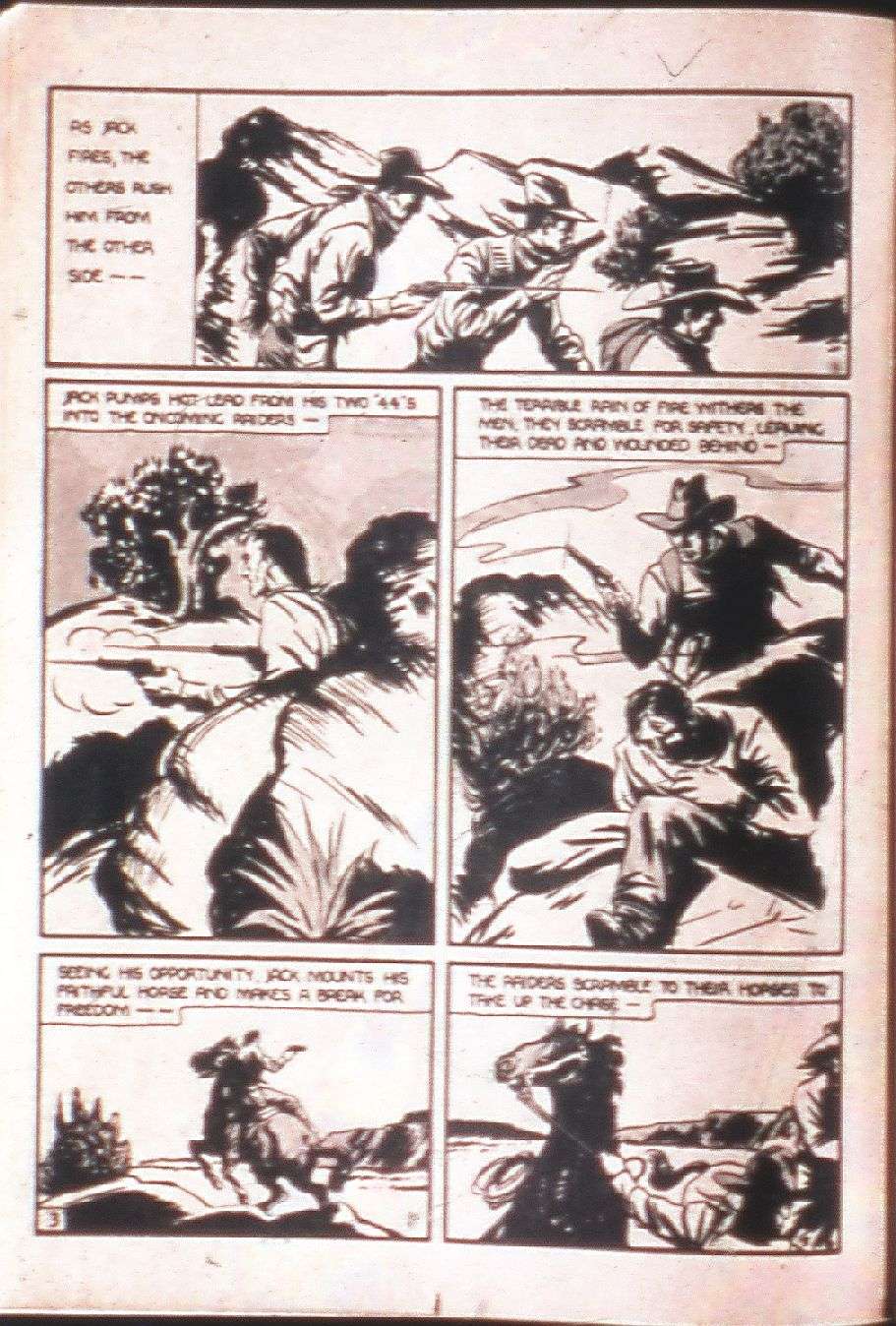
Meanwhile, Jack Woods reminds me that I should have made a Cowboy Stunt called Make Shoot at Hat. For 1 turn, all opponents must save vs. plot or shoot at the exposed hat instead of the concealed Hero.
Comic books seldom specify what type of gun is being used, and I now see it as an error that I specified so many types of historical guns on the starting equipment list. That said, this page clearly refers to Jack's weapons as being .44's, and are probably Winchester .44 revolvers.
Some amounts of climbing, like up a steep, rugged slope, or maybe even the side of a building, should be accessible to all Heroes. This, though...climbing a sheer wall, straight out of water? This has to be a special skill -- either performed by a Mysteryman (which Brad Hardy doesn't seem to be) or a stunt usable by Fighters (as Brad Hardy definitely seems to be).
It really seems like Wing Brady's player rolled a fumble in this combat. Criticals and fumbles are house rules in some games, and official rules in others. I have decided to avoid both for H&H -- I would rather the Editor control the flavor text of what happens in combat, bearing in mind the mood of the campaign he is aiming for.
(Scans courtesy of Comic Book Plus)
The only thing I can say with any certainty is that the Spy class (an unofficial class from The Trophy Case) will not make the cut into 2nd edition Hideouts & Hoodlums. It may be too specific an archetype, while Hero classes should be broad enough to be used for more than one. Also I've just received no feedback from players interested in playing one.
Good call, Sandra. If your player had been careless enough to have you shoot into a dark room, crowded with combatants, I would have rolled randomly to hit any target, friend or foe, regardless of how well you rolled on your attack roll.
I'm still unsure if Doctor Occult is public domain or not, so I'm going to continue to err on the side of not sharing these next pages -- which is a shame, because we see a lot of H&H-relevant material in them.
An old soothsayer performs a seance, not unlike the seance ability of the Trickster class (from The Trophy Case v. 1 no. 4). The trickster is more likely to end up as a mobster-type in 2nd edition than a Hero class.
The seance goes wrong and summons an elemental. Elementals, in Dr. Occult's world, are supernatural and composed of ectoplasm instead of an alchemical element. Elementals can possess people.
We also observe Dr. Occult and the elemental-possessed soothsayer in a contest of wills -- an optional rule for Magic-Users that debuted in The Trophy Case. A slightly altered version just appeared in Supplement V: Big Bang.
Meanwhile, Jack Woods reminds me that I should have made a Cowboy Stunt called Make Shoot at Hat. For 1 turn, all opponents must save vs. plot or shoot at the exposed hat instead of the concealed Hero.
Comic books seldom specify what type of gun is being used, and I now see it as an error that I specified so many types of historical guns on the starting equipment list. That said, this page clearly refers to Jack's weapons as being .44's, and are probably Winchester .44 revolvers.
Some amounts of climbing, like up a steep, rugged slope, or maybe even the side of a building, should be accessible to all Heroes. This, though...climbing a sheer wall, straight out of water? This has to be a special skill -- either performed by a Mysteryman (which Brad Hardy doesn't seem to be) or a stunt usable by Fighters (as Brad Hardy definitely seems to be).
It really seems like Wing Brady's player rolled a fumble in this combat. Criticals and fumbles are house rules in some games, and official rules in others. I have decided to avoid both for H&H -- I would rather the Editor control the flavor text of what happens in combat, bearing in mind the mood of the campaign he is aiming for.
Thursday, September 17, 2015
More Fun Comics #29
This issue starts with a really short Doctor Occult story, vs. a "spectral killer". The spectral killer looks a lot like the undead mobster-type known as a shadow, but instead of draining strength with a touch, it strangles and kills.
This is the Pirate Gold serial, and we see firecrackers being used as a diversion for the first time (it also happened not that long ago in my Sunday Nights at Home Campaign). It looks like they are being used against yellow peril hoodlums too.
Ah, the Bradley Boys use the old "high and low" trick for tripping someone. I could see, if two people work together and don't want separate attack rolls, that the attacker should get some sort of situational modifier. Perhaps, in this case, the victim would have a -1 penalty to save vs. science or fall prone. If three people were working together on tripping someone, one person would attack and the victim would save at -2.
I'm thinking of statting slavers, like this one Wing Brady is dealing with. Slavers should be tough, maybe as much as 3 Hit Dice, but they only fight with whips for 1-3 damage.
(Scans courtesy of Comic Book Plus)
This is the Pirate Gold serial, and we see firecrackers being used as a diversion for the first time (it also happened not that long ago in my Sunday Nights at Home Campaign). It looks like they are being used against yellow peril hoodlums too.
Ah, the Bradley Boys use the old "high and low" trick for tripping someone. I could see, if two people work together and don't want separate attack rolls, that the attacker should get some sort of situational modifier. Perhaps, in this case, the victim would have a -1 penalty to save vs. science or fall prone. If three people were working together on tripping someone, one person would attack and the victim would save at -2.
I'm thinking of statting slavers, like this one Wing Brady is dealing with. Slavers should be tough, maybe as much as 3 Hit Dice, but they only fight with whips for 1-3 damage.
(Scans courtesy of Comic Book Plus)
Tuesday, July 21, 2015
More Fun Comics #24
Sometimes things don't go as planned in a Hideouts & Hoodlums scenario. Sandra of the Secret Service can attest to that. Here, she and her guy-friend have gotten themselves captured again and can't figure a way out of this. What is an Editor to do? In unsubtle fashion, you let the Heroes find a sheet of paper with instructions on how to find a secret escape route. There's no official game term for this, but you can call it a freebie.
There are freebies, and there are things the Heroes are willing to pay for. Here, Wing Brady's player could have trusted to the luck of the dice on his encounter reaction roll, but he's decided to sweeten the deal and improve his chances with a $5 bribe. As the Editor of this scenario, I'd be willing to give him a +1 bonus to the roll for the bribe.
Roleplaying should matter, though, so I'd also be willing to give him a -1 penalty to the roll for being kind of a dick. "I gave you five bucks to drive the cat, not to ask questions" indeed!
This month, Brad Hardy learns that there is arm wrestling and there's ultimate arm wrestling. The first one to lose a save vs. science and fall off-balance from the bridge lands on the...well, what is that creature supposed to be, anyway? Some sort of giant catfish with tentacles? It sort of reminds me of the AD&D monster called the aboleth...
One of the best things about reading these old comic books is when you see a cool idea for an encounter area that you've never seen in a game scenario before. Bat infested caverns might be pretty common place, but ones with "sentinel-like stalagmites" taller than the Heroes? Navigating a maze of stalagmites? Sounds intriguing!
We're still months away from the debut of Superman. We've already seen one prototype, in Dr. Occult. Is Bob Merritt another? Here, he topples boulders and collapses tunnels with just a sword (yes, a ridiculously huge sword!). These feats of strength seem more appropriate for the Superhero's wrecking things game mechanic than anything a Fighter should be able to do...
And, lastly, there's Jack Woods, modern-day cowboy. Low XP-value trophies should be items that are only slightly better than ordinary. So, taking a bad guy's car would not net you any Experience Points, but a high-powered car, that might be worth 100 XP?
(Scans courtesy of Comic Book Plus)
There are freebies, and there are things the Heroes are willing to pay for. Here, Wing Brady's player could have trusted to the luck of the dice on his encounter reaction roll, but he's decided to sweeten the deal and improve his chances with a $5 bribe. As the Editor of this scenario, I'd be willing to give him a +1 bonus to the roll for the bribe.
Roleplaying should matter, though, so I'd also be willing to give him a -1 penalty to the roll for being kind of a dick. "I gave you five bucks to drive the cat, not to ask questions" indeed!
This month, Brad Hardy learns that there is arm wrestling and there's ultimate arm wrestling. The first one to lose a save vs. science and fall off-balance from the bridge lands on the...well, what is that creature supposed to be, anyway? Some sort of giant catfish with tentacles? It sort of reminds me of the AD&D monster called the aboleth...
One of the best things about reading these old comic books is when you see a cool idea for an encounter area that you've never seen in a game scenario before. Bat infested caverns might be pretty common place, but ones with "sentinel-like stalagmites" taller than the Heroes? Navigating a maze of stalagmites? Sounds intriguing!
We're still months away from the debut of Superman. We've already seen one prototype, in Dr. Occult. Is Bob Merritt another? Here, he topples boulders and collapses tunnels with just a sword (yes, a ridiculously huge sword!). These feats of strength seem more appropriate for the Superhero's wrecking things game mechanic than anything a Fighter should be able to do...
And, lastly, there's Jack Woods, modern-day cowboy. Low XP-value trophies should be items that are only slightly better than ordinary. So, taking a bad guy's car would not net you any Experience Points, but a high-powered car, that might be worth 100 XP?
(Scans courtesy of Comic Book Plus)
Friday, July 3, 2015
More Fun Comics #22
This isn't so much a playing tip, but this page of Sandra of the Secret Service amused me, reminding me of my new players in a game of Hideouts & Hoodlums, and how tying people up and hiding them in closets was their go-to plan for a significant portion of our first session...
Hey, look! It's another villain, pushed backwards off a cliff and dies! As often as I'm seeing this, I'm thinking that a "push back" or "bull rush" combat mechanic isn't the solution here. What this needs is an -
Official for H&H: The Falls off a Cliff and Dies Rule
Any time a Hero is about to get killed because of unlucky dice rolls, and you don't want it to happen (because it will spoil the narrative of the story, send a player home unhappy, etc.), you are free to have the Hero's opponent fall off a cliff and die. It is preferable, but not essential, that a cliff actually be present in the scene.
The bad guy has the drop on our Hero, Wing Brady, his gun pointing right at him. The Hero's intention is to spin around, pick up a stool, and throw it at the gunman before he can pull the trigger. Our Hero is toast, right? Then you haven't read enough comic books. This is precisely why, instead of a realistic initiative system, we need the abstraction of 2 dice rolls, higher roll goes first.
I have no idea what giant vats of boiling oil were used for in 1930s laboratories, let alone futuristic ones. Regardless, they apparently make for good hideout decor.
Now, immersion in boiling oil could be handled in one of two ways by the Editor. One is random damage (1-6, or higher, depending on how hot the oil is) per turn until the immersed is rescued, and the other is a straight save vs. poison or death. The choice might say a lot about what kind of campaign mood the Editor is going for.
The ease with which a panther is killed by one of the Bradley Boys with just a knife is a good argument for going with same damage for everything, and not scaling to an expanded weapon damage system that penalizes the "lowly" knife.
As common as cannibals are in Golden Age comics, I've shied away from using them as a distinct mobster type. Instead, I've lumped them together with other racist portrayals under "Natives" in Book II: Mobsters & Trophies.
Here Brad Hardy encounters some kind of underwater dragon. The real lesson here is, as long as you can count on your players never to turn around and fight, you can throw encounters as big and spectacle-worthy as you like at them. Of course, then it's beholden on you, the Editor, to provide someone else to do the fighting for them.
Hence, mermen with underwater lightning guns.
In a page of Doctor Occult, not shown here, Jerry Siegel shows off his talent for cleverly playing with science fiction motifs again (as we have already seen him do in Federal Men). In the last issue, Dr. Occult was killed. In this issue, a scientist brings him back to life, ala Frankenstein's Monster, only here the mad scientist is more obviously the villain and the "monster" is more obviously the Hero.
The trophy item used to bring the Doctor back must be a mad science raise dead machine.
Proof that cowboys can climb walls. It's not just a Mysteryman skill anymore!
And lastly, a page of Johnnie Law, included here because it's actually an example of good detective work -- using a clue to narrow down a smaller list of suspects, and then meticulously tail each of them.
(Scans courtesy of Comic Book Plus)
Hey, look! It's another villain, pushed backwards off a cliff and dies! As often as I'm seeing this, I'm thinking that a "push back" or "bull rush" combat mechanic isn't the solution here. What this needs is an -
Official for H&H: The Falls off a Cliff and Dies Rule
Any time a Hero is about to get killed because of unlucky dice rolls, and you don't want it to happen (because it will spoil the narrative of the story, send a player home unhappy, etc.), you are free to have the Hero's opponent fall off a cliff and die. It is preferable, but not essential, that a cliff actually be present in the scene.
The bad guy has the drop on our Hero, Wing Brady, his gun pointing right at him. The Hero's intention is to spin around, pick up a stool, and throw it at the gunman before he can pull the trigger. Our Hero is toast, right? Then you haven't read enough comic books. This is precisely why, instead of a realistic initiative system, we need the abstraction of 2 dice rolls, higher roll goes first.
I have no idea what giant vats of boiling oil were used for in 1930s laboratories, let alone futuristic ones. Regardless, they apparently make for good hideout decor.
Now, immersion in boiling oil could be handled in one of two ways by the Editor. One is random damage (1-6, or higher, depending on how hot the oil is) per turn until the immersed is rescued, and the other is a straight save vs. poison or death. The choice might say a lot about what kind of campaign mood the Editor is going for.
The ease with which a panther is killed by one of the Bradley Boys with just a knife is a good argument for going with same damage for everything, and not scaling to an expanded weapon damage system that penalizes the "lowly" knife.
As common as cannibals are in Golden Age comics, I've shied away from using them as a distinct mobster type. Instead, I've lumped them together with other racist portrayals under "Natives" in Book II: Mobsters & Trophies.
Here Brad Hardy encounters some kind of underwater dragon. The real lesson here is, as long as you can count on your players never to turn around and fight, you can throw encounters as big and spectacle-worthy as you like at them. Of course, then it's beholden on you, the Editor, to provide someone else to do the fighting for them.
Hence, mermen with underwater lightning guns.
In a page of Doctor Occult, not shown here, Jerry Siegel shows off his talent for cleverly playing with science fiction motifs again (as we have already seen him do in Federal Men). In the last issue, Dr. Occult was killed. In this issue, a scientist brings him back to life, ala Frankenstein's Monster, only here the mad scientist is more obviously the villain and the "monster" is more obviously the Hero.
The trophy item used to bring the Doctor back must be a mad science raise dead machine.
Proof that cowboys can climb walls. It's not just a Mysteryman skill anymore!
And lastly, a page of Johnnie Law, included here because it's actually an example of good detective work -- using a clue to narrow down a smaller list of suspects, and then meticulously tail each of them.
(Scans courtesy of Comic Book Plus)
Labels:
Brad Hardy,
Bradley Boys,
deathtraps,
Dr. Occult,
dressing,
initiative,
Jack Woods,
Mark Marson,
mobsters,
new mobsters,
new rules,
Pirate Gold,
Sandra of the Secret Service,
trophies,
weapon damage,
Wing Brady
Wednesday, June 24, 2015
More Fun Comics #21 - pt. 1
I wish we had more of an overhead visual of the layout of this island, because it sounds like an interesting locale for a remote hideout on, not just one, but spread out over a chain of small, uncharted islands. The building that looks like a covered bridge apparently conceals the entrance to the administrative building, which must be mostly underground.
And the hideout is extensively deep, with an elevator needing to go down to where The Brain keeps his lair.
Should punches stun temporarily? There are slim precedents in That Other Game, particularly an old Dragon magazine article I can recall, for setting a small percentage chance of punches stunning, in addition to causing damage.
For this particular instance we don't need it. In this combat, the captain goes first in turn 1, throwing his knife, and then Wing Brady punches at the end of the turn.
At the beginning of turn 2, Wing wins the initiative and attacks first. The captain misses -- but, the results of that miss can be explained away as anything by the Editor using flavor text. "Stunned temporarily" would be a good excuse for the Editor rolling a 1 to hit.
It does seem that H&H needs to have fatigue/exhaustion rules for scenes like this.
Barry O'Neill is going to learn his lesson from this scene -- always disable your enemy's transportation if you find it outside the hideout (or, if you have time, steal it first!).
I might give Mark Marson and his pal a +1 bonus to their saves vs. poison for having smashed the window first.
It seems very unlikely to me that kicking a bear would knock it off-balance. This seems like more flavor text to explain how the bear managed to miss a prone opponent (which the bear has a +2 bonus to hit!).
(Scans courtesy of Comic Book Plus)
And the hideout is extensively deep, with an elevator needing to go down to where The Brain keeps his lair.
Should punches stun temporarily? There are slim precedents in That Other Game, particularly an old Dragon magazine article I can recall, for setting a small percentage chance of punches stunning, in addition to causing damage.
For this particular instance we don't need it. In this combat, the captain goes first in turn 1, throwing his knife, and then Wing Brady punches at the end of the turn.
At the beginning of turn 2, Wing wins the initiative and attacks first. The captain misses -- but, the results of that miss can be explained away as anything by the Editor using flavor text. "Stunned temporarily" would be a good excuse for the Editor rolling a 1 to hit.
It does seem that H&H needs to have fatigue/exhaustion rules for scenes like this.
Barry O'Neill is going to learn his lesson from this scene -- always disable your enemy's transportation if you find it outside the hideout (or, if you have time, steal it first!).
I might give Mark Marson and his pal a +1 bonus to their saves vs. poison for having smashed the window first.
It seems very unlikely to me that kicking a bear would knock it off-balance. This seems like more flavor text to explain how the bear managed to miss a prone opponent (which the bear has a +2 bonus to hit!).
(Scans courtesy of Comic Book Plus)
Friday, February 27, 2015
More Fun #12
As we roll into August 1936, we are reminded that the Planet Saro is an awfully dangerous place, and how eventful any Hideouts & Hoodlums campaign would be if creatures from Saro wound up in an Earth-based campaign. Here is the latest monstrosity Don Drake has to fight, boringly called the Land Monster. What it appears to be is a cross between a rhinoceros and a dragon, with greenish gray hide, a double horn, double tusks, and fire breath that roars out of its nostrils. I would probably use red dragon stats for this monster, though next issue will tell us how tough it is (since Don has a disentegrator in his hands, I'm guessing not very).
Buckskin Jim presents an interesting problem for a H&H Editor. When the trapper shoots into a melee, he's breaking a combat rule. But how tightly do you want to enforce that rule when Buckskin Jim is about to get killed? An Editor might be forgiven for treating "no shooting into melee" as a loose guideline, or coming up with a compromise mechanic. An unofficial suggestion would be making a second attack roll against a different melee combatant (determined at random, if more than two combatants) if the initial attack misses by half or more.
Brad Hardy meets a Magic-User with an interesting new spell here. Ball of Fire is a sphere 7' in diameter that surrounds the caster and moves with him. Any combustibles touching the sphere catch fire and anyone trying to melee the Magic-User within the sphere takes 1-10 points of damage. Further, the Magic-User enjoys a +2 bonus to saving throws vs. missiles made of wood, like arrows. I see this as being a 2nd level spell.
In the Doctor Occult feature, we learn that werewolves cast a wolf reflection in mirrors, even when in human form.
Wing Brady graces this blog again for this deathtrap he's placed in. After being weakened by whipping, he's dangled by weak rope over a pit of poisonous reptiles. If he struggles too much, the ropes are supposed to break and drop him into the pit. Of course, taking damage doesn't actually make you weaker in H&H, but being low in hit points will make him more likely to be killed by either the fall or the reptile bites.
In the Wake of the Wander is just one of several stories I've read (or re-read) recently that have made me question my original assumption that languages don't matter in H&H. Yes, everyone speaks English in comic books (even aliens!), but sometimes you do need to send a coded message that not everyone around you will understand, like Morse code. Expect to see some revision here in the next edition.
(Scans courtesy of Comic Book Plus)
Thursday, February 5, 2015
More Fun #9

More Don Drake on the Planet Saro fun! This time we clearly see that Don is fighting what must be a full-sized, 15 HD, sea monster -- which means that Zetrurian Canon must pack a whopping 15 HD of damage!
The next page features those bizarre "winged death" creatures again and, even with a better look at them, I can't figure out how to stat them! It's almost more like an AD&D modron than a bird or insect. Any thoughts on them?
Poor Wing Brady is dying of thirst in the desert. How to handle that, though, in game play? Hideouts & Hoodlums includes rules for fatigue (in Book I: Men and Supermen, the combat section), but no rules for dehydration or starvation.
It is generally said that a man can go three days without water (though this site says some people have gone 8-10 days without water). So, after 3 days, I would have the Hero suffer constant fatigue and, in addition, make the Hero save vs. science each additional day, or die.
Speaking of bizarre...Brad Hardy here tackles some "ape men" -- though, as anyone with basic zoological education knows, apes don't have tails. Perhaps, if we ignored the tails, these could be the gibbon men statted in H&H Supplement I: National? The gibbon men only sprang into existence to fill a niche for a weak humanoid creature. Perhaps I should just replace them with monkey men like these in the next edition.
The "ape god" is a statue that just stood up and startled everyone. A stone golem...?
This installment of 2023 Super-Police shows that, even in the future, you can still find subterranean hideouts to explore! Here we see a cave complex made from old lava tubes, now partially filled with water. The boat conveniently left on the shore reminds me of the classic AD&D module S4 Lost Caverns of Tsojcanth.
Good thing Kiddlaw has a flare! Flares are not currently on the starting equipment list for H&H, but it bears consideration.
(Scans courtesy of Comic Book Plus at http://comicbookplus.com/?dlid=11640&b=i)
Subscribe to:
Posts (Atom)