It's been a while since we visited the comic strip reprints Dell was running with. This post is mostly about tactics.
Here, Don and company show us the best way to get through a minefield.
I didn't really need to share this page; I just think "Doctor Thor" is such a cool name. Don Winslow had a good rogues gallery.
In this age of automatics, we forget how easy it once was to stall your motor. There should maybe be a small chance (1 in 10?) per turn of a car chase of stalling your motor, or it could be just added to the list of halting obstacles listed in the chase rules in 2nd edition.
The scale seems to be off on the Dwarf in that last panel -- he looks huge in that front seat.
"Espionage, eh? Sounds like a good name for a feature!"
Trying to pass yourself off as an inspector is one of the great RPG ruses and works perfectly here. You might have to forge some credentials, as not everyone will take you at your word like Mr. Rello seems to.
Note that Ed Tracer did not have to actively feel around on that wall to spot it was fake; secret door checks can be done on sight only.
Hideouts on piers with motorboats docked underneath them is practically a cliche by now on this blog.
This is the same year Dell will begin publishing squeaky-clean Disney comics, so I'm amused that they're still publishing stories about dope smugglers in February.
I like how, in 1940, the U.S. government is never a suspect. Conspiracy-based scenarios need not apply in the golden age!
Clipping the spark plugs is one of those complications I'll have to add to my vehicular combat rules.
The fighter aircraft pictured here is most likely a P-35. It's an interesting choice to compare the stratosphere plane to, as Wikipedia claims the "P-35's performance was poor even by contemporary standard" and "it was already obsolete by the time deliveries were finished..."
Wash gives us some more pricing information, with $830 being the cost of all new windows for a building and $300 being the cost of repainting a building.
Extortionists can be statted as bandits, at least according to Wash.
Rather than stat bodyguards, I think we need to recognize that Easy's pals are probably mid-level fighters, like he is.
Another example of non-Heroes needing longer to heal, in this case the hoodlums need three weeks to recover from being reduced to zero hit points.
Wire-tapping your own phone seems a sound strategy, especially if you suspect you have a spy in your midst.
(Scans courtesy of Comic Book Plus.)
An exploration of the Golden Age of Comics, through the lens of Hideouts & Hoodlums, the comic book roleplaying game.
Showing posts with label Don Winslow U.S.N.. Show all posts
Friday, February 22, 2019
Sunday, August 5, 2018
Crackajack Funnies #19 - pt. 1
Back to public domain stories I can show!
Here we rejoin Don Winslow of the Navy, explaining a bit of problem solving he did. We also are reminded of a definition of "dope" that we might often forget these days.
Someone's been pranking this poor ship captain, replacing his maps with fakes. The Balkans do not border the Mediterranean Sea; they border the Adriatic.
What a "paravane" is is explained here.
The idea that Indians were secretly hoarding gold has enticed white men since arriving in North America.
If I ever succeed in making the Cowboy class (debuted in Supplement III: Better Quality) viable in 2nd edition, it will surely keep the ability to summon mount.
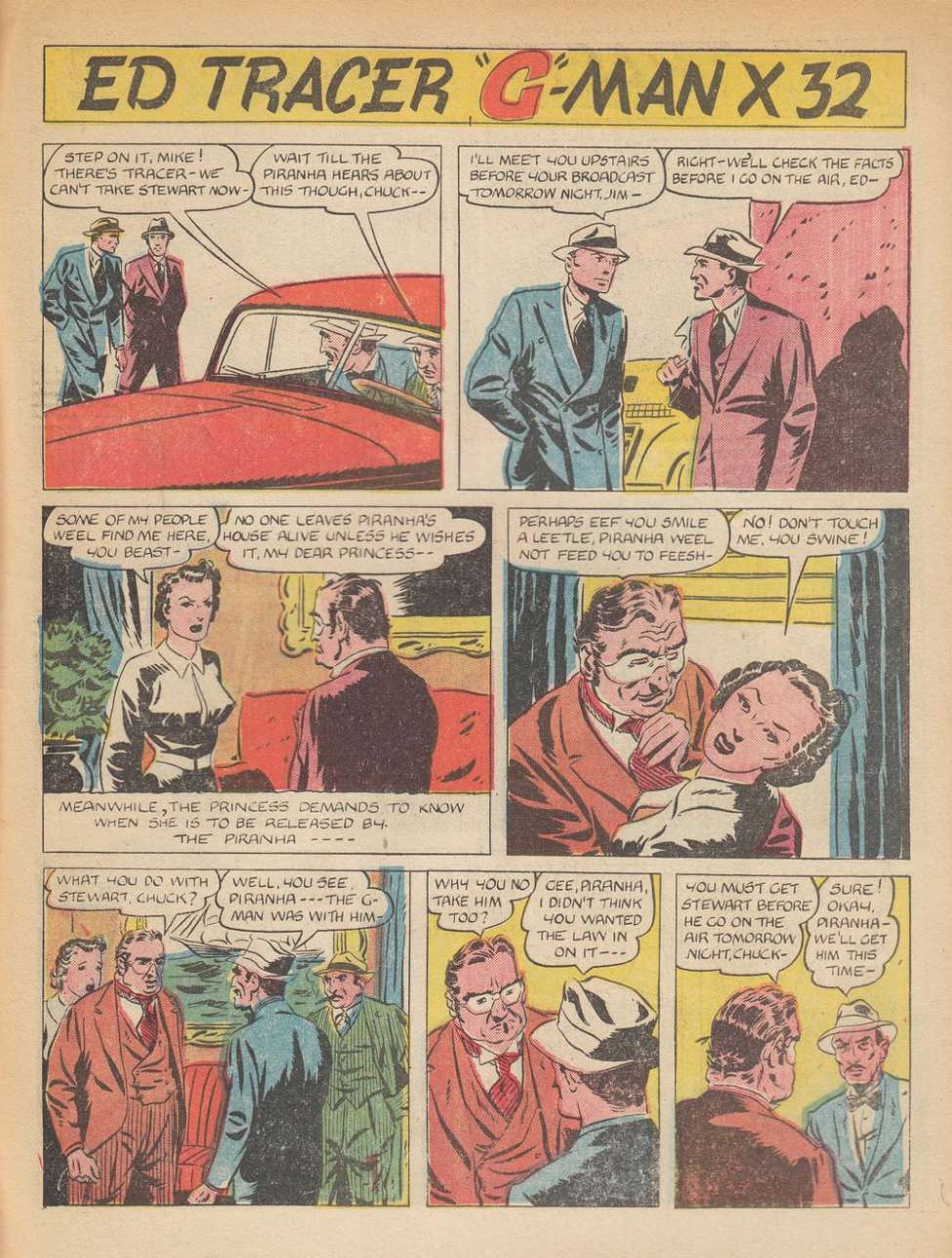
This is Ed Tracer, G-Man X32.
Dapper Danz is very excited about narcotics.
The secret hideout is an old moonshiner's cave with a secret front door.
This page is a nice twist. When we met "Deacon" Slade a few pages earlier, he just seemed like a harmless wandering encounter, maybe a red herring. But it turns out he's a rival with a different agenda vs. Dapper Danz.
Man, that sure is a nice looking Donald Duck pocket watch. It's going to cost a lot more than $1 today!
Stratosphere Jim has an interesting alternative explanation for how VTOL planes would work. A pressurized cabin was also a rare novelty circa 1940.
It would be 1953 before any plane officially matched this airspeed record. A simple system for keeping track of trophy items would be to say that a plane 13 years ahead of its time is a Plane +1, 26 years ahead of its time would be a Plane +2, 39 years ahead of its time would be a Plane +3, and so on.
The notion that secrets need to be kept, even from your own government, were a comic book staple before WWII, but would quickly seem unpatriotic. Yet, I wonder how many superheroes quietly shared their weapons' secrets with the War Department...
(Scans courtesy of Digital Comic Museum.)
Here we rejoin Don Winslow of the Navy, explaining a bit of problem solving he did. We also are reminded of a definition of "dope" that we might often forget these days.
Someone's been pranking this poor ship captain, replacing his maps with fakes. The Balkans do not border the Mediterranean Sea; they border the Adriatic.
What a "paravane" is is explained here.
The idea that Indians were secretly hoarding gold has enticed white men since arriving in North America.
If I ever succeed in making the Cowboy class (debuted in Supplement III: Better Quality) viable in 2nd edition, it will surely keep the ability to summon mount.
This is Ed Tracer, G-Man X32.
Dapper Danz is very excited about narcotics.
The secret hideout is an old moonshiner's cave with a secret front door.
This page is a nice twist. When we met "Deacon" Slade a few pages earlier, he just seemed like a harmless wandering encounter, maybe a red herring. But it turns out he's a rival with a different agenda vs. Dapper Danz.
Man, that sure is a nice looking Donald Duck pocket watch. It's going to cost a lot more than $1 today!
Stratosphere Jim has an interesting alternative explanation for how VTOL planes would work. A pressurized cabin was also a rare novelty circa 1940.
It would be 1953 before any plane officially matched this airspeed record. A simple system for keeping track of trophy items would be to say that a plane 13 years ahead of its time is a Plane +1, 26 years ahead of its time would be a Plane +2, 39 years ahead of its time would be a Plane +3, and so on.
The notion that secrets need to be kept, even from your own government, were a comic book staple before WWII, but would quickly seem unpatriotic. Yet, I wonder how many superheroes quietly shared their weapons' secrets with the War Department...
(Scans courtesy of Digital Comic Museum.)
Friday, February 17, 2017
Four Color #2: Don Winslow of the Navy
This special issue includes just about every page of the Don Winslow comic strip Dell had reprinted up to this point. Here's some things I missed discussing the first time round.
There needs to be limits to trophy items. A good rule of thumb would be to set a weight limit. For the basic book, nothing weighing more than 3 tons will be available. At 10,000 tons, a tramp steamer is going to be way out of bounds, not to mention the naval carrier.
Here we see what the international code flags are for distress. We also see how much easier you make it for your players when your villains aren't smart enough to board ships under fake names.
Centaur's paralyzing machine is different from a raygun in that it effects all targets with a radius instead of in a straight path. That would make this a mad science invention instead, categorically.
Sound-muffling hoods that can protect against sound-based machines could also be a trophy item.
I'm having some serious deja vu here, having shared this page way back when.
The reference to the "Cyclops" is explained here.
Not sure why Dr. Centaur keeps a handkerchief soaked in cobalt salts, but apparently cobalt salt is a good ingredient for invisible ink.
When a villain endangers innocents in order to escape, the Heroes have to save vs. plot to pursue the villain instead of saving the innocents.
I'm skeptical that you could turn a ship at just the right angle to make a smokescreen, but smokescreens are another classic villain strategy. When I get to the evasion rules, I'll have to make mention of smokescreens.
Centaur's lair is this ring-shaped island, but like every island it has a door. This is a big one, though, a concealed drawbridge made to look like part of the wall. It could be a clue to the scale of the hideout on the other side, or just a trick to make it look more impressive than it is inside.
The entrance to the hideout is trapped, there's a dynamite charge here that will create a landslide. On the next page it sends tons of rock crashing down. That's a lot of potential damage.
A school of sharks is the proper term. This school seems to have five sharks, which isn't a lot, but it's probably the most sharks I've seen in one panel yet.
(Scans courtesy of Comic Book Plus)
There needs to be limits to trophy items. A good rule of thumb would be to set a weight limit. For the basic book, nothing weighing more than 3 tons will be available. At 10,000 tons, a tramp steamer is going to be way out of bounds, not to mention the naval carrier.
Here we see what the international code flags are for distress. We also see how much easier you make it for your players when your villains aren't smart enough to board ships under fake names.
Centaur's paralyzing machine is different from a raygun in that it effects all targets with a radius instead of in a straight path. That would make this a mad science invention instead, categorically.
Sound-muffling hoods that can protect against sound-based machines could also be a trophy item.
I'm having some serious deja vu here, having shared this page way back when.
The reference to the "Cyclops" is explained here.
Not sure why Dr. Centaur keeps a handkerchief soaked in cobalt salts, but apparently cobalt salt is a good ingredient for invisible ink.
When a villain endangers innocents in order to escape, the Heroes have to save vs. plot to pursue the villain instead of saving the innocents.
I'm skeptical that you could turn a ship at just the right angle to make a smokescreen, but smokescreens are another classic villain strategy. When I get to the evasion rules, I'll have to make mention of smokescreens.
Centaur's lair is this ring-shaped island, but like every island it has a door. This is a big one, though, a concealed drawbridge made to look like part of the wall. It could be a clue to the scale of the hideout on the other side, or just a trick to make it look more impressive than it is inside.
The entrance to the hideout is trapped, there's a dynamite charge here that will create a landslide. On the next page it sends tons of rock crashing down. That's a lot of potential damage.
A school of sharks is the proper term. This school seems to have five sharks, which isn't a lot, but it's probably the most sharks I've seen in one panel yet.
(Scans courtesy of Comic Book Plus)
Saturday, August 27, 2016
Crackajack Funnies #14
We haven't checked in on Dan Dunn in awhile. Here, I'm interested in the double protection of having a secret room, behind a secret door, and a second concealed door behind a painting in the secret room. But can we distinguish between secret and concealed doors here? We don't actually see the first secret door behind the bookcase; it's just described to us. If the bookcase is only blocking a normal door, then I would call that a concealed door. But if it looked like blank wall behind the bookcase until you pulled a lever disguised to look like a book on the shelf, causing it to slide open, then you have a secret door.
Slade missed his save vs. plot to see through Dan's act, but Fallon made his. It's worth pointing out that a disguise doesn't have to be a fake mustache or stage make-up; it can be trying to pass yourself off as someone else.
This reminds me of the Cowboy stunt Jump into Saddle (from Supplement III), and also reminds me that Jump into Saddle could have explained how Abdul the Arab could have leaped down into a moving car in the post I did on Smash Comics #1 two days ago.
Only a hoodlum who's never read Treasure Island would skip searching a crutch.
But I'm more interested here in Peggy's Mother's concern about her jewelry being all fakes. Granted, this is a non-Hero character, but if it was a Hero, how would I handle this? A successful appraisal check tells her they're fake, but a failed roll only tells her she doesn't know for sure yet.
In Hideouts & Hoodlums I don't tell you who should make the dice rolls, leaving that up to each Editor to decide. Often, I like to let players make their own encounter reaction rolls. I normally do let them make their own skill checks -- but I can see situations, like appraisal, where a secret check by the Editor might make more sense. Then the players have to react to what the Editor tells them, instead of what they know from the dice roll.
The nice thing about this escape plan is that there's no time crunch involved. If the cistern had been filling up with water, that would be another thing, but because the three of them can try the human pyramid trick as many times as they want, there's no reason not to just wave game mechanics, say it works, and reward Easy's player for his good idea.
From Myra North, Special Nurse, we learn that artificial respiration was much different in the 1930s! It makes you wonder how first aid ever worked back then. No wonder it doesn't give you immediate hit points back in H&H!
I just had to share this because it's pretty cool. Myra North must have at least one level in Fighter. Here she takes on a spy armed with a gun, using only a pair of scissors, and still wins!
Sound-proof doors in hideouts is something to consider. It would waste a lot of players' hear noise rolls during a hideout-clearing expedition. On the other hand, it would also keep mobsters from being able to hear combat in their neighbors' rooms and lend aid.
(Scans courtesy of Digital Comics Museum)
Slade missed his save vs. plot to see through Dan's act, but Fallon made his. It's worth pointing out that a disguise doesn't have to be a fake mustache or stage make-up; it can be trying to pass yourself off as someone else.
This reminds me of the Cowboy stunt Jump into Saddle (from Supplement III), and also reminds me that Jump into Saddle could have explained how Abdul the Arab could have leaped down into a moving car in the post I did on Smash Comics #1 two days ago.
Only a hoodlum who's never read Treasure Island would skip searching a crutch.
But I'm more interested here in Peggy's Mother's concern about her jewelry being all fakes. Granted, this is a non-Hero character, but if it was a Hero, how would I handle this? A successful appraisal check tells her they're fake, but a failed roll only tells her she doesn't know for sure yet.
In Hideouts & Hoodlums I don't tell you who should make the dice rolls, leaving that up to each Editor to decide. Often, I like to let players make their own encounter reaction rolls. I normally do let them make their own skill checks -- but I can see situations, like appraisal, where a secret check by the Editor might make more sense. Then the players have to react to what the Editor tells them, instead of what they know from the dice roll.
The nice thing about this escape plan is that there's no time crunch involved. If the cistern had been filling up with water, that would be another thing, but because the three of them can try the human pyramid trick as many times as they want, there's no reason not to just wave game mechanics, say it works, and reward Easy's player for his good idea.
From Myra North, Special Nurse, we learn that artificial respiration was much different in the 1930s! It makes you wonder how first aid ever worked back then. No wonder it doesn't give you immediate hit points back in H&H!
I just had to share this because it's pretty cool. Myra North must have at least one level in Fighter. Here she takes on a spy armed with a gun, using only a pair of scissors, and still wins!
Sound-proof doors in hideouts is something to consider. It would waste a lot of players' hear noise rolls during a hideout-clearing expedition. On the other hand, it would also keep mobsters from being able to hear combat in their neighbors' rooms and lend aid.
(Scans courtesy of Digital Comics Museum)
Sunday, July 24, 2016
Crackajack Funnies #13
This is Red Ryder and...hmm...that's one impressive panel. I wonder if I shouldn't consider a cattle stampede a save or die situation...
Wash Tubbs and Captain Easy are lucky to defeat a single mobster and win a boat as a trophy item.
The "ghostly ruins of an old plantation" is an atmospheric location for a hideout. That there's only building on the island makes it easy to find the hideout.
The hideout is under the ruins -- a common place for hideouts. The entrance is a concealed trapdor and has to be found, though. Luckily, the Editor rolls a wandering encounter and gives them someone to question.
Also note that time of day affects what the mobsters are doing in the hideout; they aren't just static stat blocks, frozen in place until encountered.
The first thing Easy does in the hideout after knocking out the lone guard isn't to slit the throats of the sleeping bad guys, but to sneak around and take all their weapons. And this is the behavior of a Hero who can probably be defined as Neutral rather than Lawful.
Yes, leaving his prisoners alive does sometimes lead to complications. But how exactly did that mobster left on the beach get free? It seems editorial fiat created that complication. In game play, this would only discourage Heroes from leaving their prisoners alive.
It's interesting how Roy Crane, normally such an attentive artist to detail, just said "forget this!" and stopped drawing the background to panel 1 in mid-panel. This is sort of like what hideouts are like for your players when you stop adding dressing to the hideouts. Describing the brickwork, placing random barrels in hallways -- these are the things that remind players that their characters are in a physical place and helps them visualize it.
Extra guns under beds is another good dressing detail, and handy for the bad guys.
Yes, secret doors can have alarm systems hooked up to them now. No need for Magic Mouth spells!
This stage money brings up the topic of recognizing forgeries. I had written up more on the subject under the spy class (in The Trophy Case), but basically the only mechanic you need here is save vs. plot -- succeed, and you recognize the bills for what they are. Disguise works the same way, and what is a forgery but a disguised bill?
(Scans courtesy of Comic Book Plus)
Wash Tubbs and Captain Easy are lucky to defeat a single mobster and win a boat as a trophy item.
The "ghostly ruins of an old plantation" is an atmospheric location for a hideout. That there's only building on the island makes it easy to find the hideout.
The hideout is under the ruins -- a common place for hideouts. The entrance is a concealed trapdor and has to be found, though. Luckily, the Editor rolls a wandering encounter and gives them someone to question.
Also note that time of day affects what the mobsters are doing in the hideout; they aren't just static stat blocks, frozen in place until encountered.
The first thing Easy does in the hideout after knocking out the lone guard isn't to slit the throats of the sleeping bad guys, but to sneak around and take all their weapons. And this is the behavior of a Hero who can probably be defined as Neutral rather than Lawful.
Yes, leaving his prisoners alive does sometimes lead to complications. But how exactly did that mobster left on the beach get free? It seems editorial fiat created that complication. In game play, this would only discourage Heroes from leaving their prisoners alive.
It's interesting how Roy Crane, normally such an attentive artist to detail, just said "forget this!" and stopped drawing the background to panel 1 in mid-panel. This is sort of like what hideouts are like for your players when you stop adding dressing to the hideouts. Describing the brickwork, placing random barrels in hallways -- these are the things that remind players that their characters are in a physical place and helps them visualize it.
Extra guns under beds is another good dressing detail, and handy for the bad guys.
Yes, secret doors can have alarm systems hooked up to them now. No need for Magic Mouth spells!
This stage money brings up the topic of recognizing forgeries. I had written up more on the subject under the spy class (in The Trophy Case), but basically the only mechanic you need here is save vs. plot -- succeed, and you recognize the bills for what they are. Disguise works the same way, and what is a forgery but a disguised bill?
(Scans courtesy of Comic Book Plus)
Thursday, June 16, 2016
Crackajack Funnies #12
The theme for today's post is stunts, a game mechanic from the Hideouts & Hoodlums supplements that is being radically overhauled for 2nd edition. In 1st edition, stunts had one-shot activations, like powers and spells, and then automatically worked so long as you made it into the duration before it expired. What will replace this are skills, that you always have a random chance of succeeding at. Mysterymen will still get a chance to use stunts -- a limited number of times per day they can auto-succeed at a skill, with extra panache.
So, despite how heavily the new rules will talk about Mysterymen, they apply equally to Cowboys. Cowboys are from Supplement III: Better Quality, will not make it into the 2nd edition Basic Rules book, but might make it into a later book expanding Hero creation options for different settings/genres.
Here, we see Tom Mix and another cowboy performing a stunt together. Leaping from one moving horse to another seems like a skill anyone might have a chance to accomplish -- though I would make it an expert skill with a lower chance. But leaping while your hands are tied behind your back? That's something extra, and has to be a stunt.
This is something that I had not considered a skill at first, probably because Heroes don't resort to it too often, but hiding is definitely a skill.
Captain Easy is often a good source of inspiration. Here, he teaches H&H players a thing about perseverance! Without any clues to go on where the pirates who kidnapped the girl he was responsible for are hiding, Easy and Tubbs start visiting every island where they could be hiding and checking every one. They have searched 17 islands so far at this point, and are about to finally strike pay dirt on the 18th...
This is a situation where a stunt, Increase Speed, that originally debuted for the Cowboy class, made so much sense that it was also given to the Aviator class (in The Trophy Case v. 1 #6-7), and then to Paladins in Supplement V: Big Bang. Now it makes sense to just let everyone have a chance at it, which is why it will now be a skill.
I don't have a lot to say about this, and any wargamer worth their minis already knows this, but tactics are important even when your Hero is in a Naval battleship, or a bomb-dropping blimp.
The tropes of the genre work both ways. There's no way that mask should be able to conceal anyone's identity. But if it works for the heroes, it works for the villains (and everyone still has to save vs. plot to recognize him through the mask).
(Scans courtesy of Comic Book Plus)
So, despite how heavily the new rules will talk about Mysterymen, they apply equally to Cowboys. Cowboys are from Supplement III: Better Quality, will not make it into the 2nd edition Basic Rules book, but might make it into a later book expanding Hero creation options for different settings/genres.
Here, we see Tom Mix and another cowboy performing a stunt together. Leaping from one moving horse to another seems like a skill anyone might have a chance to accomplish -- though I would make it an expert skill with a lower chance. But leaping while your hands are tied behind your back? That's something extra, and has to be a stunt.
This is something that I had not considered a skill at first, probably because Heroes don't resort to it too often, but hiding is definitely a skill.
Captain Easy is often a good source of inspiration. Here, he teaches H&H players a thing about perseverance! Without any clues to go on where the pirates who kidnapped the girl he was responsible for are hiding, Easy and Tubbs start visiting every island where they could be hiding and checking every one. They have searched 17 islands so far at this point, and are about to finally strike pay dirt on the 18th...
This is a situation where a stunt, Increase Speed, that originally debuted for the Cowboy class, made so much sense that it was also given to the Aviator class (in The Trophy Case v. 1 #6-7), and then to Paladins in Supplement V: Big Bang. Now it makes sense to just let everyone have a chance at it, which is why it will now be a skill.
I don't have a lot to say about this, and any wargamer worth their minis already knows this, but tactics are important even when your Hero is in a Naval battleship, or a bomb-dropping blimp.
The tropes of the genre work both ways. There's no way that mask should be able to conceal anyone's identity. But if it works for the heroes, it works for the villains (and everyone still has to save vs. plot to recognize him through the mask).
(Scans courtesy of Comic Book Plus)
Sunday, April 24, 2016
Crackajack Funnies - part 2
This page gives you some idea of just how many hit points Easy has.
I don't really see how Lulu Belle jumps over his head and lands outside the ring. Unless she's an alien or a superhero using her leaping ability...
Don Winslow's lesson this month is, if your cell starts to fill with water -- look for fish! It could be a clue that there's a way to swim out.
This is from Clyde Beatty, Dare Devil Lion Tamer, and it's a complication from being reduced to zero hit points we haven't seen before -- temporary partial paralysis!
More evidence of long recovery times for lost hit points.
(Scans courtesy of Digital Comic Museum)
I don't really see how Lulu Belle jumps over his head and lands outside the ring. Unless she's an alien or a superhero using her leaping ability...
Don Winslow's lesson this month is, if your cell starts to fill with water -- look for fish! It could be a clue that there's a way to swim out.
This is from Clyde Beatty, Dare Devil Lion Tamer, and it's a complication from being reduced to zero hit points we haven't seen before -- temporary partial paralysis!
More evidence of long recovery times for lost hit points.
(Scans courtesy of Digital Comic Museum)
Subscribe to:
Posts (Atom)