Showing posts with label magic. Show all posts

Wednesday, May 8, 2019

Tip Top Comics #30, 32

Today's entry might be mostly price examples, but we'll get to game mechanics later on.

First, in Fritzi Ritz, Nancy finds a wishing stone that doesn't work for her -- but this made me think about wishes, or just powerful magic in general, and the issue of how common these things should be in a Hideouts & Hoodlums campaign. Should a wishing stone be just randomly hidden in plain view in the urban setting, that the Heroes may or may not find? Or
should it be at the end of a long quest involving beating dragons and giants?

In the next page, Fritzi rents a canoe for $3, and that does seem like a lot, because Ella Cinders was able to rent both a boat and aquaplane for just $3 per 15 minutes three issues ago. Now, maybe Fritzi can keep the canoe much longer, but the point to remember here is that you can't separate Heroes from the money they've been accumulating with high starting price points,
because that's not how things worked in the '30s and '40s. You didn't just go up to a guy with a canoe and offer him $100 to buy it outright; he'd look at you funny like you were up to no good, or trying to pull one over on him.

Also, on the subject of pricing, Frankie Doodle buys baloney by the nickel and buns are two for a nickel at the grocery store.
I can never tell if the dates are legitimate or just made-up, but How It Began seems to be legit when it gives us things like a timeline for bullfighting -- which could be handy during a time travel adventure. You wouldn't want to plan a bullfighting scene in a 1350 scenario and have a smart player telling you that bullfighting wasn't happening then.
Electric toasters for just 69 cents. Granted, it's a special sale price, but still...
We're now jumping ahead to vol. 3, no. 8 (Dec. 1938).

We do have a game mechanics issue to discuss on this one. The grappling rules, as they currently stand, require both the attacker and defender to spend the whole combat turn making grappling attempts at each other; the only time a bonus action is inserted is when the victim wins initiative before the grappling combat starts. But here, the Professor is able to get "bonus actions" of slipping capsules out of his belt and rubbing them under noses during grappling. Or is he? He doesn't manage to when facing a Hero in battle, and I've already established that the Editor can hand-wave combat rules applying to non-Heroes.

As to the wrestling moves: the "aeroplane spin" is a simple throw. I don't have a good equivalent for the drop kick, but I don't think I would count that as a grappling move anyway; kicking is just another form of unarmed combat and I treat it no differently than punching.

I'm not going to bother showing you how Jim Hardy finds the clue that there's a secret door by the half-footprints right up against the wall, and I'm going to spare you how Dick Moores consistently spells clue as "clew", but I did want to show you this page because of the example of how the catch for opening a secret door can be hidden in plain sight. Also, the novelty diner as hideout was an idea I thought worth sharing.
Here we see that animal attacks can disarm as well as attacks from people (indeed, just a page earlier, a mountain lion swats Bill's rifle from his hands in almost identical fashion).

Large eagles might need to get statted at some point, as this one is strong enough to partially raise a young man into the air. It's tricky to do and stick to my formula of 1 hp = 30 lbs, since the largest eagles in real life are no more than 17 lbs.

And now we come full circle back to Fritzi Ritz, with an idea you can use in your hideouts -- a trophy room where all the animals are stuffed, except for one real one hiding among the others, that can really attack!

(Scans courtesy of Comic Book Plus.)

Sunday, April 21, 2019

Tip Top Comics #7, 10

Moving through Tip Top Comics quickly...

Hawkshaw the Detective introduces us to the idea of non-classed characters/mobsters being able to "level up" certain skills.

The Captain and the Kids reminds us that stilts could be a good way for Heroes to enter hideouts on an upper level.
Chris Crusty gives us a good idea for a trap; the Hero touches something and a paralyzing electric current keeps him there (on a failed save vs. science, of course).
One does not normally run the risk of having to roll again to see if you hit a random target after missing in melee, but if the Editor wants to run a campaign with the feel of Phil Fumble, he can add that rule.
I think bison are way too cute to be shooting at, but a bison could be a fierce opponent for low-level Heroes, so I'll make sure they're statted in the Mobster Manual.
$2 is a sufficient bribe for a waiter at even the fanciest of restaurants, according to Looy Dot Dope.
If taken seriously, Billy Make Believe would definitely need to be statted as a magic-user -- but note the peculiar effect here, where shrinking Bub ends his invisibility. What that suggests is that spells cannot be stacked, but casting one ends the duration of the previous spell on that person. Luckily for magic-users, I don't intend on making magic work like that in Hideouts & Hoodlums -- unless I see a lot more evidence of this happening...
Peter Pat is going to require more watching, as this dinogator is rather interesting. The lights shining from its eyes reminds me of the blindheim, a monster in the old AD&D Fiend Folio. I'm thinking I would stat a dinogator as a ...6 HD mobster?
From issue #10...I thought this was good, subtle humor.
And, coming full circle back to Hawkshaw the Detective, we learn that laughing gas (nitrous oxide) can be mixed into milkshakes and retain its properties. Who knew? (Actually only works in comic books -- in real life nitrous oxide is a safe food additive and is even used as a propellant in whip cream cans!).

(Scans courtesy of Comic Book Plus.)

Saturday, December 15, 2018

Whiz Comics #2 - pt. 1

This is it! I feel like the last four years of this blog have led up to this moment, as I consider the first year and a half run of Captain Marvel to be one of the best runs in comic book history.

And, no, you didn't miss an issue -- Whiz Comics accidentally began with #2, counting the unpublished ashcan copy as #1 (which most companies did not add to their issue count).

Before we get into this, let me add that I fine tooth-combed this story previously for details, and annotated it carefully here, here, here, and here.

So what is there left to do? Why, talk about game mechanics, of course!

As I said on my other blog, it's unclear if the Phantom Companion is compelling Billy, perhaps with a Charm Person spell. 
The Strange Subway Car must be a trophy item, capable of Plane Shifting to prepared destinations.

Note the two figures in front of the Car. They seem to be real creatures, possibly lizard men or troglodytes. They are never encountered or mentioned again, though they could be natural inhabitants of the caverns inside the Rock of Eternity (not named as such yet).
There is currently no spell that makes thunder happen whenever you speak your own name, though it might be useful to have such a spell. It would probably be low level, unless treated as a Power Word spell and connected to something more useful like, say, Power Word: Transform into Superhero.
The Historama is itself a powerful, magical trophy item, like a flat-screen Crystal Ball that can view any moment in history sought for (Shazam can do so quickly because he's studied it for centuries; I would advise that new users have a very low chance of seeing events).
And here we get the alter ego "race" for Heroes which was absent from the Basic 2nd edition book, but will be in the Advanced Hideouts & Hoodlums Heroes Handbook.
Something happens to Billy after Shazam dies that he cannot remember, but it's really hard to assign a game mechanic to something we can only speculate about. My guess is, the death of Shazam unleashes such disruptive magic that it reverses Billy's transformation (Dispel Magic?), and a Forget spell on Billy.

This does bring up the question: should Dispel Magic work on Captain Marvel, at least if cast by a high enough level magic-user? I would say yes...but it does seem to set a precedent for allowing it to affect all powers of superheroes, which an Editor should think carefully about.

I statted Captain Marvel as an alien in Supplement IV: Captains, Magicians, and Incredible Men because he's not Billy transformed into a man, but a magical construct with its own intelligence that Billy's mind also inhabits. As an alien, he can make good jumps at will, and is unlikely burning a power here.

Television sets are minor trophy items in 1940.

As I've said before, breaking through windows does not require a roll for a superhero.
A radio silencer is a mad science trophy item in H&H.

Smashing lab equipment is the second category for wrecking things, Machines. Ripping open the door is the first category (Doors).

Less clear is if CM needs to be using a Raise Car power to lift up the elevator car. My quick research seems to indicate that an elevator car weighs over a ton -- too much to just hand-wave, I feel (I also missed this first indication of Captain Marvel's strength in my annotations!).
Moving on, here's a first look at Ibis the Invincible. In the comics, Ibis just has to say something while holding the Ibisstick to make it happen, but what spells could explain these things?

A glass-melting spell sounds too specific to be of much use, but a spell that mimics wrecking things would be useful to a magic-user.

The second spell is likely Disguise...and yet, if Ibis has had his eyes covered in mummy wrap all this time, how did he know what clothes modern people wore? Perhaps this is a 2nd level spell that clothes you in the illusion of how people expect you to look, rather than a disguise of your own choosing?

Mentioned just in passing, Ibis casts a Knock spell.

(Scans courtesy of Comic Book Plus.)

Monday, November 14, 2016

Mystery Men Comics #3 - pt. 2

The figure floating around in near-background-less panels here is Wing Turner, Air Detective. And if I seem too flip about the art, know that I am earnestly appreciative of the story details here. The pulling of the parachute cord to defeat an opponent and the intention of using the net to tangle the propeller are both good ideas -- and ones unsupported by any game mechanic in Hideouts & Hoodlums. But that's okay; when your player comes up with a clever way to win a fight quickly, sometimes you should just let it work without any dice rolls.

Maybe it's less okay when the Editor does this for himself, of course. Rather than working out ensnaring rules for non-human targets in every instance, one could just use a blanket save vs. plot or science (for the pilot, in this case).


Dan Garrett is revealed to be The Blue Beetle in this story. Here, the mysteryman punches a guy and knocks him back about 15'. And this isn't even a superhero. I have rules for pushing in combat in 2nd edition, but over time I may find my rules are too conservative as combat scenes gradually push this envelope.


This is Inspector Bancroft of Scotland Yard and this is at least the second time I've seen the "he can't talk because his tongue is cut out" cliche in comic books. And...as gross as it is, and I hate to do it to even my own mobsters as Editor -- I have to admit, it's an awfully good way to keep the Heroes from being able to question your bad guys and find out too much.


Now, Bancroft could have easily gone back to Scotland Yard and tried to enlist 20-odd policemen armed with shotguns for this raid, but he decided to go back in, unarmed, with one beat cop with a billy club as back-up. The Editor here could have had a hideout prepared full of well-armed mobsters with flak jackets, sub-machine guns, grenades -- the works -- and just stuck to his guns and killed off Bancroft. It could have been a lesson in playing smart for the future, but it wouldn't have been very fun. So a smart Editor pairs down the occupants, and limits their weapons to swords and knives, just enough to keep it challenging.

 Secret Agent D-13 is a perfect example here of one of the special abilities of the spy class (found in TTC v. 2 no. 5) that doesn't port over well to any other classes -- the ability to requisition trophy items (the seaplanes, in this case).  I guess, though, that this could be the result of a really positive encounter reaction roll, when first being given a mission.


I don't know what's going on here. Why is the radio in the wireless room hooked up to a huge dynamo? It's a radio, not a mad scientist's lab. And why is this radio able to knock out power to the whole rest of the ship? Is there no fuse box? Sometimes an Editor can go too easy on the player(s).


One nice thing about having your Heroes under orders -- they can't just commandeer captured submarines and sail off in them, unless you want them to have the sub. In this case, D-13 has to chose between a motor launch and riding around in somebody else's destroyer.

Also, 12-inch cannons are hugely dangerous in the hands of a superhero with lifting powers, so be careful putting them out there.

This is Zanzibar the Magician. He found this opium den, not by spell, but by smell -- exploring rooftops until he detected the odor from the building below.

The bad guy looks too non-threatening to be a Fu Manchu villain and is probably a Master Criminal at best.

The spell Zanzibar uses on the blowgun dart -- Protection from Missiles, with the bubbles as flavor text?

Is the hatchet turned into a snake an illusion? The spell descriptions are not crystal clear on the subject, but I believe an illusion spell could kill. That, or this is some Polymorph Weapon spell (such as we've seen Zatara cast many times already). The spell on the sword is some time of Shatter spell. Sanchoo (an absolutely terrible attempt at a Chinese name) is polymorphed into something frightening, but I don't think it's the spell that terrifies the mobsters as much as a missed morale save after all these spells.

2nd edition will be talking about magic-users casting spells and how they can do it with their hands tied.

(Scans courtesy of Digital Comic Museum)


Sunday, May 22, 2016

Action Comics #11

Superman's powers are starting to look very familiar at this point. We again see Leap I, Outrun Train, Wrecking Things, and probably even Invulnerability (because even Tough Skin might not save you from a sub-machine gun, depending on how you're rolling weapon damage). Story-wise, it is good to see consistency in what a superhero can or cannot do. Superman, for instance, uses a drill to dig for oil instead of the Dig power, and he uses an ordinary torch because he has no powers that generate heat or flame.

In most different superhero RPGs, the superhero would be limited to a specific set of powers. Here, the player is on his honor to only prepare the powers that best emulate his Hero each game session. But this gives the player great flexibility too. In this story, Superman's player decides to use X-Ray Vision and Super-Hearing for the first time. Had he decided to use Blast II and Chick Magnet instead, Superman would have turned out like a very different character!

In Scoop Scanlon's story, Scoop is undercover and, to pass himself off as a mobster, has to shoot his friend Rusty. To keep Rusty alive, Scoop shoots his metal belt buckle -- which seems to me an incredibly risky move. I'm not even sure how I would handle that with game mechanics. A big penalty to hit for a "called shot"?  Or I could treat the buckle as cover and move Rusty's AC from 9 to 8. If Scoop rolled just right to hit AC 9 or 8 it would hit the buckle, but if he rolled any higher than that, he would hit Rusty.

With this issue, Pep Morgan moves closer to being an adventure strip. Press ganged onto a gun smugglers' ship, Pep escapes by swimming to shore ahead of the ship, past some sharks that luckily choose to ignore him. It's easy for the Editor and players to fall into the trap of thinking that all encounters need to be adversarial encounters, but that's too limiting for a RPG -- which is why we have encounter reaction tables in the first place. The sharks should be just as likely to be uninterested in Pep (if they've eaten recently), and what a more memorable encounter it would be if the sharks turned out to be friendly!

The gun smuggling ship captain takes shots at Pep as he swims away, but luckily the water serves as cover.

How The Adventures of Marco Polo hails from different times! A leopard hunt is already over when Marco decides he wants a leopard cub to train. So he instigates a fight with a female leopard protecting her cubs, the poor mother is killed by others in his hunting party -- and Marco is commended for his bravery! You know, instead of everyone telling him what a Class A jerk he was. At least, from this scenario, we see trained cheetahs being used like hunting dogs (an interesting idea, though I doubt wild cats would do that unless being magically controlled), jackals being used as a clue during the hunt, and a pack of leopards.

I almost want to keep jackals out of H&H -- they're so small they would, at best, share stats with a giant rat. A cheetah I would give 2 Hit Dice, the same as I would give a leopard. There would be little reason to stat them differently, except to give the cheetah a faster movement rate.

Tex Thompson and a party of supporting cast members explore a lost island. Despite the H&H rules on languages, Tex can't speak to the local Malays and needs an interpreter. Supplement I: National suggested an optional rule for language barriers. Basically, instead of tracking how many languages your Hero can speak, you track the exceptions (this will be explained as such in 2nd ed.).

Tex has to pass three challenges on the Malay island. The first challenge drops him through a pit trap into a pool with a shark in it. The second challenge is to overcome a warrior in single combat. In each challenge, the Malays are generous and make sure Tex always has a weapon. The third challenge is to get through a wall of fire. Here, Tex plays it smart and goes through the previous two rooms to look for items that will help him get through the wall of fire. He settles on a flag from the warrior room that he soaks in water from the pool room. It is important for the Editor to allow for multiple solutions to a puzzle like this; don't penalize the players if they fail to come up with the single solution you had in mind (so long as their solutions also make sense!).

Chuck Dawson's adventure reminds us that it's important to give some thought, when you're constructing a trap for your players, as to how the trap would be reset. In this story, a trapdoor in a cabin has a concealed pull-string rigged up so you can pull the trapdoor closed from outside the cabin (though, in this case, I don't get why you would need something so elaborate).

Zatara has a travel adventure -- that is, an adventure that happens to him as he's traveling from place to place, rather than having to travel to the adventure. His cruise ship crossing the Pacific is haunted by a ghost that can't be harmed by magic. Zatara figures out (before I did!) that the ghost is an illusion spell. This story sets a precedent for people being "killed" by illusions -- the body is convinced it is dead and stops functioning, so the person is effectively killed -- but a person killed by an illusion can be revived if done quickly enough before all body functions cease.

For spells, Zatara throws around a powerful polymorph spell that can turn a man into a door (that's got to be pretty high level -- it not only affects the man, but a nearby wall as well!), a Polymorph spell on both himself and Tong -- to turn them into mice (setting a precedent for how small the new form can be with that spell), and Gaseous Form on himself (this lets him move through keyholes). He casts some kind of spell that creates a hole in the wall (like Stone Shape, but is not limited to stone -- maybe it's just a 3rd level spell called Create Hole?).  He casts a polymorph spell that turns one object into another (4th level?).  He casts a spell that conjures items (Minor Creation?), then Fly Sphere on the audience around him. He casts an "astral form" spell that seems to be linked to the spell Locate Object -- this reminds me of the Improved Locate Object spell I already planned to introduce. He uses Phantasmal Force/Silent Image, and Dispel Magic. Finally, he uses Flesh to Stone.

Zatara must be at least 12th level magic-user at this point, and probably more like 16th level.  In comparison, Superman is probably only a 5th or 6th level superhero at this point. Which is why I plan to flip the xp charts around and let magic-users advance much faster than superheroes.

(Superman adventure read in Superman: The Action Comics Archives vol. 1, select other pages read at the Babbling about DC Comics blog, while summaries of the rest were read at DC Wikia.)


Monday, May 2, 2016

Comics on Parade #12

And we're back to the "present" of March 1939!

We pick up with the Captain and the Kids (and their mother) tumbling down a chute into a crocodile pit under a pyramid. Luckily the Editor allowed for them to do falling damage to the crocodiles!

It's an interesting complication to have rival bad guys waiting outside the pyramid -- but a really challenging encounter if the Heroes (can I call them heroes in this case?) come out injured or weak.


I like the trap of the spring-loaded mummy.

That King Tut would have a secret cache of magic potions -- including a Potion of Invisibility -- seems comic book plausible, minus the perfume bottles. On the other hand, loading magic potions into a perfume bottle so they can be sprayed on does seem an...intriguing notion. It would be up to the Editor to decide if potions need to be ingested or not.


This adaptation makes me want to run the classic D&D module Dungeonland, but for Hideouts & Hoodlums sooo bad.


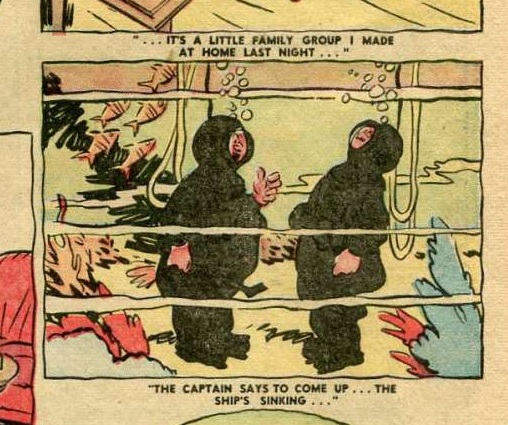
This is from a gag filler page called Grin and Bear It, but I think this is pretty funny.


And this one too.

(Scans courtesy of Comic Book Plus)


Monday, July 27, 2015

More Fun Comics #25

We'll start this revisit of More Fun with Sandra of the Service and this question -- in Hideouts & Hoodlums, do non-Heroes have to roll to notice things, like the men on the larger boat spotting Sandra's rowboat? It does make the game more fair if everyone rolls and plays by the results of the dice rolls. If, however, a specific result would make for a better story, the Editor should hand-wave the dice roll, or fudge the results to a better one. The most important thing is that the players should never feel cheated by hand-waving of dice fudging.


A seemingly simple, 2-page story of Doctor Occult, the Ghost Detective, actually requires a lot of unpacking. One point is that, in the climactic scene, the scientist seems to be casting a spell, one that can transmute, or polymorph, a human being into a small statuette. It's worth pointing out again that the narrator specifically refers to the villain as a scientist.  

Another point is that we see Dr. Occult's magic symbol reflecting the spell back on the scientist. Now, this seems very much like the Superhero power Turn Gun on Bad Guy, but the scientist has no visible weapon. A less literal interpretation of the power might allow it to reflect any form of attack. Or perhaps we need a new spell for spell reflection. 

The difficulty we're seeing here in Doctor Occult we've seen before -- it's the trope of magic and advanced science being indistinguishable and it tends to play havoc with a set of game mechanics that tries very hard to keep magic and science separate. Ultimately, I'll have to look at whether this is really the exception, or is it the rule, when dealing with magic in comic books. The latter situation could require a drastic overhaul of H&H.

Less dramatically, Johnnie Law deals with the threat of -- marijuana!  Reefer madness will occur frequently in comics until all mention is squashed by the comics book code in the 1950s, and it will be interesting to trace all the permutations of how the effects of marijuana were perceived by the average comic book artist, who was almost always too square to know anything about the drug other than its name. Here, we learn that marijuana causes hallucinations and fits of violence. 

(Scans courtesy of Comic Book Plus)

Thursday, April 2, 2015

More Fun Comics #16

It's the last More Fun of 1936 and Sandra of the Secret Service is dodging machine gun fire!  This is why Hideouts & Hoodlums needs the save vs. missiles mechanic -- because Sandra would be toast without it.

Sandra and Lorenz dive into the moat to escape. The rules cover falling damage, but are less specific about falling into water. Editors are free to hand-wave all damage away, reduce, or minimize damage in any way that makes sense in such an instance. Note that reduced damage is a privilege, not a right!  Heroes need to do all they can to minimize their damage; belly-flopping into the moat just to test the Editor should not be given any reduction.


Look out, Spike Spalding, they're searching for you!  Thank goodness you didn't have to bother with putting points into a skill like Hide just so you could have a chance of remaining a fugitive. In H&H, you just tell the Editor that you're hiding and the burden of finding you is entirely on the mobsters. Most everyone has either a 1 or 2 in 6 chance of finding concealed doors, which applies to concealed people too. Of course, some exceptions to this are the Mysteryman, a class with a higher chance of hiding, and the Magic-User, who has even better spells of concealment like Invisibility.


In this month's installment of Dr. Occult, we learn more about the magic belt that he picked up during his Egyptian quest. The belt is controlled by buttons that are pressed on the belt; one button activates a Fly function (as per the spell) and another button activates a petrification function (as per the gaze of a basilisk).  There is no indication of how many times he can use these functions. It is interesting to note that how the magic belt seems to resemble advanced technology, especially since the villainous Koth's origin on the next page is tied to outer space and a downed spacecraft on Earth in eons past. The implications of combining magic with technology were discussed in Supplement IV: Captains, Magicians, and Incredible Men, in the Dr. Fate entry.

It is even more interesting to note that Koth's origin is almost exactly like Superman's; the difference being that Koth didn't land alone, and his spaceship landed on Earth in the primitive, superstitious past. Had a nurturing society taken in Koth instead of slaughtering his shipmates, he wouldn't have wanted to wipe out mankind for eons!

Midshipman Dewey's Editor has created a bit of a poser for himself. Dewey is tied to a mast; he has cover, but not mobility.  Is he still entitled to a save vs. missiles?  I would be inclined to rule 'yes', but at a penalty.


Jack Woods is sort of dealing with a problem I often have when running H&H -- keeping track of ammunition. I am always grateful to the players who do a good job of tracking it for me. For those less fortunate, I have written some tips for "cheating" on ammo tracking in various sources, like allowing a weapon to fire for a random number of turns (determined by a die roll at the beginning of combat). 

Note that Villa isn't trying anything trickier than trying to get a surprise attack when he reaches the top of the stairs. He won't have any better a chance of surprising than anyone else would, though he won't have less because he is acting with caution.


Jack demonstrates the Cowboy stunt, Disarming Shot.  In theory, anyone could try this as a special maneuver, but would have to roll 5 or more higher than needed to hit, and Villa would have to miss a save vs. science.


After all the creatures Don Drake has defeated, these guys with whips must be awful good for Don to surrender!  Interestingly, Don, Betty, and Zira are kept prisoner in a room filled with blinding light, so they cannot see to escape.


The rules don't specifically cover shooting through doors, as happens to Sandy Kean here in Calling All Cars, but it could be assumed that Sandy has hard cover and is effectively invisible (so -2 to hit and -4 to hit).


(Scans courtesy of Comic Book Plus)