Showing posts with label distances. Show all posts

Wednesday, September 22, 2021

Top-Notch Comics #4 - pt. 1

We're going to jump straight into the first feature of this issue, The Wizard, because there's some interesting issues here. The scenario here is that Germans (called Bundonians here) are planning to launch an invasion of Texas from Mexico. But the Wizard seems to have caught onto their plan late because he's arriving in Texas and the bad guys' base is already there. Further, it only takes him two hours to fly there. The Wizard is based out of Washington, D.C. and a non-stop flight to San Antonio, Texas normally takes 3 1/2 hours. So either the Wizard is not in Washington, D.C. at the start of this scenario or his plane travels almost twice as fast as a normal plane (certainly unusual given that it appears to only be a standard mono-prop plane). 

Also note how the subplot involving the fiancee with hurt feelings is resolved in one panel and a caption. Compare to a post-1961 comic book, where this soap opera material might stretch over pages.

This diagram reminds me of the Official Handbook of the Marvel Universe. Even with specs to admire, I still don't know what a VB-Ray does. Maybe it stands for Very Brutal? It can definitely melt/wreck through walls. 

Hypnotizing one-on-one is a skill any Hero can attempt, but hypnotizing a whole room full of people seems more like a power or spell. Although, from panel 4, it appears the general's staff is just this one soldier next to him. 


There are sound tactics here; hypnotism may only last so long, or the enemy might get wise to the deception, so he' right to make their arsenal his next target. 

I, admittedly, have no Air Force experience, but it seems to me that the bombers are dive bombing, not circling. I was skeptical of this until I looked it up, but dive bombing is a thing because angling down towards the target actually helps aim the bombs with greater accuracy. I would have thought dropping them straight down would be better, but this is why no one asks me to plan bombing missions.


Here we have another diagram that looks cool but doesn't really tell us how it works. Luckily this one is a very familiar one, the cliche of a ray that kills engines. 

A nice twist is that the bad guys have a ray gun too. A dissolving raygun? The caption said it sprayed corrosive liquid, but that seems unlikely that a squirt gun would be that accurate while traveling at airplane speeds.


This top row is all kinds of interesting to me. The acid has drained his strength, but has done no visible damage to him or even to his clothes. Is that possible? Only with H&H's abstract damage mechanic (and, to be fair, the mechanic of the game H&H is based on). When he's saying all his strength is gone, what the Wizard probably means is that he's down to his last few hit points already.

I'm not sure why we need to see the inside of a flask to get how it works. It's kinda neat that it shows us how the gasses get mixed inside it, but by pulling back to the curtain to show us the "science" it reveals two made-up gas names, riaton and oxothygen. I think we were better off with the ray guns that look technical but reveal nothing of how they work. 

I have never encountered this use of "I'm all in!" before, which seems here to mean "I'm completely spent!" rather than "Yeah, let's do this!"

It's nice that even the narrator in the caption of panel 6 realized how hard it is to believe that the plane just happens to come down at his fiancee's house. That should tell you there's something wrong with your story when even your own fictional narrator doesn't believe it. 

"Eggscape"? That's a German accent?

"Phial" is an unusual word you don't see every day. And invisible gas is equally rare in a comic book. 

Ho.Mg4? Holmium Magnesium? Seems like that would be extremely dangerous, even if that was a real isotope. 

Heroes always manage to pull out a last bit of strength when needed, as if their weaknesses were just flavor text.

Here's a rare cutaway view of a hideout. Although the map only shows three soldiers on the ground floor and one guard on the upper floor, it seems that there are four men on the ground floor after all. Or one of them withstood the Wizard's surprise attack. Or the guard from upstairs came down. Or maybe a guard from outside joined in. It's important that the players never learn exactly what they're up against no matter how well they prepare.


I have a pocket transmitter too these days, but my pockets sure aren't big enough to hold the transmitter we see in panel 3. Although the Wizard's main power is called his photographic mind, it seems more like omniscience how he senses everything. That's a power I'm not keen on being in Hideouts & Hoodlums, though I suppose I could bump it up to a 7th level power so I don't have to worry about it for awhile. 

I'm also uncomfortable with the near limitless range of the Wizard's Message power; this has to be a higher level version (Greater Messaging?) of how I envision the power working. 

I don't see how a contra-gravity flask would let him run super-fast through the air, but maybe he's buffed with both Fly and Race the Plane to get that speed?

Hey Wizard, are you seriously leaving your fiancee tied up? 

In case you weren't sure from the above that the Wizard was a superhero, we get a perfect example of him using wrecking things here -- superhero-level wrecking things (any Hero can snap rope on a good roll). 

(Scans courtesy of Digital Comic Museum.)


Saturday, June 13, 2020

Zip Comics #2 - pt. 1

I'm pleased today to return to another of my favorite golden age heroes, Charles Biro's Steel Sterling. We're probably not going to skip a page of this story -- mostly because there's good content for Hideouts & Hoodlums-related discussion here, but also because it's a good adventure yarn.

And it starts fast! After a one-panel summary of Steel's origin (and a chance to see him naked), we launch straight into a prison break! But which prison? Can we find a specific prison by a river with housing nearby? It would seem a near-impossible task if I was looking at the whole country. However, in #1 I grabbed onto a tiny clue that Steel is based out of Texas. There is only one river, the Trinity River, that I can find in Texas that had jails near it. Of those four jails, are any of them near housing? Of them, Ellis County Jail looks closest to Riverside, Texas. That Riverside is 270 miles from Beeville, Texas, where I think Steel's first adventure took place, would only be an issue if Steel could not fly fast -- and we'll see that
happen very soon in this story.

We've seen Heroes pushing instead of doing damage before, but Steel pushing nine men at once is probably a first. It's certainly possible by the rules, if Steel is using the Flurry of Blows power, and choosing to make each hit a pushing attack. Normally, you would only be able to hit people in melee range with you, but for pushing, it makes sense that you could push people behind the people you're pushing.

There is zero game mechanic difference in H&H between slapping and punching, and Steel's punch would not have killed that guy.

Steel has Imperviousness activated for crossing the courtyard. Or is is Invulnerability? He may be needing that shortly...


Maybe I don't know cars well enough, but I cannot figure out what those things are on the side of the car in panel 1. Giant segmented worms? They're gone by panel 4, so...

Panels 2-3 would be tricky to replicate in H&H. The grenades wrecking the wall is easy enough, but determining where the debris goes is trickier. To be fair, I would position Steel on a map of the courtyard first, and then roll randomly between compass points to see where the majority of the debris falls.

How much damage should tons of brick and debris do when it falls on you? One of the underlying mechanics of H&H is that 30 lbs = 1 hp. If I calculated damage by weight at this rate gradually, 2 tons of debris could do a total of 133 points of damage. If I calculated it exponentially, doubling weight per point, that would be no more than 9 damage for 2 tons, so perhaps a range of 2-9. Anywhere in between those two seems
fair to me, but it seems that Steel took a major beating here if he

was only buffed with Imperviousness.

I love the flavor text in panel 5, that Steel has to use static electricity in his hair to jump start his powers. Here he's clearly using Race the Train.

Falling 300' would have done 30d6 damage, which Steel would have survived while invulnerable, but the prisoner in the car wouldn't. Instead it seems he used Feather Landing.

One nice thing about prison breaks is, you don't have to bother leaving crooks with evidence at the police station, since they already want them back.
This is a real curious first panel. Zooming "across the continent" to Alaska makes me think my Texas guesses were all wrong and Steel was on the East Coast after all.

Did Steel really zoom there with "lightning speed?" He can't arrive too quickly, because the escaped cons got there ahead of him, traveling by conventional means.

Let's still assume Steel is coming from Texas; that means the distance involved is roughly 4,000 miles (if NYC, add 360 miles to that). If he was using the Race the Plane power (which seems to make the most sense, going along with flying), it would need to last for 16 rest turns, meaning Steel would need to be a minimum of 13th level, as the duration on that power currently stands.


Of course, another possibility is that he took conventional travel most of the way to Alaska, and then "zooms" in by his own power only towards the end.

The crew is a mix of pirates and thugs, with that guy holding the harpoon gun under one arm probably being a higher-level fighter/leader. The harpoon gun definitely looks like a trophy weapon, probably doing at least 2-8 damage -- if Steel wasn't buffed with a protective power. Too bad he decides to wreck it!

Wrecking a propeller is treated only as a machine, whereas wrecking the entire boat would have been a tougher category.

In the golden age, if you meet a villain twice, he becomes your arch enemy. Repeat engagements are that rare!


Fake iceberg hideouts is very ingenious by 1940 standards, when most villains were still using warehouses. And having five polar bears in room 1 really sets this as a high-level hideout!


In actual play, these polar bears would be a lot tougher, but because this is a golden age story, they go down quickly in one hit each. Of all the ways H&H purposely chooses not to emulate the actual practice of golden age comics, this one is probably the most dramatically different.

This page does illustrate, though, that grappling moves can be reversed between turns.


What material is that wall made out of, that it would break away like that? And the wall is so thin...

Most players would, if their Heroes saw that much gold, would immediately start thinking about how much XP all that gold is worth.

Apropos of current events, Steel is tear gassed. No doubt this was intended to show that Steel has weaknesses, but a H&H player knows this only shows he missed a saving throw vs poison.

On taking a look at that pile of chains, one could be forgiven for thinking that's overkill. I'm not sure how heavy a 7' tall pile of chains is, but I'm guessing it would be enough to pin down an ordinary man. A superhero probably doesn't need a Raise power buffing him to get that off, though; I'd either allow it instantly, or require a save vs. science, depending on the superhero concept and how strong we pictured him being. And, for non-superheroes, I would probably go with the saving throw.

(Scans courtesy of Comic Book Plus.)

Monday, April 27, 2020

Marvel Mystery Comics #5 - pt. 2

We're still in Prince Namor, the Sub-Mariner's story in this issue. Namor is heading home! Golden Age Comic book readers know that Namor's home wasn't an Atlantis off the North American Atlantic Coast, but an icy realm under Antarctica. Namor is in the North Seas and says it is 9,000 miles from the North Sea to Antarctica. Bill Everett was either a good guesser or he spent some time with a map working that out. He is actually only a little off; it's 9,500 miles. He says the submarine can make it there in two days; assuming 24-hour travel, that means a speed of roughly 200 MPH; that's almost four times the fastest real submarine speed.

Namor refers to his uncle, the king, as "Holy one," suggesting that royalty is divinity in their culture.

Namor travels via his own power from Antarctica back to New York, a journey of roughly 9,100 miles that he makes in three days, and meaning Namor can travel an average of 126 MPH (though he is said to make this journey by air and water, so it's impossible to say how much of this reflects his swimming and how much his flying speed).

Namor does not yet spend all his time in just swim trunks; he returns to New York in a shirt, pants, gloves, and cloak. Anticipating Edna Mode and her "no capes!" advice, Namor's cloak is caught in the landing gear of a passing plane while he's flying away from police and this knocks him out -- either from the cloak collar strangling him or being buffeted by wings against the side of the plane, though I favor the first explanation. This makes no game mechanic sense, though, as he should have easily been able to use his wrecking things ability to tear the cloak before it choked him or led him to being buffeted unconscious. Unless, Namor was considered surprised by the situation, giving the cloak's strangulation a free surprise turn in which he could not react. It is still harsh, if not unlikely, to say Namor would run out of air in just 30 seconds (the time of a surprise turn in 2nd edition Hideouts & Hoodlums).

Actually, Namor is only stunned and when he recovers, he uses "jiu-jitsu" to throw a fireman trying to grapple him. It's unlikely Namor has any direct knowledge of Japanese wrestling moves, but it's not like the Japanese invented the idea of flipping someone over their shoulder.

Namor fails his saving throw vs. chloroform and is knocked out by a really brave ambulance driver and taken into police custody.

Based only on a sergeant's permission, Betty Dean gets Namor released into her custody. Namor is uncharacteristically forgiving of his treatment by the police, pledging to work with them if he is deputized.

At that same time, a subway "accident" floods the tunnel at "5th street." In Midtown, this is likely the 5th Avenue-59th Street Subway Station. There, he uses "the strength of 100 whales" to tip the subway cars upright. I don't know how to measure the strength of 100 whales, but we could talk about the weight of 100 whales, with 100 of the smallest whales (dwarf sperm whales) weighing 25 tons total. This would be a 4th-level Raise power. By watching for air bubbles, he can find submerged passengers to rescue without having to make a search skill check (or does so at a bonus, since the bubbles should be easier to see).

Finding the hole that is the source of the flood, Namor flies into it with "his usual impulsiveness," showing Everett had a strong idea of Namor's character that has stayed with him for 80 years. The hole was made by three robbers trying to drill into the "Treasury," which we would know today as Federal Hall National Memorial. When Namor comes across a vault door, he thinks it will be hard for him to open, but he rips it open easily. Inside he finds the men and beats them up, breaking their bones in the process. The gold vault under Federal Hall was protected by a reservoir of water that they drilled and drained into the subway tunnel.

Next up is The Masked Raider. MR comes to talk to a troubled sheriff, but the sheriff mistakes him for an outlaw and draws on MR. MR is able to close the distance and punch him, despite the gun being pulled on him at range. So, in H&H, random initiative has to take priority over a more reasonable order of attack (not all missiles first, then melee).

MR uses an interesting tactic to lure out the bad guys in town, hanging a threatening sign from an arrow in town as the bad guys have been doing, and then following whoever sees it and looks suspicious. The bad guys plan to off the sheriff with poisoned arrows (the plan is to make gullible locals think Indians did it), but the Masked Raider shoots the head off the first arrow before it's fired and the bad guys all fail a morale save. That was one lucky roll, particularly since MR had to have been at long range to be out of sight; I would have said only a natural 20 would have made that shot.

Next up is Electro, the Marvel of the Age. In it, Professor Zog summons two of his twelve agents (he must have an 18 Charisma to have such a large supporting cast -- unless Zog is a non-Hero character and only his operatives are being played) and assigns them an international mission. He must be using code, though, because he describes a country called "Molivia" being attacked by a country called "Torpis." Molivia is easy -- that has to be a poorly disguised Bolivia. Torpis is going to be trickier. If we go by number of syllables, it has to be Brazil, Chile, or Peru. And yet...if we go by history, this whole story was likely inspired by the Chaco War of 1932-1935, suggesting a renewal of fighting between Bolivia and Paraguay. And yet again...when they finally get to "Molivia" it looks very European, and has a king instead of a president, so...who knows!

The brutality of war is illustrated by dead women and children in the street -- though the figures lack any gory details.

The radio controls for Electro have fantastic range -- 4,336 miles, in fact, if the operatives are summoning Electro from Sucre, capital city of Bolivia (called "Braka" in this story). It is unclear how long it takes Electro to fly the distance; it is possible there is some story compression before and during the siege of the city. Regardless, Electro does make it the entire way without needing to refuel, or that, if statted as a superhero, his Fly power has a remarkably long duration.

At the scene of the siege, machine gun bullets bounce off Electro, suggesting he has the Imperviousness power activated. When cannonballs and bombs dropped from planes fail to harm Electro, we know he has the Invulnerability power activated. Electro's wrecking things ability makes short work of the army, allowing him to even wreck "huge" tanks. If the tanks are truly of abnormal size, I would shift them up one category to battleships. Tanks were not used during the real Chaco War.

In the end, Torpis' dictator, Kalph Belgri commits suicide when his invasion fails, perhaps anticipating Hitler's famous suicide. No one committed suicide after the Chaco War.

(Read at readcomicsonline.to)


Saturday, November 9, 2019

Thrilling Comics #2 - pt. 1

Mike's Amazing World of Comics tells me that the next comic book I should be reviewing, in order, is War Comics #1. But I accidentally reviewed that early, a year ago. Oops! So let's skip another ahead to Better's Thrilling Comics and the original Dr. Strange.

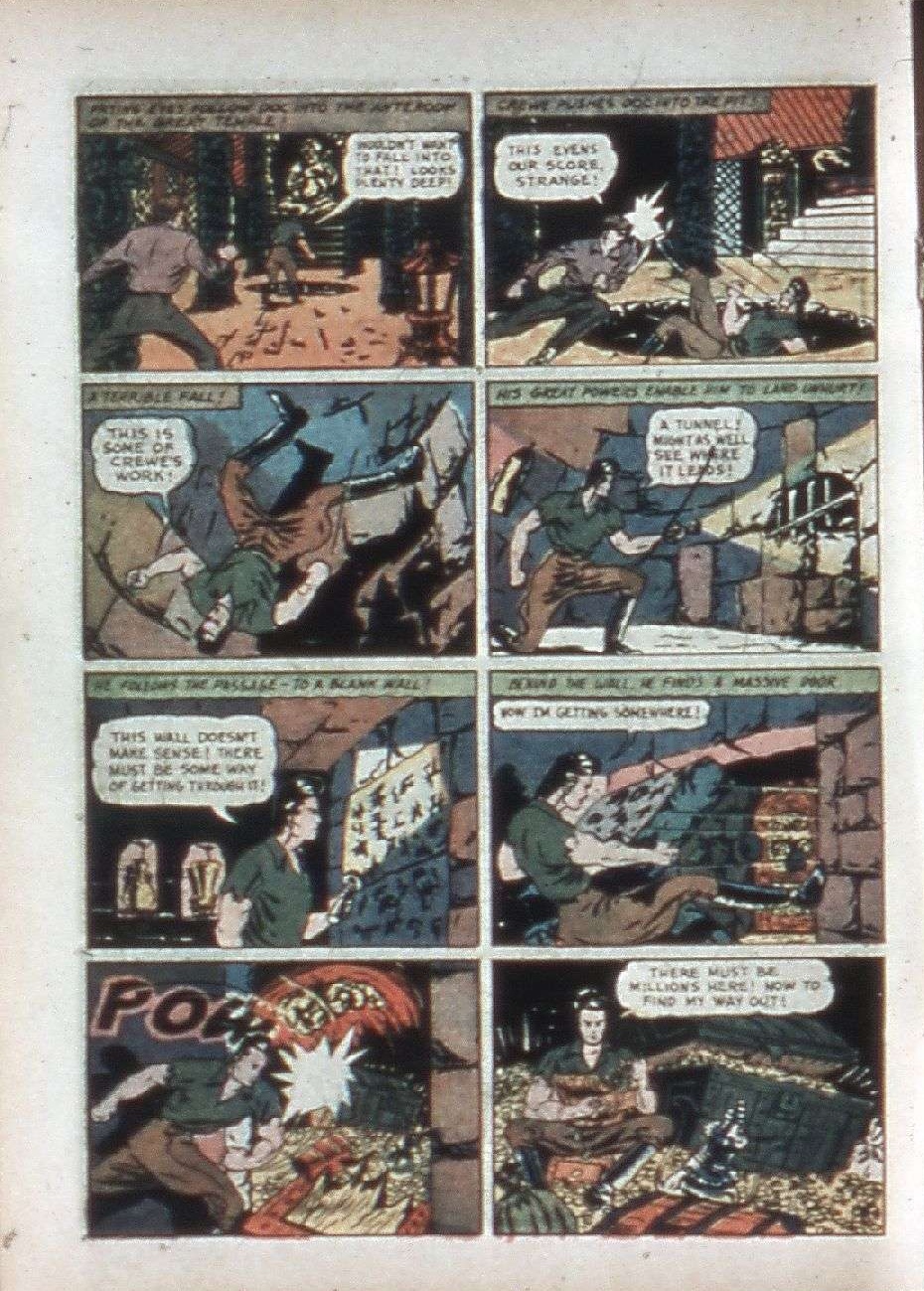
Our adventure begins with a mysterious death and the easy plot hook of Strange being asked to investigate it by the police. Strange looks for clues and, in an unusual move that I want to call your attention to, appears to be using scissors to cut into the dead man's clothing (unless, of course, he's also planning on performing an autopsy...). This is how he finds a secretive pin sewn into the seam of the clothing.
Note how Strange now has dark hair. Does he, instead of wearing a costume or uniform, just darken his hair before going into action?

Really, Fleming? The only place in the world you would find a three-headed serpent is an ancient lost city? I decided to do a quick Internet search on three-headed serpents to see if he was right. Besides an awful lot of hits for the video game Hitman 2, there was an article about a pillar depicting a three-headed serpent that came from Delphi. Good thing Strange didn't go there instead!

I wouldn't put much stock in what that assistant's telling you either, Strange. And you, Richard Hughes, writer of this story, if you knew you were going to base this story in Tibet, how hard would it have been in 1940 to do a little research and learn the real name of the desert there (which is the Gobi)?
One of the nice things about that last page is the fallibility of the assassin, who allows the assistant to get one vital word out before offing him. This makes it pretty easy to follow from one plot character right to the next -- and then risk killing him by punching him through a wall.

The game mechanics of Hideouts & Hoodlums (remember, this blog is also about a game!) don't currently support punching villains through walls, and would either need a modification to the pushing rules, or a new power that combines damage with wrecking things. I would definitely need to consider this as we move ahead, as I can think of quite a few later comic books that combine violence with such a flagrant disregard for property.

This third page, to the right, makes no sense to me...

Strange seems to have Crewe dead to rights already, yet after beating up his henchmen and showing off his Nigh-Invulnerable Skin, he just leaves so he can tail Crewe instead. You would think Crewe would be extra-cautious now about Strange and not act so brazenly criminal.

As stupid as Crewe is, his henchmen must be even stupider to nab a girl and bring her to their boss, just for loitering around a giant skyscraper. Strange isn't happy with them either, as he's perfectly willing to toss one of them out the window, knowing it's a lethal fall from that height.


Now this page has some tricky geometry to it. I'm not sure how Strange twists his body to land on the roof across the street, but it definitely appears that he is still leaping instead of flying. And, the fact that he needs to land on the roof instead suggests there is an upper limit to how far he feels he can fall safely.

In game mechanics-terms, maybe an upper limit needs to be put on the Feather Landing power. 

A herb that cures diseases like the spell would be a very valuable item in any campaign, and probably one best to keep out of the Heroes' grasp so it doesn't change the campaign world too dramatically.

Mongols are just wandering around Tibet? Mongolia is about 1,400 miles from Tibet. Seems like more writing done without research to me. Though the artist, Alexander Kostuk, at least looked at some old references for how Mongolians once dressed.
Strange uses his wrecking things ability on a stone wall, a door, and a cage here, demonstrating that a superhero needs the ability to use that game mechanic in quick succession.

What's going on with the guards being drawn like primitive African natives, hurling spears? How does that make sense in Tibet?

Rescuing prisoners is always a good idea, for the "good deed" XP award, the useful information they may have about the hideout, and their Supporting Cast recruitment potential.

Animals never fare well against Golden Age comic book Heroes and the fights are usually over in a single panel. This one, with Strange fighting two lions, occurs largely off-panel!

Once again, Hughes gets his geography wrong. The "Mountains of the Moon" are a legendary mountain range in east Africa, once thought to be the source of the Nile River.
More evidence that ordinary people can make push attacks on superheroes.

Strange wisely carries a flashlight.

Finding a secret door usually includes finding the means of opening it. But, if you just suspect a secret door is there, but you're getting impatient waiting for that successful "find secret doors" check, you can always wreck the wall. If you're right, you will only be wrecking against the door category, even if you can't actually see the door.

Millions of dollars' worth of treasure is usually a campaign-busting find and should be avoided doling out in actual play.

(Scans courtesy of Comic Book Plus.)

Sunday, September 22, 2019

Keen Detective Funnies #18 - pt. 4

Only because I'm a Harry Campbell fan, I'm going to devote one more blog post to this issue, devoted entirely to Dean Denton...despite Dean not being my favorite of Campbell's characters, and this installment in particular being terribly racist.

At least Campbell, as usual, had done his homework. "Bomba" is Boma, capital city of the Belgian Congo, and is still an important city in the Democratic Republic of the Congo today.

The text makes it sound like Katanga is a city, but it is a province in the southeast corner of the Congo. The narrator's assertion that Katanga is 700 miles away is pretty accurate.

"Compagnie Belgique" is not a real thing, but seems very plausible, even though  the correct way to say it would be "Compagnie de la Belgique," or Belgium Company.
---

Here we see a rare example of kit-bashing hi-tech trophy items during an adventure instead of during downtime. This is how a scientist class would use powers, which would here include a new power, Detect Radiation.  It's a weird sort of power and not how, I think, Geiger counters actually work. It's functioning here more like a long-range Locate Object spell, or a Find the Path spell, rather than detecting something's presence in a certain radius.

---

Oh look, Dean is sexist now too. Sigh...
You're going to have to choke down some really terrible dialogue on this page, but one interesting piece of dialogue is the unusual phrase from Dean, "you're like money from home!" While certainly rare today, I wonder if this was a more common saying circa 1940.

---

And check out that sleight of hand! Has Absalom been carrying rabbits and canaries around in his pockets all this time, just hoping for an opportunity to do a magic act? Or is there more than even simple cantrips going on here? It almost seems more like an Animal Summoning spell!

This page is troubling to me, from a game mechanics perspective. We have an aerial dogfight and, the way I have the mechanics for this working out in my head, you make attack rolls each turn you are facing your opponent's plane and the more hits you get, the more a percentage chance of a random complication happens. I see this all the time in dogfight scenes -- but not this one, where the plane simply goes down without explanation, almost as if it had simply run out of hit points.

I guess I will need to watch for more examples.

(Scans courtesy of Comic Book Plus.)

Thursday, May 30, 2019

Science Comics #1 - pt. 3

Still plowing through the inaugural issue of Science Comics and...boy, this is becoming a tougher and tougher read! I think Electro was the best thing they had ready and quickly whipped up a bunch of sci fi filler to go around it.

Case in point, Cosmic Carson, with its near empty rooms on this page, and its almost entirely empty three panels on the last page.

That said, I do like the symmetry of that last wide panel on this page, and an empty entrance hall with a single guard manning a machine gun...well, it has merits for hideout design.
 ...As does this "acid well." I'm not sure what you would use an acid well for, but it's an interesting detail, and could make for a potent trap too.
Here we have another interplanetary adventure taking place in the future of the year 2000. It's adorable how confident we used to be in the march of progress.

The Interplanetary Transport Company reminds me of Futurama. But what, do you suppose, does it mean by "air routes?" Surely this author doesn't think there's air in space? If you can call fighters "space fighters" (which is what the class Fighter should be called in a sci-fi campaign, by the way!), then you should be able to figure out to call them "space routes."
Although the slavers are an intergalactic threat, with a base on Saturn, they look disappointingly like ordinary humans.

But there's something much fisher going on here -- if Payne is going from Earth to the Moon to refuel, how on Earth (*ahem*) does the slave ship get to the Moon just minutes later? Distances make no sense in these early comics. I'm not sure how to emulate that in Hideouts & Hoodlums, but I'm also not sure I care to.
Marga the Panther Woman is a weird one. At times looking like a Sheena rip-off, Marga is a woman in the future endowed with panther-like fighting ability by a mad scientist. After the scientist kills himself, Marga escapes and goes on this little mini-rampage, killing that poor little tiger with her claws.

===
A long time ago, a suggested race for H&H was the beastman, but I never had good examples of them in comic books. Marga is the perfect example, though, and we see how beastmen would have a short list of mutations to choose from, like how she gets claws.
"Protective current" isn't clearly defined here, but probably means an electric forcefield that either greatly enhances Armor Class or buffs the ship with a defensive power, as if it was a superhero.

Although these look like spaceships, their portholes and glass cockpits and holes in the walls serving as gun ports suggest these planes fly around at lower altitudes than would require pressurization.
Now this is Dr. Doom -- but neither the Fantastic Four villain nor the International Spy we've seen reprinted in earlier comic books. This Dr. Doom is an old man/mad scientist with assistants (finally found some art for that mobstertype I can use!) and they live on some kind of colony world where there are some other humans, but so few that the assistants have to go looking for them.

Jan Swift (descendant of Tom Swift?) and Wanda are explorers in the D&D sense -- they just seem to be randomly wandering and looking for experience, instead of working for someone or towards some specific goal.

One of the two assistants has a paralysis raygun that turns the tide for them.
I believe it was Dragon magazine #111 that had a great article statting real world microscopic monsters that you could either enlarge to giant size, or shrink the characters down to microscopic size so they can encounter them.

You can see Dr. Doom's shrink ray is slow enough that Jan can be picked up with tweezers while still 2 inches tall.
It would be interesting to research how many microscopic organisms were identified before 1940 -- probably not many, admittedly, as this was a few years before the electron microscope was invented. This artist didn't do any research on that, but just made up some bizarre bird-fish, regular fish, and a "giant ameoba" (amoeba) that looks more like a donut-headed snake.

(Scans courtesy of Comic Book Plus.)

Friday, March 29, 2019

Miracle Comics #1 - pt. 1

Sky Wizard! I was pretty impressed with this guy when I read all his published stories to research his write-up in Supplement IV: Captains, Magicians, and Incredible Men. Will he hold up to a re-read?

In 2019, it takes approximately 24 hours to fly from Texas to China (depending on where in China you're going), which means the stratosphere plane is three times as fast as a modern commercial jet.
I appreciate the names in Sky Wizard -- Captain Dare is a good enough name to have his own feature, but he's just supporting cast here. And I like how the guy with the monocle isn't called "The Monocle" or "Baron Fritz" or something so obvious, but is called Hawk Armand, which you would never expect.

Being "Pathan" means that Kee-Shan is one of the Pashtun people who settled in the Punjab region of Pakistan. Kee-Shan seems an unlikely Pakistani name, but I love how he looks tailor made to be played by John Rhys-Davies in a Sky Wizard movie.
The paralyzer gun looks suspiciously like the toy raygun that is advertised for sale elsewhere in this comic book. The difference between the first setting, that paralyzes, and the second setting, that kills instantly, seems pretty grim. I hope Sky Wizard never sets his gun to the wrong setting by mistake!
Oh, Sky Wizard, the crazy things that come out of your mouth when you've been inhaling chemical fumes! By even the most generous estimates ants do not have 6,000 times the relative strength of a man. More perplexing is the notion of an "ant virus" -- what is that? An illness that only ants can get? A germ that makes you more ant-like?
The land speed record at this time was
369.7 mph, a record set in August 1939. But that would be on a straight line -- Sky Wizard's supercharger can go 175 MPH on country roads with bends and corners, something I wouldn't want to try in even a modern day car. 

Whether or not SW can make it to save the kids in time seems like a math puzzle worthy of Jim McClain's Solution Squad.  He has six minutes left to get there. His supercharger can go 175 MPH, which is 2.9 Miles Per Minute and some change. It's 10 miles to Lone Pine, so it should only take him approximately 3.4 minutes to get there. This is close to SW's dialogue in panel 4; perhaps he just rounds up to four minutes. 

The trick then is to find the fiends once he reaches Lone Pine. Clearly they aren't standing in the middle of the main road through town, for he has to spend two minutes searching the woods outside of town (I'm assuming Lone Pine is a town and not an actual lone pine tree!), which is less than a full exploration turn in Hideouts & Hoodlums game mechanics. 

This brings me to two questions that I can't fully answer. One, why does Hawk set such a difficult deadline for SW to save the children by? Two, how does SW find them in the woods so quickly? I actually have a guess at the second answer -- the Editor may have allowed SW to spot their car from the road, which told him that they were nearby. 

Here we find out that the duration of the Q-beam is 1 hour (though a save vs. science to resist should still apply!).
Although rubberium is a goofy name, metal rubber has been a real thing since 2004; it is a conductive plastic polymer with metal ions and is used today in aerospace/defense, as well as other applications.   
Sky Wizard must not plan to stop at 50,000 feet, as the ceiling record for planes was 56,000 feet (set by the Italians in 1938). Now, this is spectacularly high for a blimp -- the record for a blimp is still a modest 16,000 feet, and that was set in 2016!
That same blimp, the Airlander 10, was a record-breaking size for a blimp -- 302' long, and filled with 1.3 million cubic feet of helium. This blimp is said to be acres in size, though it fair to say that dialogue was intended to come out of one of the kids' mouths, and was a gross exaggeration. 

(Scans courtesy of Comic Book Plus.)